The EOQ Inventory Formula
                                       James M. Cargal
                                   Mathematics Department
                             Troy University – Montgomery Campus


        A basic problem for businesses and manufacturers is, when ordering supplies, to determine
what quantity of a given item to order. A great deal of literature has dealt with this problem
(unfortunately many of the best books on the subject are out of print). Many formulas and
algorithms have been created. Of these the simplest formula is the most used: The EOQ (economic
order quantity) or Lot Size formula. The EOQ formula has been independently discovered many
times in the last eighty years. We will see that the EOQ formula is simplistic and uses several
unrealistic assumptions. This raises the question, which we will address: given that it is so
unrealistic, why does the formula work so well? Indeed, despite the many more sophisticated
formulas and algorithms available, even large corporations use the EOQ formula. In general, large
corporations that use the EOQ formula do not want the public or competitors to know they use
something so unsophisticated. Hence you might wonder how I can state that large corporations do
use the EOQ formula. Let’s just say that I have good sources of information that I feel can be relied
upon.

The Variables of the EOQ Problem
       Let us assume that we are interested in optimal inventory policies for widgets. The EOQ
formula uses four variables. They are:

       D:      The demand for widgets in quantity per unit time. Demand can be thought of as a
               rate.
       Q:      The order quantity. This is the variable we want to optimize. All the other variables
               are fixed quantities.
       C:      The order cost. This is the flat fee charged for making any order and is independent
               of Q.
       h:      Holding costs per widget per unit time. If we store x widgets for one unit of time,
               it costs us x@h.

        The EOQ problem can be summarized as determining the order quantity Q, that balances the
order cost C and the holding costs h to minimize total costs. The greater Q is, the less we will spend
on orders, since we order less often. On the other hand, the greater Q is the more we spend on
inventory. Note that the price of widgets is a variables that does not interest us. This is because
we plan to meet the demand for widgets. Hence the value of Q has nothing to do with this quantity.
If we put the price of widgets into our problem formulation, when we finally have finally solved the
optimal value for Q, it will not involve this term.
The EOQ Inventory Formula by J. M. Cargal


The Assumptions of the EOQ Model
        The underlying assumptions of the EOQ problem can be represented by Figure 1. The idea
is that orders for widgets arrive instantly and all at once. Secondly, the demand for widgets is
perfectly steady. Note that it is relatively easy to modify these assumptions; Hadley and Whitin
[1963] cover many such cases. Despite the fact that many more elaborate models have been
constructed for inventory problem the EOQ model is by far the most used.


Figure 1 The EOQ Process


An Incorrect Solution
        Solving for the EOQ, that is the quantity that minimizes total costs, requires that we
formulate what the costs are. The order period is the block of time between two consecutive orders.
The length of the order period, which we will denote by P, is Q/D. For example, if the order
quantity is 20 widgets and the rate of demand is five widgets per day, then the order period is 20/5,
or four days. Let Tp be the total costs per order period. By definition, the order cost per order period
will be C. During the order period the inventory will go steadily from Q, the order amount, to zero.
Hence the average inventory is Q/2 and the inventory costs per period is the average cost, Q/2, times
the length of the period, Q/D. Hence the total cost per period is:
                                    Q Q      Q2 h
                            TP  C  h   C
                                    2 D      2D
If we take the derivative of Tp with respect to Q and set it to zero, we get Q = 0. The problem is
solved by the device of not ordering anything. This indeed minimizes the inventory costs but at the
small inconvenience of not meeting demand and therefore going out of business. This is what many
people, perhaps most people do, when trying to solve for the EOQ the first time.

The Classic EOQ Derivation
        The first step to solving the EOQ problem is to correctly state the inventory costs formula.
This can be done by taking the cost per period Tp and dividing by the length of the period, Q/D, to
get the total cost per unit time, Tu:

                                                 CD Qh
                                            Tu    
                                                 Q   2


                                                   2
The EOQ Inventory Formula by J. M. Cargal

In this formula the order cost per unit time is CD/Q and Qh/2 is the average inventory cost per unit
time. If we take the derivative of Tu with respect to Q and set that equal to 0, we can solve for the
economic order quantity (where the exponent * implies that this is the optimal order quantity):
                                                          2CD
                                               Q* 
                                                           h
If we plug Q* into the formula for Tu, we get the optimal cost, per unit time:

                                               Tu 
                                                *
                                                       2CDh

The Algebraic Solution
         It never hurts to solve a problem in two different ways. Usually each solution technique will
yield its own insights. In any case, getting the same answer by two different methods, is a great way
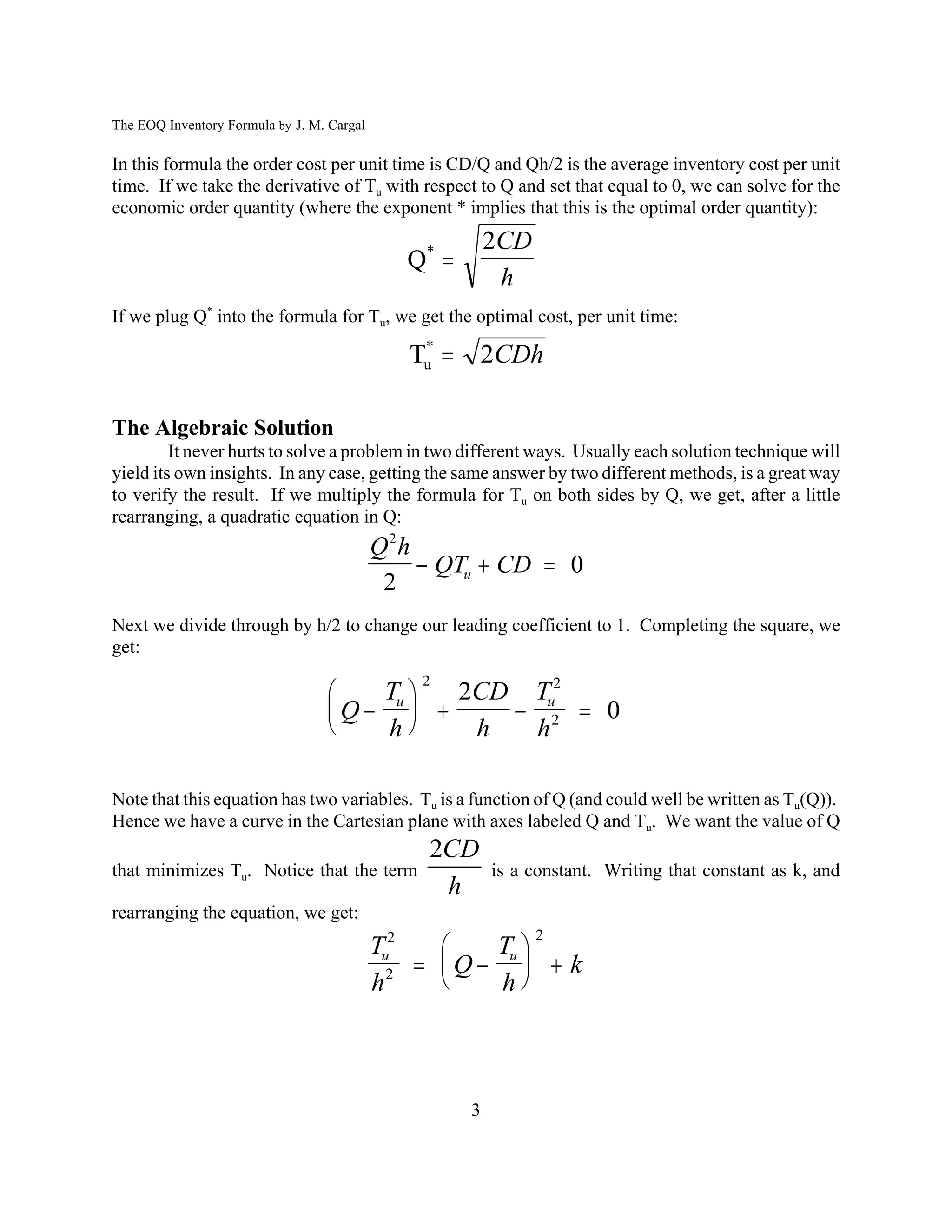
to verify the result. If we multiply the formula for Tu on both sides by Q, we get, after a little
rearranging, a quadratic equation in Q:
                                            Q2 h
                                                  QTu  CD  0
                                             2
Next we divide through by h/2 to change our leading coefficient to 1. Completing the square, we
get:
                                                2
                                    Tu  2CD Tu2
                                  Q       2  0
                                    h    h  h

Note that this equation has two variables. Tu is a function of Q (and could well be written as Tu(Q)).
Hence we have a curve in the Cartesian plane with axes labeled Q and Tu. We want the value of Q
                                                 2CD
that minimizes Tu. Notice that the term                   is a constant. Writing that constant as k, and
                                                  h
rearranging the equation, we get:
                                                                2
                                            Tu2     T
                                                 Q u  k
                                            h2       h


                                                      3
The EOQ Inventory Formula by J. M. Cargal


If we set the quadratic term to zero, then Tu  h k . Any change in the quadratic term from zero
increases the size of Tu. Hence the optimal size of Tu is         h k   which just happens to be
                                                                                                   Tu
   2CDh which is the value we found earlier. The quadratic term is zero if and only if Q             .
                                                                                                   h
This gives us the identity          Q*h  Tu* .

An Example
        It is useful at this point to consider a numerical example. The demand for klabitz’s is 50 per
week. The order cost is $30 (regardless of the size of the order), and the holding cost is $6 per
klabitz per week. Plugging these figures into the EOQ formula we get:
                                            2  30  50
                                     Q*                 22.36
                                                 6
This brings up a little mentioned drawback of the EOQ formula. The EOQ formula is not an integer
formula. It would be more appropriate if we ordered klabitz’s by the gallon. Most of the time, the
nearest integer will be the optimal integer amount. In this case, the total inventory cost Tu is $134.18
per week when we order 22 klabitz’s. If instead, we order 23 klabitz’s the cost is $134.22.


                             1600
                             1400
                             1200
                Total Cost


                             1000
                             800
                             600
                                                  Min
                             400
                             200
                               0
                                    1 6 11 16 21 26 31 36 41 46 51 56 61 66 71 76
                                                  Order Quantity


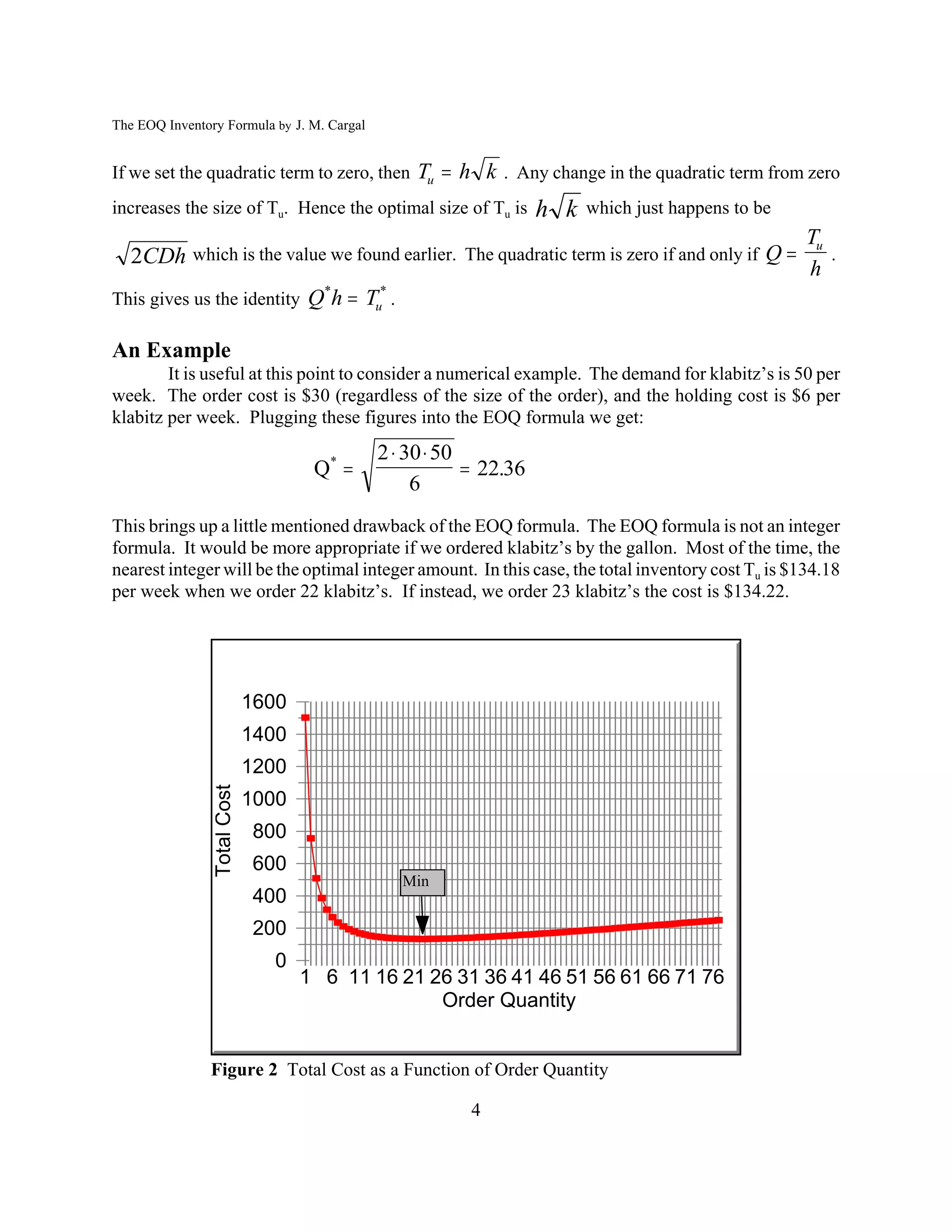
               Figure 2 Total Cost as a Function of Order Quantity

                                                        4
The EOQ Inventory Formula by J. M. Cargal


                                1600
                                1400
                                1200


                                                                                   Holding Cost
                   Order Cost


                                1000
                                 800
                                 600
                                              Min
                                 400
                                 200
                                   0
                                       1 6 1116212631364146515661667176
                                                 Order Quantity


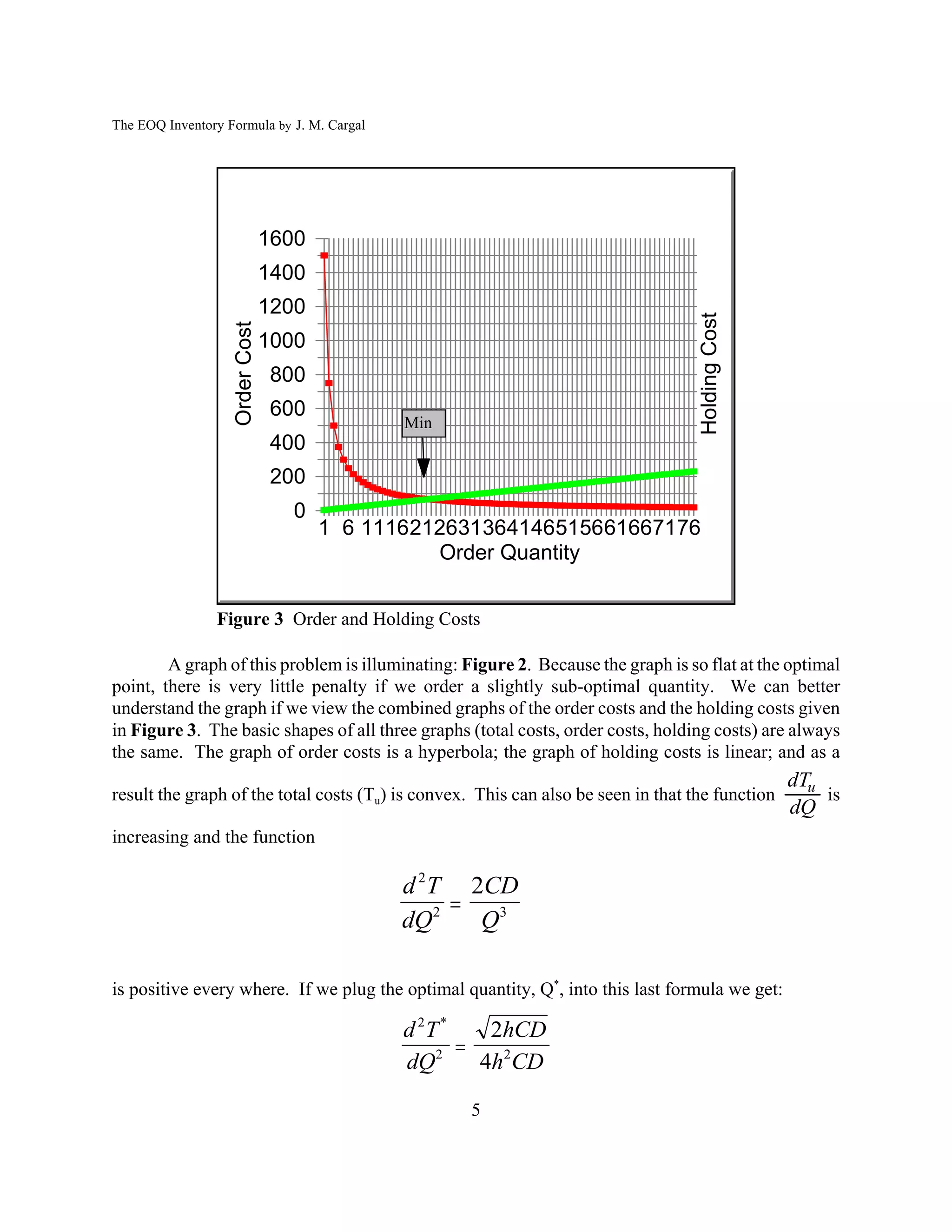
                Figure 3 Order and Holding Costs

        A graph of this problem is illuminating: Figure 2. Because the graph is so flat at the optimal
point, there is very little penalty if we order a slightly sub-optimal quantity. We can better
understand the graph if we view the combined graphs of the order costs and the holding costs given
in Figure 3. The basic shapes of all three graphs (total costs, order costs, holding costs) are always
the same. The graph of order costs is a hyperbola; the graph of holding costs is linear; and as a
                                                                                                  dTu
result the graph of the total costs (Tu) is convex. This can also be seen in that the function        is
                                                                                                  dQ
increasing and the function

                                              d 2 T 2CD
                                                   
                                              dQ2    Q3

is positive every where. If we plug the optimal quantity, Q*, into this last formula we get:

                                              d 2T *    2hCD
                                                     
                                              dQ2      4h2CD

                                                    5
The EOQ Inventory Formula by J. M. Cargal

Ordinarily this last quantity is very small, which indicates that the total cost of inventory Tu changes
very slowly with Q (in the optimal region). Hence the assumptions of the EOQ model do not have
to be accurate because the problem usually is tolerant of errors.
        If you study closely the graphs in Figure 3, it may seem clear to you that their sum, Tu,
reaches a minimum precisely where the two graphs intersect; that is at the point where order costs
                                                              
                                                         Qh       CD
and holding costs are equal. The gives us the equality    2       Q    . Solving that equality is the easiest
way to derive the EOQ formula.


Why Use the EOQ Formula At All?
         A problem that occurs in applied mathematics more than pure is that we hang onto formulas
and techniques that have been made (mostly) obsolete by technology. Try to think what it was like
to solve a problem like the one here forty years ago. The simple operation of division was either
done by hand, or by use of logarithms out of a table, or less exactly by using a slide rule. It was not
practical to simply calculate the total cost of inventory for a large set of order quantities and to
compare answers. The EOQ formula simplified the problem to a minimal number of calculations.
However, now it is quite simple to calculate total costs of inventory for hundreds of order quantities,
and this can be done from scratch in less time than it use to take to employ the EOQ formula. We
can do it with a spreadsheet.
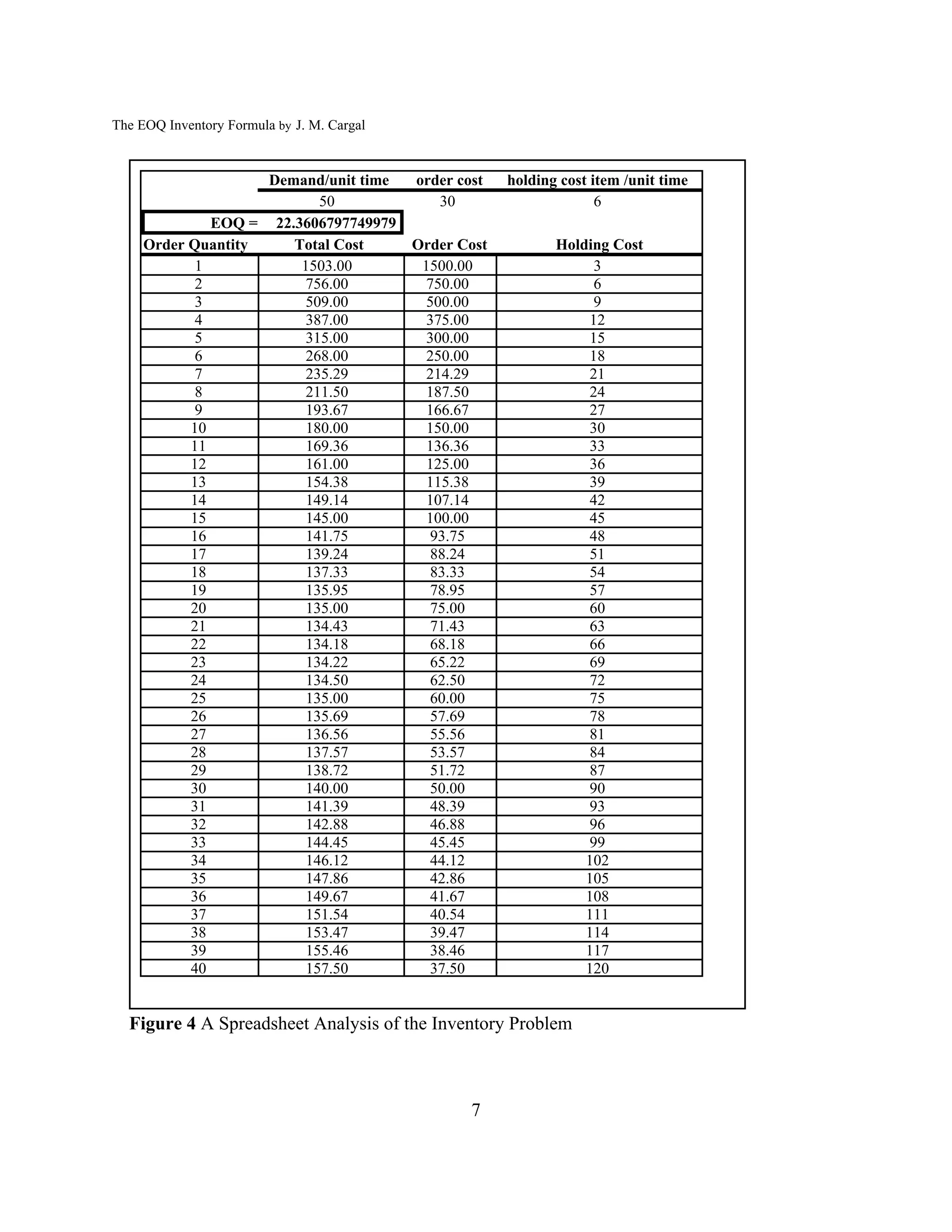
         The spreadsheet in Figure 4, takes the problem from the previous example, and computes
for a large variety of quantities the order costs, holding costs, and total costs. It took about 15
minutes to set this spreadsheet up, and most of that time was spent on formatting (for example
putting in lines). The formulas for order costs and holding costs were inserted to calculate the
respective entries for the order quantity of one. The total cost entry is defined to be the sum of the
first two entries (although its column comes first). Then the formulas are copied down the length
of the order quantity column. The only trick is that you must remember to use absolute addresses
for the fixed parameters. Once the spreadsheet is set up, the values for C, D, and h can be changed
and the entire spreadsheet will recalculate in less than a second. Note also, that the EOQ formula
itself is calculated at the top of the spreadsheet: its result can be compared with the columns. The
spreadsheet also provided the graphs in Figure 2 and Figure 3.
         Spreadsheets are superb for many problems in discrete mathematics. Knowing this, software
companies have endowed current spreadsheets with hundreds of scientific functions. Just like
formulas, the spreadsheet can be made to incorporate assumptions more realistic than those in the
EOQ model. In many cases it is easier to do this with spreadsheets and more illuminating.


                                                   6
The EOQ Inventory Formula by J. M. Cargal


                    Demand/unit time        order cost   holding cost item /unit time
                           50                  30                      6
              EOQ = 22.3606797749979
     Order Quantity    Total Cost           Order Cost          Holding Cost
            1           1503.00              1500.00                 3
            2            756.00               750.00                 6
            3            509.00               500.00                 9
            4            387.00               375.00                12
            5            315.00               300.00                15
            6            268.00               250.00                18
            7            235.29               214.29                21
            8            211.50               187.50                24
            9            193.67               166.67                27
           10            180.00               150.00                30
           11            169.36               136.36                33
           12            161.00               125.00                36
           13            154.38               115.38                39
           14            149.14               107.14                42
           15            145.00               100.00                45
           16            141.75               93.75                 48
           17            139.24               88.24                 51
           18            137.33               83.33                 54
           19            135.95               78.95                 57
           20            135.00               75.00                 60
           21            134.43               71.43                 63
           22            134.18               68.18                 66
           23            134.22               65.22                 69
           24            134.50               62.50                 72
           25            135.00               60.00                 75
           26            135.69               57.69                 78
           27            136.56               55.56                 81
           28            137.57               53.57                 84
           29            138.72               51.72                 87
           30            140.00               50.00                 90
           31            141.39               48.39                 93
           32            142.88               46.88                 96
           33            144.45               45.45                 99
           34            146.12               44.12                 102
           35            147.86               42.86                 105
           36            149.67               41.67                 108
           37            151.54               40.54                 111
           38            153.47               39.47                 114
           39            155.46               38.46                 117
           40            157.50               37.50                 120


  Figure 4 A Spreadsheet Analysis of the Inventory Problem


                                                    7
The EOQ Inventory Formula by J. M. Cargal

Hadley, G. and T. M. Whitin. Analysis of Inventory Systems. 1963. Englewood Cliffs, New Jersey:
Prentice-Hall.


                                              8

The EOQ Formula

  • 1.
    The EOQ InventoryFormula James M. Cargal Mathematics Department Troy University – Montgomery Campus A basic problem for businesses and manufacturers is, when ordering supplies, to determine what quantity of a given item to order. A great deal of literature has dealt with this problem (unfortunately many of the best books on the subject are out of print). Many formulas and algorithms have been created. Of these the simplest formula is the most used: The EOQ (economic order quantity) or Lot Size formula. The EOQ formula has been independently discovered many times in the last eighty years. We will see that the EOQ formula is simplistic and uses several unrealistic assumptions. This raises the question, which we will address: given that it is so unrealistic, why does the formula work so well? Indeed, despite the many more sophisticated formulas and algorithms available, even large corporations use the EOQ formula. In general, large corporations that use the EOQ formula do not want the public or competitors to know they use something so unsophisticated. Hence you might wonder how I can state that large corporations do use the EOQ formula. Let’s just say that I have good sources of information that I feel can be relied upon. The Variables of the EOQ Problem Let us assume that we are interested in optimal inventory policies for widgets. The EOQ formula uses four variables. They are: D: The demand for widgets in quantity per unit time. Demand can be thought of as a rate. Q: The order quantity. This is the variable we want to optimize. All the other variables are fixed quantities. C: The order cost. This is the flat fee charged for making any order and is independent of Q. h: Holding costs per widget per unit time. If we store x widgets for one unit of time, it costs us x@h. The EOQ problem can be summarized as determining the order quantity Q, that balances the order cost C and the holding costs h to minimize total costs. The greater Q is, the less we will spend on orders, since we order less often. On the other hand, the greater Q is the more we spend on inventory. Note that the price of widgets is a variables that does not interest us. This is because we plan to meet the demand for widgets. Hence the value of Q has nothing to do with this quantity. If we put the price of widgets into our problem formulation, when we finally have finally solved the optimal value for Q, it will not involve this term.
  • 2.
    The EOQ InventoryFormula by J. M. Cargal The Assumptions of the EOQ Model The underlying assumptions of the EOQ problem can be represented by Figure 1. The idea is that orders for widgets arrive instantly and all at once. Secondly, the demand for widgets is perfectly steady. Note that it is relatively easy to modify these assumptions; Hadley and Whitin [1963] cover many such cases. Despite the fact that many more elaborate models have been constructed for inventory problem the EOQ model is by far the most used. Figure 1 The EOQ Process An Incorrect Solution Solving for the EOQ, that is the quantity that minimizes total costs, requires that we formulate what the costs are. The order period is the block of time between two consecutive orders. The length of the order period, which we will denote by P, is Q/D. For example, if the order quantity is 20 widgets and the rate of demand is five widgets per day, then the order period is 20/5, or four days. Let Tp be the total costs per order period. By definition, the order cost per order period will be C. During the order period the inventory will go steadily from Q, the order amount, to zero. Hence the average inventory is Q/2 and the inventory costs per period is the average cost, Q/2, times the length of the period, Q/D. Hence the total cost per period is: Q Q Q2 h TP  C  h  C 2 D 2D If we take the derivative of Tp with respect to Q and set it to zero, we get Q = 0. The problem is solved by the device of not ordering anything. This indeed minimizes the inventory costs but at the small inconvenience of not meeting demand and therefore going out of business. This is what many people, perhaps most people do, when trying to solve for the EOQ the first time. The Classic EOQ Derivation The first step to solving the EOQ problem is to correctly state the inventory costs formula. This can be done by taking the cost per period Tp and dividing by the length of the period, Q/D, to get the total cost per unit time, Tu: CD Qh Tu   Q 2 2
  • 3.
    The EOQ InventoryFormula by J. M. Cargal In this formula the order cost per unit time is CD/Q and Qh/2 is the average inventory cost per unit time. If we take the derivative of Tu with respect to Q and set that equal to 0, we can solve for the economic order quantity (where the exponent * implies that this is the optimal order quantity): 2CD Q*  h If we plug Q* into the formula for Tu, we get the optimal cost, per unit time: Tu  * 2CDh The Algebraic Solution It never hurts to solve a problem in two different ways. Usually each solution technique will yield its own insights. In any case, getting the same answer by two different methods, is a great way to verify the result. If we multiply the formula for Tu on both sides by Q, we get, after a little rearranging, a quadratic equation in Q: Q2 h  QTu  CD  0 2 Next we divide through by h/2 to change our leading coefficient to 1. Completing the square, we get: 2  Tu  2CD Tu2 Q    2  0  h h h Note that this equation has two variables. Tu is a function of Q (and could well be written as Tu(Q)). Hence we have a curve in the Cartesian plane with axes labeled Q and Tu. We want the value of Q 2CD that minimizes Tu. Notice that the term is a constant. Writing that constant as k, and h rearranging the equation, we get: 2 Tu2  T  Q u  k h2  h 3
  • 4.
    The EOQ InventoryFormula by J. M. Cargal If we set the quadratic term to zero, then Tu  h k . Any change in the quadratic term from zero increases the size of Tu. Hence the optimal size of Tu is h k which just happens to be Tu 2CDh which is the value we found earlier. The quadratic term is zero if and only if Q  . h This gives us the identity Q*h  Tu* . An Example It is useful at this point to consider a numerical example. The demand for klabitz’s is 50 per week. The order cost is $30 (regardless of the size of the order), and the holding cost is $6 per klabitz per week. Plugging these figures into the EOQ formula we get: 2  30  50 Q*   22.36 6 This brings up a little mentioned drawback of the EOQ formula. The EOQ formula is not an integer formula. It would be more appropriate if we ordered klabitz’s by the gallon. Most of the time, the nearest integer will be the optimal integer amount. In this case, the total inventory cost Tu is $134.18 per week when we order 22 klabitz’s. If instead, we order 23 klabitz’s the cost is $134.22. 1600 1400 1200 Total Cost 1000 800 600 Min 400 200 0 1 6 11 16 21 26 31 36 41 46 51 56 61 66 71 76 Order Quantity Figure 2 Total Cost as a Function of Order Quantity 4
  • 5.
    The EOQ InventoryFormula by J. M. Cargal 1600 1400 1200 Holding Cost Order Cost 1000 800 600 Min 400 200 0 1 6 1116212631364146515661667176 Order Quantity Figure 3 Order and Holding Costs A graph of this problem is illuminating: Figure 2. Because the graph is so flat at the optimal point, there is very little penalty if we order a slightly sub-optimal quantity. We can better understand the graph if we view the combined graphs of the order costs and the holding costs given in Figure 3. The basic shapes of all three graphs (total costs, order costs, holding costs) are always the same. The graph of order costs is a hyperbola; the graph of holding costs is linear; and as a dTu result the graph of the total costs (Tu) is convex. This can also be seen in that the function is dQ increasing and the function d 2 T 2CD  dQ2 Q3 is positive every where. If we plug the optimal quantity, Q*, into this last formula we get: d 2T * 2hCD  dQ2 4h2CD 5
  • 6.
    The EOQ InventoryFormula by J. M. Cargal Ordinarily this last quantity is very small, which indicates that the total cost of inventory Tu changes very slowly with Q (in the optimal region). Hence the assumptions of the EOQ model do not have to be accurate because the problem usually is tolerant of errors. If you study closely the graphs in Figure 3, it may seem clear to you that their sum, Tu, reaches a minimum precisely where the two graphs intersect; that is at the point where order costs  Qh CD and holding costs are equal. The gives us the equality 2 Q . Solving that equality is the easiest way to derive the EOQ formula. Why Use the EOQ Formula At All? A problem that occurs in applied mathematics more than pure is that we hang onto formulas and techniques that have been made (mostly) obsolete by technology. Try to think what it was like to solve a problem like the one here forty years ago. The simple operation of division was either done by hand, or by use of logarithms out of a table, or less exactly by using a slide rule. It was not practical to simply calculate the total cost of inventory for a large set of order quantities and to compare answers. The EOQ formula simplified the problem to a minimal number of calculations. However, now it is quite simple to calculate total costs of inventory for hundreds of order quantities, and this can be done from scratch in less time than it use to take to employ the EOQ formula. We can do it with a spreadsheet. The spreadsheet in Figure 4, takes the problem from the previous example, and computes for a large variety of quantities the order costs, holding costs, and total costs. It took about 15 minutes to set this spreadsheet up, and most of that time was spent on formatting (for example putting in lines). The formulas for order costs and holding costs were inserted to calculate the respective entries for the order quantity of one. The total cost entry is defined to be the sum of the first two entries (although its column comes first). Then the formulas are copied down the length of the order quantity column. The only trick is that you must remember to use absolute addresses for the fixed parameters. Once the spreadsheet is set up, the values for C, D, and h can be changed and the entire spreadsheet will recalculate in less than a second. Note also, that the EOQ formula itself is calculated at the top of the spreadsheet: its result can be compared with the columns. The spreadsheet also provided the graphs in Figure 2 and Figure 3. Spreadsheets are superb for many problems in discrete mathematics. Knowing this, software companies have endowed current spreadsheets with hundreds of scientific functions. Just like formulas, the spreadsheet can be made to incorporate assumptions more realistic than those in the EOQ model. In many cases it is easier to do this with spreadsheets and more illuminating. 6
  • 7.
    The EOQ InventoryFormula by J. M. Cargal Demand/unit time order cost holding cost item /unit time 50 30 6 EOQ = 22.3606797749979 Order Quantity Total Cost Order Cost Holding Cost 1 1503.00 1500.00 3 2 756.00 750.00 6 3 509.00 500.00 9 4 387.00 375.00 12 5 315.00 300.00 15 6 268.00 250.00 18 7 235.29 214.29 21 8 211.50 187.50 24 9 193.67 166.67 27 10 180.00 150.00 30 11 169.36 136.36 33 12 161.00 125.00 36 13 154.38 115.38 39 14 149.14 107.14 42 15 145.00 100.00 45 16 141.75 93.75 48 17 139.24 88.24 51 18 137.33 83.33 54 19 135.95 78.95 57 20 135.00 75.00 60 21 134.43 71.43 63 22 134.18 68.18 66 23 134.22 65.22 69 24 134.50 62.50 72 25 135.00 60.00 75 26 135.69 57.69 78 27 136.56 55.56 81 28 137.57 53.57 84 29 138.72 51.72 87 30 140.00 50.00 90 31 141.39 48.39 93 32 142.88 46.88 96 33 144.45 45.45 99 34 146.12 44.12 102 35 147.86 42.86 105 36 149.67 41.67 108 37 151.54 40.54 111 38 153.47 39.47 114 39 155.46 38.46 117 40 157.50 37.50 120 Figure 4 A Spreadsheet Analysis of the Inventory Problem 7
  • 8.
    The EOQ InventoryFormula by J. M. Cargal Hadley, G. and T. M. Whitin. Analysis of Inventory Systems. 1963. Englewood Cliffs, New Jersey: Prentice-Hall. 8