• Meaning Of Uniform Costing
• Features Of Uniform Costing
• Need Of Uniform Costing
• Objectives Of Uniform Costing
• Advantages Of Uniform Costing
• Limitations Of Uniform Costing
• Essential Requisites Of Good Uniform Costing System
• Meaning Of Uniform Costing Manual
• Contents Of Uniform Costing Manual
• Meaning of Inter-Firm Comparison
• Objectives of Inter-firm Comparison
• Requirements (Pre-Requisites) of an Inter-Firm Comparison Scheme
• Advantages of Inter-firm Comparison
• Limitations of Inter-firm Comparison
Unit No 3
Uniform Costing, Interfirm
Comparison and Productivity
Meaning of Uniform Costing
 Uniform costing is the application of the same accounting and costing principles,
methods or procedures uniformly by various undertakings in the same industry.
 It is a particular technique which applies the usual accounting methods like
standard costing, marginal costing and budgetary control.
 The basic idea behind uniform costing is that the different concerns in an industry
should adopt a common method of costing and apply uniformity the same
principles and techniques for better cost comparison and better good.
Features of Uniform costing
 The same costing principles are applied by all member units for ascertaining cost.
 Cost statements and reports are prepared on a uniform basis.
 The accounting period is common for all member units.
 All the member units adapt the same costing methods, techniques and systems
for collection, ascertainment and control of cost.
Need of uniform costing:
 Size of Business: In small concerns all the problems are handled by one person and
there is no need of elaborate system of costing but in big business there is need of
division of work and responsibility and the authority is given to the different levels of
managers to complete their work efficiently.
 Nature of Business: The nature of businesses differs because of different
manufacturing processes and the types of machines used. Some concerns use heavy
machinery for carrying out their operations while others use labour intensive machines.
 Product Differentiation: the need for uniform costing arises because of differences in
size and organization set up, wage structure, methods of production and degree of
automation and application of different methods and principles of cost accounting.
Objectives of uniform costing
 Fixation of Common Price:
 Improving Performance:
 Inter Unit Comparison of Cost of Production:
 Control of Cost:
 Helpful for General Control Over Member Units:
Advantages of uniform costing
 Useful for Management Control
 Locating weak spots
 Customers confidence
 Facilitates Price Fixation
 Helps Government in regulating the price of production
 Computerized accounting system is possible
Limitations of uniform costing
 Difficulty in application
 Expensive
 Unwillingness for supply information
 Difficulty in understanding
 Difficulty in achieving uniformity
Essential Requisites of Good Uniform
Costing System:
 The firms in the industry should be willing to share/ furnish relevant data
 A spirit of cooperation and mutual trust should prevail among the participating
firm.
 Mutual exchange of ideas, methods used, special achievement made, research etc.
should be frequent.
 Bigger firms should take the dead towards sharing their experience and know-
how with smaller firms to enable the latter to improve their performance.
Meaning of Uniform Costing Manual:
 A uniform costing manual is a booklet which contains detailed instructions to be
followed by various firms in an industry in connection with cost determination and
control. It is a formal document which lays down the recommended cost
accounting plans; policies and other related matters, so that system can be
operated effectively.
 A typical uniform costing manual details the objectives and the method of its
administration and the procedure to be followed for regular collection, analysis
and reporting of cost data and their interpretation to the member units.
Contents of Uniform Costing Manual:
A typical costing manual may contain the following:
 Introduction: The introduction part of the manual may include the statement of
objectives and the purpose of the system, scope of the system, advantages to be
derived, educating the management to appreciate the system, and the extent of
cooperation necessary.
 Organization: This part will include the organisation for developing and
operating the system and the stages in which the system is to be introduced.
 Accounting System and Plans: The manual should also include essential details
regarding material, labour and overhead costs, collection and control.
Contents of Uniform Costing Manual:
A typical costing manual may contain the following:
 Presentation of Information: Presentation of information and data which would
cover forms, contents of statements to be prepared for submission of information
to management and computation of various ratios for comparison of performance
and efficiency between firms. In short, this chapter should deal with the number of
reports, their format, frequency and contents
 Control: Essential details regarding control of inventory, labour and overheads.
Contents of Uniform Costing Manual:
A typical costing manual may contain the following:
 Miscellaneous Information: the other miscellaneous matters which would
include treatment of depreciation, interest on capital, wastages scraps, by-
products, joint product etc.
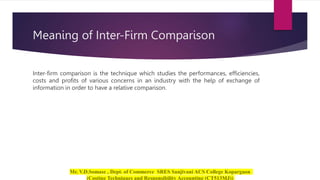
Meaning of Inter-Firm Comparison
Inter-firm comparison is the technique which studies the performances, efficiencies,
costs and profits of various concerns in an industry with the help of exchange of
information in order to have a relative comparison.
Objectives of Inter-firm Comparison:
 To know where one stand
 Locate the weakness and area of improvement
 Adequacy of the profits
 Minimization of wastage
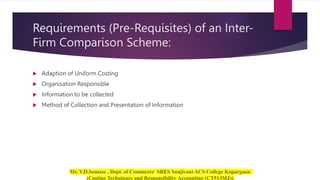
Requirements (Pre-Requisites) of an Inter-
Firm Comparison Scheme:
 Adaption of Uniform Costing
 Organisation Responsible
 Information to be collected
 Method of Collection and Presentation of Information
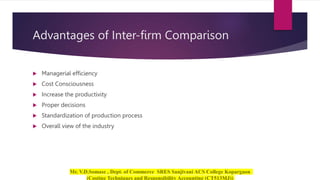
Advantages of Inter-firm Comparison
 Managerial efficiency
 Cost Consciousness
 Increase the productivity
 Proper decisions
 Standardization of production process
 Overall view of the industry
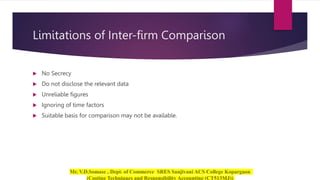
Limitations of Inter-firm Comparison
 No Secrecy
 Do not disclose the relevant data
 Unreliable figures
 Ignoring of time factors
 Suitable basis for comparison may not be available.

Uniform Costing And Inter-Firm Comparison.pptx

  • 1.
    • Meaning OfUniform Costing • Features Of Uniform Costing • Need Of Uniform Costing • Objectives Of Uniform Costing • Advantages Of Uniform Costing • Limitations Of Uniform Costing • Essential Requisites Of Good Uniform Costing System • Meaning Of Uniform Costing Manual • Contents Of Uniform Costing Manual • Meaning of Inter-Firm Comparison • Objectives of Inter-firm Comparison • Requirements (Pre-Requisites) of an Inter-Firm Comparison Scheme • Advantages of Inter-firm Comparison • Limitations of Inter-firm Comparison Unit No 3 Uniform Costing, Interfirm Comparison and Productivity
  • 2.
    Meaning of UniformCosting  Uniform costing is the application of the same accounting and costing principles, methods or procedures uniformly by various undertakings in the same industry.  It is a particular technique which applies the usual accounting methods like standard costing, marginal costing and budgetary control.  The basic idea behind uniform costing is that the different concerns in an industry should adopt a common method of costing and apply uniformity the same principles and techniques for better cost comparison and better good.
  • 3.
    Features of Uniformcosting  The same costing principles are applied by all member units for ascertaining cost.  Cost statements and reports are prepared on a uniform basis.  The accounting period is common for all member units.  All the member units adapt the same costing methods, techniques and systems for collection, ascertainment and control of cost.
  • 4.
    Need of uniformcosting:  Size of Business: In small concerns all the problems are handled by one person and there is no need of elaborate system of costing but in big business there is need of division of work and responsibility and the authority is given to the different levels of managers to complete their work efficiently.  Nature of Business: The nature of businesses differs because of different manufacturing processes and the types of machines used. Some concerns use heavy machinery for carrying out their operations while others use labour intensive machines.  Product Differentiation: the need for uniform costing arises because of differences in size and organization set up, wage structure, methods of production and degree of automation and application of different methods and principles of cost accounting.
  • 5.
    Objectives of uniformcosting  Fixation of Common Price:  Improving Performance:  Inter Unit Comparison of Cost of Production:  Control of Cost:  Helpful for General Control Over Member Units:
  • 6.
    Advantages of uniformcosting  Useful for Management Control  Locating weak spots  Customers confidence  Facilitates Price Fixation  Helps Government in regulating the price of production  Computerized accounting system is possible
  • 7.
    Limitations of uniformcosting  Difficulty in application  Expensive  Unwillingness for supply information  Difficulty in understanding  Difficulty in achieving uniformity
  • 8.
    Essential Requisites ofGood Uniform Costing System:  The firms in the industry should be willing to share/ furnish relevant data  A spirit of cooperation and mutual trust should prevail among the participating firm.  Mutual exchange of ideas, methods used, special achievement made, research etc. should be frequent.  Bigger firms should take the dead towards sharing their experience and know- how with smaller firms to enable the latter to improve their performance.
  • 9.
    Meaning of UniformCosting Manual:  A uniform costing manual is a booklet which contains detailed instructions to be followed by various firms in an industry in connection with cost determination and control. It is a formal document which lays down the recommended cost accounting plans; policies and other related matters, so that system can be operated effectively.  A typical uniform costing manual details the objectives and the method of its administration and the procedure to be followed for regular collection, analysis and reporting of cost data and their interpretation to the member units.
  • 10.
    Contents of UniformCosting Manual: A typical costing manual may contain the following:  Introduction: The introduction part of the manual may include the statement of objectives and the purpose of the system, scope of the system, advantages to be derived, educating the management to appreciate the system, and the extent of cooperation necessary.  Organization: This part will include the organisation for developing and operating the system and the stages in which the system is to be introduced.  Accounting System and Plans: The manual should also include essential details regarding material, labour and overhead costs, collection and control.
  • 11.
    Contents of UniformCosting Manual: A typical costing manual may contain the following:  Presentation of Information: Presentation of information and data which would cover forms, contents of statements to be prepared for submission of information to management and computation of various ratios for comparison of performance and efficiency between firms. In short, this chapter should deal with the number of reports, their format, frequency and contents  Control: Essential details regarding control of inventory, labour and overheads.
  • 12.
    Contents of UniformCosting Manual: A typical costing manual may contain the following:  Miscellaneous Information: the other miscellaneous matters which would include treatment of depreciation, interest on capital, wastages scraps, by- products, joint product etc.
  • 13.
    Meaning of Inter-FirmComparison Inter-firm comparison is the technique which studies the performances, efficiencies, costs and profits of various concerns in an industry with the help of exchange of information in order to have a relative comparison.
  • 14.
    Objectives of Inter-firmComparison:  To know where one stand  Locate the weakness and area of improvement  Adequacy of the profits  Minimization of wastage
  • 15.
    Requirements (Pre-Requisites) ofan Inter- Firm Comparison Scheme:  Adaption of Uniform Costing  Organisation Responsible  Information to be collected  Method of Collection and Presentation of Information
  • 16.
    Advantages of Inter-firmComparison  Managerial efficiency  Cost Consciousness  Increase the productivity  Proper decisions  Standardization of production process  Overall view of the industry
  • 17.
    Limitations of Inter-firmComparison  No Secrecy  Do not disclose the relevant data  Unreliable figures  Ignoring of time factors  Suitable basis for comparison may not be available.