Capacity and Inventory
    Management
Capacity Management
• Capacity = Maximum Output Rate (how many
  products can be produced or how much service
  can be provided when system is running at full
  tilt)
• What is the capacity of:
  –   Theatre
  –   Coffee Shop
  –   Mechanic Shop
  –   Factory
  –   Human Brain
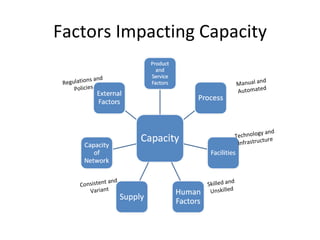
Factors Impacting Capacity

            s and
 Regulation                            Manual an
                                                 d
     Policies                          Automate
                                                 d


                                                 y and
                                       Technolog e
                                                  tur
                                        Infrastruc


                 t and   Skilled and
       Consisten
          Variant         Unskilled
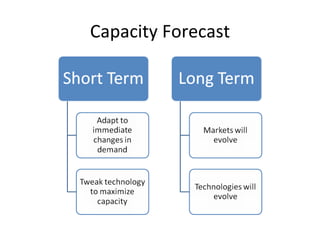
Capacity Forecast
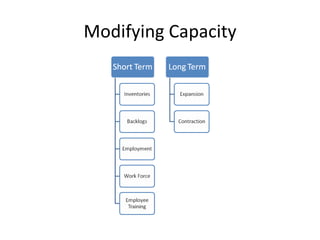
Modifying Capacity
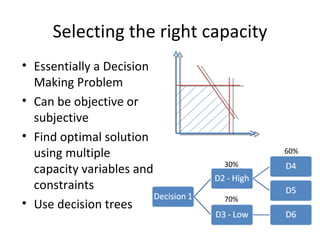
Selecting the right capacity
• Essentially a Decision
  Making Problem
• Can be objective or
  subjective
• Find optimal solution
  using multiple                    60%
                           30%
  capacity variables and
  constraints
                           70%
• Use decision trees
Inventory Management
• Why is Inventory required?

• What will happen if we have too little inventory?

• What will happen if we have too much
  inventory?

• When can we say that we have optimum
  inventory?
Inventory is required as a cover for
    all kinds of variations and
  uncertainties in the production
     process and supply chain


  Inventory allows economies of
         scale to kick in
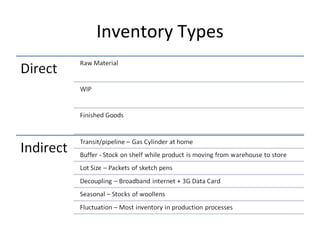
Inventory Types
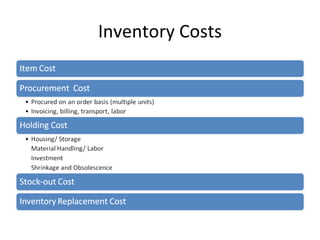
Inventory Costs
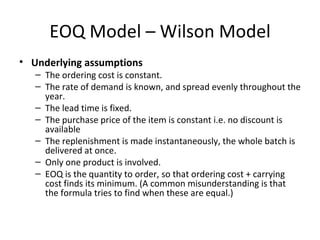
EOQ Model – Wilson Model
• Underlying assumptions
   – The ordering cost is constant.
   – The rate of demand is known, and spread evenly throughout the
     year.
   – The lead time is fixed.
   – The purchase price of the item is constant i.e. no discount is
     available
   – The replenishment is made instantaneously, the whole batch is
     delivered at once.
   – Only one product is involved.
   – EOQ is the quantity to order, so that ordering cost + carrying
     cost finds its minimum. (A common misunderstanding is that
     the formula tries to find when these are equal.)
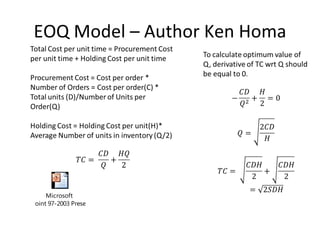
EOQ Model – Author Ken Homa


          Microsoft
PowerPoint 97-2003 Presentation
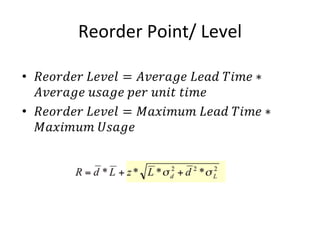
Reorder Point/ Level
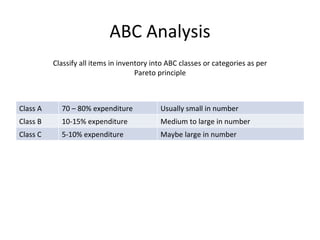
ABC Analysis
          Classify all items in inventory into ABC classes or categories as per
                                     Pareto principle


Class A     70 – 80% expenditure            Usually small in number
Class B     10-15% expenditure              Medium to large in number
Class C     5-10% expenditure               Maybe large in number

Capacity & Inventory Management

  • 1.
  • 2.
    Capacity Management • Capacity= Maximum Output Rate (how many products can be produced or how much service can be provided when system is running at full tilt) • What is the capacity of: – Theatre – Coffee Shop – Mechanic Shop – Factory – Human Brain
  • 3.
    Factors Impacting Capacity s and Regulation Manual an d Policies Automate d y and Technolog e tur Infrastruc t and Skilled and Consisten Variant Unskilled
  • 4.
  • 5.
  • 6.
    Selecting the rightcapacity • Essentially a Decision Making Problem • Can be objective or subjective • Find optimal solution using multiple 60% 30% capacity variables and constraints 70% • Use decision trees
  • 7.
    Inventory Management • Whyis Inventory required? • What will happen if we have too little inventory? • What will happen if we have too much inventory? • When can we say that we have optimum inventory?
  • 8.
    Inventory is requiredas a cover for all kinds of variations and uncertainties in the production process and supply chain Inventory allows economies of scale to kick in
  • 9.
  • 10.
  • 11.
    EOQ Model –Wilson Model • Underlying assumptions – The ordering cost is constant. – The rate of demand is known, and spread evenly throughout the year. – The lead time is fixed. – The purchase price of the item is constant i.e. no discount is available – The replenishment is made instantaneously, the whole batch is delivered at once. – Only one product is involved. – EOQ is the quantity to order, so that ordering cost + carrying cost finds its minimum. (A common misunderstanding is that the formula tries to find when these are equal.)
  • 12.
    EOQ Model –Author Ken Homa Microsoft PowerPoint 97-2003 Presentation
  • 13.
  • 14.
    ABC Analysis Classify all items in inventory into ABC classes or categories as per Pareto principle Class A 70 – 80% expenditure Usually small in number Class B 10-15% expenditure Medium to large in number Class C 5-10% expenditure Maybe large in number