Leadership
Overview

•   Define leadership

•   Present the background & classic studies of leadership

•   Discuss the traditional theories of leadership

•   Identify modern frameworks for leadership

•   Relate the style implications from the classic studies & modern
    theories of leadership

•   Identify and analyze the skills needed for effective leadership
Leadership


• The ability to influence a group toward the
  achievement of goals
• “When you boil it down, contemporary
  leadership seems to a matter of aligning people
  toward common goals and empowering them to
  take the actions needed to reach them.”
                             Sherman, 1995
• Sanctioned vs. non sanctioned leadership
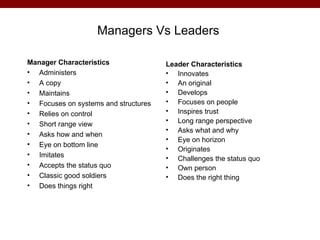
Managers Vs Leaders

Manager Characteristics               Leader Characteristics
• Administers                         • Innovates
• A copy                              • An original
• Maintains                           • Develops
• Focuses on systems and structures   • Focuses on people
• Relies on control                   • Inspires trust
• Short range view                    • Long range perspective
                                      • Asks what and why
• Asks how and when
                                      • Eye on horizon
• Eye on bottom line
                                      • Originates
• Imitates                            • Challenges the status quo
• Accepts the status quo              • Own person
• Classic good soldiers               • Does the right thing
• Does things right
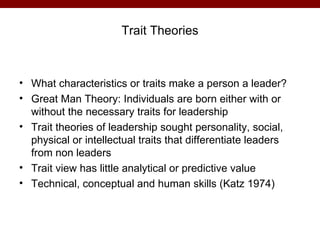
Trait Theories


• What characteristics or traits make a person a leader?
• Great Man Theory: Individuals are born either with or
  without the necessary traits for leadership
• Trait theories of leadership sought personality, social,
  physical or intellectual traits that differentiate leaders
  from non leaders
• Trait view has little analytical or predictive value
• Technical, conceptual and human skills (Katz 1974)
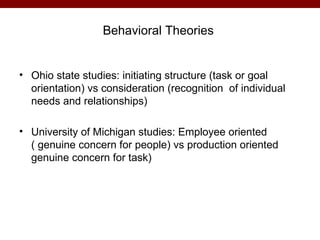
Behavioral Theories


• Ohio state studies: initiating structure (task or goal
  orientation) vs consideration (recognition of individual
  needs and relationships)

• University of Michigan studies: Employee oriented
  ( genuine concern for people) vs production oriented
  genuine concern for task)
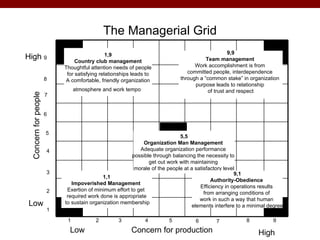
The Managerial Grid
                                             1,9                                                9,9
High 9                         Country club management                                Team management
                          Thoughtful attention needs of people                   Work accomplishment is from
                           for satisfying relationships leads to              committed people, interdependence
                      8   A comfortable, friendly organization             through a “common stake” in organization
                                                                                 purpose leads to relationship
                               atmosphere and work tempo                               of trust and respect
 Concern for people


                      7


                      6


                      5
                                                                           5,5
                                                            Organization Man Management
                      4                                   Adequate organization performance
                                                       possible through balancing the necessity to
                                                              get out work with maintaining
                                                        morale of the people at a satisfactory level
                      3                                                                             9,1
                                          1,1
                                                                                         Authority-Obedience
                             Impoverished Management
                                                                                    Efficiency in operations results
                      2    Exertion of minimum effort to get
                                                                                      from arranging conditions of
                           required work done is appropriate
                                                                                    work in such a way that human
Low                       to sustain organization membership
                                                                                 elements interfere to a minimal degree
                      1

                           1           2         3           4        5          6        7            8          9
                            Low                        Concern for production                               High
Fiedler Contingency Model
• Effective groups depend upon a proper match
  between a leader's style of interacting with
  subordinates and the degree to which the
  situation gives control and influence to the
  leader
• LPC measures task- or relationship-oriented
  leadership style ( think of all the coworkers you
  have ever had and describe one person you
  least enjoyed working with)
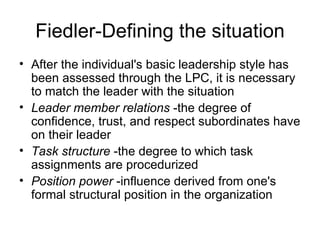
Fiedler-Defining the situation
• After the individual's basic leadership style has
  been assessed through the LPC, it is necessary
  to match the leader with the situation
• Leader member relations -the degree of
  confidence, trust, and respect subordinates have
  on their leader
• Task structure -the degree to which task
  assignments are procedurized
• Position power -influence derived from one's
  formal structural position in the organization
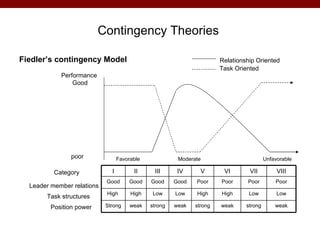
Contingency Theories

Fiedler’s contingency Model                                            Relationship Oriented
                                                                       Task Oriented
            Performance
                Good


               poor               Favorable             Moderate                         Unfavorable

          Category            I         II     III      IV      V       VI       VII          VIII
                            Good       Good   Good     Good   Poor     Poor     Poor         Poor
  Leader member relations
                            High       High    Low     Low    High     High      Low          Low
       Task structures
         Position power     Strong     weak   strong   weak   strong   weak     strong       weak
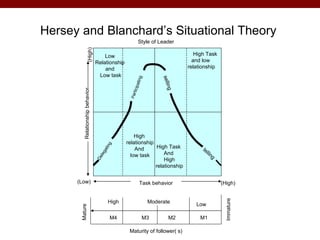
Hersey and Blanchard’s Situational Theory
                                                       Style of Leader


                  (High)
                                     Low                                        High Task
                                 Relationship                                  and low
                                     and                                     relationship
                                  Low task


                                                                   selli
                                                       g
                                                   atin


                                                                        ng
                                                  ticip
         Relationship behavior


                                                 Par
                                                    High
                                                relationship
                                         ng


                                                    And       High Task            te
                                      ati


                                                                 And                    llin
                                   leg


                                                  low task                                     g
                                 De


                                                                 High
                                                             relationship

      (Low)                                               Task behavior                            (High)


                                                                                                    Immature
                                        High                 Moderate           Low
       Mature


                                         M4               M3           M2         M1

                                                 Maturity of follower( s)
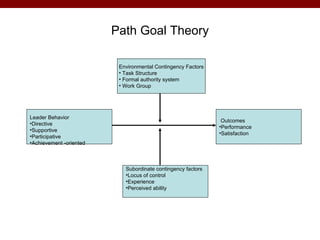
Path Goal Theory

                          Environmental Contingency Factors
                          • Task Structure
                          • Formal authority system
                          • Work Group


Leader Behavior
                                                               Outcomes
•Directive
                                                              •Performance
•Supportive
                                                              •Satisfaction
•Participative
•Achievement -oriented


                            Subordinate contingency factors
                            •Locus of control
                            •Experience
                            •Perceived ability
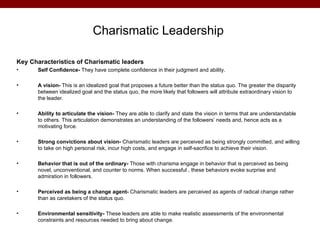
Charismatic Leadership

Key Characteristics of Charismatic leaders
•      Self Confidence- They have complete confidence in their judgment and ability.

•      A vision- This is an idealized goal that proposes a future better than the status quo. The greater the disparity
       between idealized goal and the status quo, the more likely that followers will attribute extraordinary vision to
       the leader.

•      Ability to articulate the vision- They are able to clarify and state the vision in terms that are understandable
       to others. This articulation demonstrates an understanding of the followers’ needs and, hence acts as a
       motivating force.

•      Strong convictions about vision- Charismatic leaders are perceived as being strongly committed, and willing
       to take on high personal risk, incur high costs, and engage in self-sacrifice to achieve their vision.

•      Behavior that is out of the ordinary- Those with charisma engage in behavior that is perceived as being
       novel, unconventional, and counter to norms. When successful , these behaviors evoke surprise and
       admiration in followers.

•      Perceived as being a change agent- Charismatic leaders are perceived as agents of radical change rather
       than as caretakers of the status quo.

•      Environmental sensitivity- These leaders are able to make realistic assessments of the environmental
       constraints and resources needed to bring about change.
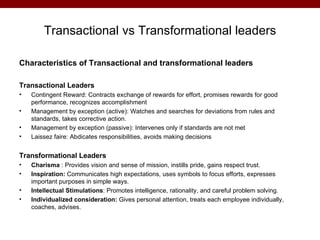
Transactional vs Transformational leaders

Characteristics of Transactional and transformational leaders

Transactional Leaders
•   Contingent Reward: Contracts exchange of rewards for effort, promises rewards for good
    performance, recognizes accomplishment
•   Management by exception (active): Watches and searches for deviations from rules and
    standards, takes corrective action.
•   Management by exception (passive): Intervenes only if standards are not met
•   Laissez faire: Abdicates responsibilities, avoids making decisions


Transformational Leaders
•   Charisma : Provides vision and sense of mission, instills pride, gains respect trust.
•   Inspiration: Communicates high expectations, uses symbols to focus efforts, expresses
    important purposes in simple ways.
•   Intellectual Stimulations: Promotes intelligence, rationality, and careful problem solving.
•   Individualized consideration: Gives personal attention, treats each employee individually,
    coaches, advises.
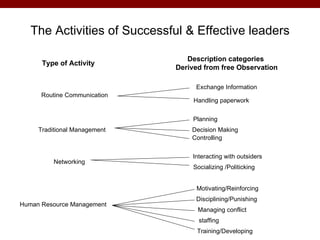
The Activities of Successful & Effective leaders

                                 Description categories
      Type of Activity
                              Derived from free Observation

                                    Exchange Information
      Routine Communication
                                   Handling paperwork


                                  Planning
     Traditional Management       Decision Making
                                  Controlling


                                  Interacting with outsiders
          Networking
                                   Socializing /Politicking


                                    Motivating/Reinforcing
                                    Disciplining/Punishing
Human Resource Management
                                    Managing conflict
                                     staffing
                                    Training/Developing
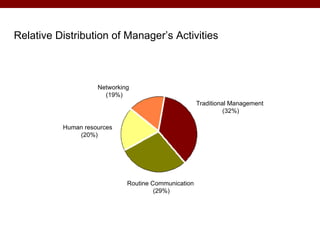
Relative Distribution of Manager’s Activities


                    Networking
                      (19%)
                                                     Traditional Management
                                                               (32%)

          Human resources
              (20%)


                             Routine Communication
                                      (29%)
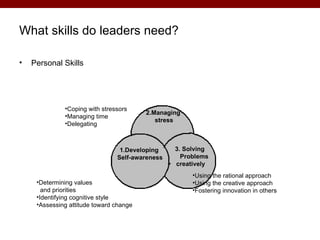
What skills do leaders need?

•   Personal Skills


              •Coping with stressors
                                         2.Managing
              •Managing time
                                            stress
              •Delegating


                                 1.Developing    3. Solving
                                Self-awareness     Problems
                                                 creatively
                                                      •Using the rational approach
     •Determining values                              •Using the creative approach
       and priorities                                 •Fostering innovation in others
     •Identifying cognitive style
     •Assessing attitude toward change
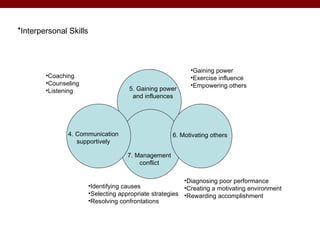
•Interpersonal Skills


                                                            •Gaining power
        •Coaching                                           •Exercise influence
        •Counseling                                         •Empowering others
        •Listening                    5. Gaining power
                                       and influences


               4. Communication                      6. Motivating others
                  supportively

                                     7. Management
                                         conflict

                                                          •Diagnosing poor performance
                        •Identifying causes               •Creating a motivating environment
                        •Selecting appropriate strategies •Rewarding accomplishment
                        •Resolving confrontations
The right stuff
                         Covey
•   Empower your inner child-children are genuine, speak their mind-so
    do successful leaders
•   Be slightly weird-effective leaders have their own approach to do
    things
•   Embrace compensation-everyone likes money, but successful
    leaders can talk about it
•   Focus carefully –successful leaders are able to handle more than
    2-3 things at a time because they are able to filter out extraneous
    information and focus on critical issues
•   Speak openly- successful leaders say what they think
•   Don't get even-get mad-good leaders let off steam and get on to the
    next issue
•   Keep up on the latest developments- successful leaders know the
    latest jargon and trnds

Organizational Behavior Chapter 9

  • 1.
  • 2.
    Overview • Define leadership • Present the background & classic studies of leadership • Discuss the traditional theories of leadership • Identify modern frameworks for leadership • Relate the style implications from the classic studies & modern theories of leadership • Identify and analyze the skills needed for effective leadership
  • 3.
    Leadership • The abilityto influence a group toward the achievement of goals • “When you boil it down, contemporary leadership seems to a matter of aligning people toward common goals and empowering them to take the actions needed to reach them.” Sherman, 1995 • Sanctioned vs. non sanctioned leadership
  • 4.
    Managers Vs Leaders ManagerCharacteristics Leader Characteristics • Administers • Innovates • A copy • An original • Maintains • Develops • Focuses on systems and structures • Focuses on people • Relies on control • Inspires trust • Short range view • Long range perspective • Asks what and why • Asks how and when • Eye on horizon • Eye on bottom line • Originates • Imitates • Challenges the status quo • Accepts the status quo • Own person • Classic good soldiers • Does the right thing • Does things right
  • 5.
    Trait Theories • Whatcharacteristics or traits make a person a leader? • Great Man Theory: Individuals are born either with or without the necessary traits for leadership • Trait theories of leadership sought personality, social, physical or intellectual traits that differentiate leaders from non leaders • Trait view has little analytical or predictive value • Technical, conceptual and human skills (Katz 1974)
  • 6.
    Behavioral Theories • Ohiostate studies: initiating structure (task or goal orientation) vs consideration (recognition of individual needs and relationships) • University of Michigan studies: Employee oriented ( genuine concern for people) vs production oriented genuine concern for task)
  • 7.
    The Managerial Grid 1,9 9,9 High 9 Country club management Team management Thoughtful attention needs of people Work accomplishment is from for satisfying relationships leads to committed people, interdependence 8 A comfortable, friendly organization through a “common stake” in organization purpose leads to relationship atmosphere and work tempo of trust and respect Concern for people 7 6 5 5,5 Organization Man Management 4 Adequate organization performance possible through balancing the necessity to get out work with maintaining morale of the people at a satisfactory level 3 9,1 1,1 Authority-Obedience Impoverished Management Efficiency in operations results 2 Exertion of minimum effort to get from arranging conditions of required work done is appropriate work in such a way that human Low to sustain organization membership elements interfere to a minimal degree 1 1 2 3 4 5 6 7 8 9 Low Concern for production High
  • 8.
    Fiedler Contingency Model •Effective groups depend upon a proper match between a leader's style of interacting with subordinates and the degree to which the situation gives control and influence to the leader • LPC measures task- or relationship-oriented leadership style ( think of all the coworkers you have ever had and describe one person you least enjoyed working with)
  • 9.
    Fiedler-Defining the situation •After the individual's basic leadership style has been assessed through the LPC, it is necessary to match the leader with the situation • Leader member relations -the degree of confidence, trust, and respect subordinates have on their leader • Task structure -the degree to which task assignments are procedurized • Position power -influence derived from one's formal structural position in the organization
  • 10.
    Contingency Theories Fiedler’s contingencyModel Relationship Oriented Task Oriented Performance Good poor Favorable Moderate Unfavorable Category I II III IV V VI VII VIII Good Good Good Good Poor Poor Poor Poor Leader member relations High High Low Low High High Low Low Task structures Position power Strong weak strong weak strong weak strong weak
  • 11.
    Hersey and Blanchard’sSituational Theory Style of Leader (High) Low High Task Relationship and low and relationship Low task selli g atin ng ticip Relationship behavior Par High relationship ng And High Task te ati And llin leg low task g De High relationship (Low) Task behavior (High) Immature High Moderate Low Mature M4 M3 M2 M1 Maturity of follower( s)
  • 12.
    Path Goal Theory Environmental Contingency Factors • Task Structure • Formal authority system • Work Group Leader Behavior Outcomes •Directive •Performance •Supportive •Satisfaction •Participative •Achievement -oriented Subordinate contingency factors •Locus of control •Experience •Perceived ability
  • 13.
    Charismatic Leadership Key Characteristicsof Charismatic leaders • Self Confidence- They have complete confidence in their judgment and ability. • A vision- This is an idealized goal that proposes a future better than the status quo. The greater the disparity between idealized goal and the status quo, the more likely that followers will attribute extraordinary vision to the leader. • Ability to articulate the vision- They are able to clarify and state the vision in terms that are understandable to others. This articulation demonstrates an understanding of the followers’ needs and, hence acts as a motivating force. • Strong convictions about vision- Charismatic leaders are perceived as being strongly committed, and willing to take on high personal risk, incur high costs, and engage in self-sacrifice to achieve their vision. • Behavior that is out of the ordinary- Those with charisma engage in behavior that is perceived as being novel, unconventional, and counter to norms. When successful , these behaviors evoke surprise and admiration in followers. • Perceived as being a change agent- Charismatic leaders are perceived as agents of radical change rather than as caretakers of the status quo. • Environmental sensitivity- These leaders are able to make realistic assessments of the environmental constraints and resources needed to bring about change.
  • 14.
    Transactional vs Transformationalleaders Characteristics of Transactional and transformational leaders Transactional Leaders • Contingent Reward: Contracts exchange of rewards for effort, promises rewards for good performance, recognizes accomplishment • Management by exception (active): Watches and searches for deviations from rules and standards, takes corrective action. • Management by exception (passive): Intervenes only if standards are not met • Laissez faire: Abdicates responsibilities, avoids making decisions Transformational Leaders • Charisma : Provides vision and sense of mission, instills pride, gains respect trust. • Inspiration: Communicates high expectations, uses symbols to focus efforts, expresses important purposes in simple ways. • Intellectual Stimulations: Promotes intelligence, rationality, and careful problem solving. • Individualized consideration: Gives personal attention, treats each employee individually, coaches, advises.
  • 15.
    The Activities ofSuccessful & Effective leaders Description categories Type of Activity Derived from free Observation Exchange Information Routine Communication Handling paperwork Planning Traditional Management Decision Making Controlling Interacting with outsiders Networking Socializing /Politicking Motivating/Reinforcing Disciplining/Punishing Human Resource Management Managing conflict staffing Training/Developing
  • 16.
    Relative Distribution ofManager’s Activities Networking (19%) Traditional Management (32%) Human resources (20%) Routine Communication (29%)
  • 17.
    What skills doleaders need? • Personal Skills •Coping with stressors 2.Managing •Managing time stress •Delegating 1.Developing 3. Solving Self-awareness Problems creatively •Using the rational approach •Determining values •Using the creative approach and priorities •Fostering innovation in others •Identifying cognitive style •Assessing attitude toward change
  • 18.
    •Interpersonal Skills •Gaining power •Coaching •Exercise influence •Counseling •Empowering others •Listening 5. Gaining power and influences 4. Communication 6. Motivating others supportively 7. Management conflict •Diagnosing poor performance •Identifying causes •Creating a motivating environment •Selecting appropriate strategies •Rewarding accomplishment •Resolving confrontations
  • 19.
    The right stuff Covey • Empower your inner child-children are genuine, speak their mind-so do successful leaders • Be slightly weird-effective leaders have their own approach to do things • Embrace compensation-everyone likes money, but successful leaders can talk about it • Focus carefully –successful leaders are able to handle more than 2-3 things at a time because they are able to filter out extraneous information and focus on critical issues • Speak openly- successful leaders say what they think • Don't get even-get mad-good leaders let off steam and get on to the next issue • Keep up on the latest developments- successful leaders know the latest jargon and trnds