The Decisions to be Made
One of the most frequent decisions faced by operations
managers is “how much” or “how many” of something to make
or buy in order to satisfy external or internal requirements for
some item.
Many times, this decision is made with little or no thought
about its cost consequences.
The Definition of EOQ
 EOQ, or Economic Order Quantity, is defined as the optimal quantity
of orders that minimizes total variable costs required to order and
hold inventory.
The basic model makes the following
assumptions:
 Demand is uniform, constant and continuous over time;
 The leadtime is constant;
 There is no limit on order size due either to stores capacity;
 The cost of placing an order is independent of size of order;
 The cost of holding a unit of stock does not depend on the quantity
in stock;
 Exactly the same quantity is ordered each time that a purchase is
made.
How to use EOQ in your organization
 How much inventory should we order each month ?
The EOQ tool can be used to model the amount of
inventory that we should order.
SOME BASIC TERMS OF EOQ MODEL
 Let D be the annual demand of a product
 C0 = Ordering cost per order.
 CH = Holding / inventory carrying cost in Rs. Per unit / Per unit time.
 Cp = price per unit.
 Q = order quantity.
 EOQ = Economic order quantity.
 N = No. of order placed per annum.
 Tc = Total cost per annum.
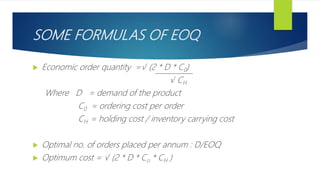
SOME FORMULAS OF EOQ
 Economic order quantity =√ (2 * D * C0)
√ CH
Where D = demand of the product
C0 = ordering cost per order
CH = holding cost / inventory carrying cost
 Optimal no. of orders placed per annum : D/EOQ
 Optimum cost = √ (2 * D * Co * CH )
 A company makes bicycles. It produces 450 bicycles a month. It buys the tires for
bicycles from a supplier at a cost of $20 per tire. The company’s inventory carrying
cost is estimated to be 15% of cost and the ordering is $50 per order.
 Calculate the EOQ
 In this problem: D = annual demand = (2 tires per bicycle) x (450 bicycles per
month) x (12 months in a year) = 10,800 tires
 S = ordering cost = $50 per order
 H = carrying cost = (15%) x ($20 per unit) = $ 3.00 per unit per year
 EOQ = Square root of { (2 x 10,800 x $50) / $3 = Square root of 400,000 = 600 tires
The company should order about 600 tires each time it places an order.
 What is the number of orders per year?
 Number of orders per year = D / EOQ = 10,800 / 600 = 18 orders per year
 Compute the average annual ordering cost.
 Average annual ordering cost = (18 orders per year) x ($50 per order) = $900 per
year.
 Compute the average inventory.
 Average inventory = Q / 2 = 600 / 2 = 300 tires
 What is the average annual carrying cost?
 Average annual carrying cost = (average inventory) x (H) = (300 tires) x ( $3)
= $900 per year
 Compute the total cost.
 Total cost = (Average annual ordering cost) + (average annual carrying) =
($900) + ($900) = $1,800
economic order quantity

economic order quantity

  • 2.
    The Decisions tobe Made One of the most frequent decisions faced by operations managers is “how much” or “how many” of something to make or buy in order to satisfy external or internal requirements for some item. Many times, this decision is made with little or no thought about its cost consequences.
  • 3.
    The Definition ofEOQ  EOQ, or Economic Order Quantity, is defined as the optimal quantity of orders that minimizes total variable costs required to order and hold inventory.
  • 4.
    The basic modelmakes the following assumptions:  Demand is uniform, constant and continuous over time;  The leadtime is constant;  There is no limit on order size due either to stores capacity;  The cost of placing an order is independent of size of order;  The cost of holding a unit of stock does not depend on the quantity in stock;  Exactly the same quantity is ordered each time that a purchase is made.
  • 5.
    How to useEOQ in your organization  How much inventory should we order each month ? The EOQ tool can be used to model the amount of inventory that we should order.
  • 6.
    SOME BASIC TERMSOF EOQ MODEL  Let D be the annual demand of a product  C0 = Ordering cost per order.  CH = Holding / inventory carrying cost in Rs. Per unit / Per unit time.  Cp = price per unit.  Q = order quantity.  EOQ = Economic order quantity.  N = No. of order placed per annum.  Tc = Total cost per annum.
  • 7.
    SOME FORMULAS OFEOQ  Economic order quantity =√ (2 * D * C0) √ CH Where D = demand of the product C0 = ordering cost per order CH = holding cost / inventory carrying cost  Optimal no. of orders placed per annum : D/EOQ  Optimum cost = √ (2 * D * Co * CH )
  • 8.
     A companymakes bicycles. It produces 450 bicycles a month. It buys the tires for bicycles from a supplier at a cost of $20 per tire. The company’s inventory carrying cost is estimated to be 15% of cost and the ordering is $50 per order.  Calculate the EOQ  In this problem: D = annual demand = (2 tires per bicycle) x (450 bicycles per month) x (12 months in a year) = 10,800 tires  S = ordering cost = $50 per order  H = carrying cost = (15%) x ($20 per unit) = $ 3.00 per unit per year  EOQ = Square root of { (2 x 10,800 x $50) / $3 = Square root of 400,000 = 600 tires The company should order about 600 tires each time it places an order.
  • 9.
     What isthe number of orders per year?  Number of orders per year = D / EOQ = 10,800 / 600 = 18 orders per year  Compute the average annual ordering cost.  Average annual ordering cost = (18 orders per year) x ($50 per order) = $900 per year.  Compute the average inventory.  Average inventory = Q / 2 = 600 / 2 = 300 tires
  • 10.
     What isthe average annual carrying cost?  Average annual carrying cost = (average inventory) x (H) = (300 tires) x ( $3) = $900 per year  Compute the total cost.  Total cost = (Average annual ordering cost) + (average annual carrying) = ($900) + ($900) = $1,800