



RECEIVABLE  MANAGEMENT ANAMIKA PUNDIR LECTURER
OBJECTIVES OF RECEIVABLE MANAGEMENT To obtain optimum volume of sales. To control the cost of credit & keep it at minimum. To maintain optimum investment in sundry debtors. To maximize the value of firm. To cope up with competition.
NATURE OF MAINTAINING RECEIVABLES Risk involvement Based on economic value Implies futurity Based on credit sales & collection period Ranging between stringent & linent policy Stringent-Selective basis credit sale Linent – Very liberal credit sale
COST OF MAINTAINING RECEIVABLES Credit Department Cost Credit Evaluation Cost Opportunity Cost Discounted Payment Cost Selling & Production cost Collection Cost Bad Debts Cost
FACTORS AFFECTING SIZE OF RECEIVABLES Volume of credit sales Credit policy of the firm Trade terms Seasonality  of business Collection policy
REASONS TO OFFER CREDIT Competition Market share Promotion Customer convenience Credit
BENEFITS OF RECEIVABLE MANAGEMENT Increase sales Market share increase Increase in profit Enhanced customer services Control bad debts
 
DETERMINANT OF POTENTIAL CREDIT POLICY Collection of Information Credit Analysis Credit Standard Credit Period Credit Terms Credit Limit Credit Discount Discount Terms
COLLECTION OF INFORMATION Bank Reference Credit Agency Report Published Information Credit scoring Other Sources
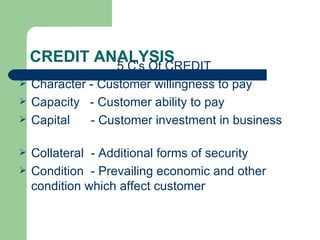
CREDIT ANALYSIS 5 C's Of CREDIT Character - Customer willingness to pay Capacity  - Customer ability to pay Capital  - Customer investment in business  Collateral  - Additional forms of security  Condition  - Prevailing economic and other condition which affect customer
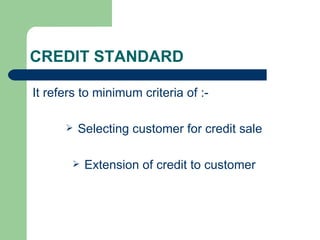
CREDIT STANDARD It refers to minimum criteria of :- Selecting customer for credit sale Extension of credit to customer
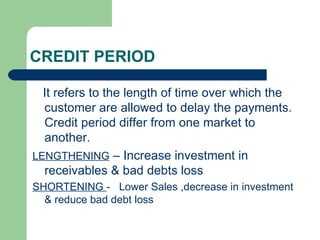
CREDIT PERIOD It refers to the length of time over which the customer are allowed to delay the payments. Credit period differ from one market to another. LENGTHENING  – Increase investment in receivables & bad debts loss SHORTENING  -  Lower Sales ,decrease in investment & reduce bad debt loss
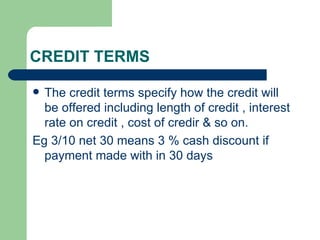
CREDIT TERMS The credit terms specify how the credit will be offered including length of credit , interest rate on credit , cost of credir & so on. Eg 3/10 net 30 means 3 % cash discount if payment made with in 30 days
CREDIT LIMIT
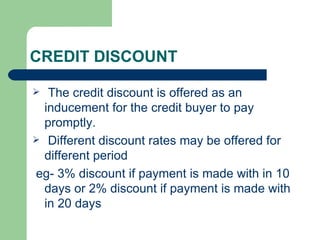
CREDIT DISCOUNT The credit discount is offered as an  inducement for the credit buyer to pay promptly. Different discount rates may be offered for different period eg- 3% discount if payment is made with in 10 days or 2% discount if payment is made with in 20 days
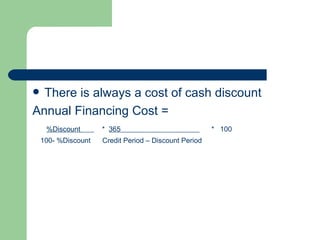
There is always a cost of cash discount Annual Financing Cost = %Discount  *  365  *  100 100- %Discount  Credit Period – Discount Period

Receivable mgmt

  • 1.
    RECEIVABLE MANAGEMENTANAMIKA PUNDIR LECTURER
  • 2.
    OBJECTIVES OF RECEIVABLEMANAGEMENT To obtain optimum volume of sales. To control the cost of credit & keep it at minimum. To maintain optimum investment in sundry debtors. To maximize the value of firm. To cope up with competition.
  • 3.
    NATURE OF MAINTAININGRECEIVABLES Risk involvement Based on economic value Implies futurity Based on credit sales & collection period Ranging between stringent & linent policy Stringent-Selective basis credit sale Linent – Very liberal credit sale
  • 4.
    COST OF MAINTAININGRECEIVABLES Credit Department Cost Credit Evaluation Cost Opportunity Cost Discounted Payment Cost Selling & Production cost Collection Cost Bad Debts Cost
  • 5.
    FACTORS AFFECTING SIZEOF RECEIVABLES Volume of credit sales Credit policy of the firm Trade terms Seasonality of business Collection policy
  • 6.
    REASONS TO OFFERCREDIT Competition Market share Promotion Customer convenience Credit
  • 7.
    BENEFITS OF RECEIVABLEMANAGEMENT Increase sales Market share increase Increase in profit Enhanced customer services Control bad debts
  • 8.
  • 9.
    DETERMINANT OF POTENTIALCREDIT POLICY Collection of Information Credit Analysis Credit Standard Credit Period Credit Terms Credit Limit Credit Discount Discount Terms
  • 10.
    COLLECTION OF INFORMATIONBank Reference Credit Agency Report Published Information Credit scoring Other Sources
  • 11.
    CREDIT ANALYSIS 5C's Of CREDIT Character - Customer willingness to pay Capacity - Customer ability to pay Capital - Customer investment in business Collateral - Additional forms of security Condition - Prevailing economic and other condition which affect customer
  • 12.
    CREDIT STANDARD Itrefers to minimum criteria of :- Selecting customer for credit sale Extension of credit to customer
  • 13.
    CREDIT PERIOD Itrefers to the length of time over which the customer are allowed to delay the payments. Credit period differ from one market to another. LENGTHENING – Increase investment in receivables & bad debts loss SHORTENING - Lower Sales ,decrease in investment & reduce bad debt loss
  • 14.
    CREDIT TERMS Thecredit terms specify how the credit will be offered including length of credit , interest rate on credit , cost of credir & so on. Eg 3/10 net 30 means 3 % cash discount if payment made with in 30 days
  • 15.
  • 16.
    CREDIT DISCOUNT Thecredit discount is offered as an inducement for the credit buyer to pay promptly. Different discount rates may be offered for different period eg- 3% discount if payment is made with in 10 days or 2% discount if payment is made with in 20 days
  • 17.
    There is alwaysa cost of cash discount Annual Financing Cost = %Discount * 365 * 100 100- %Discount Credit Period – Discount Period