FINANCIAL
MANAGEMNENT
CASH MANAGEMENT
Presented By
• Subhashni Jaiswal
• Ayushi Gupta
• Hriday Bora
• Chiranjivi R
• Phanindra Reddy
• Junaid Ali
(GROUP 10)
WHAT IS CASH?
 It is the money which a firm can disburse immediately
without any restrictions.
 The term cash include coins, currencies and checks held
by the firm in balance in its bank account.
 It includes near-cash assets, such as marketable securities
and time deposits in banks.
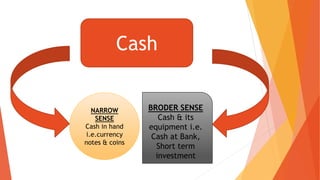
Cash
NARROW
SENSE
Cash in hand
i.e.currency
notes & coins
BRODER SENSE
Cash & its
equipment i.e.
Cash at Bank,
Short term
investment
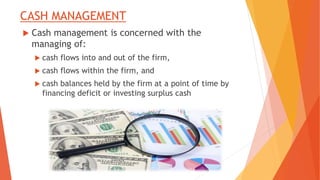
CASH MANAGEMENT
 Cash management is concerned with the
managing of:
 cash flows into and out of the firm,
 cash flows within the firm, and
 cash balances held by the firm at a point of time by
financing deficit or investing surplus cash
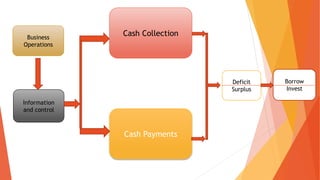
Business
Operations
Information
and control
Cash Payments
Deficit
Surplus
Borrow
Invest
Cash Collection
FOUR FACETS OF CASH MANAGEMENT
 Cash planning
 Managing the cash flows
 Optimum cash level
 Investing surplus cash
MOTIVES FOR HOLDING CASH
 Transaction motive
 Precautionary motive
 Speculative motive
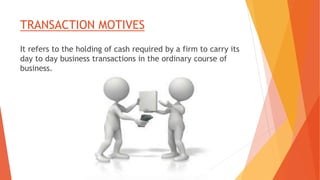
TRANSACTION MOTIVES
It refers to the holding of cash required by a firm to carry its
day to day business transactions in the ordinary course of
business.
PRECAUTIONARY MOTIVE
 The precautionary motive of holding cash is to meet the
unpredictable cash obligations of a firm.
 A cushion to meet unexpected contingencies.
 Floods, strikes and failure of imp customers
 Unexpected slowdown in collection of accounts
receivable
 Sharp increase in cost of raw materials
 Cancellation of some order of goods
SPECULATIVE MOTIVE
 This refers to maintaining cash balance ,the firm to take
advantage of investing in profit –making opportunities and
which is typically outside the normal course of business.
 Helps to take advantage of:
 An opportunity to purchase raw materials at reduced
price
 Make purchase at favorable prices
 Delay purchase on anticipation of decline in prices
 Buying securities when interest rate is expected to
decline
CASH PLANNING
 Cash Flow Planning is when a business forecasts short &
long term business expenses against the projected
incoming cash.
 It allows us to anticipate trouble by creating a cash flow
cushion, for unexpected expenses.
 A method that an insured can use to control the premium
payments that they must make on their policies.
CASH FORECASTING AND BUDGETING
CASH BUDGET
 Summary statement of the firm’s expected cash inflows
and outflows over a projected time period
CASH FORECASTS
 Estimate of the timing and amounts of cash inflows
and outflows over a specific period
SHORT-TERM CASH FORECASTS
The important functions of short-term cash
forecasts
To determine operating cash requirements
To anticipate short-term financing
To manage investment of surplus cash.
Short-term Forecasting Methods
 The receipt and disbursements method
The adjusted net income method.
THE RECEIPT AND DISBURSEMENTS
METHOD
 The virtues of the receipt and payment methods are:
It gives a complete picture of all the items of expected
cash flows.
It is a sound tool of managing daily cash operations.
 This method, however, suffers from the following
limitations:
1. Its reliability is reduced because of the uncertainty of
cash forecasts. For example, collections may be delayed,
or unanticipated demands may cause large
disbursements.
2. It fails to highlight the significant movements in the
working capital items.
THE ADJUSTED NET INCOME METHOD
 The benefits of the adjusted net income
method are:
 It highlights the movements in the working capital
items, and thus helps to keep a control on a firm’s
working capital.
 It helps in anticipating a firm’s financial
requirements.
 The major limitation of this method is:
 It fails to trace cash flows, and therefore, its
utility in controlling daily cash operations is
limited.
LONG-TERM CASH FORECASTING
 The major uses of the long-term cash forecasts are:
 It indicates as company’s future financial needs, especially
for its working capital requirements.
 It helps to evaluate proposed capital projects. It pinpoints
the cash required to finance these projects as well as the
cash to be generated by the company to support them.
 It helps to improve corporate planning. Long-term cash
forecasts compel each division to plan for future and to
formulate projects carefully.
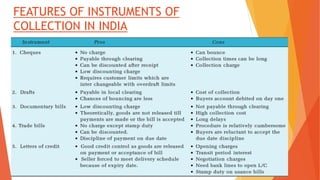
FEATURES OF INSTRUMENTS OF
COLLECTION IN INDIA
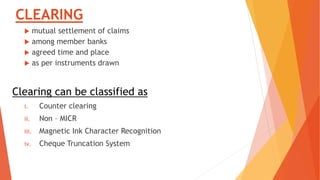
CLEARING
 mutual settlement of claims
 among member banks
 agreed time and place
 as per instruments drawn
Clearing can be classified as
i. Counter clearing
ii. Non – MICR
iii. Magnetic Ink Character Recognition
iv. Cheque Truncation System
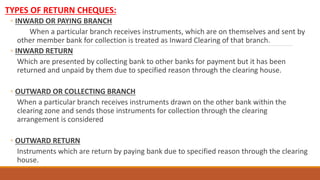
TYPES OF RETURN CHEQUES:
◦ INWARD OR PAYING BRANCH
When a particular branch receives instruments, which are on themselves and sent by
other member bank for collection is treated as Inward Clearing of that branch.
◦ INWARD RETURN
Which are presented by collecting bank to other banks for payment but it has been
returned and unpaid by them due to specified reason through the clearing house.
◦ OUTWARD OR COLLECTING BRANCH
When a particular branch receives instruments drawn on the other bank within the
clearing zone and sends those instruments for collection through the clearing
arrangement is considered
◦ OUTWARD RETURN
Instruments which are return by paying bank due to specified reason through the clearing
house.
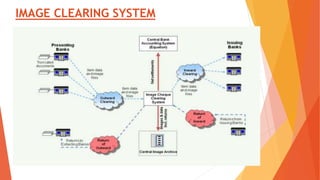
IMAGE CLEARING SYSTEM
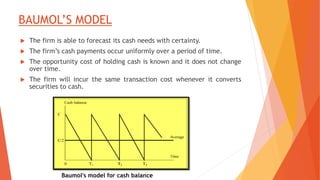
BAUMOL’S MODEL
 The firm is able to forecast its cash needs with certainty.
 The firm’s cash payments occur uniformly over a period of time.
 The opportunity cost of holding cash is known and it does not change
over time.
 The firm will incur the same transaction cost whenever it converts
securities to cash.
Baumol's model for cash balance
ASSUMPTION
 The firm is able to forecast its cash with certainty.
 The firm’s cash payment occur uniformly once a period of
time.
 The opportunity cost of holding cash is known and it does
not change over time.
 The firm will incur the same transaction cost whenever it
converts securities to cash.
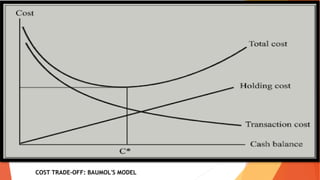
TYPES OF COST
 Holding Cost or opportunity cost
Holding Cost = k (C/2)
k = Opportunity Cost, C/2 = Average cash balance
 Transaction Cost
Transaction Cost = c(T/C)
 Total cost
Total Cost = k(C/2)+c(T/C)
 Optimum cash balance
C*= √2cT/k
COST TRADE-OFF: BAUMOL'S MODEL
THE MILLER–ORR MODEL
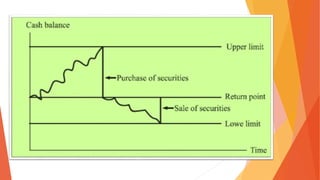
 It provides for two control limits–the upper control limit
and the lower control limit as well as a return point.
 If the firm’s cash flows fluctuate randomly and hit the
upper limit, then it buys sufficient marketable securities
to come back to a normal level of cash balance.
 Similarly, when the firm’s cash flows wander and hit the
lower limit, it sells sufficient marketable securities to
bring the cash balance back to the normal level
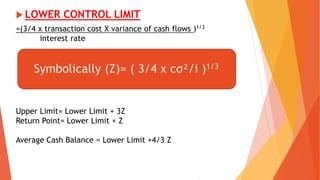
 LOWER CONTROL LIMIT
=(3/4 x transaction cost X variance of cash flows )1/3
interest rate
Upper Limit= Lower Limit + 3Z
Return Point= Lower Limit + Z
Average Cash Balance = Lower Limit +4/3 Z
Symbolically (Z)= ( 3/4 x cσ²/i )1/3
MANAGING CASH COLLECTIONS AND
DISBURSEMENTS
 Accelerating Cash Collections
Decentralised Collections
Lock-box System
 Controlling Disbursements
Disbursement or Payment Float
ACCELERATING CASH COLLECTIONS
Decentralised Collections
 Number of collection centres
 Collection centres will collect cheques from customers and
deposit in their local bank accounts
 They will deposit the funds to a central bank
Lock-box System
 Collection centers are established considering the customer
locations and volume of remittances
 At each Centre the firm hires a post office box
 Remittances are directly picked from the bank whom the firm
gives the authority
INVESTING SURPLUS CASH IN
MARKETABLE SECURITIES
 Selecting Investment Opportunities:
Safety,
Maturity, and
Marketability.
SHORT TERM INVESTMENTS
OPPORTUNITIES
 Treasury bills
 Commercial papers
 Certificates of deposits
 Bank deposits
 Inter-corporate deposits
 Money market mutual funds
Cash management

Cash management

  • 1.
    FINANCIAL MANAGEMNENT CASH MANAGEMENT Presented By •Subhashni Jaiswal • Ayushi Gupta • Hriday Bora • Chiranjivi R • Phanindra Reddy • Junaid Ali (GROUP 10)
  • 2.
    WHAT IS CASH? It is the money which a firm can disburse immediately without any restrictions.  The term cash include coins, currencies and checks held by the firm in balance in its bank account.  It includes near-cash assets, such as marketable securities and time deposits in banks.
  • 3.
    Cash NARROW SENSE Cash in hand i.e.currency notes& coins BRODER SENSE Cash & its equipment i.e. Cash at Bank, Short term investment
  • 4.
    CASH MANAGEMENT  Cashmanagement is concerned with the managing of:  cash flows into and out of the firm,  cash flows within the firm, and  cash balances held by the firm at a point of time by financing deficit or investing surplus cash
  • 5.
  • 6.
    FOUR FACETS OFCASH MANAGEMENT  Cash planning  Managing the cash flows  Optimum cash level  Investing surplus cash
  • 7.
    MOTIVES FOR HOLDINGCASH  Transaction motive  Precautionary motive  Speculative motive
  • 8.
    TRANSACTION MOTIVES It refersto the holding of cash required by a firm to carry its day to day business transactions in the ordinary course of business.
  • 9.
    PRECAUTIONARY MOTIVE  Theprecautionary motive of holding cash is to meet the unpredictable cash obligations of a firm.  A cushion to meet unexpected contingencies.  Floods, strikes and failure of imp customers  Unexpected slowdown in collection of accounts receivable  Sharp increase in cost of raw materials  Cancellation of some order of goods
  • 10.
    SPECULATIVE MOTIVE  Thisrefers to maintaining cash balance ,the firm to take advantage of investing in profit –making opportunities and which is typically outside the normal course of business.  Helps to take advantage of:  An opportunity to purchase raw materials at reduced price  Make purchase at favorable prices  Delay purchase on anticipation of decline in prices  Buying securities when interest rate is expected to decline
  • 11.
    CASH PLANNING  CashFlow Planning is when a business forecasts short & long term business expenses against the projected incoming cash.  It allows us to anticipate trouble by creating a cash flow cushion, for unexpected expenses.  A method that an insured can use to control the premium payments that they must make on their policies.
  • 12.
    CASH FORECASTING ANDBUDGETING CASH BUDGET  Summary statement of the firm’s expected cash inflows and outflows over a projected time period CASH FORECASTS  Estimate of the timing and amounts of cash inflows and outflows over a specific period
  • 13.
    SHORT-TERM CASH FORECASTS Theimportant functions of short-term cash forecasts To determine operating cash requirements To anticipate short-term financing To manage investment of surplus cash. Short-term Forecasting Methods  The receipt and disbursements method The adjusted net income method.
  • 14.
    THE RECEIPT ANDDISBURSEMENTS METHOD  The virtues of the receipt and payment methods are: It gives a complete picture of all the items of expected cash flows. It is a sound tool of managing daily cash operations.  This method, however, suffers from the following limitations: 1. Its reliability is reduced because of the uncertainty of cash forecasts. For example, collections may be delayed, or unanticipated demands may cause large disbursements. 2. It fails to highlight the significant movements in the working capital items.
  • 15.
    THE ADJUSTED NETINCOME METHOD  The benefits of the adjusted net income method are:  It highlights the movements in the working capital items, and thus helps to keep a control on a firm’s working capital.  It helps in anticipating a firm’s financial requirements.  The major limitation of this method is:  It fails to trace cash flows, and therefore, its utility in controlling daily cash operations is limited.
  • 16.
    LONG-TERM CASH FORECASTING The major uses of the long-term cash forecasts are:  It indicates as company’s future financial needs, especially for its working capital requirements.  It helps to evaluate proposed capital projects. It pinpoints the cash required to finance these projects as well as the cash to be generated by the company to support them.  It helps to improve corporate planning. Long-term cash forecasts compel each division to plan for future and to formulate projects carefully.
  • 17.
    FEATURES OF INSTRUMENTSOF COLLECTION IN INDIA
  • 18.
    CLEARING  mutual settlementof claims  among member banks  agreed time and place  as per instruments drawn Clearing can be classified as i. Counter clearing ii. Non – MICR iii. Magnetic Ink Character Recognition iv. Cheque Truncation System
  • 19.
    TYPES OF RETURNCHEQUES: ◦ INWARD OR PAYING BRANCH When a particular branch receives instruments, which are on themselves and sent by other member bank for collection is treated as Inward Clearing of that branch. ◦ INWARD RETURN Which are presented by collecting bank to other banks for payment but it has been returned and unpaid by them due to specified reason through the clearing house. ◦ OUTWARD OR COLLECTING BRANCH When a particular branch receives instruments drawn on the other bank within the clearing zone and sends those instruments for collection through the clearing arrangement is considered ◦ OUTWARD RETURN Instruments which are return by paying bank due to specified reason through the clearing house.
  • 20.
  • 21.
    BAUMOL’S MODEL  Thefirm is able to forecast its cash needs with certainty.  The firm’s cash payments occur uniformly over a period of time.  The opportunity cost of holding cash is known and it does not change over time.  The firm will incur the same transaction cost whenever it converts securities to cash. Baumol's model for cash balance
  • 22.
    ASSUMPTION  The firmis able to forecast its cash with certainty.  The firm’s cash payment occur uniformly once a period of time.  The opportunity cost of holding cash is known and it does not change over time.  The firm will incur the same transaction cost whenever it converts securities to cash.
  • 23.
    TYPES OF COST Holding Cost or opportunity cost Holding Cost = k (C/2) k = Opportunity Cost, C/2 = Average cash balance  Transaction Cost Transaction Cost = c(T/C)  Total cost Total Cost = k(C/2)+c(T/C)  Optimum cash balance C*= √2cT/k
  • 24.
  • 25.
    THE MILLER–ORR MODEL It provides for two control limits–the upper control limit and the lower control limit as well as a return point.  If the firm’s cash flows fluctuate randomly and hit the upper limit, then it buys sufficient marketable securities to come back to a normal level of cash balance.  Similarly, when the firm’s cash flows wander and hit the lower limit, it sells sufficient marketable securities to bring the cash balance back to the normal level
  • 27.
     LOWER CONTROLLIMIT =(3/4 x transaction cost X variance of cash flows )1/3 interest rate Upper Limit= Lower Limit + 3Z Return Point= Lower Limit + Z Average Cash Balance = Lower Limit +4/3 Z Symbolically (Z)= ( 3/4 x cσ²/i )1/3
  • 28.
    MANAGING CASH COLLECTIONSAND DISBURSEMENTS  Accelerating Cash Collections Decentralised Collections Lock-box System  Controlling Disbursements Disbursement or Payment Float
  • 29.
    ACCELERATING CASH COLLECTIONS DecentralisedCollections  Number of collection centres  Collection centres will collect cheques from customers and deposit in their local bank accounts  They will deposit the funds to a central bank Lock-box System  Collection centers are established considering the customer locations and volume of remittances  At each Centre the firm hires a post office box  Remittances are directly picked from the bank whom the firm gives the authority
  • 30.
    INVESTING SURPLUS CASHIN MARKETABLE SECURITIES  Selecting Investment Opportunities: Safety, Maturity, and Marketability.
  • 31.
    SHORT TERM INVESTMENTS OPPORTUNITIES Treasury bills  Commercial papers  Certificates of deposits  Bank deposits  Inter-corporate deposits  Money market mutual funds