Unit 4:
PERSONALITY &
  EMOTIONS.
INTRODUCTION.


 WHAT IS PERSONALITY??


DEFINITON OF PERSONALITY.
MAJOR DETERMINANTS.

BIOLOGICAL FACTORS.

     CULTURAL FACTORS.

          FAMILY FACTORS.

               SOCIAL FACTORS.

                      SITUATIONAL FACTORS.
Theories Of Personality.

1. Intrapyschic Theory.

2. Type Theories.

3. Trait Theories.

4. Self-Theory.

5. Social Learning Theory.
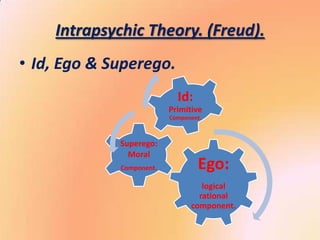
Intrapsychic Theory. (Freud).
• Id, Ego & Superego.
                            Id:
                          Primitive
                          Component.


             Superego:
               Moral
             Component.           Ego:
                                   logical
                                  rational
                                component.
Intrapsychic Theory. (Freud).

EVERY ACTION HAS AN EQUAL &
         OPPOSITE …..


    DEFENCE MECHANISM.
“TO PROTECT UR SELF-ESTEEM.”
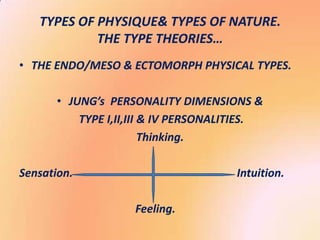
TYPES OF PHYSIQUE& TYPES OF NATURE.
            THE TYPE THEORIES…
• THE ENDO/MESO & ECTOMORPH PHYSICAL TYPES.

       • JUNG’s PERSONALITY DIMENSIONS &
           TYPE I,II,III & IV PERSONALITIES.
                         Thinking.

Sensation.                             Intuition.

                     Feeling.
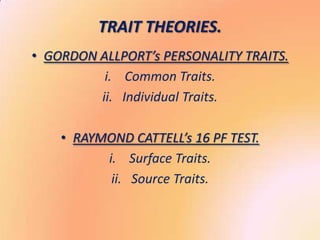
TRAIT THEORIES.
• GORDON ALLPORT’s PERSONALITY TRAITS.
          i. Common Traits.
         ii. Individual Traits.

    • RAYMOND CATTELL’s 16 PF TEST.
          i. Surface Traits.
           ii. Source Traits.
Carl Roger’s SELF-THEORY.
     Conditions of Worth.
Unconditional Positive Regard.
Social Learning Theory.

The 8 important Personality
      Characteristics in
Organizations that influence
   Individual Behaviour in
       Organizations.
Social Learning Theory.
1. Locus Of Control.

2. Machiavellianism.

3. Self-Esteem.

4. Self-Efficacy.
Social Learning Theory.
5. self-Monitoring.

6. Positive/Negative Affect.

7.Risk Taking.
Type A Personality.

Type B Personality.
EMOTIONS….
              THEORIES OF EMOTIONS.
•   James Lange. Emotion cause of body reaction.
•   Cannon Bard. No relation in emotion/body.
•   Cannon .Event leads to body + emotion.
•   Schachter Singer. Interpretation of reaction.
•   Richard Lazarus. Emotion cause of situation
    appraisal.
I know u r overwhelmed with this new
insight to Human appraisal…

BUT…. LET THIS BE OUR STRENGTH IN
MANAGEMENT, &
NOT A WEAPON OR UNFAIR ADVANTAGE!!!

Organizational Behavior Chapter 4

  • 1.
  • 2.
    INTRODUCTION. WHAT ISPERSONALITY?? DEFINITON OF PERSONALITY.
  • 3.
    MAJOR DETERMINANTS. BIOLOGICAL FACTORS. CULTURAL FACTORS. FAMILY FACTORS. SOCIAL FACTORS. SITUATIONAL FACTORS.
  • 4.
    Theories Of Personality. 1.Intrapyschic Theory. 2. Type Theories. 3. Trait Theories. 4. Self-Theory. 5. Social Learning Theory.
  • 5.
    Intrapsychic Theory. (Freud). •Id, Ego & Superego. Id: Primitive Component. Superego: Moral Component. Ego: logical rational component.
  • 6.
    Intrapsychic Theory. (Freud). EVERYACTION HAS AN EQUAL & OPPOSITE ….. DEFENCE MECHANISM. “TO PROTECT UR SELF-ESTEEM.”
  • 7.
    TYPES OF PHYSIQUE&TYPES OF NATURE. THE TYPE THEORIES… • THE ENDO/MESO & ECTOMORPH PHYSICAL TYPES. • JUNG’s PERSONALITY DIMENSIONS & TYPE I,II,III & IV PERSONALITIES. Thinking. Sensation. Intuition. Feeling.
  • 8.
    TRAIT THEORIES. • GORDONALLPORT’s PERSONALITY TRAITS. i. Common Traits. ii. Individual Traits. • RAYMOND CATTELL’s 16 PF TEST. i. Surface Traits. ii. Source Traits.
  • 9.
    Carl Roger’s SELF-THEORY. Conditions of Worth. Unconditional Positive Regard.
  • 10.
    Social Learning Theory. The8 important Personality Characteristics in Organizations that influence Individual Behaviour in Organizations.
  • 11.
    Social Learning Theory. 1.Locus Of Control. 2. Machiavellianism. 3. Self-Esteem. 4. Self-Efficacy.
  • 12.
    Social Learning Theory. 5.self-Monitoring. 6. Positive/Negative Affect. 7.Risk Taking.
  • 13.
  • 15.
    EMOTIONS…. THEORIES OF EMOTIONS. • James Lange. Emotion cause of body reaction. • Cannon Bard. No relation in emotion/body. • Cannon .Event leads to body + emotion. • Schachter Singer. Interpretation of reaction. • Richard Lazarus. Emotion cause of situation appraisal.
  • 16.
    I know ur overwhelmed with this new insight to Human appraisal… BUT…. LET THIS BE OUR STRENGTH IN MANAGEMENT, & NOT A WEAPON OR UNFAIR ADVANTAGE!!!