
-EOQ-
ECONOMIC ORDER
QUANTITY
VARGHESEKUTTY CB
varghesekutty997@gmail.com
WHAT IS
EOQ?
• Economic Order Quantity is one of the
technique of inventory control which
minimizes total holdings and ordering
cost of the year.
• This is a technique which solves the
problems of a materials manager.
varghesekutty997@gmail.com
DEFINITION
EOQ is essentially an accounting formula
that determines at which the combination of
order cost and inventory carrying cost are the
least. The result is the most cost effective
quality to order. In purchasing this is known
as order quantity, in manufacturing it is
known as the production lot size.
-Dave Piasecki
varghesekutty997@gmail.com
CONT.
• By using this model, the companies can minimize the costs
associated with the ordering and inventory holding.
• It can be a valuable tool for small business owners who
need to make decisions about how much inventory to keep
on hand, how many items to order each time, and how often
to reorder to incur the lowest possible costs.
• There are two most important categories of inventory costs
are ordering costs and carrying costs.
varghesekutty997@gmail.com
ORDERING
COST
• It is the costs that are incurred on obtaining
additional inventories.
• They include costs incurred on:
communicating the order, traveling allowance
and daily allowance to purchase officers,
printing and stationary, salary of purchase
department, cost of inspection, cost of receiving
the material, transportation cost etc.
varghesekutty997@gmail.com
CONT.
• All above cost, other than transport costs remain
unchanged per order irrespective of the order size.
• Therefore, it is assumed that ordering cost per order
remain constant.
• The more frequently orders are placed, and fewer the
quantities purchased on each order, the grater will be
ordering cost and vice versa.
varghesekutty997@gmail.com
ORDERING COST CURVE
• Here we can see that
when the size of the
order decreases the
ordering cost increases
and ordering cost
decreases when the size
of the order increases
varghesekutty997@gmail.com
CARRYING
COST
• It is the cost incurred for holding inventory in
hand.
• They include
interest on the money locked up in
stocks, storage costs, spoilage costs,
insurance, evaporation, godown rent,
pilferage, obsolescence etc.
varghesekutty997@gmail.com
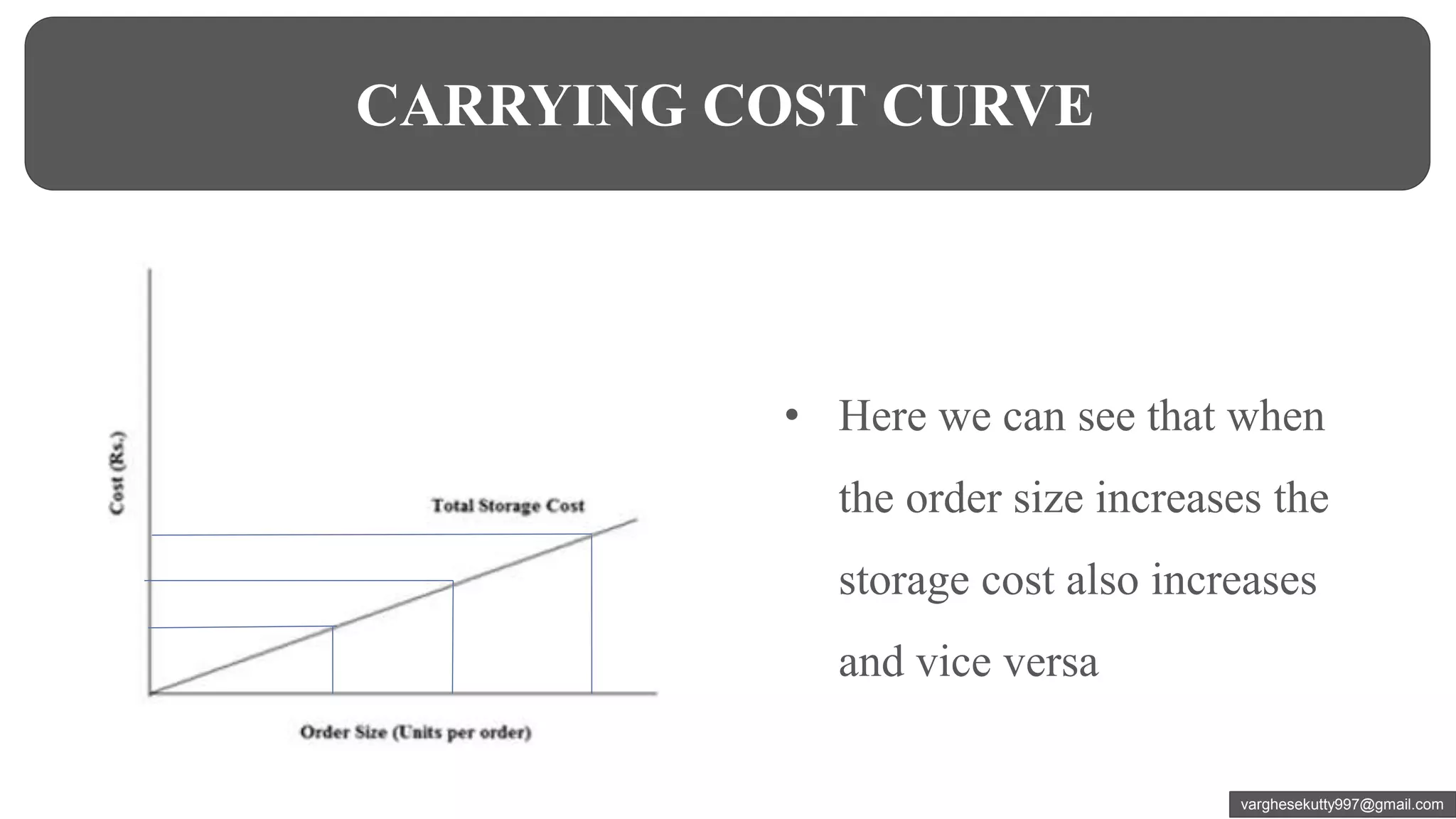
• They are assumed to be constant per unit of inventory.
• The large the volume of inventory, the higher will be the
inventory carrying cost and vice versa
CONT.
varghesekutty997@gmail.com
CARRYING COST CURVE
• Here we can see that when
the order size increases the
storage cost also increases
and vice versa
varghesekutty997@gmail.com
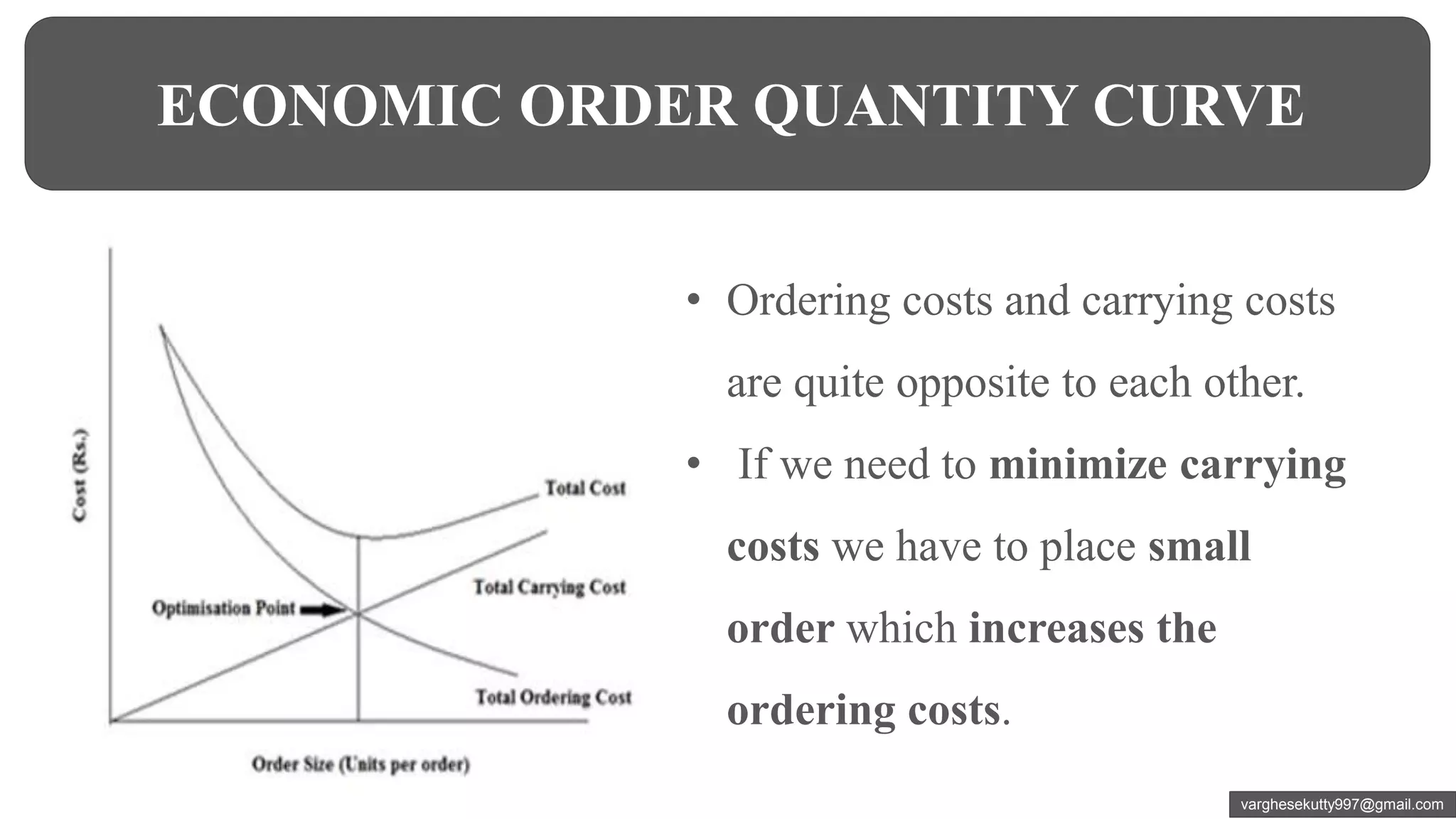
ECONOMIC ORDER QUANTITY CURVE
• Ordering costs and carrying costs
are quite opposite to each other.
• If we need to minimize carrying
costs we have to place small
order which increases the
ordering costs.
varghesekutty997@gmail.com
CONT.
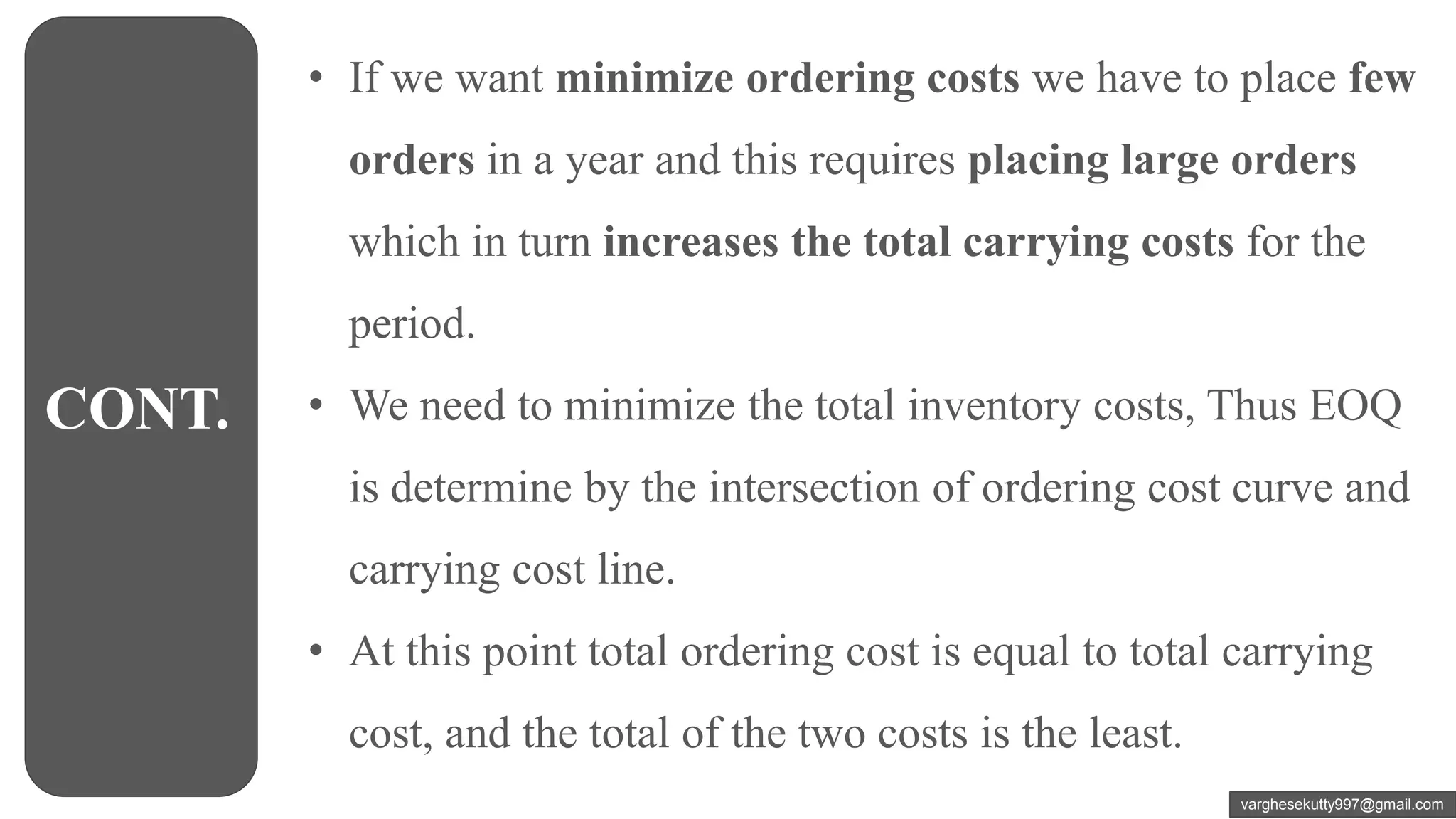
• If we want minimize ordering costs we have to place few
orders in a year and this requires placing large orders
which in turn increases the total carrying costs for the
period.
• We need to minimize the total inventory costs, Thus EOQ
is determine by the intersection of ordering cost curve and
carrying cost line.
• At this point total ordering cost is equal to total carrying
cost, and the total of the two costs is the least.
varghesekutty997@gmail.com
CALCULATION
OF EOQ
Where;
Co- ordering cost
Cc- carrying cost
A - annual requirement of the material in
. number of units
EOQ = √ Cc
2Co*A
varghesekutty997@gmail.com
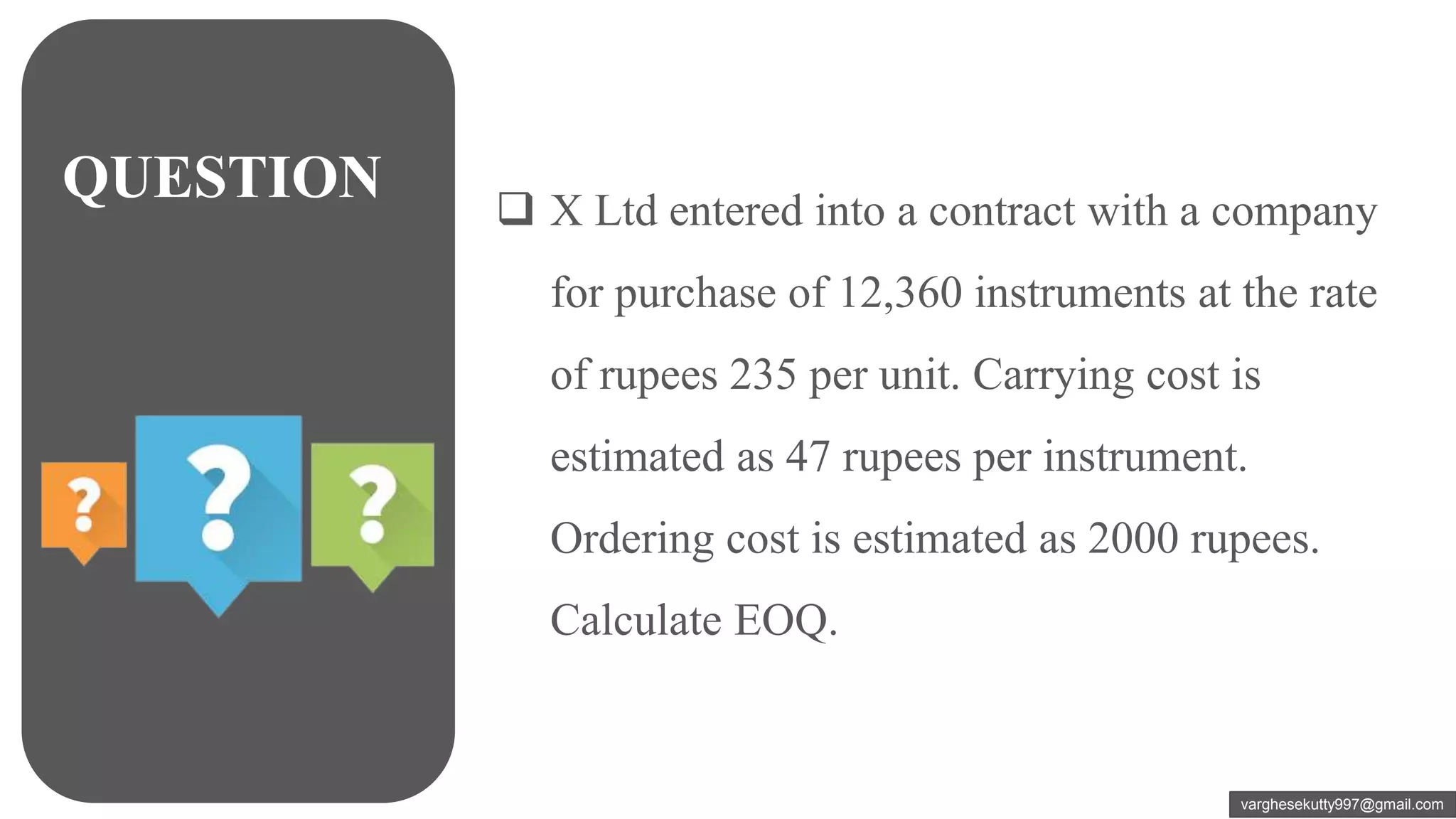
QUESTION  X Ltd entered into a contract with a company
for purchase of 12,360 instruments at the rate
of rupees 235 per unit. Carrying cost is
estimated as 47 rupees per instrument.
Ordering cost is estimated as 2000 rupees.
Calculate EOQ.
varghesekutty997@gmail.com
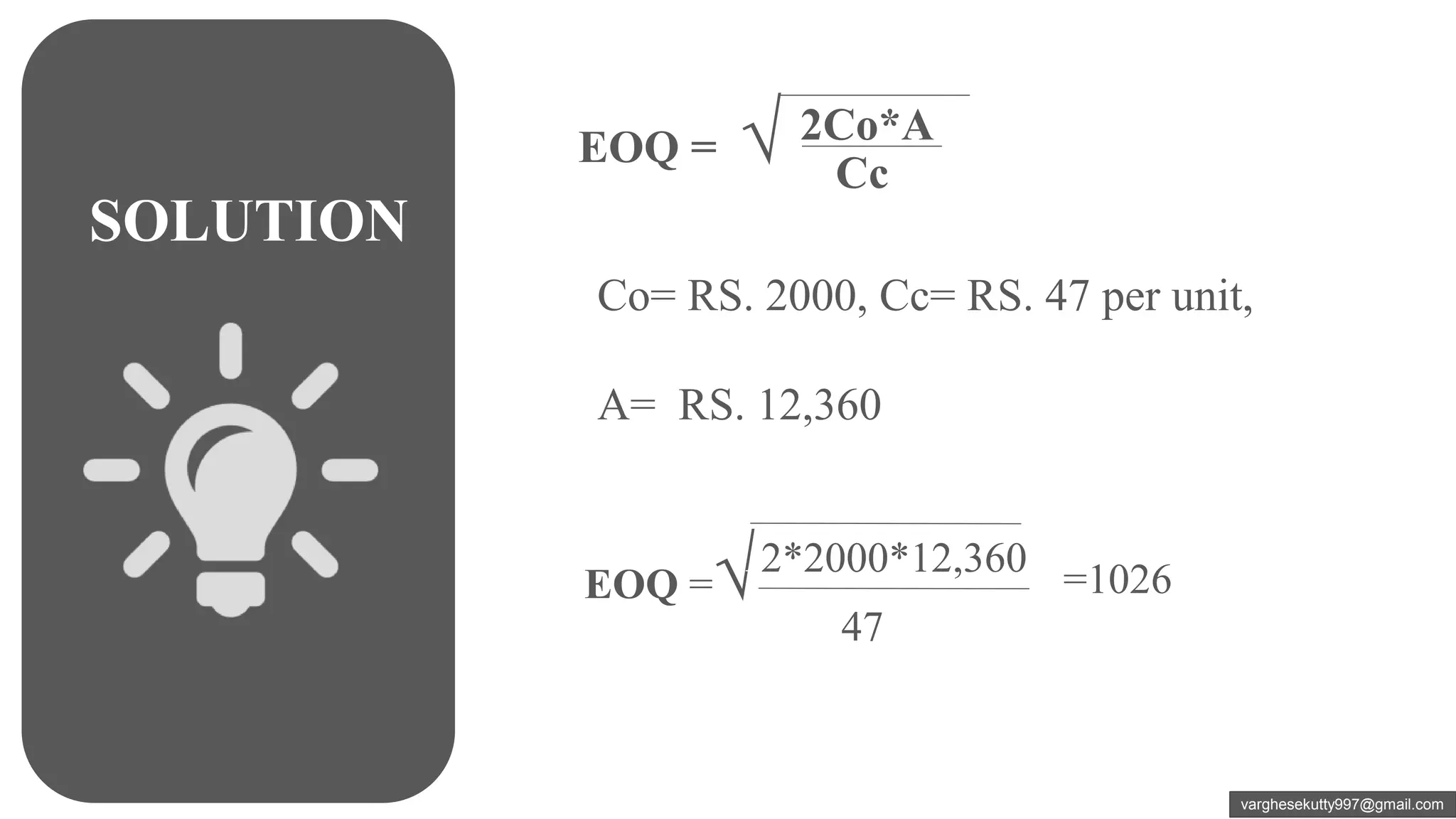
Co= RS. 2000, Cc= RS. 47 per unit,
A= RS. 12,360
EOQ =√
47
2*2000*12,360
=1026
EOQ = √ Cc
2Co*A
SOLUTION
varghesekutty997@gmail.com
LIMITATIONS
OF EOQ
MODEL
• It is necessary for the application of EOQ
order that the demands remain constant
throughout the year which is not possible.
• Ordering cost per order can’t be constant
because it’s including transport cost.
varghesekutty997@gmail.com
BY,
VARGHESEKUTTY CB
varghesekutty997@gmail.com

EOQ (Economic Order Quantity)

  • 1.
  • 2.
    WHAT IS EOQ? • EconomicOrder Quantity is one of the technique of inventory control which minimizes total holdings and ordering cost of the year. • This is a technique which solves the problems of a materials manager. varghesekutty997@gmail.com
  • 3.
    DEFINITION EOQ is essentiallyan accounting formula that determines at which the combination of order cost and inventory carrying cost are the least. The result is the most cost effective quality to order. In purchasing this is known as order quantity, in manufacturing it is known as the production lot size. -Dave Piasecki varghesekutty997@gmail.com
  • 4.
    CONT. • By usingthis model, the companies can minimize the costs associated with the ordering and inventory holding. • It can be a valuable tool for small business owners who need to make decisions about how much inventory to keep on hand, how many items to order each time, and how often to reorder to incur the lowest possible costs. • There are two most important categories of inventory costs are ordering costs and carrying costs. varghesekutty997@gmail.com
  • 5.
    ORDERING COST • It isthe costs that are incurred on obtaining additional inventories. • They include costs incurred on: communicating the order, traveling allowance and daily allowance to purchase officers, printing and stationary, salary of purchase department, cost of inspection, cost of receiving the material, transportation cost etc. varghesekutty997@gmail.com
  • 6.
    CONT. • All abovecost, other than transport costs remain unchanged per order irrespective of the order size. • Therefore, it is assumed that ordering cost per order remain constant. • The more frequently orders are placed, and fewer the quantities purchased on each order, the grater will be ordering cost and vice versa. varghesekutty997@gmail.com
  • 7.
    ORDERING COST CURVE •Here we can see that when the size of the order decreases the ordering cost increases and ordering cost decreases when the size of the order increases varghesekutty997@gmail.com
  • 8.
    CARRYING COST • It isthe cost incurred for holding inventory in hand. • They include interest on the money locked up in stocks, storage costs, spoilage costs, insurance, evaporation, godown rent, pilferage, obsolescence etc. varghesekutty997@gmail.com
  • 9.
    • They areassumed to be constant per unit of inventory. • The large the volume of inventory, the higher will be the inventory carrying cost and vice versa CONT. varghesekutty997@gmail.com
  • 10.
    CARRYING COST CURVE •Here we can see that when the order size increases the storage cost also increases and vice versa varghesekutty997@gmail.com
  • 11.
    ECONOMIC ORDER QUANTITYCURVE • Ordering costs and carrying costs are quite opposite to each other. • If we need to minimize carrying costs we have to place small order which increases the ordering costs. varghesekutty997@gmail.com
  • 12.
    CONT. • If wewant minimize ordering costs we have to place few orders in a year and this requires placing large orders which in turn increases the total carrying costs for the period. • We need to minimize the total inventory costs, Thus EOQ is determine by the intersection of ordering cost curve and carrying cost line. • At this point total ordering cost is equal to total carrying cost, and the total of the two costs is the least. varghesekutty997@gmail.com
  • 13.
    CALCULATION OF EOQ Where; Co- orderingcost Cc- carrying cost A - annual requirement of the material in . number of units EOQ = √ Cc 2Co*A varghesekutty997@gmail.com
  • 14.
    QUESTION  XLtd entered into a contract with a company for purchase of 12,360 instruments at the rate of rupees 235 per unit. Carrying cost is estimated as 47 rupees per instrument. Ordering cost is estimated as 2000 rupees. Calculate EOQ. varghesekutty997@gmail.com
  • 15.
    Co= RS. 2000,Cc= RS. 47 per unit, A= RS. 12,360 EOQ =√ 47 2*2000*12,360 =1026 EOQ = √ Cc 2Co*A SOLUTION varghesekutty997@gmail.com
  • 16.
    LIMITATIONS OF EOQ MODEL • Itis necessary for the application of EOQ order that the demands remain constant throughout the year which is not possible. • Ordering cost per order can’t be constant because it’s including transport cost. varghesekutty997@gmail.com
  • 17.