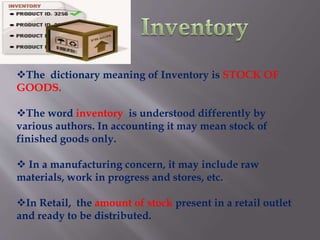
The dictionary meaning of Inventory is STOCK OF
GOODS.
The word inventory is understood differently by
various authors. In accounting it may mean stock of
finished goods only.
 In a manufacturing concern, it may include raw
materials, work in progress and stores, etc.
In Retail, the amount of stock present in a retail outlet
and ready to be distributed.
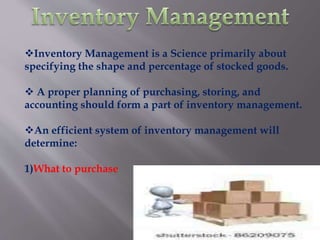
Inventory Management is a Science primarily about
specifying the shape and percentage of stocked goods.
 A proper planning of purchasing, storing, and
accounting should form a part of inventory management.
An efficient system of inventory management will
determine:
1)What to purchase
2) How much to purchase
3)From where to purchase.
4)Where to Store.
The purpose of inventory management is to keep the
stock in such a way that neither there is over- stocking nor
under- stocking.
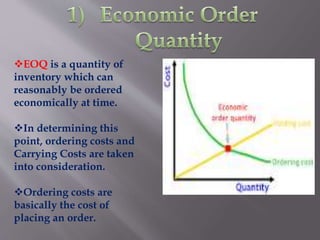
EOQ is a quantity of
inventory which can
reasonably be ordered
economically at time.
In determining this
point, ordering costs and
Carrying Costs are taken
into consideration.
Ordering costs are
basically the cost of
placing an order.
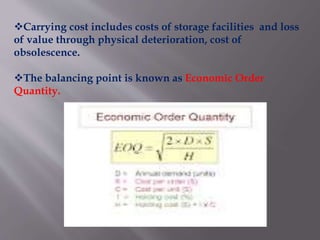
Carrying cost includes costs of storage facilities and loss
of value through physical deterioration, cost of
obsolescence.
The balancing point is known as Economic Order
Quantity.
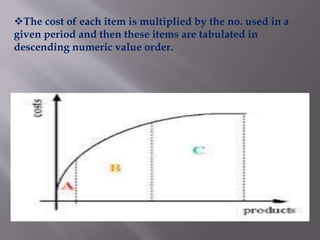
Under this the inventory is classified into 3 categories
viz. A B and C. These categories are based upon the
inventory value and cost significance .
Items of High value and small in no. are termed as A.
Items of moderate value and moderate in no. are
termed as B.
Items of small value and large in no. are in category C
It means Always Better Control
The cost of each item is multiplied by the no. used in a
given period and then these items are tabulated in
descending numeric value order.
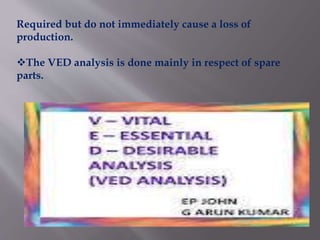
In this, the items are classified on the basis of their
criticality to the production process or other services.
 In this classification of materials, V stands for Vital
items without which the production process would come to
standstill.
E denotes Essential items whose stock out would
adversely affect the efficiency of the production system.
Their non availability might cause temporary losses.
The D items are the Desirable items which are
Required but do not immediately cause a loss of
production.
The VED analysis is done mainly in respect of spare
parts.
It is a philosophy that focuses attention on eliminating
waste by purchasing or manufacturing just enough of
the right items just in time.
It is a Japanese management philosophy applied in
manufacturing which involves having the right items of
the right quality and quantity in the right place and at the
right time.
It involves having products arrive as soon as the
customers order them.
This ratio is computed by dividing the cost of goods
sold by the average inventory.
Stock Turnover Ratio= Cost of goods sold
Average inventory
It is way of measuring how many times a business use
inventory in a given time period.
Business use inventory turnover to assess
competitiveness, project profits , and generally figure out
how well they are doing in their industry.
Stores and Spares term which commonly covers all kinds
of supplies necessary to keep production equipment
operating.
The firm should keep each and every component of
stores and spares to a reasonable level.
Stores and Spares inventory turnover:
Annual Consumption of Stores and Spares
Stores and spares inventory
Every product at the store has a unique code. This
code helps in identification and tracking of the products
at the retail store.
The retailer feeds each and every SKU in the master
computer and can easily track the product in the stock
just by entering the SKU no.
It is a regular analysis of stock versus projected future
needs. This can be done through a manual review of stock
or by using inventory software.
Inventory management tools and techniques retail

Inventory management tools and techniques retail

  • 2.
    The dictionary meaningof Inventory is STOCK OF GOODS. The word inventory is understood differently by various authors. In accounting it may mean stock of finished goods only.  In a manufacturing concern, it may include raw materials, work in progress and stores, etc. In Retail, the amount of stock present in a retail outlet and ready to be distributed.
  • 3.
    Inventory Management isa Science primarily about specifying the shape and percentage of stocked goods.  A proper planning of purchasing, storing, and accounting should form a part of inventory management. An efficient system of inventory management will determine: 1)What to purchase
  • 4.
    2) How muchto purchase 3)From where to purchase. 4)Where to Store. The purpose of inventory management is to keep the stock in such a way that neither there is over- stocking nor under- stocking.
  • 7.
    EOQ is aquantity of inventory which can reasonably be ordered economically at time. In determining this point, ordering costs and Carrying Costs are taken into consideration. Ordering costs are basically the cost of placing an order.
  • 8.
    Carrying cost includescosts of storage facilities and loss of value through physical deterioration, cost of obsolescence. The balancing point is known as Economic Order Quantity.
  • 9.
    Under this theinventory is classified into 3 categories viz. A B and C. These categories are based upon the inventory value and cost significance . Items of High value and small in no. are termed as A. Items of moderate value and moderate in no. are termed as B. Items of small value and large in no. are in category C It means Always Better Control
  • 10.
    The cost ofeach item is multiplied by the no. used in a given period and then these items are tabulated in descending numeric value order.
  • 11.
    In this, theitems are classified on the basis of their criticality to the production process or other services.  In this classification of materials, V stands for Vital items without which the production process would come to standstill. E denotes Essential items whose stock out would adversely affect the efficiency of the production system. Their non availability might cause temporary losses. The D items are the Desirable items which are
  • 12.
    Required but donot immediately cause a loss of production. The VED analysis is done mainly in respect of spare parts.
  • 13.
    It is aphilosophy that focuses attention on eliminating waste by purchasing or manufacturing just enough of the right items just in time. It is a Japanese management philosophy applied in manufacturing which involves having the right items of the right quality and quantity in the right place and at the right time. It involves having products arrive as soon as the customers order them.
  • 14.
    This ratio iscomputed by dividing the cost of goods sold by the average inventory. Stock Turnover Ratio= Cost of goods sold Average inventory It is way of measuring how many times a business use inventory in a given time period. Business use inventory turnover to assess competitiveness, project profits , and generally figure out how well they are doing in their industry.
  • 15.
    Stores and Sparesterm which commonly covers all kinds of supplies necessary to keep production equipment operating. The firm should keep each and every component of stores and spares to a reasonable level. Stores and Spares inventory turnover: Annual Consumption of Stores and Spares Stores and spares inventory
  • 16.
    Every product atthe store has a unique code. This code helps in identification and tracking of the products at the retail store. The retailer feeds each and every SKU in the master computer and can easily track the product in the stock just by entering the SKU no.
  • 17.
    It is aregular analysis of stock versus projected future needs. This can be done through a manual review of stock or by using inventory software.