Transportation and Assignment
          Problems
       Operations Research
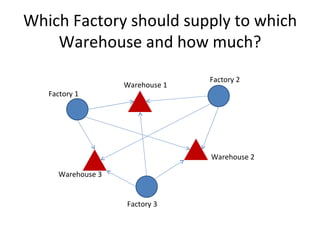
Which Factory should supply to which
    Warehouse and how much?
                                 Factory 2
                   Warehouse 1
   Factory 1


                                 Warehouse 2

     Warehouse 3


                   Factory 3
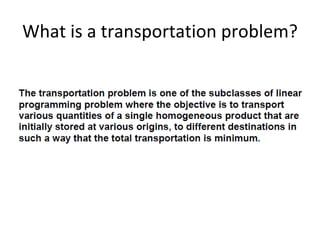
What is a transportation problem?
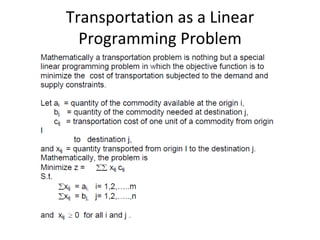
Transportation as a Linear
  Programming Problem
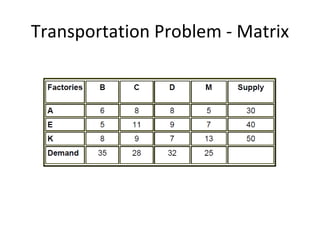
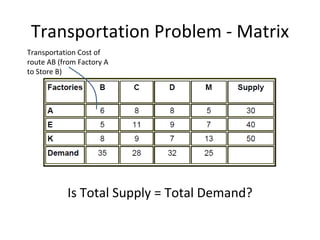
Transportation Problem - Matrix
Transportation Cost of
route AB (from Factory A
to Store B)


           Is Total Supply = Total Demand?
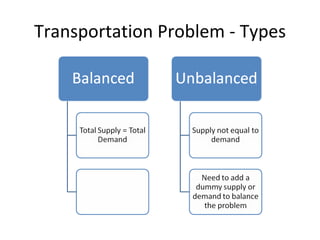
Transportation Problem - Types
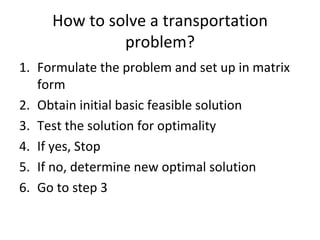
How to solve a transportation
              problem?
1. Formulate the problem and set up in matrix
   form
2. Obtain initial basic feasible solution
3. Test the solution for optimality
4. If yes, Stop
5. If no, determine new optimal solution
6. Go to step 3
Methods for finding initial solution
• North West Corner Method
• Minimum Matrix Method
• Vogel’s Corner Method
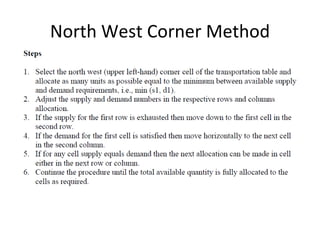
North West Corner Method
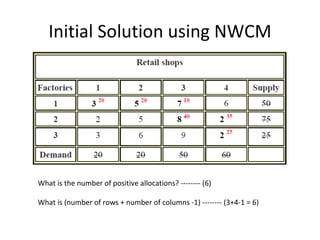
Initial Solution using NWCM


What is the number of positive allocations? -------- (6)

What is (number of rows + number of columns -1) -------- (3+4-1 = 6)
Testing for optimality
• Is there any alternative route (empty cell)
  which is better than existing routes?
• i.e. If I shift one unit from current route to any
  other route, does overall cost increase or
  decrease?
• Which out of alternative routes is best (which
  one reduces cost by maximum amount)?
Stepping Stones Method
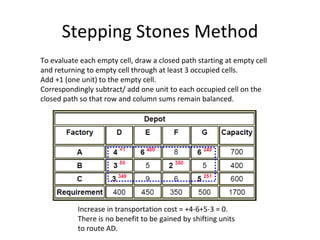
To evaluate each empty cell, draw a closed path starting at empty cell
and returning to empty cell through at least 3 occupied cells.
Add +1 (one unit) to the empty cell.
Correspondingly subtract/ add one unit to each occupied cell on the
closed path so that row and column sums remain balanced.


           Increase in transportation cost = +4-6+5-3 = 0.
           There is no benefit to be gained by shifting units
           to route AD.
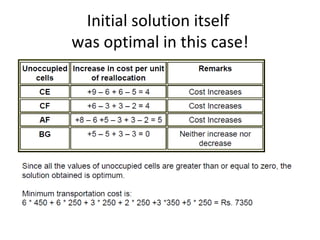
Initial solution itself
was optimal in this case!
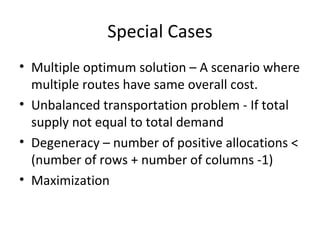
Special Cases
• Multiple optimum solution – A scenario where
  multiple routes have same overall cost.
• Unbalanced transportation problem - If total
  supply not equal to total demand
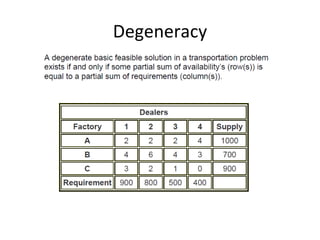
• Degeneracy – number of positive allocations <
  (number of rows + number of columns -1)
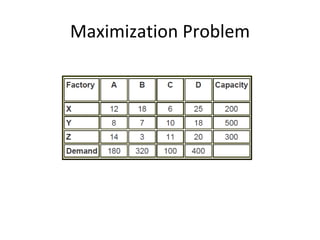
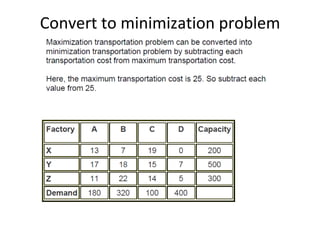
• Maximization
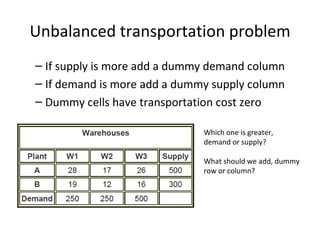
Unbalanced transportation problem
– If supply is more add a dummy demand column
– If demand is more add a dummy supply column
– Dummy cells have transportation cost zero

                              Which one is greater,
                              demand or supply?

                              What should we add, dummy
                              row or column?
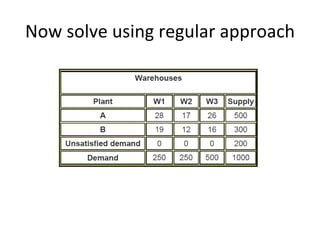
Now solve using regular approach
Degeneracy
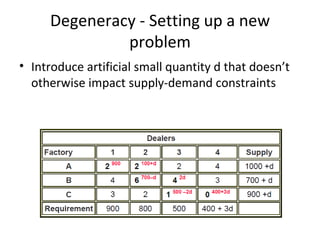
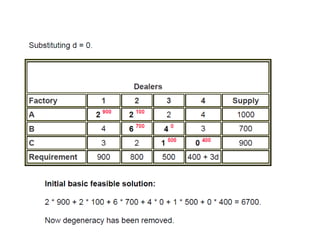
Degeneracy - Setting up a new
              problem
• Introduce artificial small quantity d that doesn’t
  otherwise impact supply-demand constraints
Maximization Problem
Convert to minimization problem
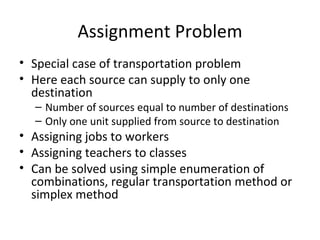
Assignment Problem
• Special case of transportation problem
• Here each source can supply to only one
  destination
  – Number of sources equal to number of destinations
  – Only one unit supplied from source to destination
• Assigning jobs to workers
• Assigning teachers to classes
• Can be solved using simple enumeration of
  combinations, regular transportation method or
  simplex method
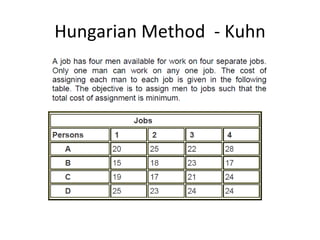
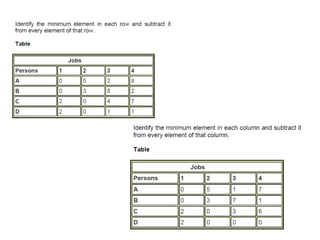
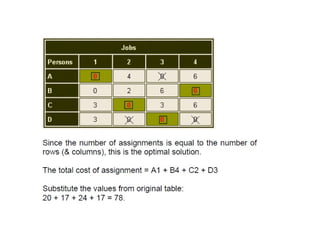
Hungarian Method - Kuhn
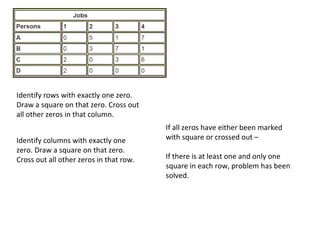
Identify rows with exactly one zero.
Draw a square on that zero. Cross out
all other zeros in that column.
                                         If all zeros have either been marked
Identify columns with exactly one        with square or crossed out –
zero. Draw a square on that zero.
Cross out all other zeros in that row.   If there is at least one and only one
                                         square in each row, problem has been
                                         solved.
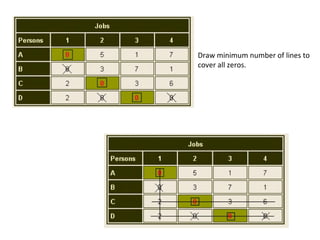
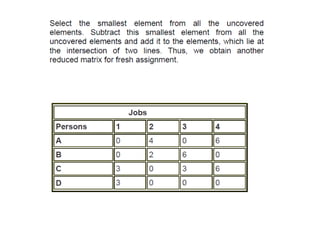
Draw minimum number of lines to
cover all zeros.
Special cases
• Unbalanced – Sources and Destinations not
  equal.
  – Add a dummy source or destination with 0 cost.
• Maximization
  – Convert to minimization problem using
    opportunity cost

Transportation Assignment

  • 1.
    Transportation and Assignment Problems Operations Research
  • 2.
    Which Factory shouldsupply to which Warehouse and how much? Factory 2 Warehouse 1 Factory 1 Warehouse 2 Warehouse 3 Factory 3
  • 3.
    What is atransportation problem?
  • 4.
    Transportation as aLinear Programming Problem
  • 5.
  • 6.
    Transportation Problem -Matrix Transportation Cost of route AB (from Factory A to Store B) Is Total Supply = Total Demand?
  • 7.
  • 8.
    How to solvea transportation problem? 1. Formulate the problem and set up in matrix form 2. Obtain initial basic feasible solution 3. Test the solution for optimality 4. If yes, Stop 5. If no, determine new optimal solution 6. Go to step 3
  • 9.
    Methods for findinginitial solution • North West Corner Method • Minimum Matrix Method • Vogel’s Corner Method
  • 10.
  • 11.
    Initial Solution usingNWCM What is the number of positive allocations? -------- (6) What is (number of rows + number of columns -1) -------- (3+4-1 = 6)
  • 12.
    Testing for optimality •Is there any alternative route (empty cell) which is better than existing routes? • i.e. If I shift one unit from current route to any other route, does overall cost increase or decrease? • Which out of alternative routes is best (which one reduces cost by maximum amount)?
  • 13.
    Stepping Stones Method Toevaluate each empty cell, draw a closed path starting at empty cell and returning to empty cell through at least 3 occupied cells. Add +1 (one unit) to the empty cell. Correspondingly subtract/ add one unit to each occupied cell on the closed path so that row and column sums remain balanced. Increase in transportation cost = +4-6+5-3 = 0. There is no benefit to be gained by shifting units to route AD.
  • 14.
    Initial solution itself wasoptimal in this case!
  • 15.
    Special Cases • Multipleoptimum solution – A scenario where multiple routes have same overall cost. • Unbalanced transportation problem - If total supply not equal to total demand • Degeneracy – number of positive allocations < (number of rows + number of columns -1) • Maximization
  • 16.
    Unbalanced transportation problem –If supply is more add a dummy demand column – If demand is more add a dummy supply column – Dummy cells have transportation cost zero Which one is greater, demand or supply? What should we add, dummy row or column?
  • 17.
    Now solve usingregular approach
  • 18.
  • 19.
    Degeneracy - Settingup a new problem • Introduce artificial small quantity d that doesn’t otherwise impact supply-demand constraints
  • 21.
  • 22.
  • 23.
    Assignment Problem • Specialcase of transportation problem • Here each source can supply to only one destination – Number of sources equal to number of destinations – Only one unit supplied from source to destination • Assigning jobs to workers • Assigning teachers to classes • Can be solved using simple enumeration of combinations, regular transportation method or simplex method
  • 24.
  • 26.
    Identify rows withexactly one zero. Draw a square on that zero. Cross out all other zeros in that column. If all zeros have either been marked Identify columns with exactly one with square or crossed out – zero. Draw a square on that zero. Cross out all other zeros in that row. If there is at least one and only one square in each row, problem has been solved.
  • 27.
    Draw minimum numberof lines to cover all zeros.
  • 30.
    Special cases • Unbalanced– Sources and Destinations not equal. – Add a dummy source or destination with 0 cost. • Maximization – Convert to minimization problem using opportunity cost