Detecting differentially
expressed genes
RNA-seq for DE analysis training
Joachim Jacob
20 and 27 January 2014

This presentation is available under the Creative Commons Attribution-ShareAlike 3.0 Unported License. Please refer to
http://www.bits.vib.be/ if you use this presentation or parts hereof.
Goal
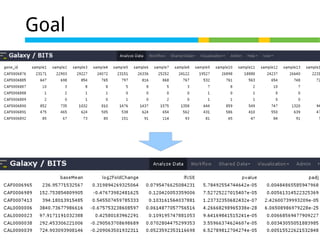
Based on a count table, we want to detect
differentially expressed genes between conditions
of interest.
We will assign to each gene a p-value (0-1), which
shows us 'how surprised we should be' to see this
difference, when we assume there is no difference.

0

p-value

1

Very big chance there is a difference
Very small chance there is a real difference
Goal
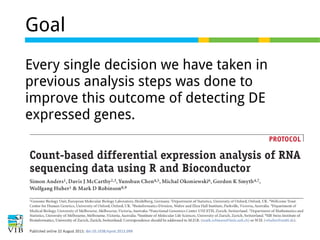
Every single decision we have taken in
previous analysis steps was done to
improve this outcome of detecting DE
expressed genes.
Goal
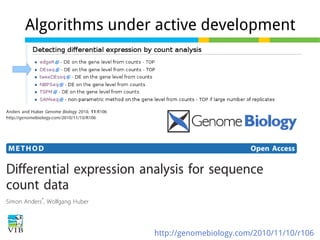
Algorithms under active development

http://wiki.bits.vib.be/index.php/RNAseq_toolbox#Detecting_differential_expression_by_count_analysis
Algorithms under active development

http://genomebiology.com/2010/11/10/r106
Intuition
gene_id

CAF0006876

Condition A

sample1
23171

sample2
22903

sample3
29227

sample4
24072

sample5
23151

sample6
26336

sample7
25252

sample8
24122

Condition B

Sample9
19527

sample10
26898

sample11
18880

sample12
24237

sample13
26640

sample14
22315

sample15
20952

sample16
25629

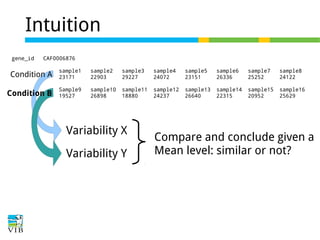
Variability X
Variability Y

Compare and conclude given a
Mean level: similar or not?
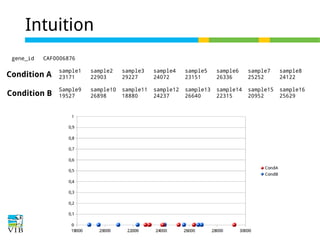
Intuition
gene_id

CAF0006876

Condition A

sample1
23171

sample2
22903

sample3
29227

sample4
24072

sample5
23151

sample6
26336

sample7
25252

sample8
24122

Condition B

Sample9
19527

sample10
26898

sample11
18880

sample12
24237

sample13
26640

sample14
22315

sample15
20952

sample16
25629
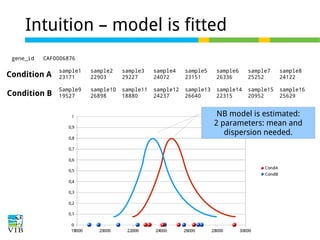
Intuition – model is fitted
gene_id

CAF0006876

Condition A

sample1
23171

sample2
22903

sample3
29227

sample4
24072

sample5
23151

sample6
26336

sample7
25252

sample8
24122

Condition B

Sample9
19527

sample10
26898

sample11
18880

sample12
24237

sample13
26640

sample14
22315

sample15
20952

sample16
25629

NB model is estimated:
2 parameters: mean and
dispersion needed.
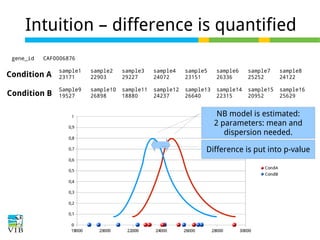
Intuition – difference is quantified
gene_id

CAF0006876

Condition A

sample1
23171

sample2
22903

sample3
29227

sample4
24072

sample5
23151

sample6
26336

sample7
25252

sample8
24122

Condition B

Sample9
19527

sample10
26898

sample11
18880

sample12
24237

sample13
26640

sample14
22315

sample15
20952

sample16
25629

NB model is estimated:
2 parameters: mean and
dispersion needed.
Difference is put into p-value
BUT counts are dependent on
The read counts of a gene between different
conditions, is dependent on (see first part):
1. Chance (NB model)
2. Expression level
3. Library size (number of reads in that library)
4. Length of transcript
5. GC content of the genes
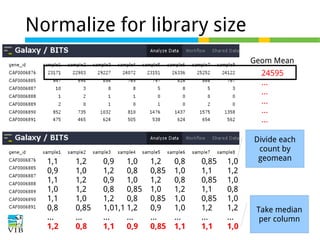
Normalize for library size
Assumption: most genes are not DE between
samples. DESeq calculates for every sample the
'effective library size' by a scale factor.
100%
100%

Rest of the
genes

Rest of the
genes

http://www.ncbi.nlm.nih.gov/pmc/articles/PMC3426807/
Normalize for library size
Original library size * scale factor = effective library size
DESeq will multiply original counts by the sample
scaling factor.
DESeq: This normalization method [14] is included in the DESeq Bioconductor package (version 1.6.0) [14] and is based on the hypothesis that most genes are not DE. A DESeq scaling
factor for a given lane is computed as the median of the ratio, for each gene, of its read count
over its geometric mean across all lanes. The underlying idea is that non-DE genes should have
similar read counts across samples, leading to a ratio of 1. Assuming most genes are not DE, the
median of this ratio for the lane provides an estimate of the correction factor that should be
applied to all read counts of this lane to fulfill the hypothesis
DESeq computes a scaling factor for a given sample by computing the median of the ratio, for each gene, of its
read count over its geometric mean across all samples. It then uses the assumption that most genes are not DE
and uses this median of ratios to obtain the scaling factor associated with this sample.

http://www.ncbi.nlm.nih.gov/pmc/articles/PMC3426807/
Normalize for library size
Geom Mean
24595
…
…
...
…
…

1,1
0,9
1,1
1,0
1,1
0,8
…
1,2

1,2
1,0
1,2
1,2
1,0
0,85
…
0,8

0,9
1,0
1,2
0,8
0,9
1,0
0,8
0,85
1,2
0,8
1,01,1 1,2
…
…
1,1
0,9

1,2
0,85
1,2
1,0
0,85
0,9
…
0,85

0,8
1,0
0,8
1,2
1,0
1,0
…
1,1

0,85
1,1
0,85
1,1
0,85
1,2
…
1,1

1,0
1,2
1,0
0,8
1,0
1,2
…
1,0

Divide each
count by
geomean

Take median
per column
Other normalisations
●

EdgeR: TMM, trimmed mean of M-values
Dispersion estimation
●

●

For every gene, an NB is fitted based on
the counts. The most important factor in
that model to be estimated is the
dispersion.
DESeq2 applies three steps
●

Estimates dispersion parameter for each gene

●

Plots and fits a curve

●

Adjusts the dispersion parameter towards the
curve ('shrinking')
Dispersion estimation
1. Black dots: estimated
from normalized data.

2. Red line: curve fitted
3. blue dots: final assigned
dispersion parameter for
that gene

Model is fit!
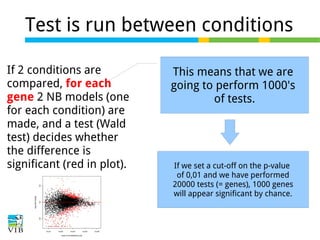
Test is run between conditions
If 2 conditions are
compared, for each
gene 2 NB models (one
for each condition) are
made, and a test (Wald
test) decides whether
the difference is
significant (red in plot).
MA-plot: mean of counts
versus the log2 fold change
between 2 conditions.

Significant (p-value < 0,01)
Not significant
Test is run between conditions
If 2 conditions are
compared, for each
gene 2 NB models (one
for each condition) are
made, and a test (Wald
test) decides whether
the difference is
significant (red in plot).

This means that we are
going to perform 1000's
of tests.

If we set a cut-off on the p-value
of 0,01 and we have performed
20000 tests (= genes), 1000 genes
will appear significant by chance.
Check the distribution of p-values
An enrichment
(smaller or
Bigger) should
be seen at low
P-values.

If the histogram of the p-values does
not match a profile as shown below,
the test is not reliable. Perhaps the
NB fitting step did not succeed, or
confounding variables are present.

Other p-values should not
show a trend.
Confounded distribution of p-values
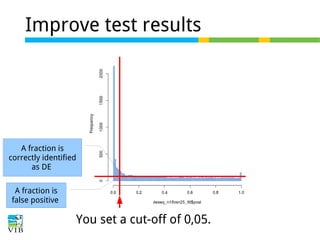
Improve test results

A fraction is
correctly identified
as DE
A fraction is
false positive

You set a cut-off of 0,05.
Improve test results
We can improve testing by 2 measures:
avoid testing: apply a filtering before testing, an
independent filtering.
●

●

apply a multiple testing correction
Independent filtering
Some scientists just
remove genes with
mean counts in the
samples <10. But there
is a more formal
method to remove
genes, in order to
reduce the testing.

http://www.bioconductor.org/help/course-materials/2012/Bressanone2012/
From this collection, read 2012-07-04-Huber-Multiple-testing-independent-filtering.pdf
Independent filtering
Left a scatter plot of
mean counts versus
transformed p-values.
The red line depicts a
cut-off of 0,1. Note that
genes with lower counts
do not reach the p-value
threshold. Some of them
are save to exclude from
testing.
http://www.bioconductor.org/help/course-materials/2012/Bressanone2012/
From this collection, read 2012-07-04-Huber-Multiple-testing-independent-filtering.pdf
Independent filtering

If we filter out increasingly bigger portions of genes based on their
mean counts, the number of significant genes increase.
Independent filtering

See later (slide 30)
Choose the variable of interest.
You can run it once on all to check the outcome.

http://www.bioconductor.org/help/course-materials/2012/Bressanone2012/
From this collection, read 2012-07-04-Huber-Multiple-testing-independent-filtering.pdf
Independent filtering
Multiple testing correction
Automatically in results: Benjamini/Hochberg
correction, to control false discovery rate (FDR).
FDR is the fraction of false positives in the genes that
are classified as DE.
If we set a threshold α of 0,05, 20% of the DE genes
will be false positives.
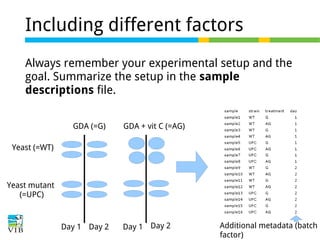
Including different factors
Always remember your experimental setup and the
goal. Summarize the setup in the sample
descriptions file.
GDA (=G)

GDA + vit C (=AG)

Yeast (=WT)

Yeast mutant
(=UPC)

Day 1 Day 2

Day 1 Day 2

Additional metadata (batch
factor)
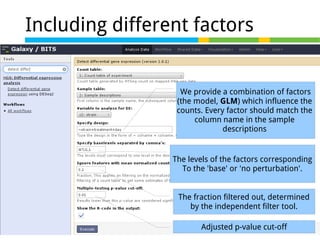
Including different factors

We provide a combination of factors
(the model, GLM) which influence the
counts. Every factor should match the
column name in the sample
descriptions

The levels of the factors corresponding
To the 'base' or 'no perturbation'.
The fraction filtered out, determined
by the independent filter tool.
Adjusted p-value cut-off
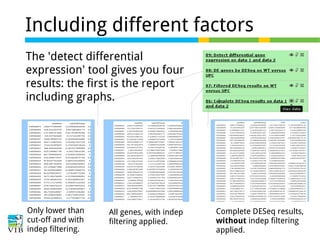
Including different factors
The 'detect differential
expression' tool gives you four
results: the first is the report
including graphs.

Only lower than
cut-off and with
indep filtering.

All genes, with indep
filtering applied.

Complete DESeq results,
without indep filtering
applied.
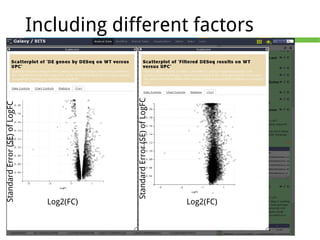
Standard Error (SE) of LogFC

Log2(FC)
Standard Error (SE) of LogFC

Including different factors

Log2(FC)
Including different factors
Volcano plot: shows
the DE genes with
our given cut-off.
Comparing different conditions
GDA (=G)

GDA + vit C (=AG)

Yeast (=WT)

Yeast mutant
(=UPC)

Day 1 Day 2

Day 1 Day 2

Which genes are DE between UPC and WT?
Which genes are DE between G and AG?
Which genes are DE in WT between G and AG?
Comparing different conditions
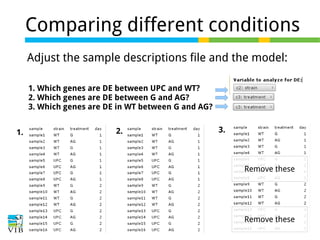
Adjust the sample descriptions file and the model:
1. Which genes are DE between UPC and WT?
2. Which genes are DE between G and AG?
3. Which genes are DE in WT between G and AG?
1.

2.

3.

Remove these

Remove these
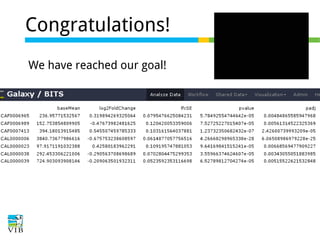
Congratulations!
We have reached our goal!
Overview

http://www.nature.com/nprot/journal/v8/n9/full/nprot.2013.099.html
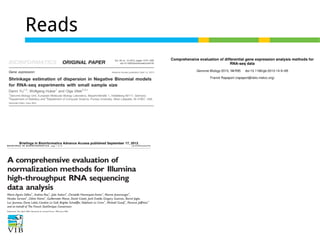
Reads
Keywords
Effective library size
dispersion
shrinking
Significantly differentially expressed
MA-plot
Alpha cut-off
Independent filtering
FDR
p-value
Write in your own words what the terms mean
Break

RNA-seq for DE analysis: detecting differential expression - part 5

  • 1.
    Detecting differentially expressed genes RNA-seqfor DE analysis training Joachim Jacob 20 and 27 January 2014 This presentation is available under the Creative Commons Attribution-ShareAlike 3.0 Unported License. Please refer to http://www.bits.vib.be/ if you use this presentation or parts hereof.
  • 2.
    Goal Based on acount table, we want to detect differentially expressed genes between conditions of interest. We will assign to each gene a p-value (0-1), which shows us 'how surprised we should be' to see this difference, when we assume there is no difference. 0 p-value 1 Very big chance there is a difference Very small chance there is a real difference
  • 3.
    Goal Every single decisionwe have taken in previous analysis steps was done to improve this outcome of detecting DE expressed genes.
  • 4.
  • 5.
    Algorithms under activedevelopment http://wiki.bits.vib.be/index.php/RNAseq_toolbox#Detecting_differential_expression_by_count_analysis
  • 6.
    Algorithms under activedevelopment http://genomebiology.com/2010/11/10/r106
  • 7.
  • 8.
  • 9.
    Intuition – modelis fitted gene_id CAF0006876 Condition A sample1 23171 sample2 22903 sample3 29227 sample4 24072 sample5 23151 sample6 26336 sample7 25252 sample8 24122 Condition B Sample9 19527 sample10 26898 sample11 18880 sample12 24237 sample13 26640 sample14 22315 sample15 20952 sample16 25629 NB model is estimated: 2 parameters: mean and dispersion needed.
  • 10.
    Intuition – differenceis quantified gene_id CAF0006876 Condition A sample1 23171 sample2 22903 sample3 29227 sample4 24072 sample5 23151 sample6 26336 sample7 25252 sample8 24122 Condition B Sample9 19527 sample10 26898 sample11 18880 sample12 24237 sample13 26640 sample14 22315 sample15 20952 sample16 25629 NB model is estimated: 2 parameters: mean and dispersion needed. Difference is put into p-value
  • 11.
    BUT counts aredependent on The read counts of a gene between different conditions, is dependent on (see first part): 1. Chance (NB model) 2. Expression level 3. Library size (number of reads in that library) 4. Length of transcript 5. GC content of the genes
  • 12.
    Normalize for librarysize Assumption: most genes are not DE between samples. DESeq calculates for every sample the 'effective library size' by a scale factor. 100% 100% Rest of the genes Rest of the genes http://www.ncbi.nlm.nih.gov/pmc/articles/PMC3426807/
  • 13.
    Normalize for librarysize Original library size * scale factor = effective library size DESeq will multiply original counts by the sample scaling factor. DESeq: This normalization method [14] is included in the DESeq Bioconductor package (version 1.6.0) [14] and is based on the hypothesis that most genes are not DE. A DESeq scaling factor for a given lane is computed as the median of the ratio, for each gene, of its read count over its geometric mean across all lanes. The underlying idea is that non-DE genes should have similar read counts across samples, leading to a ratio of 1. Assuming most genes are not DE, the median of this ratio for the lane provides an estimate of the correction factor that should be applied to all read counts of this lane to fulfill the hypothesis DESeq computes a scaling factor for a given sample by computing the median of the ratio, for each gene, of its read count over its geometric mean across all samples. It then uses the assumption that most genes are not DE and uses this median of ratios to obtain the scaling factor associated with this sample. http://www.ncbi.nlm.nih.gov/pmc/articles/PMC3426807/
  • 14.
    Normalize for librarysize Geom Mean 24595 … … ... … … 1,1 0,9 1,1 1,0 1,1 0,8 … 1,2 1,2 1,0 1,2 1,2 1,0 0,85 … 0,8 0,9 1,0 1,2 0,8 0,9 1,0 0,8 0,85 1,2 0,8 1,01,1 1,2 … … 1,1 0,9 1,2 0,85 1,2 1,0 0,85 0,9 … 0,85 0,8 1,0 0,8 1,2 1,0 1,0 … 1,1 0,85 1,1 0,85 1,1 0,85 1,2 … 1,1 1,0 1,2 1,0 0,8 1,0 1,2 … 1,0 Divide each count by geomean Take median per column
  • 15.
    Other normalisations ● EdgeR: TMM,trimmed mean of M-values
  • 16.
    Dispersion estimation ● ● For everygene, an NB is fitted based on the counts. The most important factor in that model to be estimated is the dispersion. DESeq2 applies three steps ● Estimates dispersion parameter for each gene ● Plots and fits a curve ● Adjusts the dispersion parameter towards the curve ('shrinking')
  • 17.
    Dispersion estimation 1. Blackdots: estimated from normalized data. 2. Red line: curve fitted 3. blue dots: final assigned dispersion parameter for that gene Model is fit!
  • 18.
    Test is runbetween conditions If 2 conditions are compared, for each gene 2 NB models (one for each condition) are made, and a test (Wald test) decides whether the difference is significant (red in plot). MA-plot: mean of counts versus the log2 fold change between 2 conditions. Significant (p-value < 0,01) Not significant
  • 19.
    Test is runbetween conditions If 2 conditions are compared, for each gene 2 NB models (one for each condition) are made, and a test (Wald test) decides whether the difference is significant (red in plot). This means that we are going to perform 1000's of tests. If we set a cut-off on the p-value of 0,01 and we have performed 20000 tests (= genes), 1000 genes will appear significant by chance.
  • 20.
    Check the distributionof p-values An enrichment (smaller or Bigger) should be seen at low P-values. If the histogram of the p-values does not match a profile as shown below, the test is not reliable. Perhaps the NB fitting step did not succeed, or confounding variables are present. Other p-values should not show a trend.
  • 21.
  • 22.
    Improve test results Afraction is correctly identified as DE A fraction is false positive You set a cut-off of 0,05.
  • 23.
    Improve test results Wecan improve testing by 2 measures: avoid testing: apply a filtering before testing, an independent filtering. ● ● apply a multiple testing correction
  • 24.
    Independent filtering Some scientistsjust remove genes with mean counts in the samples <10. But there is a more formal method to remove genes, in order to reduce the testing. http://www.bioconductor.org/help/course-materials/2012/Bressanone2012/ From this collection, read 2012-07-04-Huber-Multiple-testing-independent-filtering.pdf
  • 25.
    Independent filtering Left ascatter plot of mean counts versus transformed p-values. The red line depicts a cut-off of 0,1. Note that genes with lower counts do not reach the p-value threshold. Some of them are save to exclude from testing. http://www.bioconductor.org/help/course-materials/2012/Bressanone2012/ From this collection, read 2012-07-04-Huber-Multiple-testing-independent-filtering.pdf
  • 26.
    Independent filtering If wefilter out increasingly bigger portions of genes based on their mean counts, the number of significant genes increase.
  • 27.
    Independent filtering See later(slide 30) Choose the variable of interest. You can run it once on all to check the outcome. http://www.bioconductor.org/help/course-materials/2012/Bressanone2012/ From this collection, read 2012-07-04-Huber-Multiple-testing-independent-filtering.pdf
  • 28.
  • 29.
    Multiple testing correction Automaticallyin results: Benjamini/Hochberg correction, to control false discovery rate (FDR). FDR is the fraction of false positives in the genes that are classified as DE. If we set a threshold α of 0,05, 20% of the DE genes will be false positives.
  • 30.
    Including different factors Alwaysremember your experimental setup and the goal. Summarize the setup in the sample descriptions file. GDA (=G) GDA + vit C (=AG) Yeast (=WT) Yeast mutant (=UPC) Day 1 Day 2 Day 1 Day 2 Additional metadata (batch factor)
  • 31.
    Including different factors Weprovide a combination of factors (the model, GLM) which influence the counts. Every factor should match the column name in the sample descriptions The levels of the factors corresponding To the 'base' or 'no perturbation'. The fraction filtered out, determined by the independent filter tool. Adjusted p-value cut-off
  • 32.
    Including different factors The'detect differential expression' tool gives you four results: the first is the report including graphs. Only lower than cut-off and with indep filtering. All genes, with indep filtering applied. Complete DESeq results, without indep filtering applied.
  • 33.
    Standard Error (SE)of LogFC Log2(FC) Standard Error (SE) of LogFC Including different factors Log2(FC)
  • 34.
    Including different factors Volcanoplot: shows the DE genes with our given cut-off.
  • 35.
    Comparing different conditions GDA(=G) GDA + vit C (=AG) Yeast (=WT) Yeast mutant (=UPC) Day 1 Day 2 Day 1 Day 2 Which genes are DE between UPC and WT? Which genes are DE between G and AG? Which genes are DE in WT between G and AG?
  • 36.
    Comparing different conditions Adjustthe sample descriptions file and the model: 1. Which genes are DE between UPC and WT? 2. Which genes are DE between G and AG? 3. Which genes are DE in WT between G and AG? 1. 2. 3. Remove these Remove these
  • 37.
  • 38.
  • 39.
  • 40.
    Keywords Effective library size dispersion shrinking Significantlydifferentially expressed MA-plot Alpha cut-off Independent filtering FDR p-value Write in your own words what the terms mean
  • 41.