Gene Prediction Programs
Submitted by: Mugdha Sharma
Roll No.: 2185026
MSc. Biotechnology
3rd Semester
Submitted To: Ms. Ruchi
Sachdeva
INDEX
GENE PREDICTION PROGRAM
Introduction
5 GENE PREDICTION PROGRAMS
GRAIL
AUGUTUS
GENSCAN
HMMGENE
MZEF
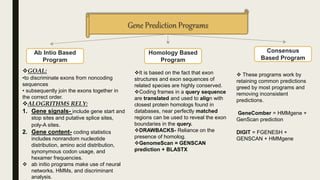
Gene Prediction Programs
Ab Intio Based
Program
Homology Based
Program
Consensus
Based Program
GOAL:
•to discriminate exons from noncoding
sequences
• subsequently join the exons together in
the correct order.
ALOGRITHMS RELY:
1. Gene signals- include gene start and
stop sites and putative splice sites,
poly-A sites.
2. Gene content- coding statistics
includes nonrandom nucleotide
distribution, amino acid distribution,
synonymous codon usage, and
hexamer frequencies.
 ab initio programs make use of neural
networks, HMMs, and discriminant
analysis.
It is based on the fact that exon
structures and exon sequences of
related species are highly conserved.
Coding frames in a query sequence
are translated and used to align with
closest protein homologs found in
databases, near perfectly matched
regions can be used to reveal the exon
boundaries in the query.
DRAWBACKS- Reliance on the
presence of homolog.
GenomeScan = GENSCAN
prediction + BLASTX
 These programs work by
retaining common predictions
greed by most programs and
removing inconsistent
predictions.
GeneComber = HMMgene +
GenScan prediction
DIGIT = FGENESH +
GENSCAN + HMMgene
5 GENE PREDICTION PROGRAMS
GRAIL
AUGUTUS
GENSCAN
HMMGENE
MZEF
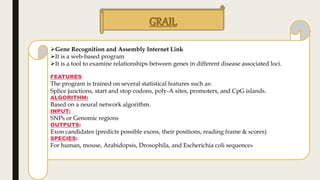
GRAIL
Gene Recognition and Assembly Internet Link
It is a web-based program
It is a tool to examine relationships between genes in different disease associated loci.
FEATURES:
The program is trained on several statistical features such as:
Splice junctions, start and stop codons, poly-A sites, promoters, and CpG islands.
ALGORITHM:
Based on a neural network algorithm.
INPUT:
SNPs or Genomic regions
OUTPUTS:
Exon candidates (predicts possible exons, their positions, reading frame & scores)
SPECIES:
For human, mouse, Arabidopsis, Drosophila, and Escherichia coli sequences
AUGUSTUS
It is program that predicts genes in Eukaryotic Genomic Sequences.
FEATURES: It can report a large number of alternative genes, including probabilities
for the transcripts and each for exon and intron.
• It can predict alternate splicing and alternative transcripts.
•It can predict the 5’UTR and 3’UTR including intron.
•It can be used ab inito & as a flexible mechanisms for incorporating extrinsic
information, e.g. from EST alignments & protein alignments.
ALGORITHM:
Based on Generalized Hidden Markov Model (GHMM)
INPUT:
The user can upload their sequences in FASTA format or paste them into a web form.
The total length of the sequences submitted to the server is 3 million base pairs (max).
OUTPUT:
Consists of exon, intron, transcript and gene boundaries in the common General Feature
Format (GFF) as well as predicted amino acid sequences and predicted coding sequences
in FASTA format.
SPECIES:
Homo sapiens, Drosophila melanogaster, Arabidopsis thaliana, Brugia malayi,Tribolium
castaneum
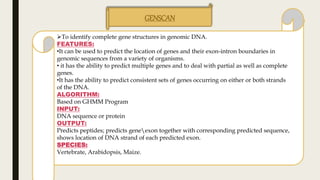
GENSCAN
To identify complete gene structures in genomic DNA.
FEATURES:
•It can be used to predict the location of genes and their exon-intron boundaries in
genomic sequences from a variety of organisms.
• it has the ability to predict multiple genes and to deal with partial as well as complete
genes.
•It has the ability to predict consistent sets of genes occurring on either or both strands
of the DNA.
ALGORITHM:
Based on GHMM Program
INPUT:
DNA sequence or protein
OUTPUT:
Predicts peptides; predicts geneexon together with corresponding predicted sequence,
shows location of DNA strand of each predicted exon.
SPECIES:
Vertebrate, Arabidopsis, Maize.
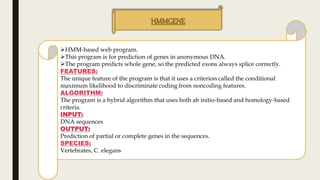
HMMGENE
HMM-based web program.
This program is for prediction of genes in anonymous DNA.
The program predicts whole gene, so the predicted exons always splice correctly.
FEATURES:
The unique feature of the program is that it uses a criterion called the conditional
maximum likelihood to discriminate coding from noncoding features.
ALGORITHM:
The program is a hybrid algorithm that uses both ab initio-based and homology-based
criteria.
INPUT:
DNA sequences
OUTPUT:
Prediction of partial or complete genes in the sequences.
SPECIES:
Vertebrates, C. elegans
MZEF
Michael Zhang’s Exon Finder
It was developed to help identify internal coding exons on human genomic DNA
sequences.
ALGORITHM:
QDA for exon prediction. (QDA= quadratic discriminant analysis)
INPUT:
DNA sequence
OUTPUT:
Predicts internal coding regions on genomic DNA sequence.
SPECIES:
Human, mouse, Arabidopsis
REFERENCE
•https://en.m.wikipedia.org/wiki/List_of_gene_prediction_software
•http://bioinf.uni-greifswald.de/augustus/
•https://www.ncbi.nlm.nih.gov/pmc/articles/PMC1160219/
•http://hollywood.mit.edu/GENSCAN.html
•https://drive.google.com/file/d/1nSK-
plEz3IGxhXv0KC7GVMBnOI7I92Jh/view?usp=drivesdk