2014 Workshop in 
Metabolomic Data Analysis 
Dmitry Grapov, PhD 
Introduction
Important 
Introduction 
This is an introduction to a series of tutorials for 
metabolomic data analysis 
1. Download all the required files and software at: 
https://sourceforge.net/projects/teachingdemos/files/WCMC%202014%20Summer%20Workshop/ 
2. Make sure you have installed R (v3.1.1, http://cran.us.r-project.org/ ), shiny (v0.10.1, 
http://shiny.rstudio.com/ ) and a modern browser (e.g., Chrome). 
3. Run the code in the folder software the file startup.R to launch all 
accompanying software; or download most current versions at the links 
below 
• DeviumWeb (https://github.com/dgrapov/DeviumWeb) 
• MetaMapR (https://github.com/dgrapov/MetaMapR) 
4. Have a great time!
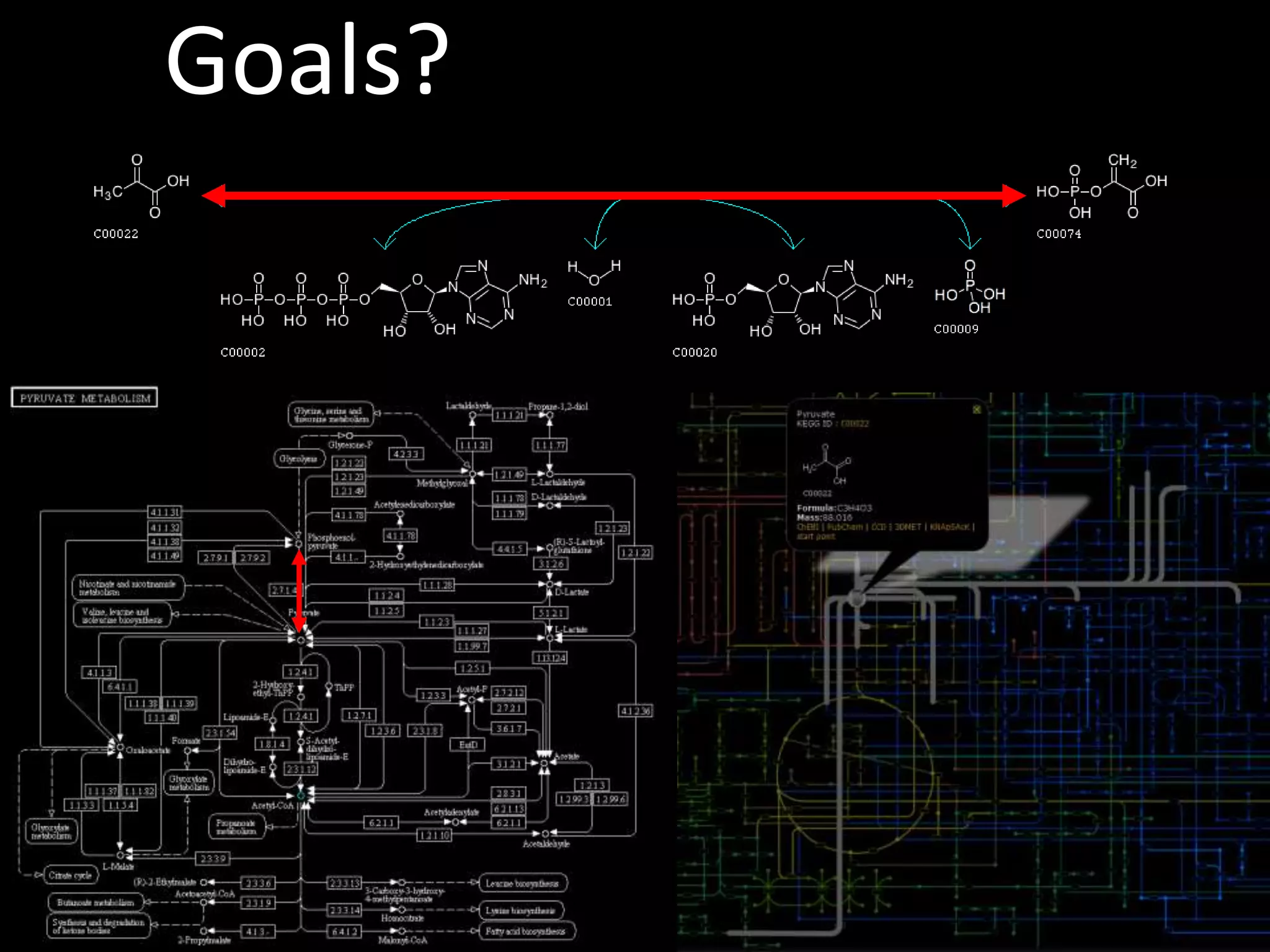
Goals?
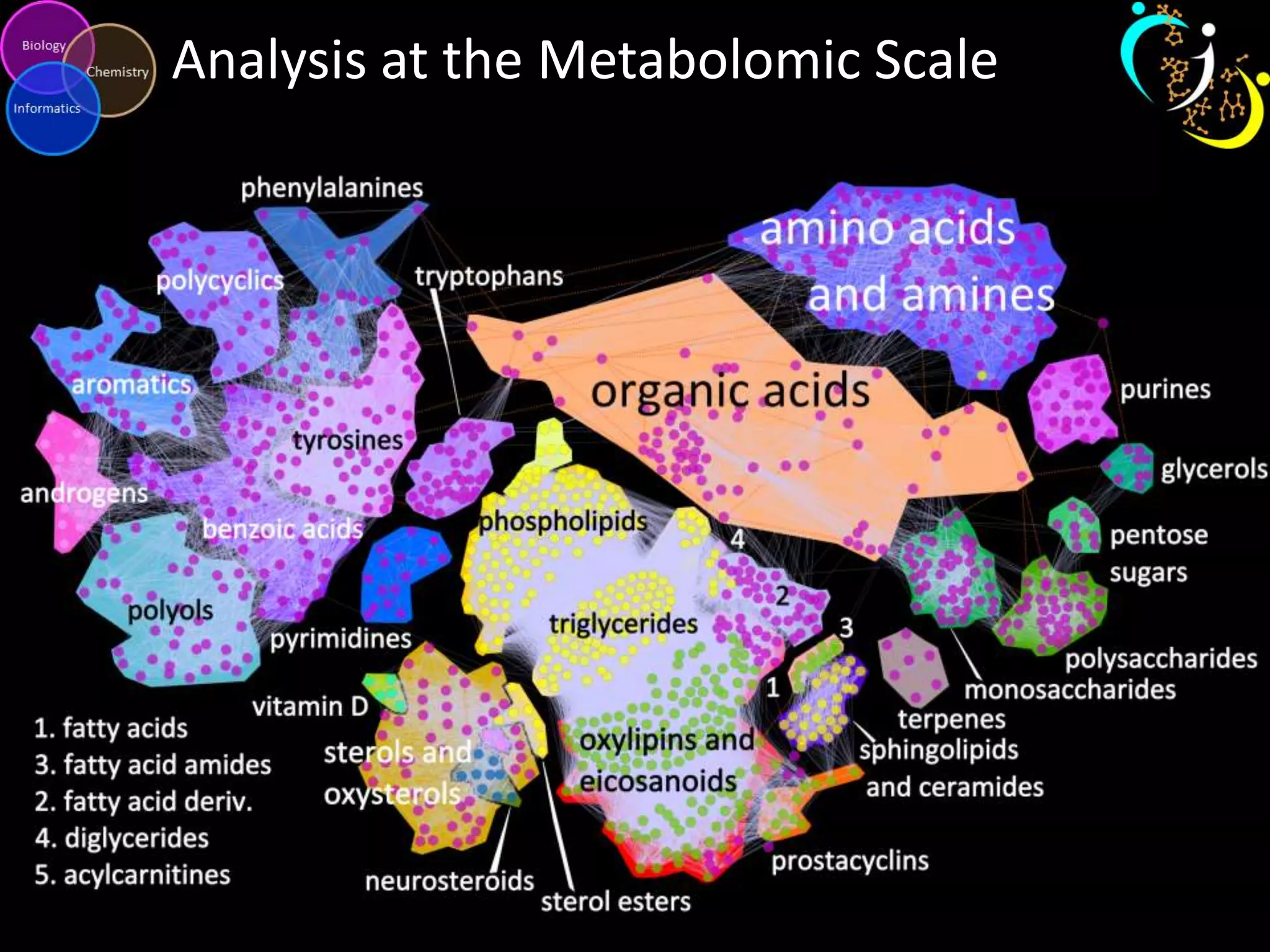
Analysis at the Metabolomic Scale
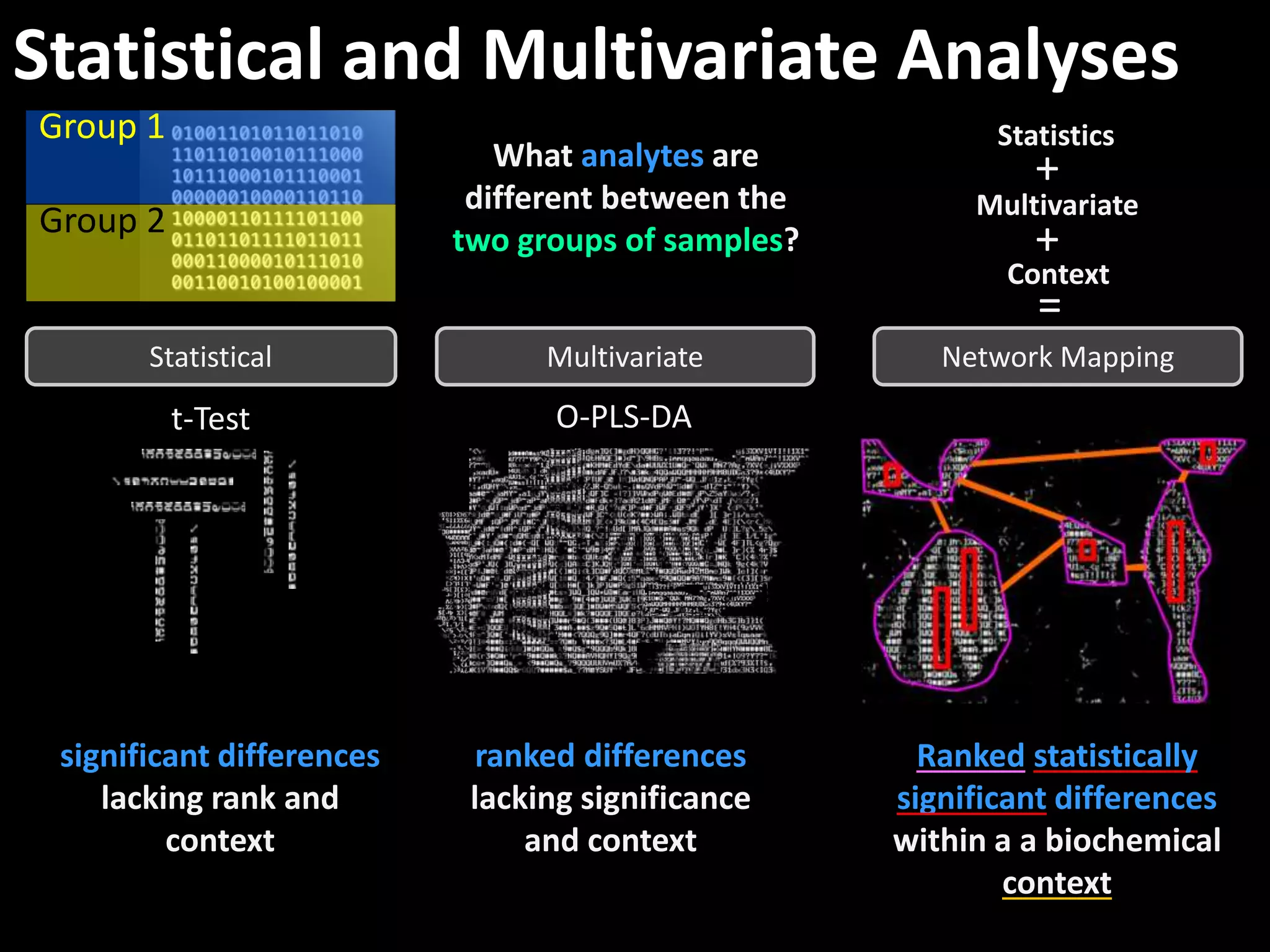
Statistical and Multivariate Analyses 
Group 1 
Statistics 
+ 
+ 
= 
Multivariate 
Context 
Network Mapping 
Ranked statistically 
significant differences 
within a a biochemical 
context 
Group 2 
What analytes are 
different between the 
two groups of samples? 
Statistical 
t-Test 
significant differences 
lacking rank and 
context 
Multivariate 
O-PLS-DA 
ranked differences 
lacking significance 
and context
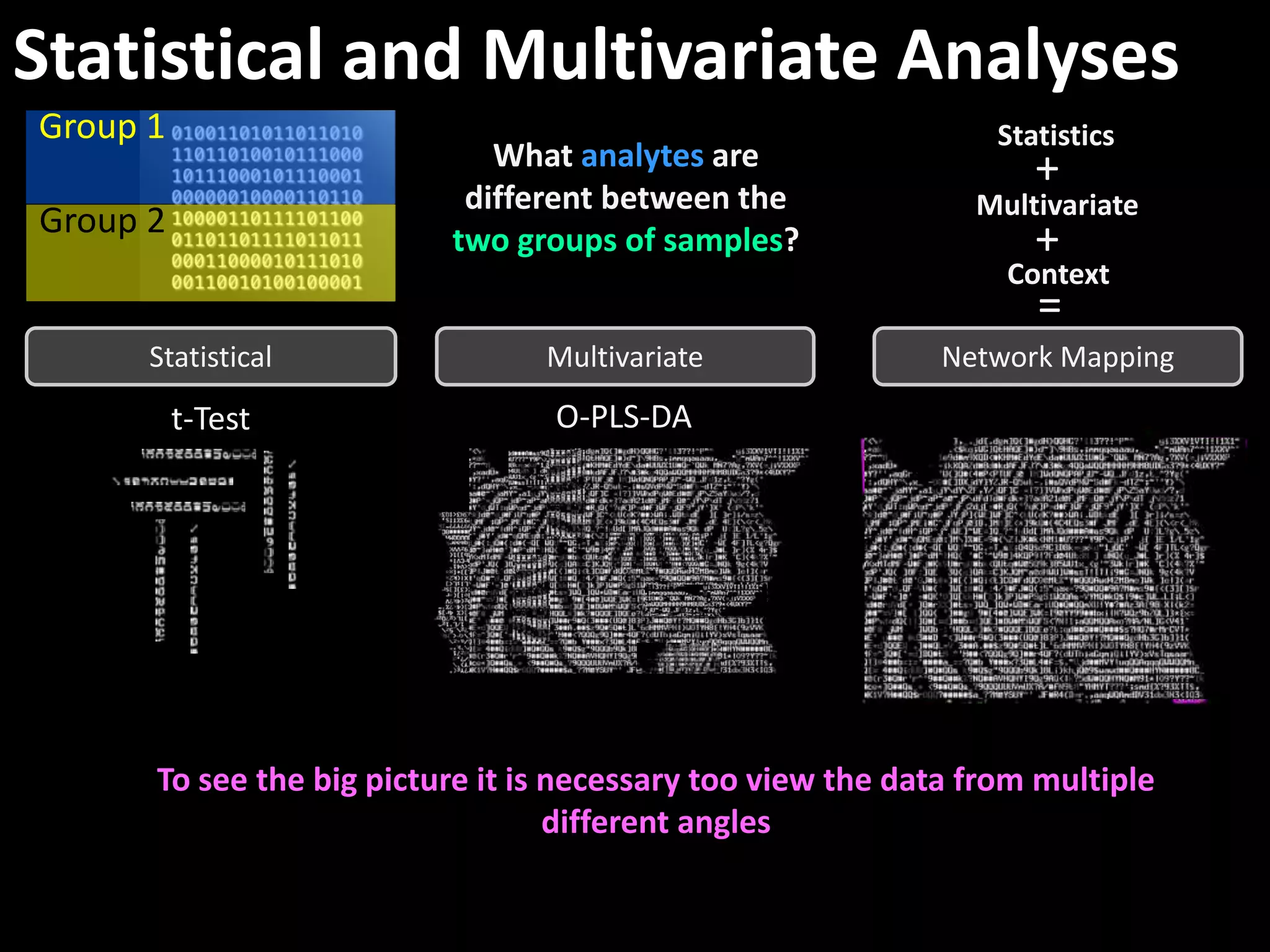
Statistical and Multivariate Analyses 
Group 1 
Statistics 
+ 
+ 
= 
Multivariate 
Context 
Network Mapping 
Group 2 
What analytes are 
different between the 
two groups of samples? 
Statistical 
t-Test 
Multivariate 
O-PLS-DA 
To see the big picture it is necessary too view the data from multiple 
different angles
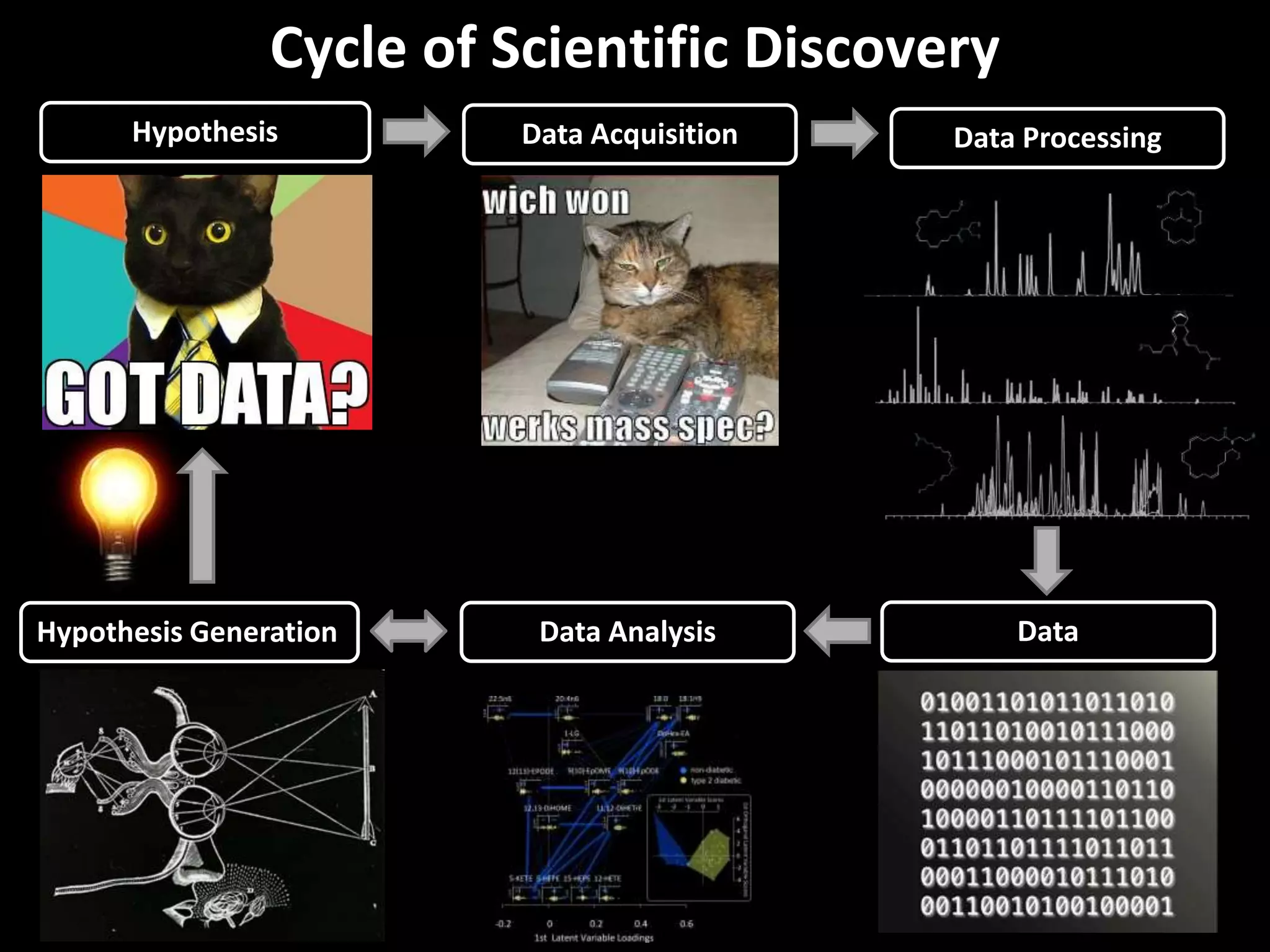
Cycle of Scientific Discovery 
Hypothesis Data Acquisition 
Data Processing 
Hypothesis Generation Data Analysis Data
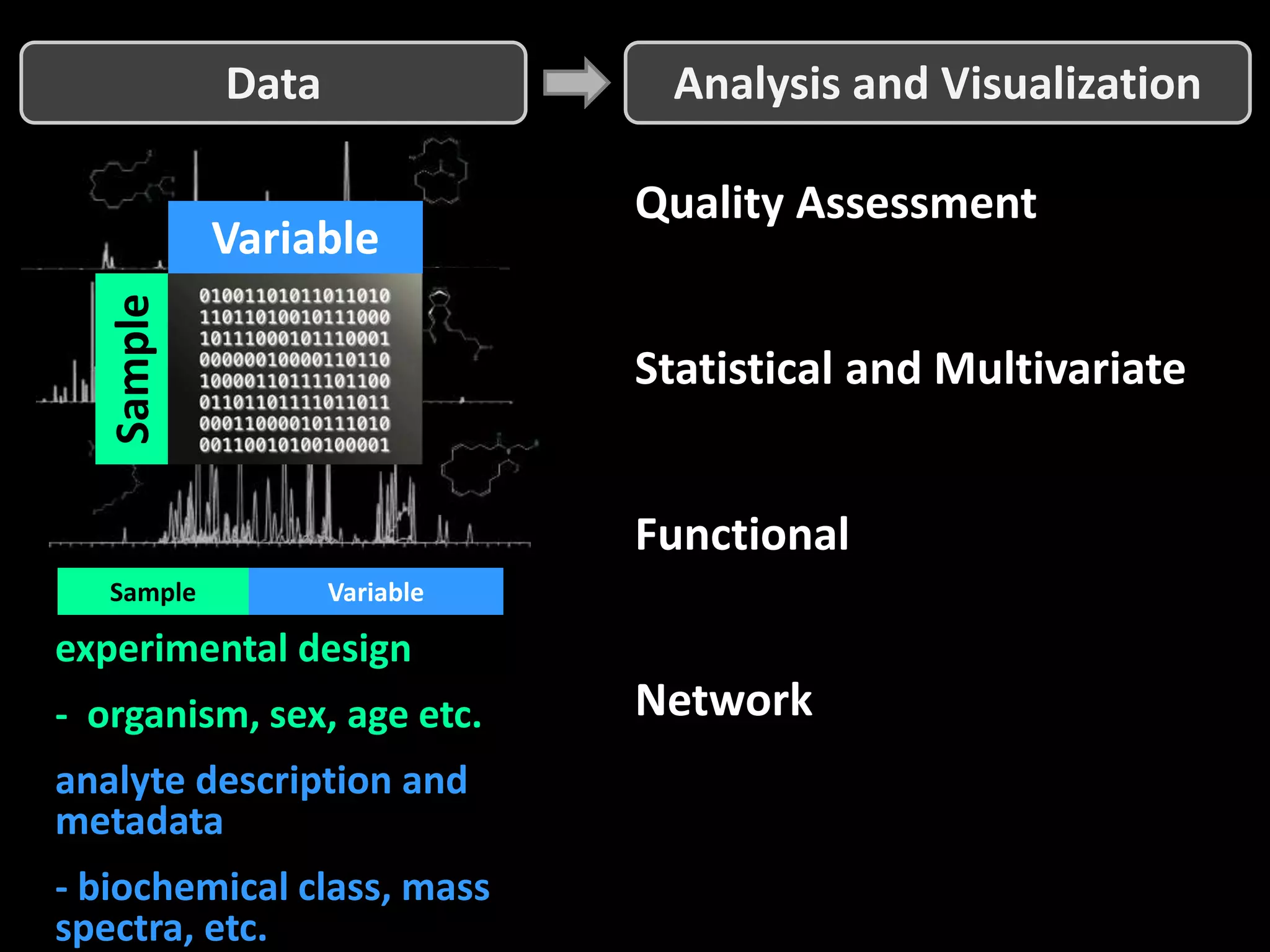
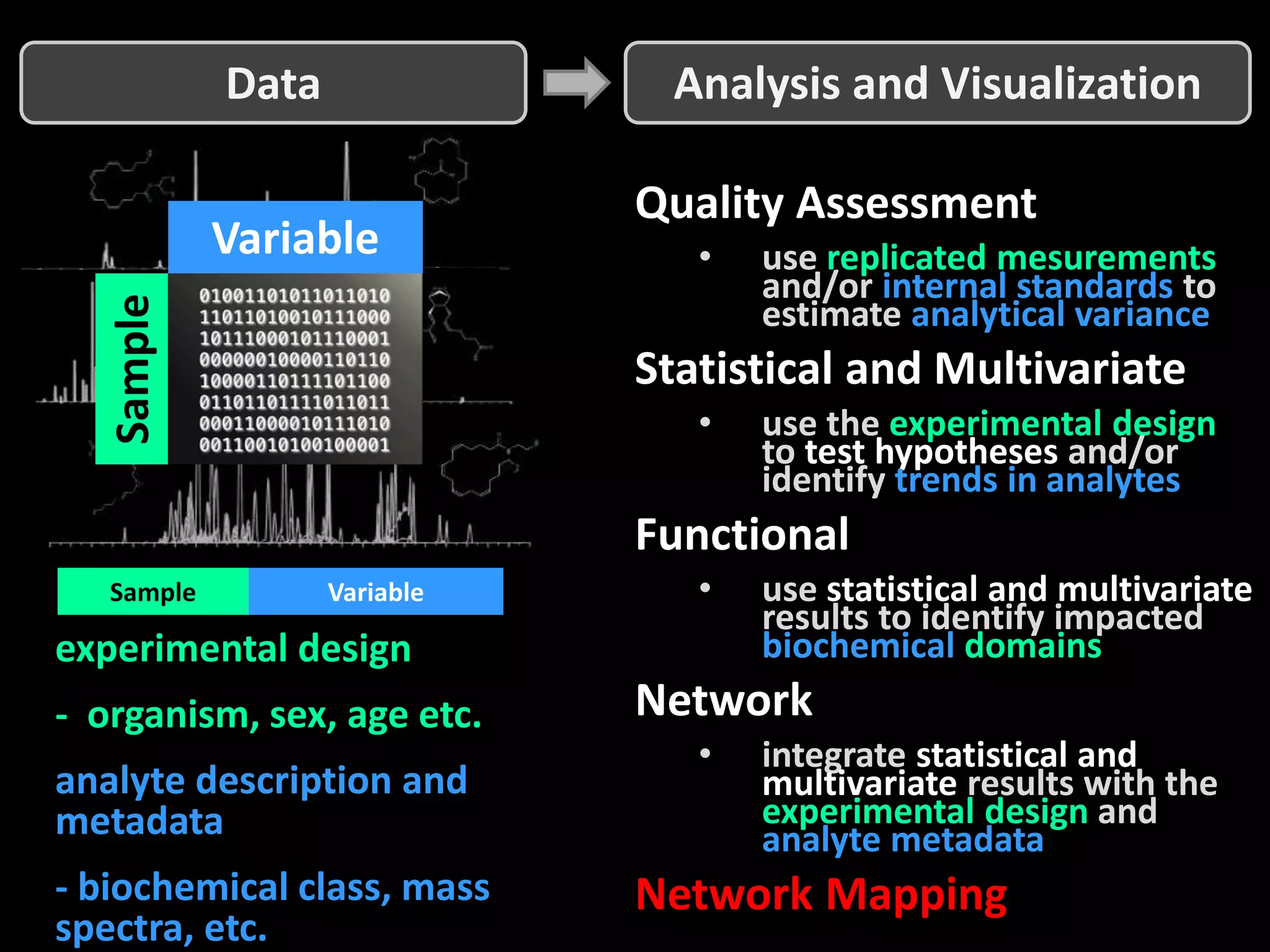
Sample 
Data Analysis and Visualization 
Variable 
Quality Assessment 
• use replicated mesurements 
and/or internal standards to 
estimate analytical variance 
Statistical and Multivariate 
• use the experimental design 
to test hypotheses and/or 
identify trends in analytes 
Functional 
• use statistical and multivariate 
results to identify impacted 
biochemical domains 
Network 
• integrate statistical and 
multivariate results with the 
experimental design and 
analyte metadata 
Sample Variable 
experimental design 
- organism, sex, age etc. 
analyte description and 
metadata 
- biochemical class, mass 
spectra, etc.
Sample 
Data Analysis and Visualization 
Variable 
Quality Assessment 
• use replicated mesurements 
and/or internal standards to 
estimate analytical variance 
Statistical and Multivariate 
• use the experimental design 
to test hypotheses and/or 
identify trends in analytes 
Functional 
• use statistical and multivariate 
results to identify impacted 
biochemical domains 
Network 
• integrate statistical and 
multivariate results with the 
experimental design and 
analyte metadata 
Network Mapping 
Sample Variable 
experimental design 
- organism, sex, age etc. 
analyte description and 
metadata 
- biochemical class, mass 
spectra, etc.
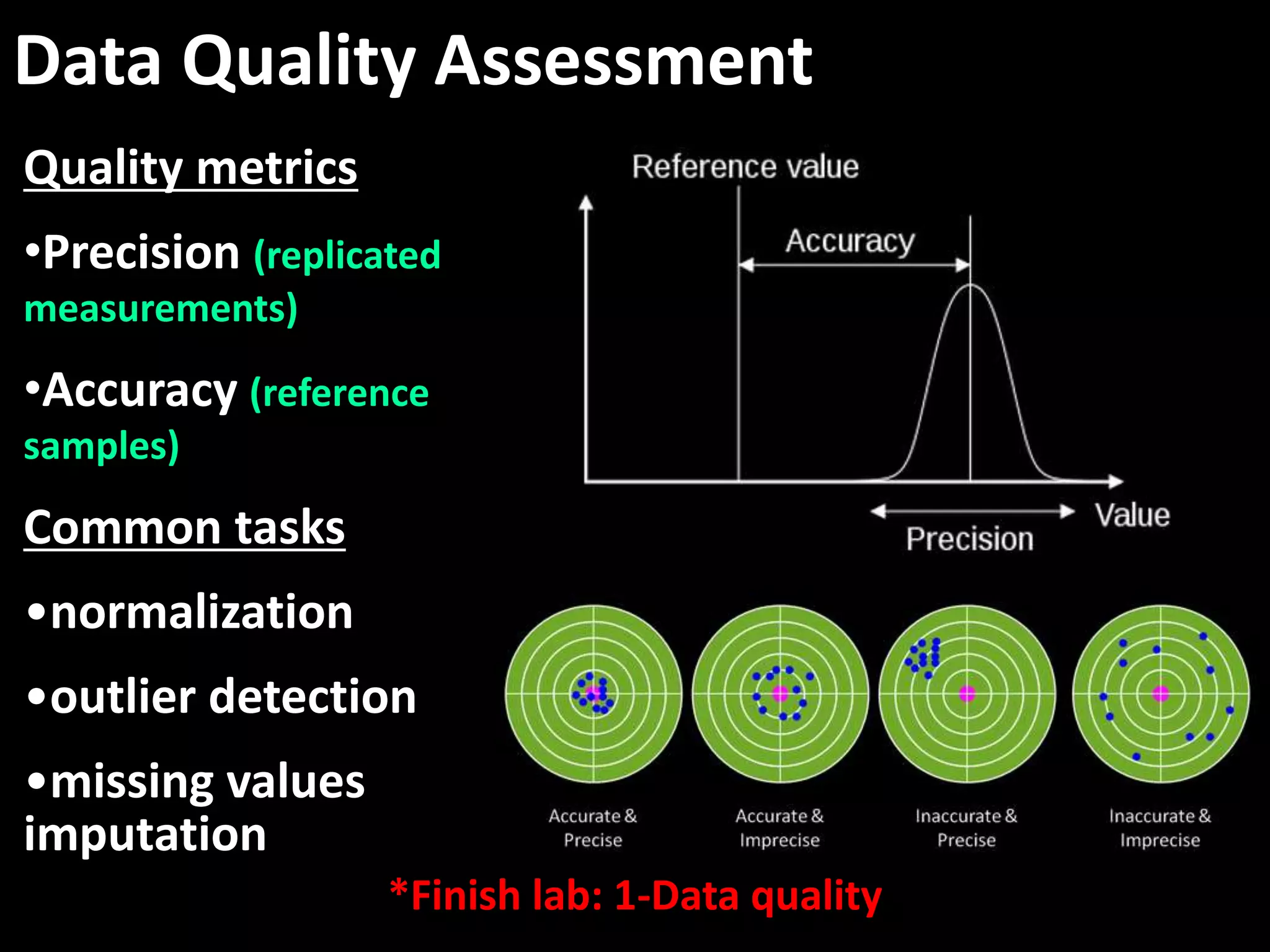
Data Quality Assessment 
Quality metrics 
•Precision (replicated 
measurements) 
•Accuracy (reference 
samples) 
Common tasks 
•normalization 
•outlier detection 
•missing values 
imputation 
*Finish lab: 1-Data quality
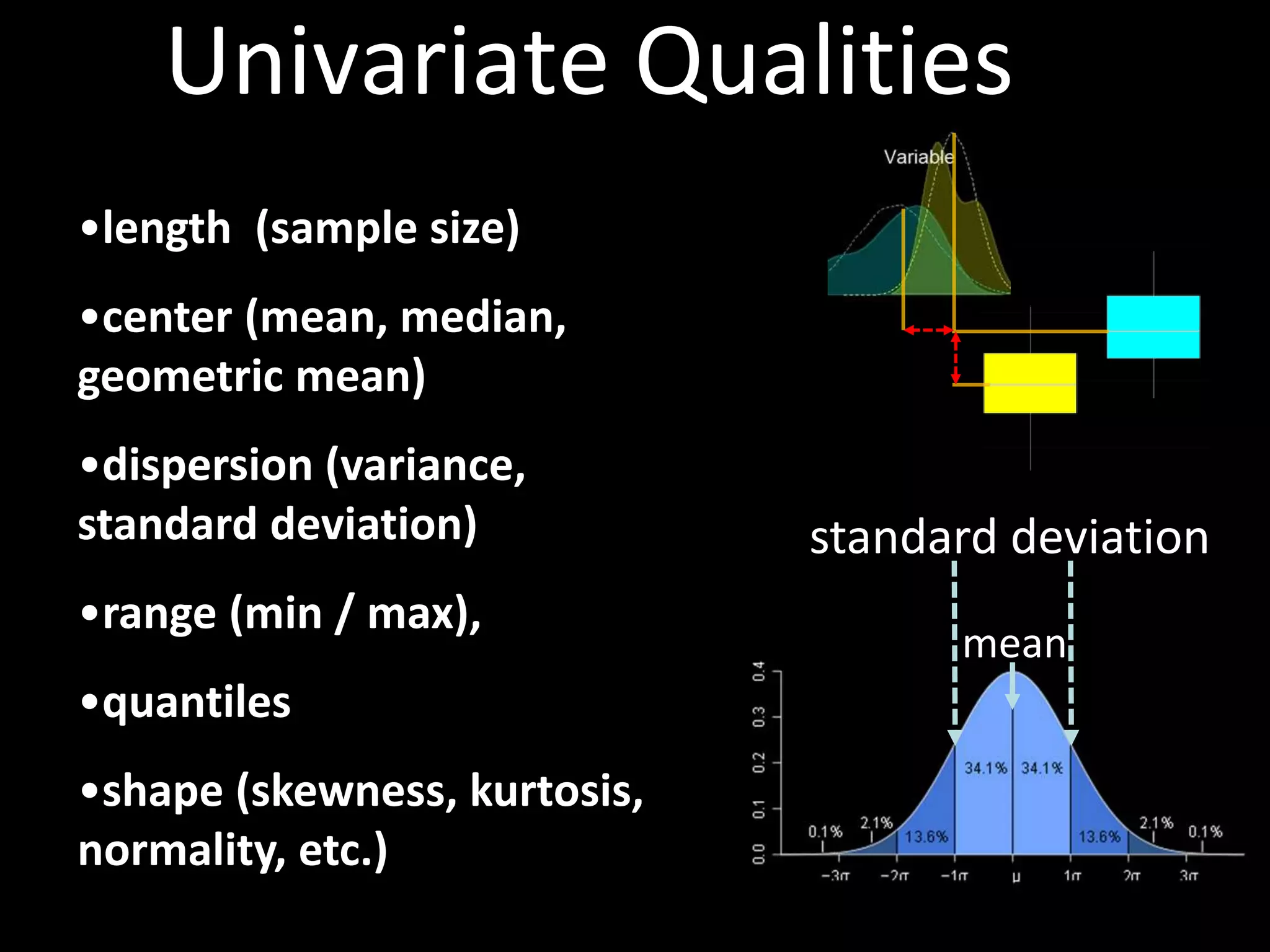
Univariate Qualities 
•length (sample size) 
•center (mean, median, 
geometric mean) 
•dispersion (variance, 
standard deviation) 
•range (min / max), 
•quantiles 
•shape (skewness, kurtosis, 
normality, etc.) 
standard deviation 
mean
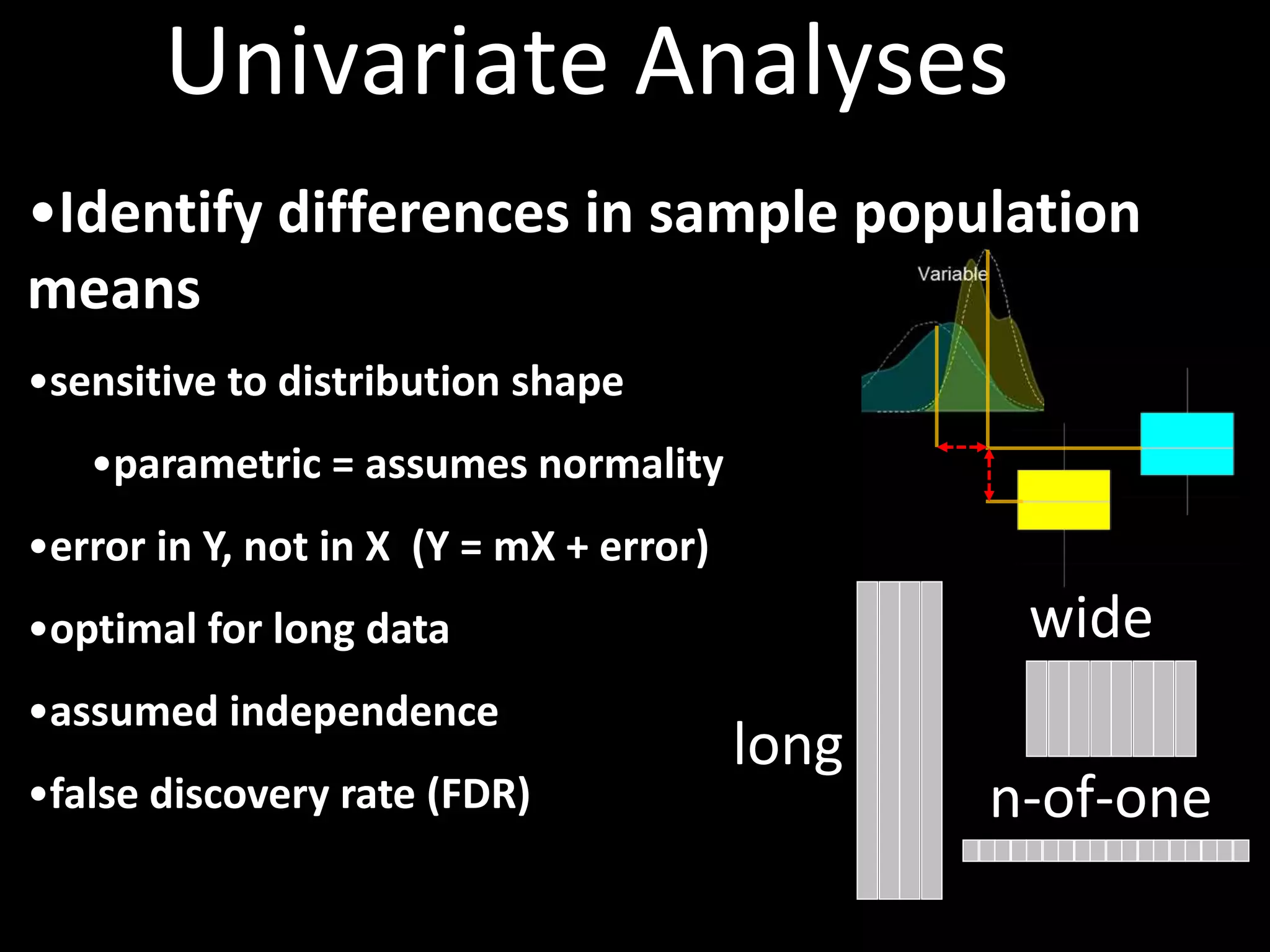
Univariate Analyses 
•Identify differences in sample population 
means 
•sensitive to distribution shape 
•parametric = assumes normality 
•error in Y, not in X (Y = mX + error) 
•optimal for long data 
•assumed independence 
•false discovery rate (FDR) 
long 
wide 
n-of-one
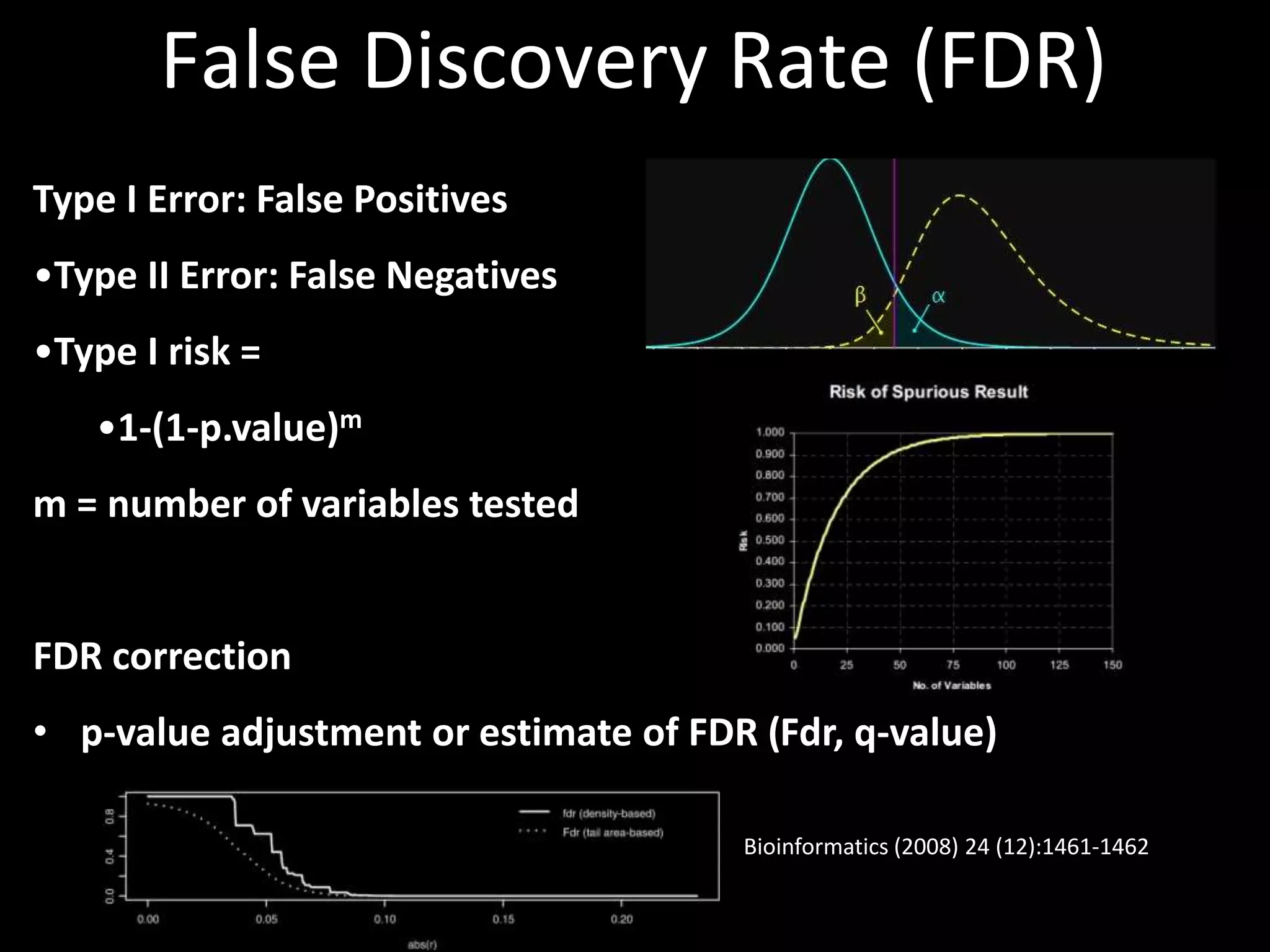
False Discovery Rate (FDR) 
Type I Error: False Positives 
•Type II Error: False Negatives 
•Type I risk = 
•1-(1-p.value)m 
m = number of variables tested 
FDR correction 
• p-value adjustment or estimate of FDR (Fdr, q-value) 
Bioinformatics (2008) 24 (12):1461-1462
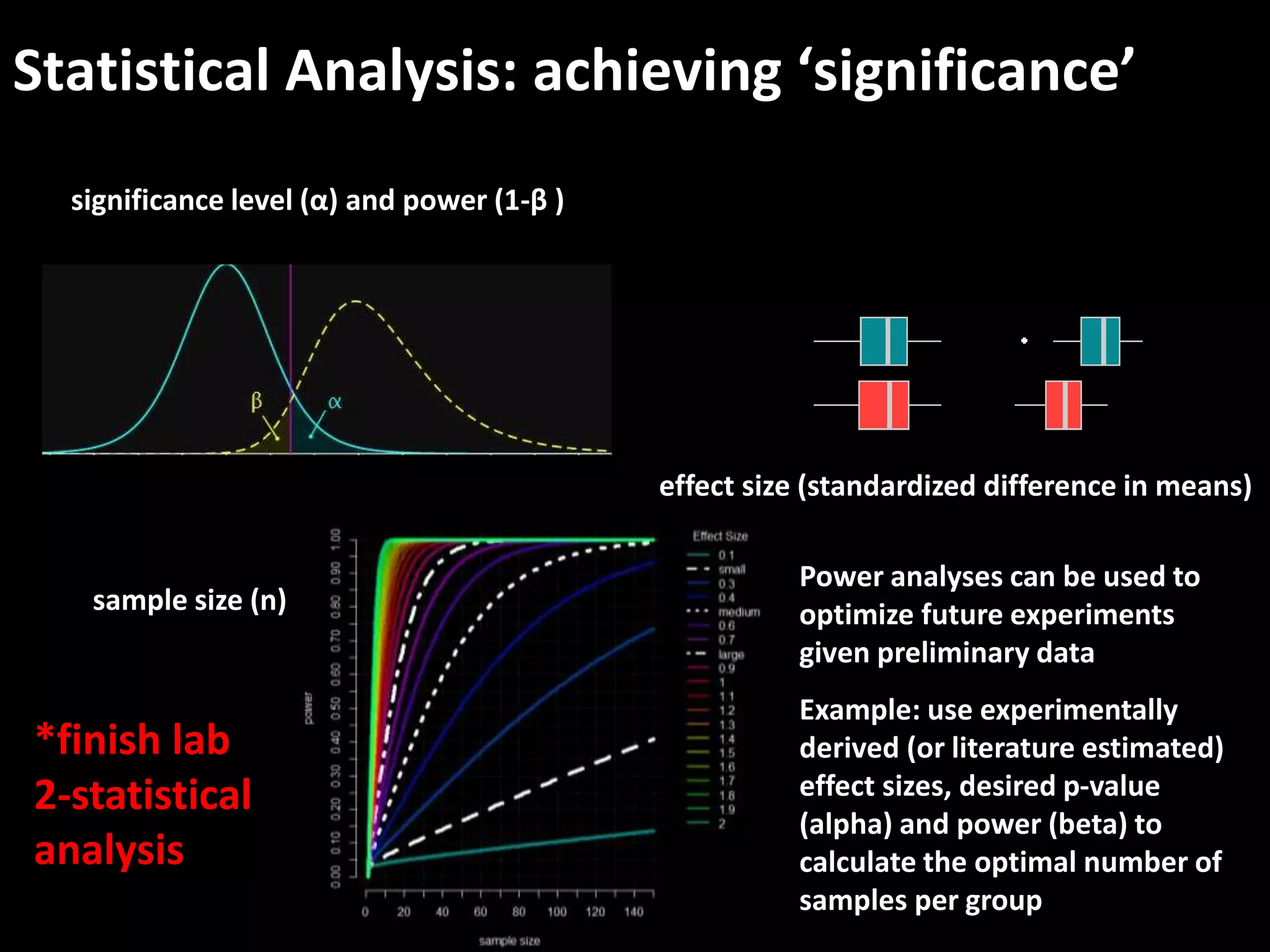
Statistical Analysis: achieving ‘significance’ 
significance level (α) and power (1-β ) 
effect size (standardized difference in means) 
sample size (n) 
Power analyses can be used to 
optimize future experiments 
given preliminary data 
Example: use experimentally 
derived (or literature estimated) 
effect sizes, desired p-value 
(alpha) and power (beta) to 
calculate the optimal number of 
samples per group 
*finish lab 
2-statistical 
analysis
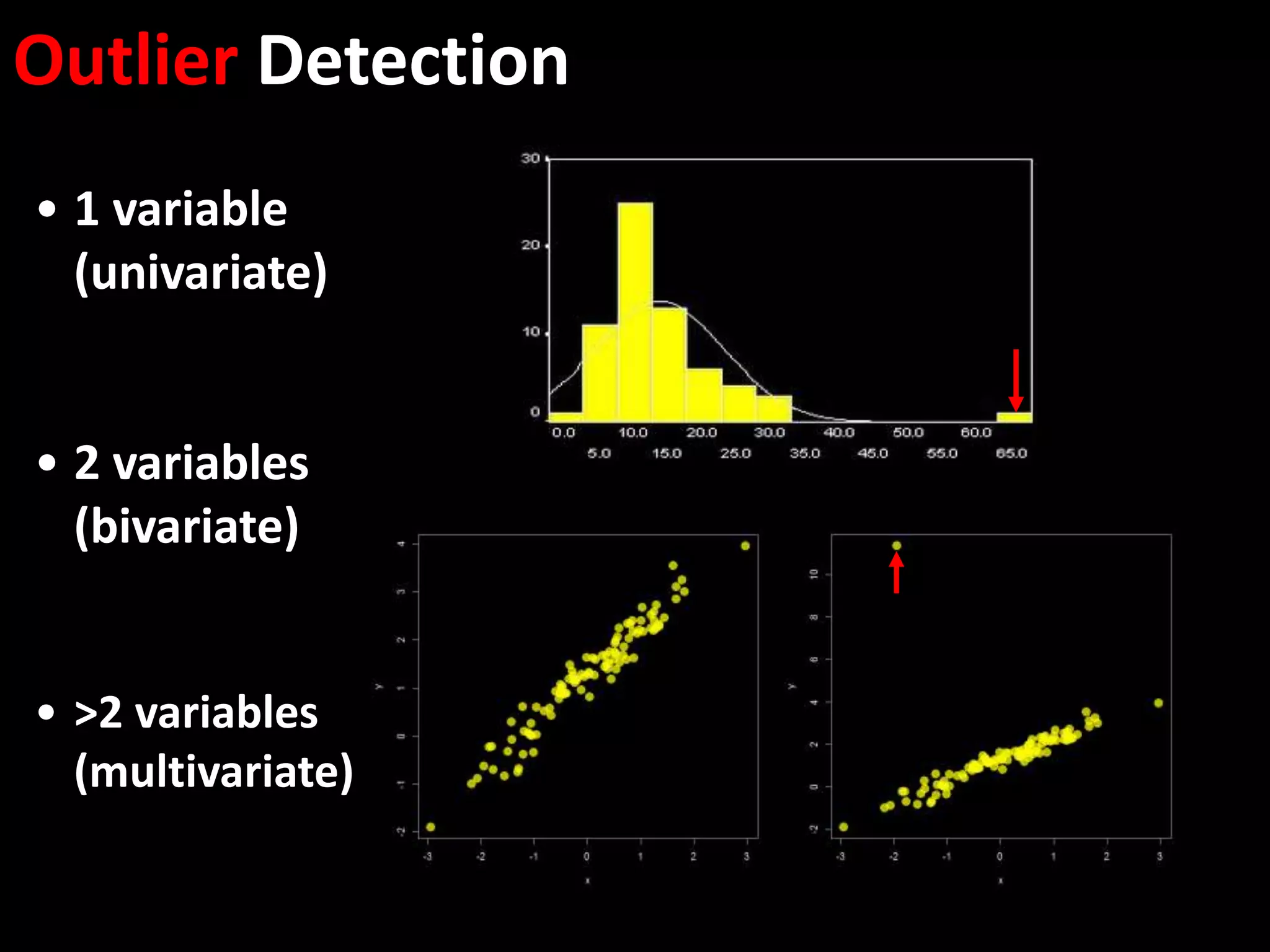
Outlier Detection 
• 1 variable 
(univariate) 
• 2 variables 
(bivariate) 
• >2 variables 
(multivariate)
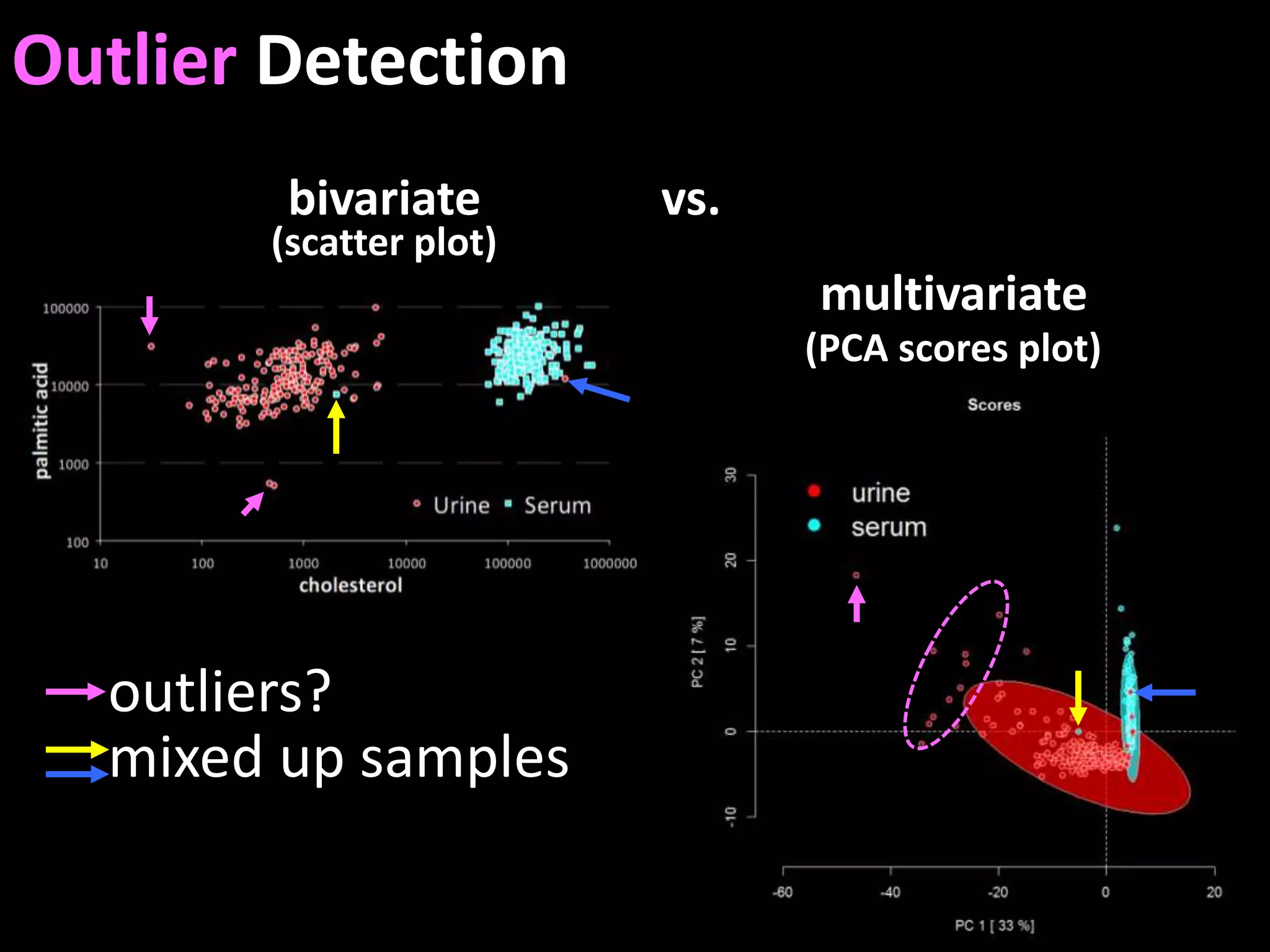
bivariate vs. 
multivariate 
(scatter plot) 
outliers? 
mixed up samples 
(PCA scores plot) 
Outlier Detection
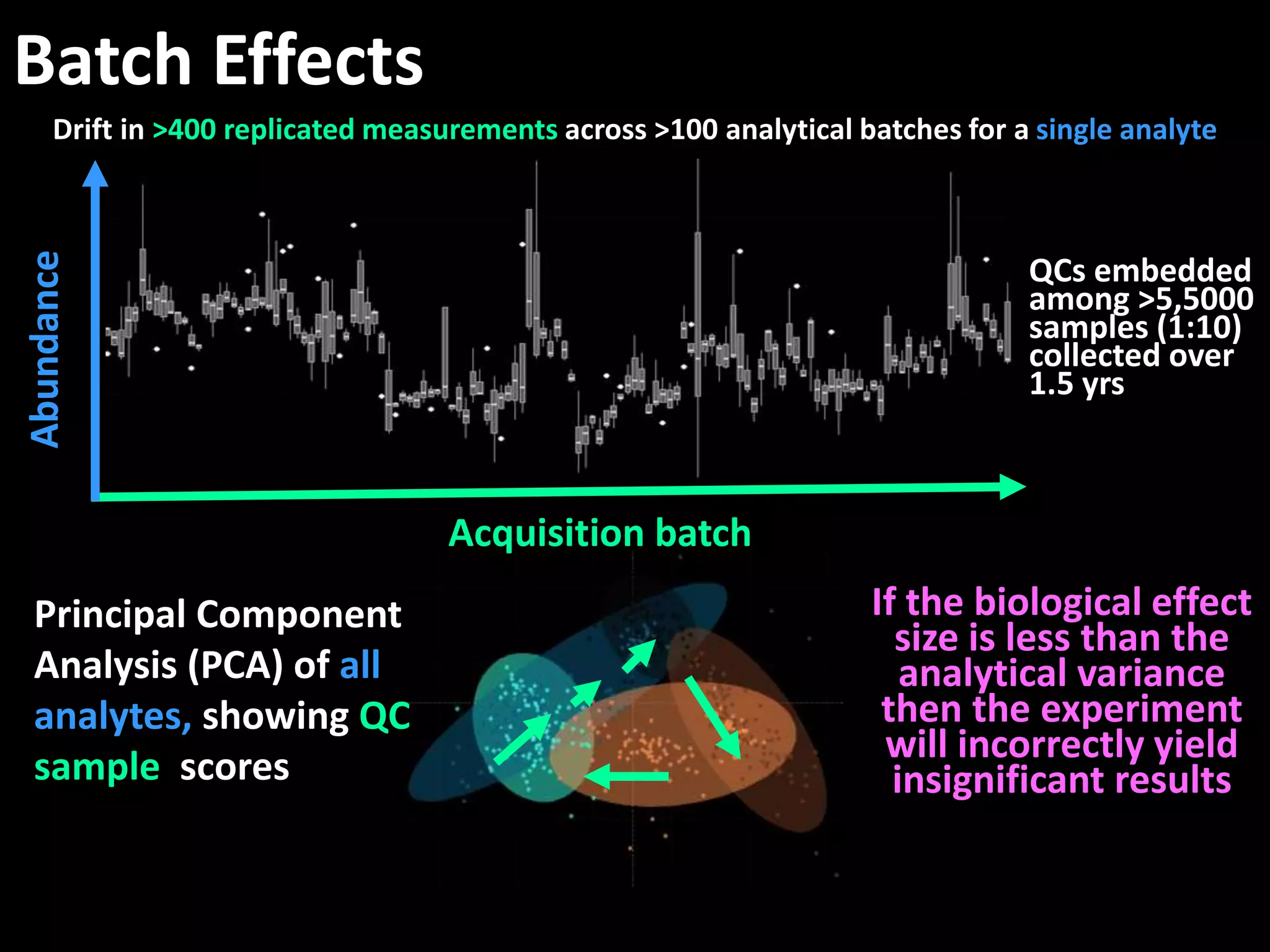
Batch Effects 
Drift in >400 replicated measurements across >100 analytical batches for a single analyte 
Principal Component 
Analysis (PCA) of all 
analytes, showing QC 
sample scores 
Acquisition batch 
Abundance 
QCs embedded 
among >5,5000 
samples (1:10) 
collected over 
1.5 yrs 
If the biological effect 
size is less than the 
analytical variance 
then the experiment 
will incorrectly yield 
insignificant results
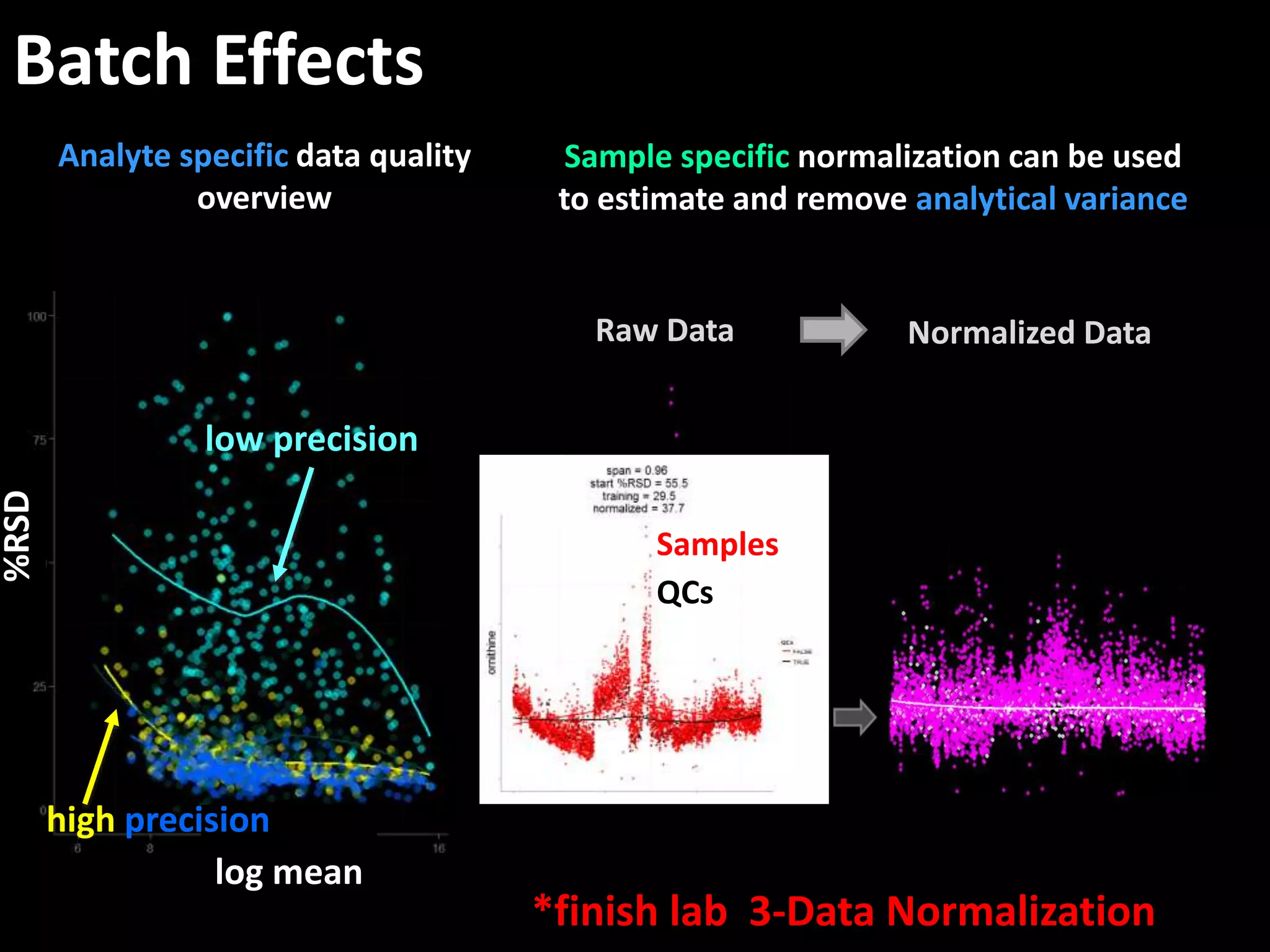
Analyte specific data quality 
overview 
Sample specific normalization can be used 
to estimate and remove analytical variance 
Raw Data Normalized Data 
low precision 
log mean 
%RSD 
high precision 
Samples 
QCs 
Batch Effects 
*finish lab 3-Data Normalization
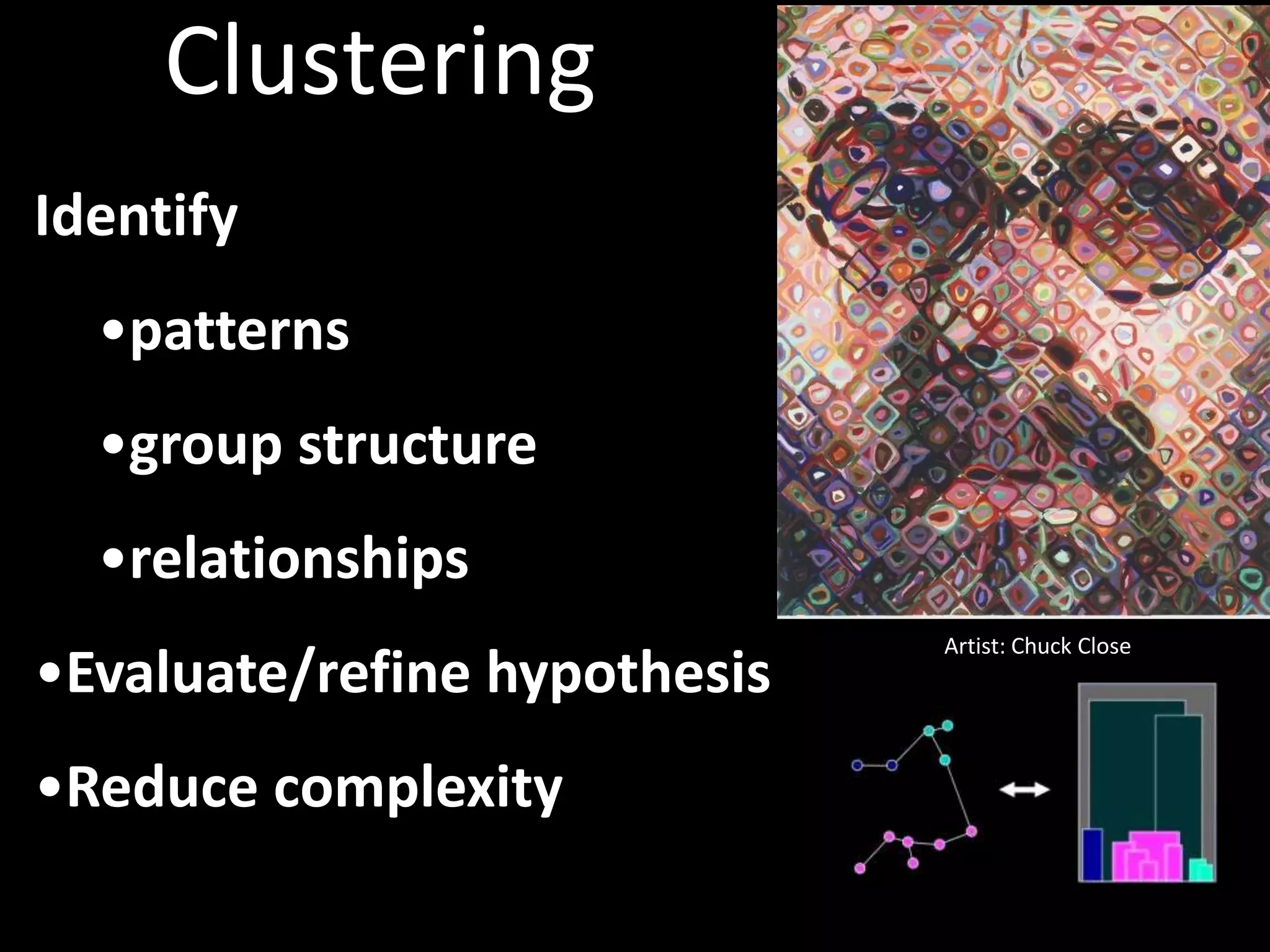
Clustering 
Identify 
•patterns 
•group structure 
•relationships 
•Evaluate/refine hypothesis 
•Reduce complexity 
Artist: Chuck Close
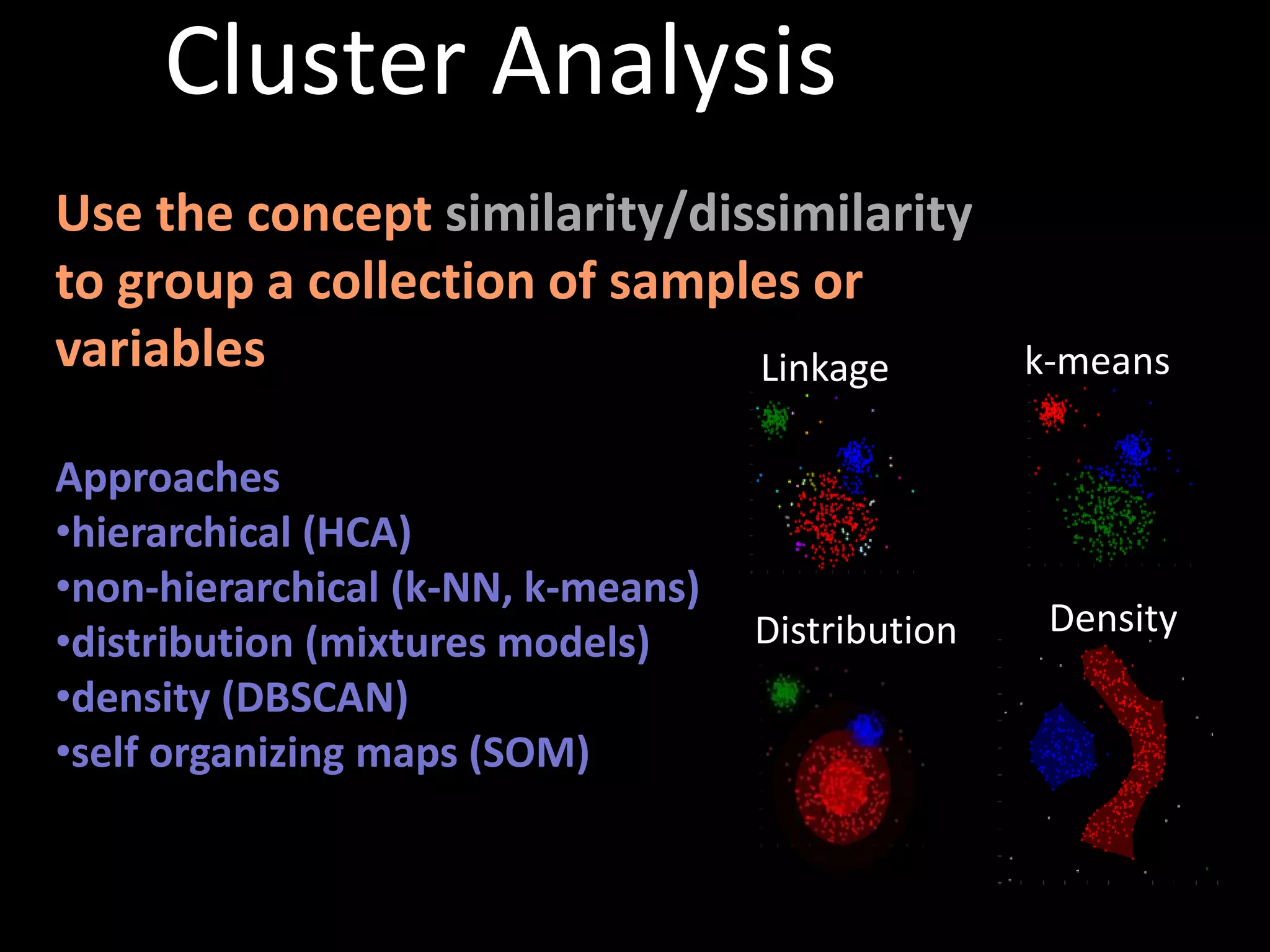
Cluster Analysis 
Use the concept similarity/dissimilarity 
to group a collection of samples or 
variables 
Approaches 
•hierarchical (HCA) 
•non-hierarchical (k-NN, k-means) 
•distribution (mixtures models) 
•density (DBSCAN) 
•self organizing maps (SOM) 
Linkage k-means 
Distribution Density
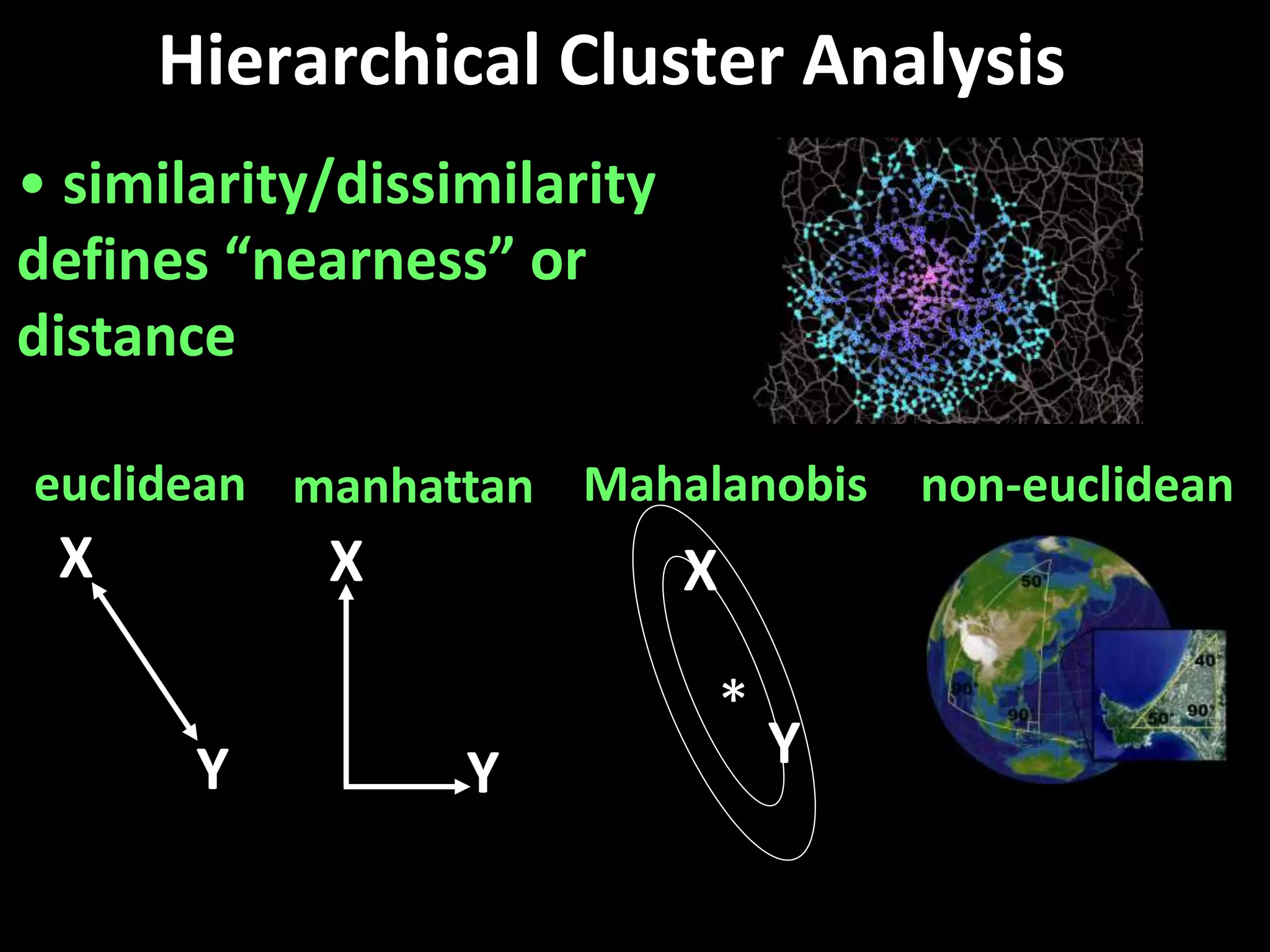
Hierarchical Cluster Analysis 
• similarity/dissimilarity 
defines “nearness” or 
distance 
euclidean 
X 
Y 
manhattan Mahalanobis 
X 
Y 
X 
Y 
* 
non-euclidean
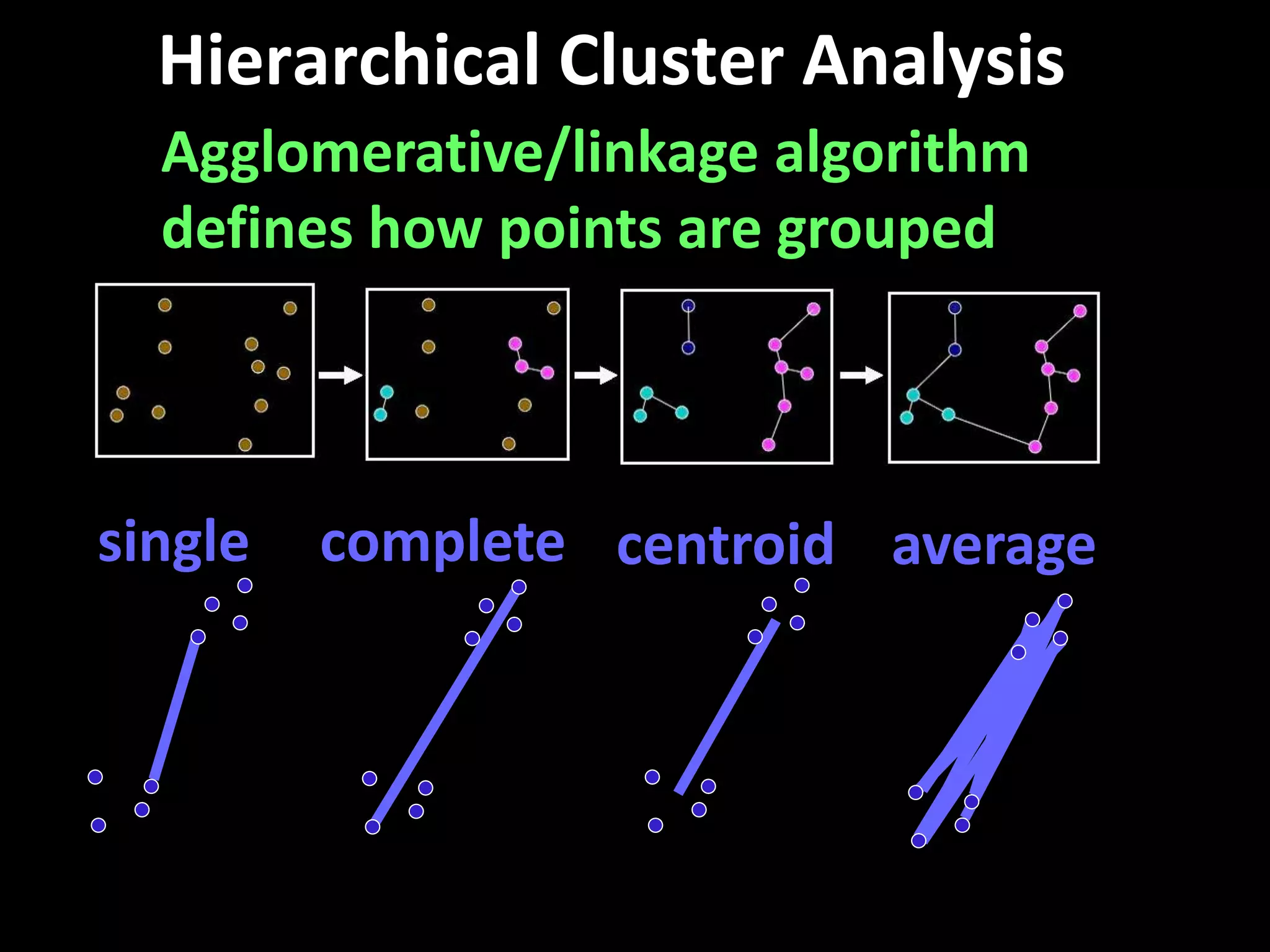
Hierarchical Cluster Analysis 
Agglomerative/linkage algorithm 
defines how points are grouped 
single complete centroid average
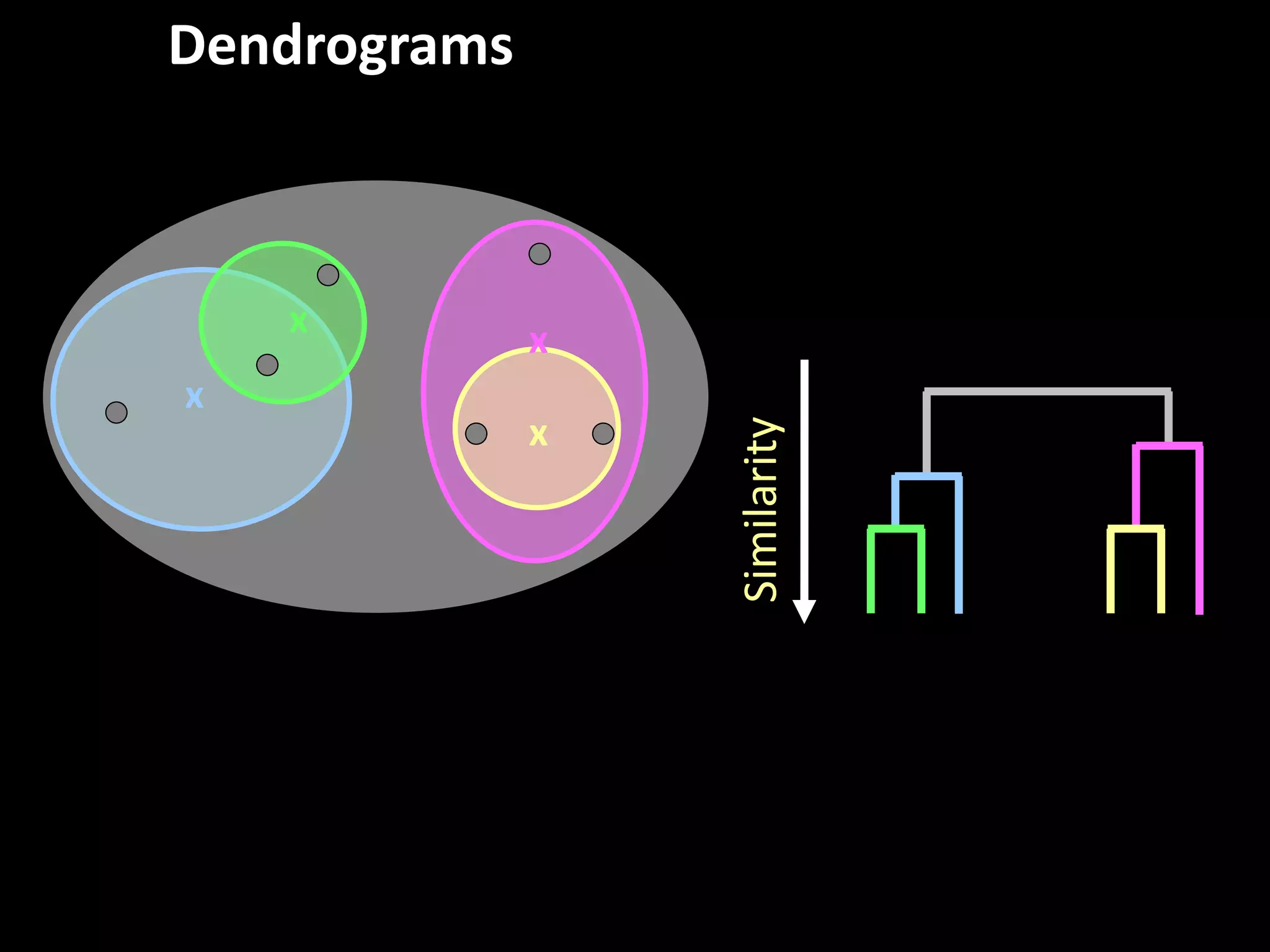
Dendrograms 
Similarity 
x 
x 
x 
x
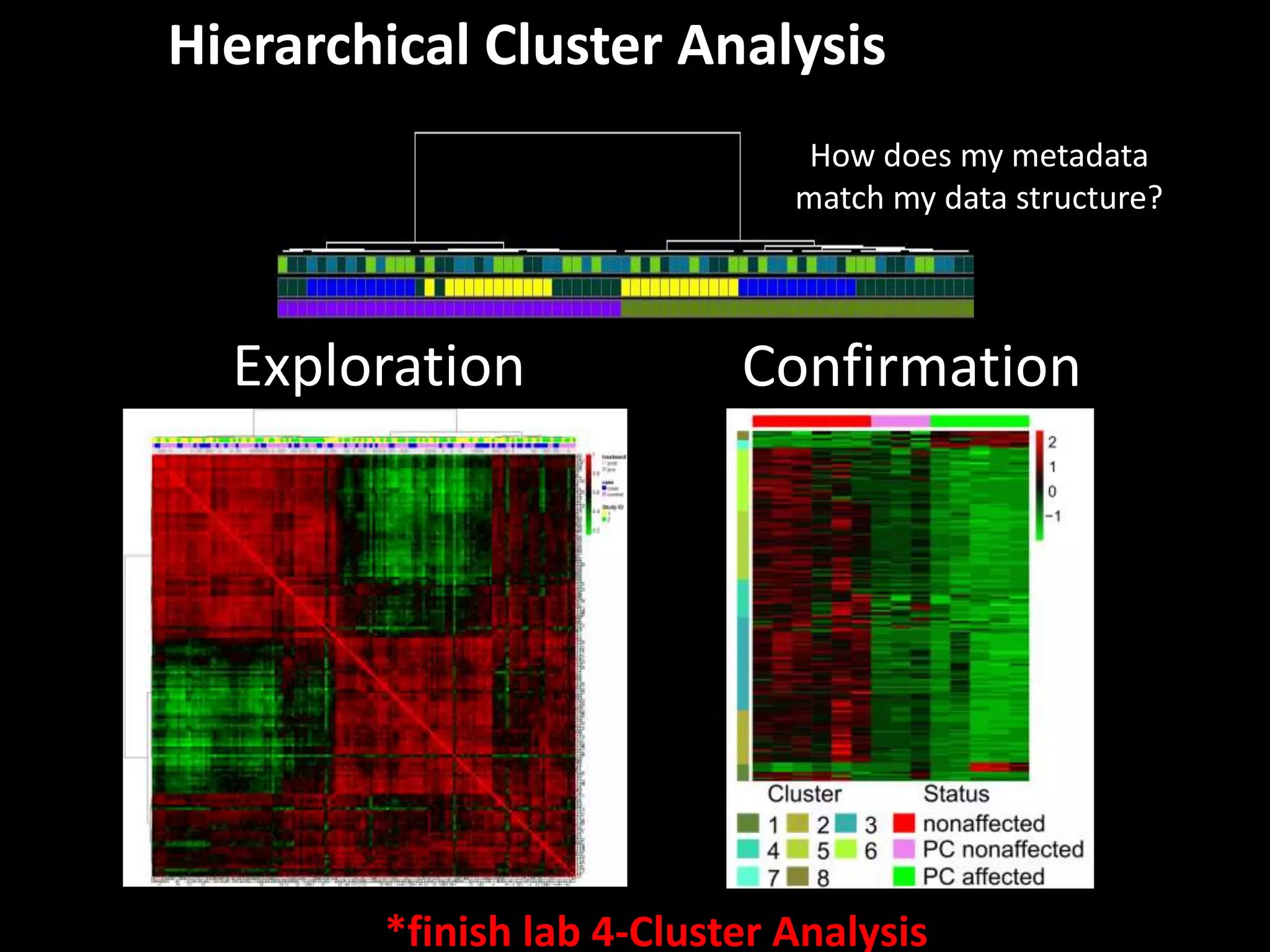
Hierarchical Cluster Analysis 
How does my metadata 
match my data structure? 
Exploration Confirmation 
*finish lab 4-Cluster Analysis
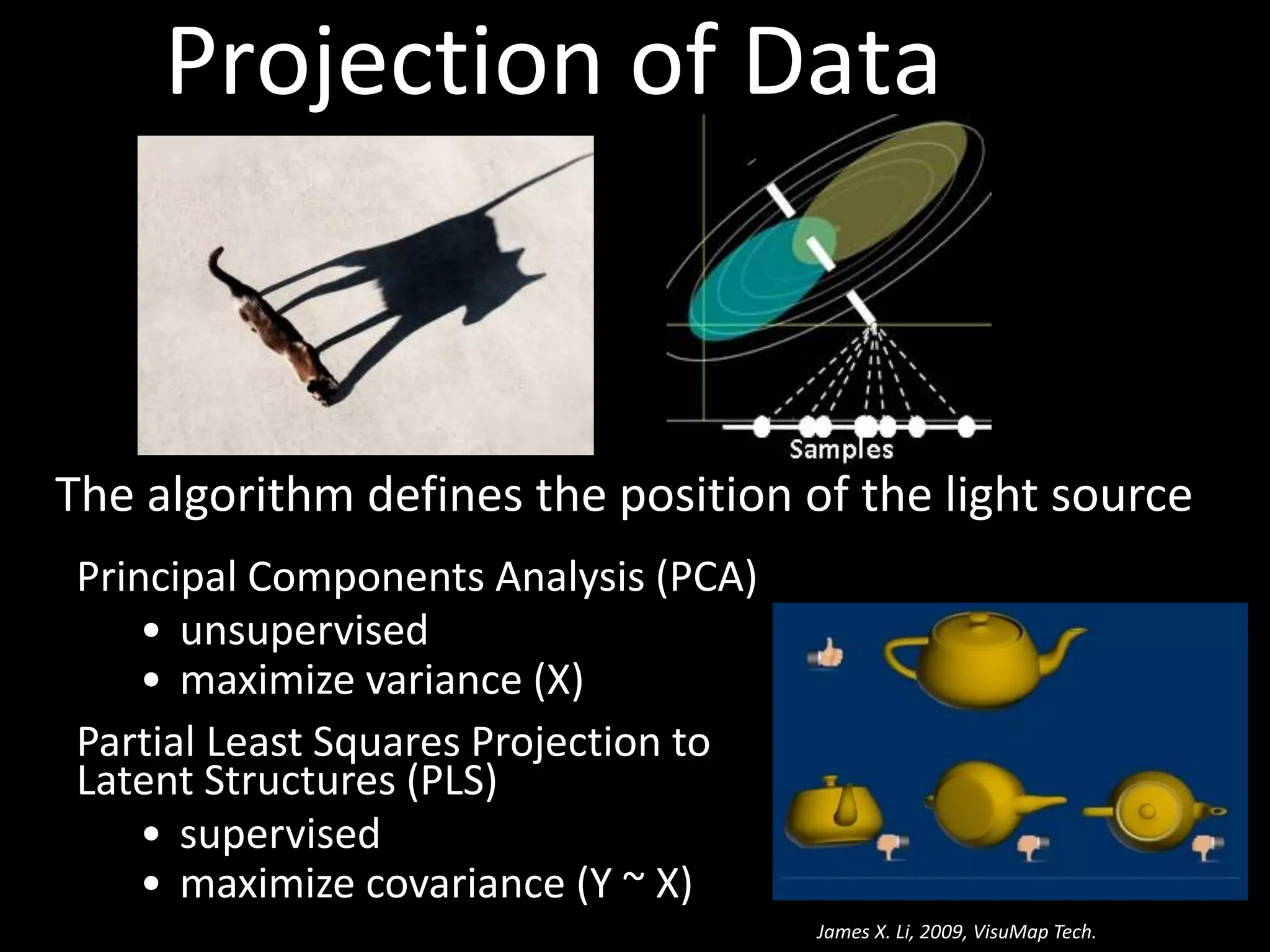
Projection of Data 
The algorithm defines the position of the light source 
Principal Components Analysis (PCA) 
• unsupervised 
• maximize variance (X) 
Partial Least Squares Projection to 
Latent Structures (PLS) 
• supervised 
• maximize covariance (Y ~ X) 
James X. Li, 2009, VisuMap Tech.
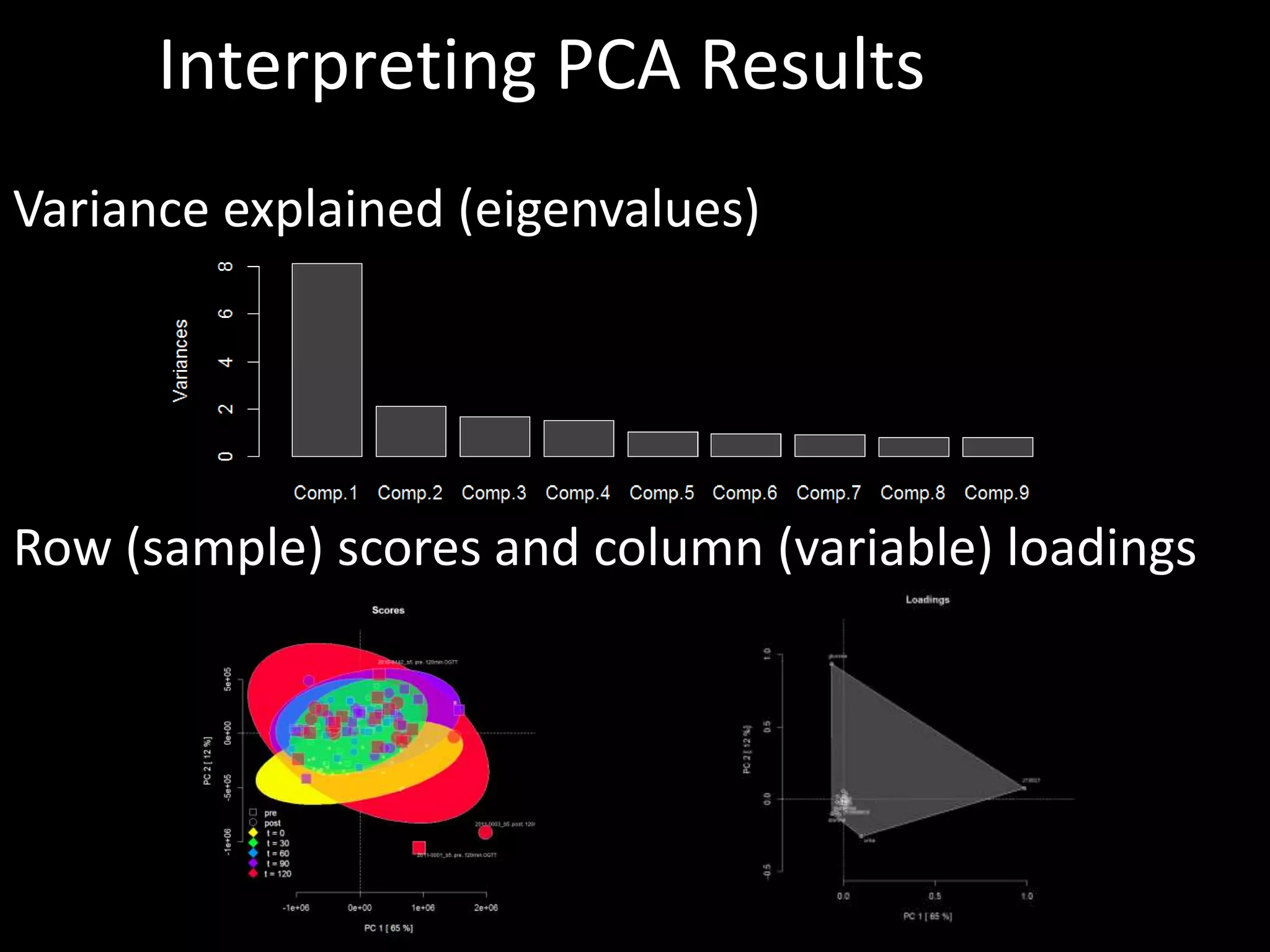
Interpreting PCA Results 
Variance explained (eigenvalues) 
Row (sample) scores and column (variable) loadings
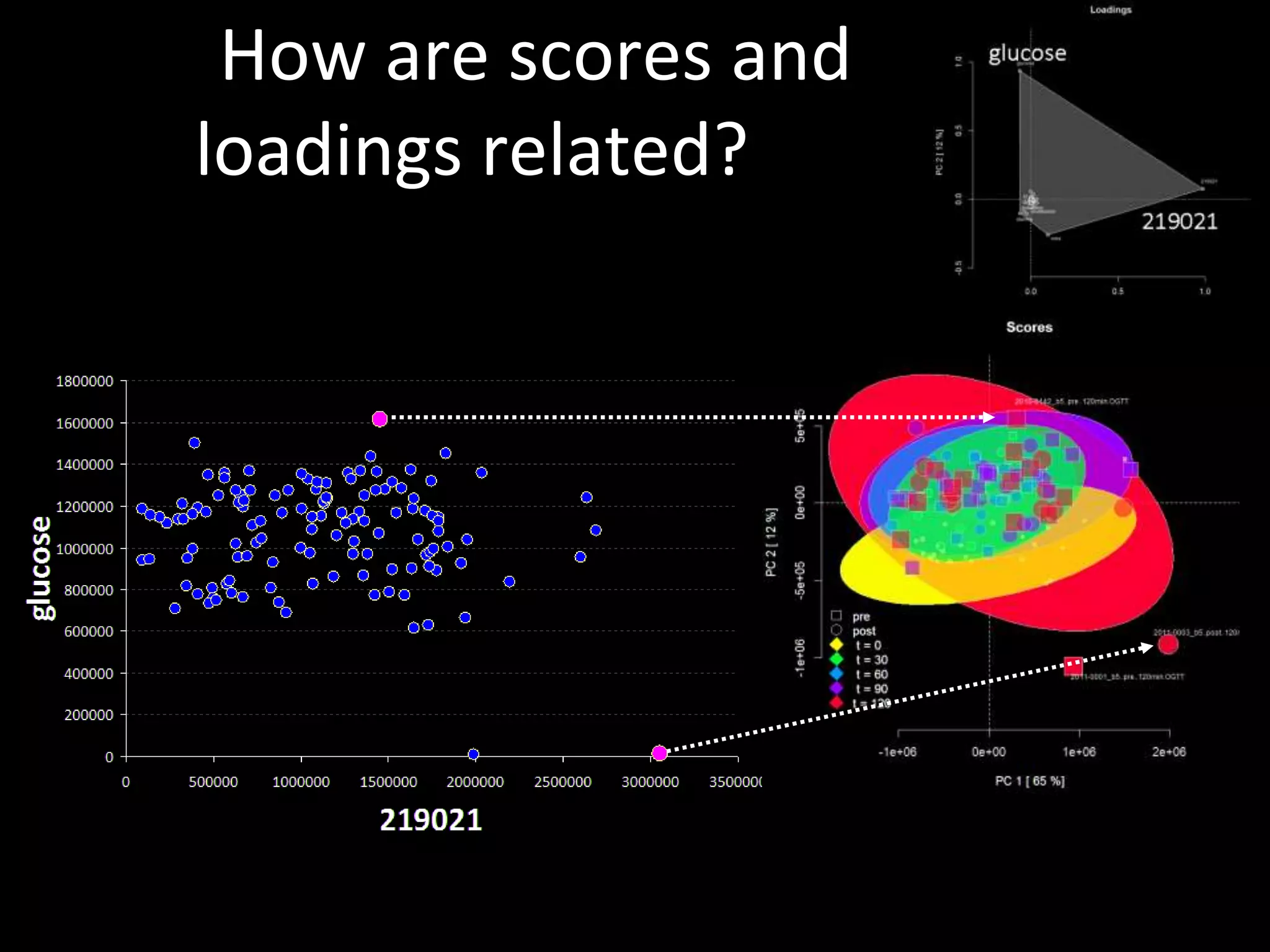
How are scores and 
loadings related?
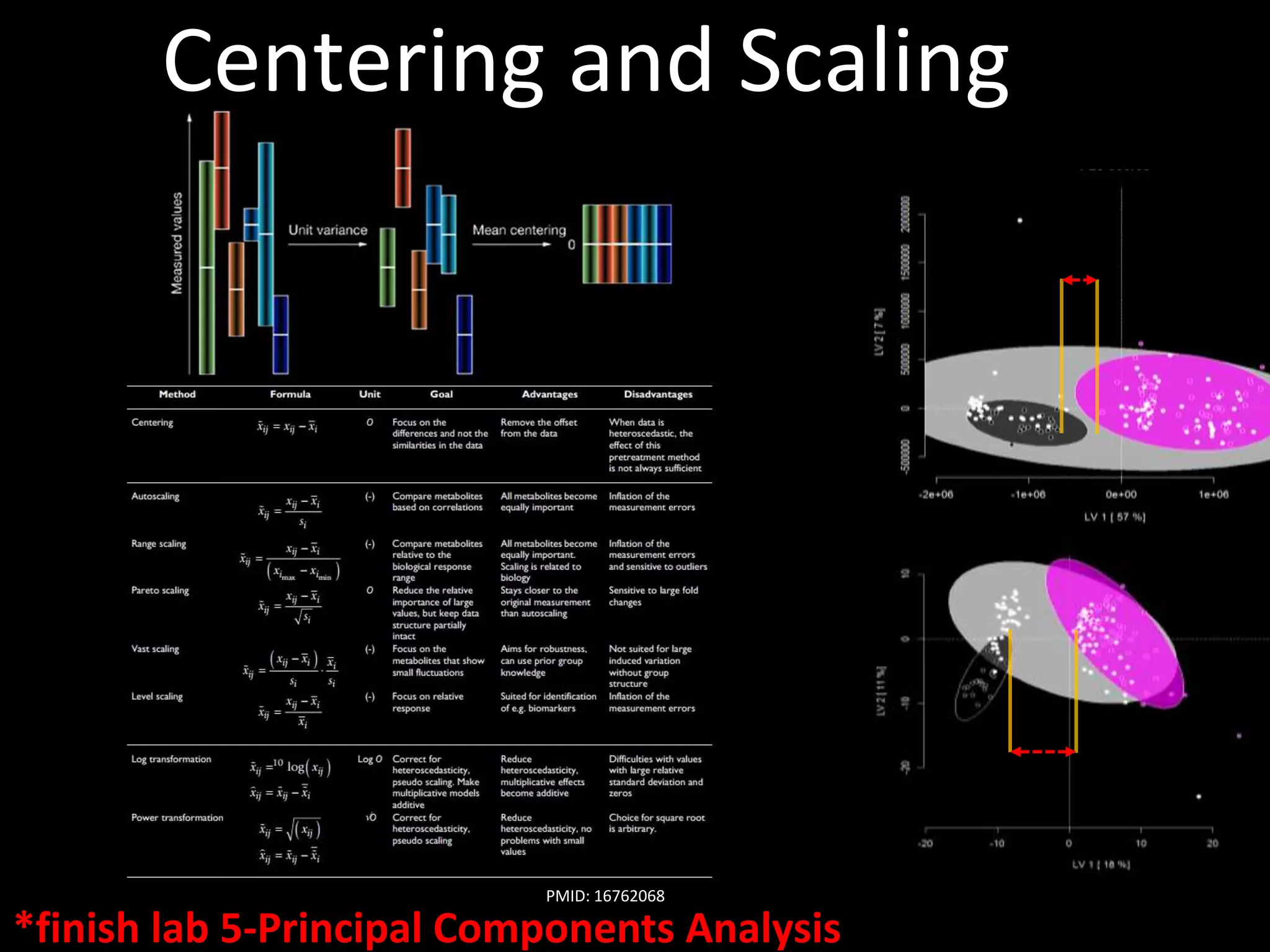
Centering and Scaling 
PMID: 16762068 
*finish lab 5-Principal Components Analysis
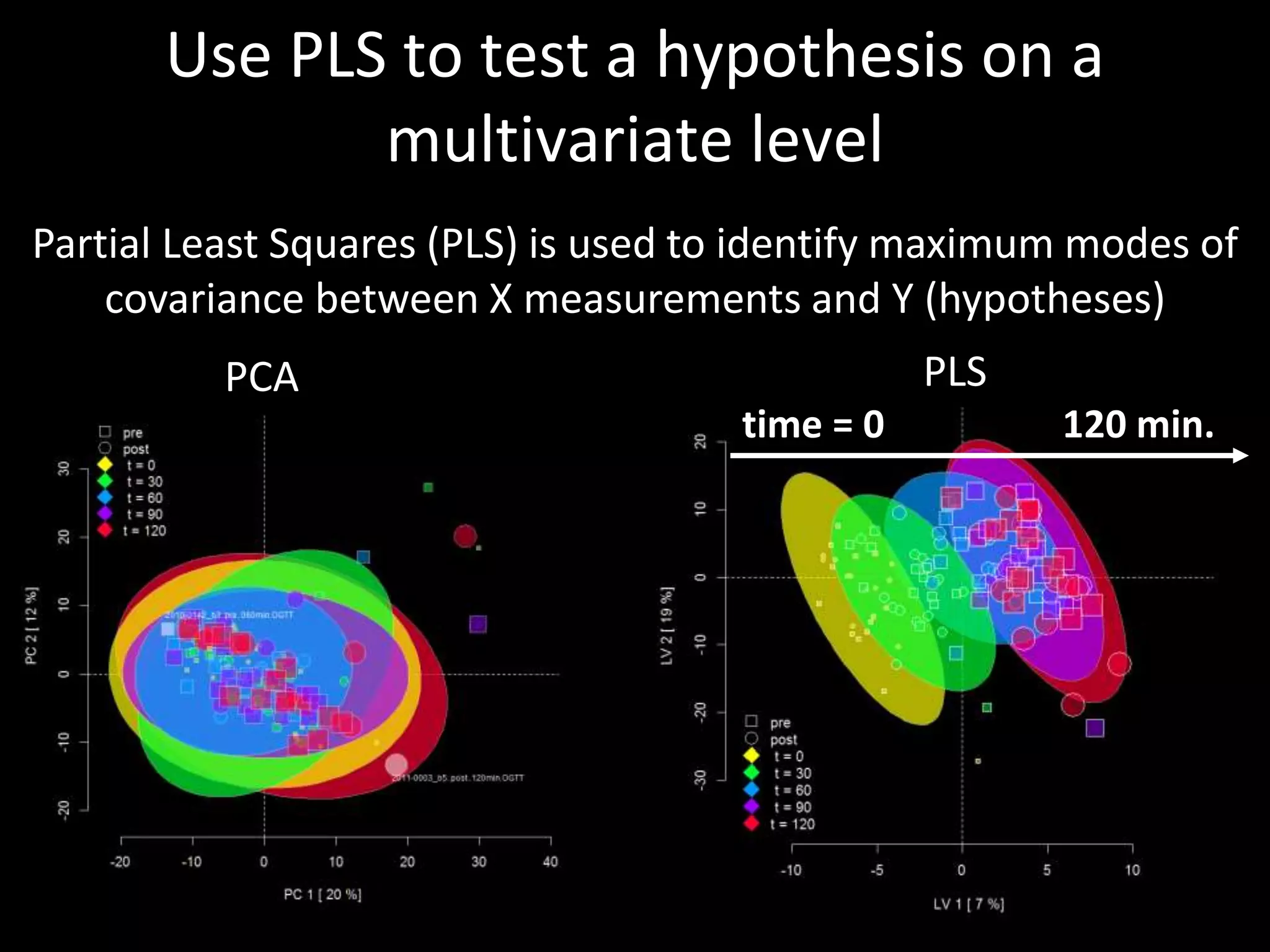
Use PLS to test a hypothesis on a 
multivariate level 
Partial Least Squares (PLS) is used to identify maximum modes of 
covariance between X measurements and Y (hypotheses) 
PCA PLS 
time = 0 120 min.
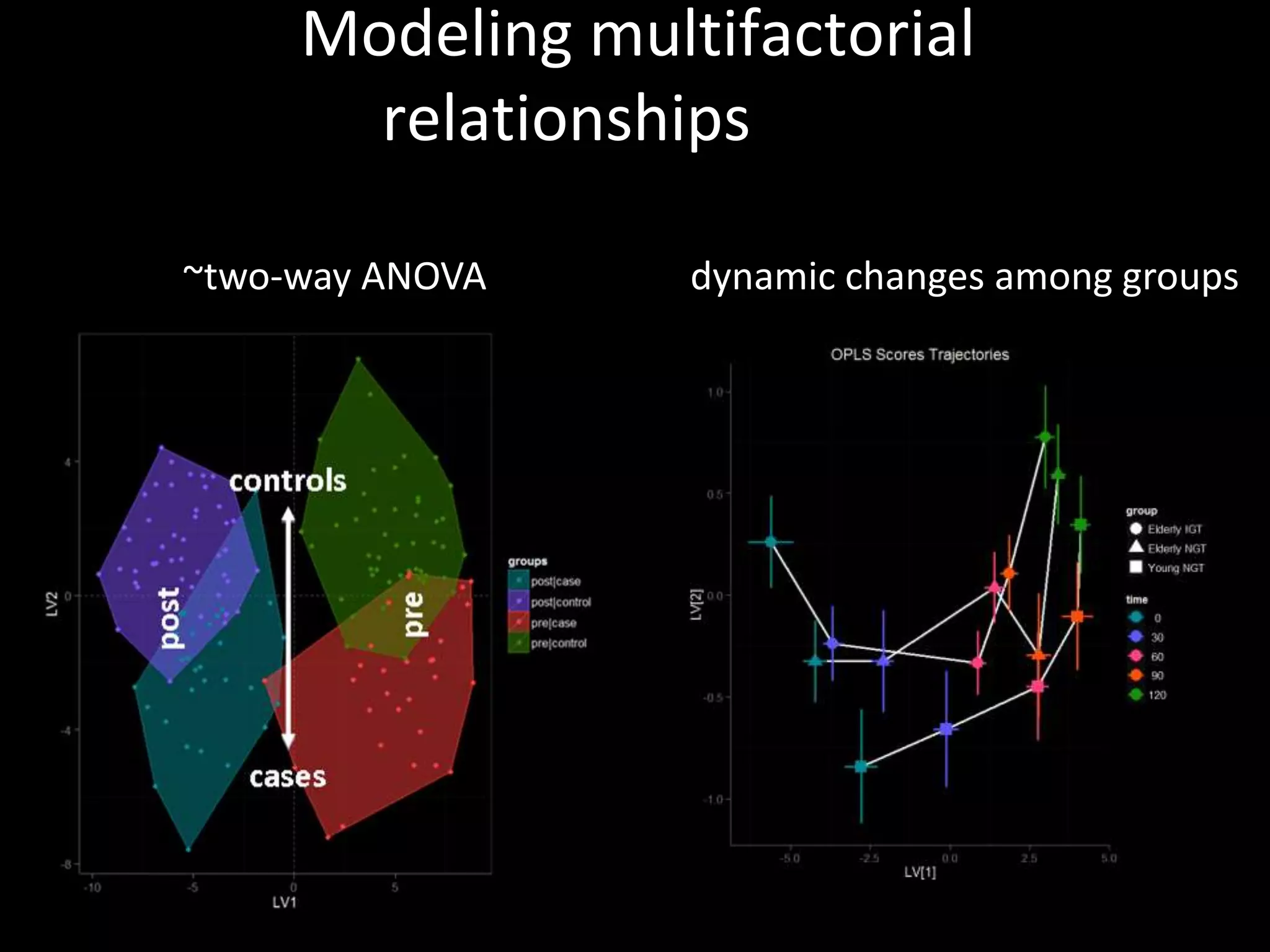
Modeling multifactorial 
relationships 
~two-way ANOVA dynamic changes among groups
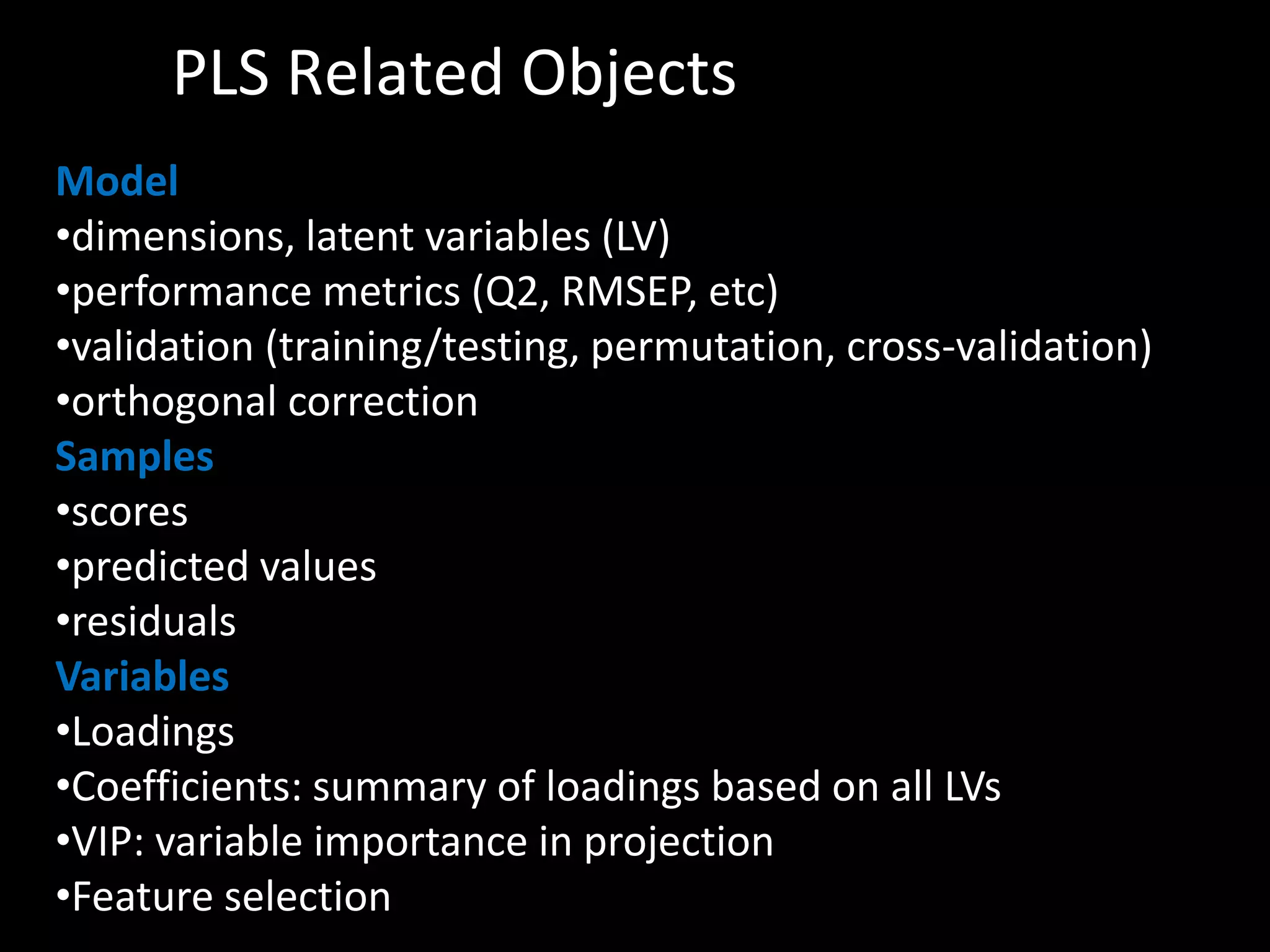
PLS Related Objects 
Model 
•dimensions, latent variables (LV) 
•performance metrics (Q2, RMSEP, etc) 
•validation (training/testing, permutation, cross-validation) 
•orthogonal correction 
Samples 
•scores 
•predicted values 
•residuals 
Variables 
•Loadings 
•Coefficients: summary of loadings based on all LVs 
•VIP: variable importance in projection 
•Feature selection
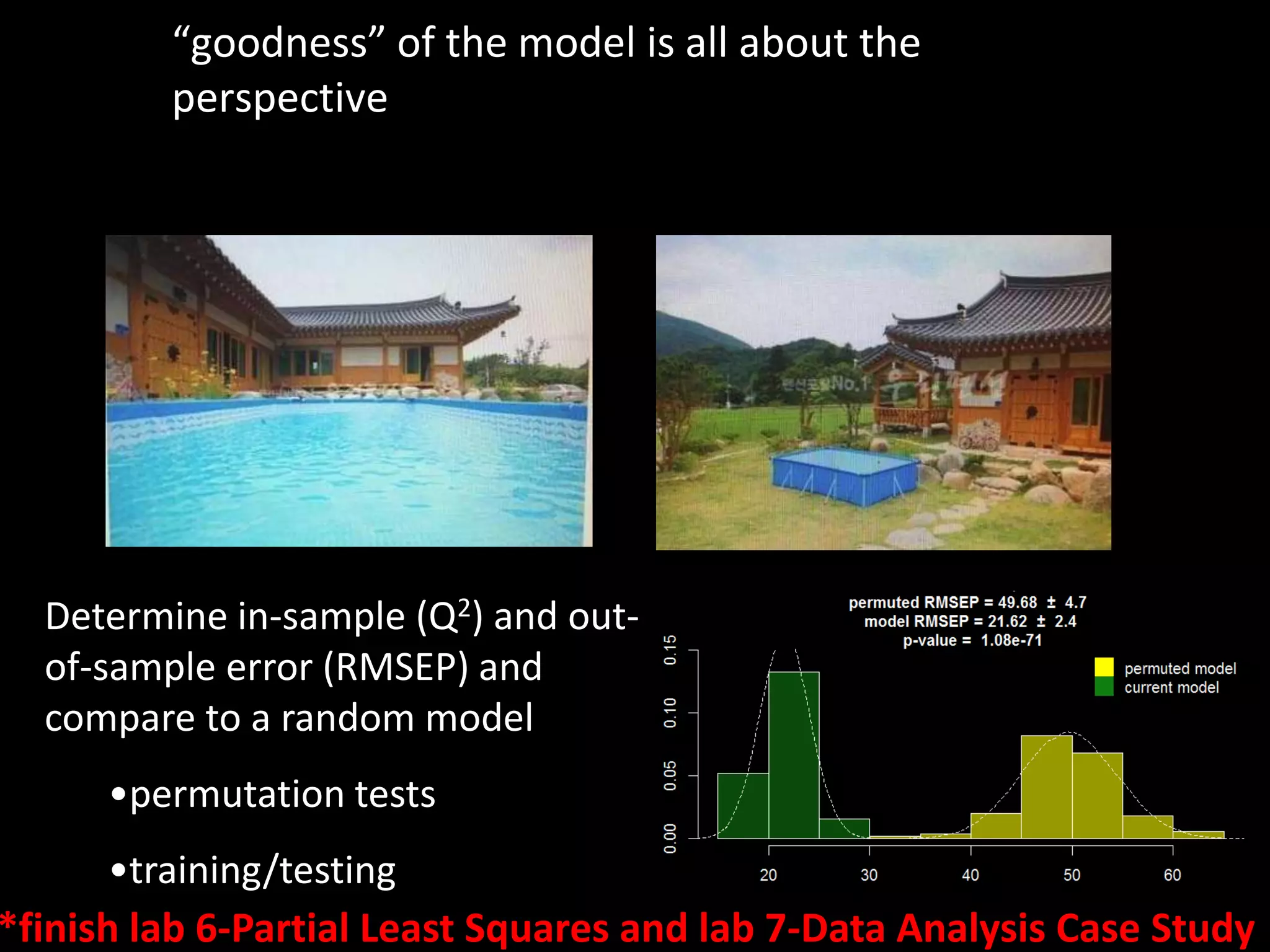
“goodness” of the model is all about the 
perspective 
Determine in-sample (Q2) and out-of- 
sample error (RMSEP) and 
compare to a random model 
•permutation tests 
•training/testing 
*finish lab 6-Partial Least Squares and lab 7-Data Analysis Case Study
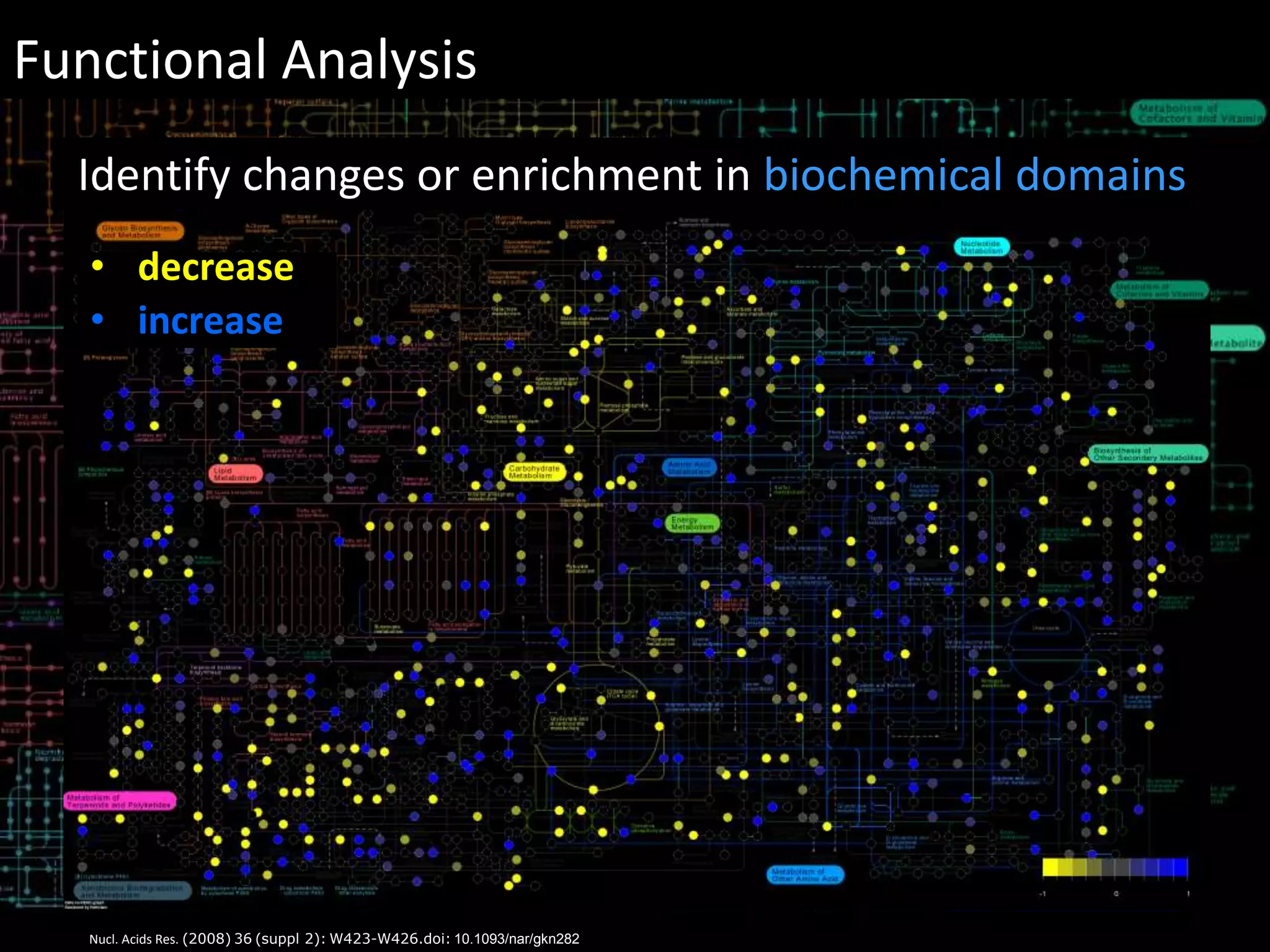
Functional Analysis 
Identify changes or enrichment in biochemical domains 
• decrease 
• increase 
Nucl. Acids Res. (2008) 36 (suppl 2): W423-W426.doi: 10.1093/nar/gkn282
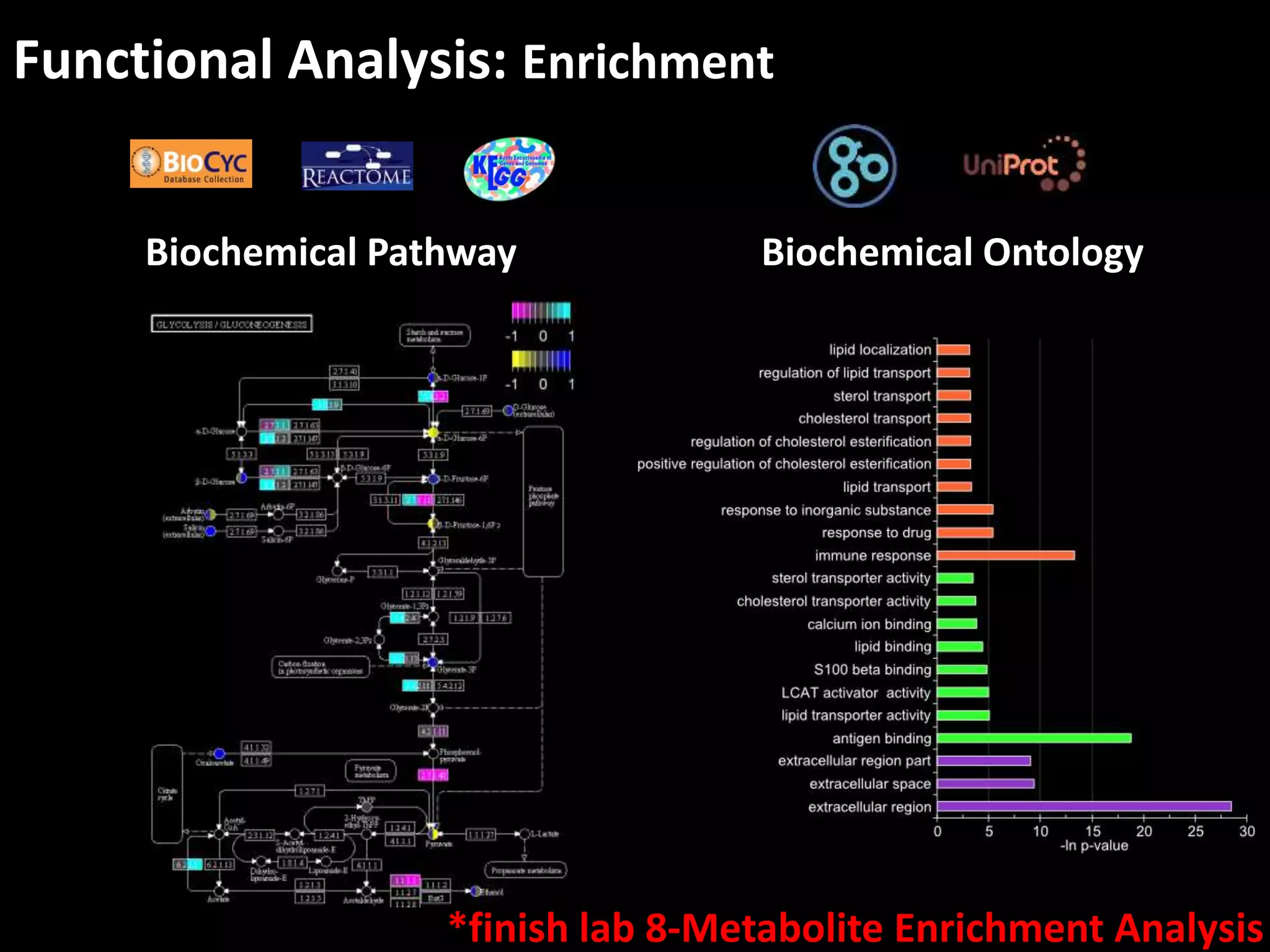
Functional Analysis: Enrichment 
Biochemical Pathway Biochemical Ontology 
*finish lab 8-Metabolite Enrichment Analysis
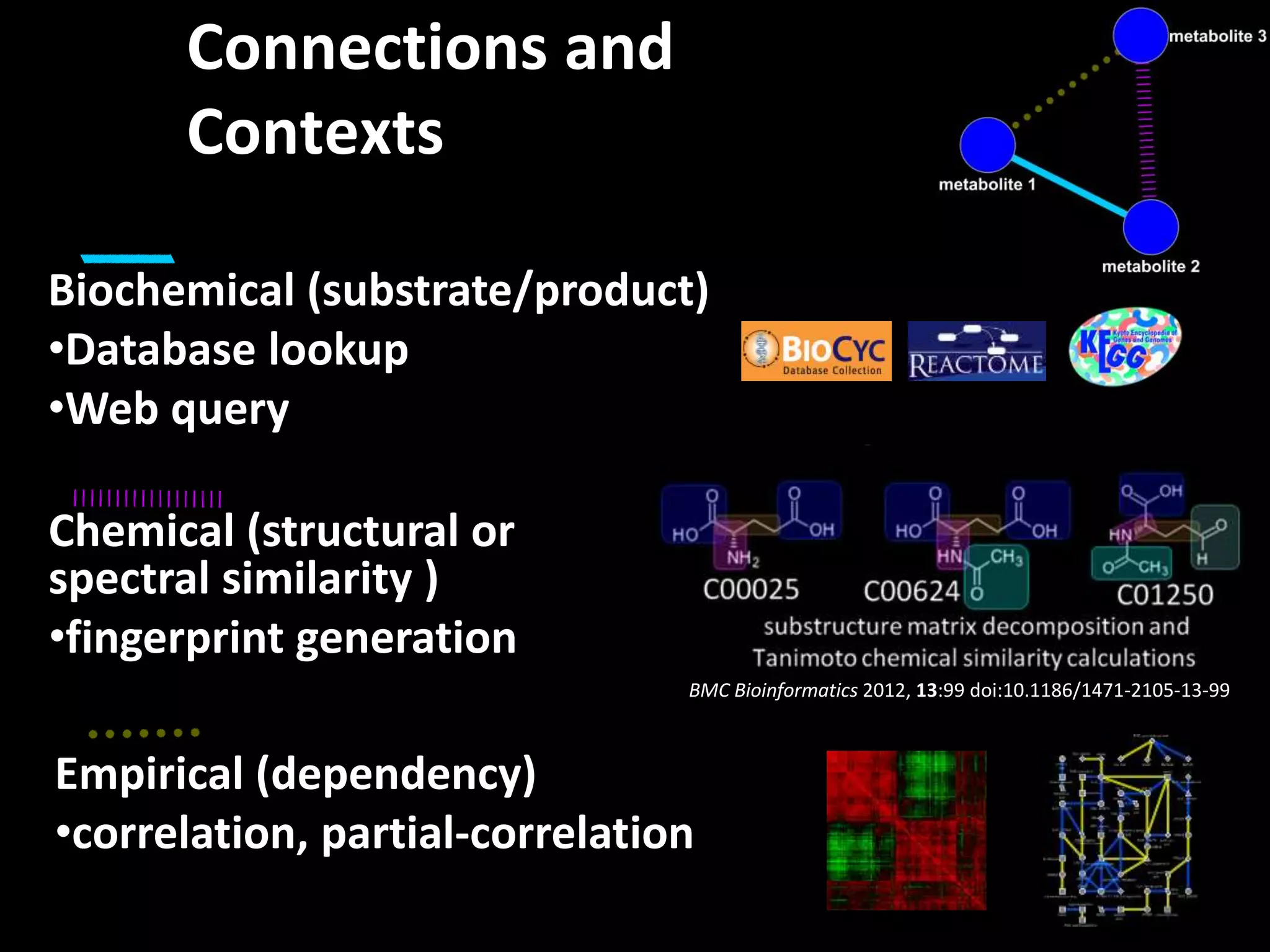
Connections and 
Contexts 
Biochemical (substrate/product) 
•Database lookup 
•Web query 
Chemical (structural or 
spectral similarity ) 
•fingerprint generation 
BMC Bioinformatics 2012, 13:99 doi:10.1186/1471-2105-13-99 
Empirical (dependency) 
•correlation, partial-correlation
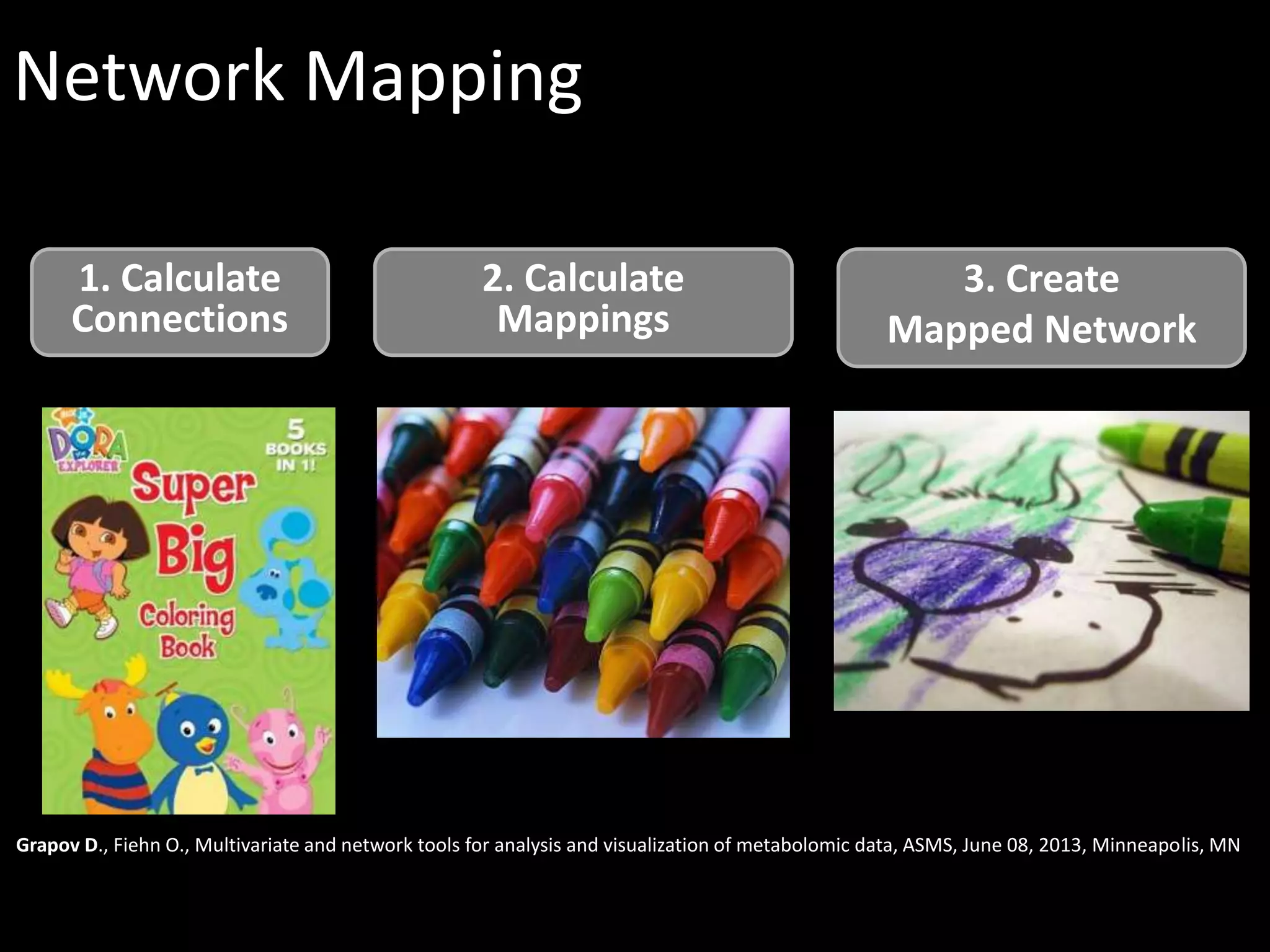
Network Mapping 
2. Calculate 
Mappings 
1. Calculate 
Connections 
3. Create 
Mapped Network 
Grapov D., Fiehn O., Multivariate and network tools for analysis and visualization of metabolomic data, ASMS, June 08, 2013, Minneapolis, MN
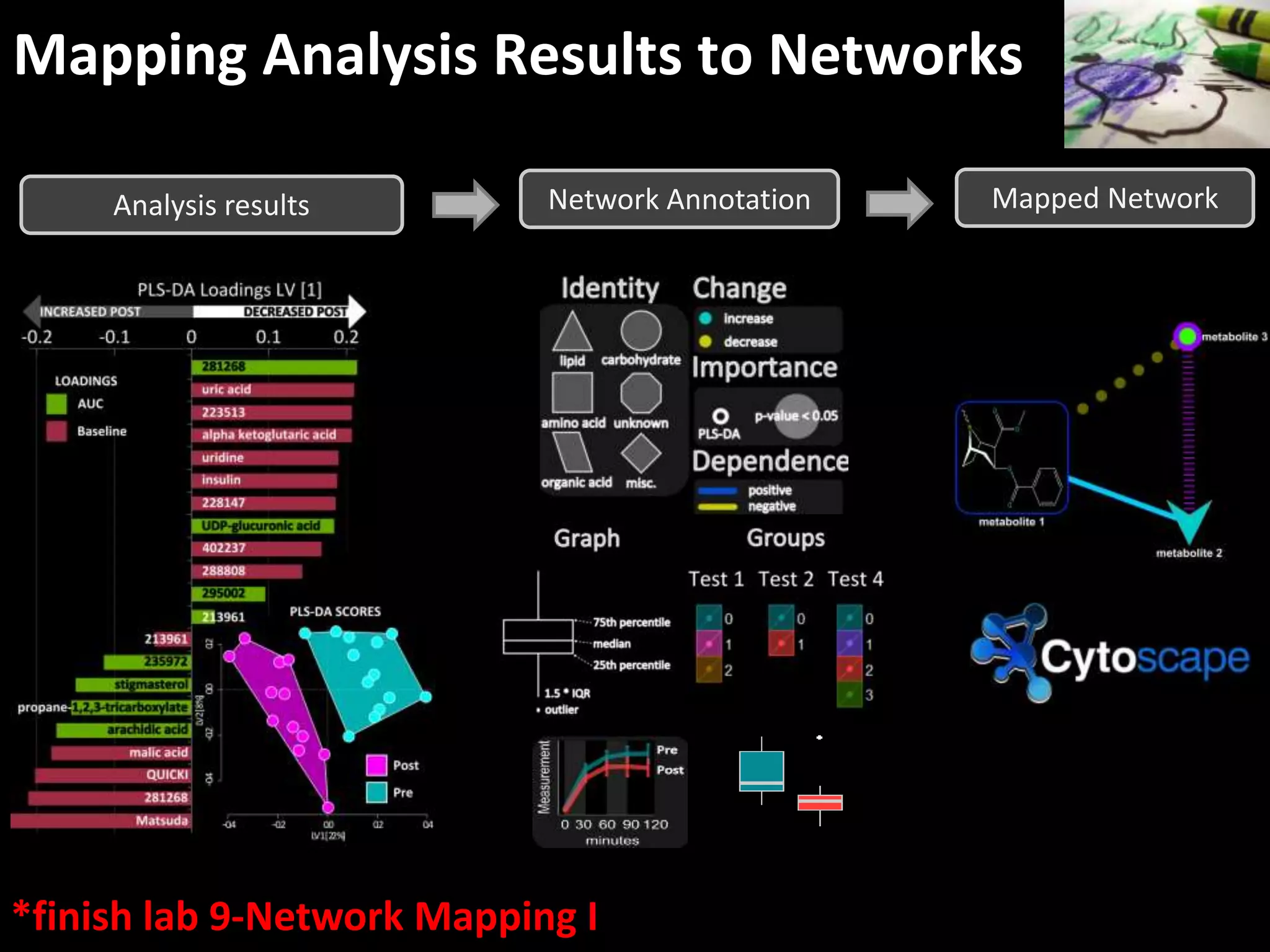
Mapping Analysis Results to Networks 
Analysis results Network Annotation Mapped Network 
*finish lab 9-Network Mapping I
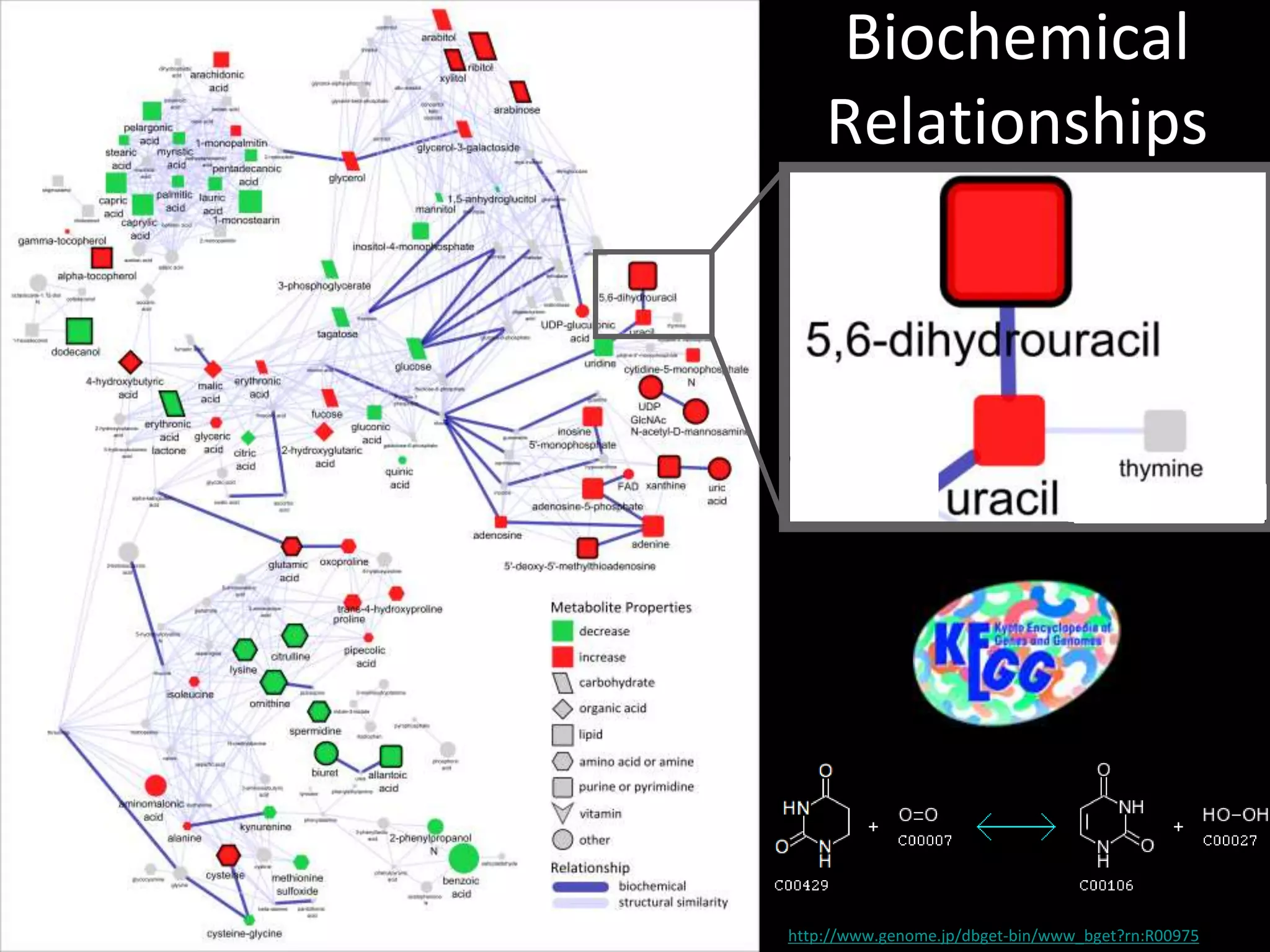
Biochemical 
Relationships 
http://www.genome.jp/dbget-bin/www_bget?rn:R00975
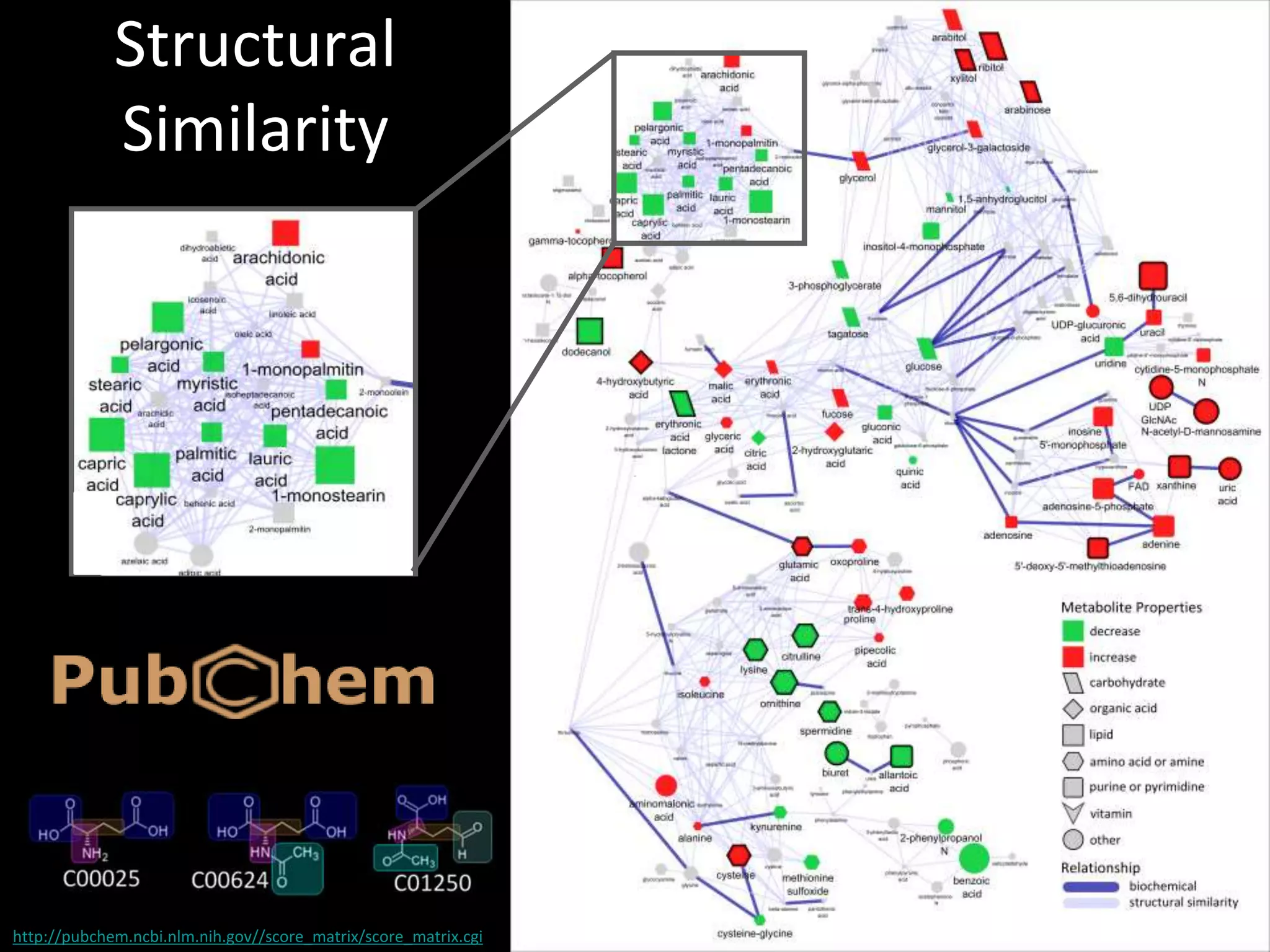
Structural 
Similarity 
http://pubchem.ncbi.nlm.nih.gov//score_matrix/score_matrix.cgi
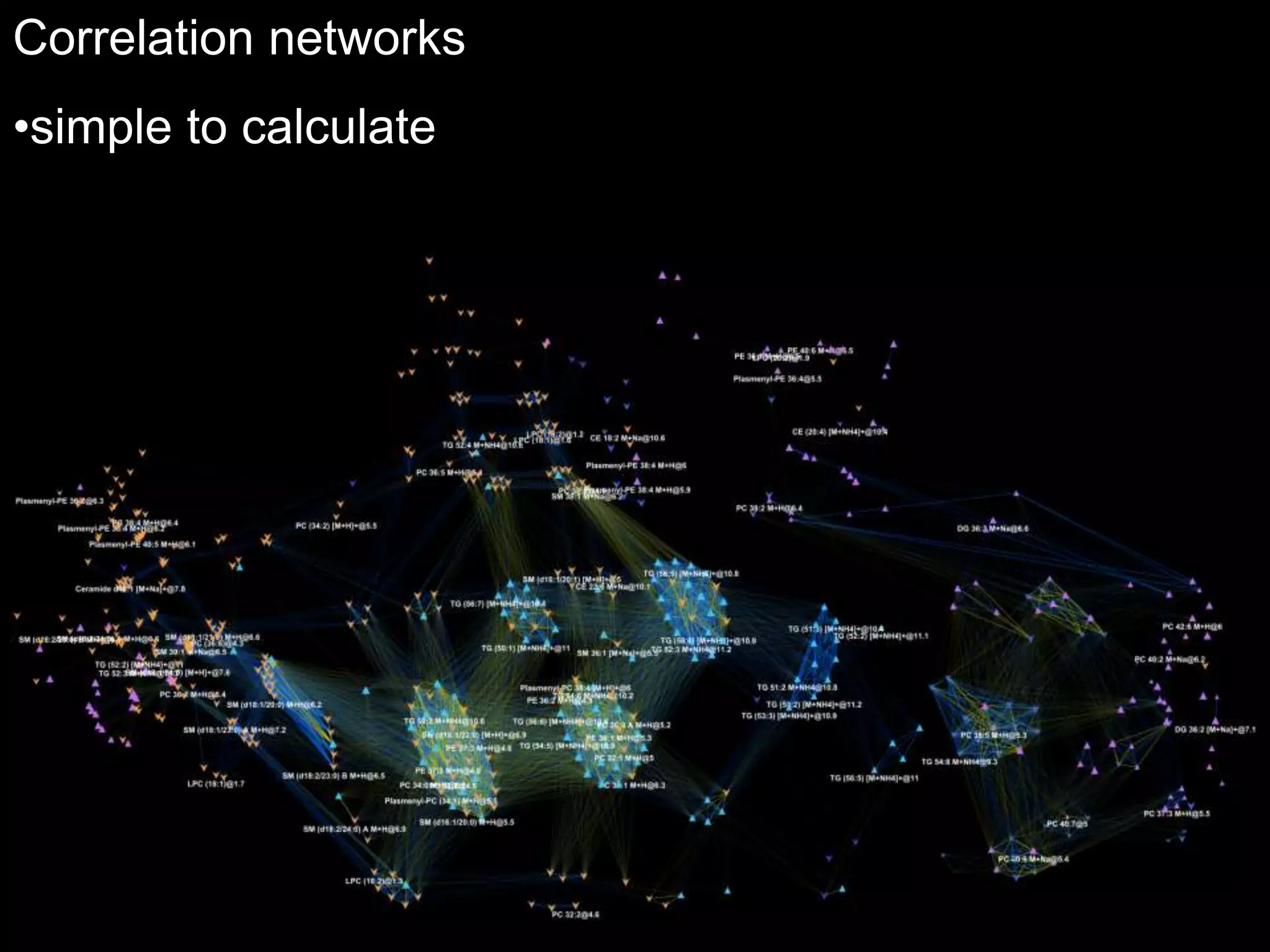
Correlation networks 
•simple to calculate 
Complex lipids correlation network in mouse serum
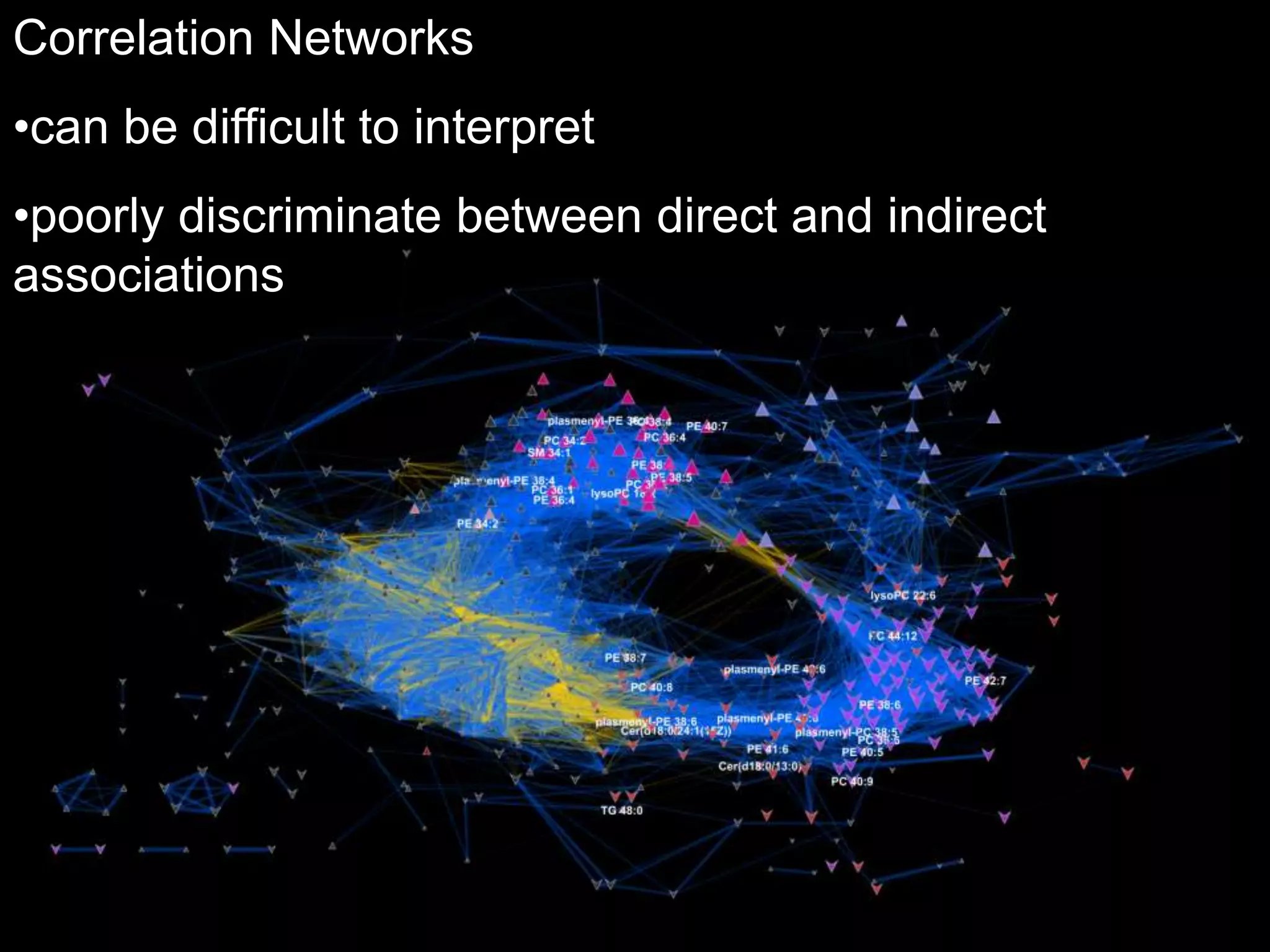
Correlation Networks 
•can be difficult to interpret 
•poorly discriminate between direct and indirect 
associations 
Complex lipids correlation network in mouse heart tissue
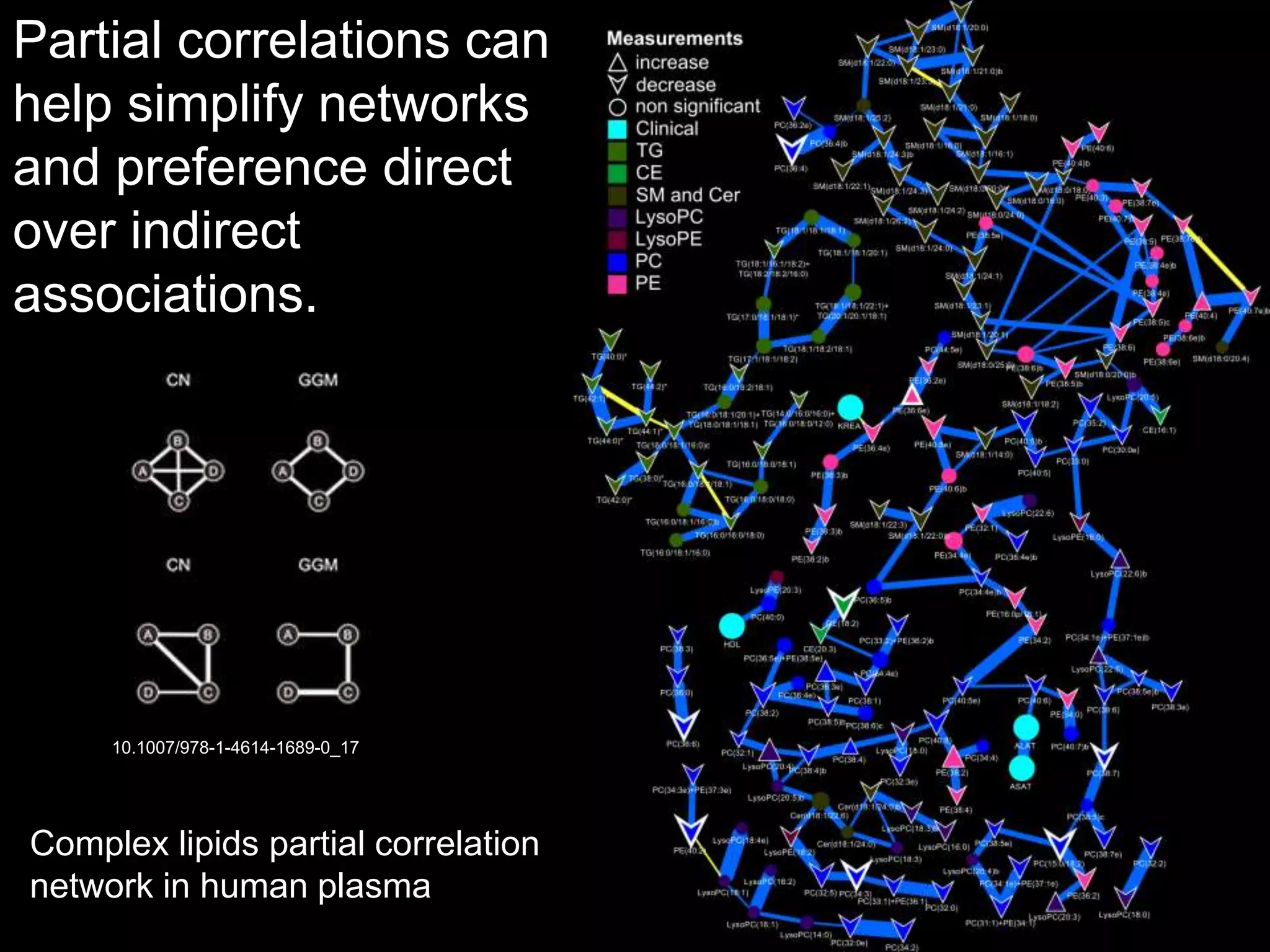
Partial correlations can 
help simplify networks 
and preference direct 
over indirect 
associations. 
10.1007/978-1-4614-1689-0_17 
Complex lipids partial correlation 
network in human plasma
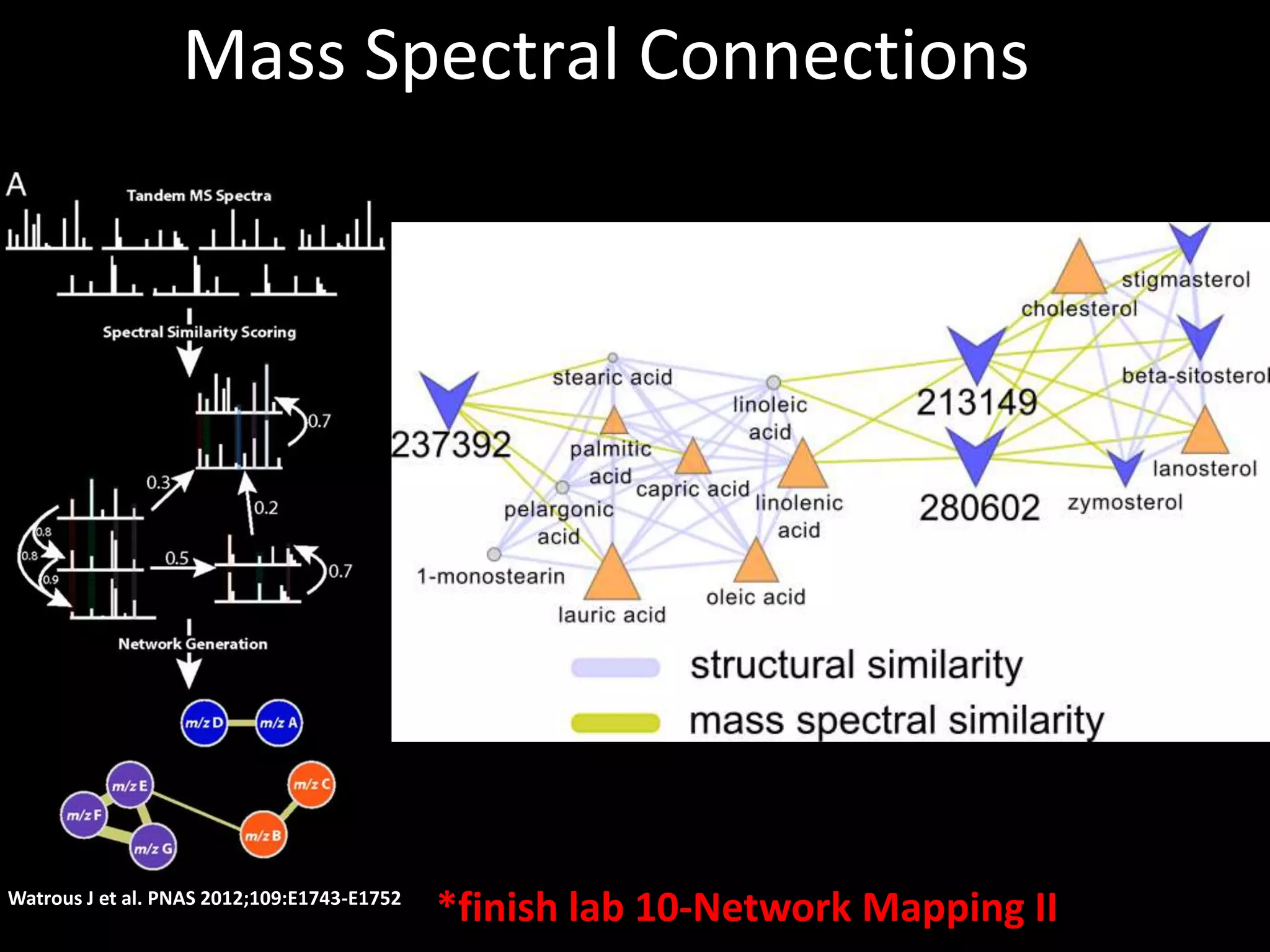
Mass Spectral Connections 
Watrous J et al. PNAS 2012;109:E1743-E1752 *finish lab 10-Network Mapping II
Software and Resources 
•DeviumWeb- Dynamic multivariate data analysis and 
visualization platform 
url: https://github.com/dgrapov/DeviumWeb 
•imDEV- Microsoft Excel add-in for multivariate analysis 
url: http://sourceforge.net/projects/imdev/ 
•MetaMapR- Network analysis tools for metabolomics 
url: https://github.com/dgrapov/MetaMapR 
•TeachingDemos- Tutorials and demonstrations 
•url: http://sourceforge.net/projects/teachingdemos/?source=directory 
•url: https://github.com/dgrapov/TeachingDemos 
•Data analysis case studies and Examples 
url: http://imdevsoftware.wordpress.com/
Questions? 
dgrapov@ucdavis.edu 
This research was supported in part by NIH 1 U24 DK097154

Metabolomic Data Analysis Workshop and Tutorials (2014)

  • 1.
    2014 Workshop in Metabolomic Data Analysis Dmitry Grapov, PhD Introduction
  • 2.
    Important Introduction Thisis an introduction to a series of tutorials for metabolomic data analysis 1. Download all the required files and software at: https://sourceforge.net/projects/teachingdemos/files/WCMC%202014%20Summer%20Workshop/ 2. Make sure you have installed R (v3.1.1, http://cran.us.r-project.org/ ), shiny (v0.10.1, http://shiny.rstudio.com/ ) and a modern browser (e.g., Chrome). 3. Run the code in the folder software the file startup.R to launch all accompanying software; or download most current versions at the links below • DeviumWeb (https://github.com/dgrapov/DeviumWeb) • MetaMapR (https://github.com/dgrapov/MetaMapR) 4. Have a great time!
  • 3.
  • 4.
    Analysis at theMetabolomic Scale
  • 5.
    Statistical and MultivariateAnalyses Group 1 Statistics + + = Multivariate Context Network Mapping Ranked statistically significant differences within a a biochemical context Group 2 What analytes are different between the two groups of samples? Statistical t-Test significant differences lacking rank and context Multivariate O-PLS-DA ranked differences lacking significance and context
  • 6.
    Statistical and MultivariateAnalyses Group 1 Statistics + + = Multivariate Context Network Mapping Group 2 What analytes are different between the two groups of samples? Statistical t-Test Multivariate O-PLS-DA To see the big picture it is necessary too view the data from multiple different angles
  • 7.
    Cycle of ScientificDiscovery Hypothesis Data Acquisition Data Processing Hypothesis Generation Data Analysis Data
  • 8.
    Sample Data Analysisand Visualization Variable Quality Assessment • use replicated mesurements and/or internal standards to estimate analytical variance Statistical and Multivariate • use the experimental design to test hypotheses and/or identify trends in analytes Functional • use statistical and multivariate results to identify impacted biochemical domains Network • integrate statistical and multivariate results with the experimental design and analyte metadata Sample Variable experimental design - organism, sex, age etc. analyte description and metadata - biochemical class, mass spectra, etc.
  • 9.
    Sample Data Analysisand Visualization Variable Quality Assessment • use replicated mesurements and/or internal standards to estimate analytical variance Statistical and Multivariate • use the experimental design to test hypotheses and/or identify trends in analytes Functional • use statistical and multivariate results to identify impacted biochemical domains Network • integrate statistical and multivariate results with the experimental design and analyte metadata Network Mapping Sample Variable experimental design - organism, sex, age etc. analyte description and metadata - biochemical class, mass spectra, etc.
  • 10.
    Data Quality Assessment Quality metrics •Precision (replicated measurements) •Accuracy (reference samples) Common tasks •normalization •outlier detection •missing values imputation *Finish lab: 1-Data quality
  • 11.
    Univariate Qualities •length(sample size) •center (mean, median, geometric mean) •dispersion (variance, standard deviation) •range (min / max), •quantiles •shape (skewness, kurtosis, normality, etc.) standard deviation mean
  • 12.
    Univariate Analyses •Identifydifferences in sample population means •sensitive to distribution shape •parametric = assumes normality •error in Y, not in X (Y = mX + error) •optimal for long data •assumed independence •false discovery rate (FDR) long wide n-of-one
  • 13.
    False Discovery Rate(FDR) Type I Error: False Positives •Type II Error: False Negatives •Type I risk = •1-(1-p.value)m m = number of variables tested FDR correction • p-value adjustment or estimate of FDR (Fdr, q-value) Bioinformatics (2008) 24 (12):1461-1462
  • 14.
    Statistical Analysis: achieving‘significance’ significance level (α) and power (1-β ) effect size (standardized difference in means) sample size (n) Power analyses can be used to optimize future experiments given preliminary data Example: use experimentally derived (or literature estimated) effect sizes, desired p-value (alpha) and power (beta) to calculate the optimal number of samples per group *finish lab 2-statistical analysis
  • 15.
    Outlier Detection •1 variable (univariate) • 2 variables (bivariate) • >2 variables (multivariate)
  • 16.
    bivariate vs. multivariate (scatter plot) outliers? mixed up samples (PCA scores plot) Outlier Detection
  • 17.
    Batch Effects Driftin >400 replicated measurements across >100 analytical batches for a single analyte Principal Component Analysis (PCA) of all analytes, showing QC sample scores Acquisition batch Abundance QCs embedded among >5,5000 samples (1:10) collected over 1.5 yrs If the biological effect size is less than the analytical variance then the experiment will incorrectly yield insignificant results
  • 18.
    Analyte specific dataquality overview Sample specific normalization can be used to estimate and remove analytical variance Raw Data Normalized Data low precision log mean %RSD high precision Samples QCs Batch Effects *finish lab 3-Data Normalization
  • 19.
    Clustering Identify •patterns •group structure •relationships •Evaluate/refine hypothesis •Reduce complexity Artist: Chuck Close
  • 20.
    Cluster Analysis Usethe concept similarity/dissimilarity to group a collection of samples or variables Approaches •hierarchical (HCA) •non-hierarchical (k-NN, k-means) •distribution (mixtures models) •density (DBSCAN) •self organizing maps (SOM) Linkage k-means Distribution Density
  • 21.
    Hierarchical Cluster Analysis • similarity/dissimilarity defines “nearness” or distance euclidean X Y manhattan Mahalanobis X Y X Y * non-euclidean
  • 22.
    Hierarchical Cluster Analysis Agglomerative/linkage algorithm defines how points are grouped single complete centroid average
  • 23.
  • 24.
    Hierarchical Cluster Analysis How does my metadata match my data structure? Exploration Confirmation *finish lab 4-Cluster Analysis
  • 25.
    Projection of Data The algorithm defines the position of the light source Principal Components Analysis (PCA) • unsupervised • maximize variance (X) Partial Least Squares Projection to Latent Structures (PLS) • supervised • maximize covariance (Y ~ X) James X. Li, 2009, VisuMap Tech.
  • 26.
    Interpreting PCA Results Variance explained (eigenvalues) Row (sample) scores and column (variable) loadings
  • 27.
    How are scoresand loadings related?
  • 28.
    Centering and Scaling PMID: 16762068 *finish lab 5-Principal Components Analysis
  • 29.
    Use PLS totest a hypothesis on a multivariate level Partial Least Squares (PLS) is used to identify maximum modes of covariance between X measurements and Y (hypotheses) PCA PLS time = 0 120 min.
  • 30.
    Modeling multifactorial relationships ~two-way ANOVA dynamic changes among groups
  • 31.
    PLS Related Objects Model •dimensions, latent variables (LV) •performance metrics (Q2, RMSEP, etc) •validation (training/testing, permutation, cross-validation) •orthogonal correction Samples •scores •predicted values •residuals Variables •Loadings •Coefficients: summary of loadings based on all LVs •VIP: variable importance in projection •Feature selection
  • 32.
    “goodness” of themodel is all about the perspective Determine in-sample (Q2) and out-of- sample error (RMSEP) and compare to a random model •permutation tests •training/testing *finish lab 6-Partial Least Squares and lab 7-Data Analysis Case Study
  • 33.
    Functional Analysis Identifychanges or enrichment in biochemical domains • decrease • increase Nucl. Acids Res. (2008) 36 (suppl 2): W423-W426.doi: 10.1093/nar/gkn282
  • 34.
    Functional Analysis: Enrichment Biochemical Pathway Biochemical Ontology *finish lab 8-Metabolite Enrichment Analysis
  • 35.
    Connections and Contexts Biochemical (substrate/product) •Database lookup •Web query Chemical (structural or spectral similarity ) •fingerprint generation BMC Bioinformatics 2012, 13:99 doi:10.1186/1471-2105-13-99 Empirical (dependency) •correlation, partial-correlation
  • 36.
    Network Mapping 2.Calculate Mappings 1. Calculate Connections 3. Create Mapped Network Grapov D., Fiehn O., Multivariate and network tools for analysis and visualization of metabolomic data, ASMS, June 08, 2013, Minneapolis, MN
  • 37.
    Mapping Analysis Resultsto Networks Analysis results Network Annotation Mapped Network *finish lab 9-Network Mapping I
  • 38.
  • 39.
  • 40.
    Correlation networks •simpleto calculate Complex lipids correlation network in mouse serum
  • 41.
    Correlation Networks •canbe difficult to interpret •poorly discriminate between direct and indirect associations Complex lipids correlation network in mouse heart tissue
  • 42.
    Partial correlations can help simplify networks and preference direct over indirect associations. 10.1007/978-1-4614-1689-0_17 Complex lipids partial correlation network in human plasma
  • 43.
    Mass Spectral Connections Watrous J et al. PNAS 2012;109:E1743-E1752 *finish lab 10-Network Mapping II
  • 44.
    Software and Resources •DeviumWeb- Dynamic multivariate data analysis and visualization platform url: https://github.com/dgrapov/DeviumWeb •imDEV- Microsoft Excel add-in for multivariate analysis url: http://sourceforge.net/projects/imdev/ •MetaMapR- Network analysis tools for metabolomics url: https://github.com/dgrapov/MetaMapR •TeachingDemos- Tutorials and demonstrations •url: http://sourceforge.net/projects/teachingdemos/?source=directory •url: https://github.com/dgrapov/TeachingDemos •Data analysis case studies and Examples url: http://imdevsoftware.wordpress.com/
  • 45.
    Questions? dgrapov@ucdavis.edu Thisresearch was supported in part by NIH 1 U24 DK097154