CEE320
Winter2006
Geometric Design
CEE 320
Steve Muench
CEE320
Winter2006
Outline
1. Concepts
2. Vertical Alignment
a. Fundamentals
b. Crest Vertical Curves
c. Sag Vertical Curves
d. Examples
3. Horizontal Alignment
a. Fundamentals
b. Superelevation
4. Other Non-Testable Stuff
CEE320
Winter2006
Concepts
• Alignment is a 3D problem broken
down into two 2D problems
– Horizontal Alignment (plan view)
– Vertical Alignment (profile view)
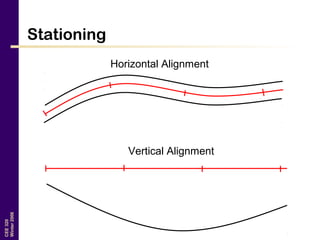
• Stationing
– Along horizontal alignment
– 12+00 = 1,200 ft.
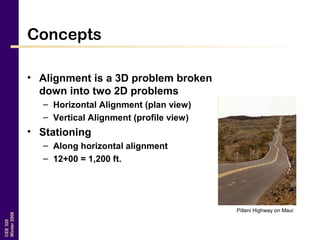
Piilani Highway on Maui
CEE320
Winter2006
Stationing
Horizontal Alignment
Vertical Alignment
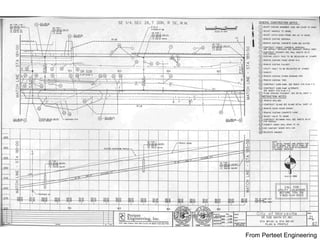
From Perteet Engineering
CEE320
Winter2006
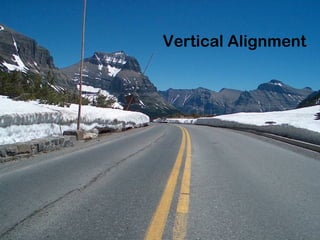
Vertical Alignment
CEE320
Winter2006
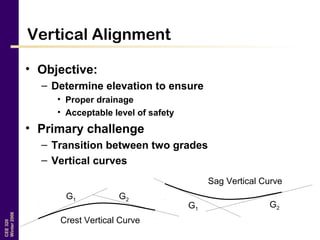
Vertical Alignment
• Objective:
– Determine elevation to ensure
• Proper drainage
• Acceptable level of safety
• Primary challenge
– Transition between two grades
– Vertical curves
G1 G2
G1
G2
Crest Vertical Curve
Sag Vertical Curve
CEE320
Winter2006
Vertical Curve Fundamentals
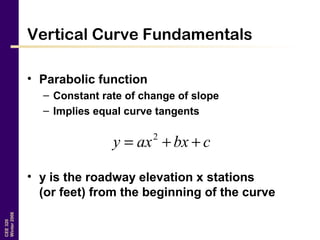
• Parabolic function
– Constant rate of change of slope
– Implies equal curve tangents
• y is the roadway elevation x stations
(or feet) from the beginning of the curve
cbxaxy ++= 2
CEE320
Winter2006
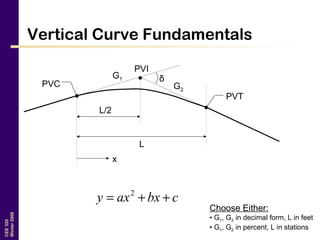
Vertical Curve Fundamentals
G1
G2
PVI
PVT
PVC
L
L/2
δ
cbxaxy ++= 2
x
Choose Either:
• G1, G2 in decimal form, L in feet
• G1, G2 in percent, L in stations
CEE320
Winter2006
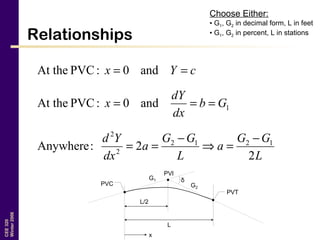
Relationships
Choose Either:
• G1, G2 in decimal form, L in feet
• G1, G2 in percent, L in stations
G1
G2
PVI
PVT
PVC
L
L/2
δ
x
1and0:PVCAt the Gb
dx
dY
x ===
cYx == and0:PVCAt the
L
GG
a
L
GG
a
dx
Yd
2
2:Anywhere 1212
2
2
−
=⇒
−
==
CEE320
Winter2006
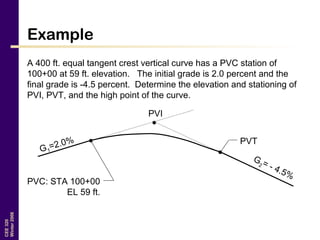
Example
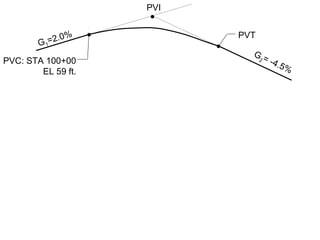
A 400 ft. equal tangent crest vertical curve has a PVC station of
100+00 at 59 ft. elevation. The initial grade is 2.0 percent and the
final grade is -4.5 percent. Determine the elevation and stationing of
PVI, PVT, and the high point of the curve.
G1
=2.0%
G
2 = - 4.5%
PVI
PVT
PVC: STA 100+00
EL 59 ft.
G1
=2.0%
G
2 = -4.5%
PVI
PVT
PVC: STA 100+00
EL 59 ft.
CEE320
Winter2006
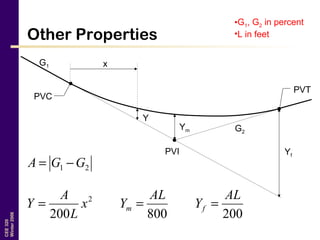
Other Properties
G1
G2
PVI
PVT
PVC
x
Ym
Yf
Y
2
200
x
L
A
Y =
800
AL
Ym =
200
AL
Yf =
21 GGA −=
•G1, G2 in percent
•L in feet
CEE320
Winter2006
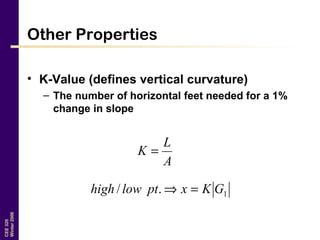
Other Properties
• K-Value (defines vertical curvature)
– The number of horizontal feet needed for a 1%
change in slope
A
L
K =
1./ GKxptlowhigh =⇒
CEE320
Winter2006
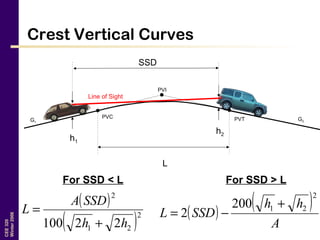
Crest Vertical Curves
G1
G2
PVI
PVTPVC
h2
h1
L
SSD
( )
( )2
21
2
22100 hh
SSDA
L
+
= ( )
( )
A
hh
SSDL
2
21200
2
+
−=
For SSD < L For SSD > L
Line of Sight
CEE320
Winter2006
Crest Vertical Curves
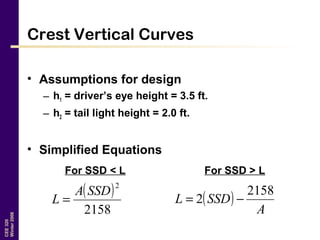
• Assumptions for design
– h1 = driver’s eye height = 3.5 ft.
– h2 = tail light height = 2.0 ft.
• Simplified Equations
( )
2158
2
SSDA
L = ( )
A
SSDL
2158
2 −=
For SSD < L For SSD > L
CEE320
Winter2006
Crest Vertical Curves
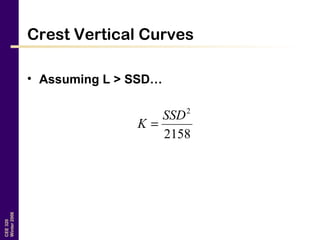
• Assuming L > SSD…
2158
2
SSD
K =
CEE320
Winter2006
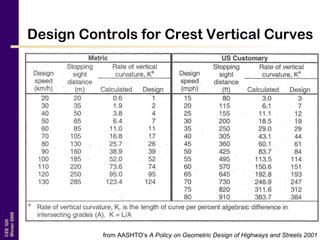
Design Controls for Crest Vertical Curves
from AASHTO’s A Policy on Geometric Design of Highways and Streets 2001
CEE320
Winter2006
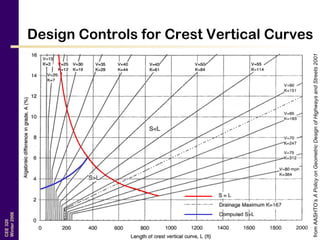
Design Controls for Crest Vertical Curves
fromAASHTO’sAPolicyonGeometricDesignofHighwaysandStreets2001
CEE320
Winter2006
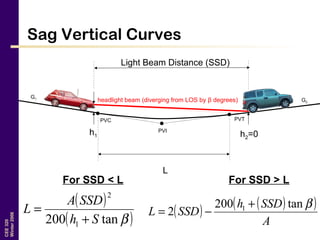
Sag Vertical Curves
G1
G2
PVI
PVTPVC
h2=0h1
L
Light Beam Distance (SSD)
( )
( )βtan200 1
2
Sh
SSDA
L
+
= ( ) ( )( )
A
SSDh
SSDL
βtan200
2 1 +
−=
For SSD < L For SSD > L
headlight beam (diverging from LOS by β degrees)
CEE320
Winter2006
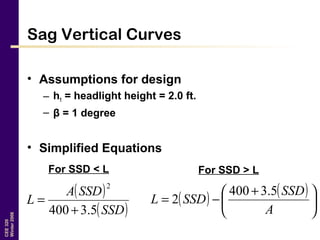
Sag Vertical Curves
• Assumptions for design
– h1 = headlight height = 2.0 ft.
– β = 1 degree
• Simplified Equations
( )
( )SSD
SSDA
L
5.3400
2
+
= ( ) ( )





 +
−=
A
SSD
SSDL
5.3400
2
For SSD < L For SSD > L
CEE320
Winter2006
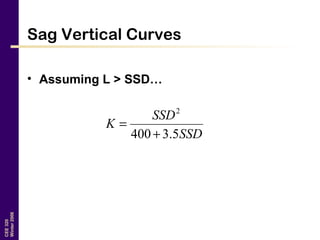
Sag Vertical Curves
• Assuming L > SSD…
SSD
SSD
K
5.3400
2
+
=
CEE320
Winter2006
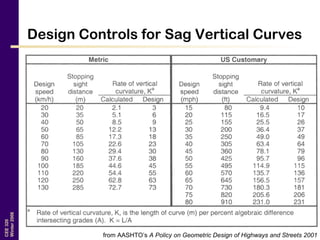
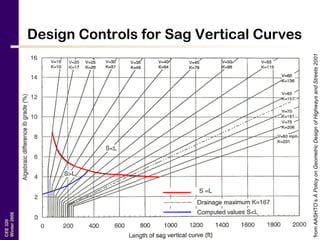
Design Controls for Sag Vertical Curves
from AASHTO’s A Policy on Geometric Design of Highways and Streets 2001
CEE320
Winter2006
Design Controls for Sag Vertical Curves
fromAASHTO’sAPolicyonGeometricDesignofHighwaysandStreets2001
CEE320
Winter2006
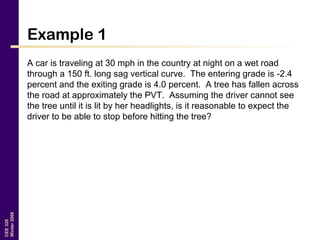
Example 1
A car is traveling at 30 mph in the country at night on a wet road
through a 150 ft. long sag vertical curve. The entering grade is -2.4
percent and the exiting grade is 4.0 percent. A tree has fallen across
the road at approximately the PVT. Assuming the driver cannot see
the tree until it is lit by her headlights, is it reasonable to expect the
driver to be able to stop before hitting the tree?
CEE320
Winter2006
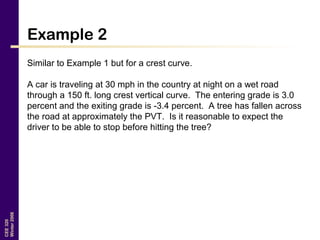
Example 2
Similar to Example 1 but for a crest curve.
A car is traveling at 30 mph in the country at night on a wet road
through a 150 ft. long crest vertical curve. The entering grade is 3.0
percent and the exiting grade is -3.4 percent. A tree has fallen across
the road at approximately the PVT. Is it reasonable to expect the
driver to be able to stop before hitting the tree?
CEE320
Winter2006
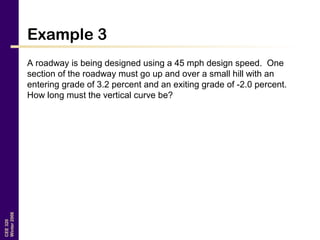
Example 3
A roadway is being designed using a 45 mph design speed. One
section of the roadway must go up and over a small hill with an
entering grade of 3.2 percent and an exiting grade of -2.0 percent.
How long must the vertical curve be?
CEE320
Winter2006
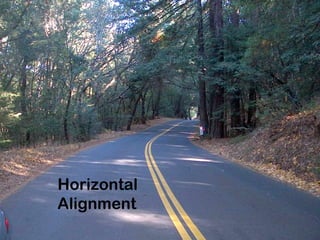
Horizontal
Alignment
CEE320
Winter2006
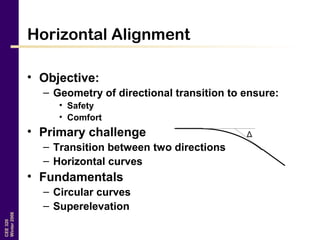
Horizontal Alignment
• Objective:
– Geometry of directional transition to ensure:
• Safety
• Comfort
• Primary challenge
– Transition between two directions
– Horizontal curves
• Fundamentals
– Circular curves
– Superelevation
Δ
CEE320
Winter2006
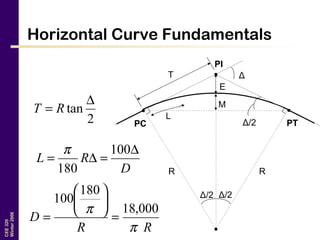
Horizontal Curve Fundamentals
R
T
PC PT
PI
M
E
R
Δ
Δ/2Δ/2
Δ/2
RR
D
π
π 000,18
180
100
=






=
2
tan
∆
= RT
D
RL
∆
=∆=
100
180
π
L
CEE320
Winter2006
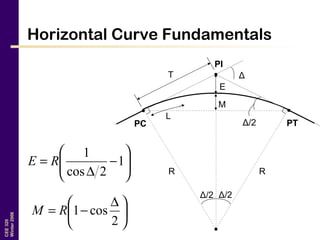
Horizontal Curve Fundamentals






−
∆
= 1
2cos
1
RE





 ∆
−=
2
cos1RM
R
T
PC PT
PI
M
E
R
Δ
Δ/2Δ/2
Δ/2
L
CEE320
Winter2006
Example 4
A horizontal curve is designed with a 1500 ft. radius. The tangent
length is 400 ft. and the PT station is 20+00. What are the PI and PT
stations?
CEE320
Winter2006
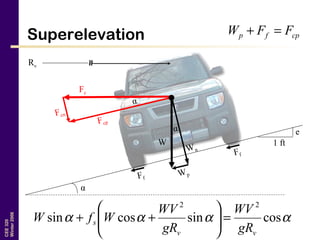
Superelevation cpfp FFW =+
αααα cossincossin
22
vv
s
gR
WV
gR
WV
WfW =





++
α
α
Fcp
Fcn
Wp
Wn
Ff
Ff
α
Fc
W 1 ft
e
≈
Rv
CEE320
Winter2006
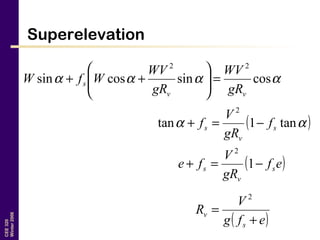
Superelevation
αααα cossincossin
22
vv
s
gR
WV
gR
WV
WfW =





++
( )αα tan1tan
2
s
v
s f
gR
V
f −=+
( )ef
gR
V
fe s
v
s −=+ 1
2
( )efg
V
R
s
v
+
=
2
CEE320
Winter2006
Selection of e and fs
• Practical limits on superelevation (e)
– Climate
– Constructability
– Adjacent land use
• Side friction factor (fs) variations
– Vehicle speed
– Pavement texture
– Tire condition
CEE320
Winter2006
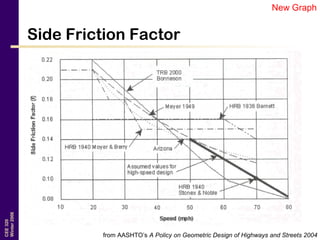
Side Friction Factor
from AASHTO’s A Policy on Geometric Design of Highways and Streets 2004
New Graph
CEE320
Winter2006
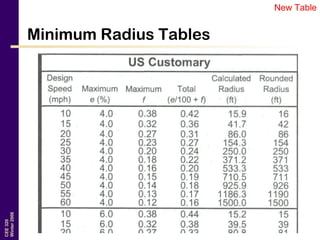
Minimum Radius Tables
New Table
CEE320
Winter2006
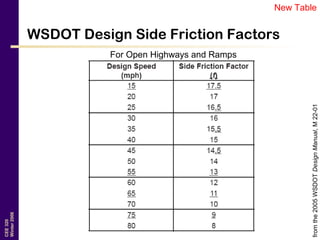
WSDOT Design Side Friction Factors
fromthe2005WSDOTDesignManual,M22-01
New Table
For Open Highways and Ramps
CEE320
Winter2006
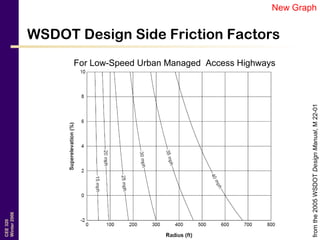
WSDOT Design Side Friction Factors
fromthe2005WSDOTDesignManual,M22-01
For Low-Speed Urban Managed Access Highways
New Graph
CEE320
Winter2006
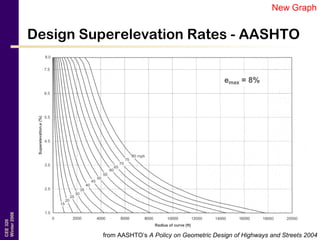
Design Superelevation Rates - AASHTO
from AASHTO’s A Policy on Geometric Design of Highways and Streets 2004
New Graph
CEE320
Winter2006
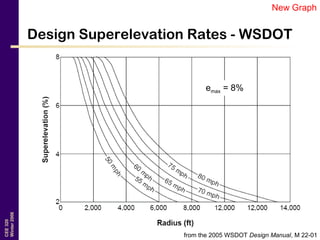
Design Superelevation Rates - WSDOT
from the 2005 WSDOT Design Manual, M 22-01
emax = 8%
New Graph
CEE320
Winter2006
Example 5
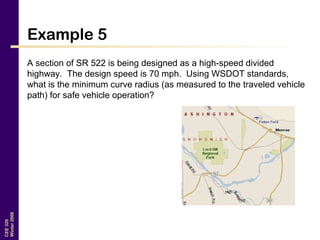
A section of SR 522 is being designed as a high-speed divided
highway. The design speed is 70 mph. Using WSDOT standards,
what is the minimum curve radius (as measured to the traveled vehicle
path) for safe vehicle operation?
CEE320
Winter2006
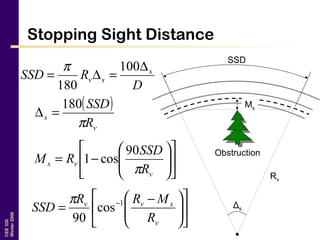
Stopping Sight Distance
Rv
Δs
Obstruction
Ms( )
v
s
R
SSD
π
180
=∆
D
RSSD s
sv
∆
=∆=
100
180
π
SSD












−=
v
vs
R
SSD
RM
π
90
cos1











 −
= −
v
svv
R
MRR
SSD 1
cos
90
π
CEE320
Winter2006
Supplemental Stuff
• Cross section
• Superelevation Transition
– Runoff
– Tangent runout
• Spiral curves
• Extra width for curves
FYI – NOT TESTABLE
CEE320
Winter2006
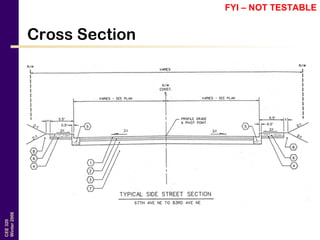
Cross Section
FYI – NOT TESTABLE
CEE320
Winter2006
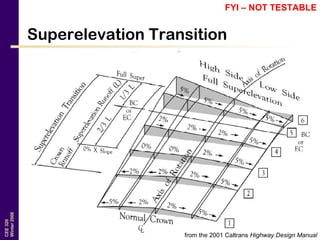
Superelevation Transition
from the 2001 Caltrans Highway Design Manual
FYI – NOT TESTABLE
CEE320
Winter2006
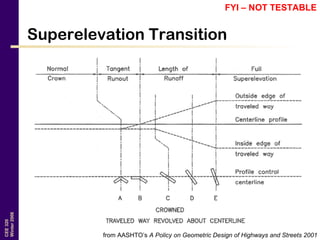
Superelevation Transition
from AASHTO’s A Policy on Geometric Design of Highways and Streets 2001
FYI – NOT TESTABLE
CEE320
Winter2006
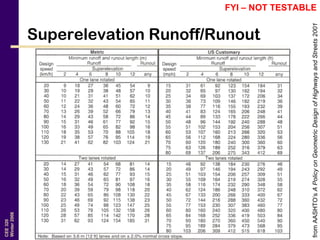
Superelevation Runoff/Runout
fromAASHTO’sAPolicyonGeometricDesignofHighwaysandStreets2001
FYI – NOT TESTABLE
CEE320
Winter2006
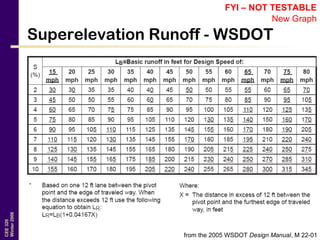
Superelevation Runoff - WSDOT
from the 2005 WSDOT Design Manual, M 22-01
FYI – NOT TESTABLE
New Graph
CEE320
Winter2006
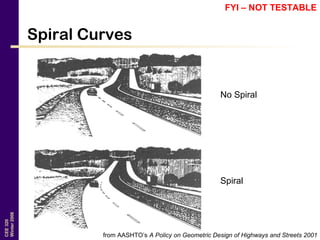
Spiral Curves
No Spiral
Spiral
from AASHTO’s A Policy on Geometric Design of Highways and Streets 2001
FYI – NOT TESTABLE
CEE320
Winter2006
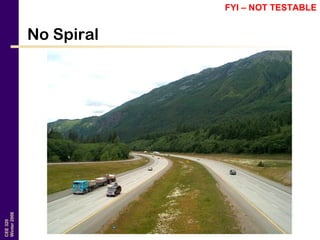
No Spiral
FYI – NOT TESTABLE
CEE320
Winter2006
Spiral Curves
• WSDOT no longer uses spiral curves
• Involve complex geometry
• Require more surveying
• Are somewhat empirical
• If used, superelevation transition should
occur entirely within spiral
FYI – NOT TESTABLE
CEE320
Winter2006
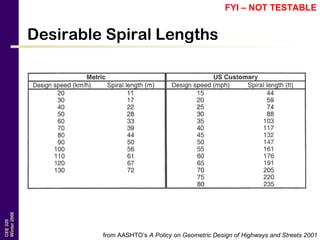
Desirable Spiral Lengths
from AASHTO’s A Policy on Geometric Design of Highways and Streets 2001
FYI – NOT TESTABLE
CEE320
Winter2006
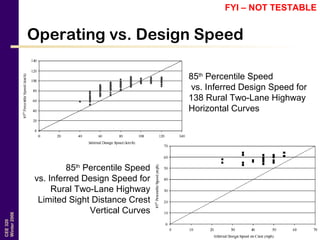
Operating vs. Design Speed
85th
Percentile Speed
vs. Inferred Design Speed for
138 Rural Two-Lane Highway
Horizontal Curves
85th
Percentile Speed
vs. Inferred Design Speed for
Rural Two-Lane Highway
Limited Sight Distance Crest
Vertical Curves
FYI – NOT TESTABLE
CEE320
Winter2006
Primary References
• Mannering, F.L.; Kilareski, W.P. and Washburn, S.S. (2005).
Principles of Highway Engineering and Traffic Analysis, Third
Edition. Chapter 3
• American Association of State Highway and Transportation
Officials (AASHTO). (2001). A Policy on Geometric Design of
Highways and Streets, Fourth Edition. Washington, D.C.

Geometric Design (Transportation Engineering)

Editor's Notes

  • #5 Therefore, roads will almost always be a bit longer than their stationing because of the vertical alignment Draw in stationing on each of these curves and explain it
  • #6 Typical set of road plans – one page only
  • #13 400 ft. vertical curve, therefore: PVI is at STA 102+00 and PVT is at STA 104+00 Elevation of the PVI is 59’ + 0.02(200) = 63 ft. Elevation of the PVT is 63’ – 0.045(200) = 54 ft. High point elevation requires figuring out the equation for a vertical curve At x = 0, y = c =&amp;gt; c=59 ft. At x = 0, dY/dx = b = G1 = +2.0% a = (G2 – G1)/2L = (-4.5 – 2)/(2(4)) = - 0.8125 y = -0.8125x2 + 2x + 59 High point is where dy/dx = 0 dy/dx = -1.625x + 2 = 0 x = 1.23 stations Find elevation at x = 1.23 stations y = -0.8125(1.23)2 + 2(1.23) + 59 y = 60.23 ft
  • #14 Last slide we found x = 1.23 stations
  • #15 G is in percent, x is in feet G is in decimal, x is in stations
  • #17 Minimum lengths are about 100 to 300 ft. Another way to get min length is 3 x (design speed in mph)
  • #22 What can you do if you need a shorter sag vertical curve than calculated? Provide fixed-source street lighting Minimum lengths are about 100 to 300 ft. Another way to get min length is 3 x design speed in mph
  • #26 Assume that S&amp;gt;L (it usually is not but for example we’ll do it this way), therefore S = 146.23 ft. which is less than L Must use S&amp;lt;L equation, it’s a quadratic with roots of 146.17 ft and -64.14 ft. The driver will see the tree when it is 146.17 feet in front of her. Available SSD is 146.17 ft. Required SSD = (1.47 x 30)2/2(32.2)(0.35 + 0) + 2.5(1.47 x 30) = 196.53 ft. Therefore, she’s not going to stop in time. OR L/A = K = 150/6.4 = 23.43, which is less than the required K of 37 for a 30 mph design speed Stopping sight distance on level ground at 30 mph is approximately 200 ft.
  • #27 Assume that S&amp;gt;L (it usually is), therefore SSD = 243.59 ft. which is greater than L The driver will see the tree when it is 243.59 feet in front of her. Available SSD = 243.59 ft. Required SSD = (1.47 x 30)2/2(32.2)(0.35 + 0) + 2.5(1.47 x 30) = 196.53 ft. Therefore, she will be able to stop in time. OR L/A = K = 150/6.4 = 23.43, which is greater than the required K of 19 for a 30 mph design speed on a crest vertical curve Stopping sight distance on level ground at 30 mph is approximately 200 ft.
  • #28 For 45 mph we get K=61, therefore L = KA = (61)(5.2) = 317.2 ft.
  • #29 Trinity Road between Sonoma and Napa valleys
  • #31 D = degree of curvature (angle subtended by a 100’ arc)
  • #33 Since we know R and T we can use T = Rtan(delta/2) to get delta = 29.86 degrees D = 5729.6/R. Therefore D = 3.82 L = 100(delta)/D = 100(29.86)/3.82 = 781 ft. PC = PT – PI = 2000 – 781 = 12+18.2 PI = PC +T = 12+18.2 + 400 = 16+18.2. Note: cannot find PI by subtracting T from PT!
  • #35 Divide both sides by Wcos(α) Assume fse is small and can be neglected – it is the normal component of centripetal acceleration
  • #36 The maximum side friction factor is the point at which the tires begin to skid Design values of fs are chosen somewhat below this maximum value so there is a margin of safety
  • #41 There is a different curve for each superelevation rate, this one is for 8%
  • #43 For the minimum curve radius we want the maximum superelevation rate. WSDOT max e = 0.10 For 70 mph, WSDOT f = 0.10 Rv = V2/g(fs+e) = (70 x 1.47)2/32.2(0.10 + 0.10) = 1644.16 ft. This is the radius to the center of the inside lane. Depending upon the number of lanes and perhaps a center divider, the actual centerline radius will be different.
  • #44 Basically it’s figuring out L and M from the normal equations
  • #48 Can also rotate about inside/outside axis
  • #51 Ease driver into the curve Think of how the steering wheel works, it’s a change from zero angle to the angle of the turn in a finite amount of time This can result in lane wander Often make lanes bigger in turns to accommodate for this
  • #52 I-90 past North Bend looking east
  • #55 According to NCHRP Report