Sight Distance forSight Distance for
Horizontal CurvesHorizontal Curves
1
Provided Sight Distance
• Potential sight obstructions
– On horizontal curves: barriers,
bridge-approach fill slopes, trees,
back slopes of cut sections
– On vertical curves: road surface at
some point on a crest vertical
curve, range of head lights on a sag
curve
3
S
R
M
O
TA
Sight
Obstruction
on for
Horizontal
Curves
4
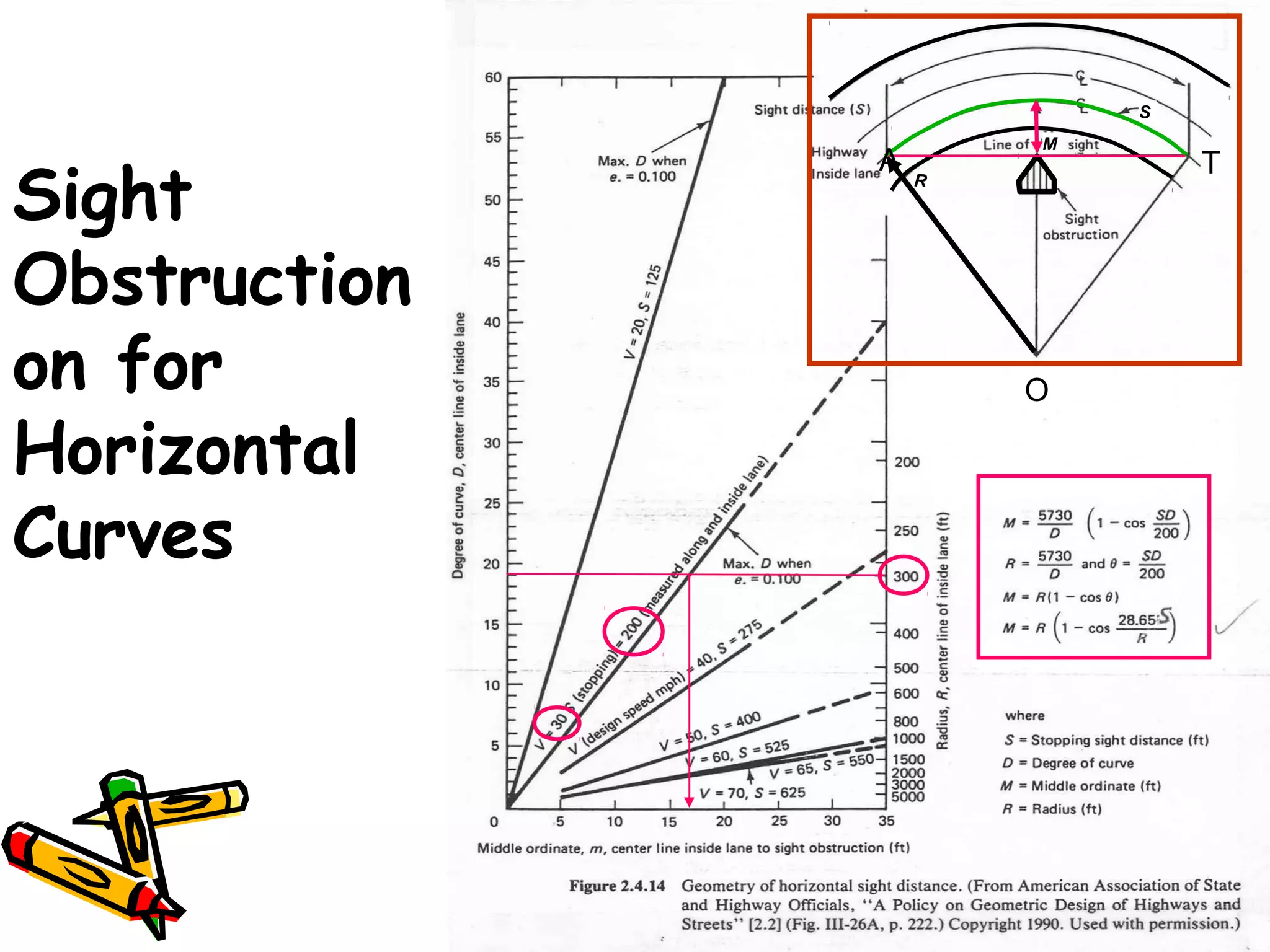
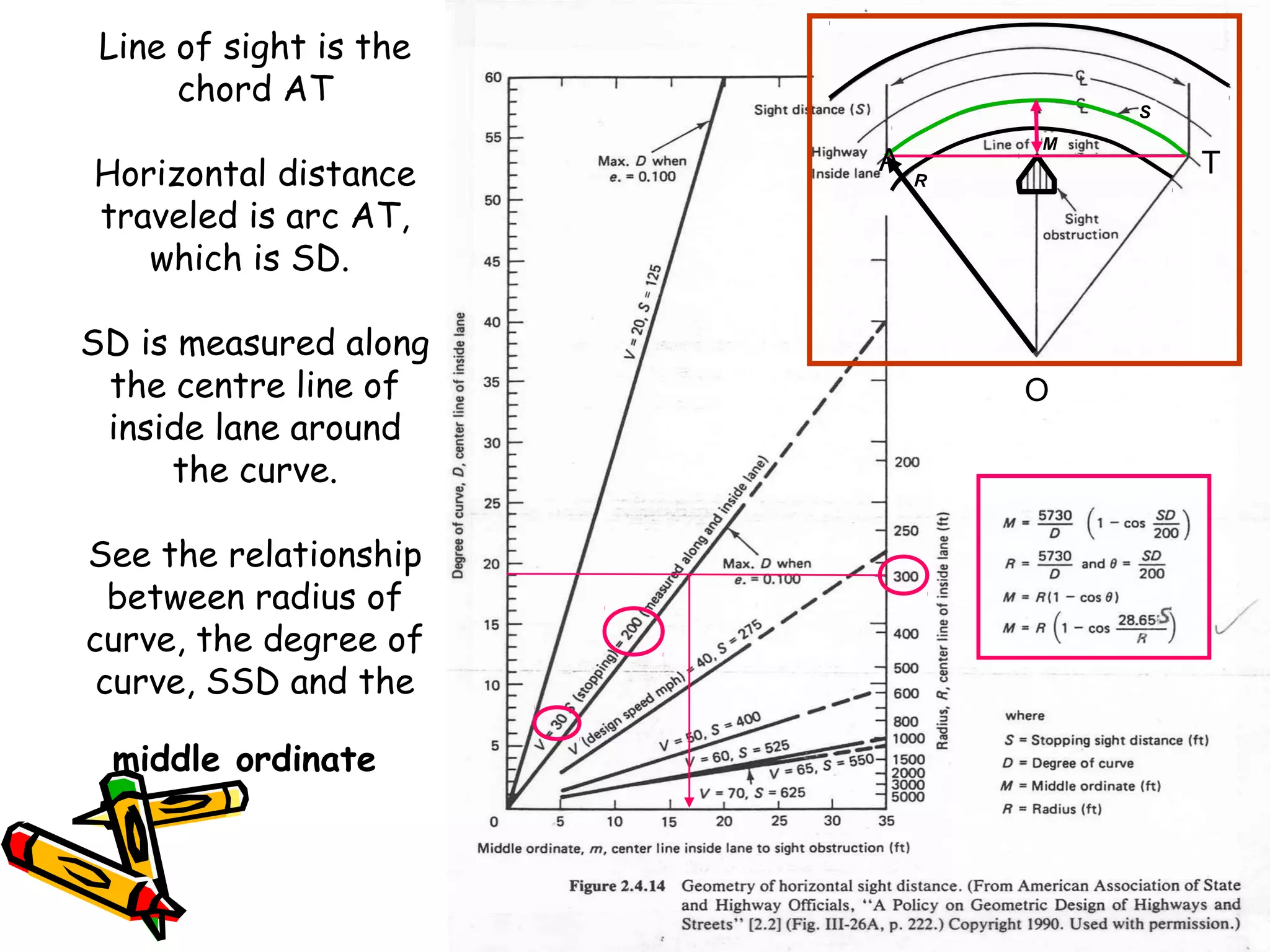
Line of sight is the
chord AT
Horizontal distance
traveled is arc AT,
which is SD.
SD is measured along
the centre line of
inside lane around
the curve.
See the relationship
between radius of
curve, the degree of
curve, SSD and the
middle ordinate
S
R
M
O
TA
5
Middle ordinate
• Location of object along chord length that
blocks line of sight around the curve
• m = R(1 – cos [28.65 S])
R
Where:
m = line of sight
S = stopping sight distance
R = radius
6
Middle ordinate
• Angle subtended at centre of circle by
arc AT is 2θ in degree then
• S / πR = 2θ / 180
• S = 2R θπ / 180
• θ = S 180 / 2R π = 28.65 (S) / R
• R-M/R = cos θ
• M = [1 – cos 28.65 (S) / R ]
θR
M
A T
B
T
O
θ
7
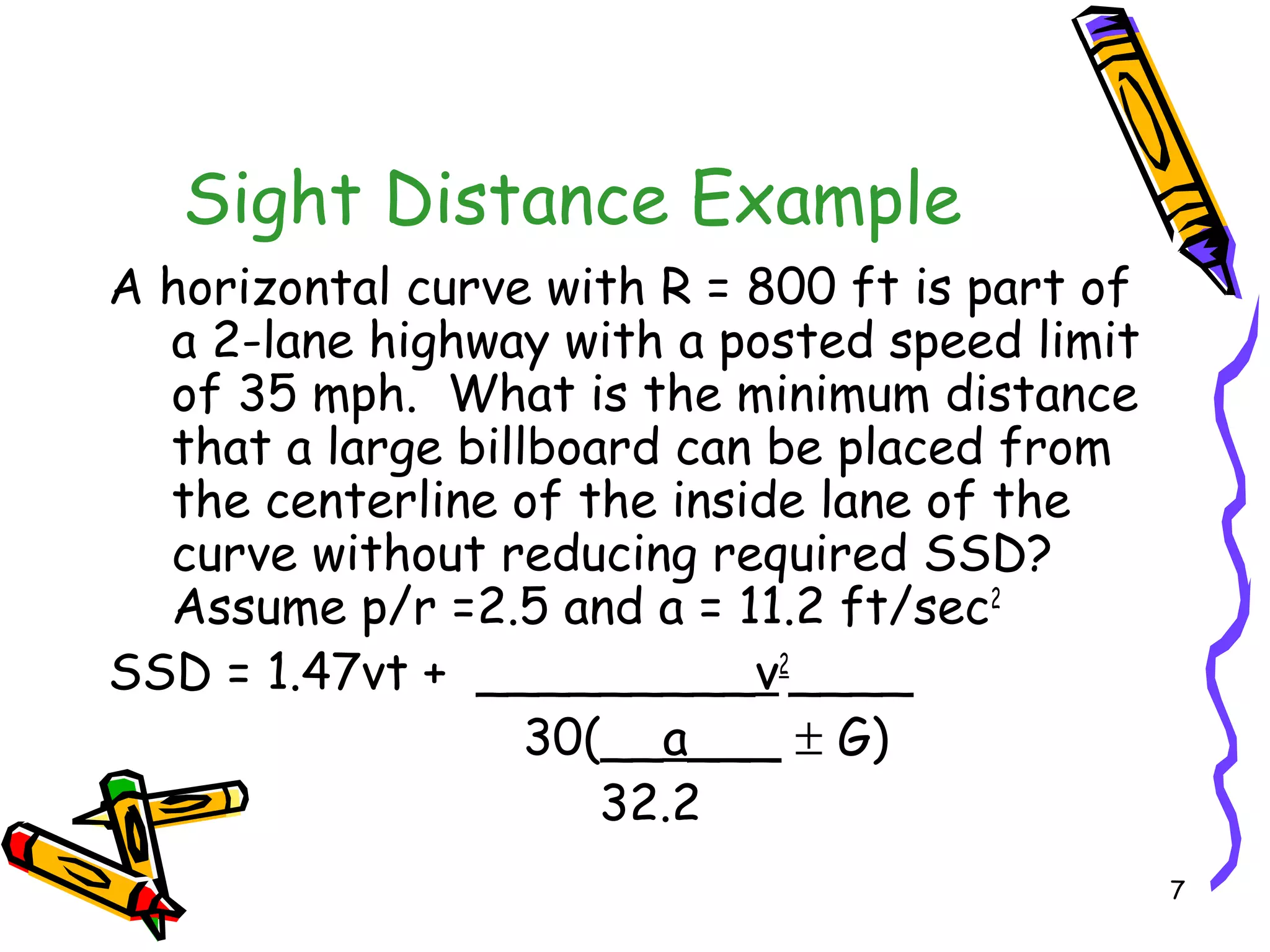
Sight Distance Example
A horizontal curve with R = 800 ft is part of
a 2-lane highway with a posted speed limit
of 35 mph. What is the minimum distance
that a large billboard can be placed from
the centerline of the inside lane of the
curve without reducing required SSD?
Assume p/r =2.5 and a = 11.2 ft/sec2
SSD = 1.47vt + _________v2
____
30(__a___ ± G)
32.2
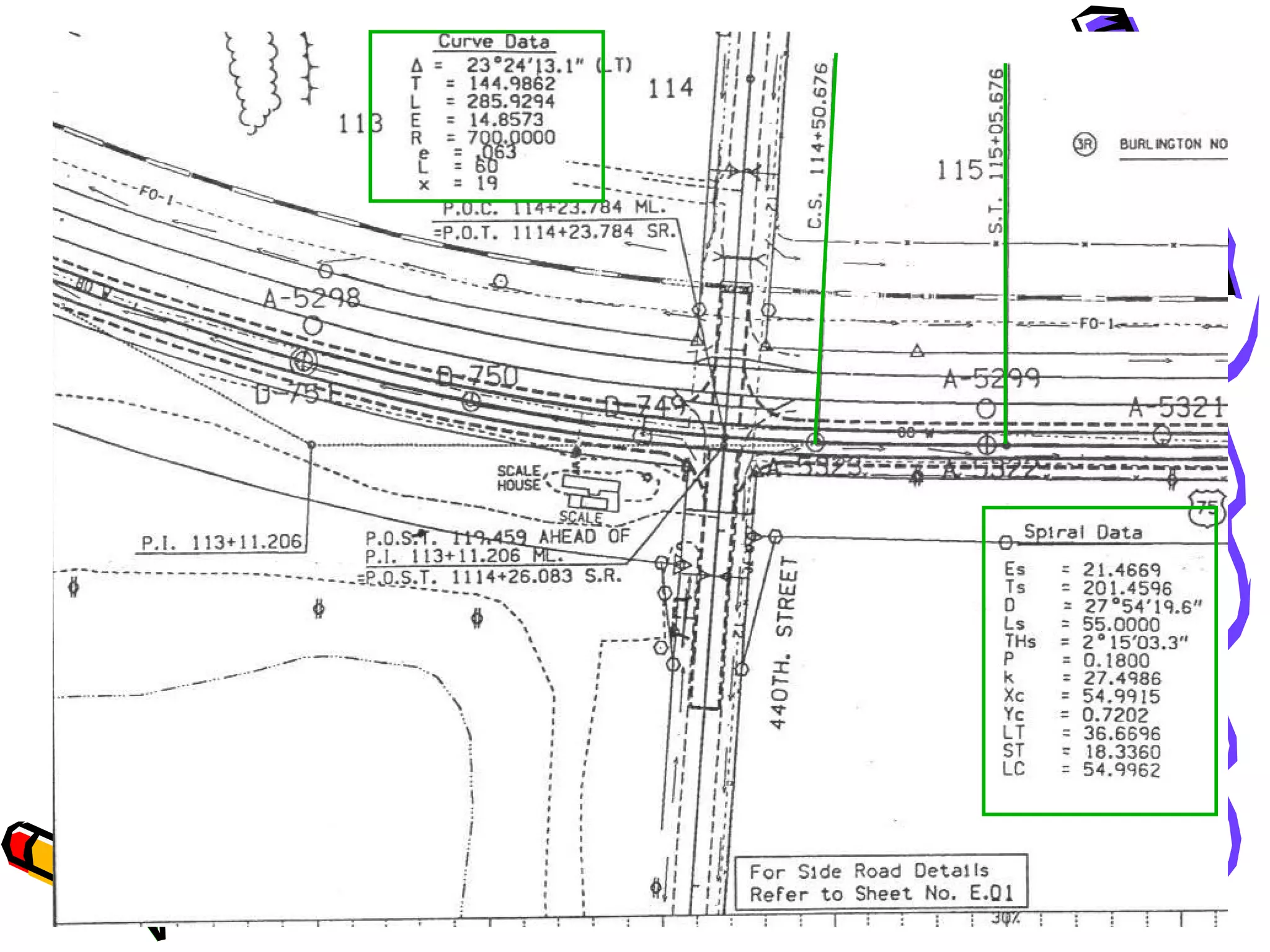
8
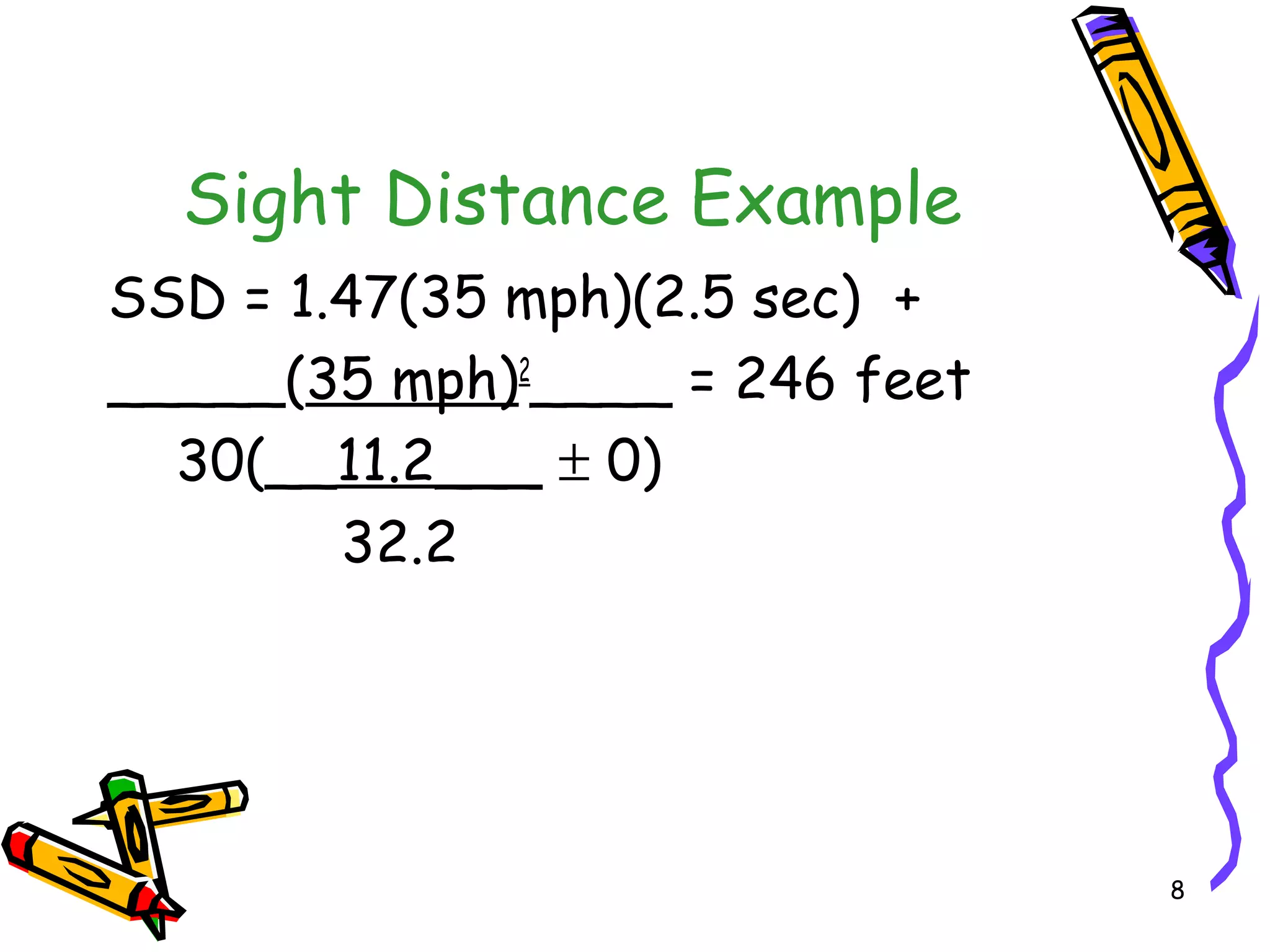
Sight Distance Example
SSD = 1.47(35 mph)(2.5 sec) +
_____(35 mph)2
____ = 246 feet
30(__11.2___ ± 0)
32.2
9
Sight Distance Example
m = R(1 – cos [28.65 S])
R
m = 800 (1 – cos [28.65 {246}])= 9.43’
800
(in radians not degrees)
10
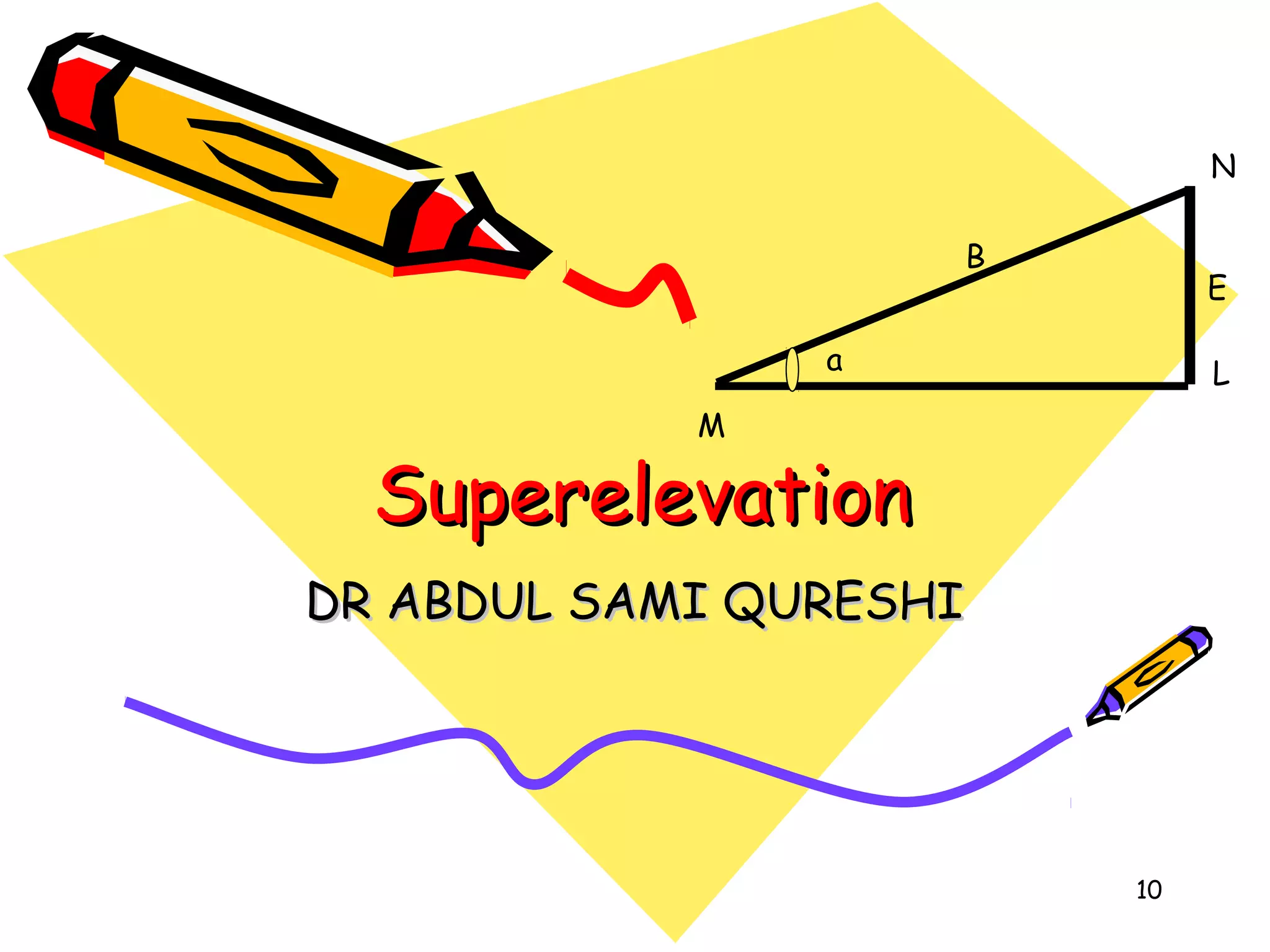
SuperelevationSuperelevation
DR ABDUL SAMI QURESHIDR ABDUL SAMI QURESHI
M
L
N
a
E
B
11
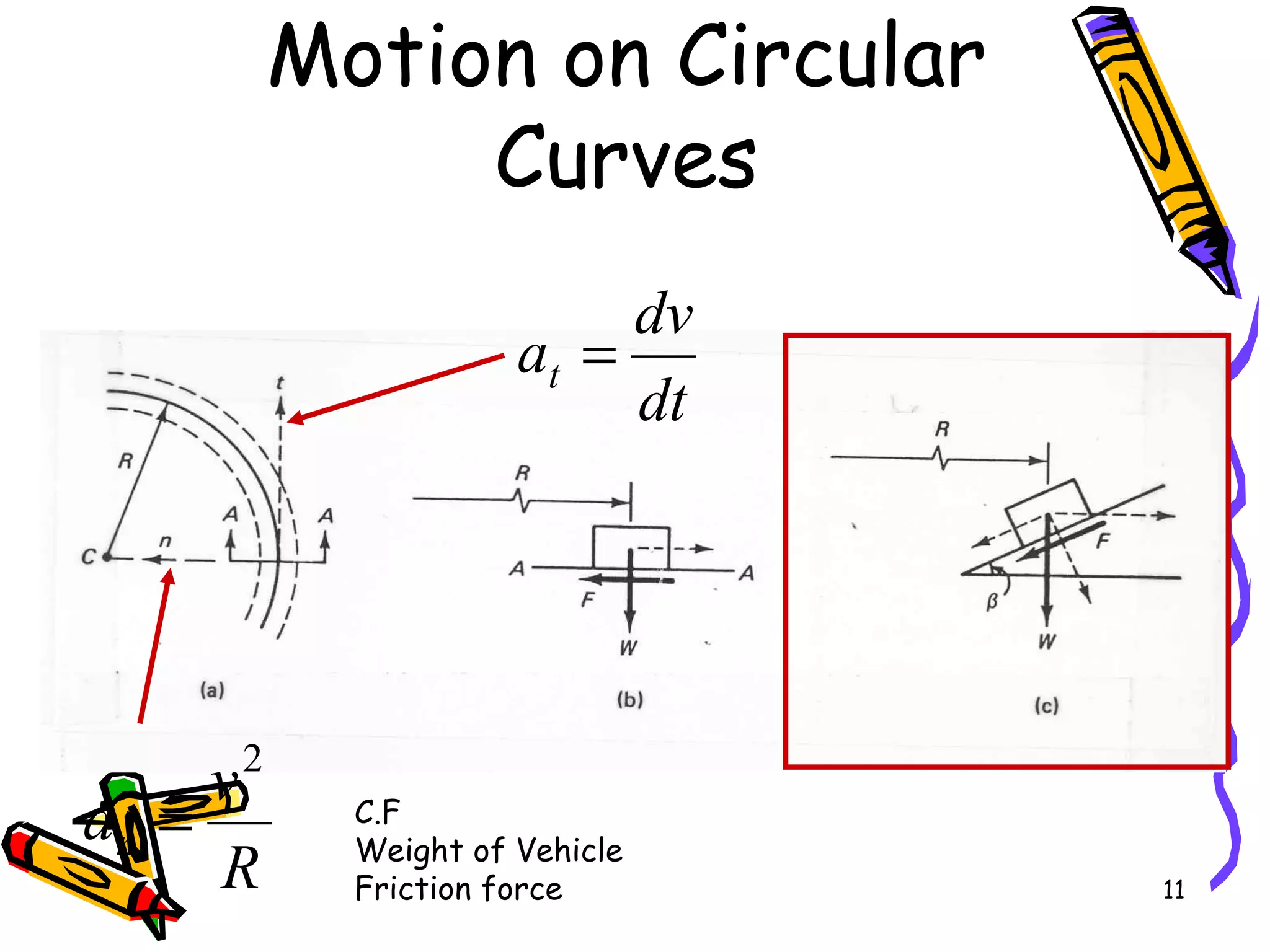
Motion on Circular
Curves
dt
dv
at =
R
v
an
2
= C.F
Weight of Vehicle
Friction force
12
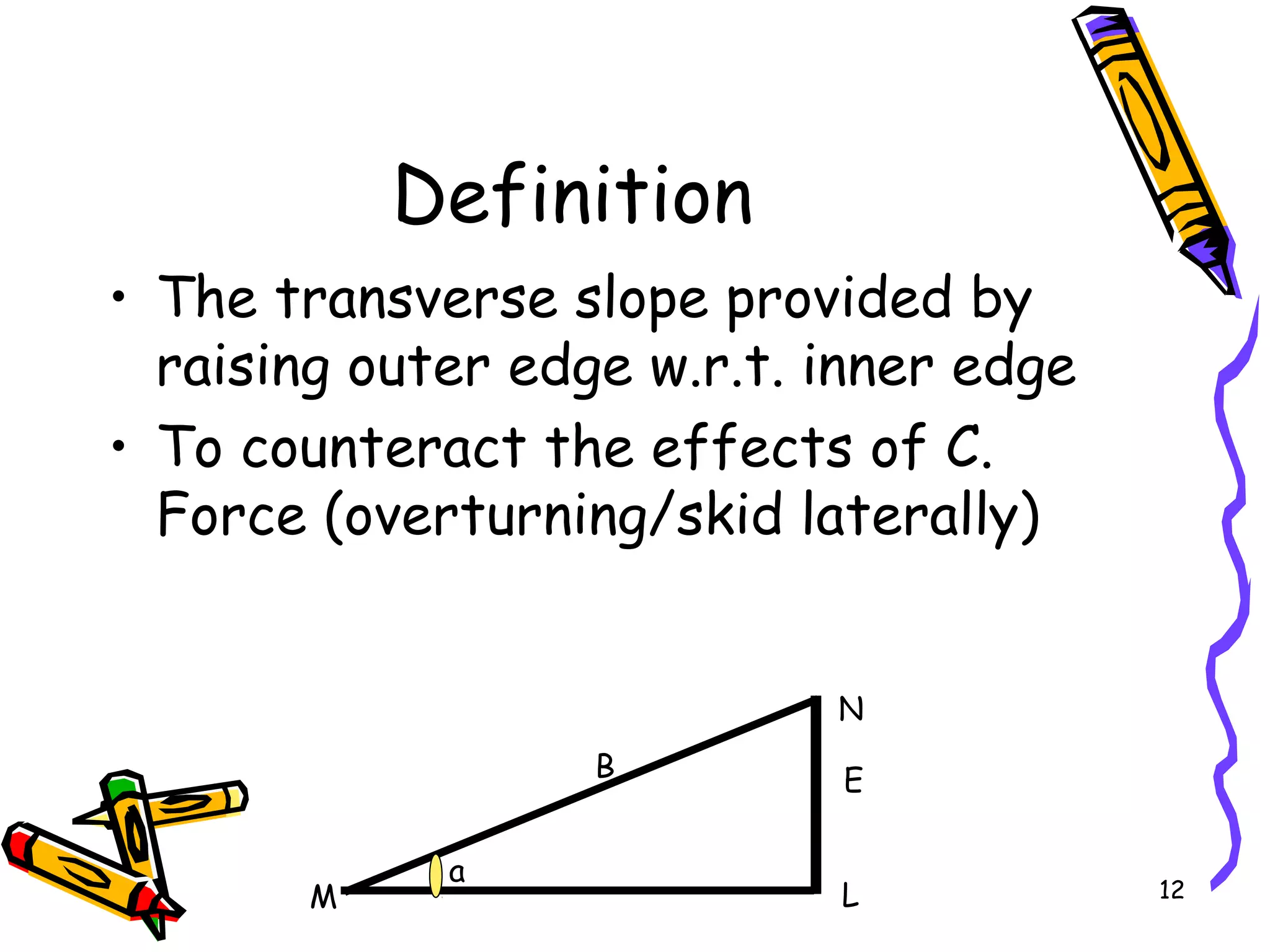
Definition
• The transverse slope provided by
raising outer edge w.r.t. inner edge
• To counteract the effects of C.
Force (overturning/skid laterally)
L
N
a
EB
M
13
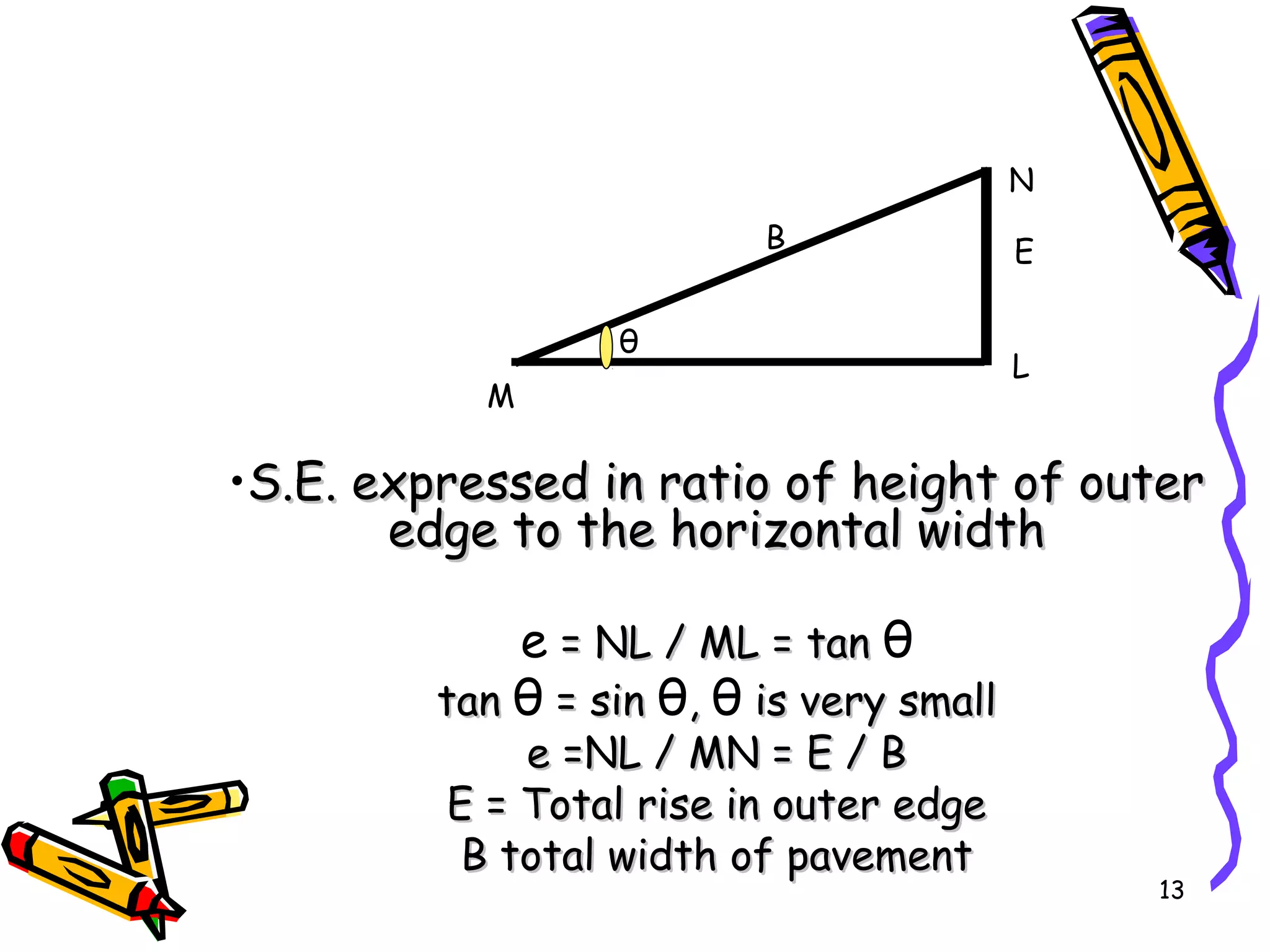
•S.E. expressed in ratio of height of outerS.E. expressed in ratio of height of outer
edge to the horizontal widthedge to the horizontal width
e = NL / ML = tan= NL / ML = tan θ
tantan θ = sin= sin θ,, θ is very smallis very small
e =NL / MN = E / Be =NL / MN = E / B
E = Total rise in outer edgeE = Total rise in outer edge
B total width of pavementB total width of pavement
M
L
N
θ
EB
14
FgFW fp =+
α
α
C cos θ Cx
Mx =M sin
θ
My =M cos a
Ff
Ff
θ
C
M 1 ft
e
≈
Rv
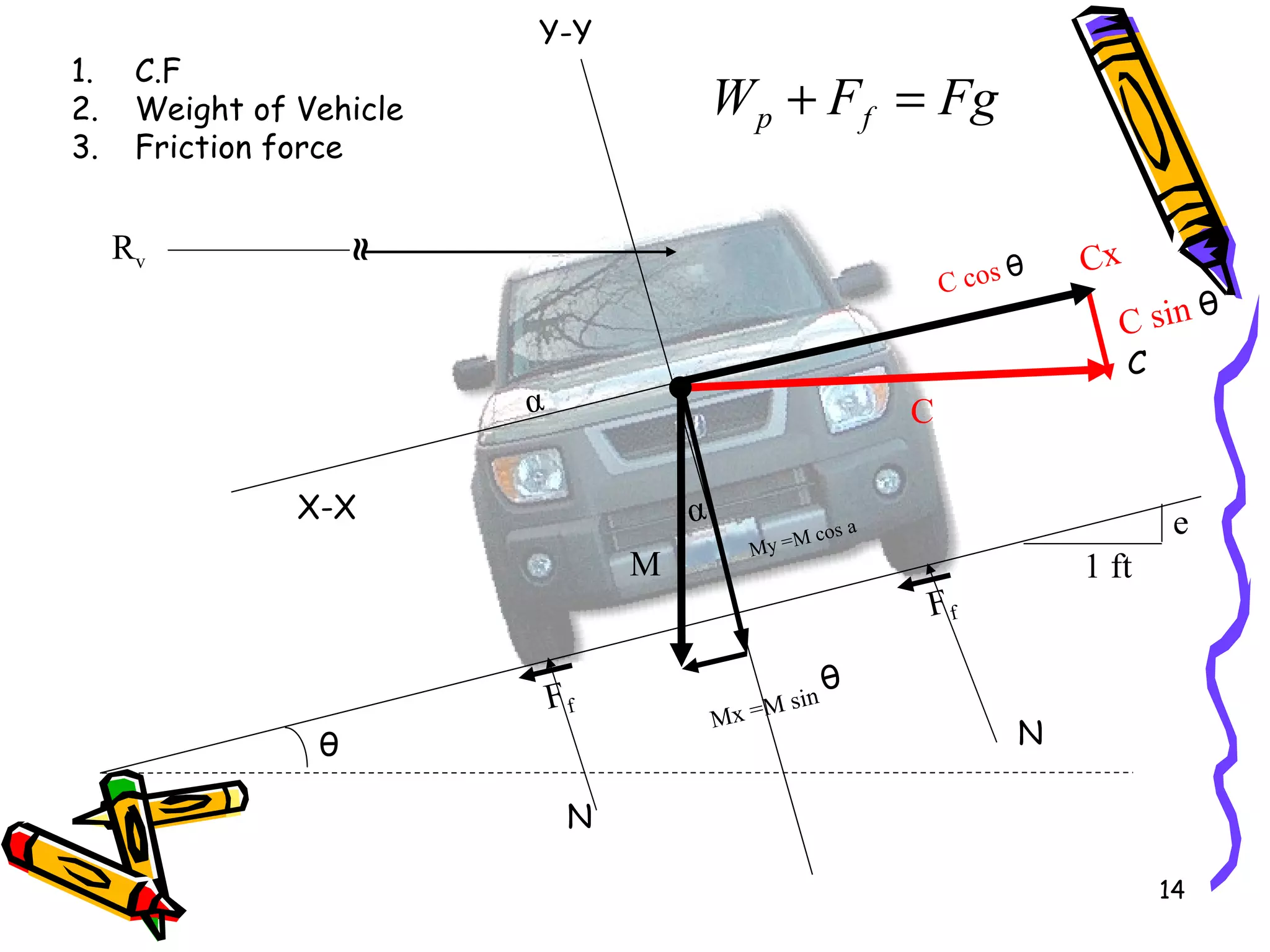
1. C.F
2. Weight of Vehicle
3. Friction force
X-X
Y-Y
C
N
N
C sin θ
15
Theo-
retical
Consi-
derati
on
16
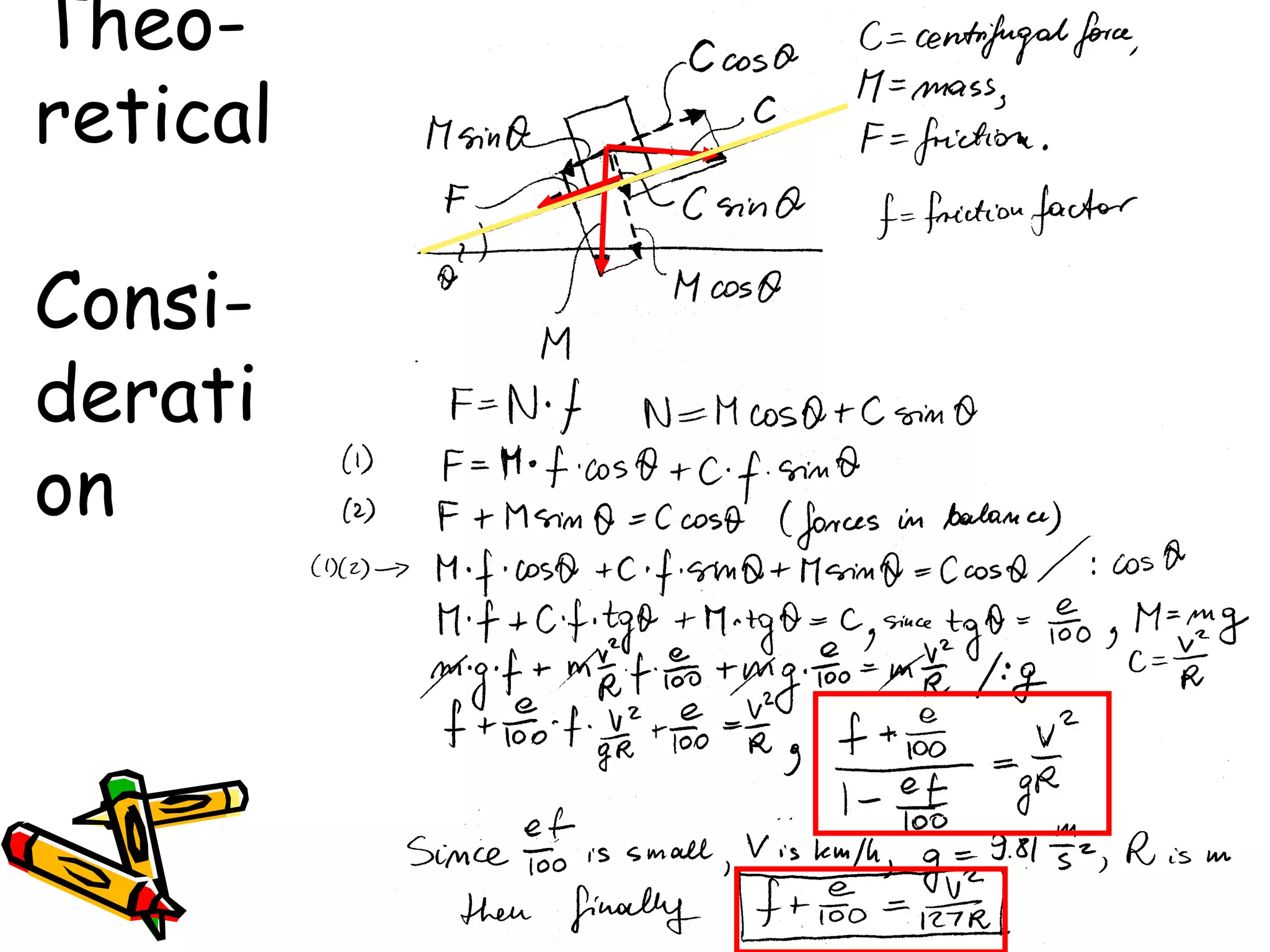
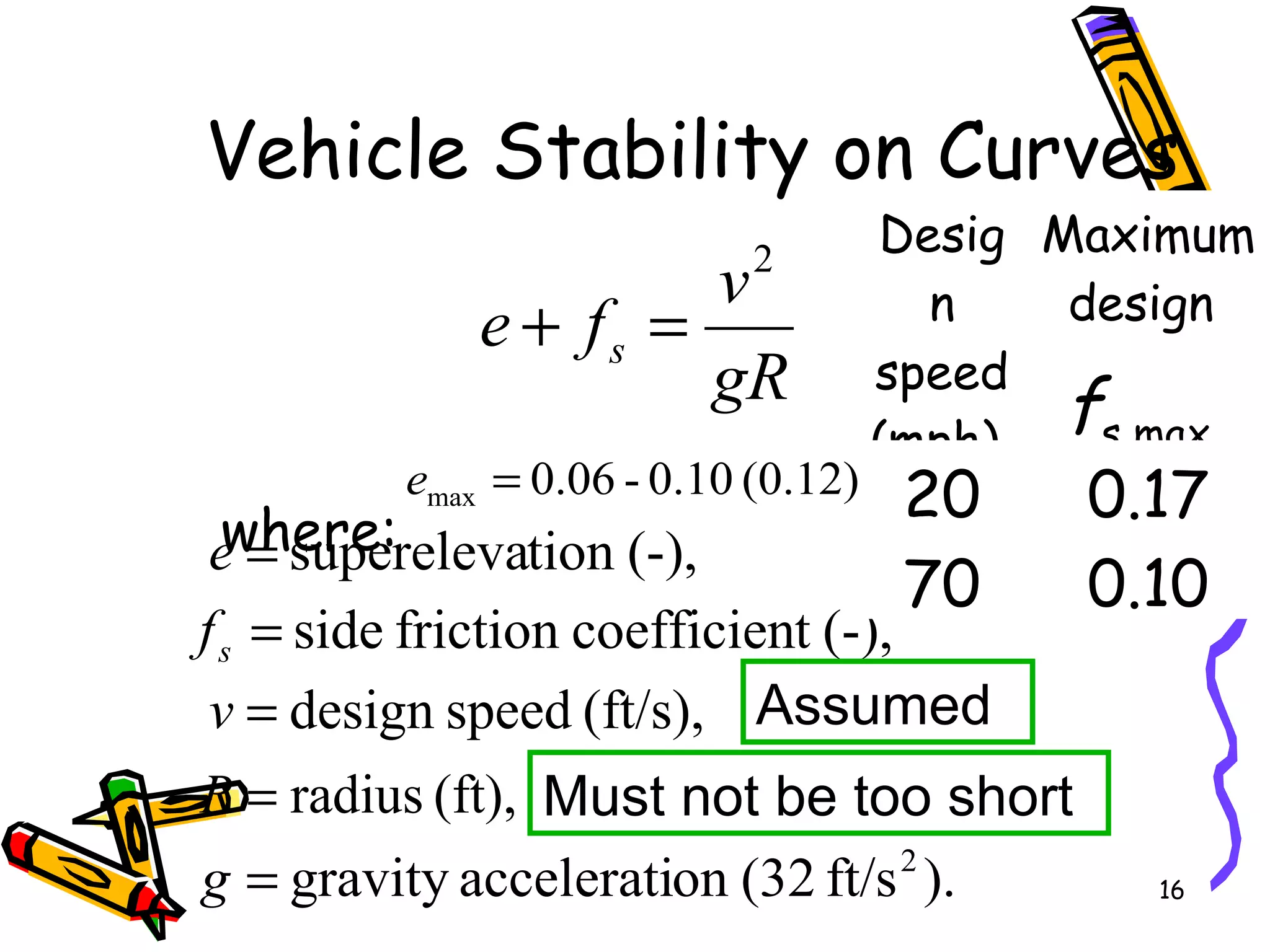
Vehicle Stability on Curves
where:
gR
v
fe s
2
=+
(ft/s),speeddesign=v
(-),tcoefficienfrictionside=sf
).ft/s(32onacceleratigravity 2
=g
(-),tionsupereleva=e
(ft),radius=R
Assumed
Desig
n
speed
(mph)
Maximum
design
fs max
20 0.17
70 0.10
Must not be too short
(0.12)0.10-0.06max =e
17
Selection of e and fs
• Practical limits on super elevation (e)
– Climate
– Constructability
– Adjacent land use
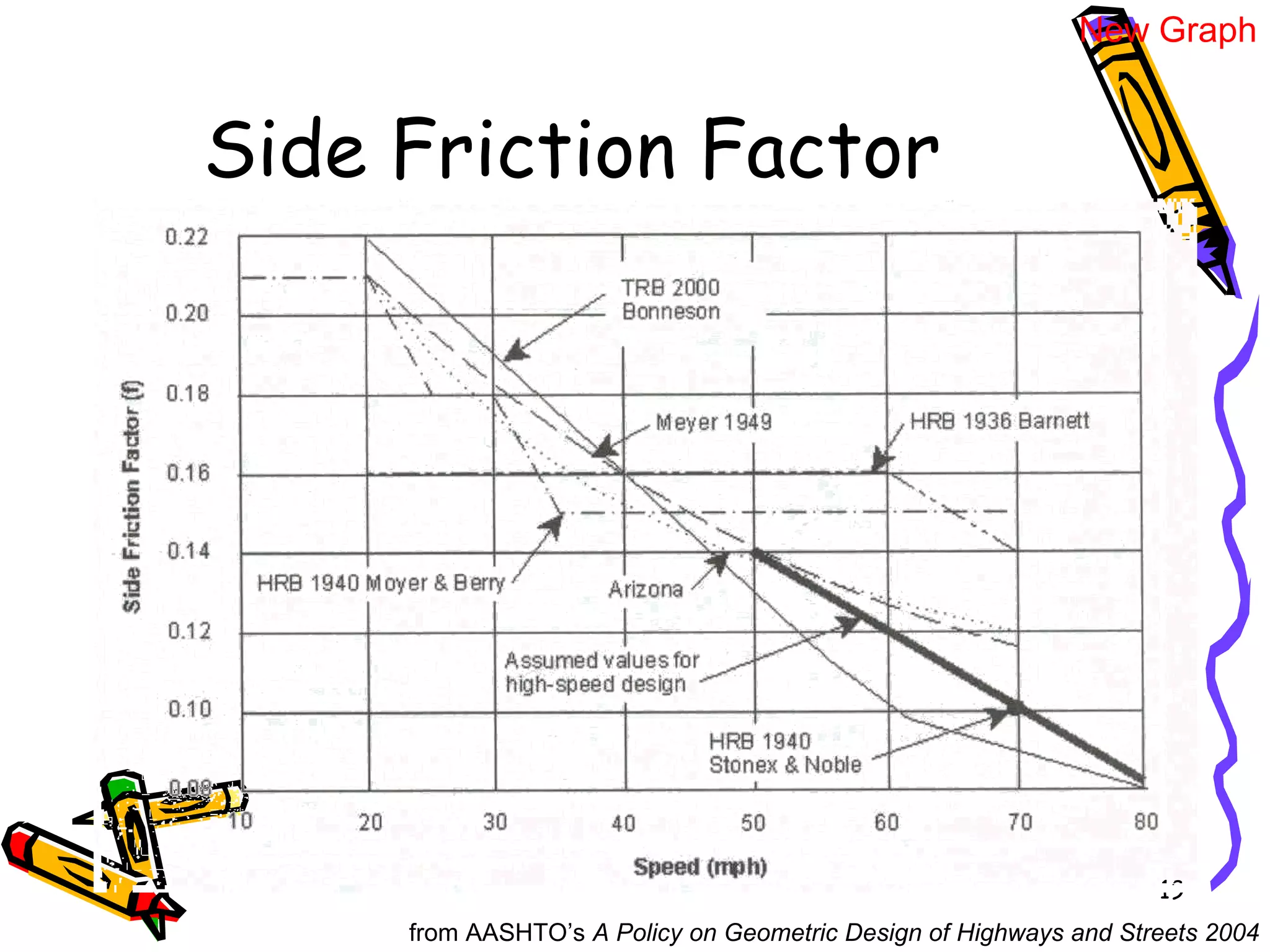
• Side friction factor (fs) variations
– Vehicle speed
– Pavement texture
– Tire condition
• The maximum side friction factor is the point at
which the tires begin to skid
• Design values of fs are chosen somewhat below
this maximum value so there is a margin of safety
18
19
Side Friction Factor
from AASHTO’s A Policy on Geometric Design of Highways and Streets 2004
New Graph
20
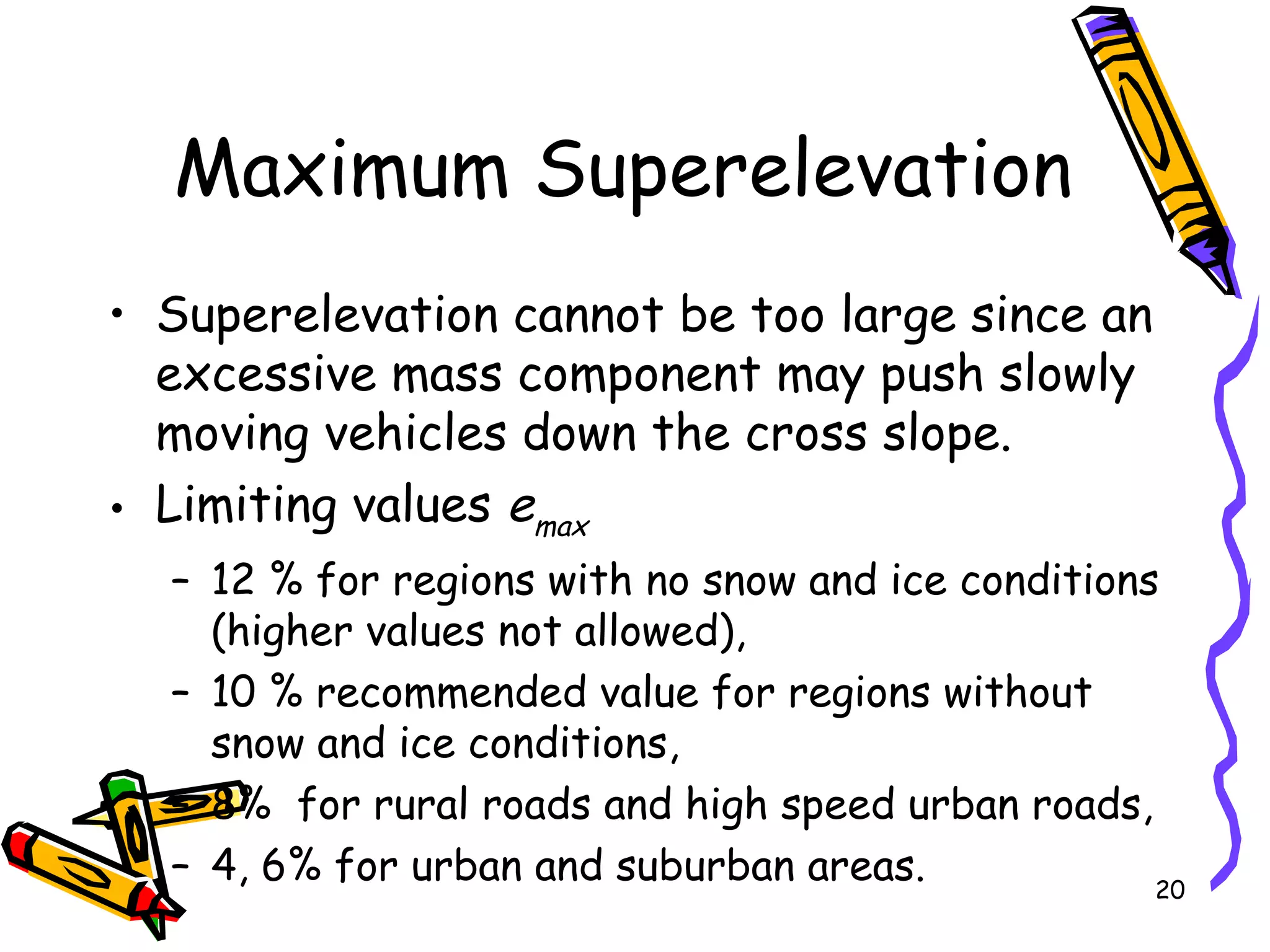
Maximum Superelevation
• Superelevation cannot be too large since an
excessive mass component may push slowly
moving vehicles down the cross slope.
• Limiting values emax
– 12 % for regions with no snow and ice conditions
(higher values not allowed),
– 10 % recommended value for regions without
snow and ice conditions,
– 8% for rural roads and high speed urban roads,
– 4, 6% for urban and suburban areas.
21
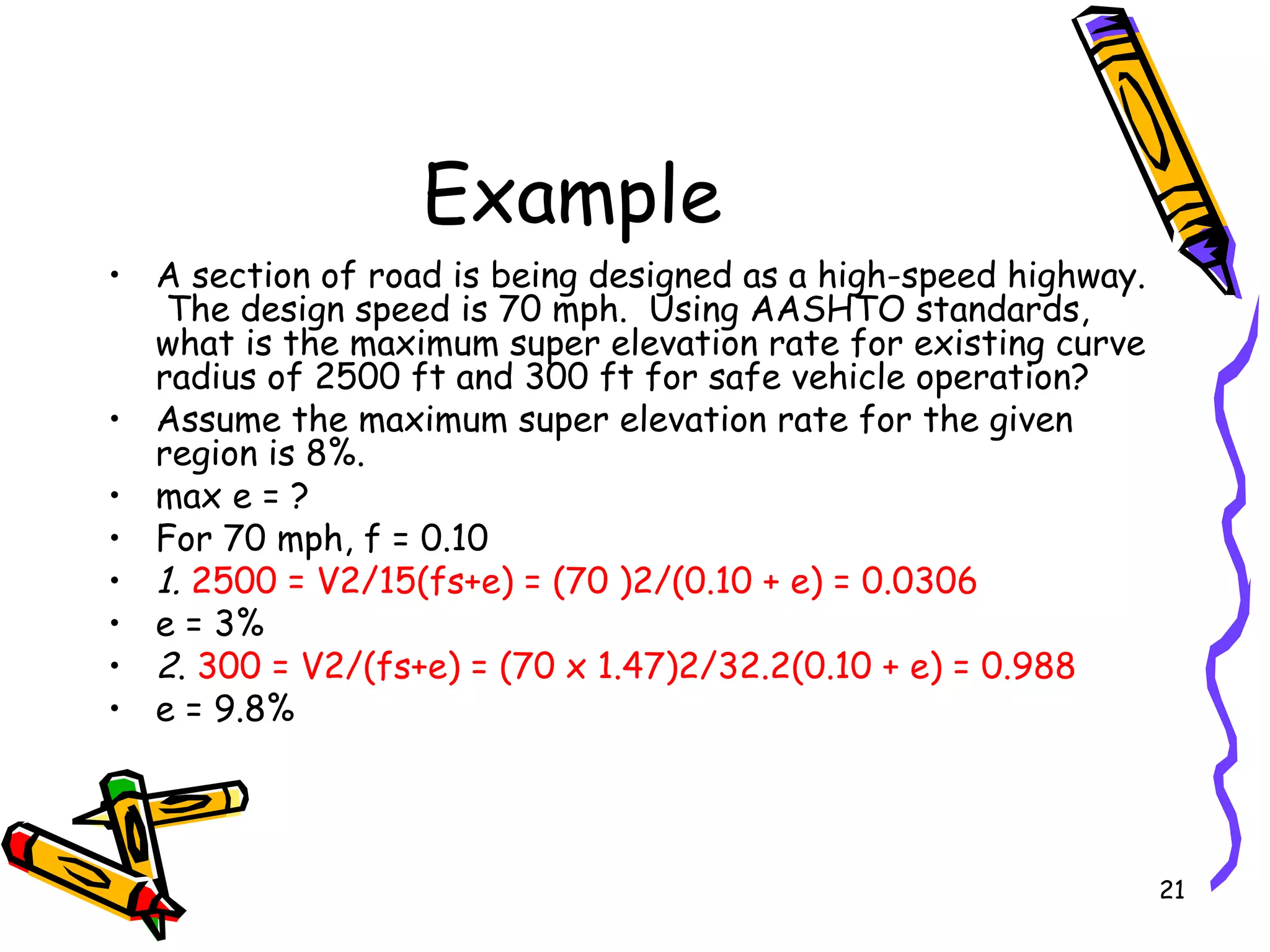
Example
• A section of road is being designed as a high-speed highway.
The design speed is 70 mph. Using AASHTO standards,
what is the maximum super elevation rate for existing curve
radius of 2500 ft and 300 ft for safe vehicle operation?
• Assume the maximum super elevation rate for the given
region is 8%.
• max e = ?
• For 70 mph, f = 0.10
• 1. 2500 = V2/15(fs+e) = (70 )2/(0.10 + e) = 0.0306
• e = 3%
• 2. 300 = V2/(fs+e) = (70 x 1.47)2/32.2(0.10 + e) = 0.988
• e = 9.8%
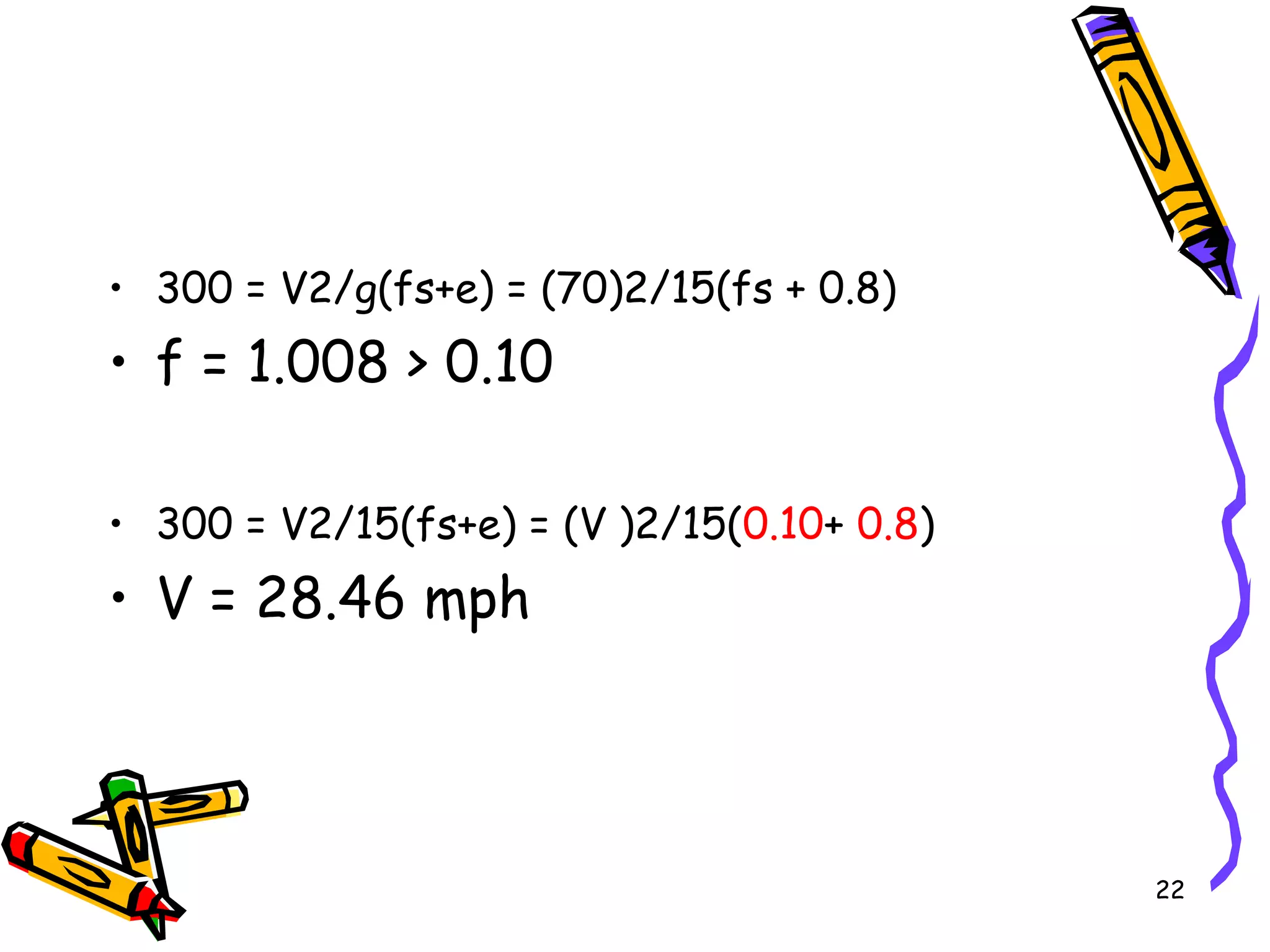
• 300 = V2/g(fs+e) = (70)2/15(fs + 0.8)
• f = 1.008 > 0.10
• 300 = V2/15(fs+e) = (V )2/15(0.10+ 0.8)
• V = 28.46 mph
22
23
Crown / super elevation
runoff length
24
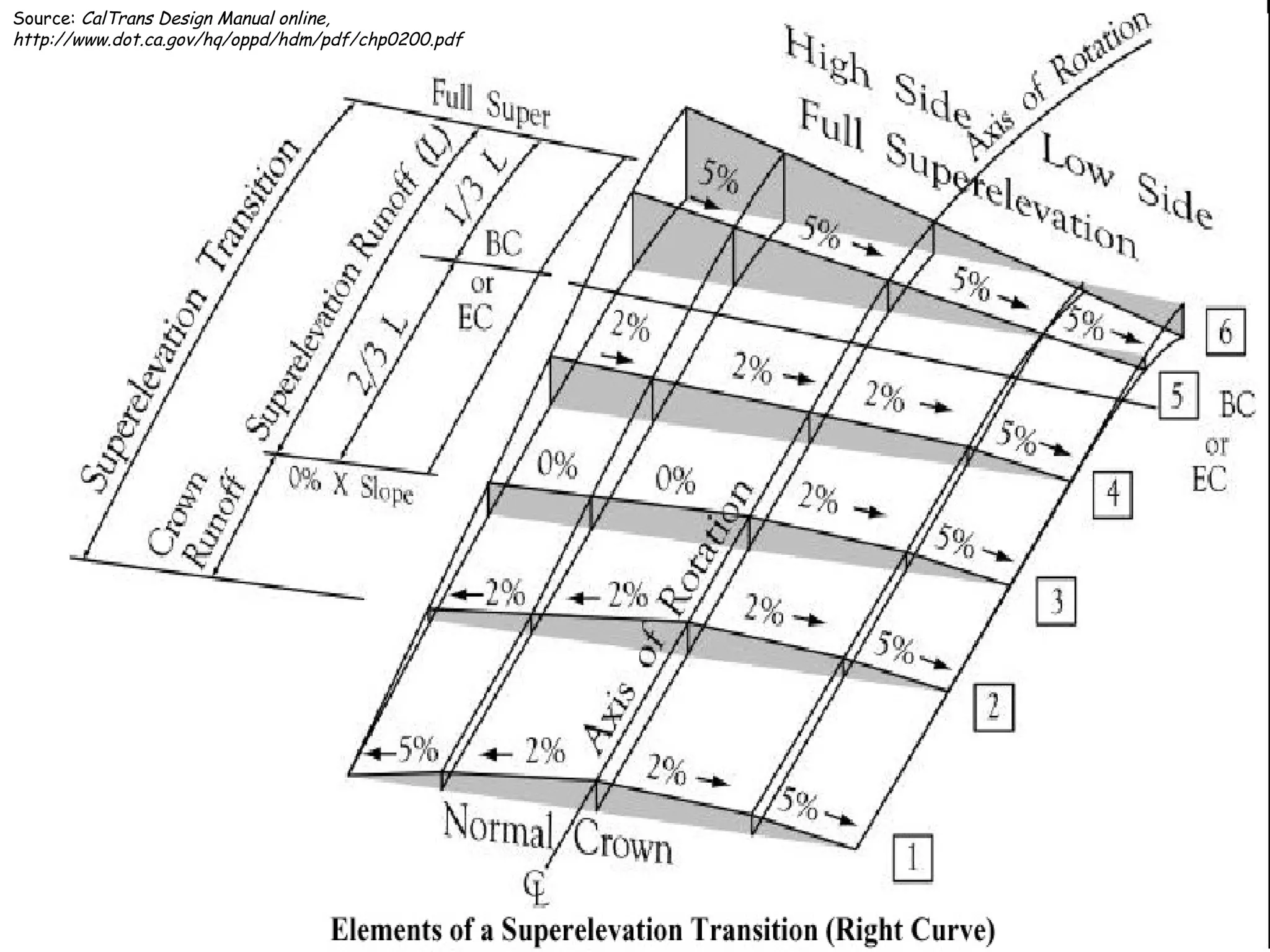
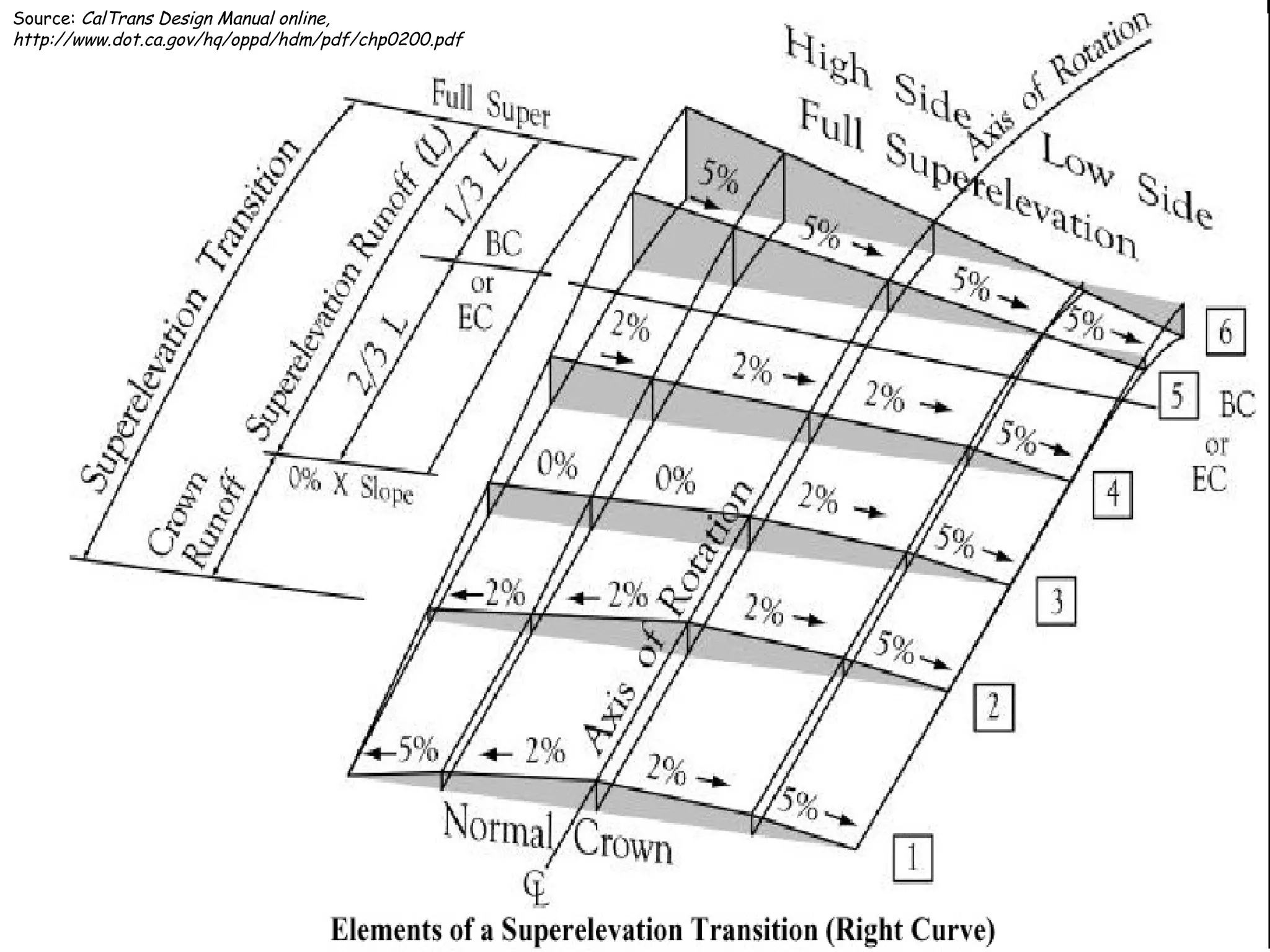
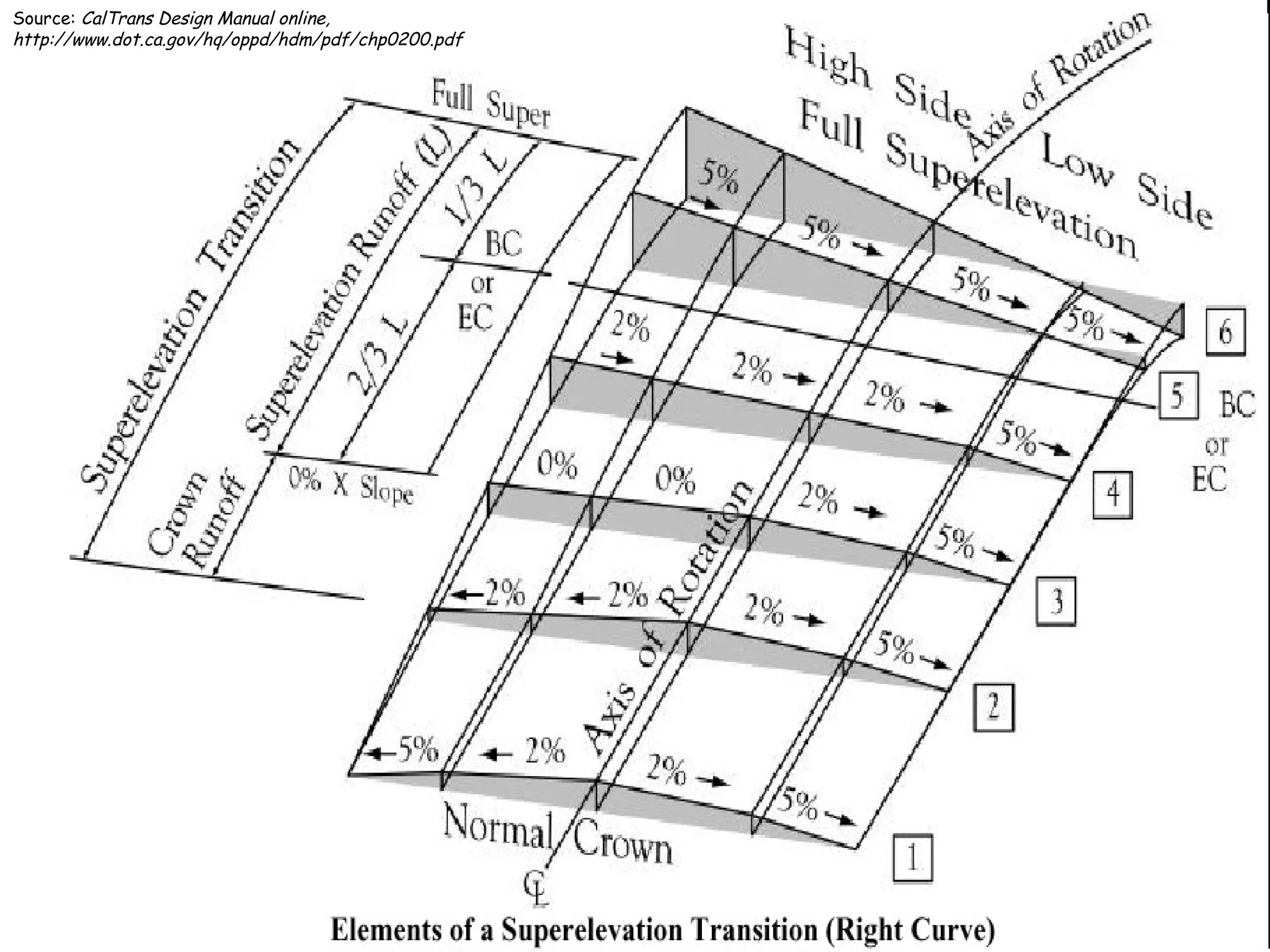
Source: CalTrans Design Manual online,
http://www.dot.ca.gov/hq/oppd/hdm/pdf/chp0200.pdf
25
Attainment of Superelevation -
General
1. Tangent to superelevation
2. Must be done gradually over a distance without
appreciable reduction in speed or safety and
with comfort
3. Change in pavement slope should be consistent
over a distance
4. Methods (Exhibit 3-37 p. 186)
a. Rotate pavement about centerline
b. Rotate about inner edge of pavement
c. Rotate about outside edge of pavement
26
Source: CalTrans Design Manual online,
http://www.dot.ca.gov/hq/oppd/hdm/pdf/chp0200.pdf
27
Common methods of developing the
transition to super elevation
• At (2)the out side edge is far below the centre
line as the inside edge
• At (3)the out side edge has reached the level of
the centre line
• At point (4) the out side edge is located as far
above as the inside edge is below the centerline.
• Finally , at point (5) the cross section is fully
super elevated and remain through out the
circular curve
• The reverse of these profiles is found at the
other end of circular curve.
28
Common methods of developing the
transition to super elevation
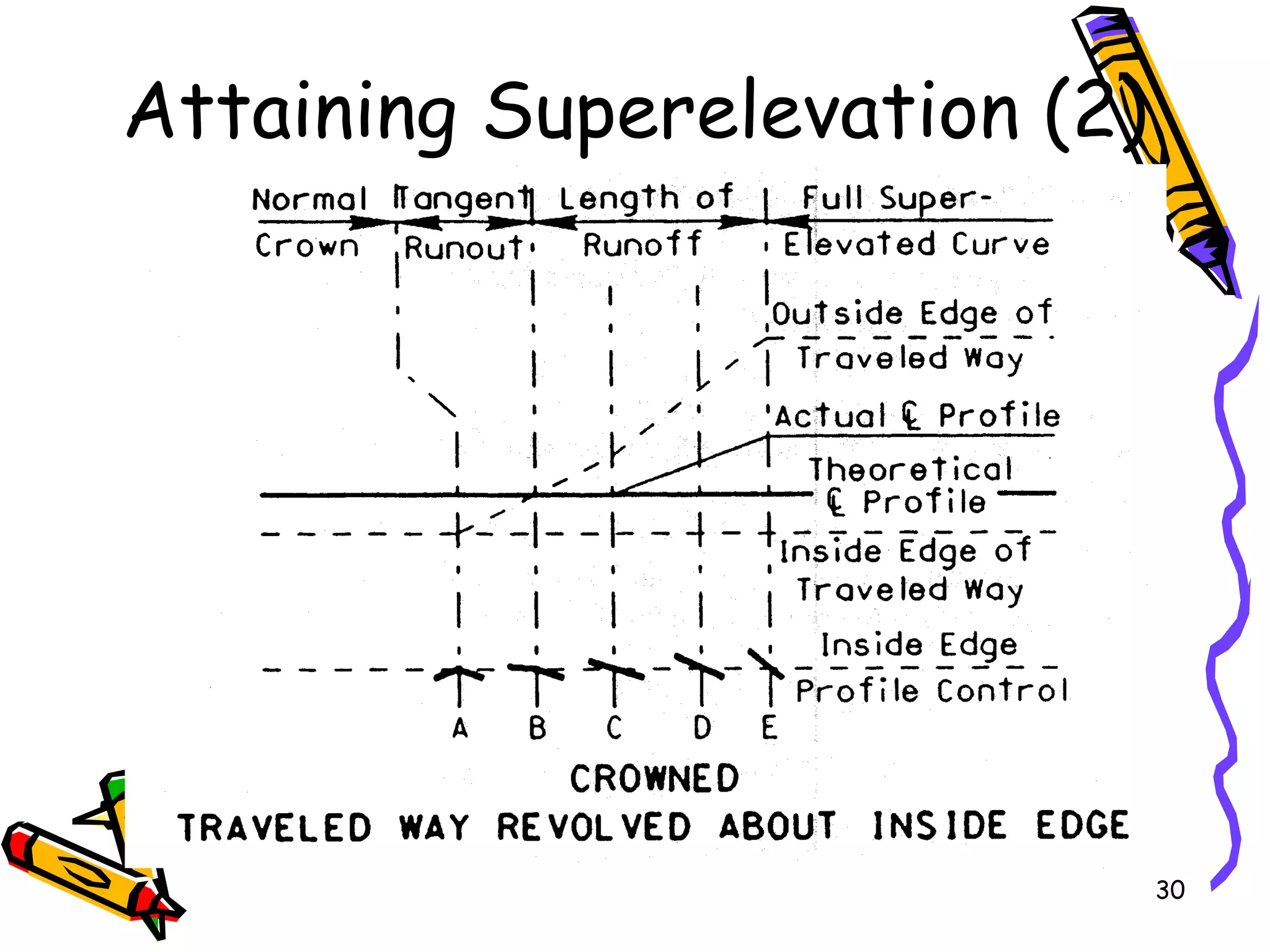
• Location of inside edge, centre line, and out side edge are
shown relative to elevation of centerline
• The difference in elevation being equal to the normal crown
times the pavement width.
• At A the out side edge is far below the centre line as the
inside edge
• At B the out side edge has reached the level of the centre
line
• At point C the out side edge is located as far above as the
inside edge is below the centerline.
• Finally , at point E the cross section is fully super elevated
• The reverse of these profiles is found at the other end of
circular curve.
29
Attaining Superelevation (1)
•Location of inside edge, centre line, and out side edge are shown
relative to elevation of centerline
30
Attaining Superelevation (2)
31
Attaining Superelevation (3)
32
Superelevation
Transition Section
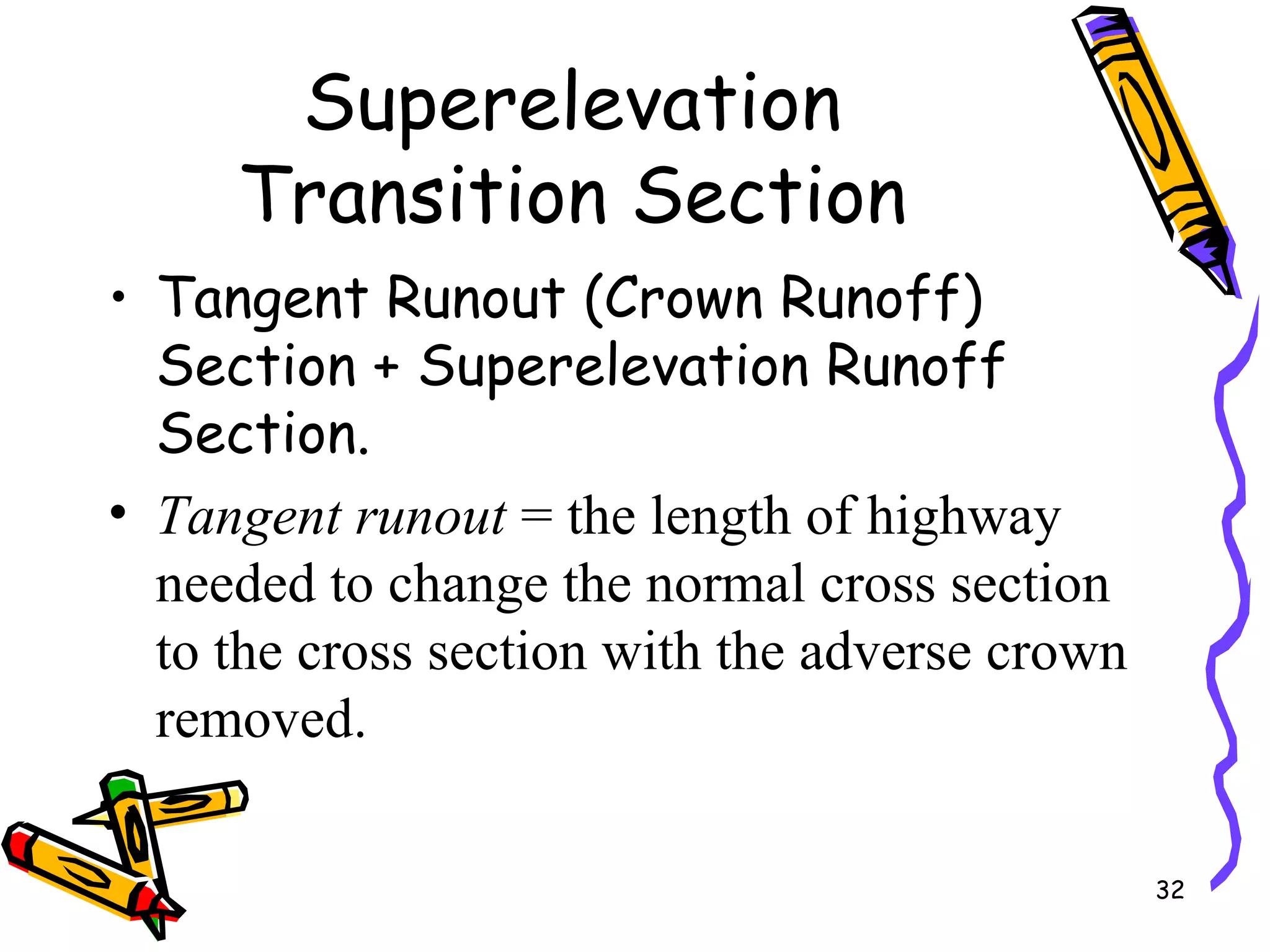
• Tangent Runout (Crown Runoff)
Section + Superelevation Runoff
Section.
• Tangent runout = the length of highway
needed to change the normal cross section
to the cross section with the adverse crown
removed.
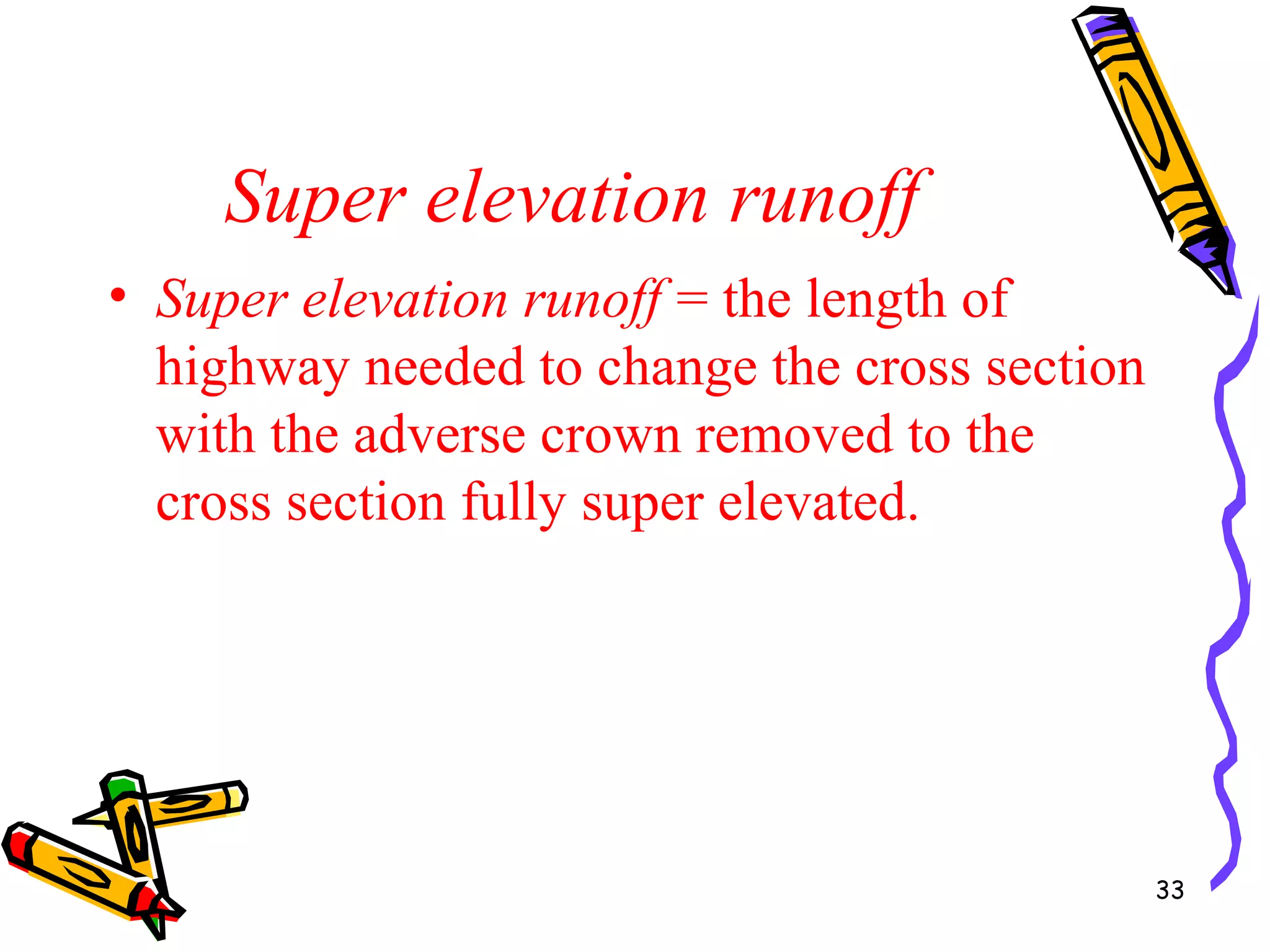
Super elevation runoff
• Super elevation runoff = the length of
highway needed to change the cross section
with the adverse crown removed to the
cross section fully super elevated.
33
34
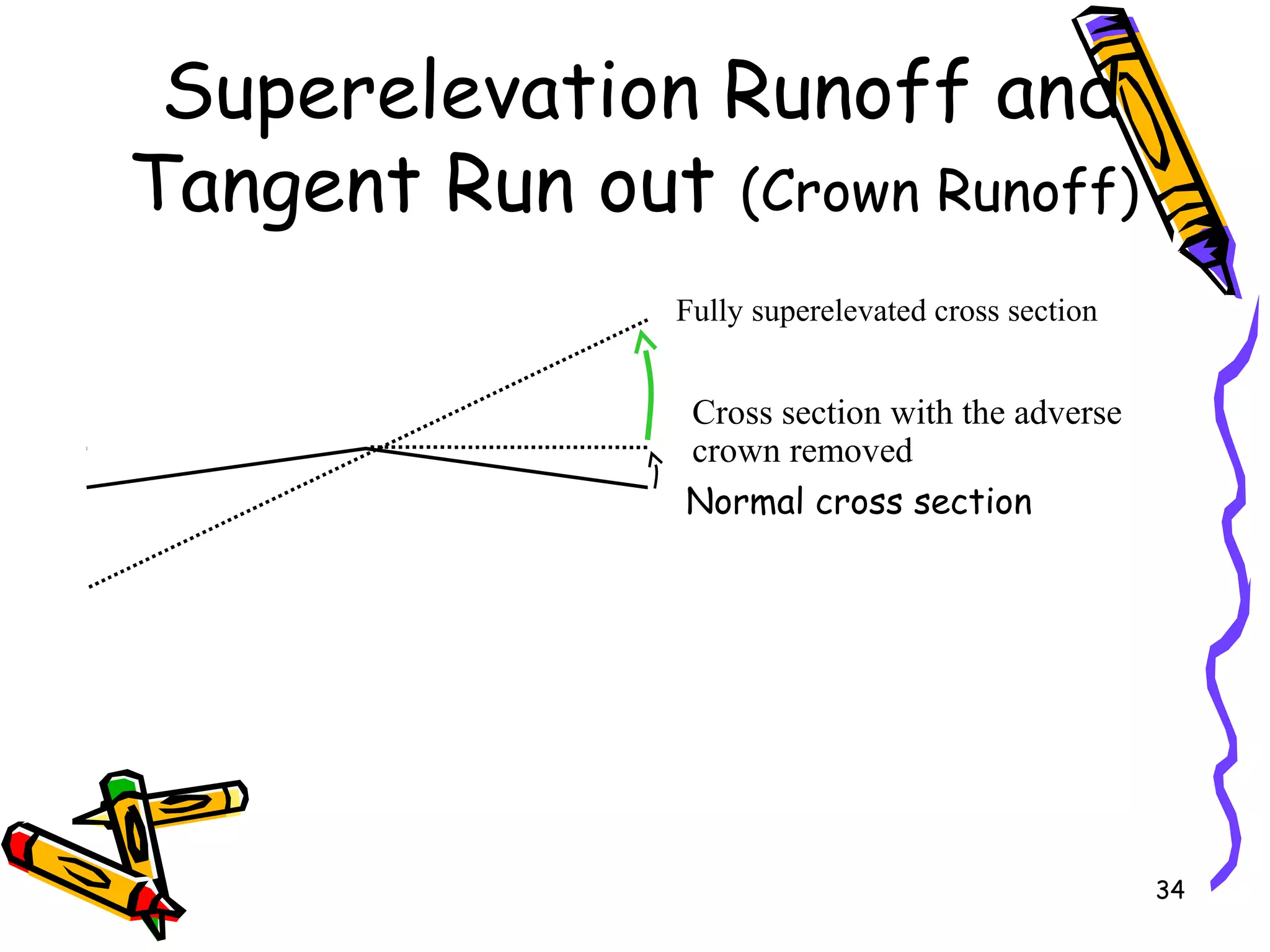
Superelevation Runoff and
Tangent Run out (Crown Runoff)
Normal cross section
Fully superelevated cross section
Cross section with the adverse
crown removed
35
Location of Runout and
Runoff
36
Tangent Runout Section
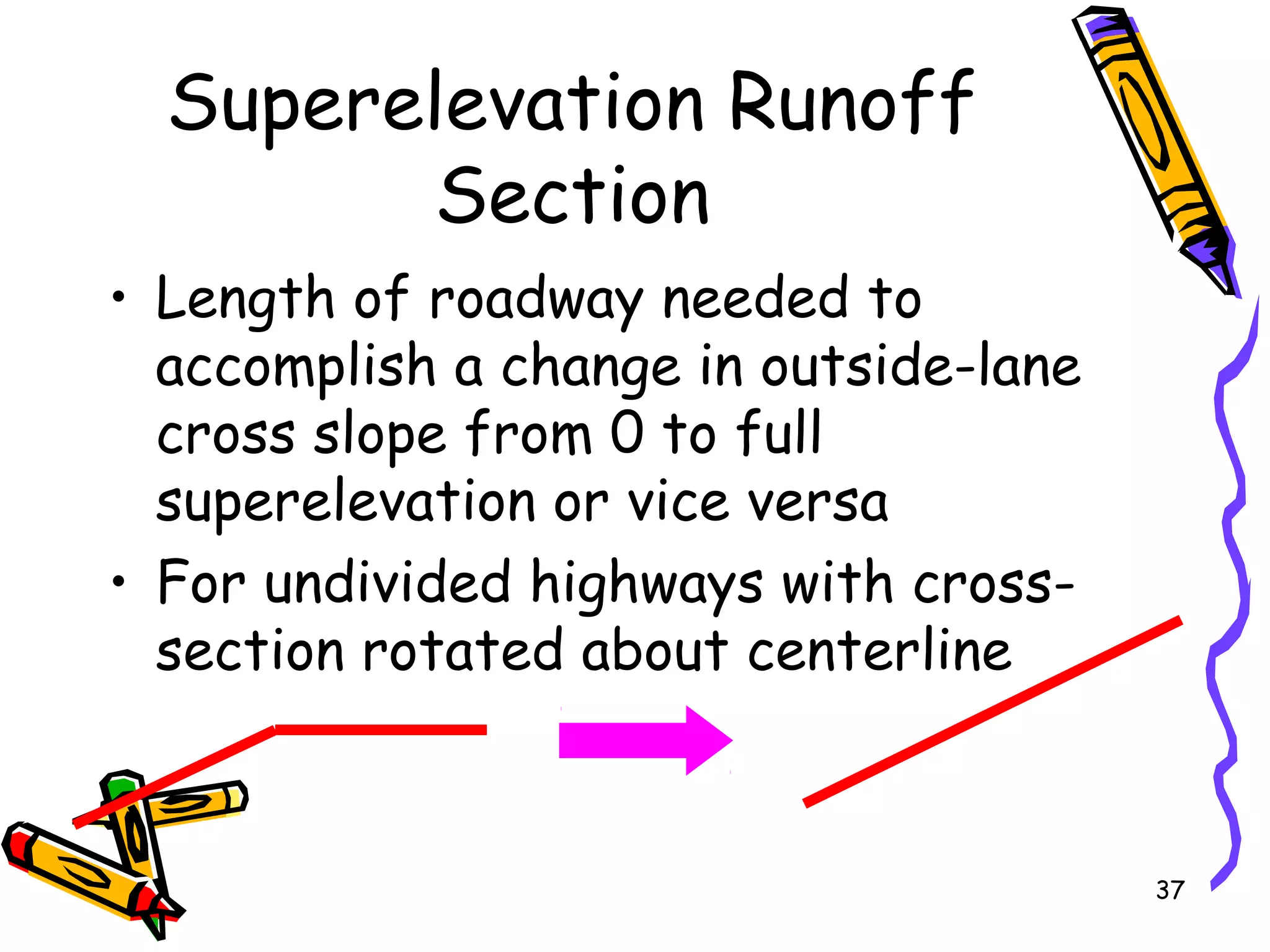
• Length of roadway needed to
accomplish a change in outside-lane
cross slope from normal cross
slope rate to zero
For rotation about
centerline
37
Superelevation Runoff
Section
• Length of roadway needed to
accomplish a change in outside-lane
cross slope from 0 to full
superelevation or vice versa
• For undivided highways with cross-
section rotated about centerline
38
Source: CalTrans Design Manual online,
http://www.dot.ca.gov/hq/oppd/hdm/pdf/chp0200.pdf
39
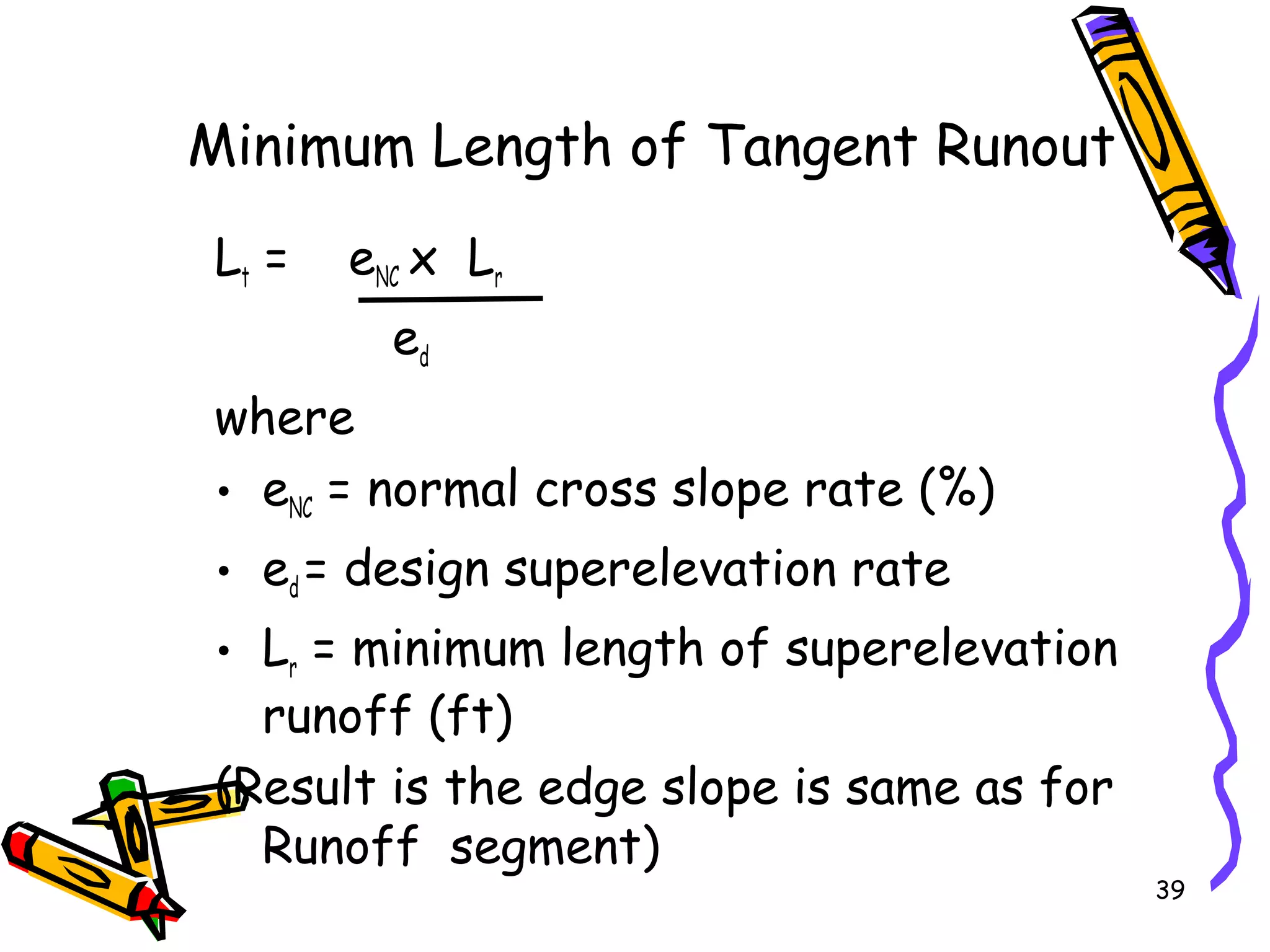
Minimum Length of Tangent Runout
Lt = eNC x Lr
ed
where
• eNC = normal cross slope rate (%)
• ed = design superelevation rate
• Lr = minimum length of superelevation
runoff (ft)
(Result is the edge slope is same as for
Runoff segment)
40
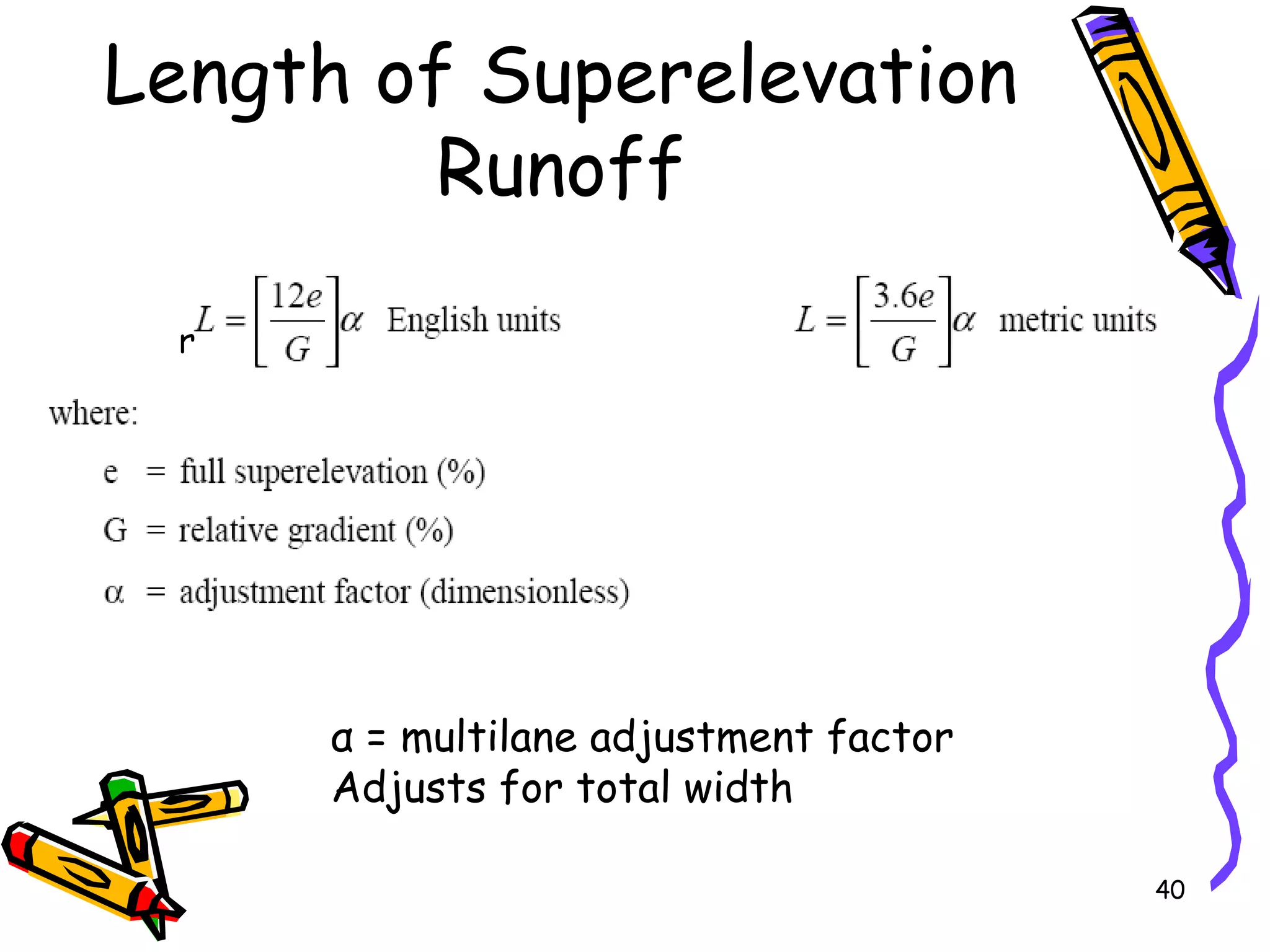
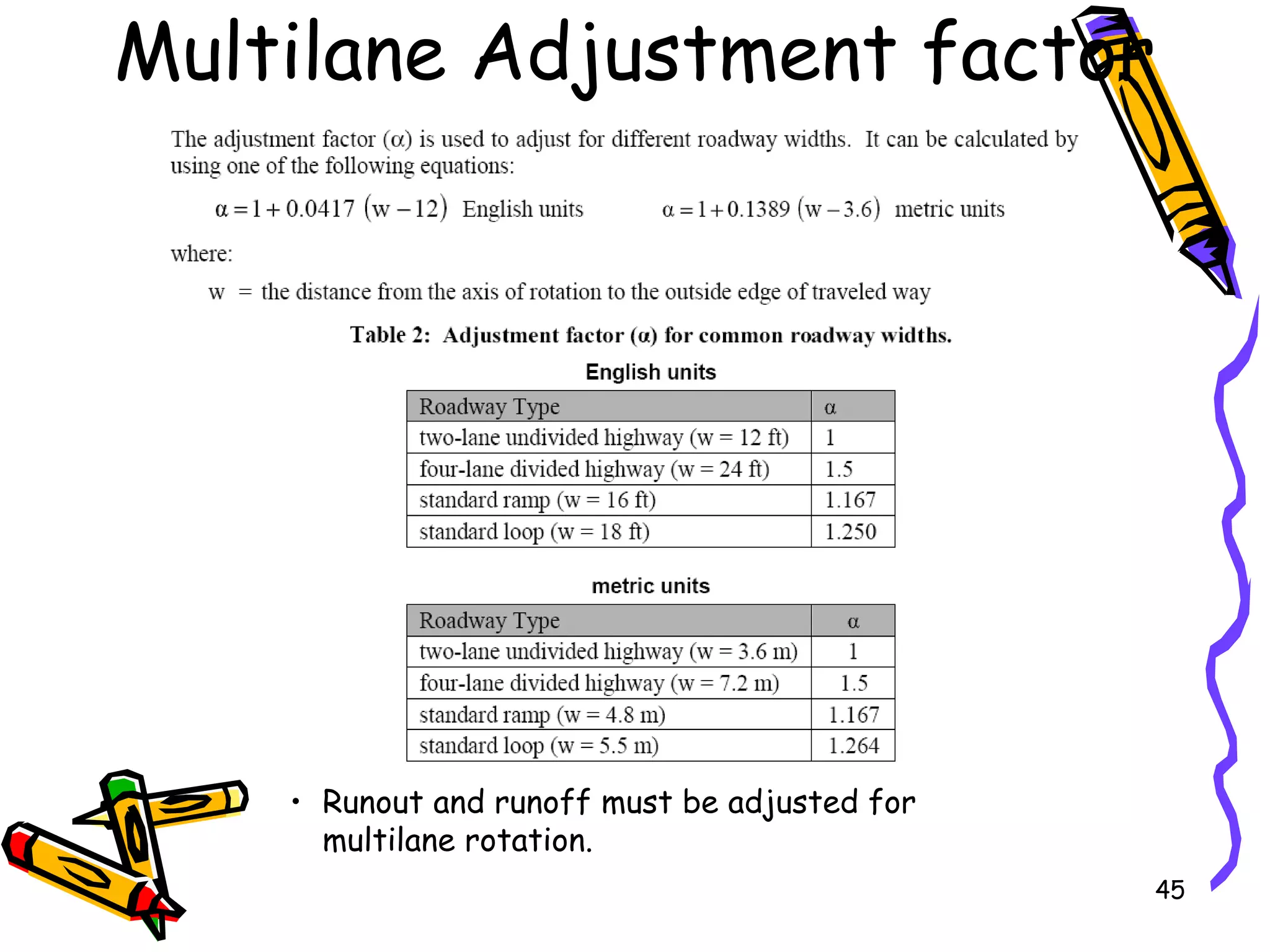
Length of Superelevation
Runoff
α = multilane adjustment factor
Adjusts for total width
r
41
Minimum Length of Runoff
for curve
• Lr based on drainage and
aesthetics and design speed.
• Relative gradient is the rate of
transition of edge line from NC
to full superelevation
traditionally taken at 0.5% ( 1
foot rise per 200 feet along the
road)
42
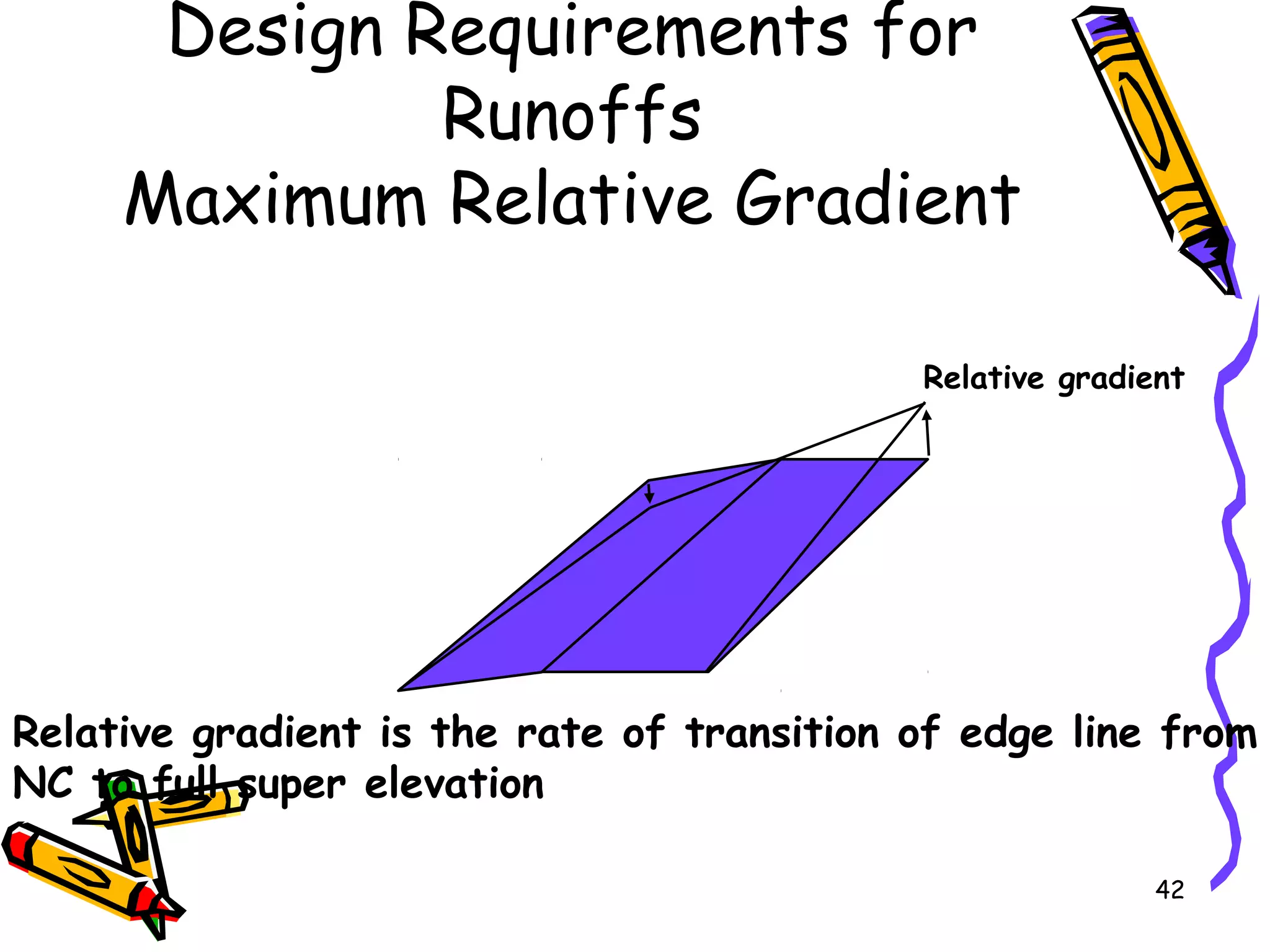
Design Requirements for
Runoffs
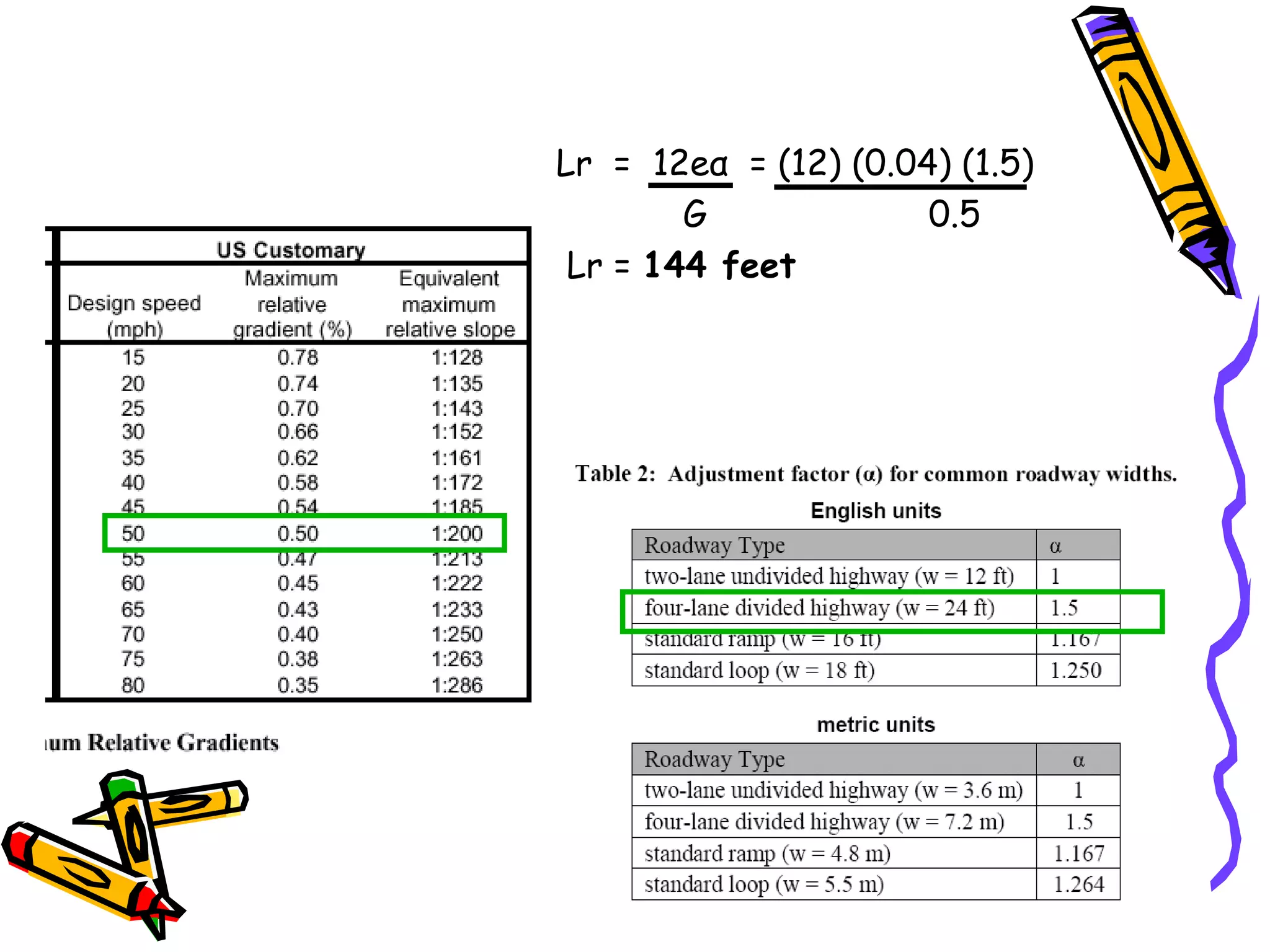
Maximum Relative Gradient
Relative gradient is the rate of transition of edge line from
NC to full super elevation
Relative gradient
43
Relative Gradient (G)
• Maximum longitudinal slope
• Depends on design speed, higher
speed = gentler slope. For example:
• For 15 mph, G = 0.78%
• For 80 mph, G = 0.35%
• See table, next page
44
Maximum Relative
Gradient (G)
Source: A Policy on Geometric Design of
Highways and Streets (The Green Book).
Washington, DC. American Association of
State Highway and Transportation Officials,
2001 4th
Ed.
45
Multilane Adjustment factor
• Runout and runoff must be adjusted for
multilane rotation.
46
Length of Superelevation
Runoff Example
For a 4-lane divided highway with cross-
section rotated about centerline, design
superelevation rate = 4%. Design speed
is 50 mph. What is the minimum length
of superelevation runoff (ft)
Lr = 12eα
G
•
47
Lr = 12eα = (12) (0.04) (1.5)
G 0.5
Lr = 144 feet
48
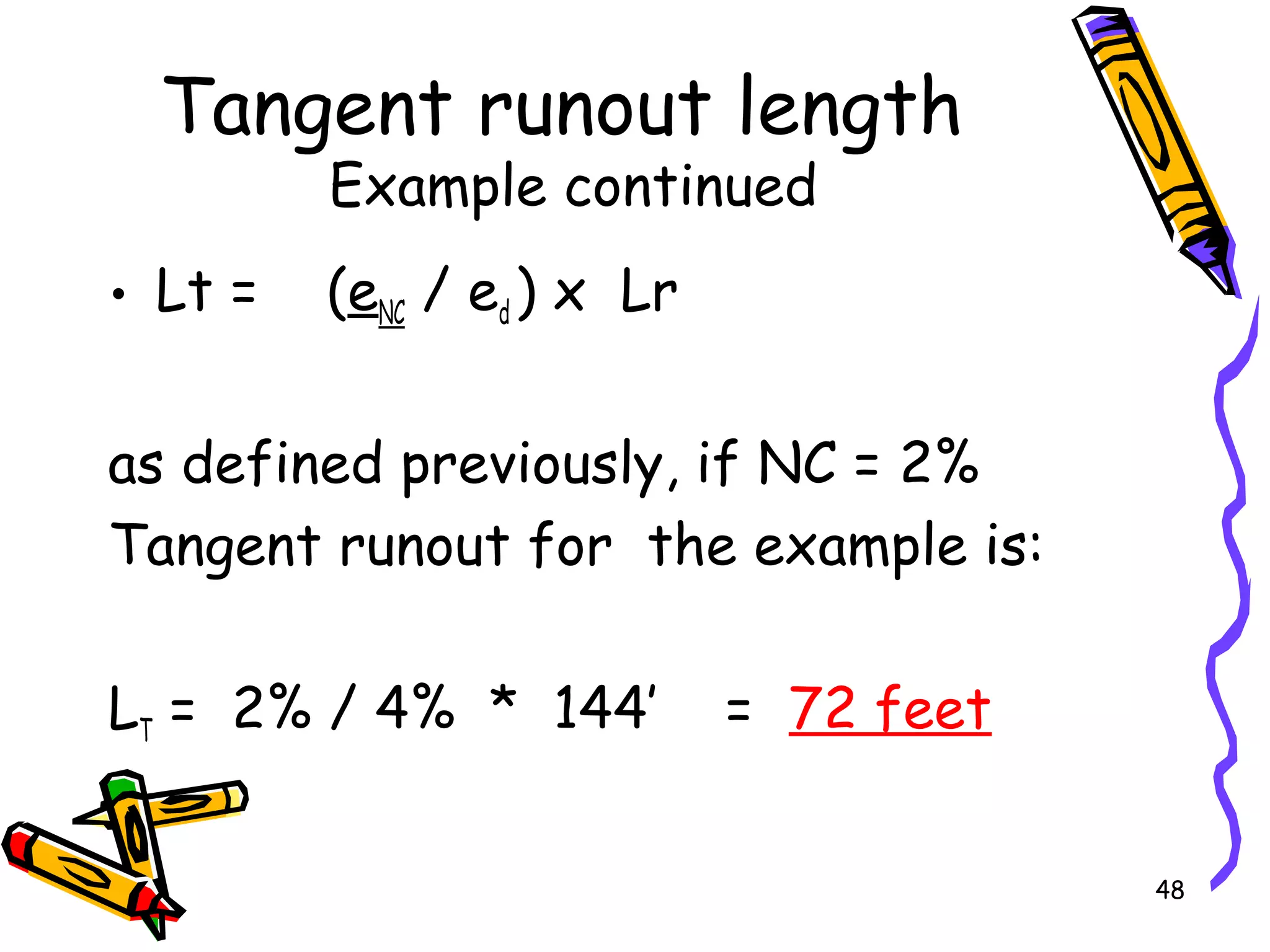
Tangent runout length
Example continued
• Lt = (eNC / ed ) x Lr
as defined previously, if NC = 2%
Tangent runout for the example is:
LT = 2% / 4% * 144’ = 72 feet
49
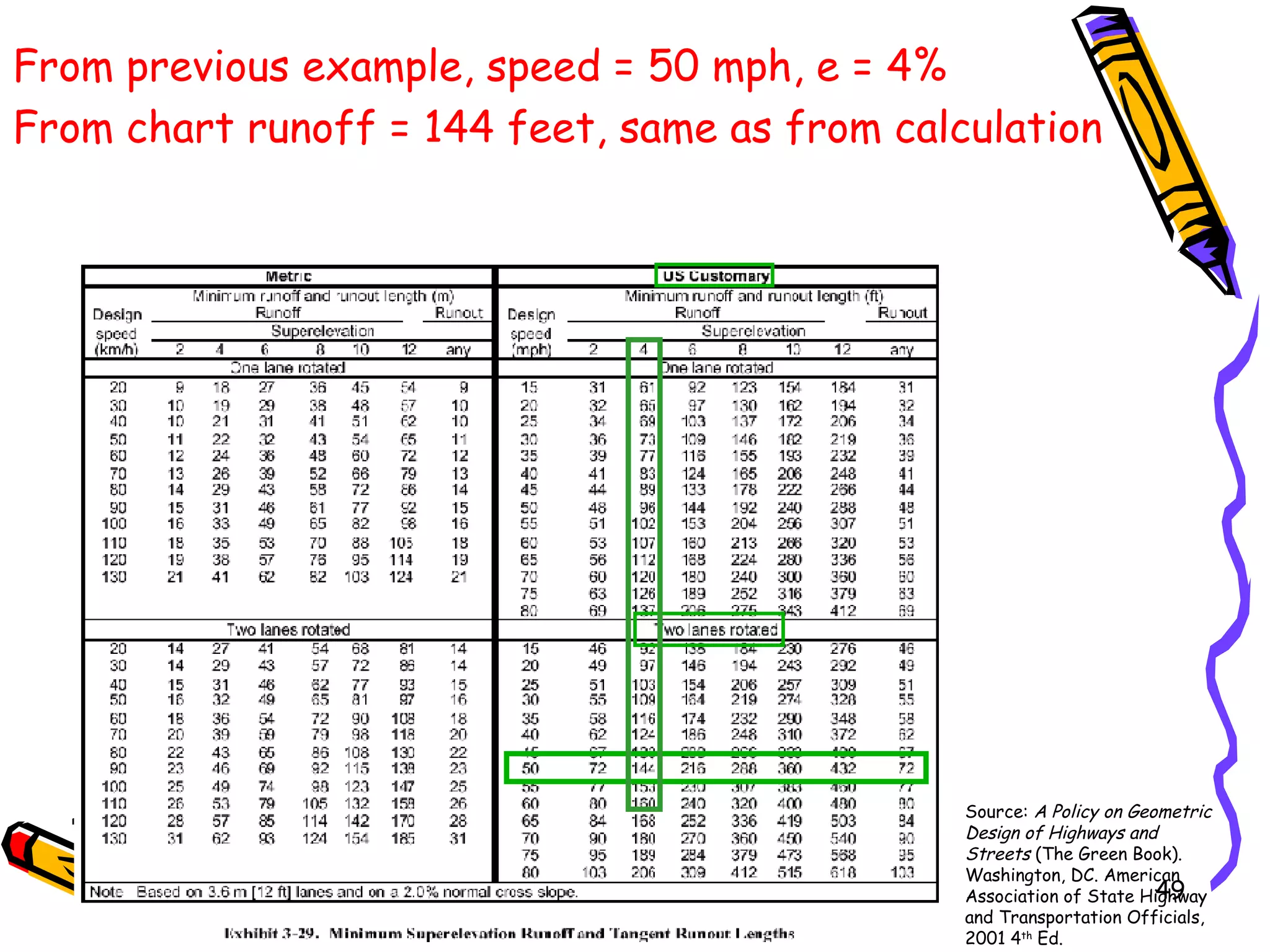
From previous example, speed = 50 mph, e = 4%
From chart runoff = 144 feet, same as from calculation
Source: A Policy on Geometric
Design of Highways and
Streets (The Green Book).
Washington, DC. American
Association of State Highway
and Transportation Officials,
2001 4th
Ed.
50
Transition curve
51
Spiral CurveSpiral Curve
TransitionsTransitions
52
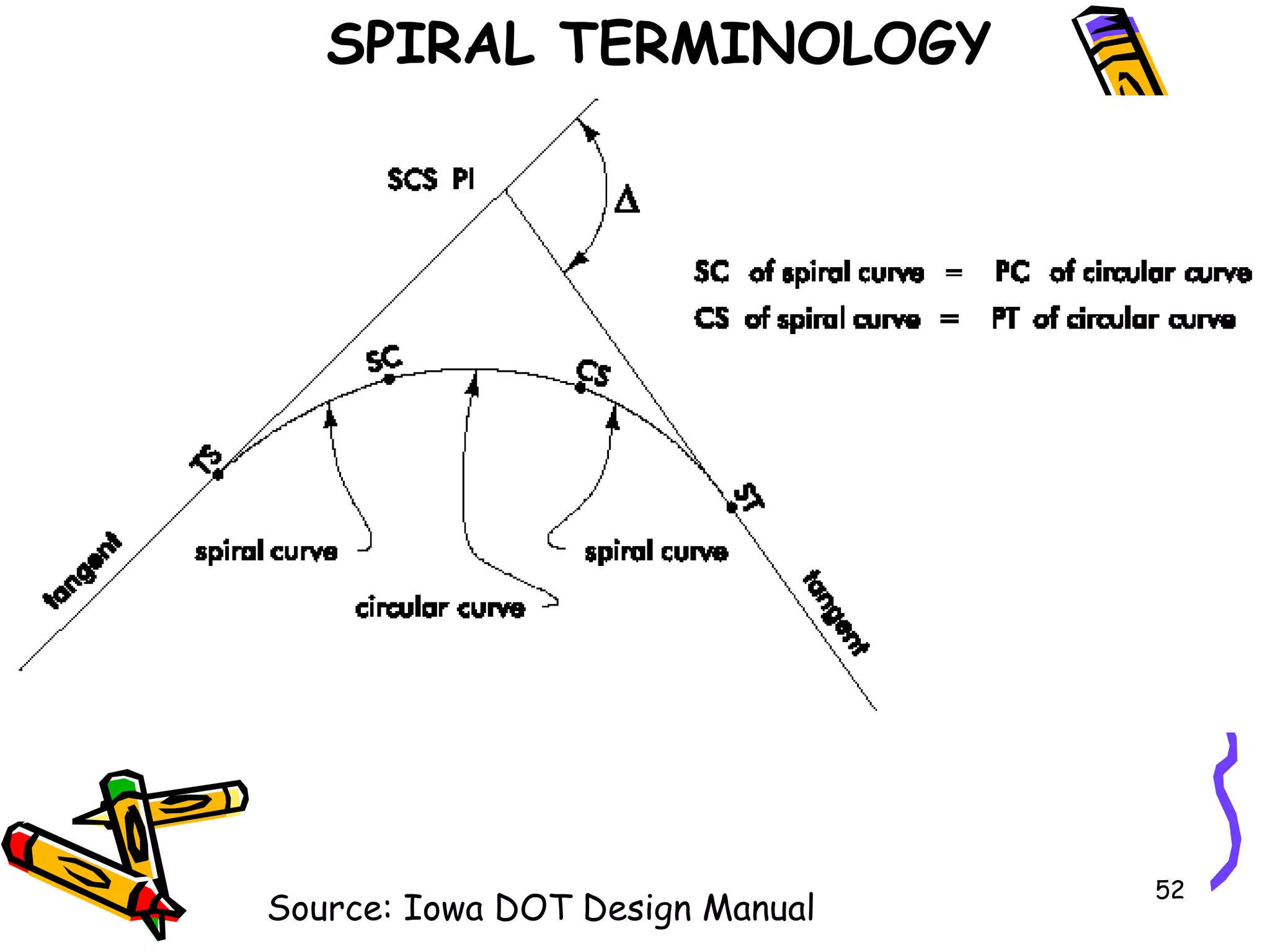
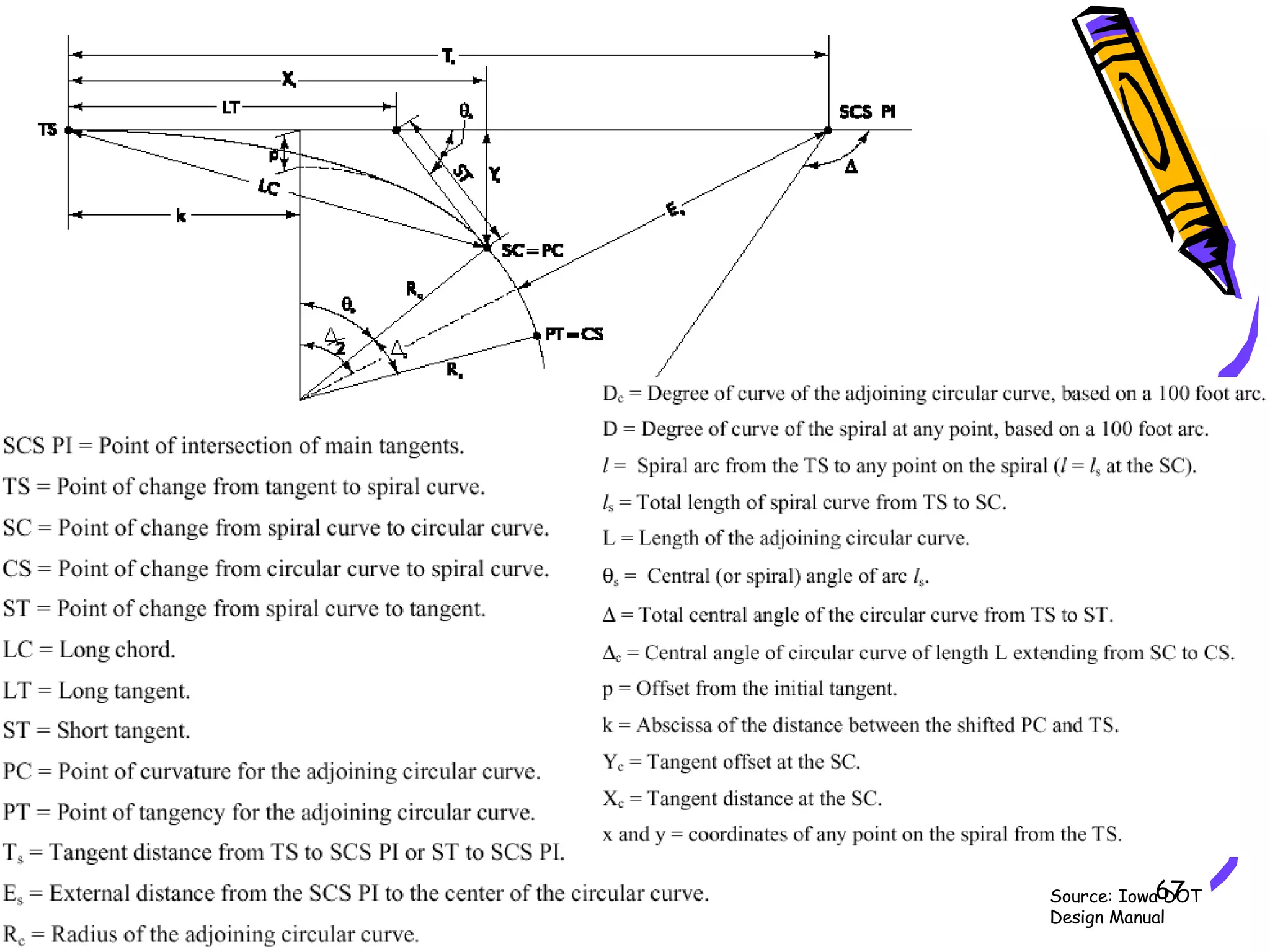
Source: Iowa DOT Design Manual
SPIRAL TERMINOLOGY
53
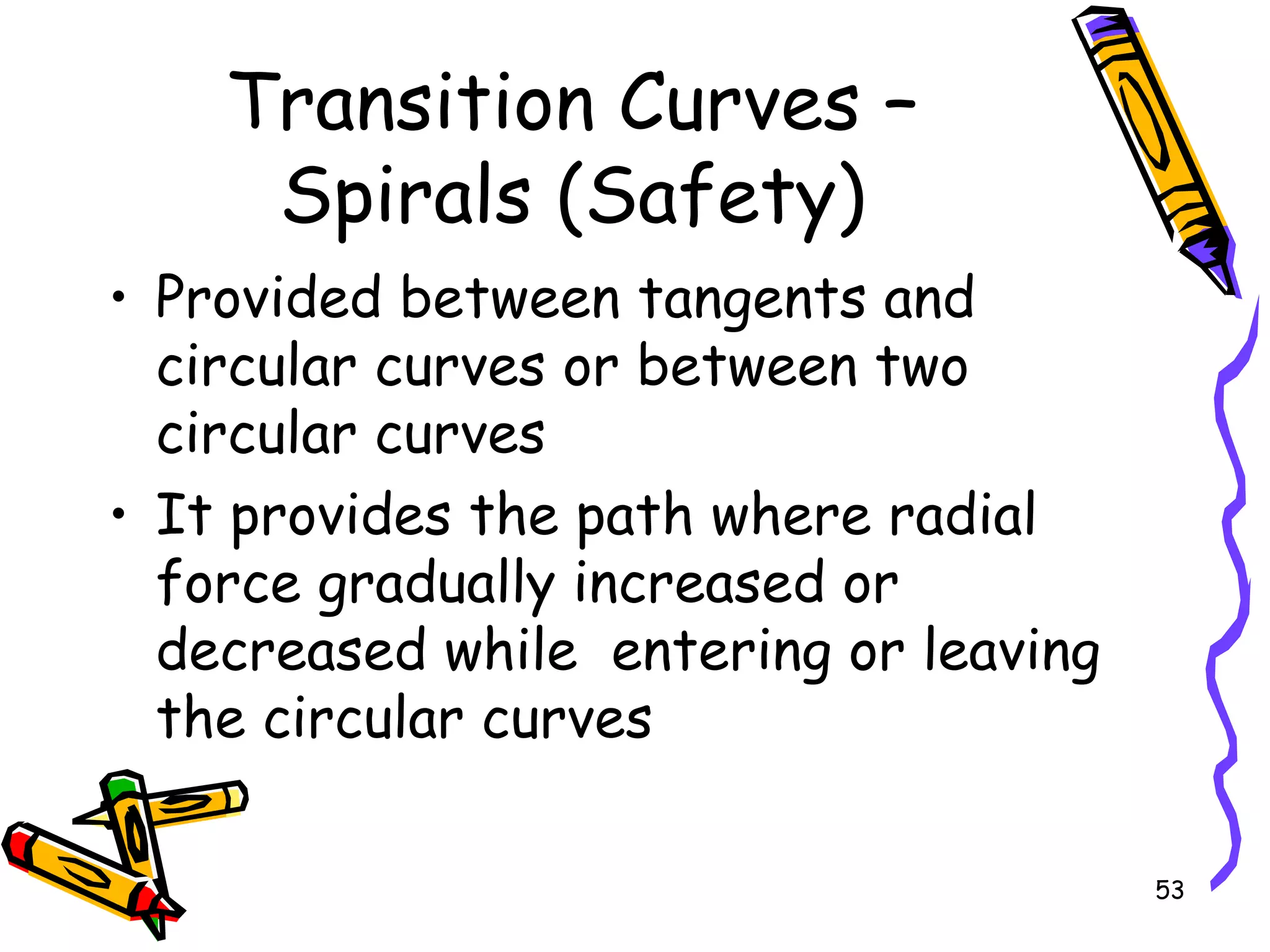
Transition Curves –
Spirals (Safety)
• Provided between tangents and
circular curves or between two
circular curves
• It provides the path where radial
force gradually increased or
decreased while entering or leaving
the circular curves
54
Tangent-to-Curve
Transition (Appearance)
• Improves appearance of the highways
and streets
• Provides natural path for drivers
55
Tangent-to-Curve
Transition (Superelvation or curve
widening requirement)
• Accommodates distance needed to
attain super elevation
• Accommodates gradual roadway
widening
56
Ideal shape of transition curve
• When rate of introduction of C.F. is
consistent
• When rate of change C. Acceleration
is consistent
• When radius of transition curve
consistently change from infinity to
radius of circular curve
57
Shape of transition
curves
• Spiral (Clotoid)= mostly used
• Lemniscates (rate of change of
radius not constant)
• Cubic parabola
58
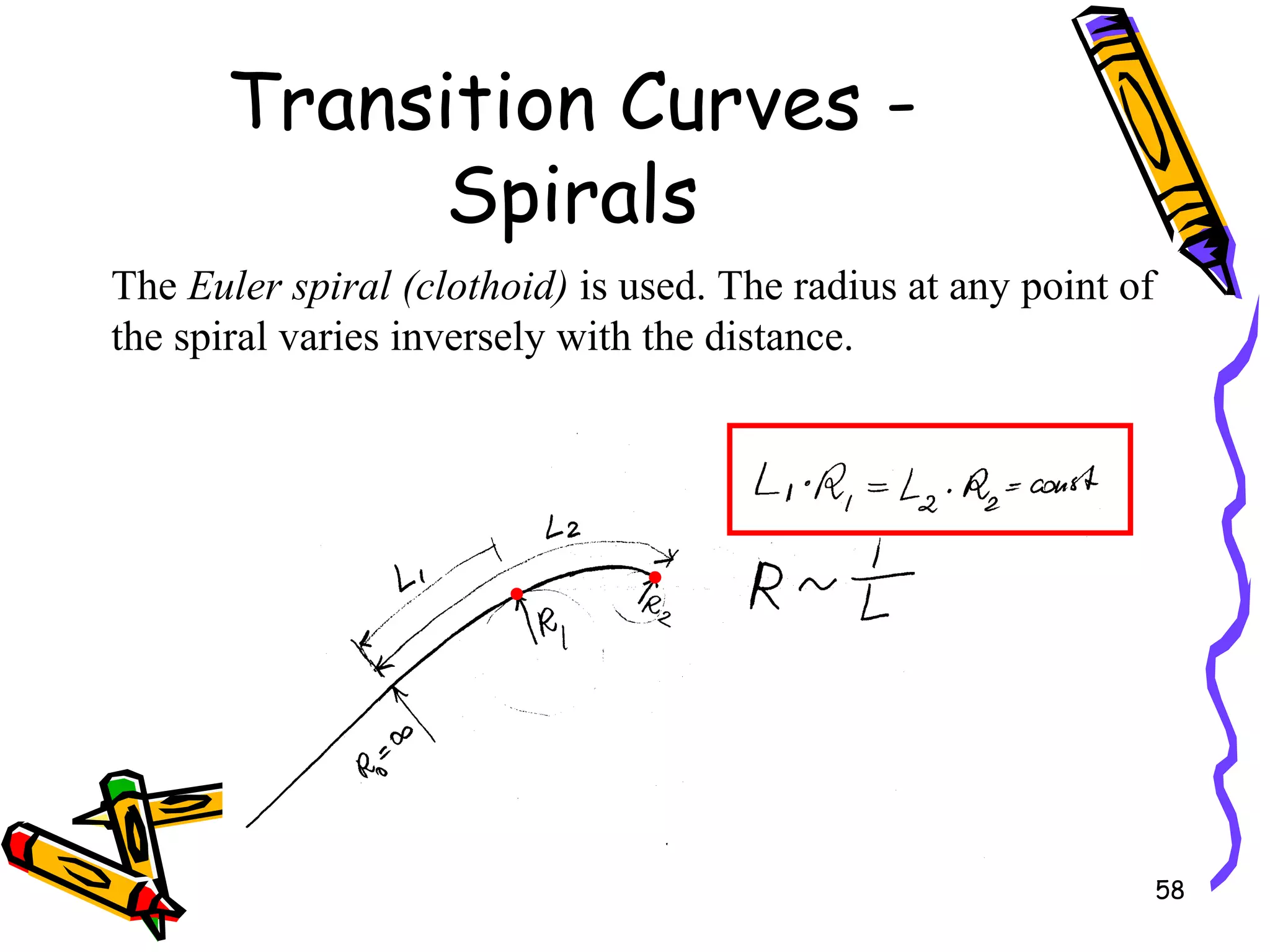
Transition Curves -
Spirals
The Euler spiral (clothoid) is used. The radius at any point of
the spiral varies inversely with the distance.
59
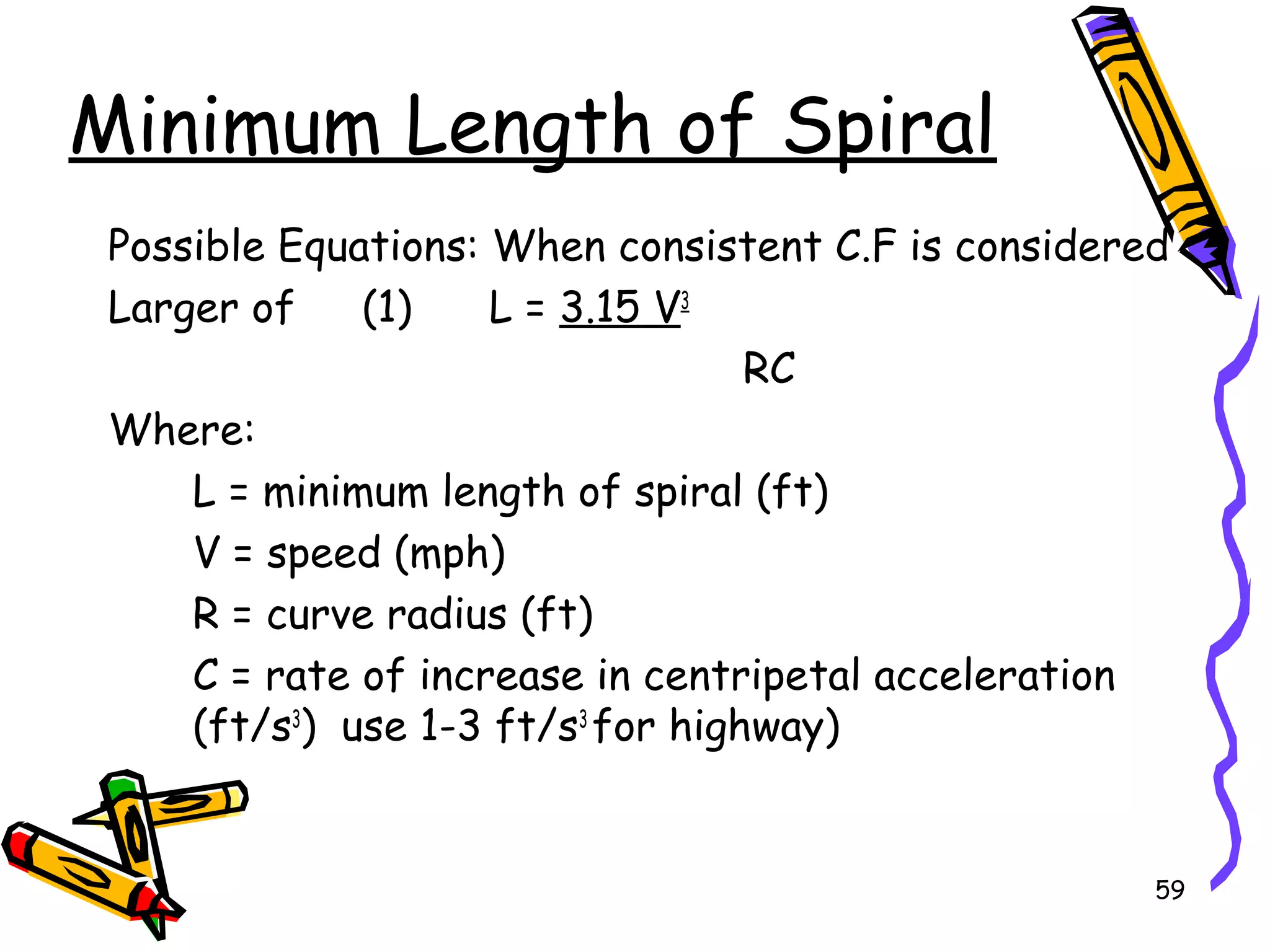
Minimum Length of Spiral
Possible Equations: When consistent C.F is considered
Larger of (1) L = 3.15 V3
RC
Where:
L = minimum length of spiral (ft)
V = speed (mph)
R = curve radius (ft)
C = rate of increase in centripetal acceleration
(ft/s3
) use 1-3 ft/s3
for highway)
60
• V= 50 mph
• C = 3 ft p c. sec
• R= 929
• Ls = 141 ft
61
Minimum Length of Spiral
When appearance of the highways is considered
1.Minimum- 2.Maximum Length of Spiral
Or L = (24pminR)1/2
Where:
L = minimum length of spiral (ft) = 121.1 ft
R = curve radius (ft) = 930
pmin = minimum lateral offset between the
tangent and circular curve (0.66 feet)
62
Maximum Length of Spiral
• Safety problems may occur when
spiral curves are too long – drivers
underestimate sharpness of
approaching curve (driver
expectancy)
63
Maximum Length of Spiral
L = (24pmaxR)1/2
Where:
L = maximum length of spiral (ft) = 271
R = curve radius (ft)
pmax = maximum lateral offset between the
tangent and circular curve (3.3 feet)
64
Length of Spiral
o AASHTO also provides recommended spiral
lengths based on driver behavior rather
than a specific equation.
o Super elevation runoff length is set equal
to the spiral curve length when spirals are
used.
o Design Note: For construction purposes,
round your designs to a reasonable values;
e.g.
Ls = 141 feet, round it to
Ls = 150 feet.
65
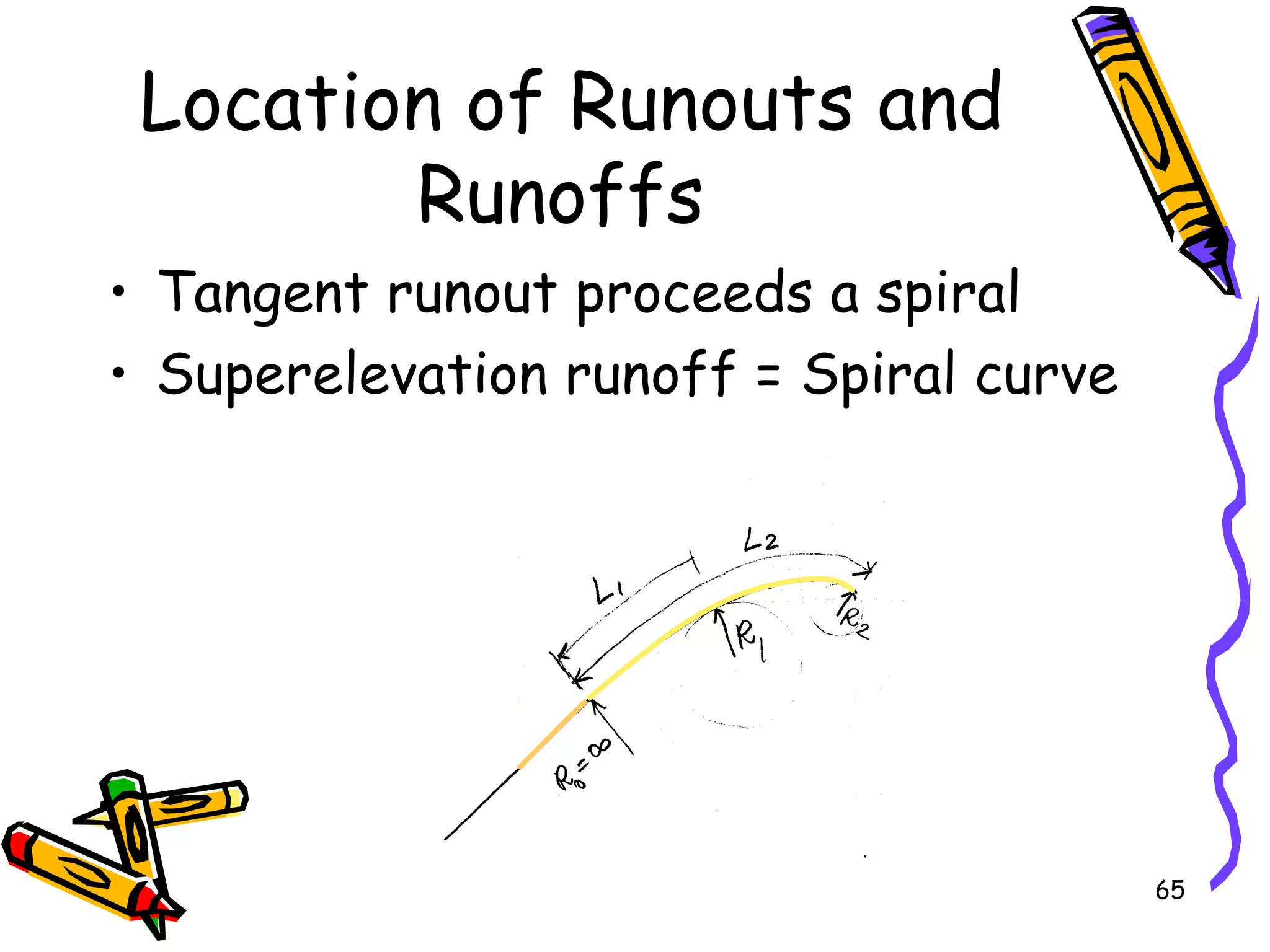
Location of Runouts and
Runoffs
• Tangent runout proceeds a spiral
• Superelevation runoff = Spiral curve
66
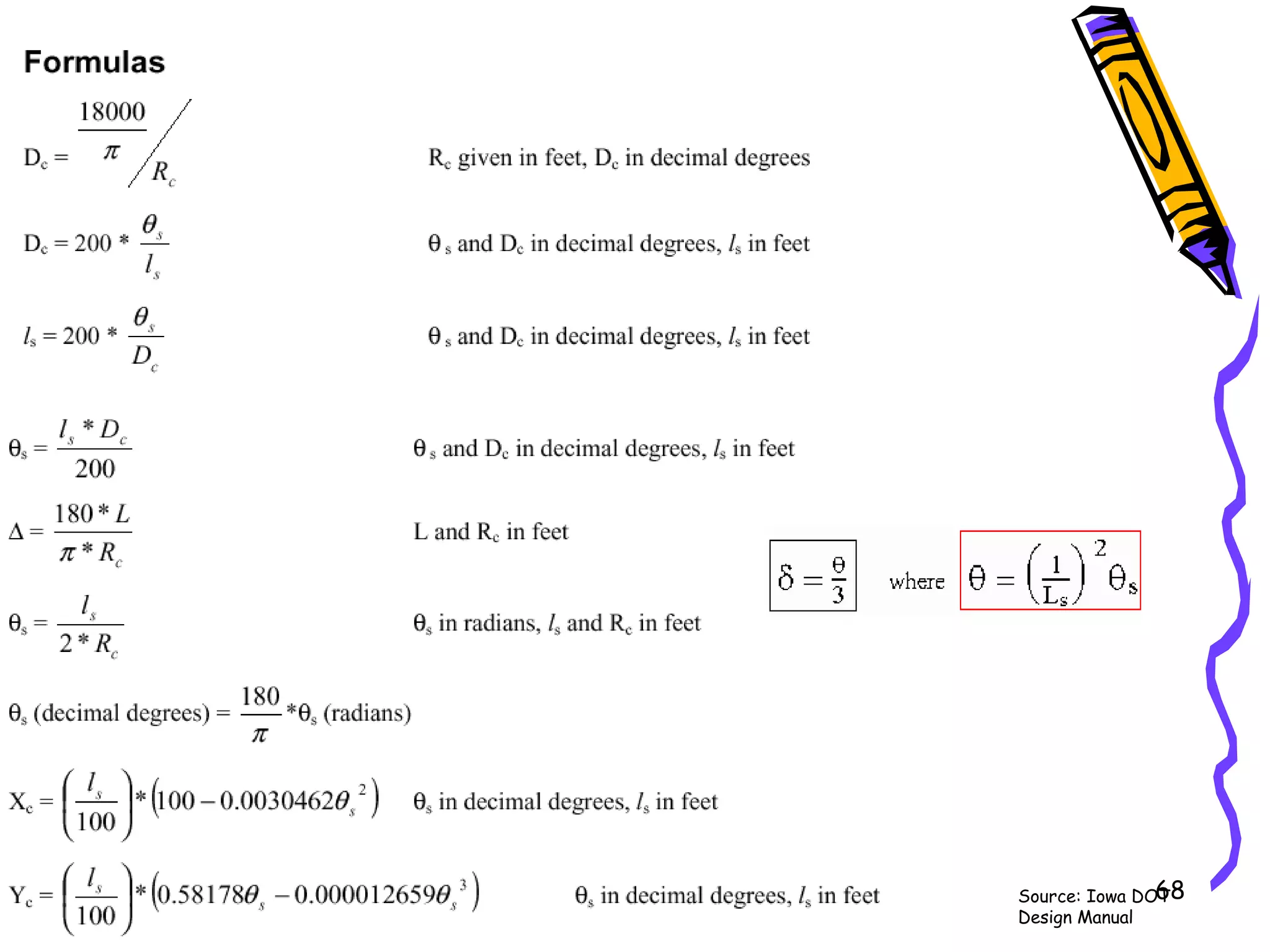
67Source: Iowa DOT
Design Manual
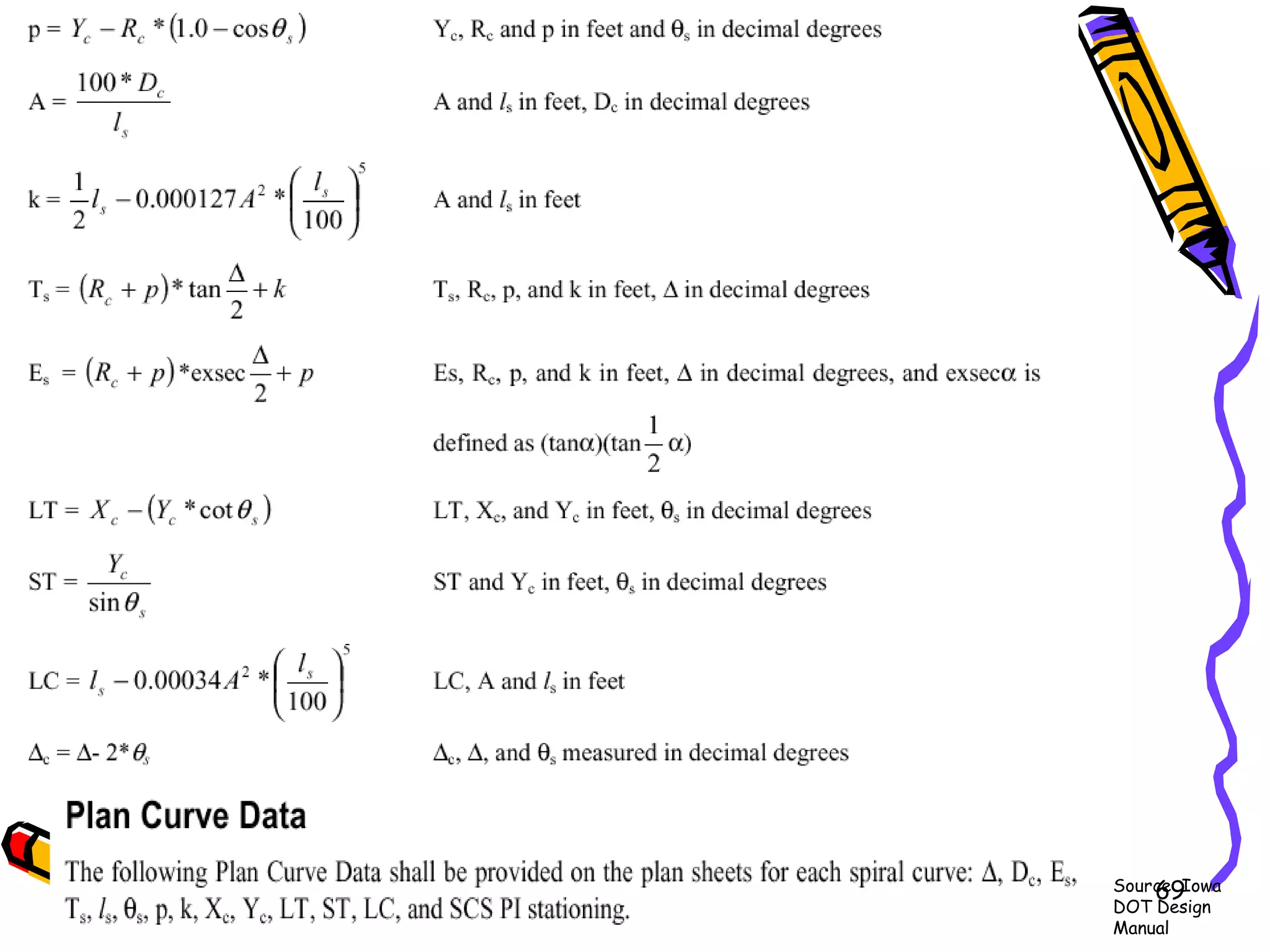
68Source: Iowa DOT
Design Manual
69Source: Iowa
DOT Design
Manual
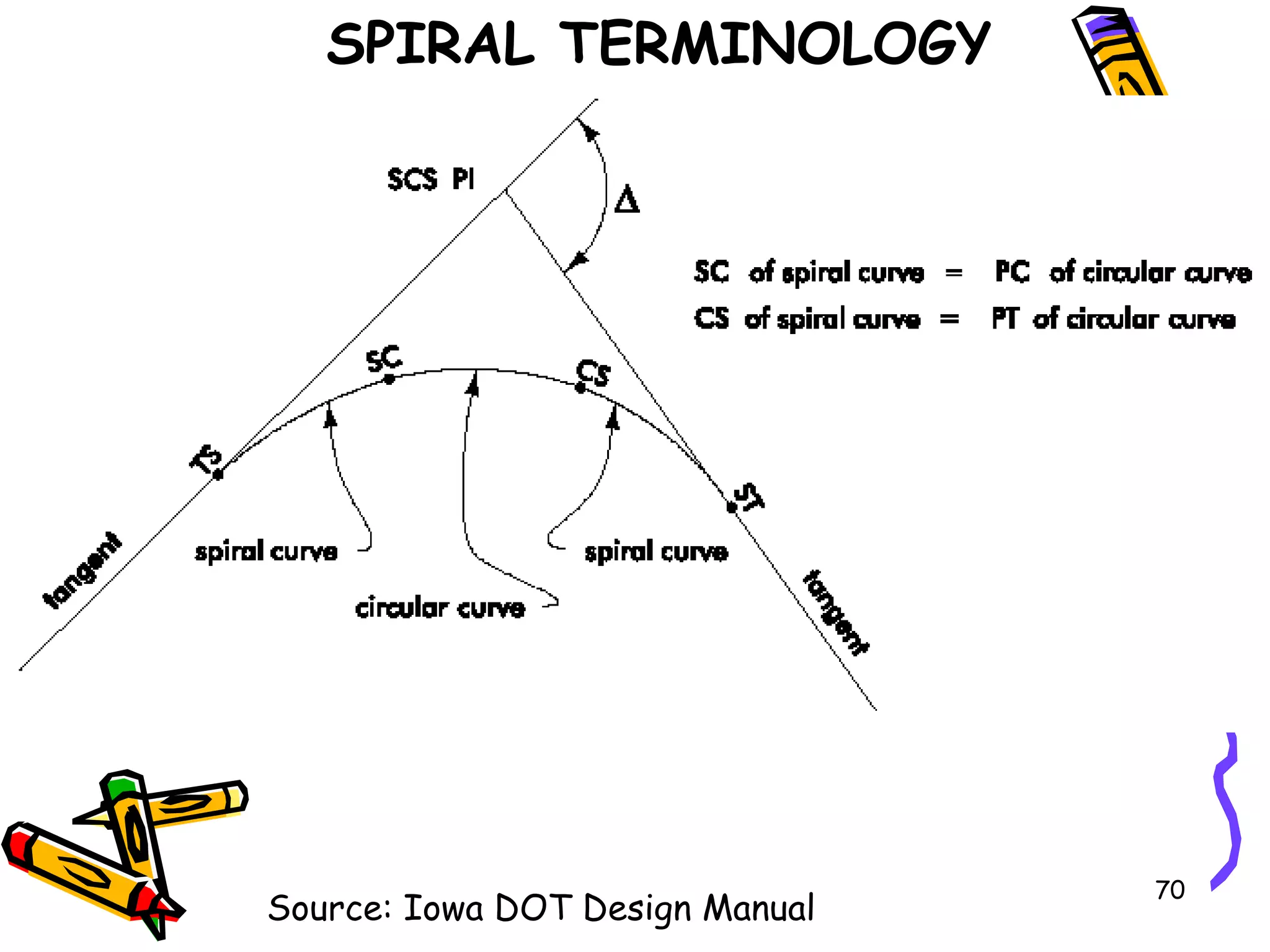
70
Source: Iowa DOT Design Manual
SPIRAL TERMINOLOGY
71
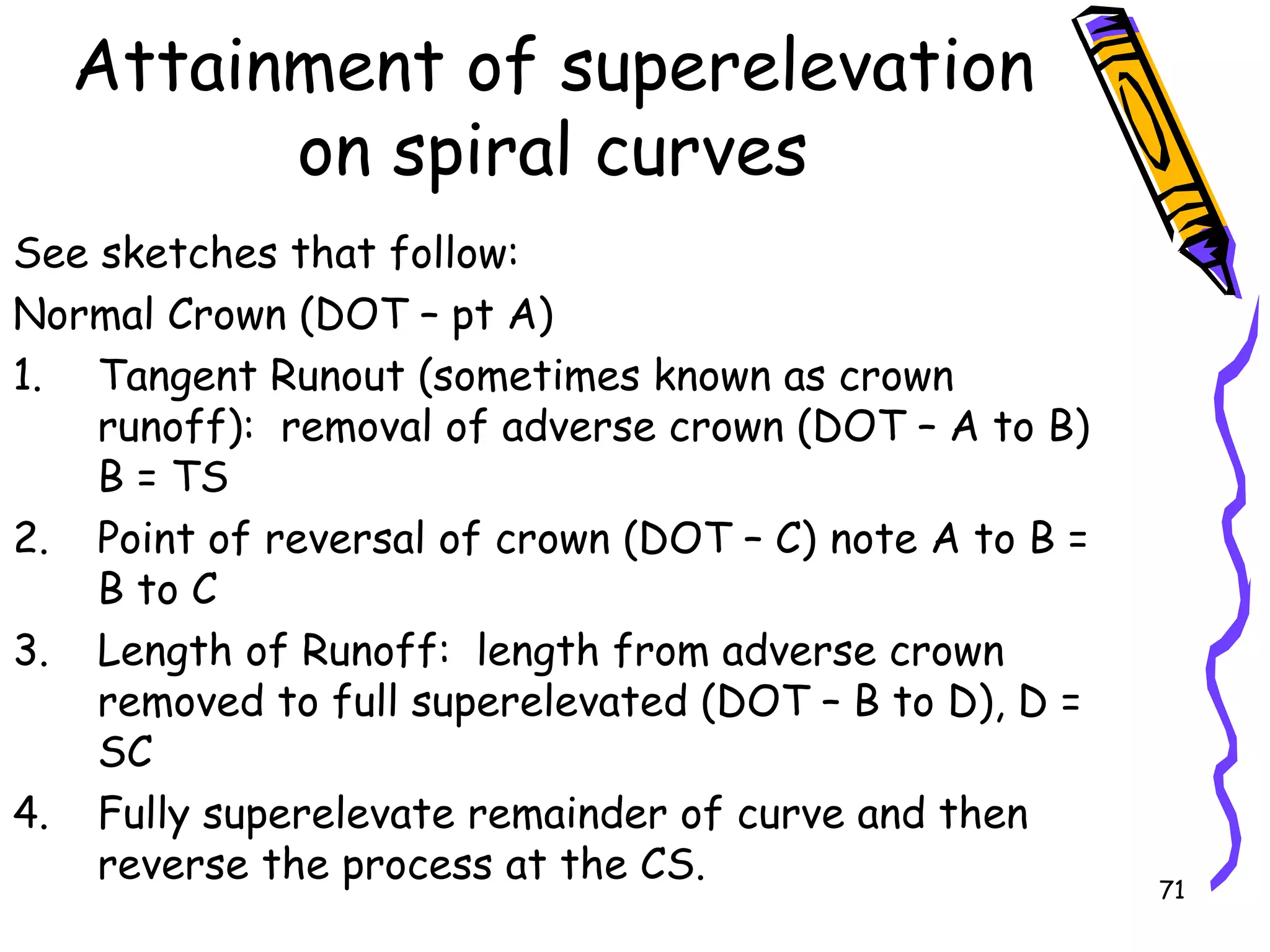
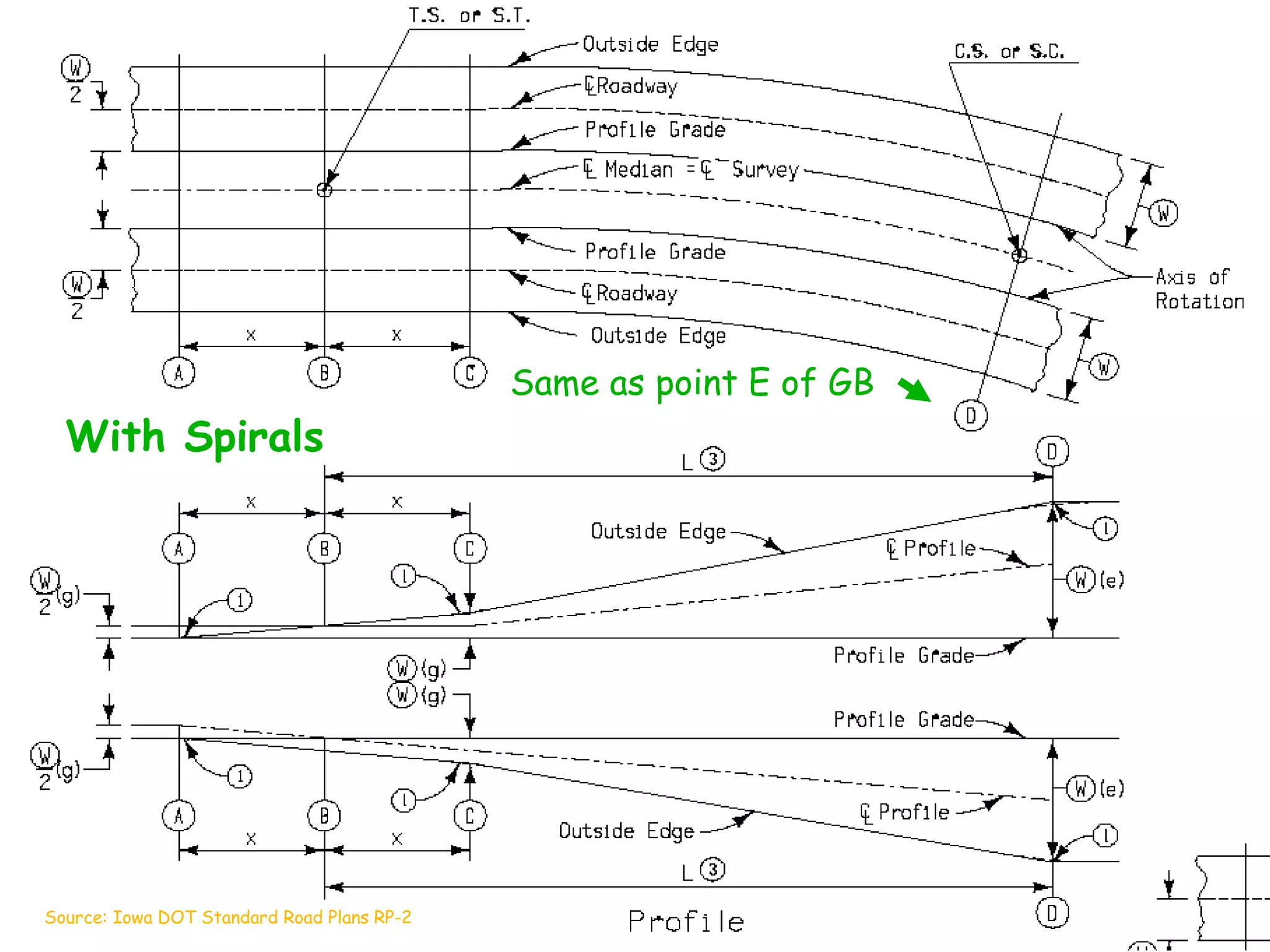
Attainment of superelevation
on spiral curves
See sketches that follow:
Normal Crown (DOT – pt A)
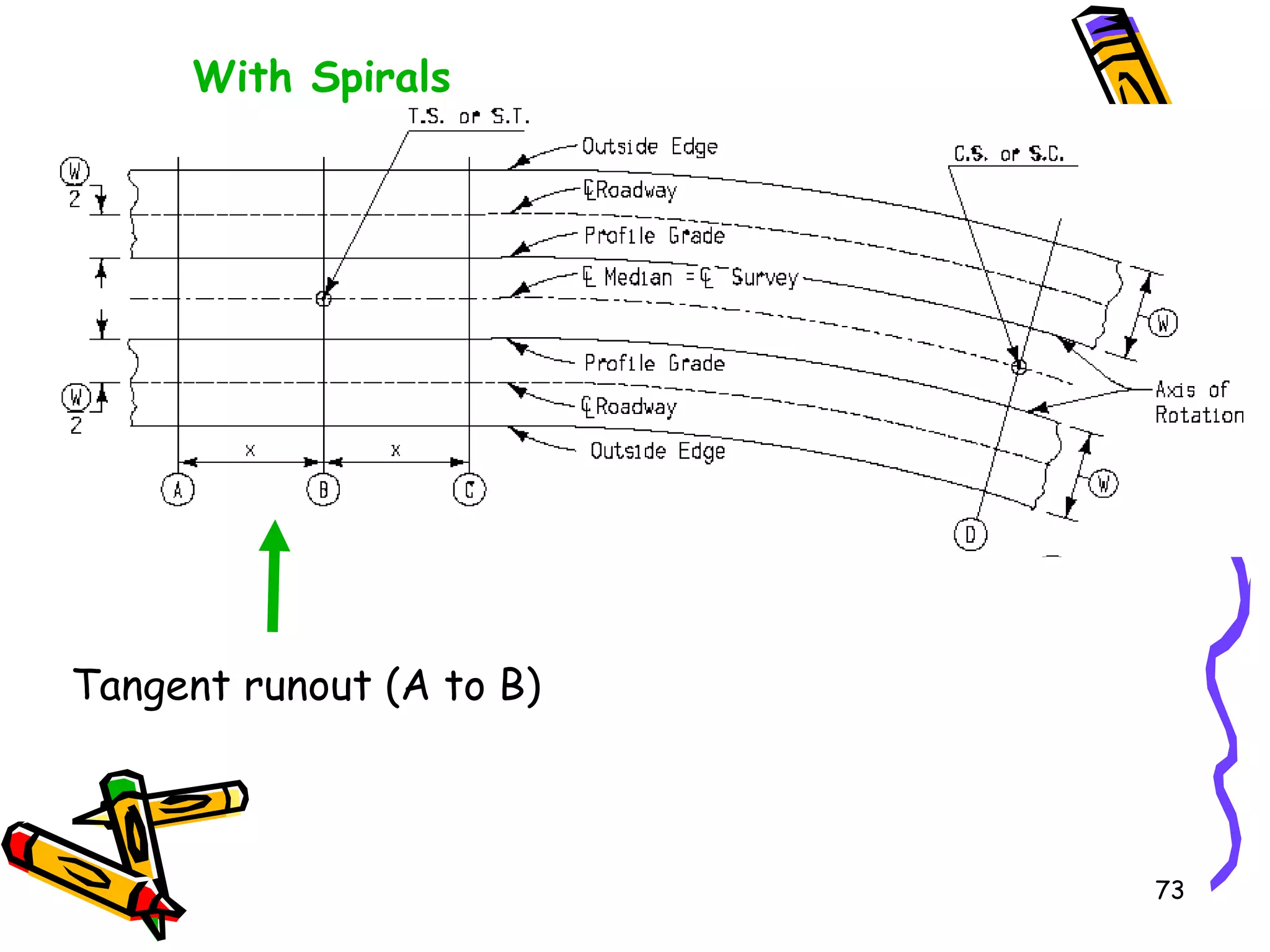
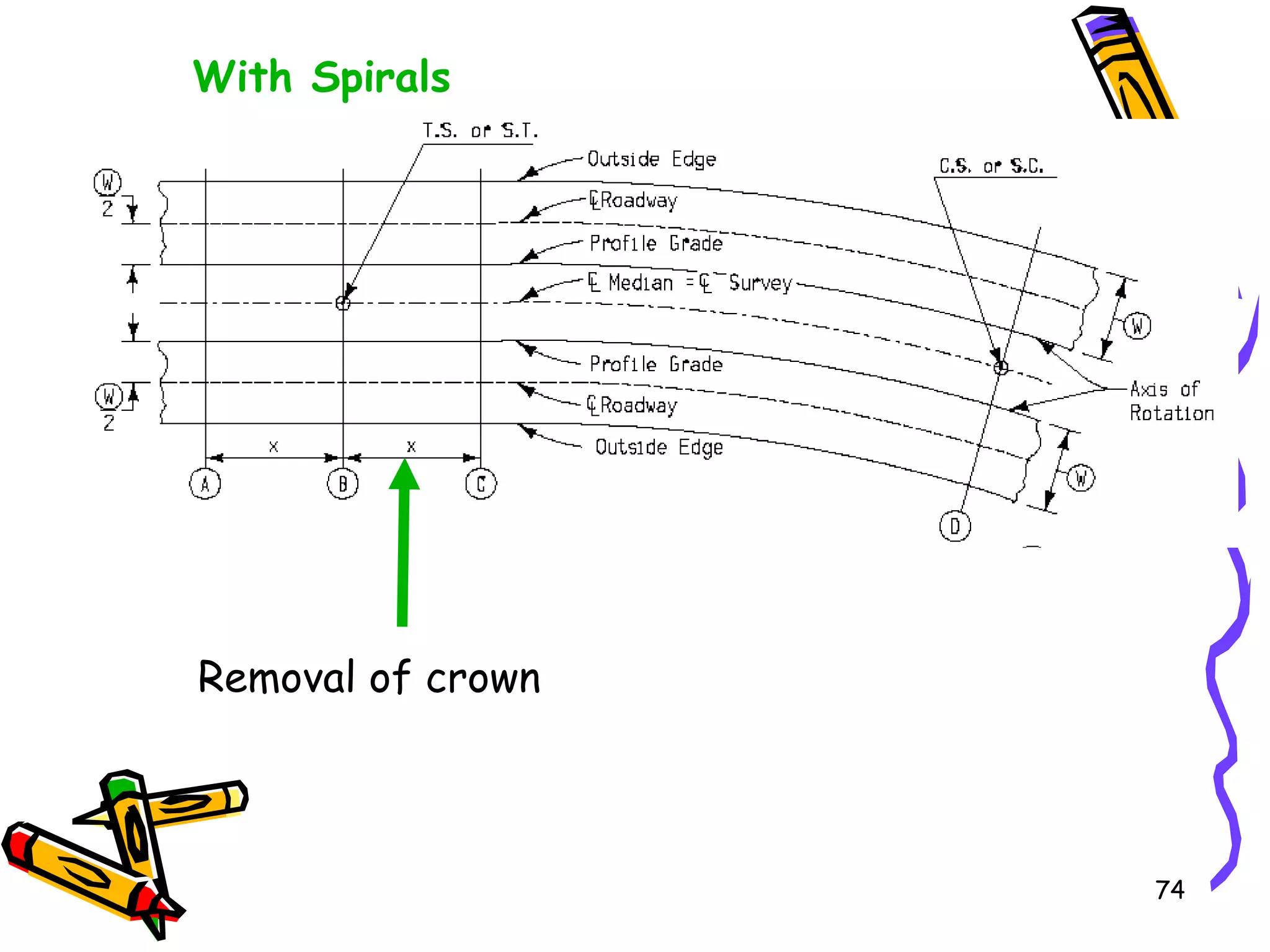
1. Tangent Runout (sometimes known as crown
runoff): removal of adverse crown (DOT – A to B)
B = TS
2. Point of reversal of crown (DOT – C) note A to B =
B to C
3. Length of Runoff: length from adverse crown
removed to full superelevated (DOT – B to D), D =
SC
4. Fully superelevate remainder of curve and then
reverse the process at the CS.
72
Source: Iowa DOT Standard Road Plans RP-2
With Spirals
Same as point E of GB
73
With Spirals
Tangent runout (A to B)
74
With Spirals
Removal of crown
75
With Spirals
Transition of
superelevation
Full superelevation
76
77
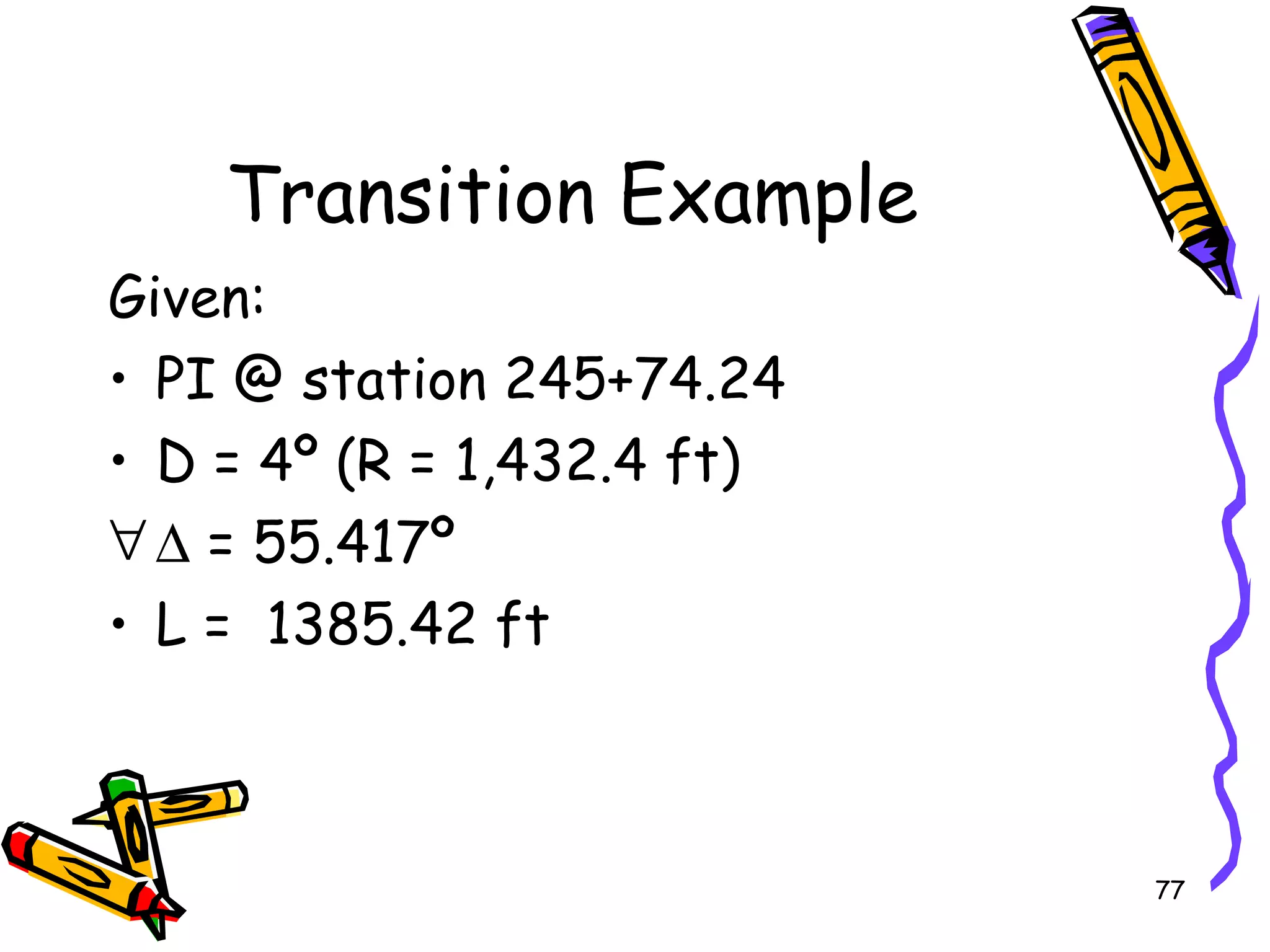
Transition Example
Given:
• PI @ station 245+74.24
• D = 4º (R = 1,432.4 ft)
∀∆ = 55.417º
• L = 1385.42 ft
78
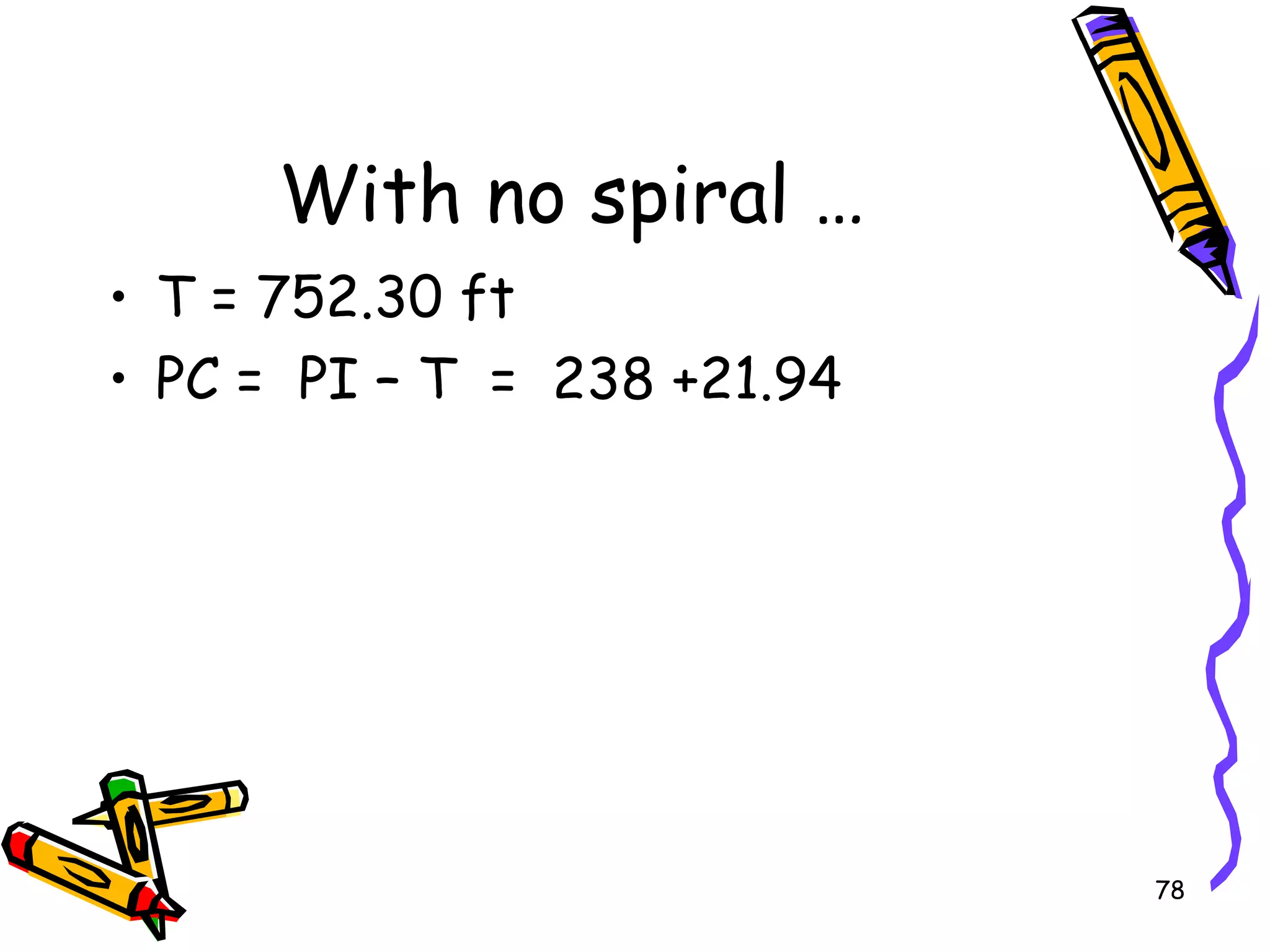
With no spiral …
• T = 752.30 ft
• PC = PI – T = 238 +21.94
79
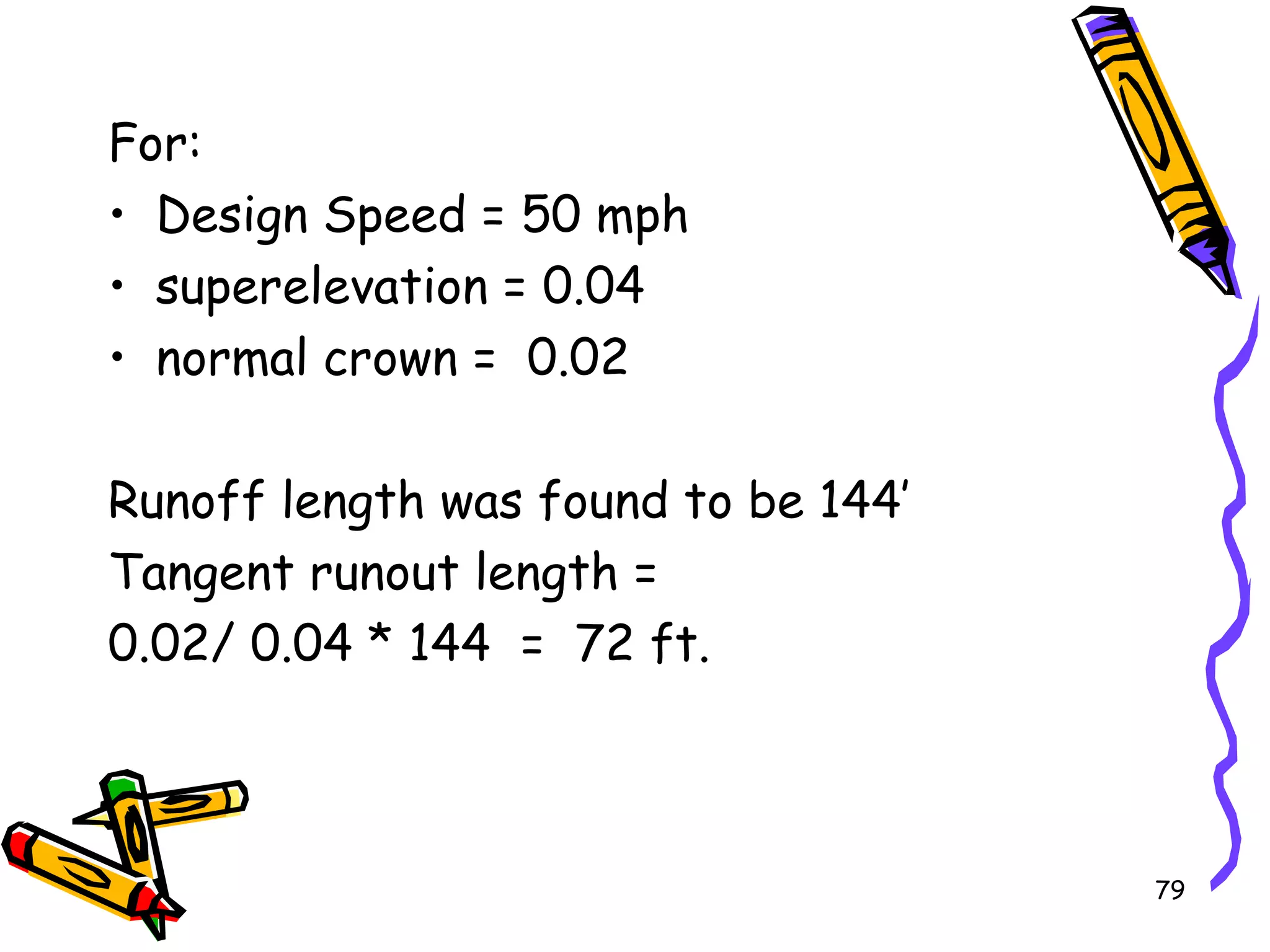
For:
• Design Speed = 50 mph
• superelevation = 0.04
• normal crown = 0.02
Runoff length was found to be 144’
Tangent runout length =
0.02/ 0.04 * 144 = 72 ft.
80
Where to start transition for superelevation?
Using 2/3 of Lr on tangent, 1/3 on curve for
superelevation runoff:
Distance before PC = Lt + 2/3 Lr
=72 +2/3 (144) = 168
Start removing crown at:
PC station – 168’ = 238+21.94 - 168.00 =
Station = 236+ 53.94
81
Location Example – with spiral
• Speed, e and NC as before and
∀∆ = 55.417º
• PI @ Station 245+74.24
• R = 1,432.4’
• Lr was 144’, so set Ls = 150’
82
Location Example – with spiral
See Iowa DOT design manual for more
equations:
http://www.dot.state.ia.us/design/00_toc.htm#Ch
• Spiral angle Θs = Ls * D /200 = 3 degrees
• P = 0.65 (calculated)
• Ts = (R + p ) tan (delta /2) + k = 827.63 ft
83
• TS station = PI – Ts
= 245+74.24 – 8 + 27.63
= 237+46.61
Runoff length = length of spiral
Tangent runout length = Lt = (eNC / ed ) x Lr
= 2% / 4% * 150’ = 75’
Therefore: Transition from Normal crown begins
at (237+46.61) – (0+75.00) = 236+71.61
Location Example – with spiral
84
With spirals, the central angle for the
circular curve is reduced by 2 * Θs
Lc = ((delta – 2 * Θs) / D) * 100
Lc = (55.417-2*3)/4)*100 = 1235.42 ft
Total length of curves = Lc +2 * Ls = 1535.42
Verify that this is exactly 1 spiral length
longer than when spirals are not used
(extra credit for who can tell me why,
provide a one-page memo by Monday)
Location Example – with spiral
85
Also note that the tangent length with
a spiral should be longer than the
non-spiraled curve by approximately ½
of the spiral length used. (good check
– but why???)
Location Example – with spiral
86
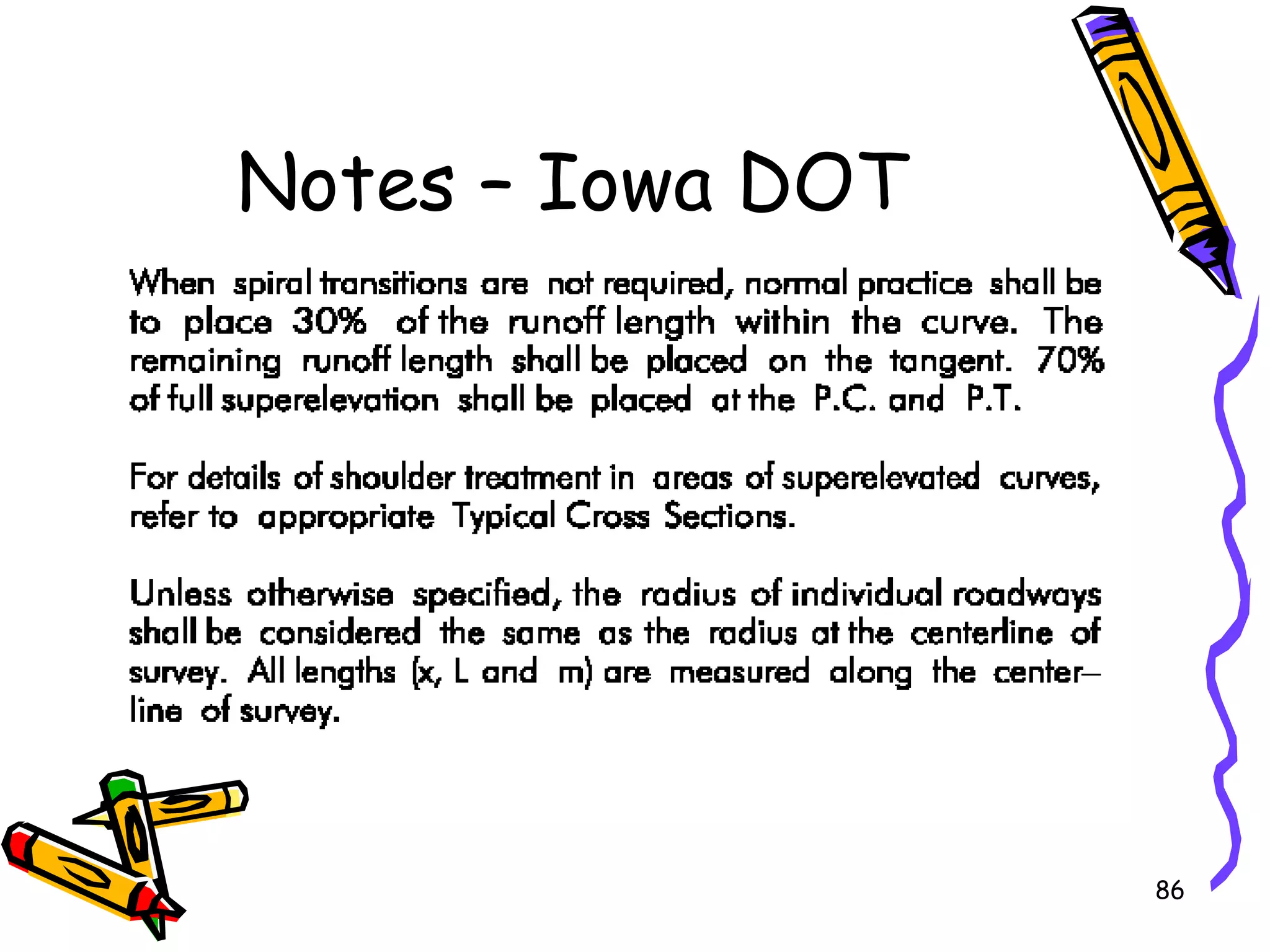
Notes – Iowa DOT
87
Quiz Answers
What can be done to improve the safety of a
horizontal curve?
 Make it less sharp
 Widen lanes and shoulders on curve
 Add spiral transitions
 Increase superelevation
88
Quiz Answers
5. Increase clear zone
6. Improve horizontal and vertical
alignment
7. Assure adequate surface drainage
8. Increase skid resistance on downgrade
curves
89
Some of Your Answers
 Decrease posted speed
 Add rumble strips
 Bigger or better signs
 Guardrail
 Better lane markers
 Sight distance
 Decrease radius

Sight Distance for horizontal curves

  • 1.
    Sight Distance forSightDistance for Horizontal CurvesHorizontal Curves 1
  • 2.
    Provided Sight Distance •Potential sight obstructions – On horizontal curves: barriers, bridge-approach fill slopes, trees, back slopes of cut sections – On vertical curves: road surface at some point on a crest vertical curve, range of head lights on a sag curve
  • 3.
  • 4.
    4 Line of sightis the chord AT Horizontal distance traveled is arc AT, which is SD. SD is measured along the centre line of inside lane around the curve. See the relationship between radius of curve, the degree of curve, SSD and the middle ordinate S R M O TA
  • 5.
    5 Middle ordinate • Locationof object along chord length that blocks line of sight around the curve • m = R(1 – cos [28.65 S]) R Where: m = line of sight S = stopping sight distance R = radius
  • 6.
    6 Middle ordinate • Anglesubtended at centre of circle by arc AT is 2θ in degree then • S / πR = 2θ / 180 • S = 2R θπ / 180 • θ = S 180 / 2R π = 28.65 (S) / R • R-M/R = cos θ • M = [1 – cos 28.65 (S) / R ] θR M A T B T O θ
  • 7.
    7 Sight Distance Example Ahorizontal curve with R = 800 ft is part of a 2-lane highway with a posted speed limit of 35 mph. What is the minimum distance that a large billboard can be placed from the centerline of the inside lane of the curve without reducing required SSD? Assume p/r =2.5 and a = 11.2 ft/sec2 SSD = 1.47vt + _________v2 ____ 30(__a___ ± G) 32.2
  • 8.
    8 Sight Distance Example SSD= 1.47(35 mph)(2.5 sec) + _____(35 mph)2 ____ = 246 feet 30(__11.2___ ± 0) 32.2
  • 9.
    9 Sight Distance Example m= R(1 – cos [28.65 S]) R m = 800 (1 – cos [28.65 {246}])= 9.43’ 800 (in radians not degrees)
  • 10.
    10 SuperelevationSuperelevation DR ABDUL SAMIQURESHIDR ABDUL SAMI QURESHI M L N a E B
  • 11.
    11 Motion on Circular Curves dt dv at= R v an 2 = C.F Weight of Vehicle Friction force
  • 12.
    12 Definition • The transverseslope provided by raising outer edge w.r.t. inner edge • To counteract the effects of C. Force (overturning/skid laterally) L N a EB M
  • 13.
    13 •S.E. expressed inratio of height of outerS.E. expressed in ratio of height of outer edge to the horizontal widthedge to the horizontal width e = NL / ML = tan= NL / ML = tan θ tantan θ = sin= sin θ,, θ is very smallis very small e =NL / MN = E / Be =NL / MN = E / B E = Total rise in outer edgeE = Total rise in outer edge B total width of pavementB total width of pavement M L N θ EB
  • 14.
    14 FgFW fp =+ α α Ccos θ Cx Mx =M sin θ My =M cos a Ff Ff θ C M 1 ft e ≈ Rv 1. C.F 2. Weight of Vehicle 3. Friction force X-X Y-Y C N N C sin θ
  • 15.
  • 16.
    16 Vehicle Stability onCurves where: gR v fe s 2 =+ (ft/s),speeddesign=v (-),tcoefficienfrictionside=sf ).ft/s(32onacceleratigravity 2 =g (-),tionsupereleva=e (ft),radius=R Assumed Desig n speed (mph) Maximum design fs max 20 0.17 70 0.10 Must not be too short (0.12)0.10-0.06max =e
  • 17.
    17 Selection of eand fs • Practical limits on super elevation (e) – Climate – Constructability – Adjacent land use • Side friction factor (fs) variations – Vehicle speed – Pavement texture – Tire condition • The maximum side friction factor is the point at which the tires begin to skid • Design values of fs are chosen somewhat below this maximum value so there is a margin of safety
  • 18.
  • 19.
    19 Side Friction Factor fromAASHTO’s A Policy on Geometric Design of Highways and Streets 2004 New Graph
  • 20.
    20 Maximum Superelevation • Superelevationcannot be too large since an excessive mass component may push slowly moving vehicles down the cross slope. • Limiting values emax – 12 % for regions with no snow and ice conditions (higher values not allowed), – 10 % recommended value for regions without snow and ice conditions, – 8% for rural roads and high speed urban roads, – 4, 6% for urban and suburban areas.
  • 21.
    21 Example • A sectionof road is being designed as a high-speed highway. The design speed is 70 mph. Using AASHTO standards, what is the maximum super elevation rate for existing curve radius of 2500 ft and 300 ft for safe vehicle operation? • Assume the maximum super elevation rate for the given region is 8%. • max e = ? • For 70 mph, f = 0.10 • 1. 2500 = V2/15(fs+e) = (70 )2/(0.10 + e) = 0.0306 • e = 3% • 2. 300 = V2/(fs+e) = (70 x 1.47)2/32.2(0.10 + e) = 0.988 • e = 9.8%
  • 22.
    • 300 =V2/g(fs+e) = (70)2/15(fs + 0.8) • f = 1.008 > 0.10 • 300 = V2/15(fs+e) = (V )2/15(0.10+ 0.8) • V = 28.46 mph 22
  • 23.
    23 Crown / superelevation runoff length
  • 24.
    24 Source: CalTrans DesignManual online, http://www.dot.ca.gov/hq/oppd/hdm/pdf/chp0200.pdf
  • 25.
    25 Attainment of Superelevation- General 1. Tangent to superelevation 2. Must be done gradually over a distance without appreciable reduction in speed or safety and with comfort 3. Change in pavement slope should be consistent over a distance 4. Methods (Exhibit 3-37 p. 186) a. Rotate pavement about centerline b. Rotate about inner edge of pavement c. Rotate about outside edge of pavement
  • 26.
    26 Source: CalTrans DesignManual online, http://www.dot.ca.gov/hq/oppd/hdm/pdf/chp0200.pdf
  • 27.
    27 Common methods ofdeveloping the transition to super elevation • At (2)the out side edge is far below the centre line as the inside edge • At (3)the out side edge has reached the level of the centre line • At point (4) the out side edge is located as far above as the inside edge is below the centerline. • Finally , at point (5) the cross section is fully super elevated and remain through out the circular curve • The reverse of these profiles is found at the other end of circular curve.
  • 28.
    28 Common methods ofdeveloping the transition to super elevation • Location of inside edge, centre line, and out side edge are shown relative to elevation of centerline • The difference in elevation being equal to the normal crown times the pavement width. • At A the out side edge is far below the centre line as the inside edge • At B the out side edge has reached the level of the centre line • At point C the out side edge is located as far above as the inside edge is below the centerline. • Finally , at point E the cross section is fully super elevated • The reverse of these profiles is found at the other end of circular curve.
  • 29.
    29 Attaining Superelevation (1) •Locationof inside edge, centre line, and out side edge are shown relative to elevation of centerline
  • 30.
  • 31.
  • 32.
    32 Superelevation Transition Section • TangentRunout (Crown Runoff) Section + Superelevation Runoff Section. • Tangent runout = the length of highway needed to change the normal cross section to the cross section with the adverse crown removed.
  • 33.
    Super elevation runoff •Super elevation runoff = the length of highway needed to change the cross section with the adverse crown removed to the cross section fully super elevated. 33
  • 34.
    34 Superelevation Runoff and TangentRun out (Crown Runoff) Normal cross section Fully superelevated cross section Cross section with the adverse crown removed
  • 35.
  • 36.
    36 Tangent Runout Section •Length of roadway needed to accomplish a change in outside-lane cross slope from normal cross slope rate to zero For rotation about centerline
  • 37.
    37 Superelevation Runoff Section • Lengthof roadway needed to accomplish a change in outside-lane cross slope from 0 to full superelevation or vice versa • For undivided highways with cross- section rotated about centerline
  • 38.
    38 Source: CalTrans DesignManual online, http://www.dot.ca.gov/hq/oppd/hdm/pdf/chp0200.pdf
  • 39.
    39 Minimum Length ofTangent Runout Lt = eNC x Lr ed where • eNC = normal cross slope rate (%) • ed = design superelevation rate • Lr = minimum length of superelevation runoff (ft) (Result is the edge slope is same as for Runoff segment)
  • 40.
    40 Length of Superelevation Runoff α= multilane adjustment factor Adjusts for total width r
  • 41.
    41 Minimum Length ofRunoff for curve • Lr based on drainage and aesthetics and design speed. • Relative gradient is the rate of transition of edge line from NC to full superelevation traditionally taken at 0.5% ( 1 foot rise per 200 feet along the road)
  • 42.
    42 Design Requirements for Runoffs MaximumRelative Gradient Relative gradient is the rate of transition of edge line from NC to full super elevation Relative gradient
  • 43.
    43 Relative Gradient (G) •Maximum longitudinal slope • Depends on design speed, higher speed = gentler slope. For example: • For 15 mph, G = 0.78% • For 80 mph, G = 0.35% • See table, next page
  • 44.
    44 Maximum Relative Gradient (G) Source:A Policy on Geometric Design of Highways and Streets (The Green Book). Washington, DC. American Association of State Highway and Transportation Officials, 2001 4th Ed.
  • 45.
    45 Multilane Adjustment factor •Runout and runoff must be adjusted for multilane rotation.
  • 46.
    46 Length of Superelevation RunoffExample For a 4-lane divided highway with cross- section rotated about centerline, design superelevation rate = 4%. Design speed is 50 mph. What is the minimum length of superelevation runoff (ft) Lr = 12eα G •
  • 47.
    47 Lr = 12eα= (12) (0.04) (1.5) G 0.5 Lr = 144 feet
  • 48.
    48 Tangent runout length Examplecontinued • Lt = (eNC / ed ) x Lr as defined previously, if NC = 2% Tangent runout for the example is: LT = 2% / 4% * 144’ = 72 feet
  • 49.
    49 From previous example,speed = 50 mph, e = 4% From chart runoff = 144 feet, same as from calculation Source: A Policy on Geometric Design of Highways and Streets (The Green Book). Washington, DC. American Association of State Highway and Transportation Officials, 2001 4th Ed.
  • 50.
  • 51.
  • 52.
    52 Source: Iowa DOTDesign Manual SPIRAL TERMINOLOGY
  • 53.
    53 Transition Curves – Spirals(Safety) • Provided between tangents and circular curves or between two circular curves • It provides the path where radial force gradually increased or decreased while entering or leaving the circular curves
  • 54.
    54 Tangent-to-Curve Transition (Appearance) • Improvesappearance of the highways and streets • Provides natural path for drivers
  • 55.
    55 Tangent-to-Curve Transition (Superelvation orcurve widening requirement) • Accommodates distance needed to attain super elevation • Accommodates gradual roadway widening
  • 56.
    56 Ideal shape oftransition curve • When rate of introduction of C.F. is consistent • When rate of change C. Acceleration is consistent • When radius of transition curve consistently change from infinity to radius of circular curve
  • 57.
    57 Shape of transition curves •Spiral (Clotoid)= mostly used • Lemniscates (rate of change of radius not constant) • Cubic parabola
  • 58.
    58 Transition Curves - Spirals TheEuler spiral (clothoid) is used. The radius at any point of the spiral varies inversely with the distance.
  • 59.
    59 Minimum Length ofSpiral Possible Equations: When consistent C.F is considered Larger of (1) L = 3.15 V3 RC Where: L = minimum length of spiral (ft) V = speed (mph) R = curve radius (ft) C = rate of increase in centripetal acceleration (ft/s3 ) use 1-3 ft/s3 for highway)
  • 60.
    60 • V= 50mph • C = 3 ft p c. sec • R= 929 • Ls = 141 ft
  • 61.
    61 Minimum Length ofSpiral When appearance of the highways is considered 1.Minimum- 2.Maximum Length of Spiral Or L = (24pminR)1/2 Where: L = minimum length of spiral (ft) = 121.1 ft R = curve radius (ft) = 930 pmin = minimum lateral offset between the tangent and circular curve (0.66 feet)
  • 62.
    62 Maximum Length ofSpiral • Safety problems may occur when spiral curves are too long – drivers underestimate sharpness of approaching curve (driver expectancy)
  • 63.
    63 Maximum Length ofSpiral L = (24pmaxR)1/2 Where: L = maximum length of spiral (ft) = 271 R = curve radius (ft) pmax = maximum lateral offset between the tangent and circular curve (3.3 feet)
  • 64.
    64 Length of Spiral oAASHTO also provides recommended spiral lengths based on driver behavior rather than a specific equation. o Super elevation runoff length is set equal to the spiral curve length when spirals are used. o Design Note: For construction purposes, round your designs to a reasonable values; e.g. Ls = 141 feet, round it to Ls = 150 feet.
  • 65.
    65 Location of Runoutsand Runoffs • Tangent runout proceeds a spiral • Superelevation runoff = Spiral curve
  • 66.
  • 67.
  • 68.
  • 69.
  • 70.
    70 Source: Iowa DOTDesign Manual SPIRAL TERMINOLOGY
  • 71.
    71 Attainment of superelevation onspiral curves See sketches that follow: Normal Crown (DOT – pt A) 1. Tangent Runout (sometimes known as crown runoff): removal of adverse crown (DOT – A to B) B = TS 2. Point of reversal of crown (DOT – C) note A to B = B to C 3. Length of Runoff: length from adverse crown removed to full superelevated (DOT – B to D), D = SC 4. Fully superelevate remainder of curve and then reverse the process at the CS.
  • 72.
    72 Source: Iowa DOTStandard Road Plans RP-2 With Spirals Same as point E of GB
  • 73.
  • 74.
  • 75.
  • 76.
  • 77.
    77 Transition Example Given: • PI@ station 245+74.24 • D = 4º (R = 1,432.4 ft) ∀∆ = 55.417º • L = 1385.42 ft
  • 78.
    78 With no spiral… • T = 752.30 ft • PC = PI – T = 238 +21.94
  • 79.
    79 For: • Design Speed= 50 mph • superelevation = 0.04 • normal crown = 0.02 Runoff length was found to be 144’ Tangent runout length = 0.02/ 0.04 * 144 = 72 ft.
  • 80.
    80 Where to starttransition for superelevation? Using 2/3 of Lr on tangent, 1/3 on curve for superelevation runoff: Distance before PC = Lt + 2/3 Lr =72 +2/3 (144) = 168 Start removing crown at: PC station – 168’ = 238+21.94 - 168.00 = Station = 236+ 53.94
  • 81.
    81 Location Example –with spiral • Speed, e and NC as before and ∀∆ = 55.417º • PI @ Station 245+74.24 • R = 1,432.4’ • Lr was 144’, so set Ls = 150’
  • 82.
    82 Location Example –with spiral See Iowa DOT design manual for more equations: http://www.dot.state.ia.us/design/00_toc.htm#Ch • Spiral angle Θs = Ls * D /200 = 3 degrees • P = 0.65 (calculated) • Ts = (R + p ) tan (delta /2) + k = 827.63 ft
  • 83.
    83 • TS station= PI – Ts = 245+74.24 – 8 + 27.63 = 237+46.61 Runoff length = length of spiral Tangent runout length = Lt = (eNC / ed ) x Lr = 2% / 4% * 150’ = 75’ Therefore: Transition from Normal crown begins at (237+46.61) – (0+75.00) = 236+71.61 Location Example – with spiral
  • 84.
    84 With spirals, thecentral angle for the circular curve is reduced by 2 * Θs Lc = ((delta – 2 * Θs) / D) * 100 Lc = (55.417-2*3)/4)*100 = 1235.42 ft Total length of curves = Lc +2 * Ls = 1535.42 Verify that this is exactly 1 spiral length longer than when spirals are not used (extra credit for who can tell me why, provide a one-page memo by Monday) Location Example – with spiral
  • 85.
    85 Also note thatthe tangent length with a spiral should be longer than the non-spiraled curve by approximately ½ of the spiral length used. (good check – but why???) Location Example – with spiral
  • 86.
  • 87.
    87 Quiz Answers What canbe done to improve the safety of a horizontal curve?  Make it less sharp  Widen lanes and shoulders on curve  Add spiral transitions  Increase superelevation
  • 88.
    88 Quiz Answers 5. Increaseclear zone 6. Improve horizontal and vertical alignment 7. Assure adequate surface drainage 8. Increase skid resistance on downgrade curves
  • 89.
    89 Some of YourAnswers  Decrease posted speed  Add rumble strips  Bigger or better signs  Guardrail  Better lane markers  Sight distance  Decrease radius