Traffic Flow Characteristics
CIVL 4162/6162
(Traffic Engineering)
Lesson Objective
• Define traffic stream parameters
• Establish the relationship between traffic
stream parameters
• Calculate and compute parameters with given
data
What is a Traffic Stream
• Traffic streams are made up of
– Individual drivers
– Vehicles
– Roadway and environment
• Driver behavior and vehicle characteristics
typically vary
• No two traffic streams will behave exactly in
the same way
Variability in Traffic Stream (1)
• Traffic flow (movement of vehicles) involves
variability
– Unlike pipe flow (homogeneous)
• A given traffic flow will vary
– By time
– By space
• Constraints are defined by
– Physical constraints
– Complex driver characteristics
Variability in Traffic Stream (2)
• Although traffic characteristics vary there is a
reasonable range
– Example: In a 65 miles/hr roadway some drivers
will drive 50 miles/hr and some will drive 80
miles/hr
• There exists a range
• Before we study traffic characteristics let us
see what are
– Facilities
– Basic flow parameters
Types of Facilities
• Uninterrupted Flow Facilities
– No external interruptions
– Primarily on freeways
– Also on certain segments of long rural highways
– In peak hours also freeways are uninterrupted
• Interrupted Flow Facilities
– External interruptions exists
– Most frequent are signals, stop/yield signs
– Creates platoons of vehicles progress in traffic
stream
Types of Facilities and Major Difference
• The major difference between two facilities
– Impact of time (no interventions at any time)
– Availability of roadways
• On uninterrupted facilities roadways are available to
users all the time
• But sections of roadway are not available to users
because of traffic control (signal, stop, and yield signs)
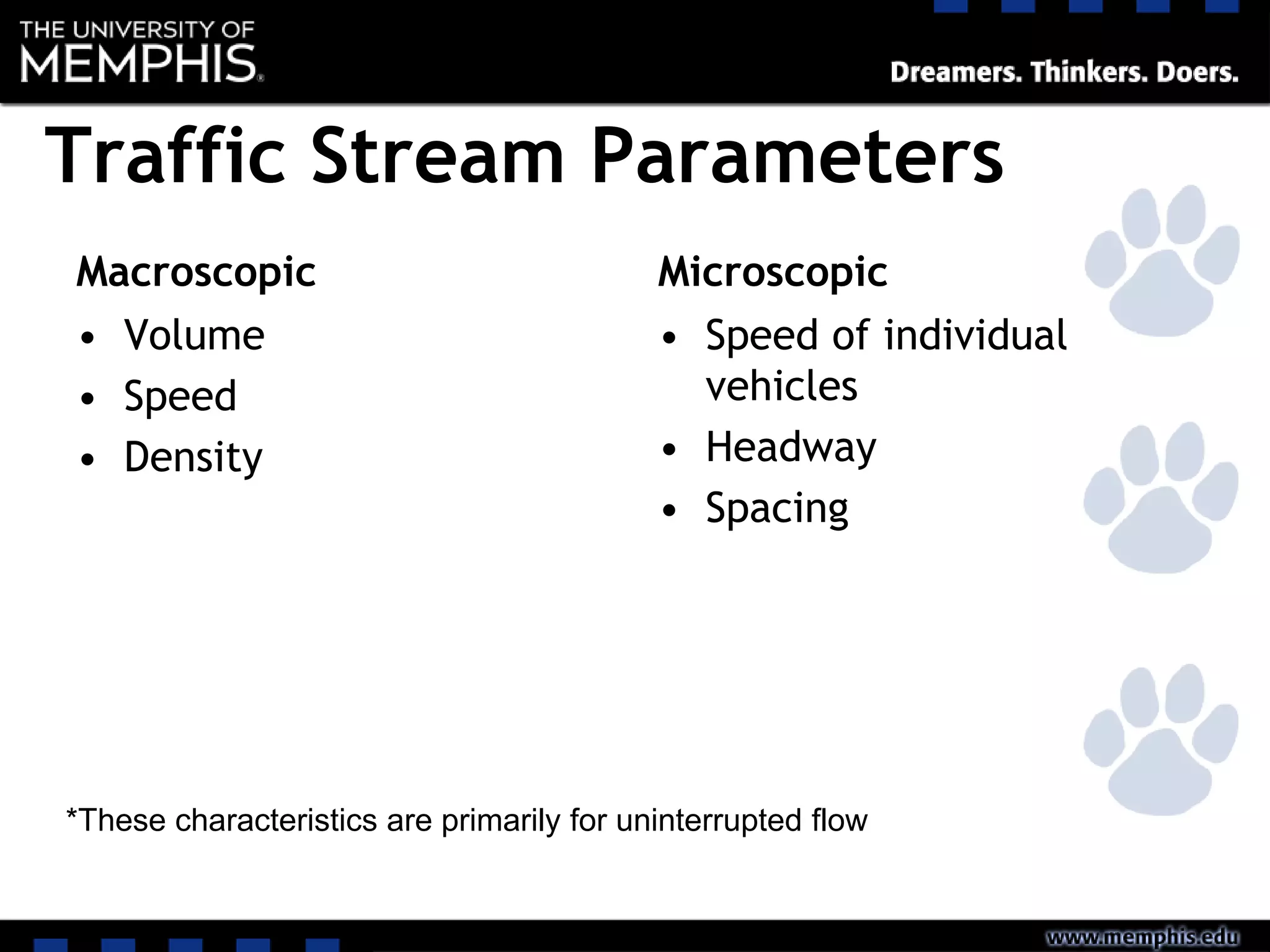
Traffic Stream Parameters
Macroscopic
• Volume
• Speed
• Density
Microscopic
• Speed of individual
vehicles
• Headway
• Spacing
*These characteristics are primarily for uninterrupted flow
Volume
• Traffic volume is defined as the number of
vehicles passing a point on highway or a given
lane or direction of a highway in a specific
time
• Unit: vehicles per unit time
• Usually expressed as vehicles / hour
• Denoted as veh/hr
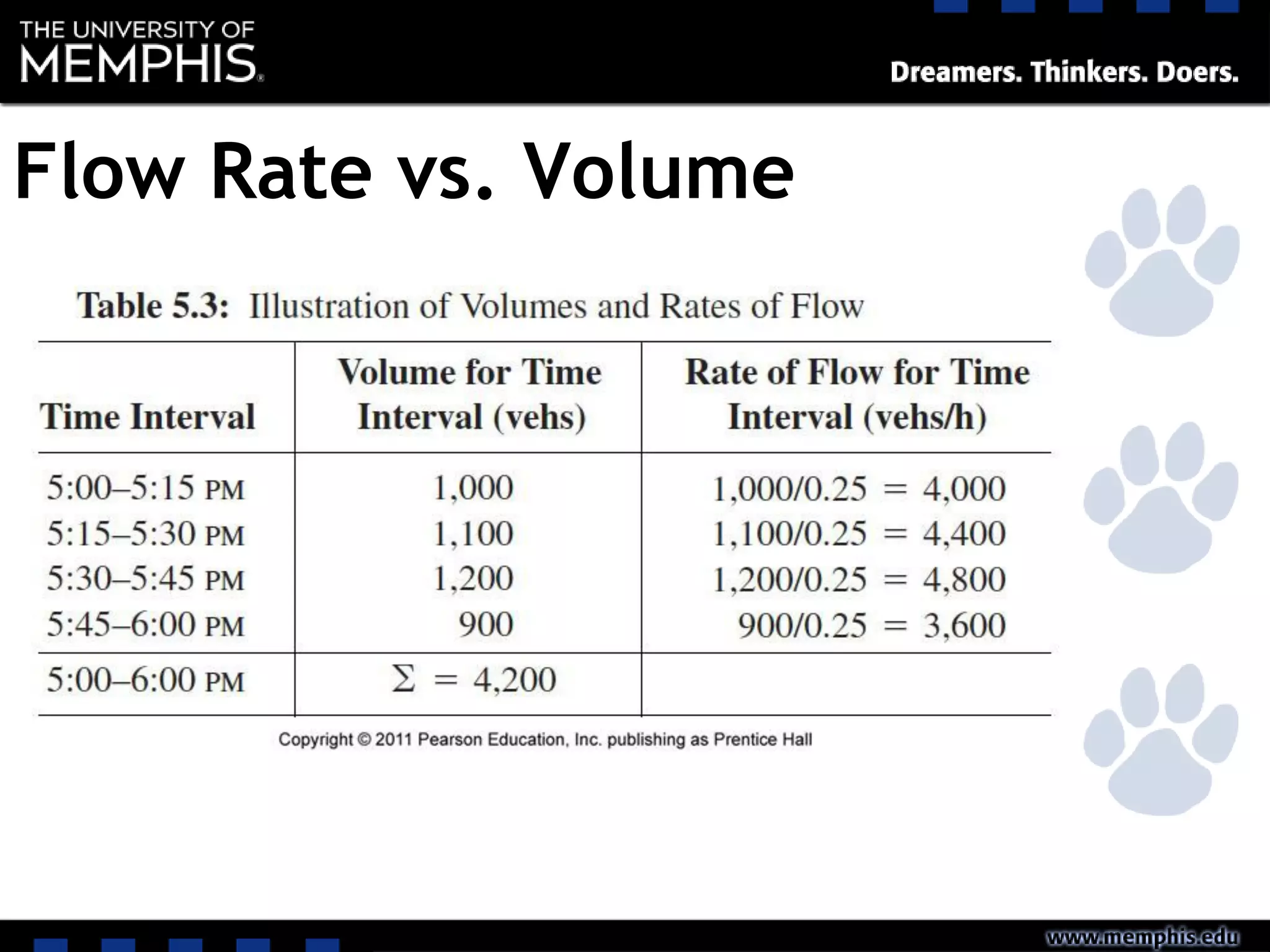
Rate of Flow
• Rate of flow are generally expressed in units
of “veh/hr” but represents flows that exists
for period of time less than an hour.
• Example: 200 vehicles are observed for 15min.
• The equivalent hourly volume will be 800
veh/hr
• Even though 800 veh/hr would not be
observed if one hour was counted
Daily Volumes (1)
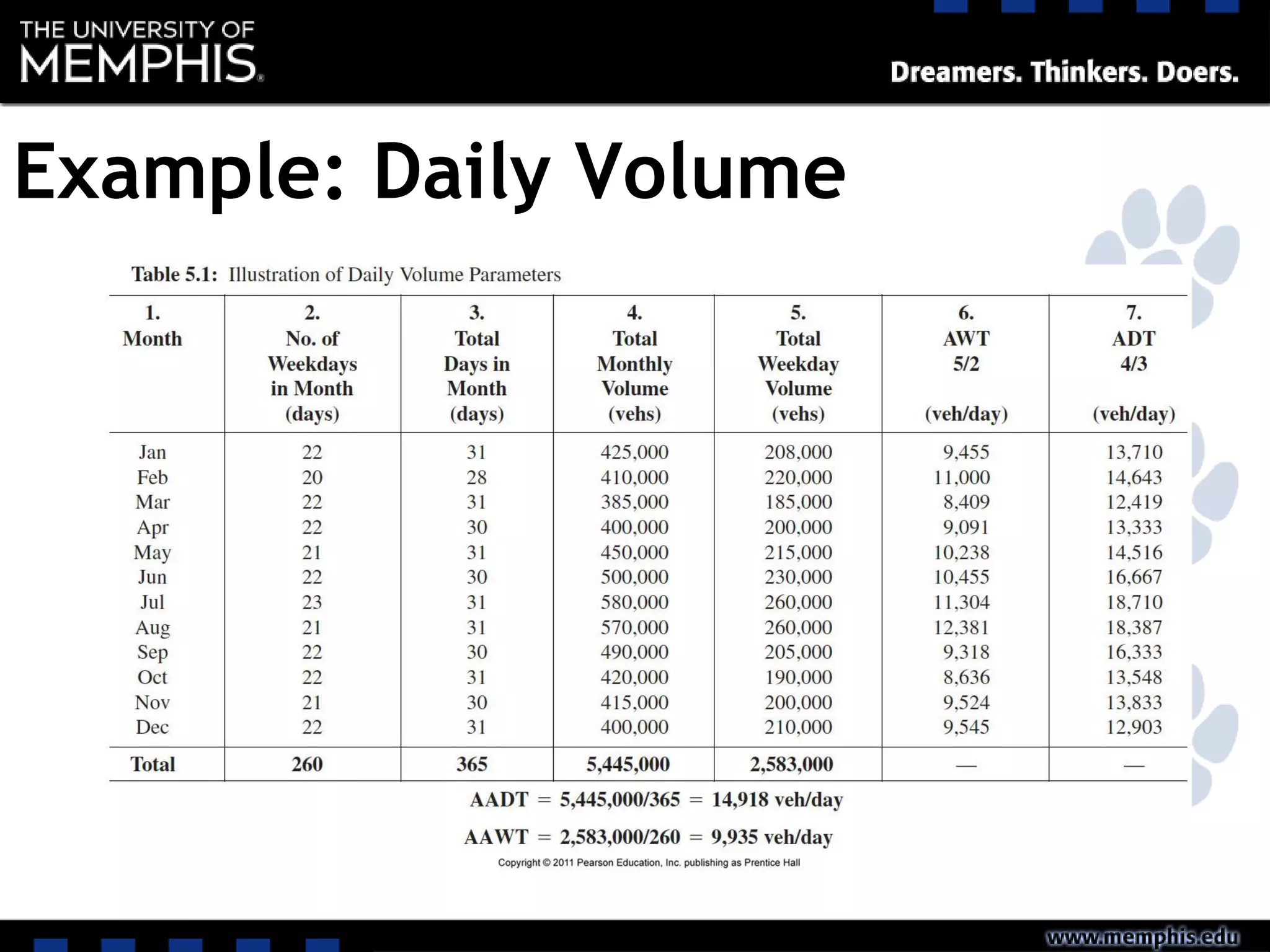
• Average Annual Daily Traffic (AADT) –
– The average 24 hour volume at a given location
over a full 365 day year.
– avg. 24-hour volume at a site over a full year
• Average Annual Weekday Traffic (AAWT) –
– The average 24 hour volume at a given location
occurring on weekdays over a full 365 day year.
– Usually 260 days week days per year
Daily Volumes (2)
• Average Daily Traffic (ADT) –
– The average 24 hour volume at a given location
over a defined time period less than a year
• Average Weekday Traffic (AWT)
– The average 24 hour weekday volume at a given
location over a defined period less than one year
Example: Daily Volume
Hourly Volume
• Measured in volume/hour
• Used for design and operational purposes
• The hour with highest volume is referred as
– Peak hour
• Peak hour volume is stated as directional
volume
• Sometimes referred as Directional Design
Hourly Volume (DDHV)
DDHV
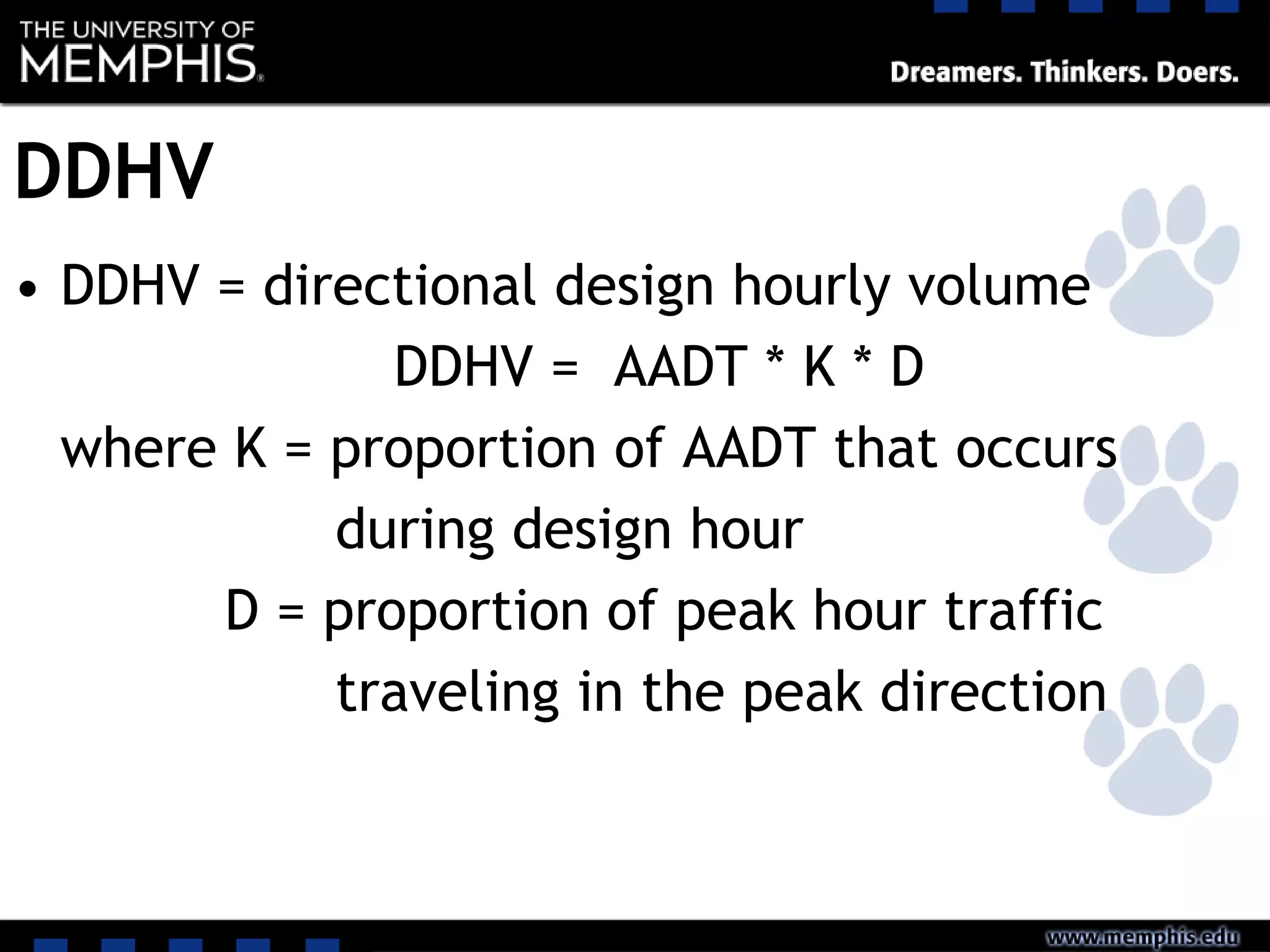
• DDHV = directional design hourly volume
DDHV = AADT * K * D
where K = proportion of AADT that occurs
during design hour
D = proportion of peak hour traffic
traveling in the peak direction
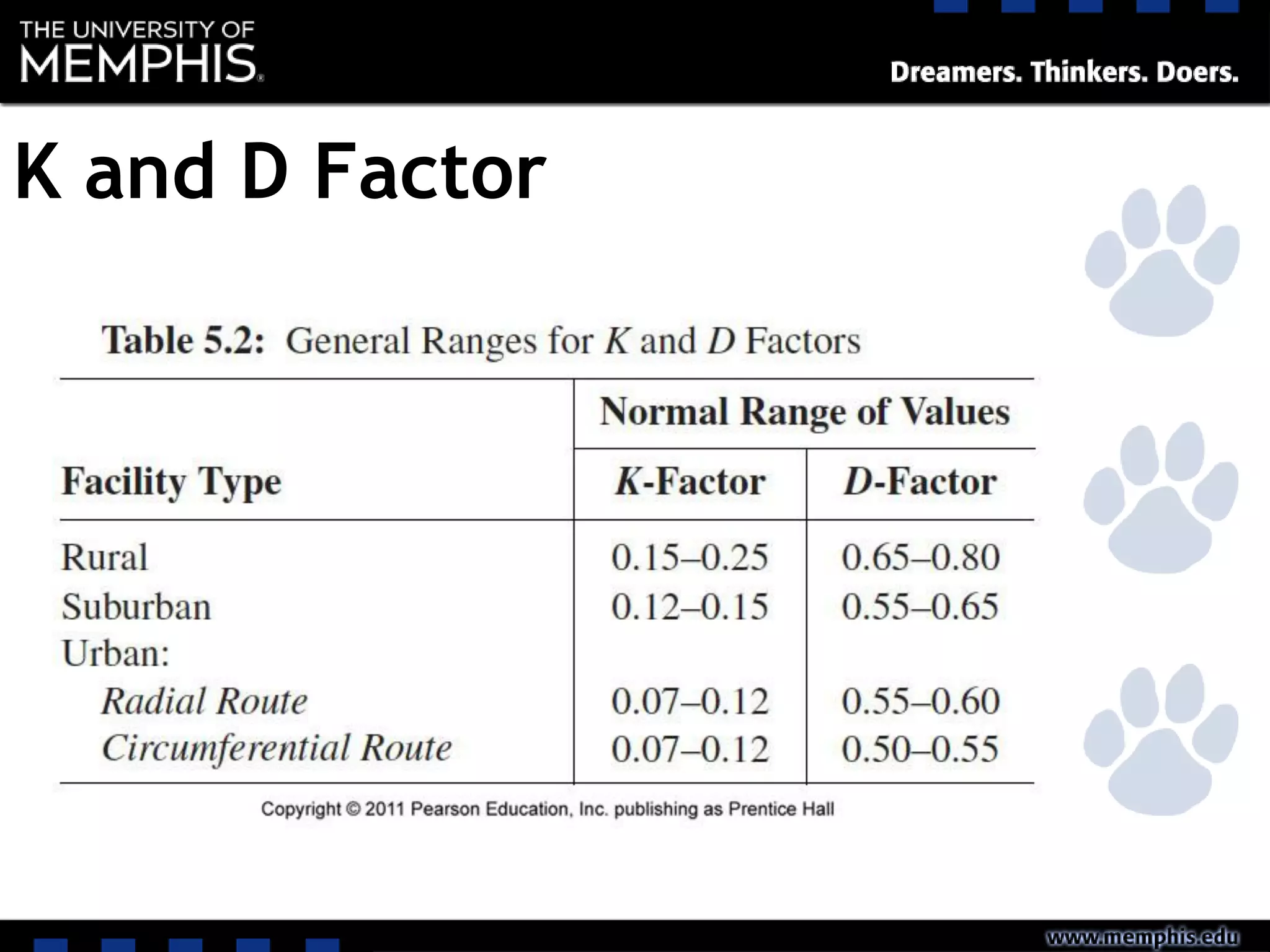
K-Factor
• Typically, K factor represents proportion of AADT occurring
during 30th peak hour of the year
• How does K-factor vary by urban density?
– Urban, suburban, and rural
• D Factors
– More variable than K
– Influenced by development density, radial vs.
circumferential route
K and D Factor
Flow Rate vs. Volume
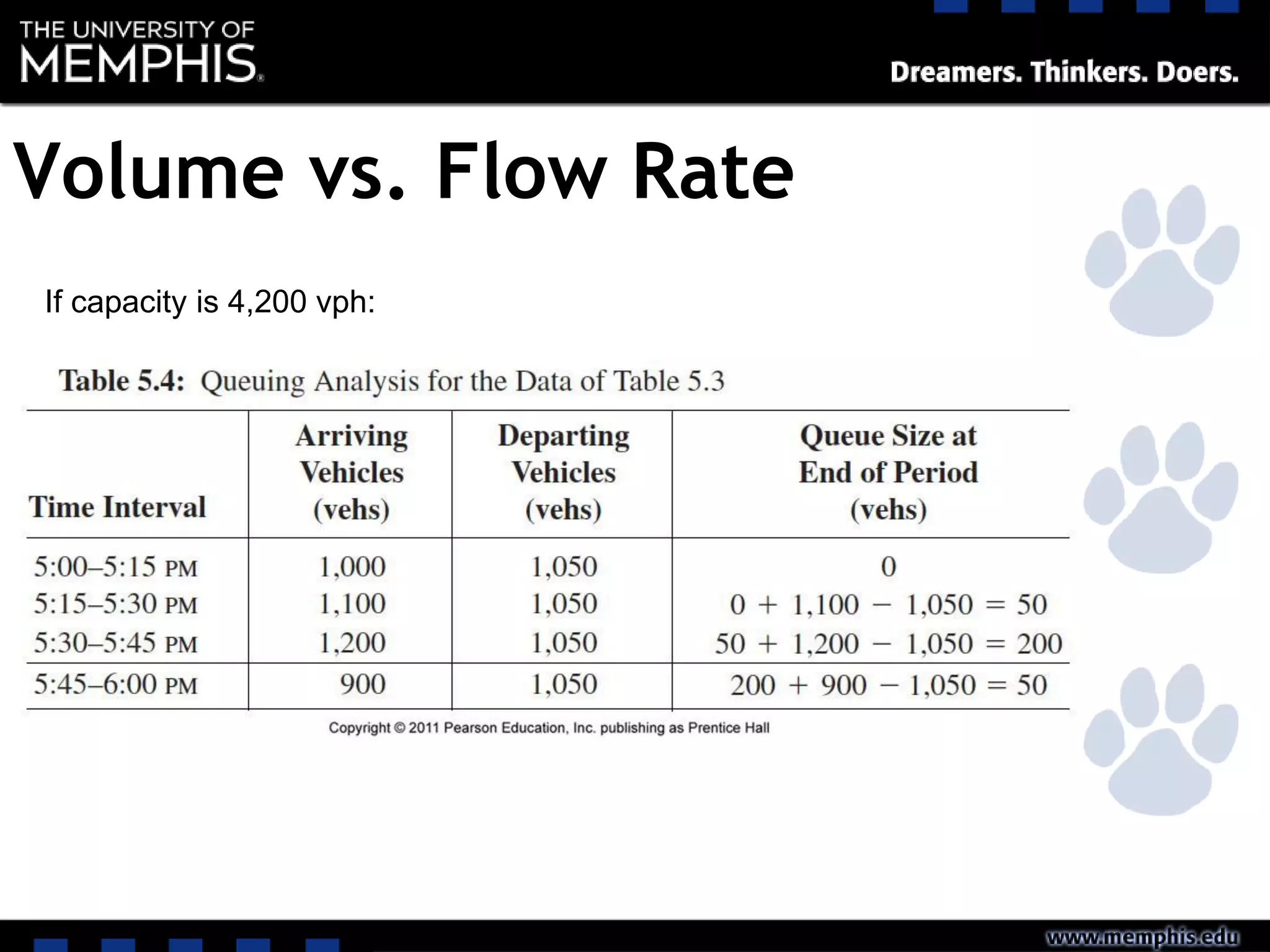
Volume vs. Flow Rate
If capacity is 4,200 vph:
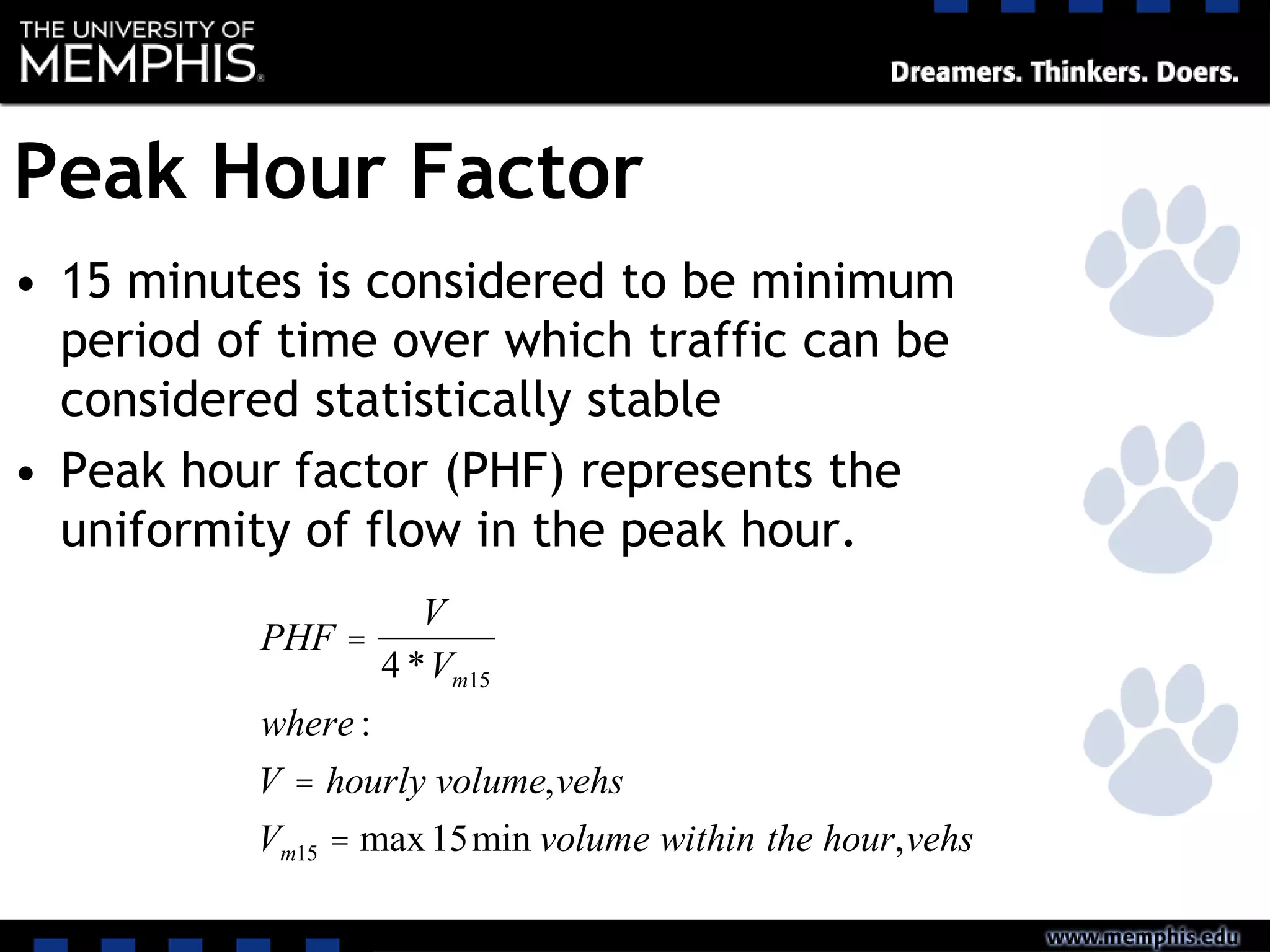
Peak Hour Factor
• 15 minutes is considered to be minimum
period of time over which traffic can be
considered statistically stable
• Peak hour factor (PHF) represents the
uniformity of flow in the peak hour.
PHF =
V
4 *Vm15
where :
V = hourly volume,vehs
Vm15 = max15min volume within the hour,vehs
Peak Hour Factor (2)
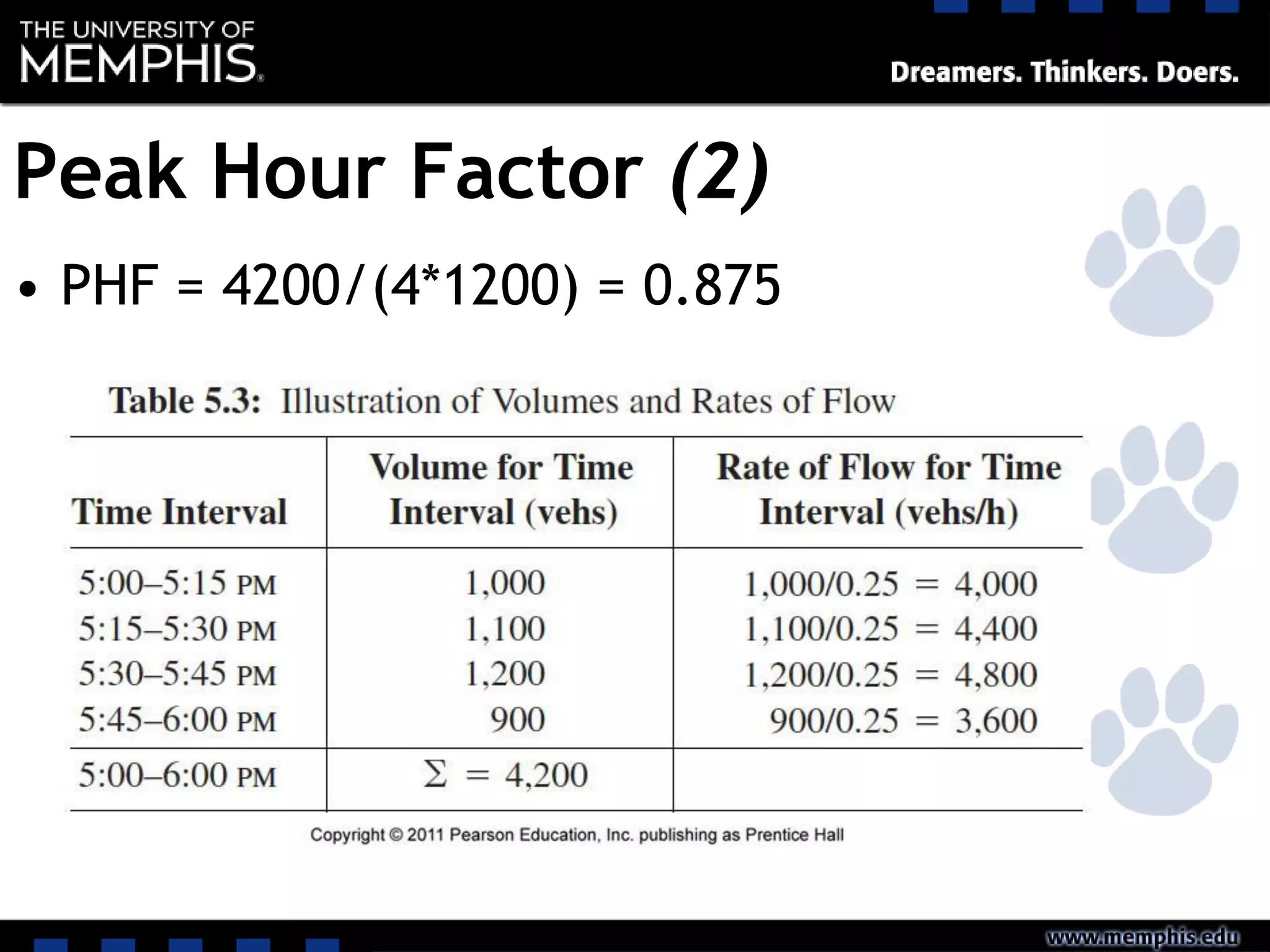
• PHF = 4200/(4*1200) = 0.875
Peak Hour Factor (3)
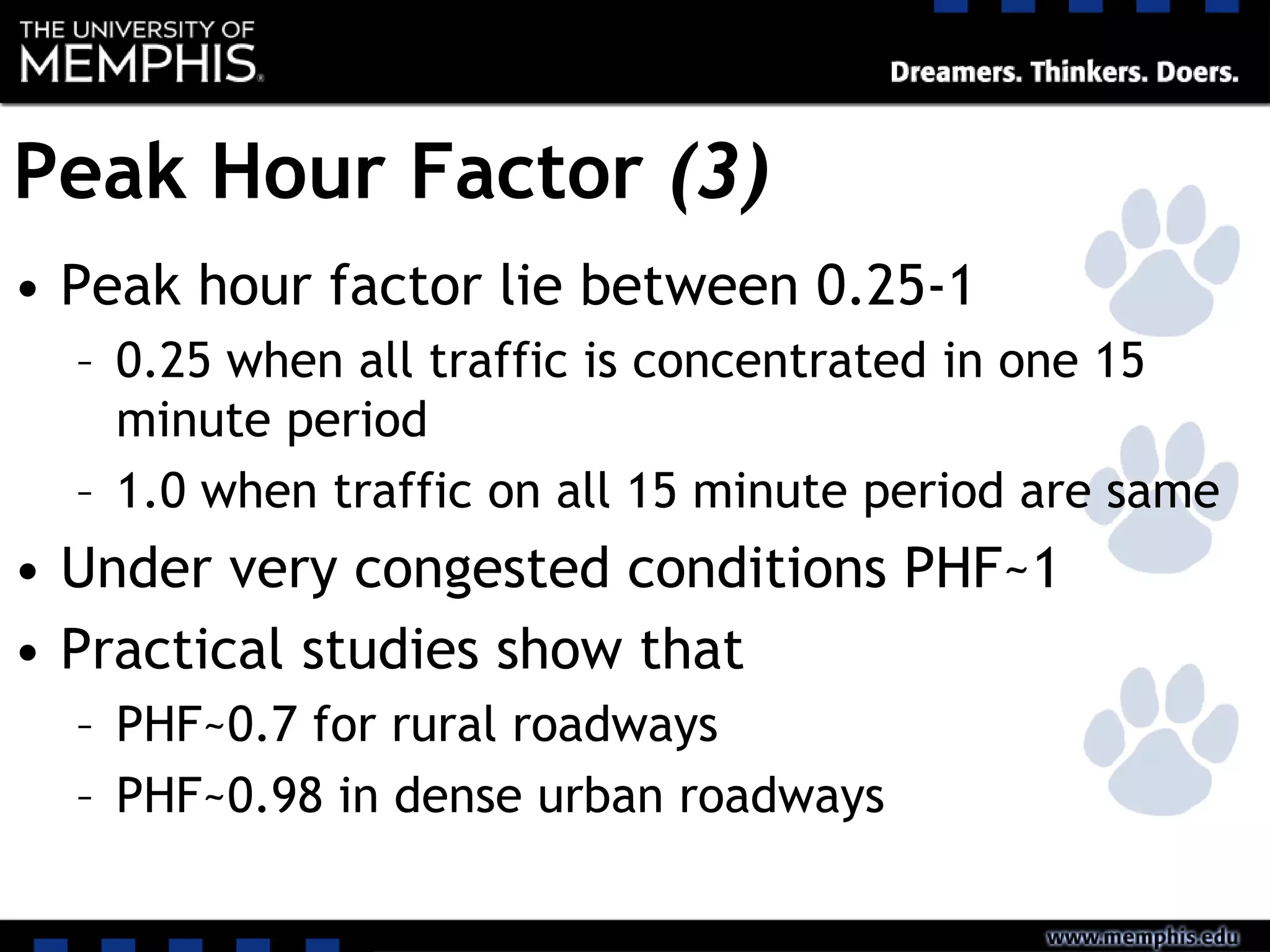
• Peak hour factor lie between 0.25-1
– 0.25 when all traffic is concentrated in one 15
minute period
– 1.0 when traffic on all 15 minute period are same
• Under very congested conditions PHF~1
• Practical studies show that
– PHF~0.7 for rural roadways
– PHF~0.98 in dense urban roadways
Speed
• Speed and travel time are inversely related
– S = d/t
– Where S->speed in mi/hr; d->distance traversed in mi; t-> time to
traverse distance d in hr
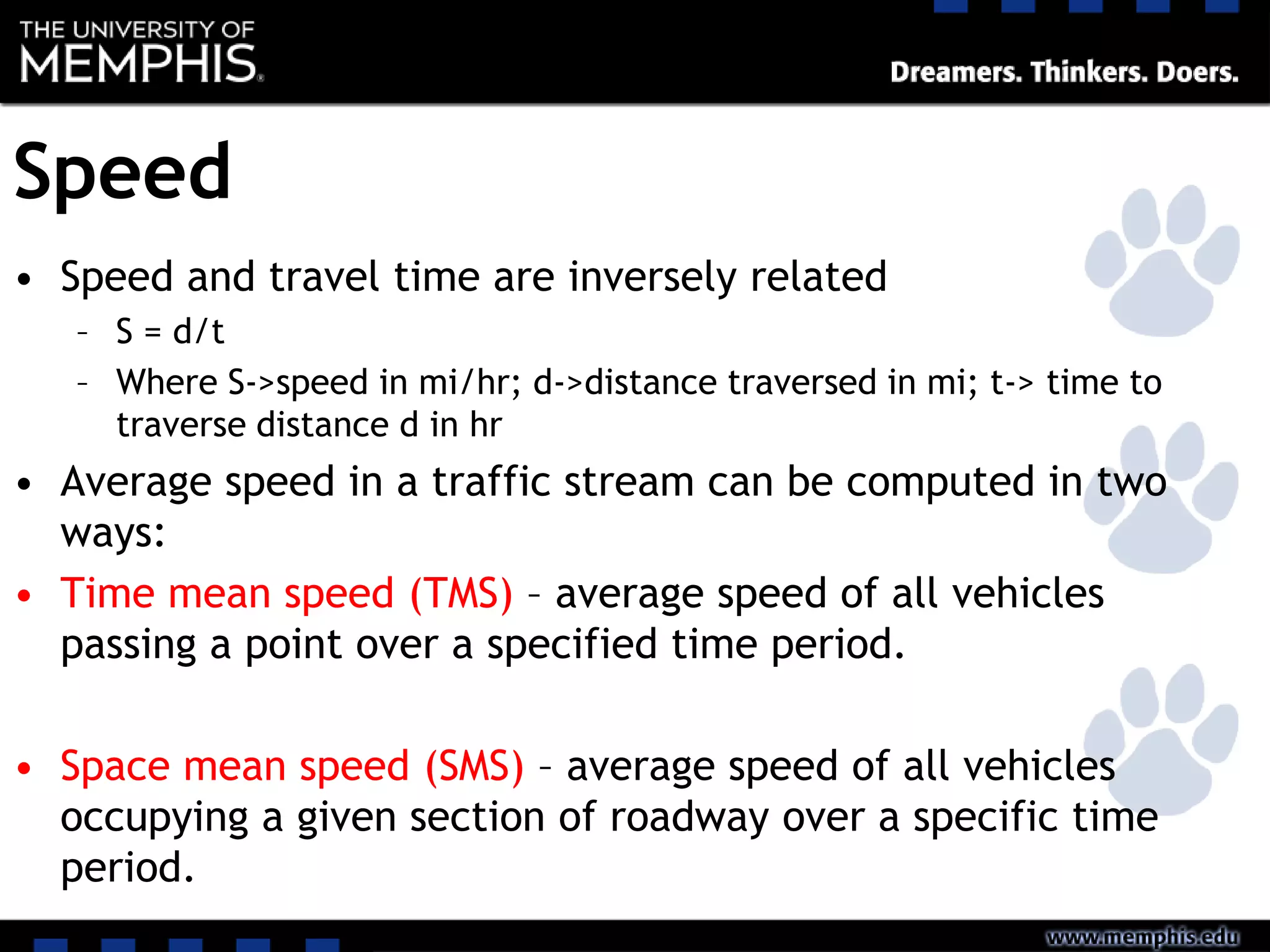
• Average speed in a traffic stream can be computed in two
ways:
• Time mean speed (TMS) – average speed of all vehicles
passing a point over a specified time period.
• Space mean speed (SMS) – average speed of all vehicles
occupying a given section of roadway over a specific time
period.
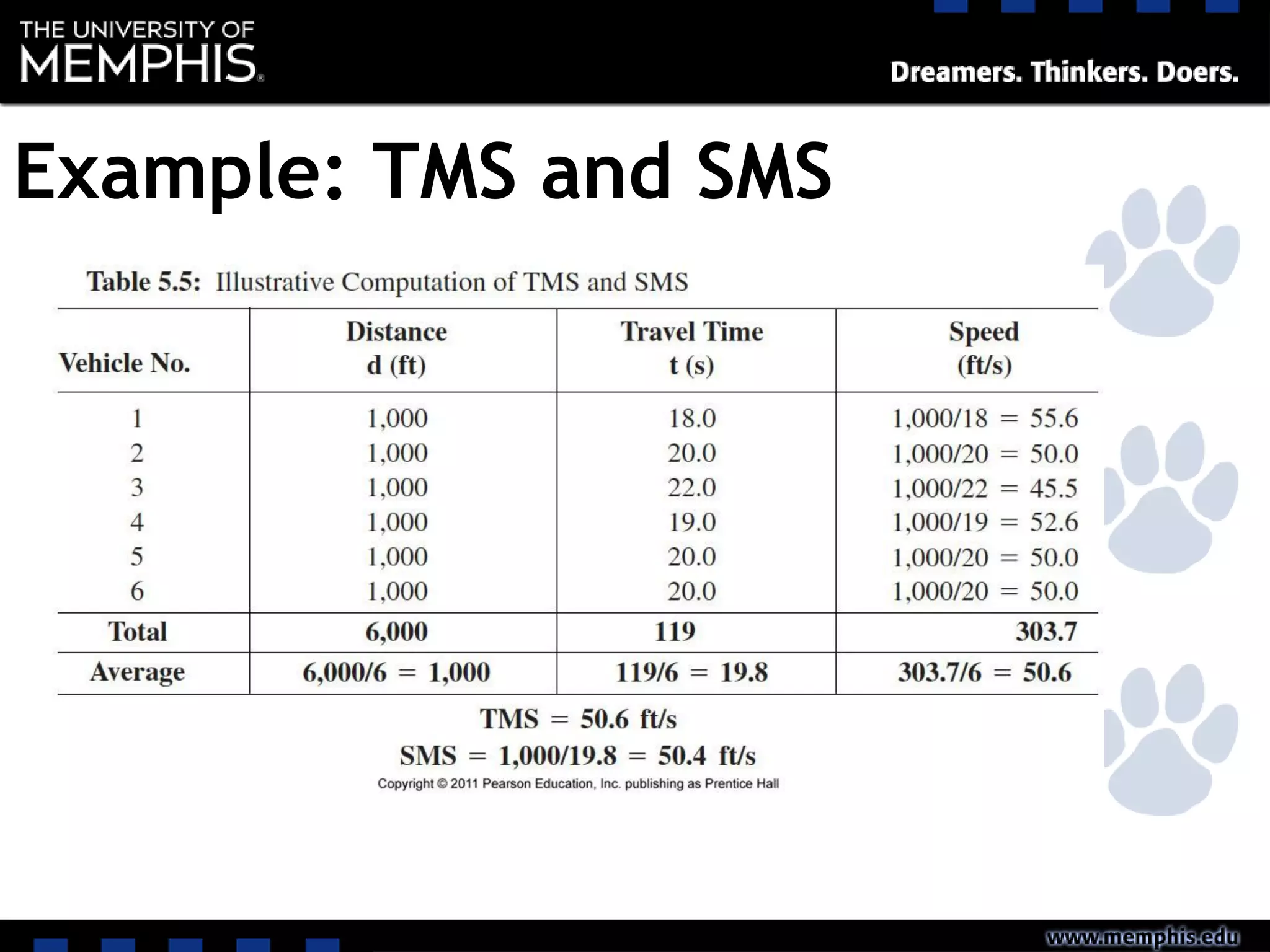
TMS and SMS
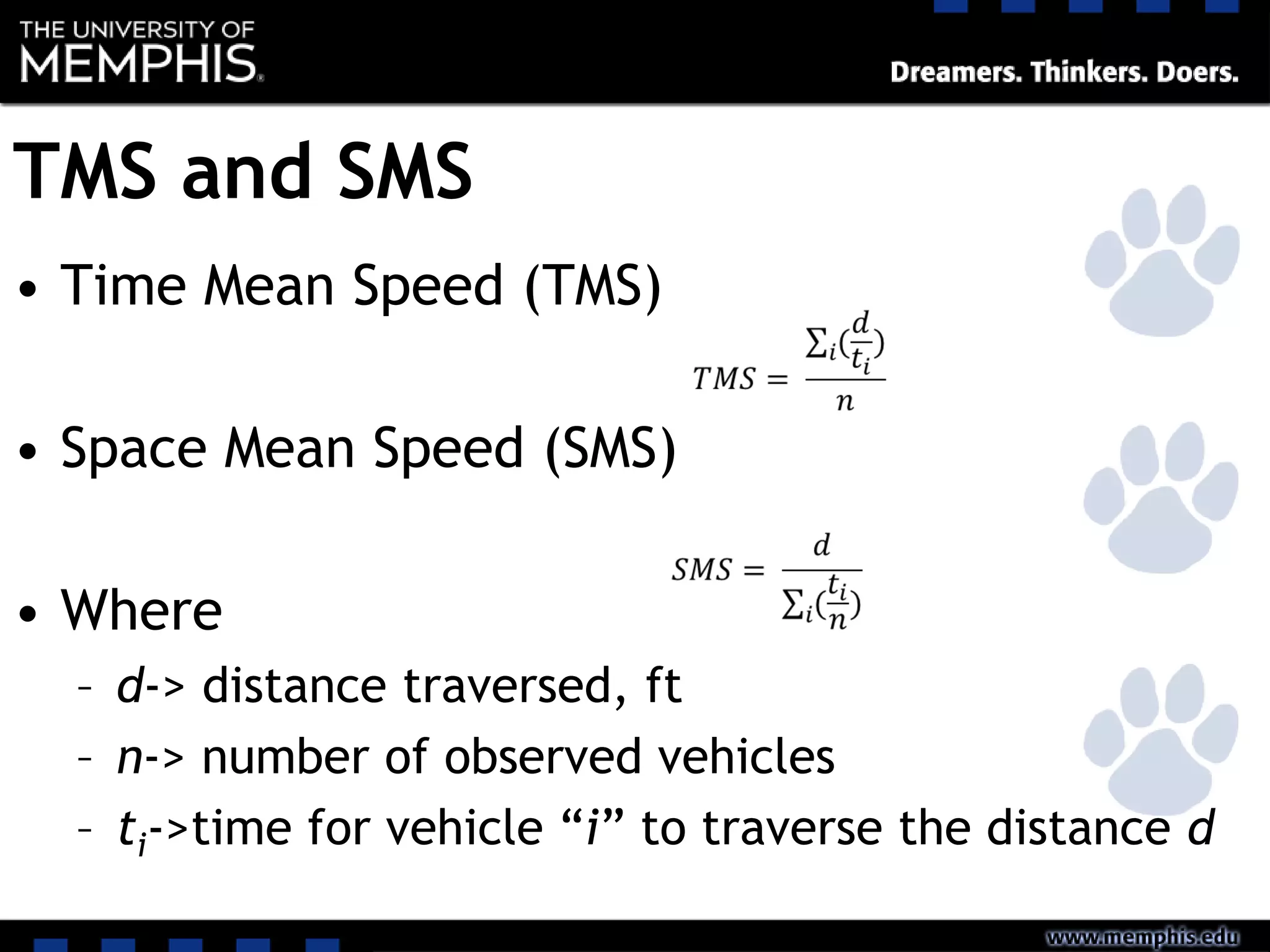
• Time Mean Speed (TMS)
• Space Mean Speed (SMS)
• Where
– d-> distance traversed, ft
– n-> number of observed vehicles
– ti->time for vehicle “i” to traverse the distance d
Example: TMS and SMS
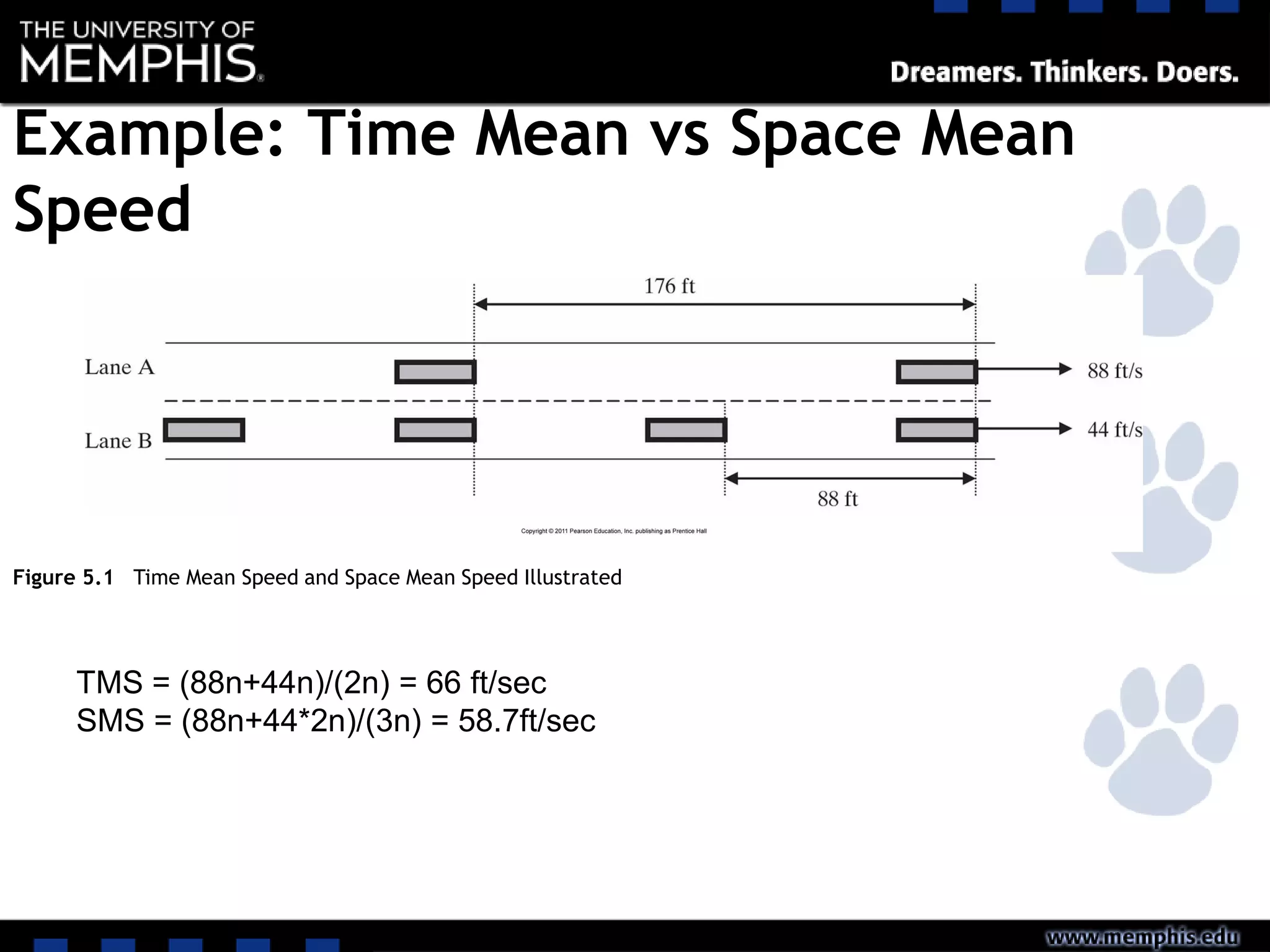
Example: Time Mean vs Space Mean
Speed
Figure 5.1 Time Mean Speed and Space Mean Speed Illustrated
TMS = (88n+44n)/(2n) = 66 ft/sec
SMS = (88n+44*2n)/(3n) = 58.7ft/sec
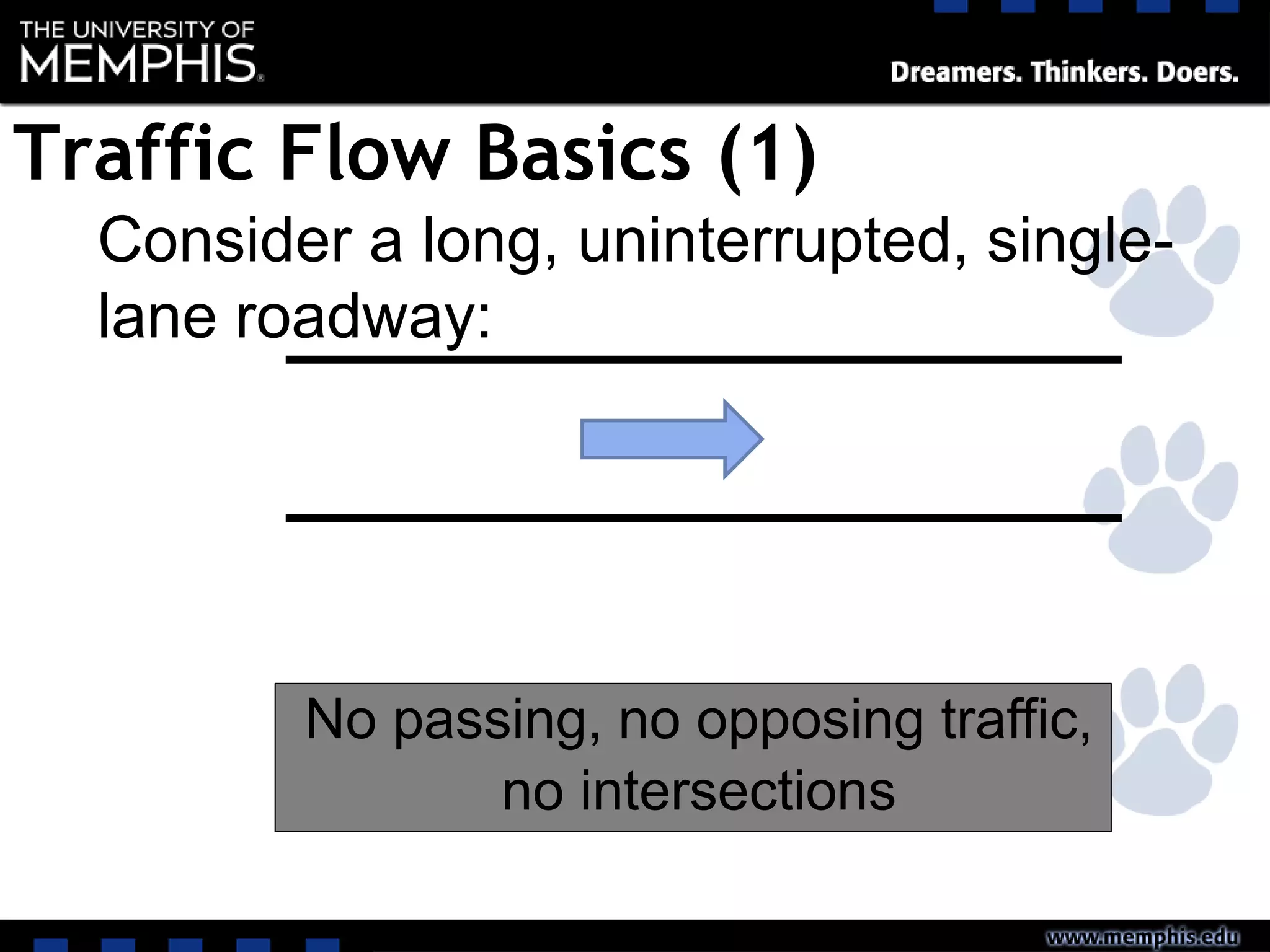
Consider a long, uninterrupted, single-
lane roadway:
No passing, no opposing traffic,
no intersections
Traffic Flow Basics (1)
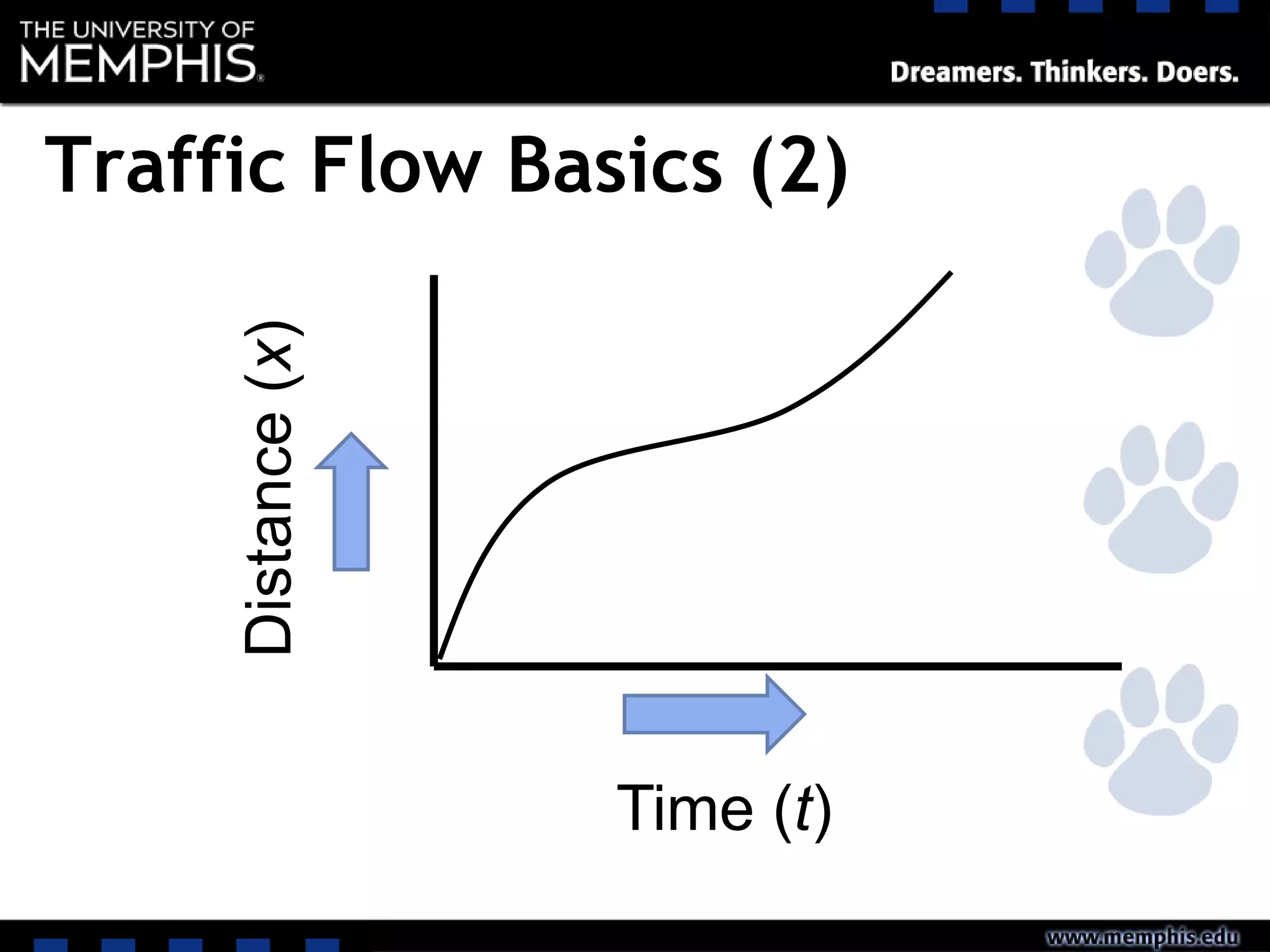
Time (t)
Distance(x)
Traffic Flow Basics (2)
Time (t)
Distance(x)
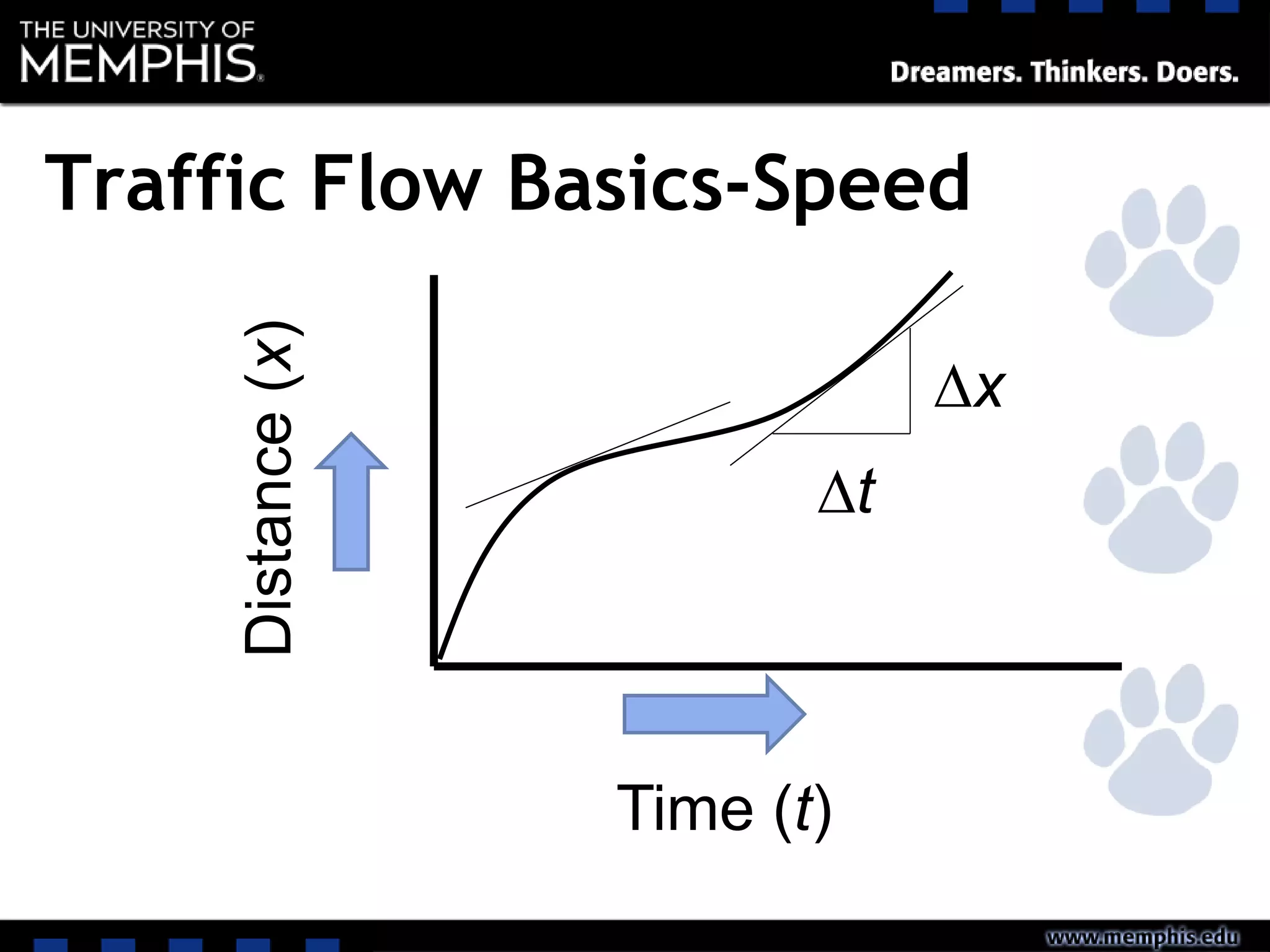
Dt
Dx
Traffic Flow Basics-Speed
Time (t)
Distance(x)
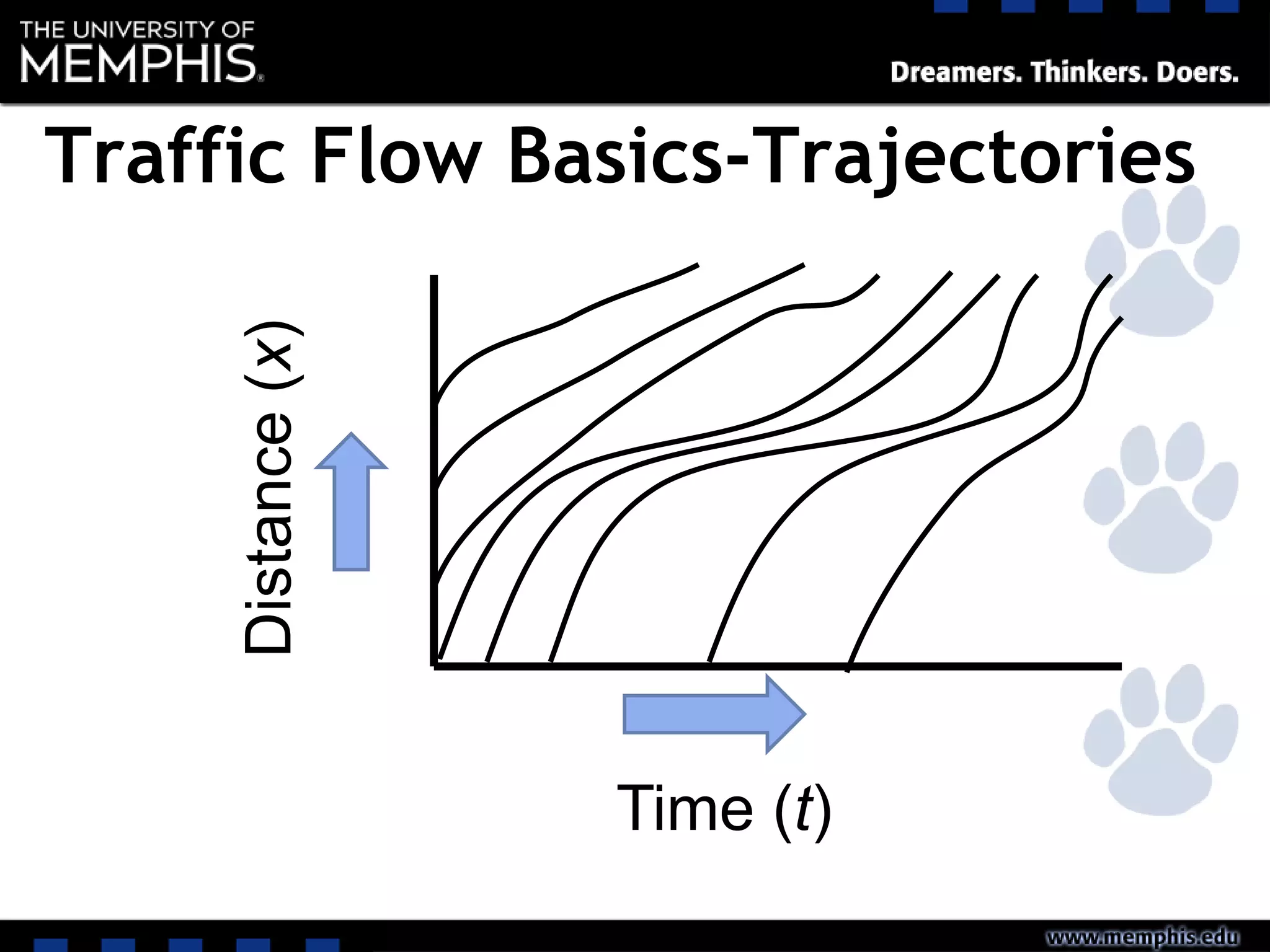
Traffic Flow Basics-Trajectories
Time (t)
Distance(x)
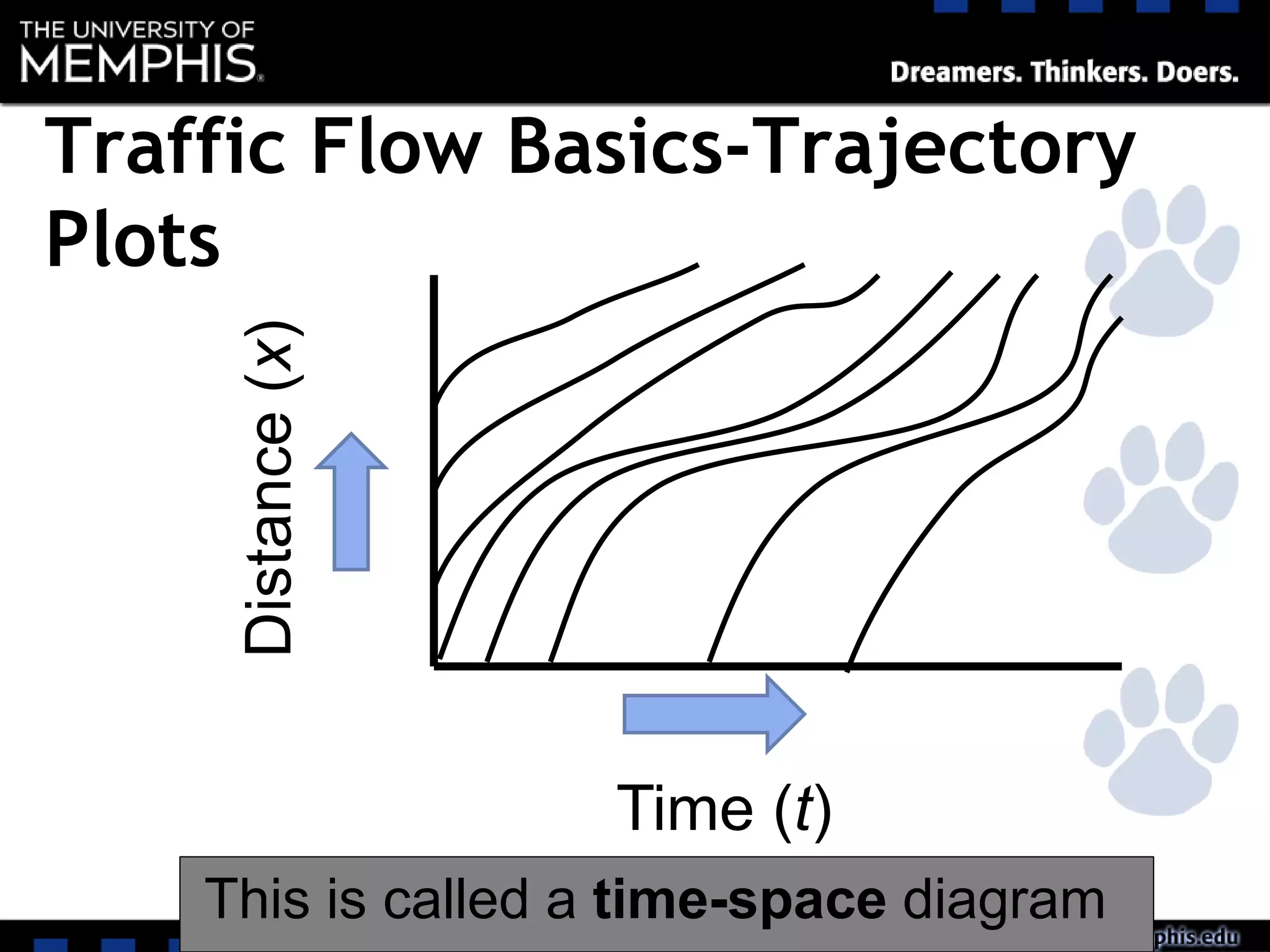
This is called a time-space diagram
Traffic Flow Basics-Trajectory
Plots
Time (t)
Distance(x)
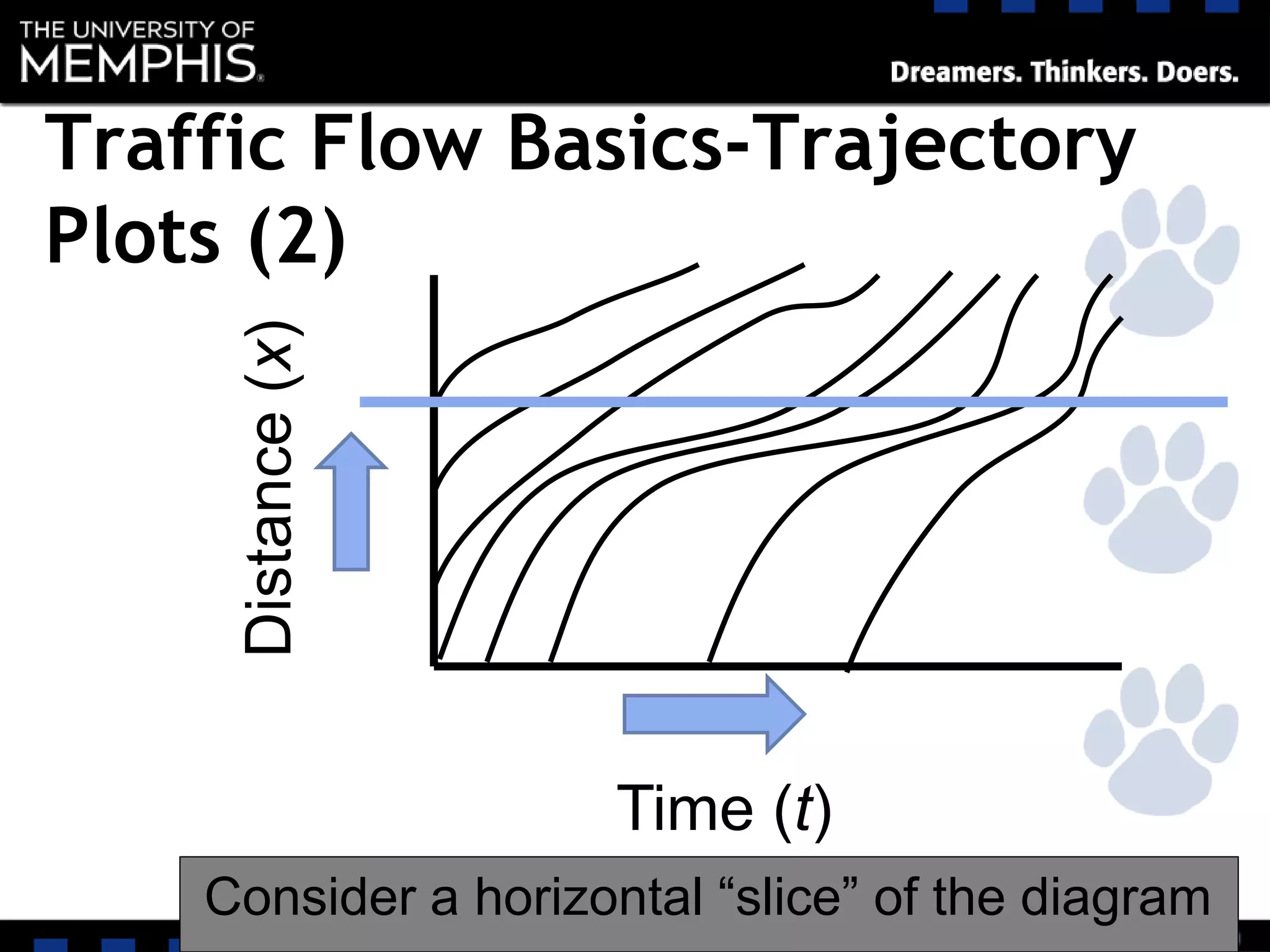
Consider a horizontal “slice” of the diagram
Traffic Flow Basics-Trajectory
Plots (2)
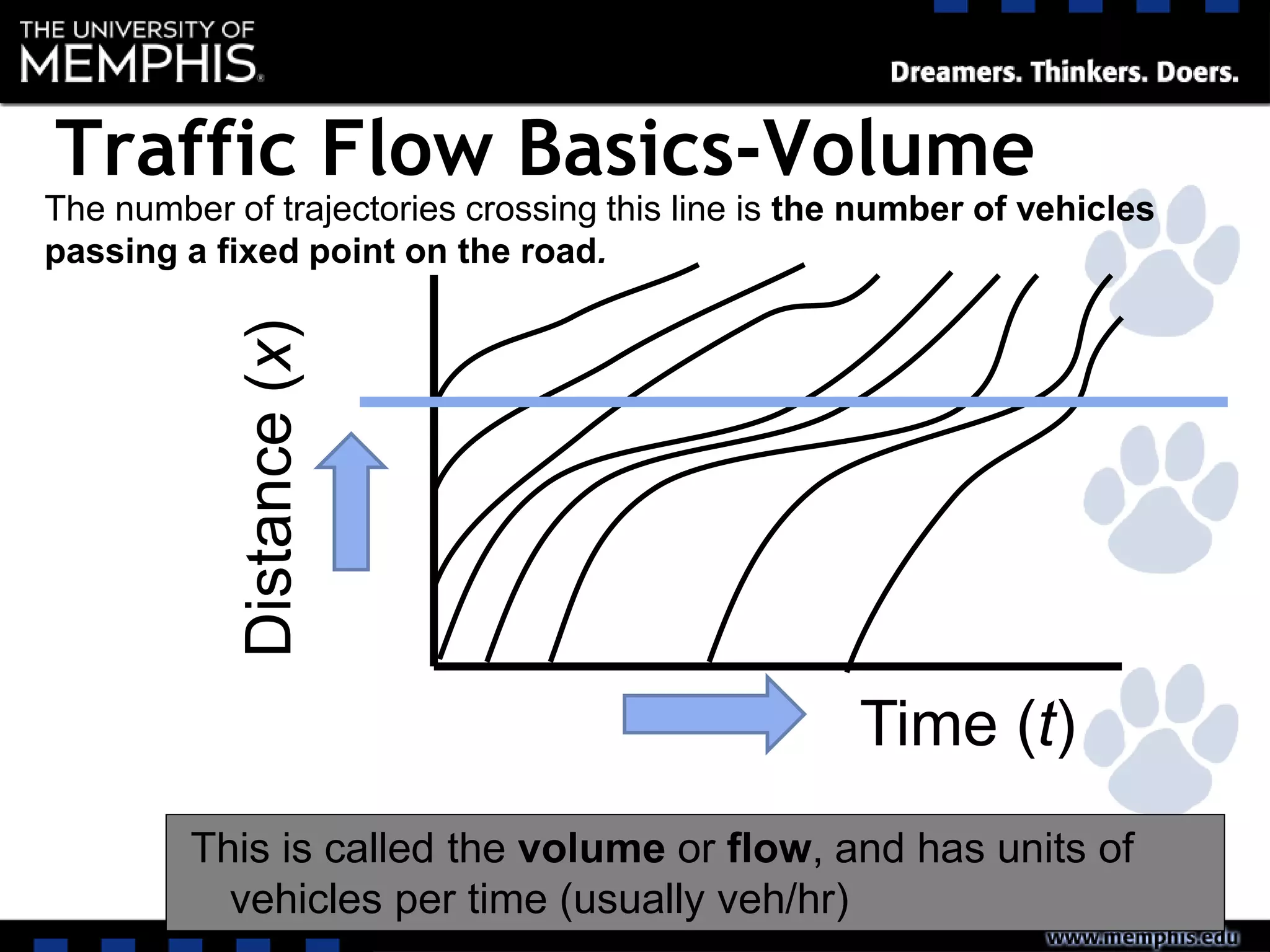
The number of trajectories crossing this line is the number of vehicles
passing a fixed point on the road.
Time (t)
Distance(x)
This is called the volume or flow, and has units of
vehicles per time (usually veh/hr)
Traffic Flow Basics-Volume
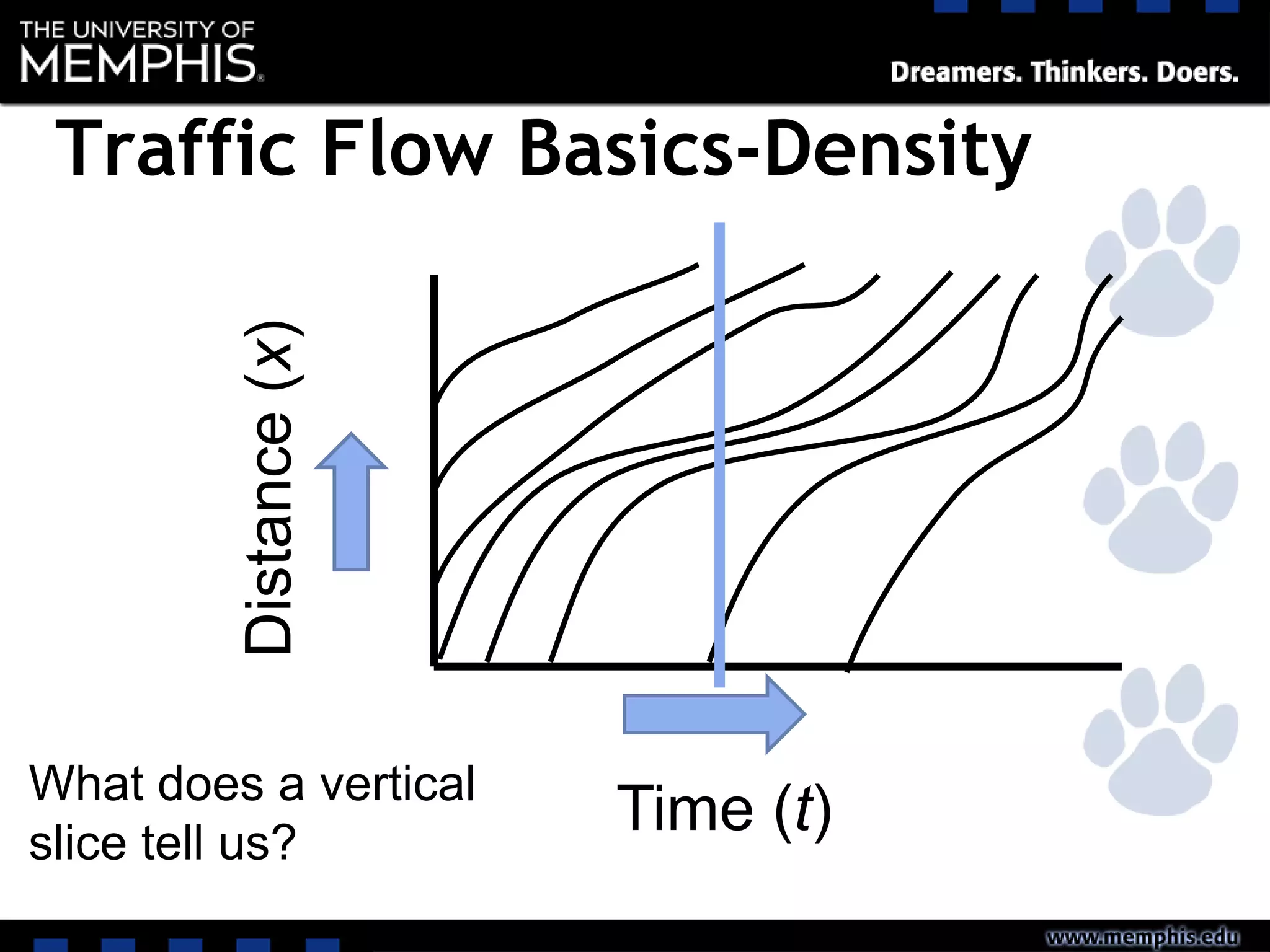
What does a vertical
slice tell us?
Time (t)
Distance(x)
Traffic Flow Basics-Density
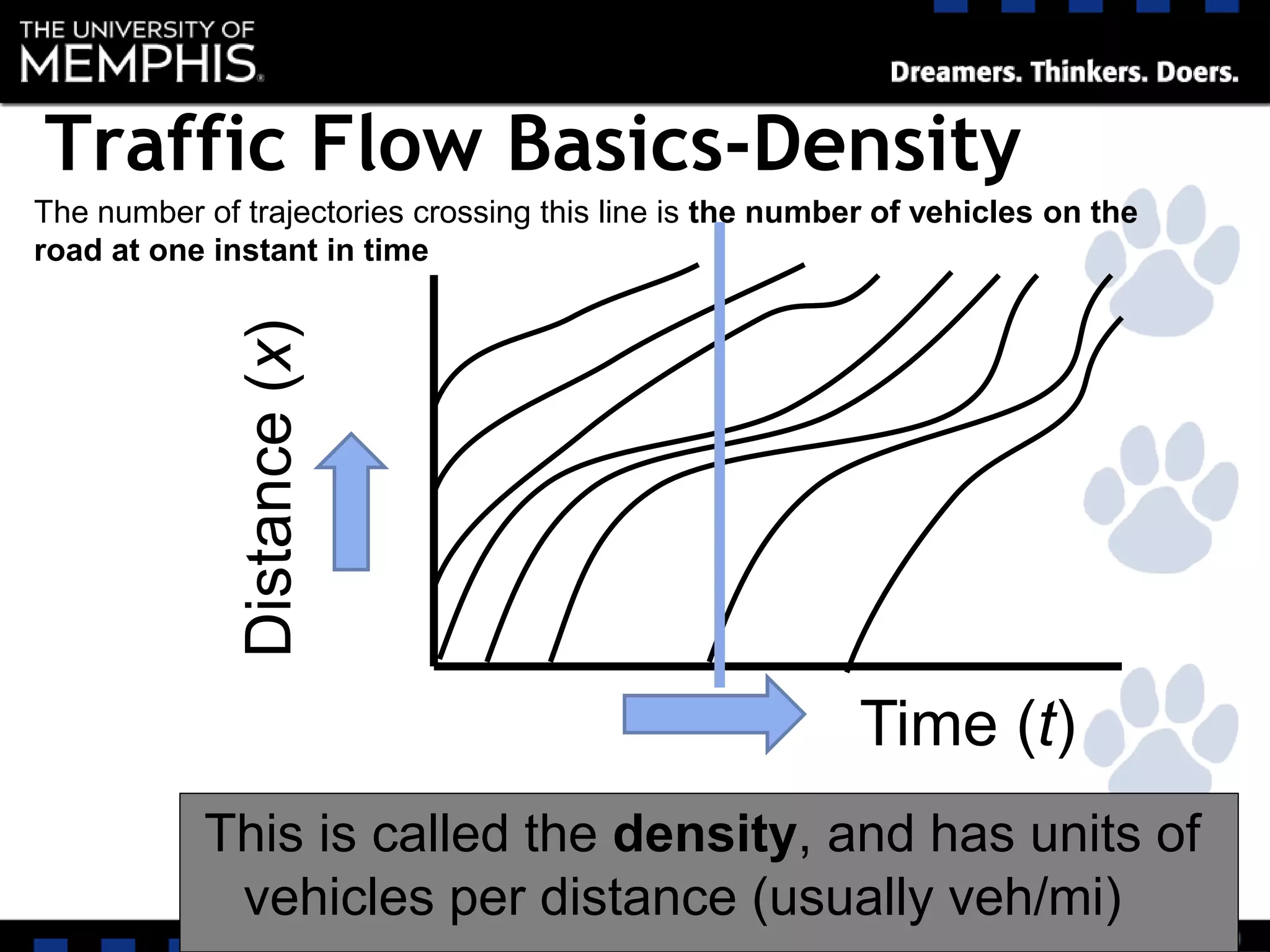
The number of trajectories crossing this line is the number of vehicles on the
road at one instant in time
Time (t)
Distance(x)
This is called the density, and has units of
vehicles per distance (usually veh/mi)
Traffic Flow Basics-Density
Density
• Most direct measure of traffic demand
• Difficult to measure directly
• Important measure of quality of traffic flow
• Occupancy is related, and can be measured directly
• Occupancy – proportion of time that a detector is
occupied by a vehicle in a defined time period.
Figure 5.2 Density and Occupancy Illustrated
Density and Occupancy

L1 Traffic Flow Parameters

  • 1.
    Traffic Flow Characteristics CIVL4162/6162 (Traffic Engineering)
  • 2.
    Lesson Objective • Definetraffic stream parameters • Establish the relationship between traffic stream parameters • Calculate and compute parameters with given data
  • 3.
    What is aTraffic Stream • Traffic streams are made up of – Individual drivers – Vehicles – Roadway and environment • Driver behavior and vehicle characteristics typically vary • No two traffic streams will behave exactly in the same way
  • 4.
    Variability in TrafficStream (1) • Traffic flow (movement of vehicles) involves variability – Unlike pipe flow (homogeneous) • A given traffic flow will vary – By time – By space • Constraints are defined by – Physical constraints – Complex driver characteristics
  • 5.
    Variability in TrafficStream (2) • Although traffic characteristics vary there is a reasonable range – Example: In a 65 miles/hr roadway some drivers will drive 50 miles/hr and some will drive 80 miles/hr • There exists a range • Before we study traffic characteristics let us see what are – Facilities – Basic flow parameters
  • 6.
    Types of Facilities •Uninterrupted Flow Facilities – No external interruptions – Primarily on freeways – Also on certain segments of long rural highways – In peak hours also freeways are uninterrupted • Interrupted Flow Facilities – External interruptions exists – Most frequent are signals, stop/yield signs – Creates platoons of vehicles progress in traffic stream
  • 7.
    Types of Facilitiesand Major Difference • The major difference between two facilities – Impact of time (no interventions at any time) – Availability of roadways • On uninterrupted facilities roadways are available to users all the time • But sections of roadway are not available to users because of traffic control (signal, stop, and yield signs)
  • 8.
    Traffic Stream Parameters Macroscopic •Volume • Speed • Density Microscopic • Speed of individual vehicles • Headway • Spacing *These characteristics are primarily for uninterrupted flow
  • 9.
    Volume • Traffic volumeis defined as the number of vehicles passing a point on highway or a given lane or direction of a highway in a specific time • Unit: vehicles per unit time • Usually expressed as vehicles / hour • Denoted as veh/hr
  • 10.
    Rate of Flow •Rate of flow are generally expressed in units of “veh/hr” but represents flows that exists for period of time less than an hour. • Example: 200 vehicles are observed for 15min. • The equivalent hourly volume will be 800 veh/hr • Even though 800 veh/hr would not be observed if one hour was counted
  • 11.
    Daily Volumes (1) •Average Annual Daily Traffic (AADT) – – The average 24 hour volume at a given location over a full 365 day year. – avg. 24-hour volume at a site over a full year • Average Annual Weekday Traffic (AAWT) – – The average 24 hour volume at a given location occurring on weekdays over a full 365 day year. – Usually 260 days week days per year
  • 12.
    Daily Volumes (2) •Average Daily Traffic (ADT) – – The average 24 hour volume at a given location over a defined time period less than a year • Average Weekday Traffic (AWT) – The average 24 hour weekday volume at a given location over a defined period less than one year
  • 13.
  • 14.
    Hourly Volume • Measuredin volume/hour • Used for design and operational purposes • The hour with highest volume is referred as – Peak hour • Peak hour volume is stated as directional volume • Sometimes referred as Directional Design Hourly Volume (DDHV)
  • 15.
    DDHV • DDHV =directional design hourly volume DDHV = AADT * K * D where K = proportion of AADT that occurs during design hour D = proportion of peak hour traffic traveling in the peak direction
  • 16.
    K-Factor • Typically, Kfactor represents proportion of AADT occurring during 30th peak hour of the year • How does K-factor vary by urban density? – Urban, suburban, and rural • D Factors – More variable than K – Influenced by development density, radial vs. circumferential route
  • 17.
    K and DFactor
  • 18.
  • 19.
    Volume vs. FlowRate If capacity is 4,200 vph:
  • 20.
    Peak Hour Factor •15 minutes is considered to be minimum period of time over which traffic can be considered statistically stable • Peak hour factor (PHF) represents the uniformity of flow in the peak hour. PHF = V 4 *Vm15 where : V = hourly volume,vehs Vm15 = max15min volume within the hour,vehs
  • 21.
    Peak Hour Factor(2) • PHF = 4200/(4*1200) = 0.875
  • 22.
    Peak Hour Factor(3) • Peak hour factor lie between 0.25-1 – 0.25 when all traffic is concentrated in one 15 minute period – 1.0 when traffic on all 15 minute period are same • Under very congested conditions PHF~1 • Practical studies show that – PHF~0.7 for rural roadways – PHF~0.98 in dense urban roadways
  • 23.
    Speed • Speed andtravel time are inversely related – S = d/t – Where S->speed in mi/hr; d->distance traversed in mi; t-> time to traverse distance d in hr • Average speed in a traffic stream can be computed in two ways: • Time mean speed (TMS) – average speed of all vehicles passing a point over a specified time period. • Space mean speed (SMS) – average speed of all vehicles occupying a given section of roadway over a specific time period.
  • 24.
    TMS and SMS •Time Mean Speed (TMS) • Space Mean Speed (SMS) • Where – d-> distance traversed, ft – n-> number of observed vehicles – ti->time for vehicle “i” to traverse the distance d
  • 25.
  • 26.
    Example: Time Meanvs Space Mean Speed Figure 5.1 Time Mean Speed and Space Mean Speed Illustrated TMS = (88n+44n)/(2n) = 66 ft/sec SMS = (88n+44*2n)/(3n) = 58.7ft/sec
  • 27.
    Consider a long,uninterrupted, single- lane roadway: No passing, no opposing traffic, no intersections Traffic Flow Basics (1)
  • 28.
  • 29.
  • 30.
  • 31.
    Time (t) Distance(x) This iscalled a time-space diagram Traffic Flow Basics-Trajectory Plots
  • 32.
    Time (t) Distance(x) Consider ahorizontal “slice” of the diagram Traffic Flow Basics-Trajectory Plots (2)
  • 33.
    The number oftrajectories crossing this line is the number of vehicles passing a fixed point on the road. Time (t) Distance(x) This is called the volume or flow, and has units of vehicles per time (usually veh/hr) Traffic Flow Basics-Volume
  • 34.
    What does avertical slice tell us? Time (t) Distance(x) Traffic Flow Basics-Density
  • 35.
    The number oftrajectories crossing this line is the number of vehicles on the road at one instant in time Time (t) Distance(x) This is called the density, and has units of vehicles per distance (usually veh/mi) Traffic Flow Basics-Density
  • 36.
    Density • Most directmeasure of traffic demand • Difficult to measure directly • Important measure of quality of traffic flow • Occupancy is related, and can be measured directly • Occupancy – proportion of time that a detector is occupied by a vehicle in a defined time period.
  • 37.
    Figure 5.2 Densityand Occupancy Illustrated Density and Occupancy