1
Geometric design of highway
Transportation Engineering
2
Static Characteristics
 Size:
 Design of lane widths, parking bays, etc…
 Vertical clearance
 Weight:
 Pavement design, bridge design, axle loads
 Maximum grade
 Radius of Curvature:
 Intersection design
 Interchange ramps
3
Kinematic (Dynamic)
Characteristics
 Acceleration (Constant or variable):
 Passing maneuvers
 Gap acceptance
 Dimensions of freeway ramps and passing
lanes
 Motion elements (Distance and Velocity)
4
Sight distance
Distance a driver can see ahead at any specific time
Must allow sufficient distance for a driver to
perceive/react and stop, swerve etc when necessary
5
Stopping Sight Distance
where:
Db = braking distance
u = initial velocity when brakes are applied
f = coefficient of friction
G = grade (decimal)
t = time to perceive/react
a = vehicle acceleration
g = acceleration due to gravity (32.2 ft/sec2)
Distance to stop vehicle, includes P/R and braking distance
S = 1.47ut + _____u2_____
30({a/g} ± G)
6
Stopping Sight Distance
where:
Db = braking distance
u = initial velocity when brakes are applied
f = coefficient of friction
G = grade (decimal)
t = time to perceive/react
With assumed acceleration, using friction
S = 1.47ut + _____u2_____
30(f ± G)
7
SSD Example
SSD = 1.47ut + _____u2_____
30({a/g} ± G)
Stopping distance = 405 feet
405 feet = 1.47u(0.8 sec) + ________u2________
30({11.2/32.2} + 0.01)
405 feet = 1.17u + ________u2________
30(0.358)
405 feet = 1.17u + ________u2________
10.73
Solving for u, u = 59.9 mph
8
Decision Sight Distance
When situation is unexpected or driver makes unusual
maneuvers or under difficult to perceive situations
Requires higher PIEV time
Depends on type of maneuver made and roadway
setting (urban vs. rural)
9
Passing Sight Distance
10
Passing Sight Distance
Dpassing = d1 + d2 + d3 + d4
d1 = distance traveled during P/R time to point where
vehicle just enters the left lane
d1 = 1.47t1(u – m + at1)
2
where
t1 = time for initial maneuver (sec)
u = average speed of passing vehicle (mph)
a = acceleration (mph/s)
m = difference between speeds of passing and passed
vehicle
11
Passing Sight Distance
Dpassing = d1 + d2 + d3 + d4
d2 = distance traveled by vehicle while in left lane
d2 = 1.47ut2
where:
u = speed of passing vehicle (mph)
t2 = time spent passing in left lane (sec)
12
Passing Sight Distance
Dpassing = d1 + d2 + d3 + d4
d3 = clearance distance varies from 110 to 300 feet
d4 = distance traveled by opposing vehicle during passing
maneuver
d4 usually taken as 2/3 d2
13
Lateral displacement
a
l

14
Lateral displacement
 Experiments showed that the narrower the pavement and the
closer the object to the pavement edge, the greater the
magnitude of lateral displacement.
 The relationship between the longitudinal distance l, the lateral
placement of a given object a, and the visual angle  is l= a cot 
 By differentiating both side of equation with respect to time and
22
2222
2
/)(csc/
csc
la
va
dt
d
alaandvdtdl
dt
d
a
dt
dl







V= vehicle’s speed
d/dt= rate of change of
the visual angle
15
Functional classification of
highways
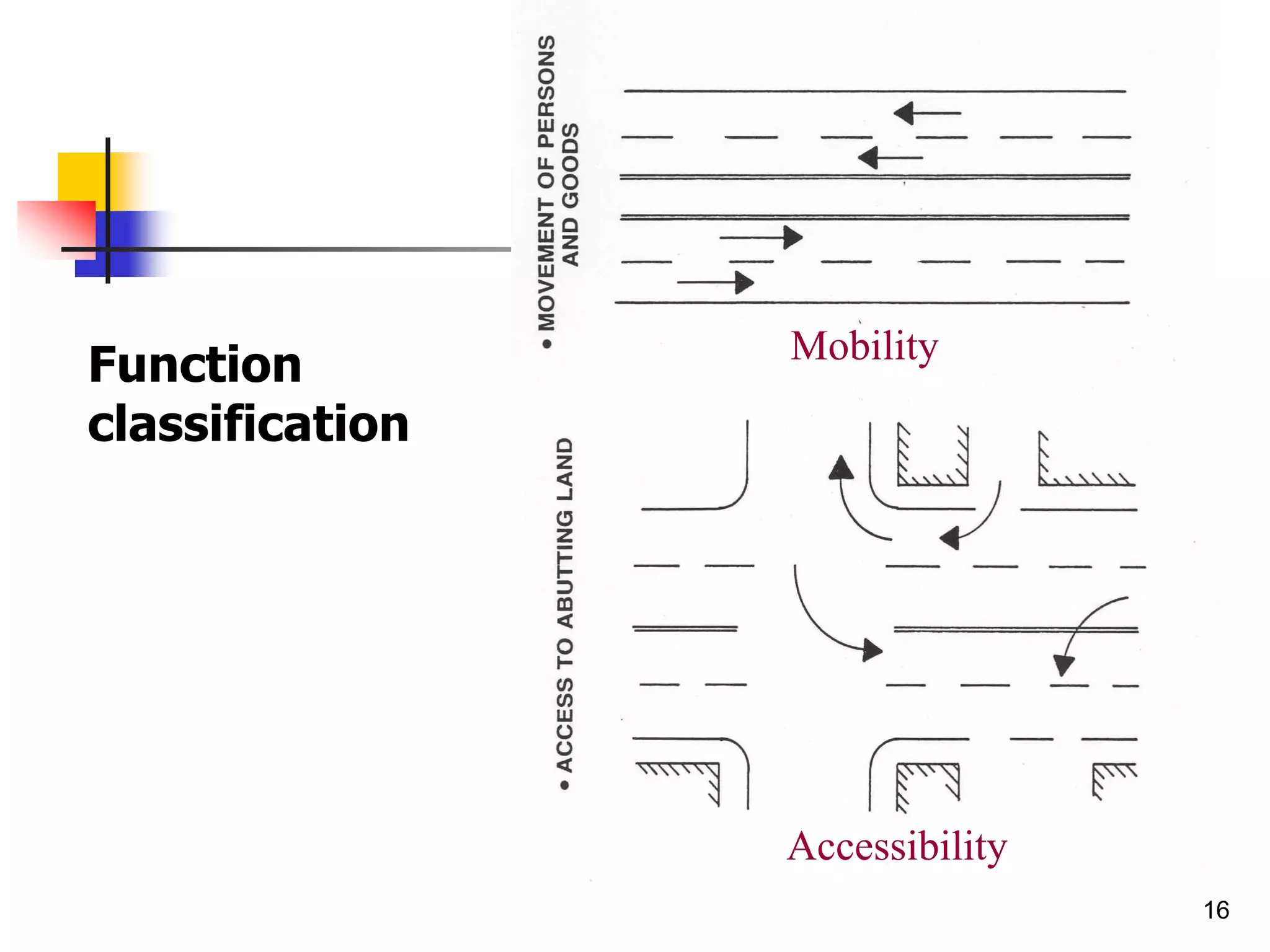
 Highways are classified either by
 The function they serve (functional classification)
 The entity responsible for their construction and
maintenance (jurisdictional classification)
 Two concepts are used when classifying
highway by their function
 Mobility: continuous travel
 Accessibility: direct access to abutting (next to or
adjacent) property
 Some roads serve one of these two function
while few can satisfy both
16
Mobility
Accessibility
Function
classification
17
Mobility versus accessibility
18
Three Major Roadway Classes
and their functions:
 Arterial (high mobility, low access,
long trips, fast speeds)
 Collector (moderate, moderate,
moderate, moderate)
 Local (low, high, short, slow)
19
Roadway Functional Classes
 Determined by characteristics:
 Function
 access density
 traffic demands
 trip length
 expected speed
20
21
Freeway versus expressway
 The distinction between freeways and
expressway is based on the accessibility
control
 Freeways have a full control of access [access or
exit are permitted only at controlled locations (exit
ramp)]
 Expressways have a partial access control. (access
or exit are maybe permitted directly from or
adjacent land or via a limited number of at grade
intersections)
22
Rural road classification
Principal Arterials
 Function: Long disance Travel and
Connect urbanized areas
 Characteristics: Long trips, no stubs, high
speed, widely spaced, full/partial access
control
 Subclasses: Freeways, Other non-
Freeways with access control
23
Minor Arterials
 Function: connect small urban areas
with major trip generators
 Characteristics: Moderate everything
(routes, speed, spacing, mostly
mobility)
24
Rural Collectors
 Major Collectors: Connect small twon to large towns
not served by arterials, link entities with nearby
arterials, urban areas
 Minor Collectors: Serve remaining small towns, link
local traffic generators with rural areas
 Characteristics: Shorter, Moderate Speeds (in rural
areas), Intermediate spacing
25
Rural Local Roads
 Function: Provide access to land on collector
network, serve short distance travel
 Characteristics: Short routes that terminate at
higher classes, relatively low speeds,
intermediate spacing
26
27
Urban Functional System
Principal Arterials
 Functions: carry most trips entering/leaving
urban area, serve intra-urban trips, carry
intra-urban and intercity bus routes, provide
continuity to rural arterials
 Characteristics: longest distance routes and
highest volume, high speed, spacing is less
than 1 km in CBD and greater than 8 km in
urban fringe, full/partial access control
 Subclasses: interstates, other freeways and
expressways, other principal arterials with
partial access control
28
29
Urban Minor Arterials
 Functions: interconnect with and augment
principle arterials, accommodate moderate
length trips, distribute traffic, carry local
buses, provide intra-community continuity,
connect to urban collectors
 Characteristics: moderate trip length high
volumes, moderate speeds, spacing 0.2
to1.0 km in CBD and 3 to 5 km in suburbs
30
Urban Collectors
 Functions: Provide traffic circulation within
residential neighborhoods and
industrial/commercial areas, Collect traffic
from locals and channel to arterials, Carry
local buses, Provide some direct land access
 Characteristics: Shorter than minor arterials,
Moderate speeds, Spacing intermediate to
arterials, Penetrates residential
neighborhoods
 Subclasses: major and minor
31
Urban Locals
 Functions: Provide direct access to land,
Connect properties to higher class
streets (i.e., collectors)
 Characteristics: Short in length, Dead
end – terminate at collections, Low
speeds, No bus routes
32
33
34
Highway
Component
s
Cross-section
35
Cross section components
 Highways are categorized into
 Divided highways
 Undivided highways
 The distinction is based on the viability of median (Divided
highways).
 The components of divided highways within the right of way are
 Carriageway or travelling lanes
 Median
 Shoulder
 Ditches
 Side-slopes
 Barrier
 Marking
 Cross section slope

Lec 04 Geometric Design (Transportation Engineering)

  • 1.
    1 Geometric design ofhighway Transportation Engineering
  • 2.
    2 Static Characteristics  Size: Design of lane widths, parking bays, etc…  Vertical clearance  Weight:  Pavement design, bridge design, axle loads  Maximum grade  Radius of Curvature:  Intersection design  Interchange ramps
  • 3.
    3 Kinematic (Dynamic) Characteristics  Acceleration(Constant or variable):  Passing maneuvers  Gap acceptance  Dimensions of freeway ramps and passing lanes  Motion elements (Distance and Velocity)
  • 4.
    4 Sight distance Distance adriver can see ahead at any specific time Must allow sufficient distance for a driver to perceive/react and stop, swerve etc when necessary
  • 5.
    5 Stopping Sight Distance where: Db= braking distance u = initial velocity when brakes are applied f = coefficient of friction G = grade (decimal) t = time to perceive/react a = vehicle acceleration g = acceleration due to gravity (32.2 ft/sec2) Distance to stop vehicle, includes P/R and braking distance S = 1.47ut + _____u2_____ 30({a/g} ± G)
  • 6.
    6 Stopping Sight Distance where: Db= braking distance u = initial velocity when brakes are applied f = coefficient of friction G = grade (decimal) t = time to perceive/react With assumed acceleration, using friction S = 1.47ut + _____u2_____ 30(f ± G)
  • 7.
    7 SSD Example SSD =1.47ut + _____u2_____ 30({a/g} ± G) Stopping distance = 405 feet 405 feet = 1.47u(0.8 sec) + ________u2________ 30({11.2/32.2} + 0.01) 405 feet = 1.17u + ________u2________ 30(0.358) 405 feet = 1.17u + ________u2________ 10.73 Solving for u, u = 59.9 mph
  • 8.
    8 Decision Sight Distance Whensituation is unexpected or driver makes unusual maneuvers or under difficult to perceive situations Requires higher PIEV time Depends on type of maneuver made and roadway setting (urban vs. rural)
  • 9.
  • 10.
    10 Passing Sight Distance Dpassing= d1 + d2 + d3 + d4 d1 = distance traveled during P/R time to point where vehicle just enters the left lane d1 = 1.47t1(u – m + at1) 2 where t1 = time for initial maneuver (sec) u = average speed of passing vehicle (mph) a = acceleration (mph/s) m = difference between speeds of passing and passed vehicle
  • 11.
    11 Passing Sight Distance Dpassing= d1 + d2 + d3 + d4 d2 = distance traveled by vehicle while in left lane d2 = 1.47ut2 where: u = speed of passing vehicle (mph) t2 = time spent passing in left lane (sec)
  • 12.
    12 Passing Sight Distance Dpassing= d1 + d2 + d3 + d4 d3 = clearance distance varies from 110 to 300 feet d4 = distance traveled by opposing vehicle during passing maneuver d4 usually taken as 2/3 d2
  • 13.
  • 14.
    14 Lateral displacement  Experimentsshowed that the narrower the pavement and the closer the object to the pavement edge, the greater the magnitude of lateral displacement.  The relationship between the longitudinal distance l, the lateral placement of a given object a, and the visual angle  is l= a cot   By differentiating both side of equation with respect to time and 22 2222 2 /)(csc/ csc la va dt d alaandvdtdl dt d a dt dl        V= vehicle’s speed d/dt= rate of change of the visual angle
  • 15.
    15 Functional classification of highways Highways are classified either by  The function they serve (functional classification)  The entity responsible for their construction and maintenance (jurisdictional classification)  Two concepts are used when classifying highway by their function  Mobility: continuous travel  Accessibility: direct access to abutting (next to or adjacent) property  Some roads serve one of these two function while few can satisfy both
  • 16.
  • 17.
  • 18.
    18 Three Major RoadwayClasses and their functions:  Arterial (high mobility, low access, long trips, fast speeds)  Collector (moderate, moderate, moderate, moderate)  Local (low, high, short, slow)
  • 19.
    19 Roadway Functional Classes Determined by characteristics:  Function  access density  traffic demands  trip length  expected speed
  • 20.
  • 21.
    21 Freeway versus expressway The distinction between freeways and expressway is based on the accessibility control  Freeways have a full control of access [access or exit are permitted only at controlled locations (exit ramp)]  Expressways have a partial access control. (access or exit are maybe permitted directly from or adjacent land or via a limited number of at grade intersections)
  • 22.
    22 Rural road classification PrincipalArterials  Function: Long disance Travel and Connect urbanized areas  Characteristics: Long trips, no stubs, high speed, widely spaced, full/partial access control  Subclasses: Freeways, Other non- Freeways with access control
  • 23.
    23 Minor Arterials  Function:connect small urban areas with major trip generators  Characteristics: Moderate everything (routes, speed, spacing, mostly mobility)
  • 24.
    24 Rural Collectors  MajorCollectors: Connect small twon to large towns not served by arterials, link entities with nearby arterials, urban areas  Minor Collectors: Serve remaining small towns, link local traffic generators with rural areas  Characteristics: Shorter, Moderate Speeds (in rural areas), Intermediate spacing
  • 25.
    25 Rural Local Roads Function: Provide access to land on collector network, serve short distance travel  Characteristics: Short routes that terminate at higher classes, relatively low speeds, intermediate spacing
  • 26.
  • 27.
    27 Urban Functional System PrincipalArterials  Functions: carry most trips entering/leaving urban area, serve intra-urban trips, carry intra-urban and intercity bus routes, provide continuity to rural arterials  Characteristics: longest distance routes and highest volume, high speed, spacing is less than 1 km in CBD and greater than 8 km in urban fringe, full/partial access control  Subclasses: interstates, other freeways and expressways, other principal arterials with partial access control
  • 28.
  • 29.
    29 Urban Minor Arterials Functions: interconnect with and augment principle arterials, accommodate moderate length trips, distribute traffic, carry local buses, provide intra-community continuity, connect to urban collectors  Characteristics: moderate trip length high volumes, moderate speeds, spacing 0.2 to1.0 km in CBD and 3 to 5 km in suburbs
  • 30.
    30 Urban Collectors  Functions:Provide traffic circulation within residential neighborhoods and industrial/commercial areas, Collect traffic from locals and channel to arterials, Carry local buses, Provide some direct land access  Characteristics: Shorter than minor arterials, Moderate speeds, Spacing intermediate to arterials, Penetrates residential neighborhoods  Subclasses: major and minor
  • 31.
    31 Urban Locals  Functions:Provide direct access to land, Connect properties to higher class streets (i.e., collectors)  Characteristics: Short in length, Dead end – terminate at collections, Low speeds, No bus routes
  • 32.
  • 33.
  • 34.
  • 35.
    35 Cross section components Highways are categorized into  Divided highways  Undivided highways  The distinction is based on the viability of median (Divided highways).  The components of divided highways within the right of way are  Carriageway or travelling lanes  Median  Shoulder  Ditches  Side-slopes  Barrier  Marking  Cross section slope