Design Control and
Criteria-2
1
Traffic characteristics - Introduction
• The design of a highway depends upon:
– traffic volumes
– traffic characteristics
2
Traffic characteristics - Introduction
• Other factors - ?
• Traffic volumes indicates the need for the improvement and directly
influence the selection of geometric design features, such as
number of lanes, widths, alignments, and grades
3
Traffic characteristics - Volume
4
• Traffic Volume.
Number of vehicles passing a point on a highway during a
specified time interval. Units: Simply vehicles or vehicles per unit
time (veh/day; veh/hr)
• Average annual daily traffic (AADT).
The average 24-hour volume at a given location over a full 365-
day year.
• Average daily traffic (ADT).
The average 24-hour volume at a given location over a defined
time period less than one year; a common application is to
measure an ADT for each month of the year
Traffic characteristics - Volume
5
Peak-Hour Traffic
• Peak Hour Volume - The single hour of the day that has the highest
hourly volume is referred to as “Peak Hour volume”.
• Design traffic volume
– a value that will not be exceeded very often or by very much
– Sufficiently utilized
• It is recommended that the hourly traffic volume that should
generally be used in design is the 30th highest hourly volume of the
year, abbreviated as 30 HV
Traffic characteristics - Volume
• Basic measure of the traffic
demand - average daily traffic
• ADT measurement - periodic
traffic counts
• Season, month, or day of week
adjustment to period counts
• ADT - does not indicate traffic
volume variations
• A highway designed for the traffic
on an average day would need to
carry a greater volume on some
days
6
Traffic characteristics - Volume
Directional Distribution
• Highways must be designed to
adequately serve the peak-hour traffic
volume in the peak direction of flow.
• Total hourly traffic in both directions is
used to design two-lane roads
• Typically, one direction contributes by
55-70% in total traffic, although
occasionally 80% is observed.
7
Traffic characteristics - Volume
8
Directional Distribution - Example
• For example, consider a rural road with a design volume of 4,000
vehicles per hour (vph) for both directions of travel combined
• If during the design hour, the directional distribution is equally split,
or 2,000 vph is one direction, two lanes in each direction may be
adequate
• If 80 percent of the DHV is in one direction, at least three lanes in
each direction would be needed for the 3,200 vph
Traffic characteristics - Volume
9
Directional Distribution -Directional Design Hourly Volumes
 DDHV- ADTs are converted to a peak-hour volume in the peak
direction of flow
DDHV  AADT * K(Peakhr)* D(Peakdir  flow)
 K = proportion of daily traffic occurring during peak hour
 D = proportion of peak hour traffic travelling in peak direction
of flow
 For design, the K factor often represents the proportion of ADT
occurring during the 30th peak hour of the year
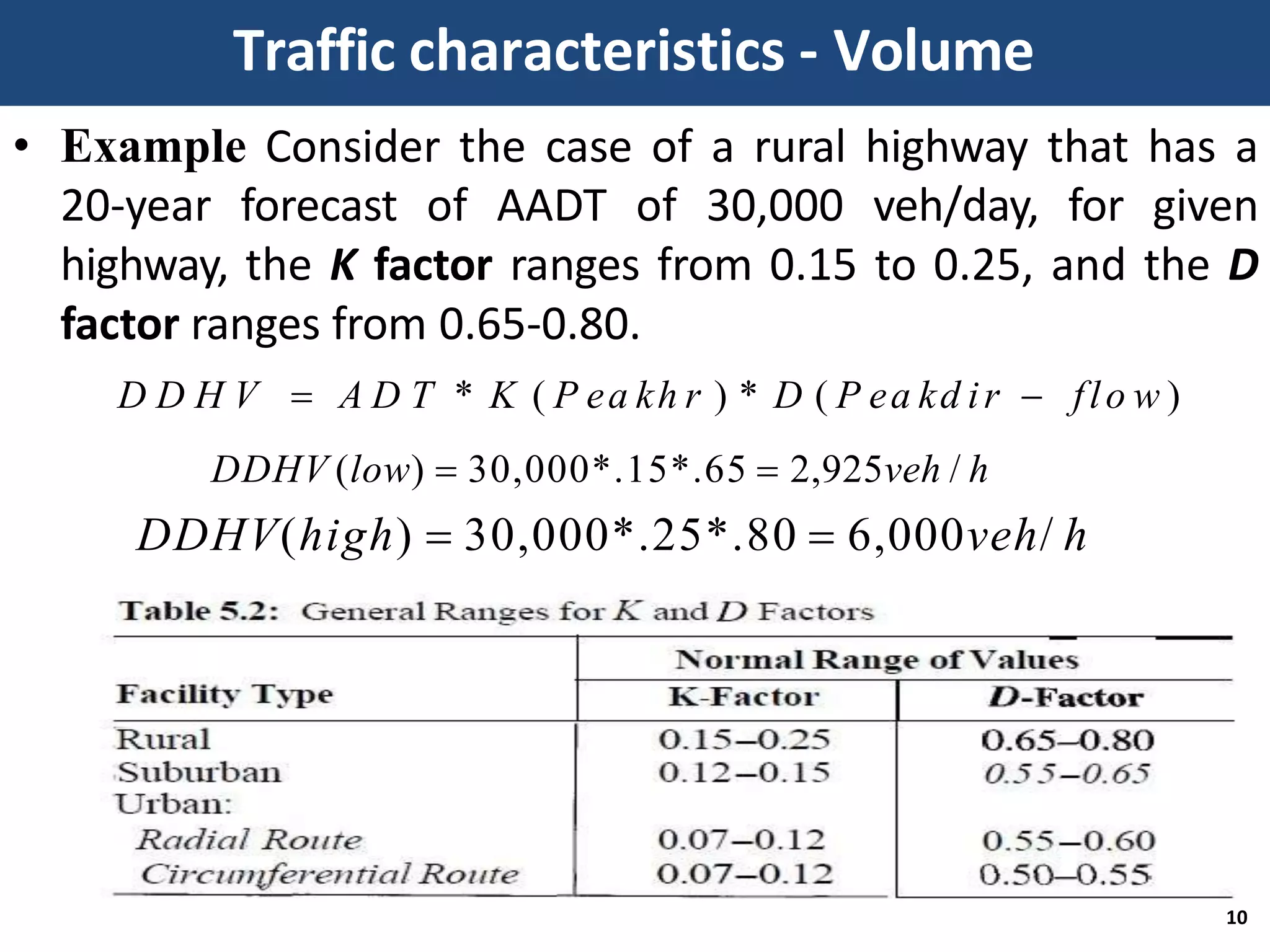
• Example Consider the case of a rural highway that has a
20-year forecast of AADT of 30,000 veh/day, for given
highway, the K factor ranges from 0.15 to 0.25, and the D
factor ranges from 0.65-0.80.
D D H V  A D T * K ( P ea kh r ) * D ( P ea kd ir  flo w )
DDHV (low)  30,000*.15*.65  2,925veh / h
DDHV(high)  30,000*.25*.80  6,000veh/ h
Traffic characteristics - Volume
10
Traffic characteristics - Volume
11
Composition of Traffic –Traffic Mix
• Vehicles operating characteristics:
– Sizes
– Weight
– Speed
– Space consumed on highway
Traffic characteristics - Volume
Composition of Traffic –Traffic Mix
• Consequently, trucks have a greater individual effect on highway
traffic operation than do passenger vehicles
• The effect on traffic operation of one truck is often equivalent to
several passenger cars
12
Traffic characteristics - Volume
Composition of Traffic –Traffic Mix
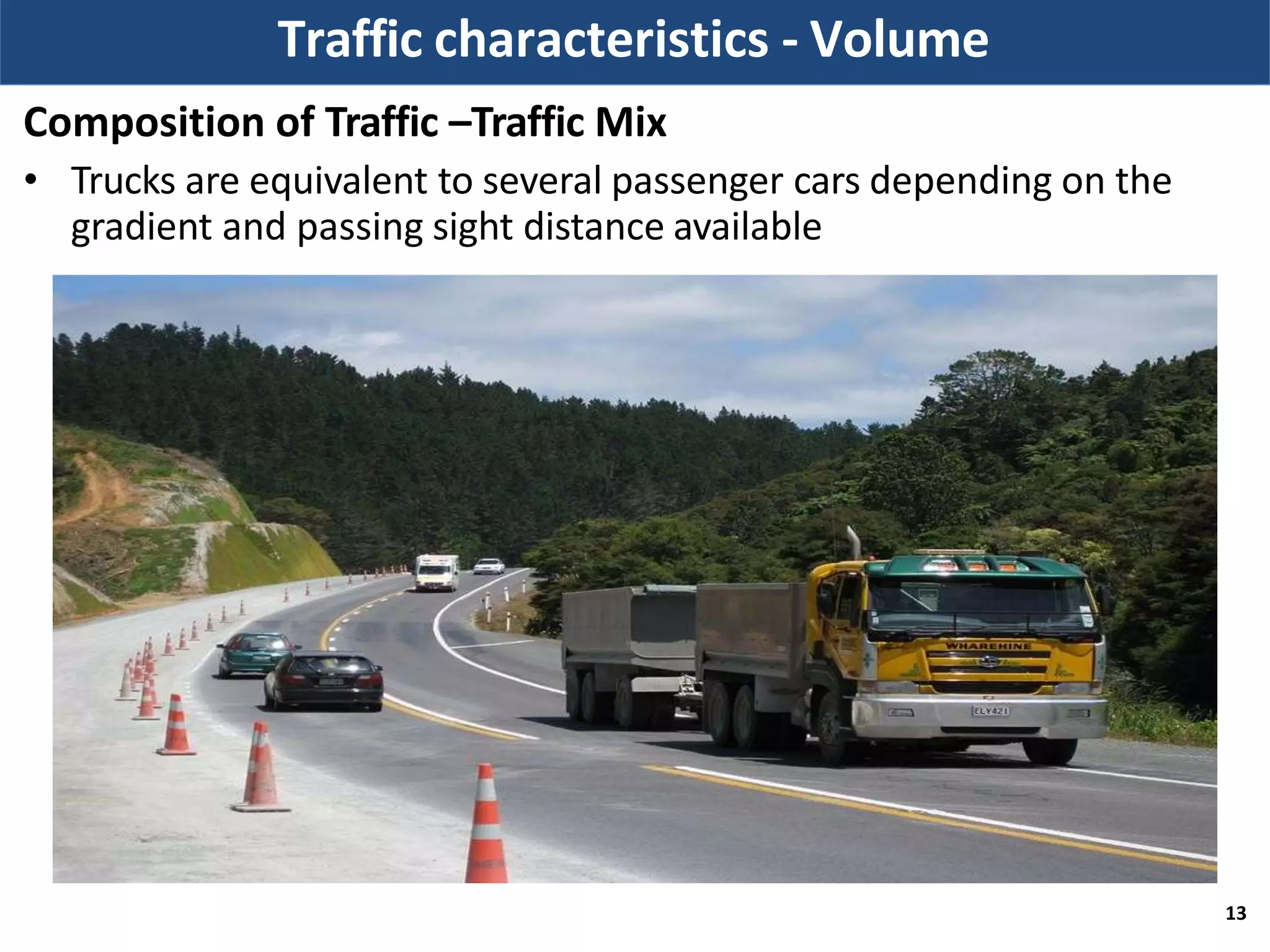
• Trucks are equivalent to several passenger cars depending on the
gradient and passing sight distance available
13
Traffic characteristics - Volume
14
Projection of Future Traffic Demands
• Geometric design based on future traffic volumes
• Defining life of highway / Life-cycle
• Physical life expectancies:
– right-of-way and grading
– bridges
– pavement
- 100 years,
- 25-100 years,
- 10-30 years.
• Period of 20 years is widely used as a basis for design
Traffic characteristics - Speed
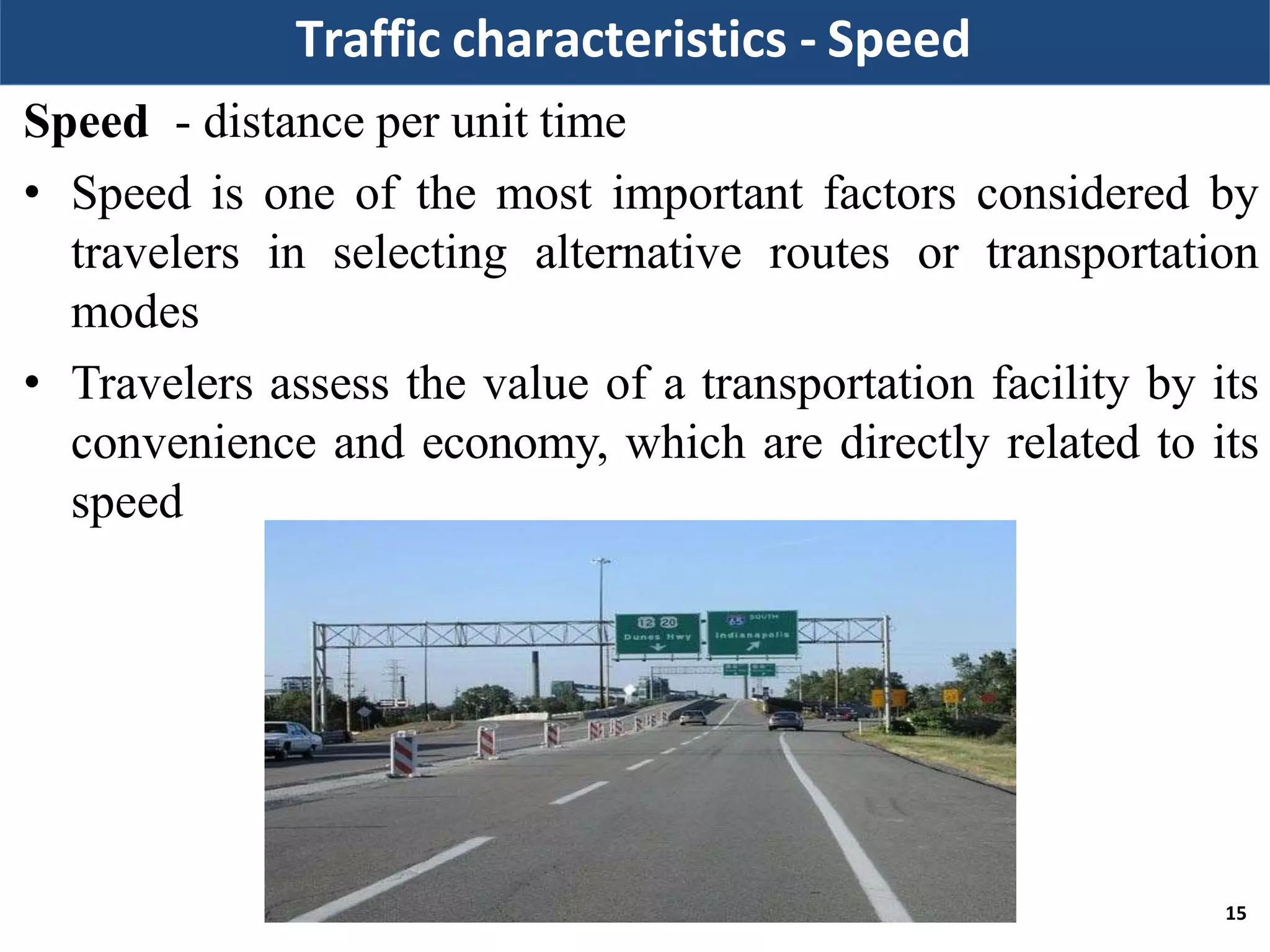
Speed - distance per unit time
• Speed is one of the most important factors considered by
travelers in selecting alternative routes or transportation
modes
• Travelers assess the value of a transportation facility by its
convenience and economy, which are directly related to its
speed
15
Traffic characteristics - Speed
16
Design Speed:
• Design speed is a selected speed used to determine the various
geometric design features of the roadway
• The selected design speed should be a logical one with respect to
the anticipated operating speed, topography, the adjacent land use,
and the functional classification of the highway
• In selection of design speed, every effort should be made to attain a
desired combination of safety, mobility, and efficiency within the
constraints of environmental quality, economics, aesthetics, and
social or political impacts
• Some design features, such as curvature, superelevation, and sight
distance, are directly related to, and vary appreciably with, design
speed
Traffic characteristics - Speed
17
Design Speed Important Considerations
• Should be consistent with drivers' expectations
• Should fit the traffic habits of nearly all drivers
• Should not change over a substantial length of highway
km/h with 10 km/h
• Depends on the functional class
• Ranges from 30 km/h to 110
increment

Highway Geometric Design control and criteria-2

  • 1.
  • 2.
    Traffic characteristics -Introduction • The design of a highway depends upon: – traffic volumes – traffic characteristics 2
  • 3.
    Traffic characteristics -Introduction • Other factors - ? • Traffic volumes indicates the need for the improvement and directly influence the selection of geometric design features, such as number of lanes, widths, alignments, and grades 3
  • 4.
    Traffic characteristics -Volume 4 • Traffic Volume. Number of vehicles passing a point on a highway during a specified time interval. Units: Simply vehicles or vehicles per unit time (veh/day; veh/hr) • Average annual daily traffic (AADT). The average 24-hour volume at a given location over a full 365- day year. • Average daily traffic (ADT). The average 24-hour volume at a given location over a defined time period less than one year; a common application is to measure an ADT for each month of the year
  • 5.
    Traffic characteristics -Volume 5 Peak-Hour Traffic • Peak Hour Volume - The single hour of the day that has the highest hourly volume is referred to as “Peak Hour volume”. • Design traffic volume – a value that will not be exceeded very often or by very much – Sufficiently utilized • It is recommended that the hourly traffic volume that should generally be used in design is the 30th highest hourly volume of the year, abbreviated as 30 HV
  • 6.
    Traffic characteristics -Volume • Basic measure of the traffic demand - average daily traffic • ADT measurement - periodic traffic counts • Season, month, or day of week adjustment to period counts • ADT - does not indicate traffic volume variations • A highway designed for the traffic on an average day would need to carry a greater volume on some days 6
  • 7.
    Traffic characteristics -Volume Directional Distribution • Highways must be designed to adequately serve the peak-hour traffic volume in the peak direction of flow. • Total hourly traffic in both directions is used to design two-lane roads • Typically, one direction contributes by 55-70% in total traffic, although occasionally 80% is observed. 7
  • 8.
    Traffic characteristics -Volume 8 Directional Distribution - Example • For example, consider a rural road with a design volume of 4,000 vehicles per hour (vph) for both directions of travel combined • If during the design hour, the directional distribution is equally split, or 2,000 vph is one direction, two lanes in each direction may be adequate • If 80 percent of the DHV is in one direction, at least three lanes in each direction would be needed for the 3,200 vph
  • 9.
    Traffic characteristics -Volume 9 Directional Distribution -Directional Design Hourly Volumes  DDHV- ADTs are converted to a peak-hour volume in the peak direction of flow DDHV  AADT * K(Peakhr)* D(Peakdir  flow)  K = proportion of daily traffic occurring during peak hour  D = proportion of peak hour traffic travelling in peak direction of flow  For design, the K factor often represents the proportion of ADT occurring during the 30th peak hour of the year
  • 10.
    • Example Considerthe case of a rural highway that has a 20-year forecast of AADT of 30,000 veh/day, for given highway, the K factor ranges from 0.15 to 0.25, and the D factor ranges from 0.65-0.80. D D H V  A D T * K ( P ea kh r ) * D ( P ea kd ir  flo w ) DDHV (low)  30,000*.15*.65  2,925veh / h DDHV(high)  30,000*.25*.80  6,000veh/ h Traffic characteristics - Volume 10
  • 11.
    Traffic characteristics -Volume 11 Composition of Traffic –Traffic Mix • Vehicles operating characteristics: – Sizes – Weight – Speed – Space consumed on highway
  • 12.
    Traffic characteristics -Volume Composition of Traffic –Traffic Mix • Consequently, trucks have a greater individual effect on highway traffic operation than do passenger vehicles • The effect on traffic operation of one truck is often equivalent to several passenger cars 12
  • 13.
    Traffic characteristics -Volume Composition of Traffic –Traffic Mix • Trucks are equivalent to several passenger cars depending on the gradient and passing sight distance available 13
  • 14.
    Traffic characteristics -Volume 14 Projection of Future Traffic Demands • Geometric design based on future traffic volumes • Defining life of highway / Life-cycle • Physical life expectancies: – right-of-way and grading – bridges – pavement - 100 years, - 25-100 years, - 10-30 years. • Period of 20 years is widely used as a basis for design
  • 15.
    Traffic characteristics -Speed Speed - distance per unit time • Speed is one of the most important factors considered by travelers in selecting alternative routes or transportation modes • Travelers assess the value of a transportation facility by its convenience and economy, which are directly related to its speed 15
  • 16.
    Traffic characteristics -Speed 16 Design Speed: • Design speed is a selected speed used to determine the various geometric design features of the roadway • The selected design speed should be a logical one with respect to the anticipated operating speed, topography, the adjacent land use, and the functional classification of the highway • In selection of design speed, every effort should be made to attain a desired combination of safety, mobility, and efficiency within the constraints of environmental quality, economics, aesthetics, and social or political impacts • Some design features, such as curvature, superelevation, and sight distance, are directly related to, and vary appreciably with, design speed
  • 17.
    Traffic characteristics -Speed 17 Design Speed Important Considerations • Should be consistent with drivers' expectations • Should fit the traffic habits of nearly all drivers • Should not change over a substantial length of highway km/h with 10 km/h • Depends on the functional class • Ranges from 30 km/h to 110 increment