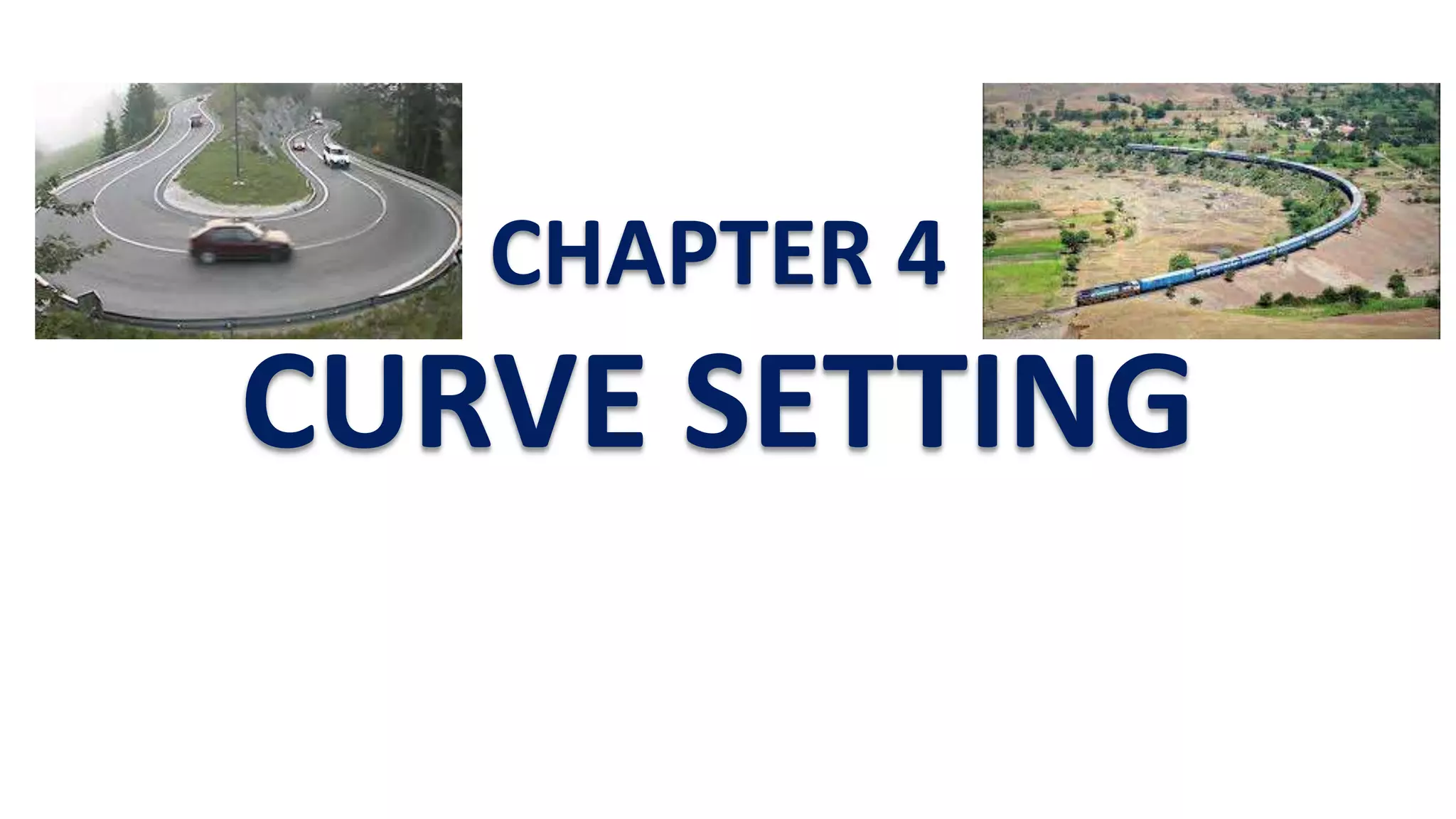
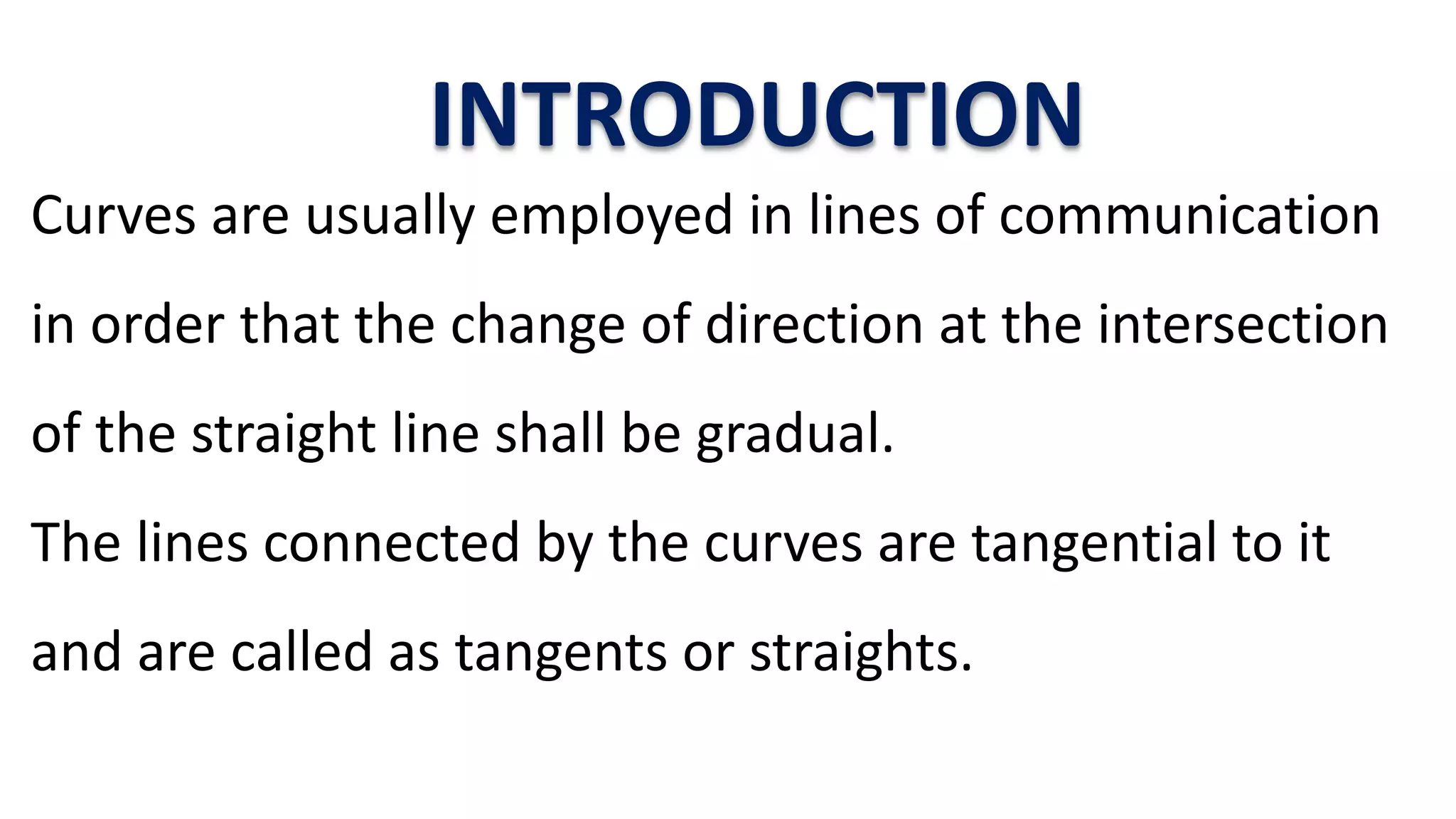

CHAPTER 4
CURVE SETTING
INTRODUCTION
Curves are usually employed in lines of communication
in order that the change of direction at the intersection
of the straight line shall be gradual.
The lines connected by the curves are tangential to it
and are called as tangents or straights.
NECESSITY
Excessive cutting and filling can be prevented by providing the change in
alignment by curves.
The obstruction which came in the way of straight alignment can be
made easier by providing by pass with the help of curves
In the straight route gradient are made more comfortable and easy
providing diversions with help of curves
In the straight route costly land comes in the way then it can avoided by
providing diversions with the help of curves.
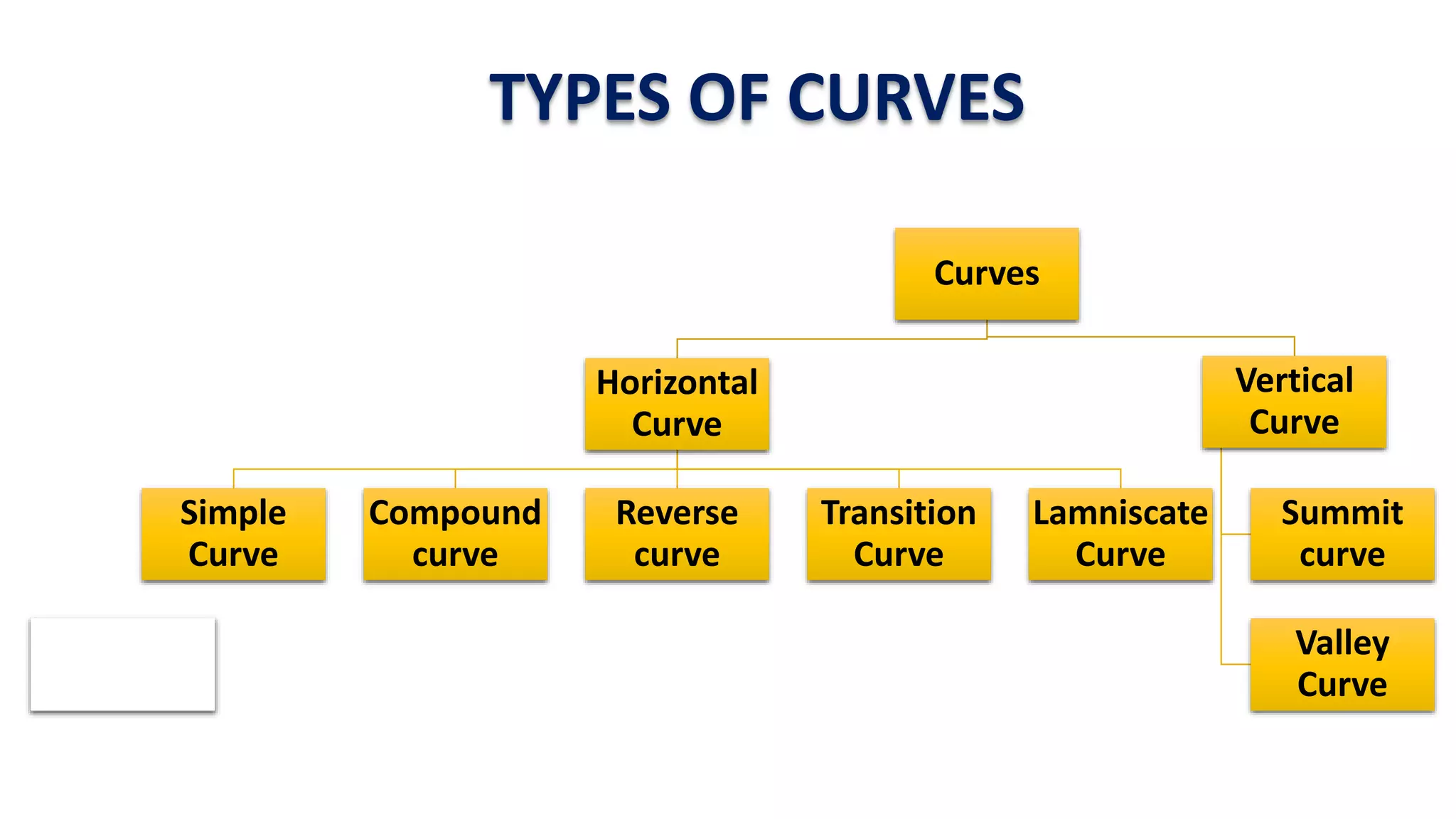
TYPES OF CURVES
Curves
Horizontal
Curve
Simple
Curve
Compound
curve
Reverse
curve
Transition
Curve
Lamniscate
Curve
Vertical
Curve
Summit
curve
Valley
Curve
SIMPLE CIRCULAR CURVE
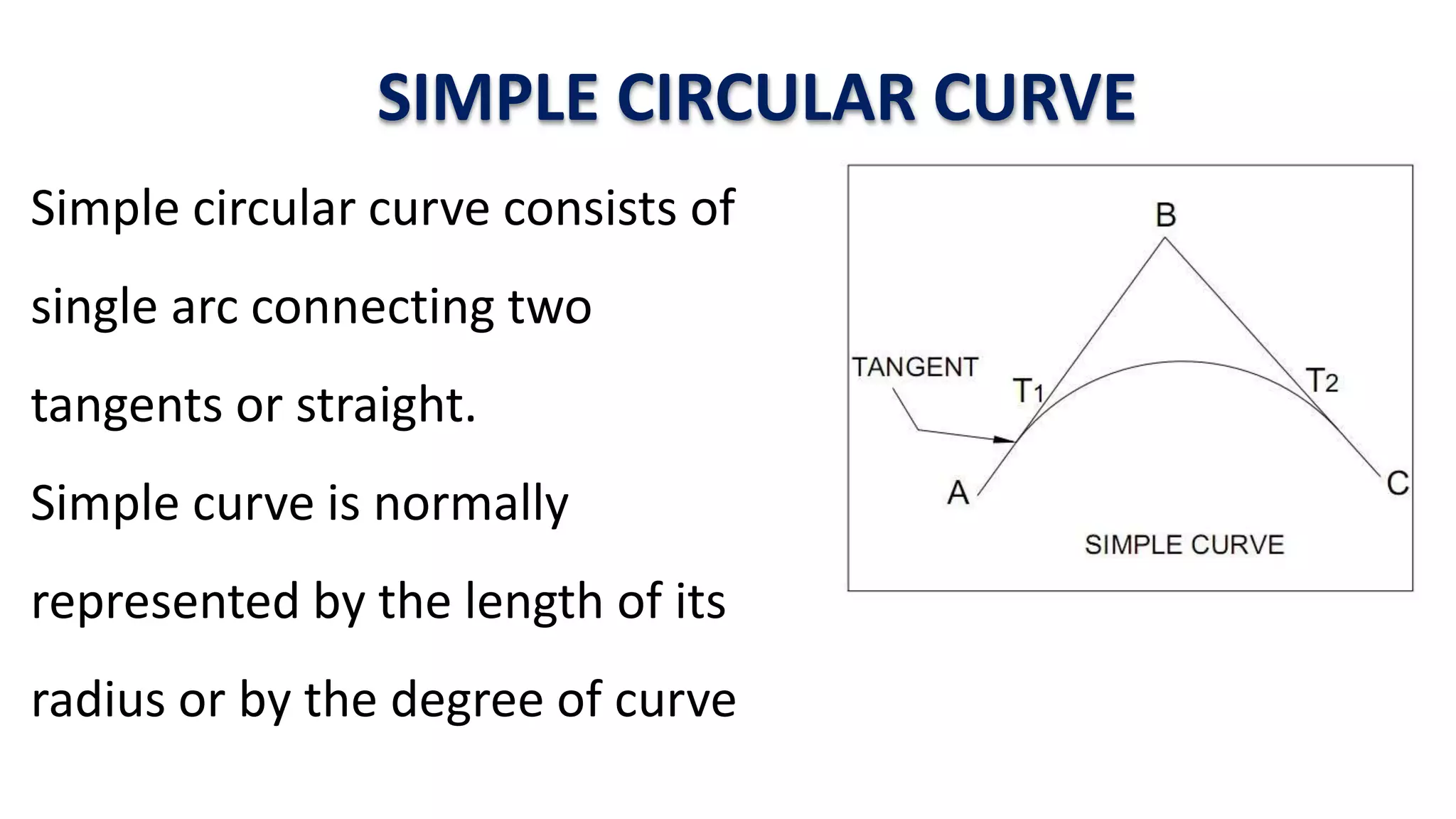
Simple circular curve consists of
single arc connecting two
tangents or straight.
Simple curve is normally
represented by the length of its
radius or by the degree of curve
COMPOUND CURVE
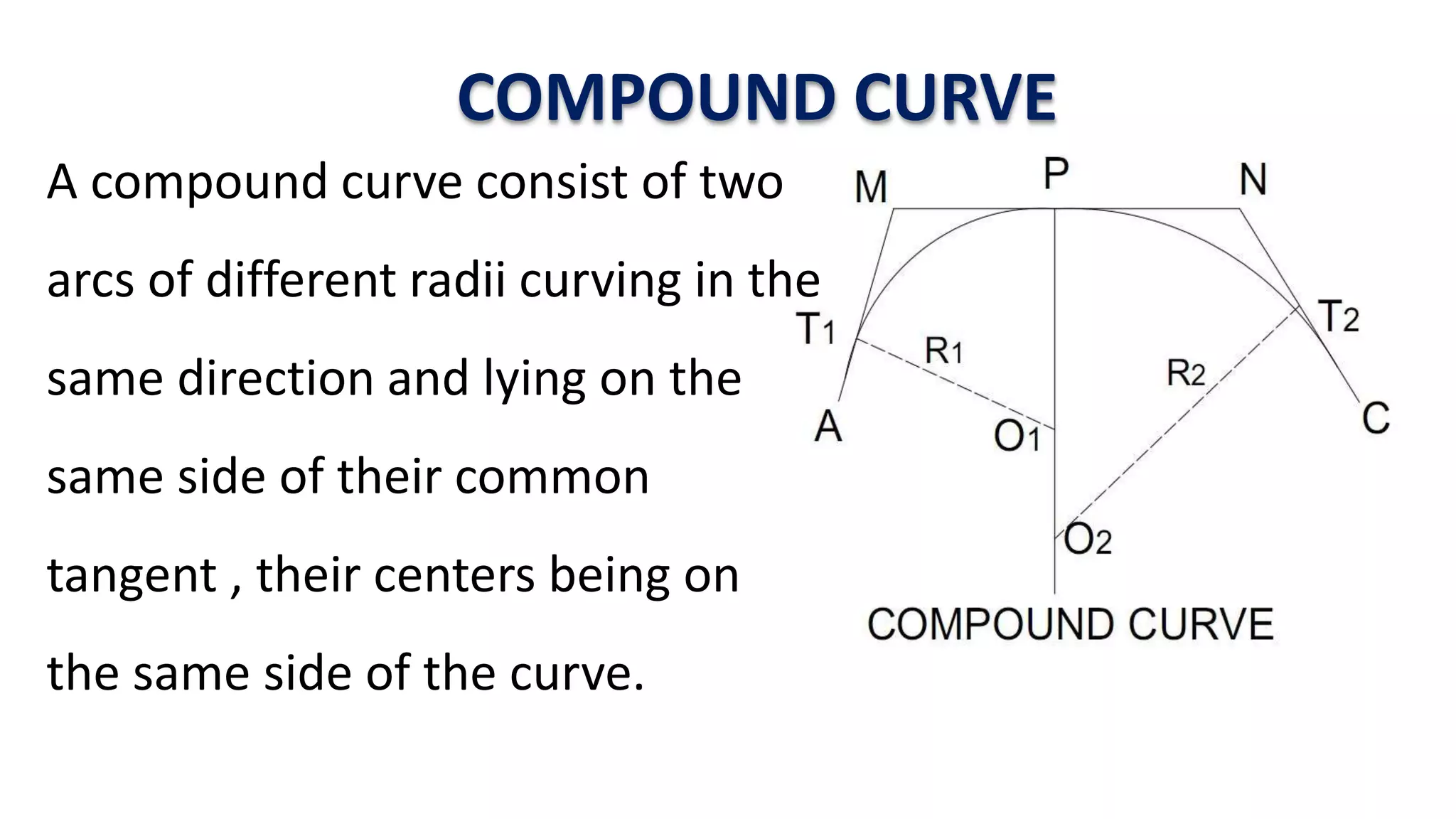
A compound curve consist of two
arcs of different radii curving in the
same direction and lying on the
same side of their common
tangent , their centers being on
the same side of the curve.
REVERSE CURVE
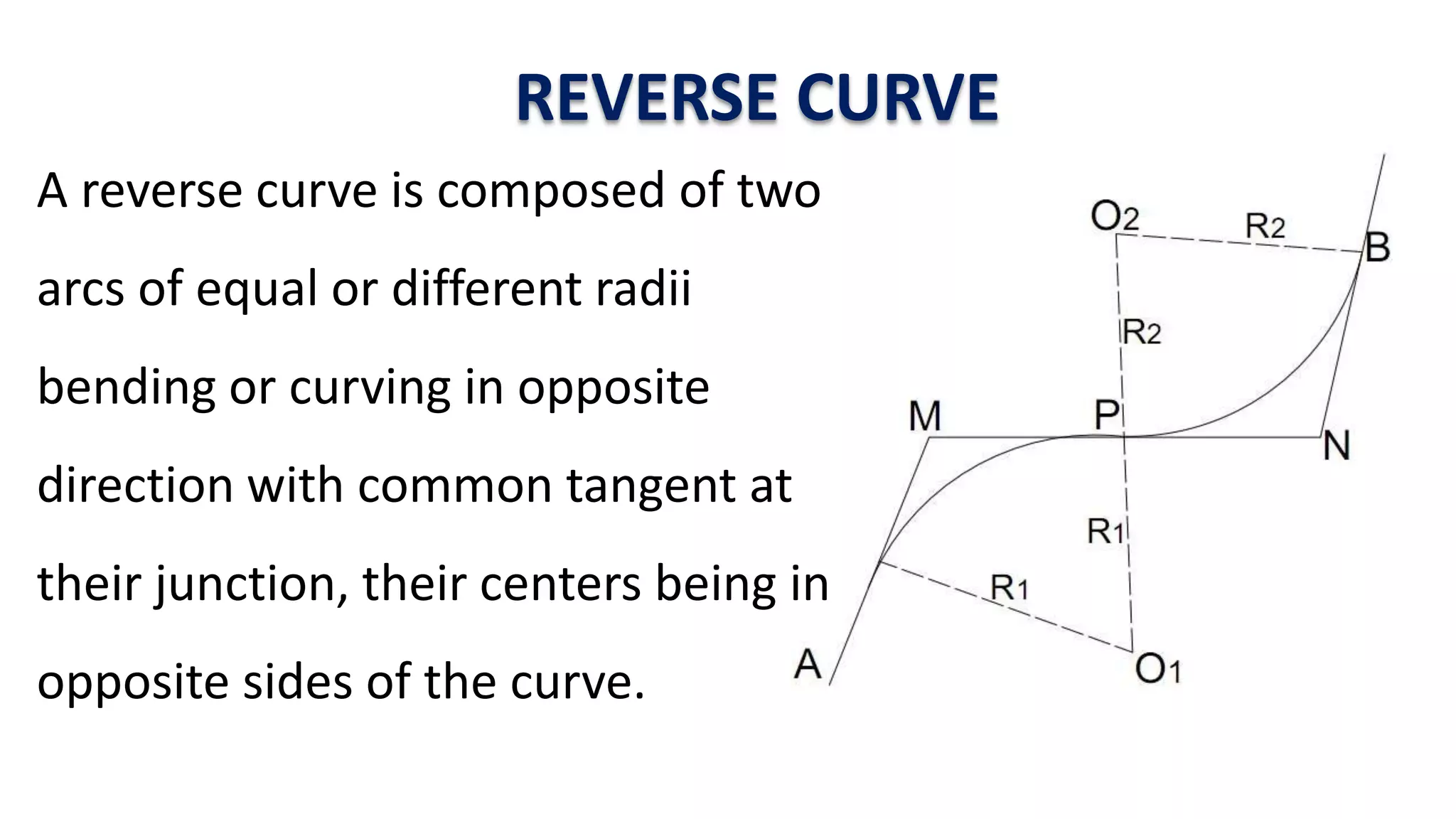
A reverse curve is composed of two
arcs of equal or different radii
bending or curving in opposite
direction with common tangent at
their junction, their centers being in
opposite sides of the curve.
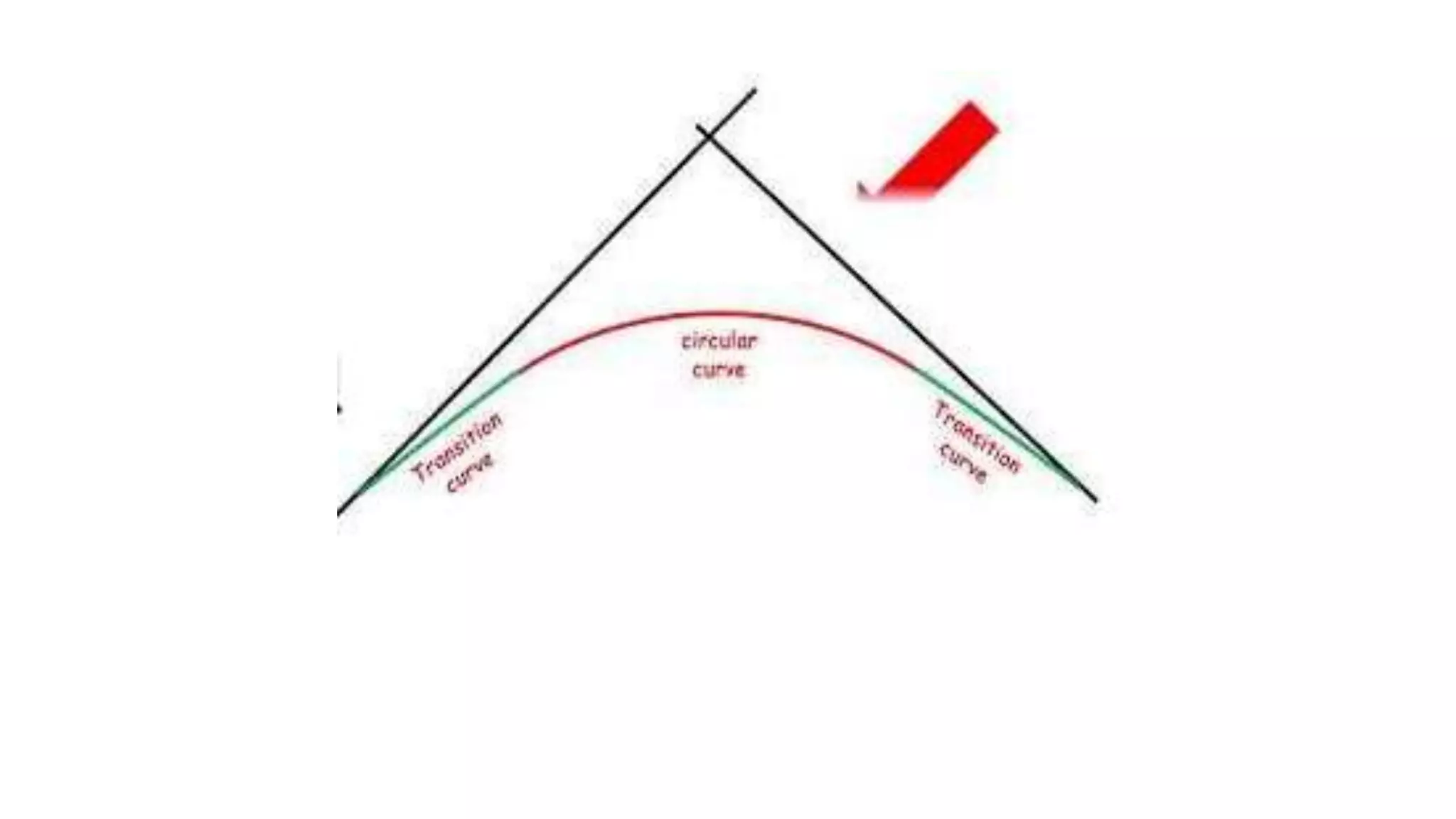
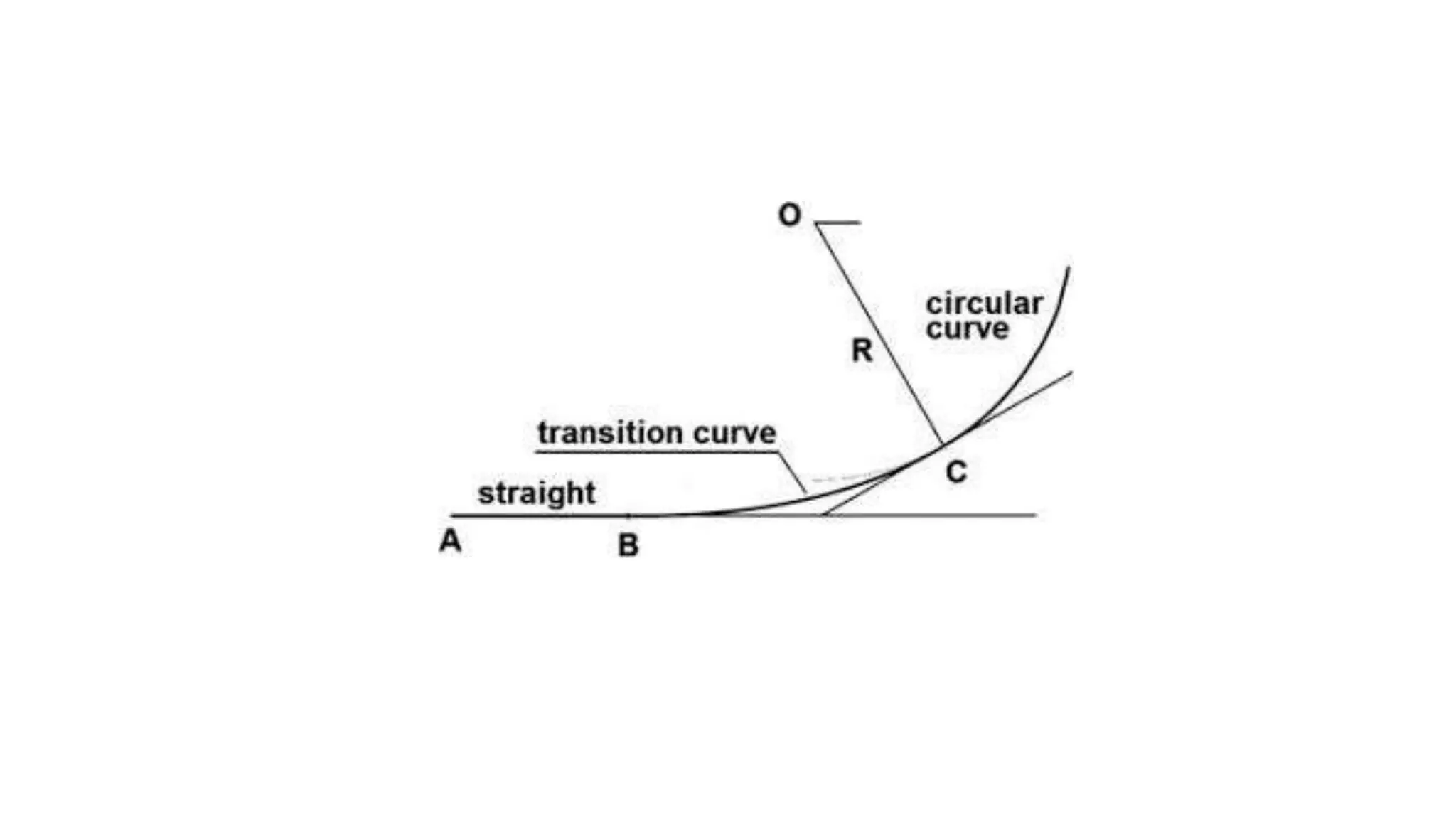
TRANSITION CURVE
A curve of varying radius is known as ‘transition curve’.
The radius of such curve varies from infinity to certain
fixed value. A transition curve is provided on both ends
of the circular curve. The transition curve is also called
as spiral or easement curve.
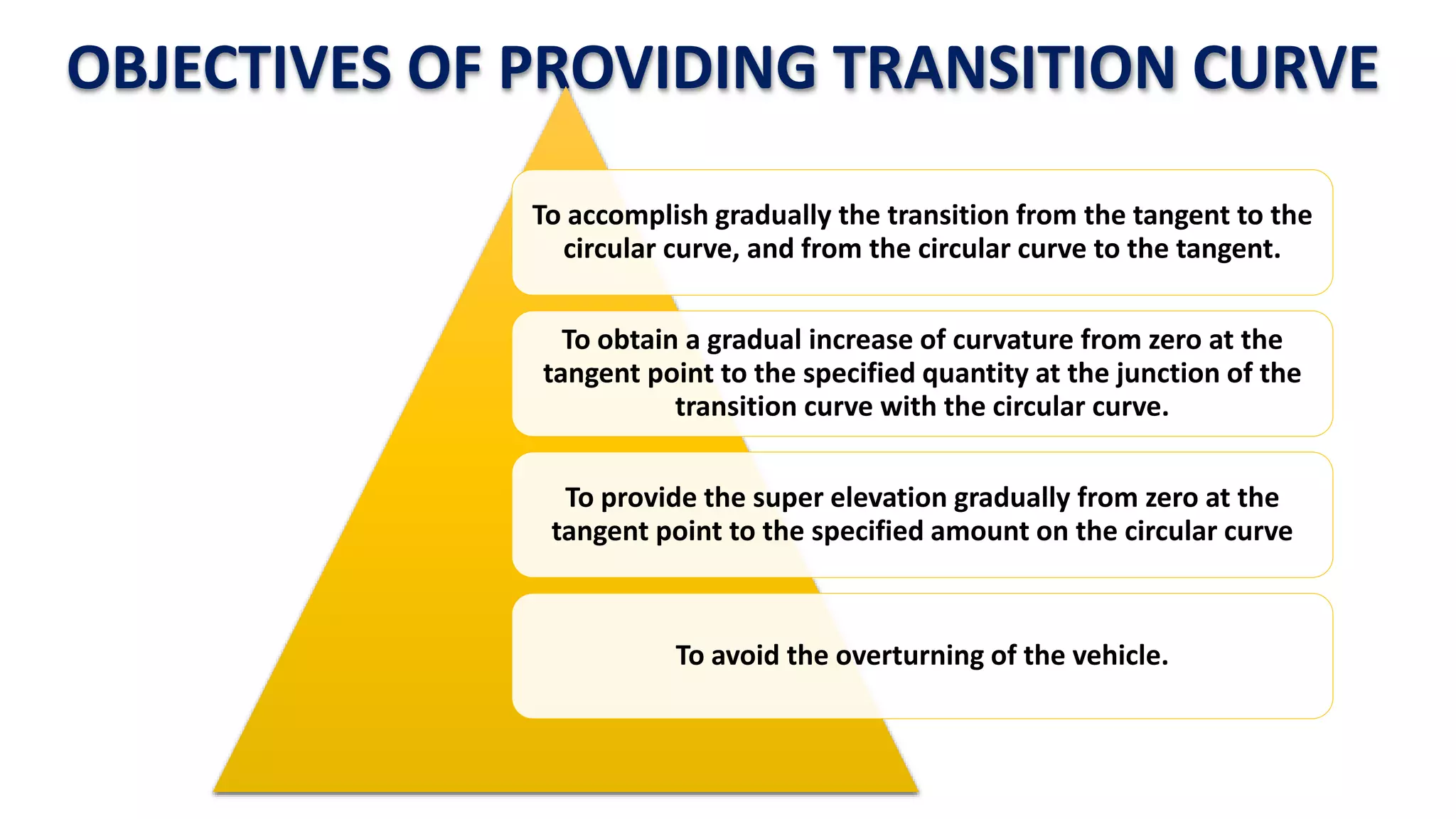
OBJECTIVES OF PROVIDING TRANSITION CURVE
To accomplish gradually the transition from the tangent to the
circular curve, and from the circular curve to the tangent.
To obtain a gradual increase of curvature from zero at the
tangent point to the specified quantity at the junction of the
transition curve with the circular curve.
To provide the super elevation gradually from zero at the
tangent point to the specified amount on the circular curve
To avoid the overturning of the vehicle.
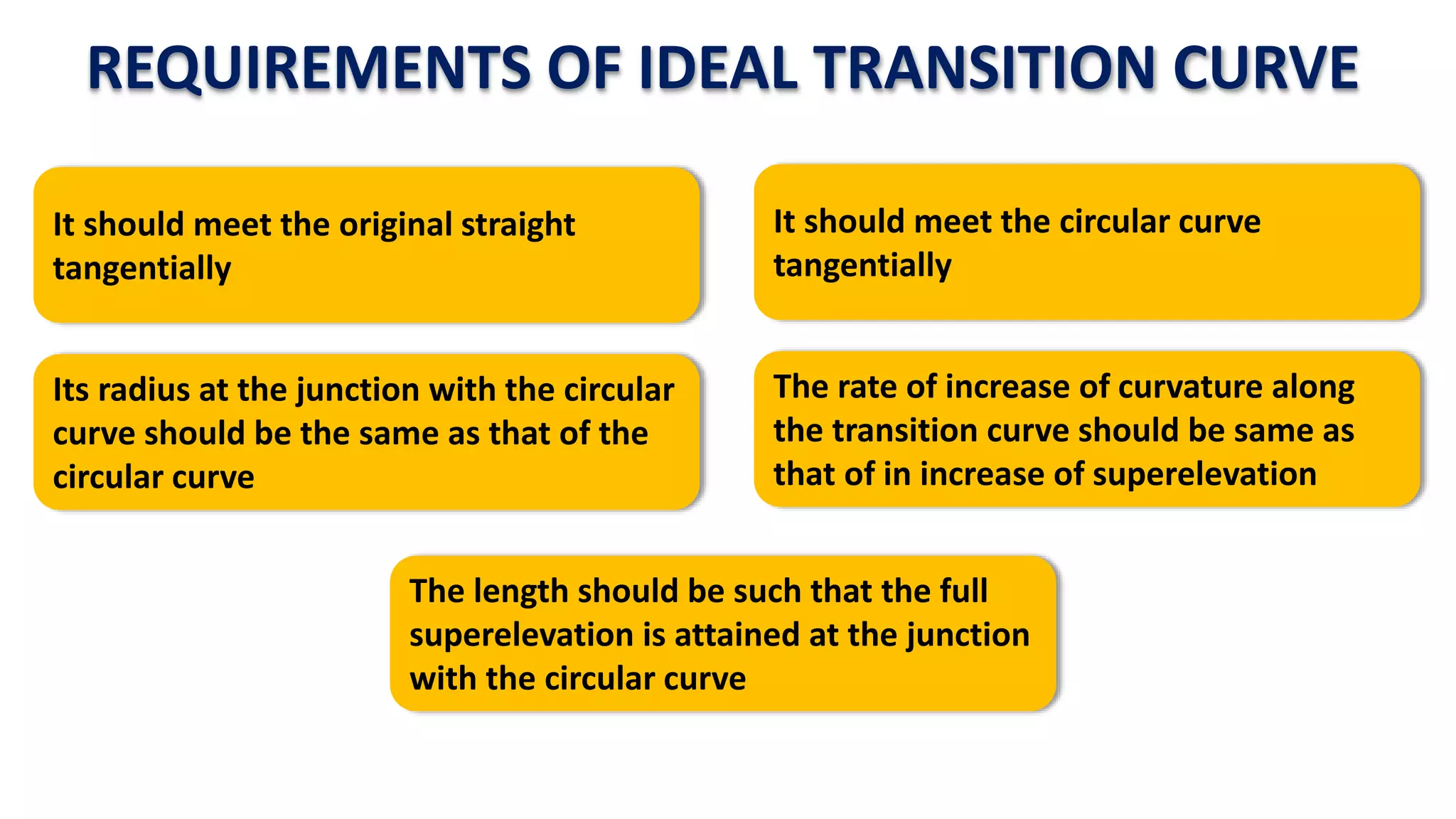
REQUIREMENTS OF IDEAL TRANSITION CURVE
It should meet the original straight
tangentially
It should meet the circular curve
tangentially
Its radius at the junction with the circular
curve should be the same as that of the
circular curve
The rate of increase of curvature along
the transition curve should be same as
that of in increase of superelevation
The length should be such that the full
superelevation is attained at the junction
with the circular curve
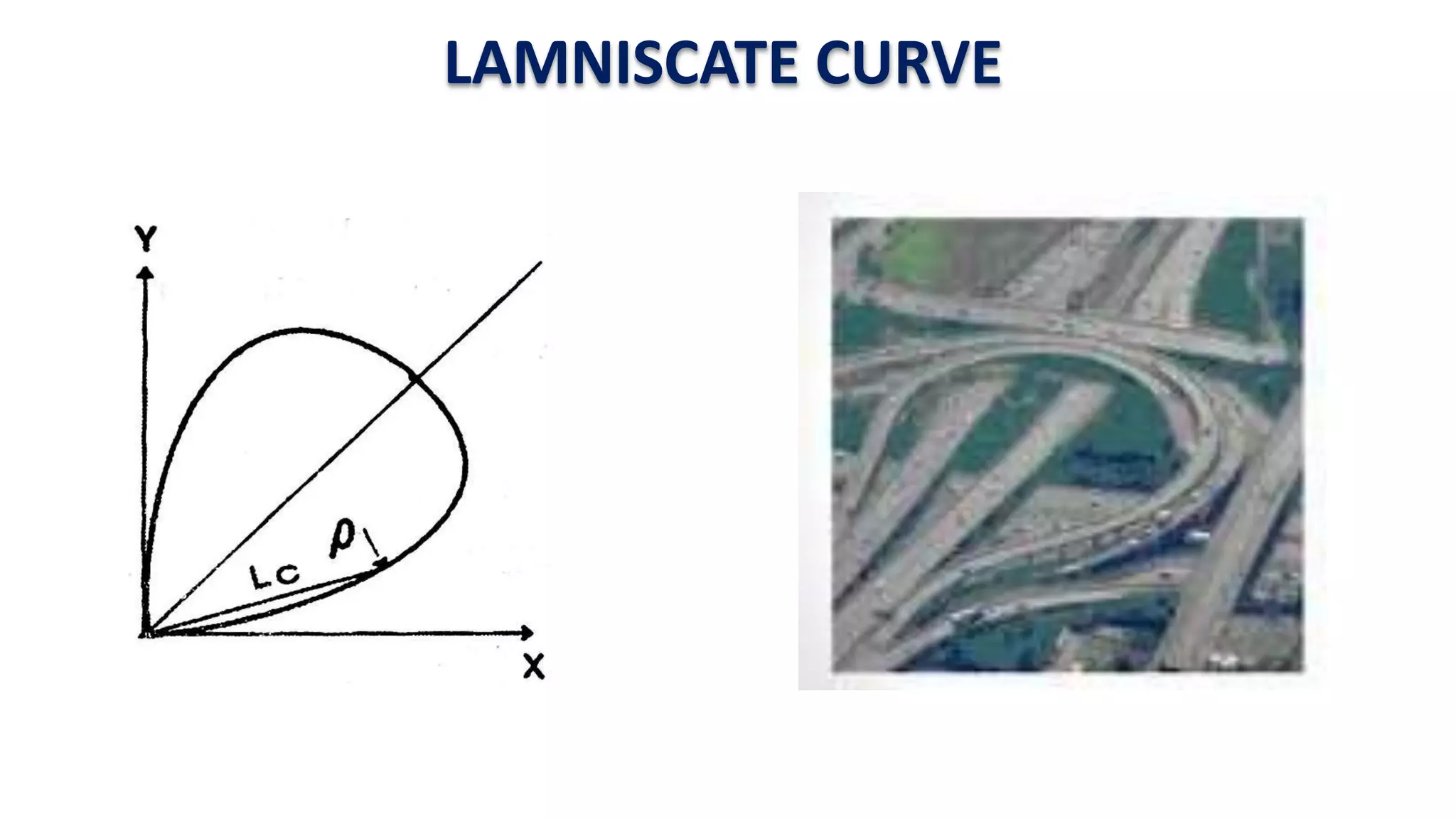
LAMNISCATE CURVE
It is mostly used in roads when it is required to have curve
transitional throughout having no intermediate circular curve
Since the curve is symmetrical and transitional throughout the
super elevation or cant continuously increases till the apex is
reached
This may be objectionable in case of railways
REASONS OF PROVIDING LAMNISCATE CURVE IN ROADS
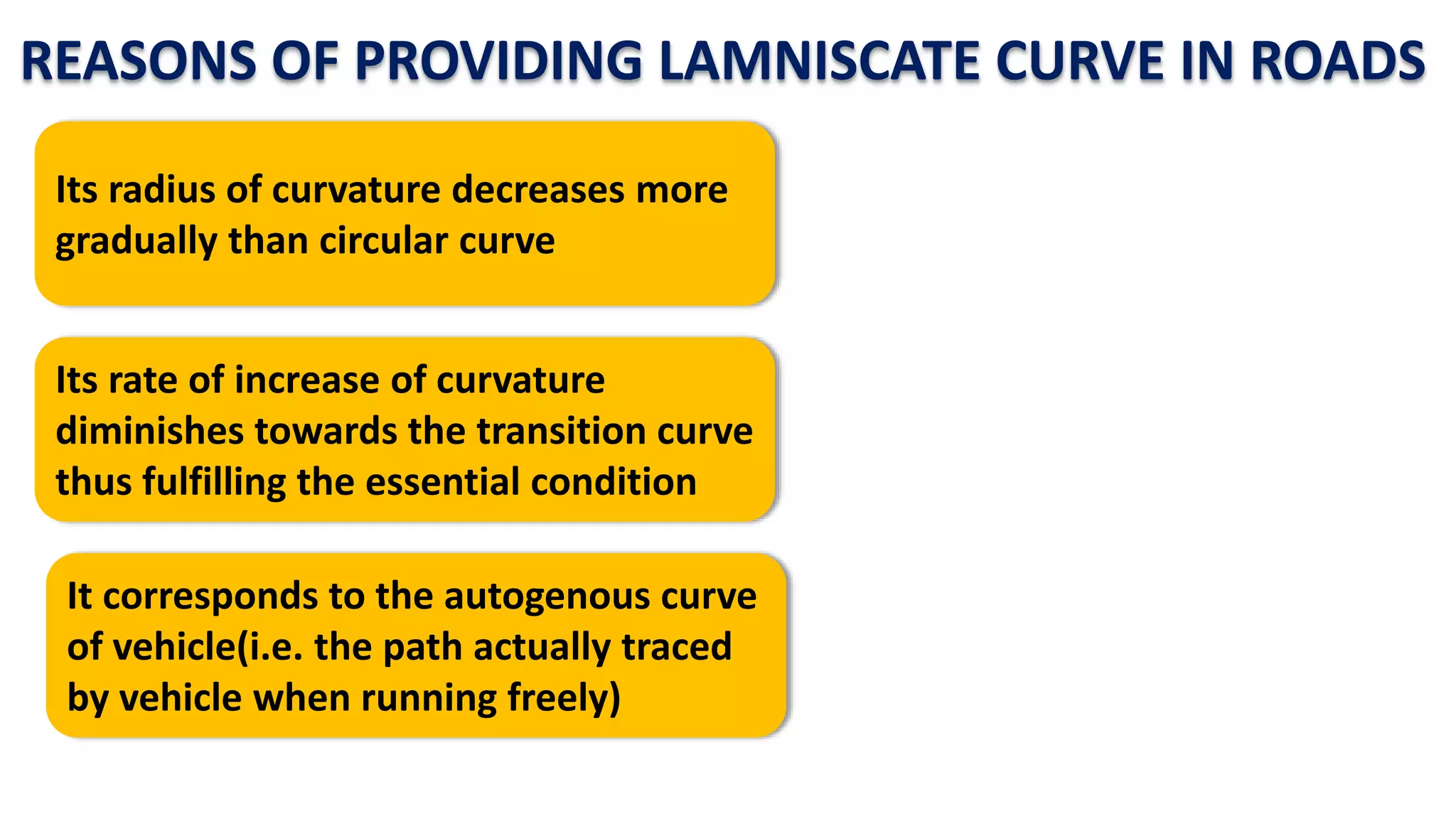
Its radius of curvature decreases more
gradually than circular curve
Its rate of increase of curvature
diminishes towards the transition curve
thus fulfilling the essential condition
It corresponds to the autogenous curve
of vehicle(i.e. the path actually traced
by vehicle when running freely)
LAMNISCATE CURVE
DEGREE OF CURVE
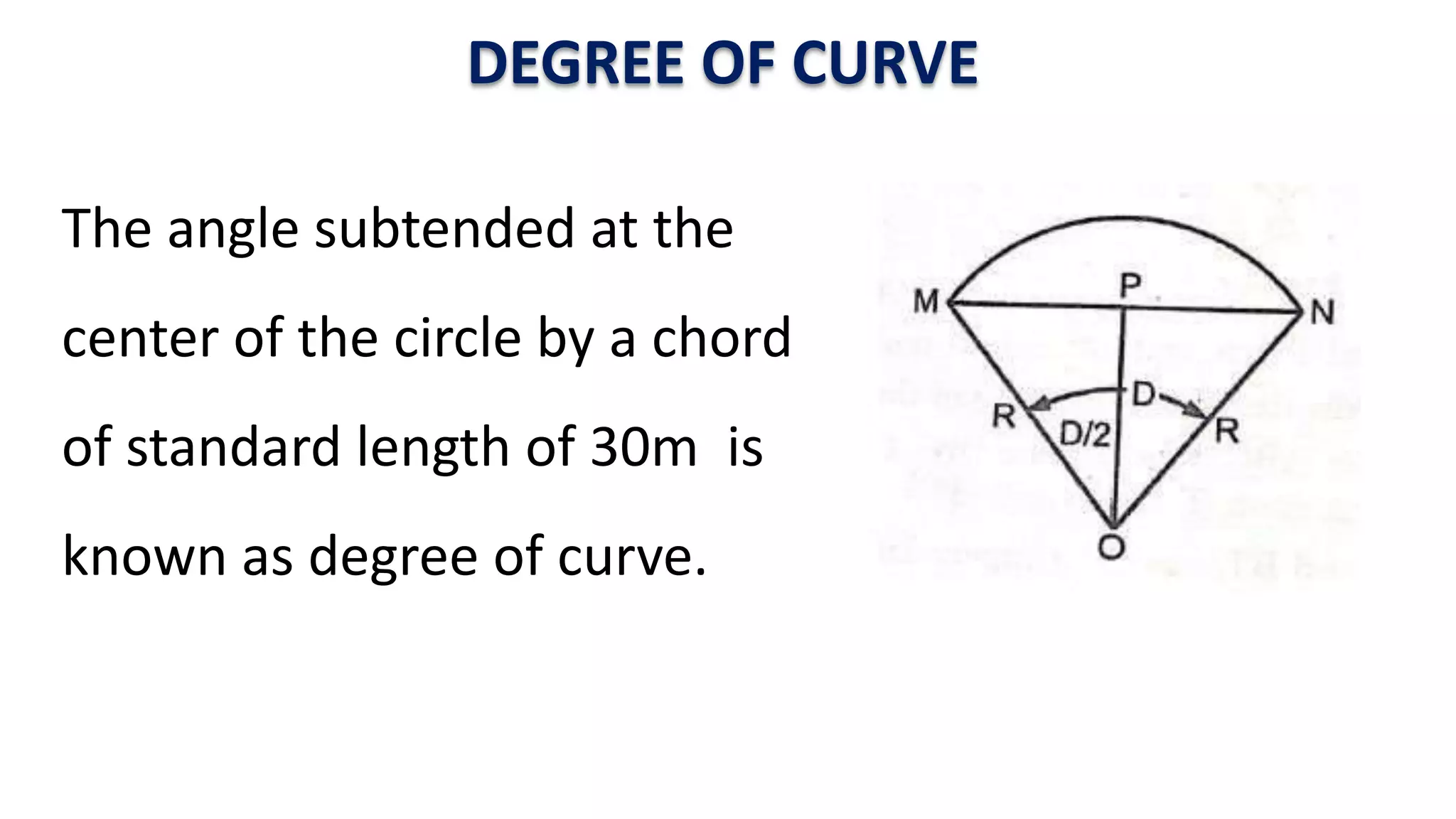
The angle subtended at the
center of the circle by a chord
of standard length of 30m is
known as degree of curve.
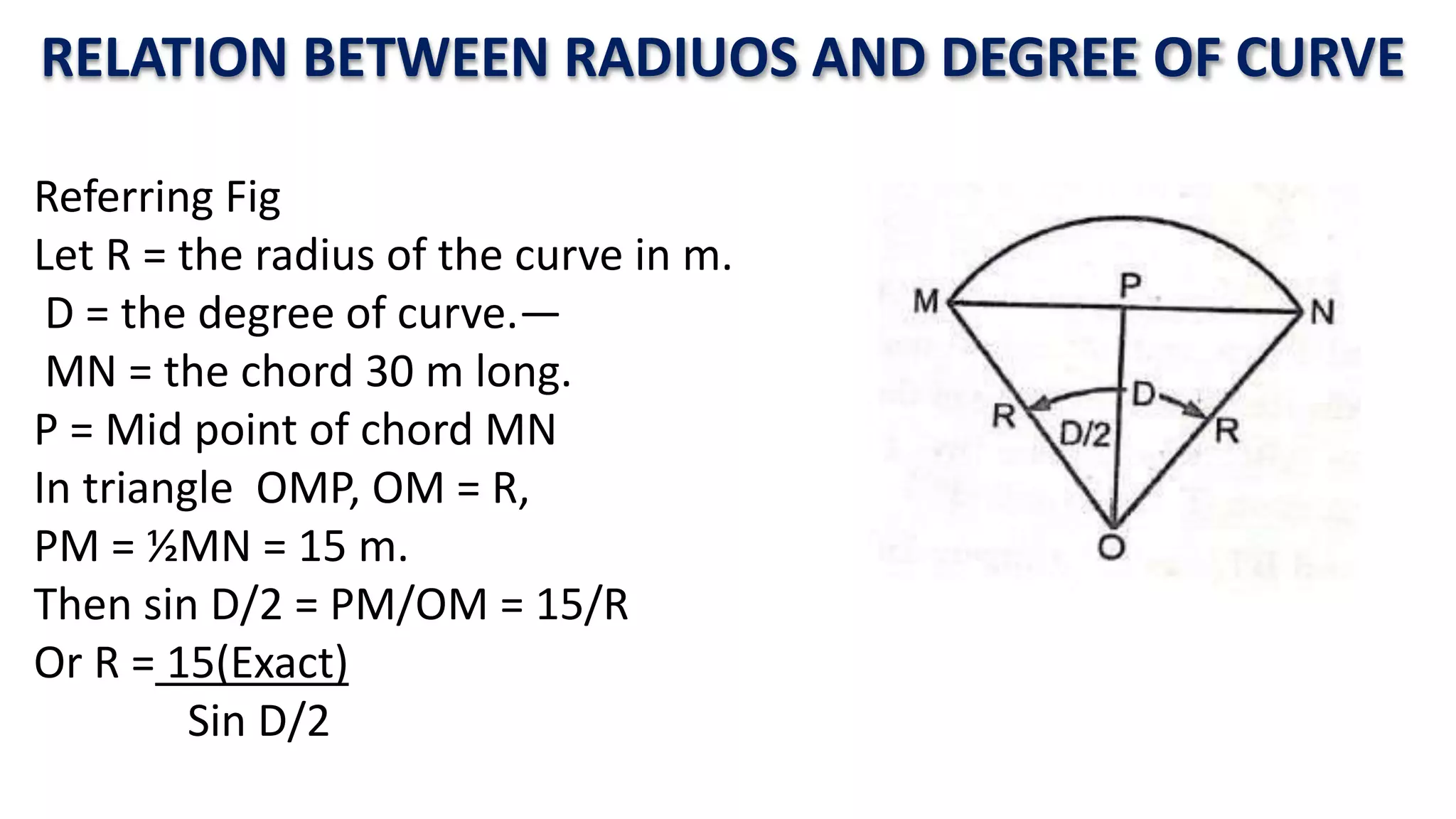
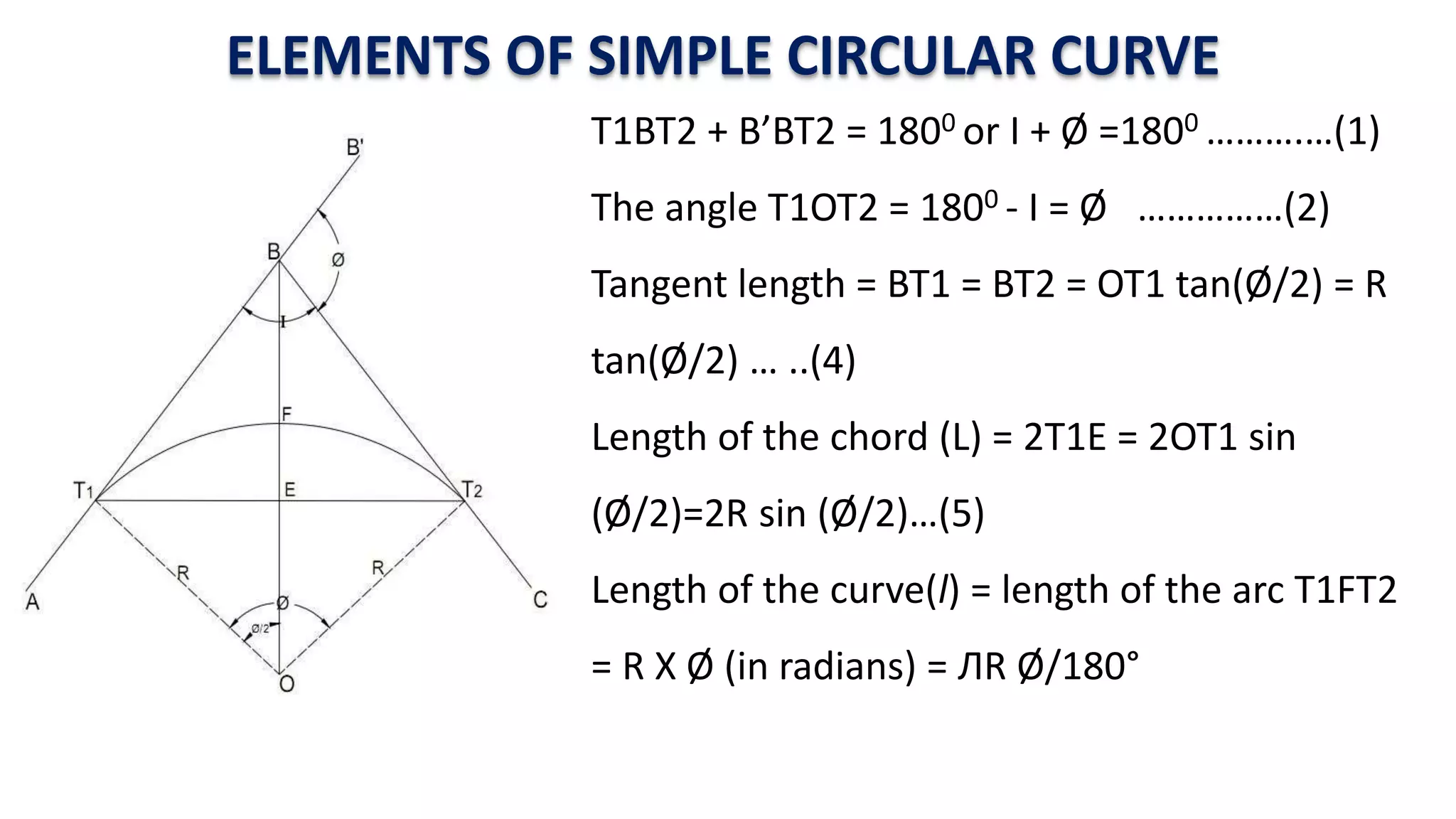
Referring Fig
Let R = the radius of the curve in m.
D = the degree of curve.—
MN = the chord 30 m long.
P = Mid point of chord MN
In triangle OMP, OM = R,
PM = ½MN = 15 m.
Then sin D/2 = PM/OM = 15/R
Or R = 15(Exact)
Sin D/2
RELATION BETWEEN RADIUOS AND DEGREE OF CURVE
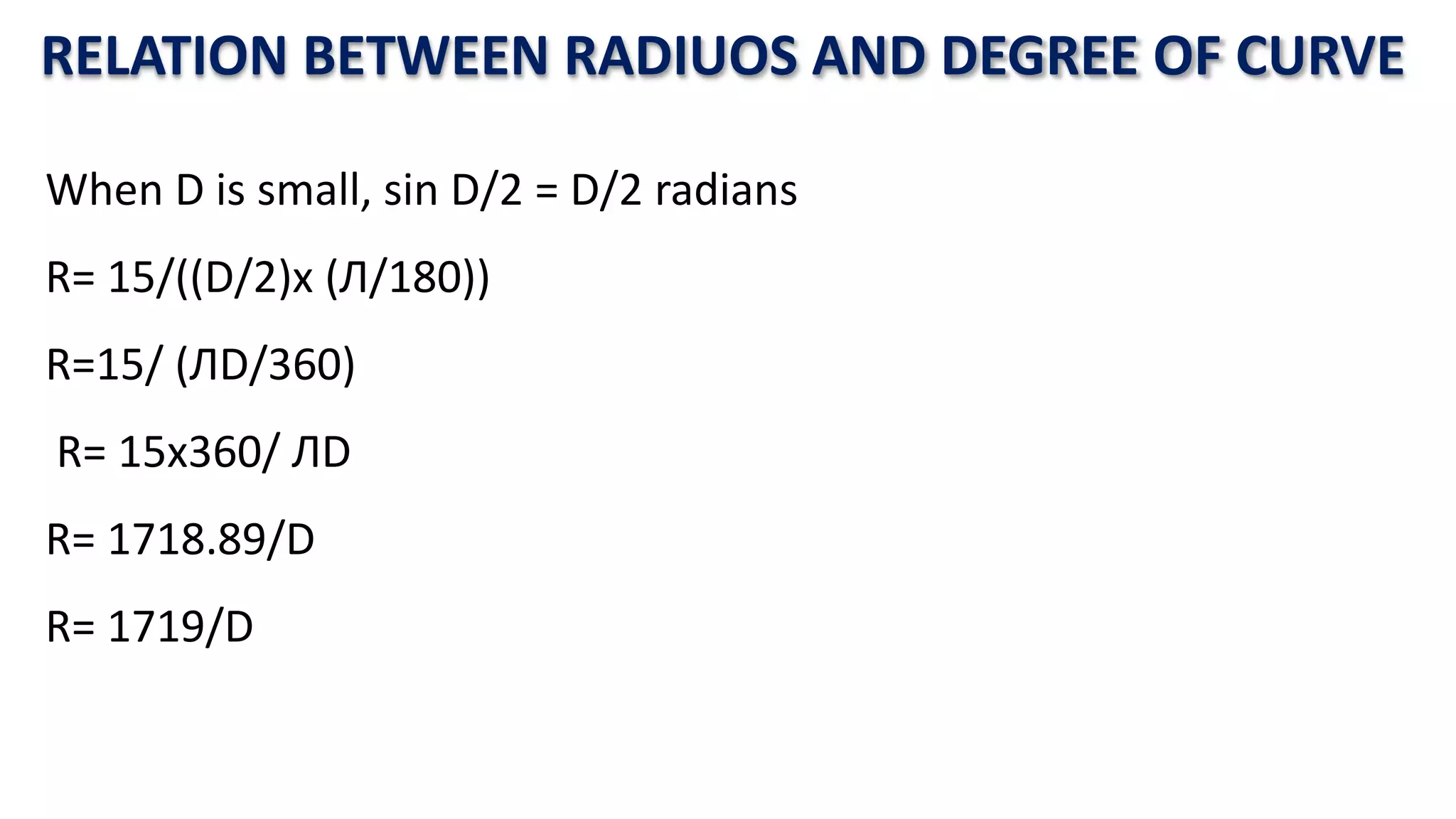
When D is small, sin D/2 = D/2 radians
R= 15/((D/2)x (Л/180))
R=15/ (ЛD/360)
R= 15x360/ ЛD
R= 1718.89/D
R= 1719/D
NOTATIONS USED IN SIMPLE CIRCULAR CURVE
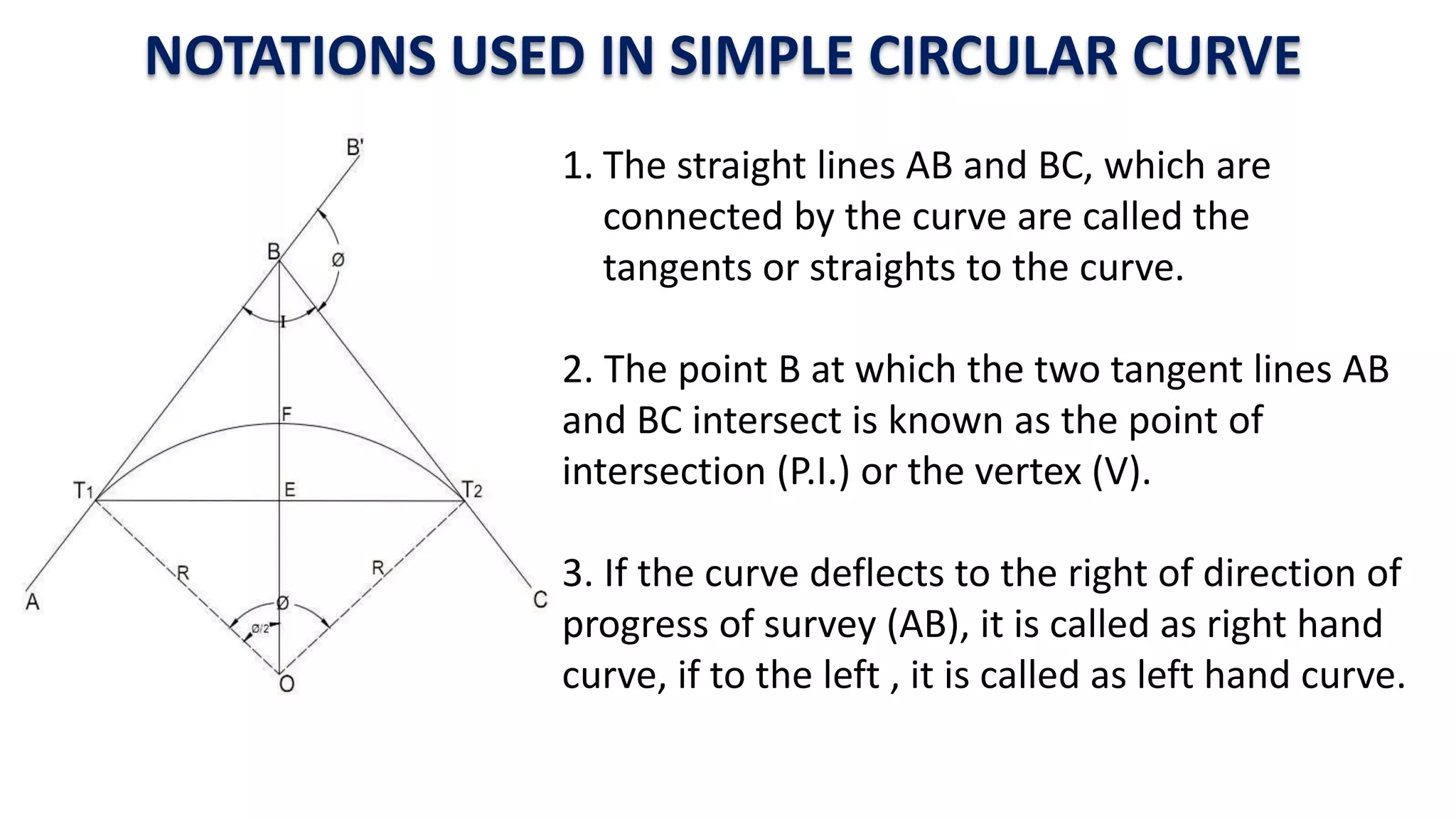
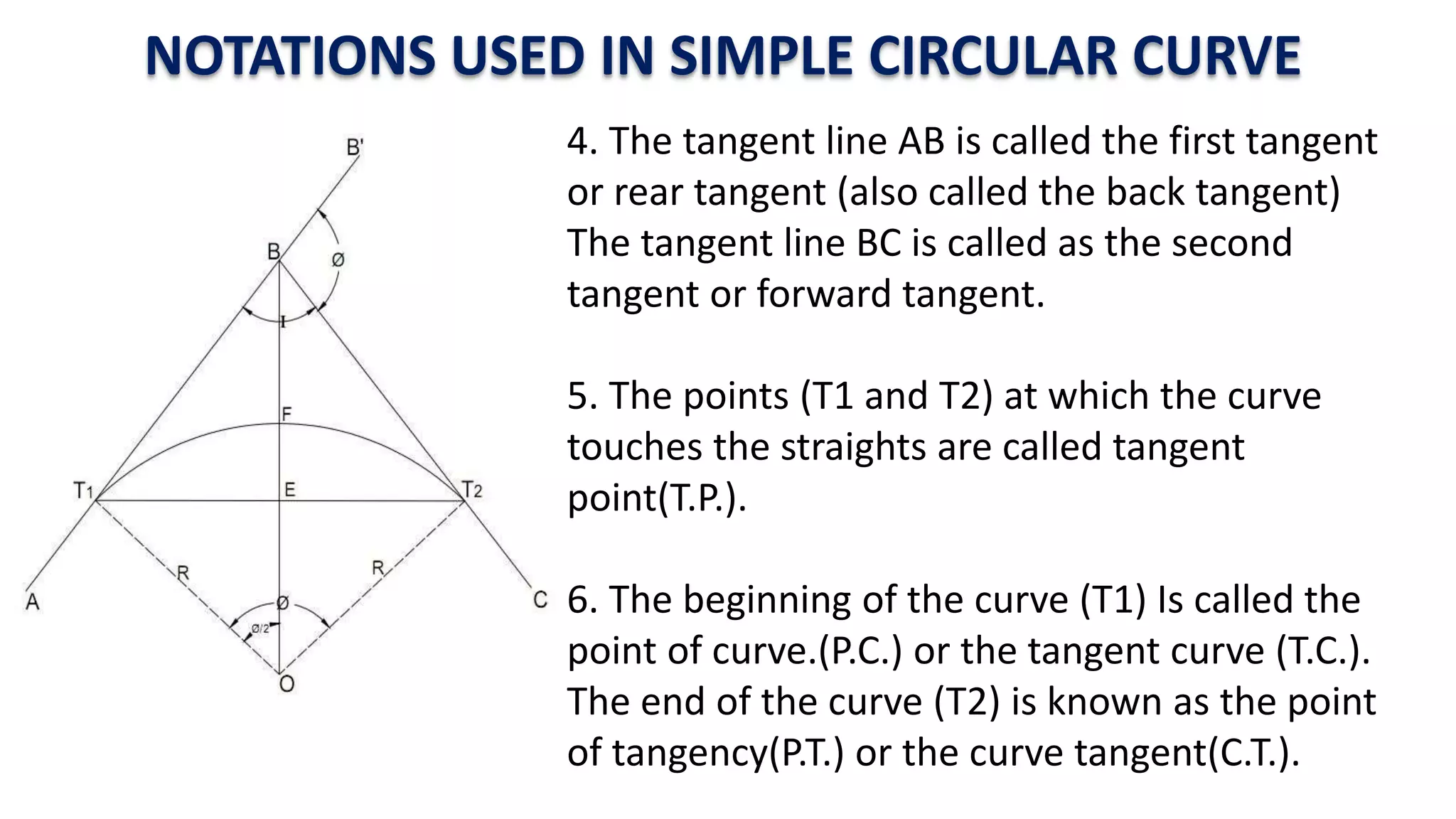
1. The straight lines AB and BC, which are
connected by the curve are called the
tangents or straights to the curve.
2. The point B at which the two tangent lines AB
and BC intersect is known as the point of
intersection (P.I.) or the vertex (V).
3. If the curve deflects to the right of direction of
progress of survey (AB), it is called as right hand
curve, if to the left , it is called as left hand curve.
NOTATIONS USED IN SIMPLE CIRCULAR CURVE
4. The tangent line AB is called the first tangent
or rear tangent (also called the back tangent)
The tangent line BC is called as the second
tangent or forward tangent.
5. The points (T1 and T2) at which the curve
touches the straights are called tangent
point(T.P.).
6. The beginning of the curve (T1) Is called the
point of curve.(P.C.) or the tangent curve (T.C.).
The end of the curve (T2) is known as the point
of tangency(P.T.) or the curve tangent(C.T.).
NOTATIONS USED IN SIMPLE CIRCULAR CURVE
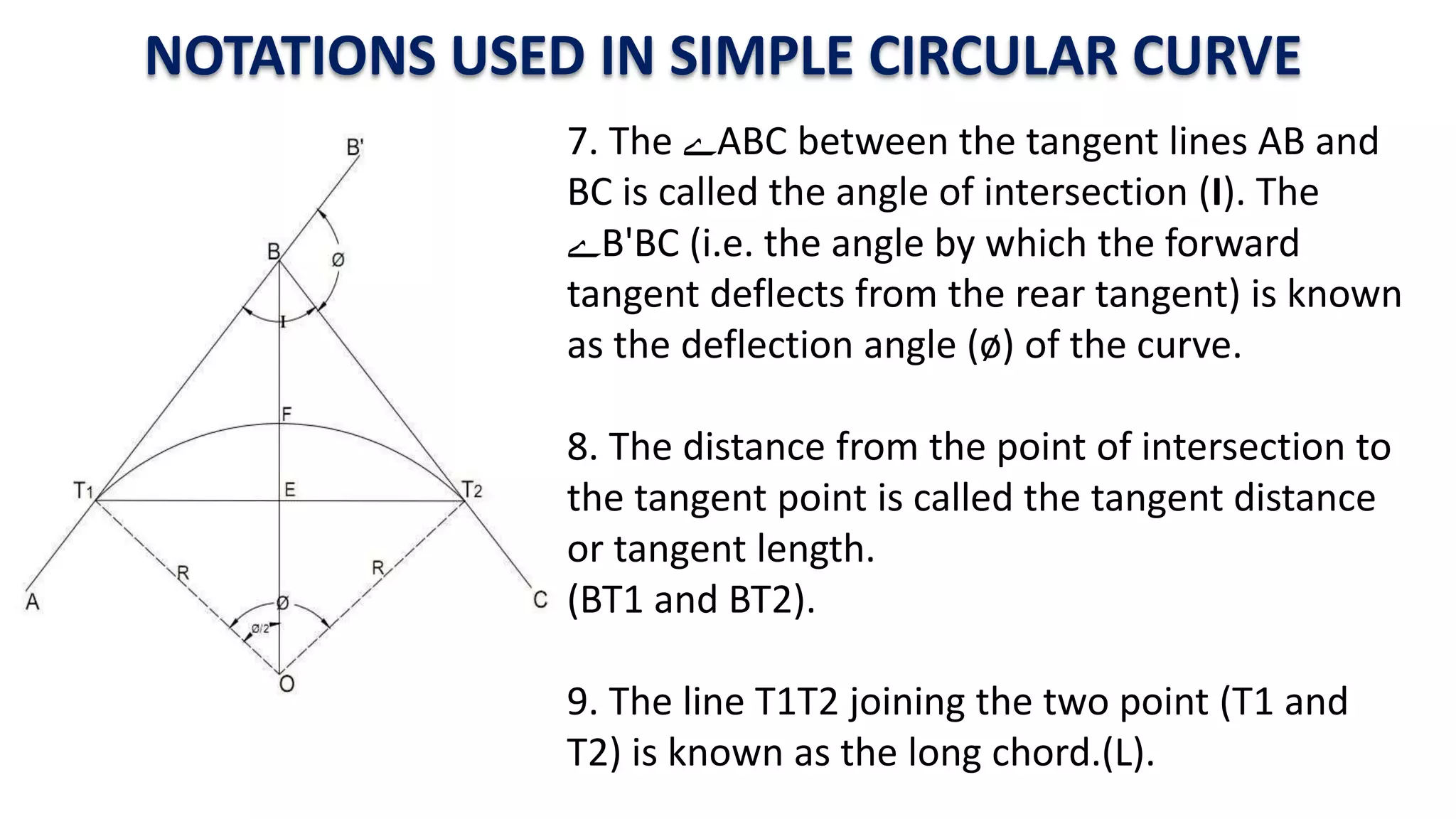
7. The ‫ے‬ABC between the tangent lines AB and
BC is called the angle of intersection (I). The
‫ے‬B'BC (i.e. the angle by which the forward
tangent deflects from the rear tangent) is known
as the deflection angle (ø) of the curve.
8. The distance from the point of intersection to
the tangent point is called the tangent distance
or tangent length.
(BT1 and BT2).
9. The line T1T2 joining the two point (T1 and
T2) is known as the long chord.(L).
NOTATIONS USED IN SIMPLE CIRCULAR CURVE
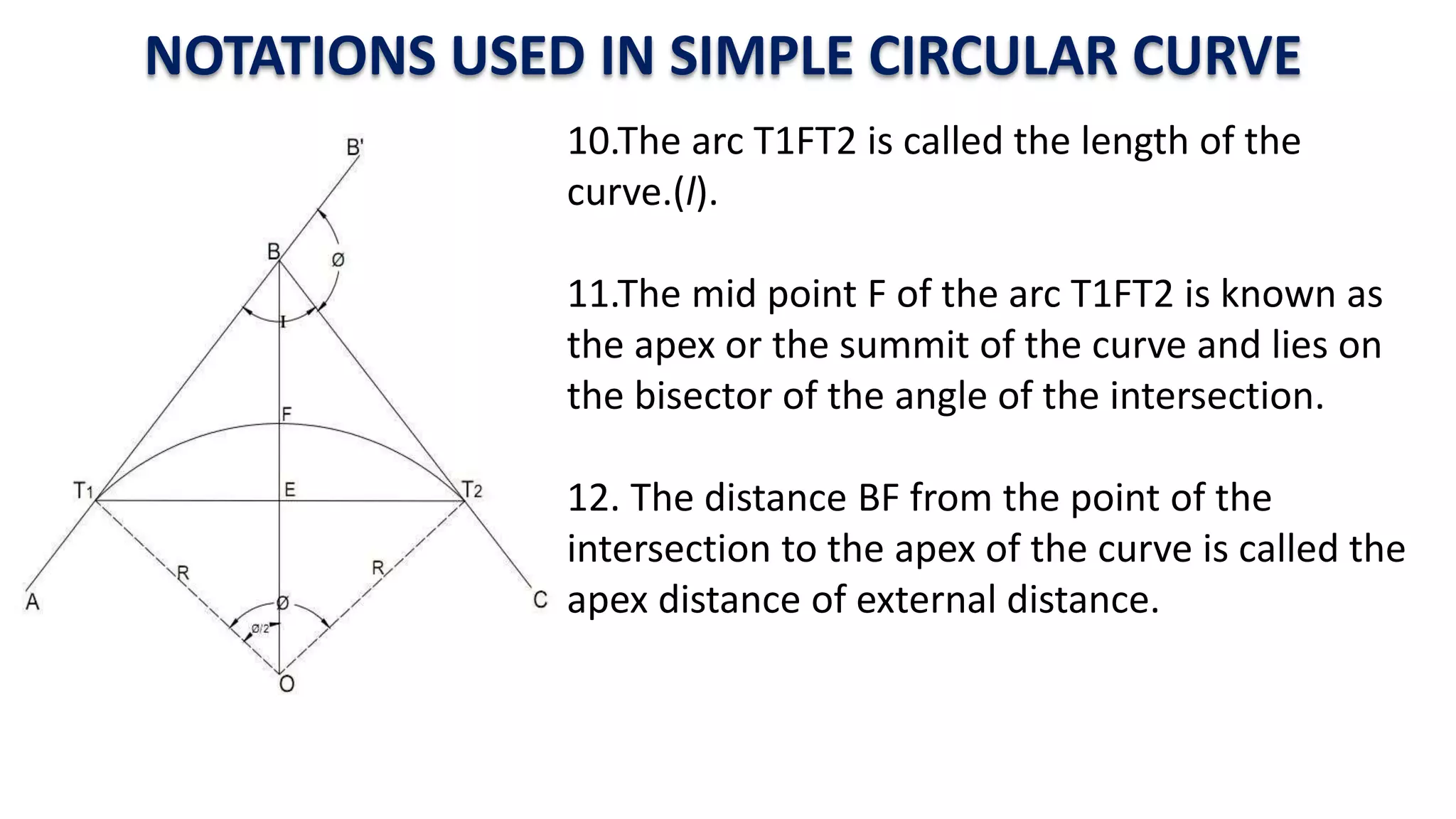
10.The arc T1FT2 is called the length of the
curve.(l).
11.The mid point F of the arc T1FT2 is known as
the apex or the summit of the curve and lies on
the bisector of the angle of the intersection.
12. The distance BF from the point of the
intersection to the apex of the curve is called the
apex distance of external distance.
NOTATIONS USED IN SIMPLE CIRCULAR CURVE
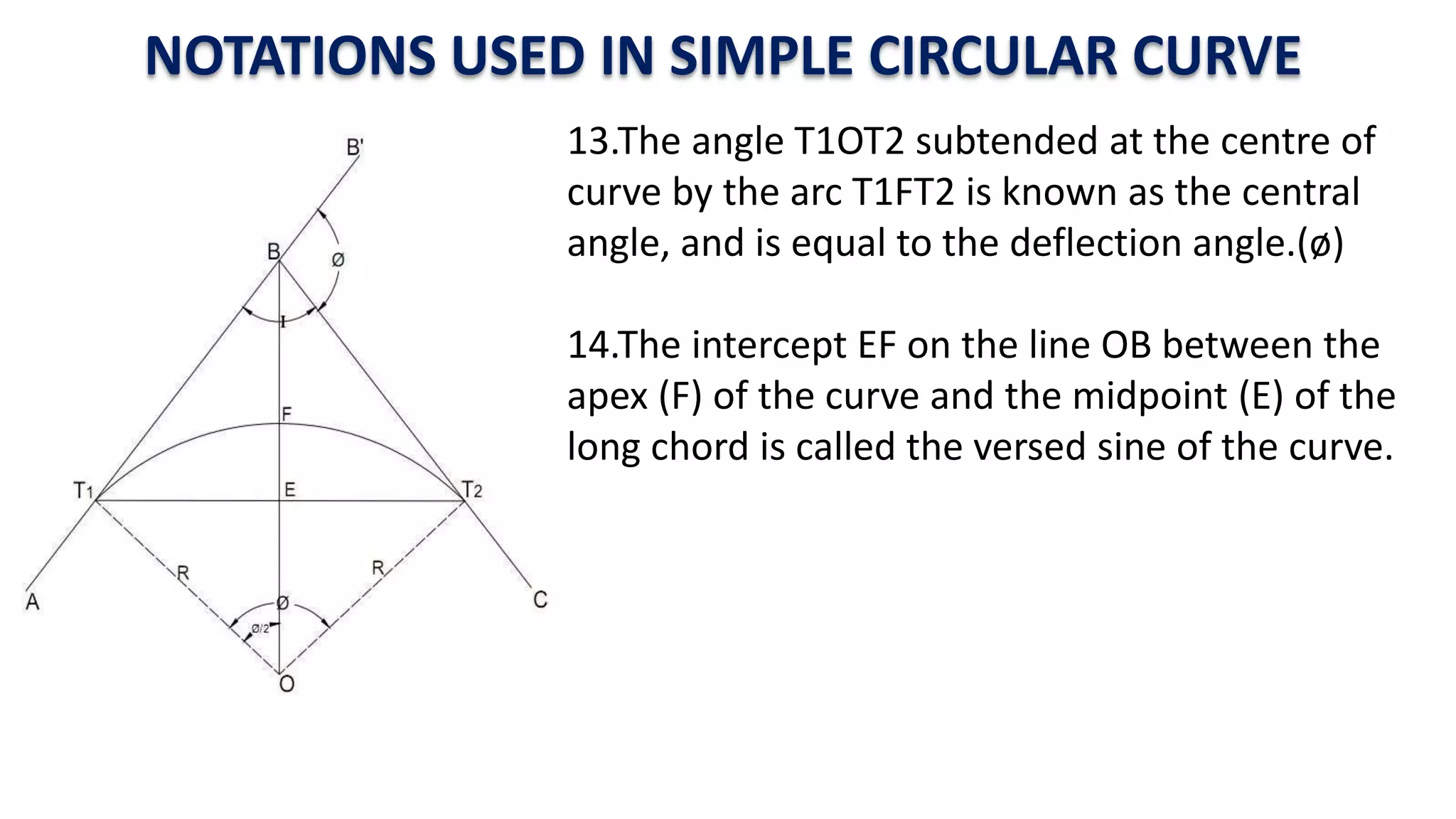
13.The angle T1OT2 subtended at the centre of
curve by the arc T1FT2 is known as the central
angle, and is equal to the deflection angle.(ø)
14.The intercept EF on the line OB between the
apex (F) of the curve and the midpoint (E) of the
long chord is called the versed sine of the curve.
ELEMENTS OF SIMPLE CIRCULAR CURVE
T1BT2 + B’BT2 = 1800 or I + Ø =1800 ……….…(1)
The angle T1OT2 = 1800 - I = Ø ……………(2)
Tangent length = BT1 = BT2 = OT1 tan(Ø/2) = R
tan(Ø/2) … ..(4)
Length of the chord (L) = 2T1E = 2OT1 sin
(Ø/2)=2R sin (Ø/2)…(5)
Length of the curve(l) = length of the arc T1FT2
= R X Ø (in radians) = ЛR Ø/180°
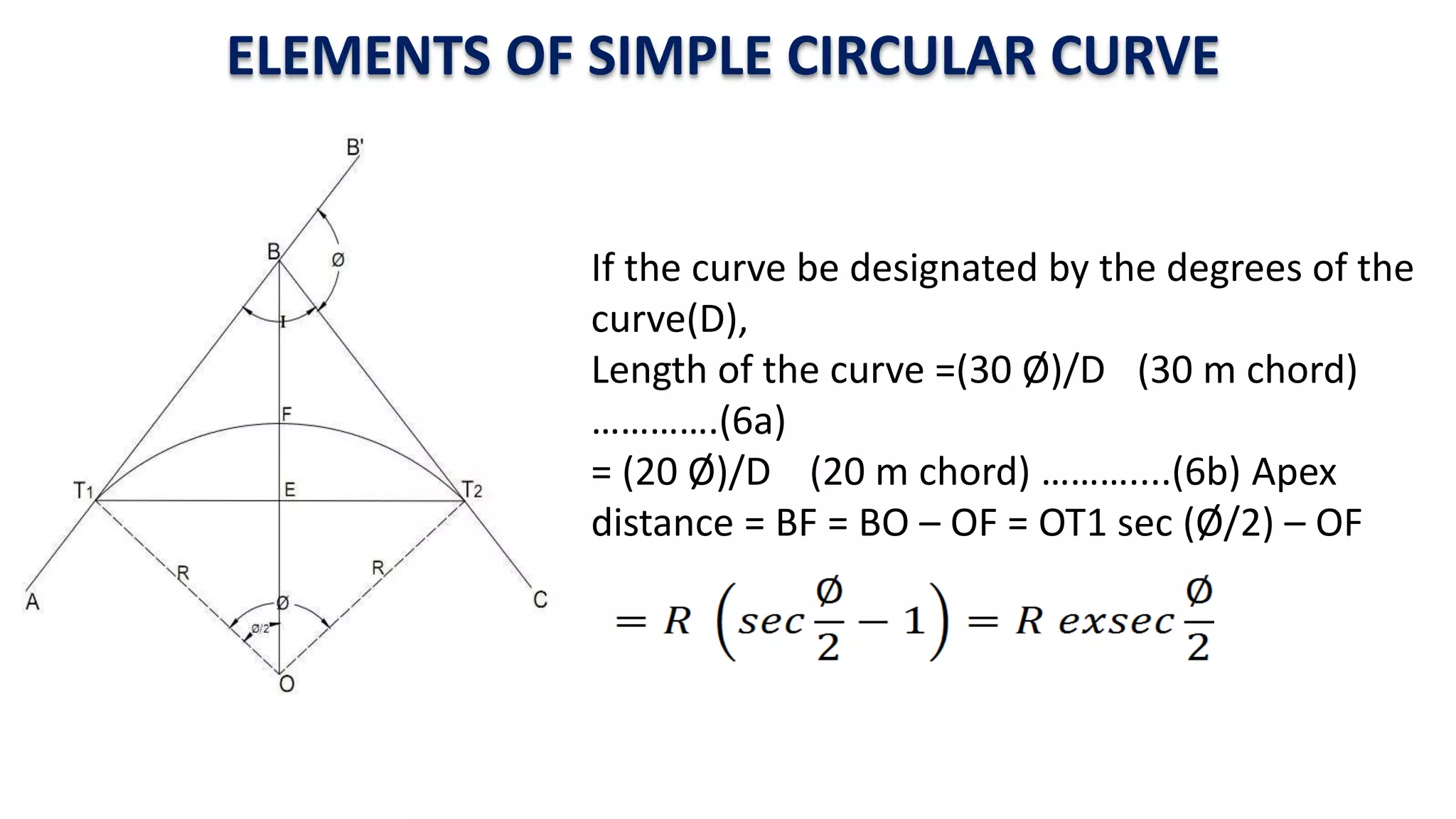
ELEMENTS OF SIMPLE CIRCULAR CURVE
If the curve be designated by the degrees of the
curve(D),
Length of the curve =(30 Ø)/D (30 m chord)
………….(6a)
= (20 Ø)/D (20 m chord) ………....(6b) Apex
distance = BF = BO – OF = OT1 sec (Ø/2) – OF
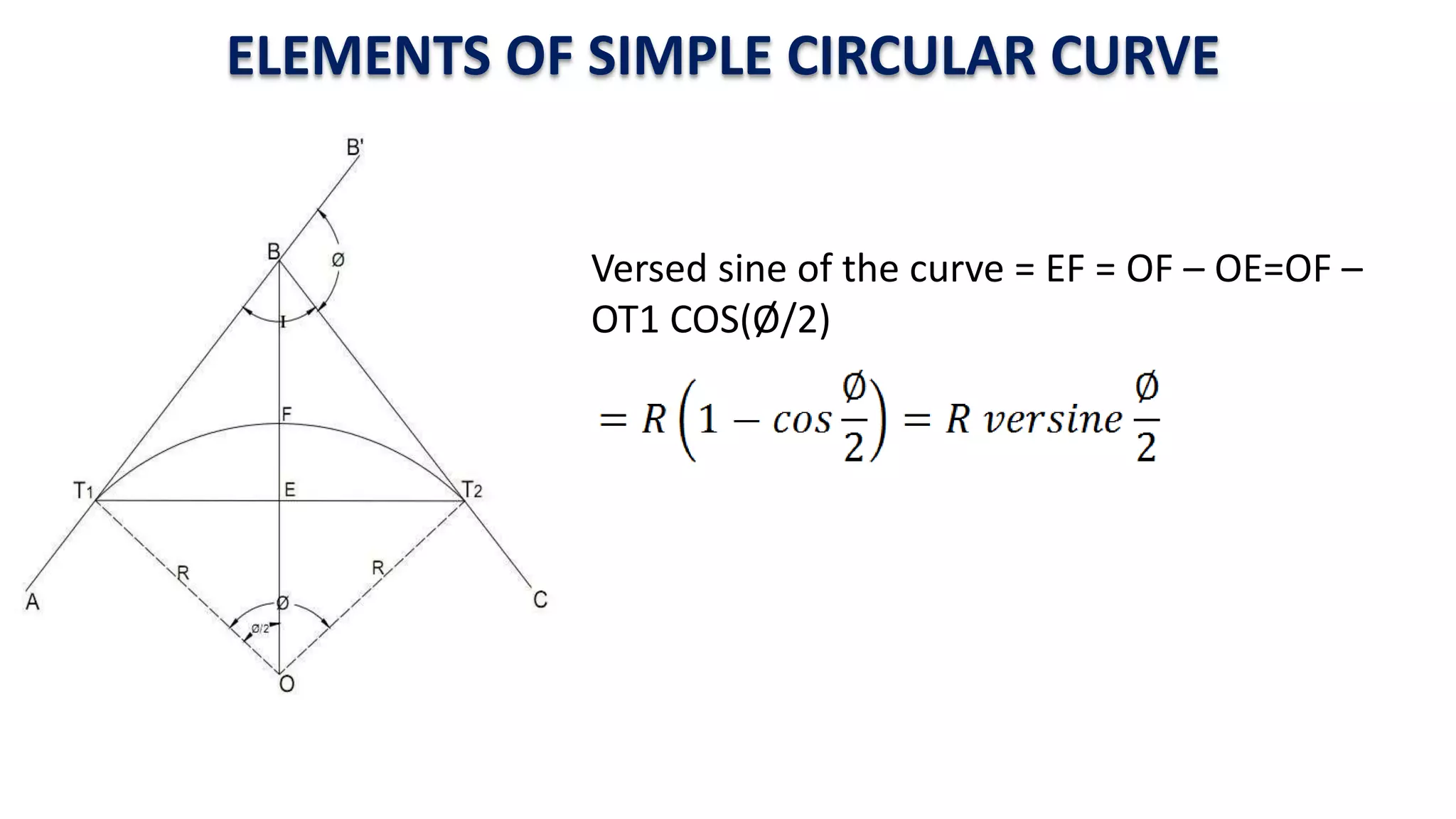
ELEMENTS OF SIMPLE CIRCULAR CURVE
Versed sine of the curve = EF = OF – OE=OF –
OT1 COS(Ø/2)
Peg interval :-
It is the usual practice to fix pegs at equal intervalon the curve
as along the straight.
The interval between the peg is usually 20 to 30 m. strictly
speaking this interval must be measured as the arch intercept
between them.
However as it is necessarily measured along the chord, the
curve consist of series of a chord rather than of arcs. In other
words, the length of the chord is assume to be equal to be that
of the arc.
Peg interval :-
In order that the difference in length between the arc and
chord may be negligible, the length of the chord should not be
more than 1/20th of the radius of the curve.
 The length of unit chord (peg interval) is,therefore, 30m for
flat curve, 20m for sharp curve, and 10 m or less for very sharp
curve.
When the curve is of a small radius, the peg interval are
considered to be along the arc and the length of the
corresponding chords are calculated to locate the pegs.
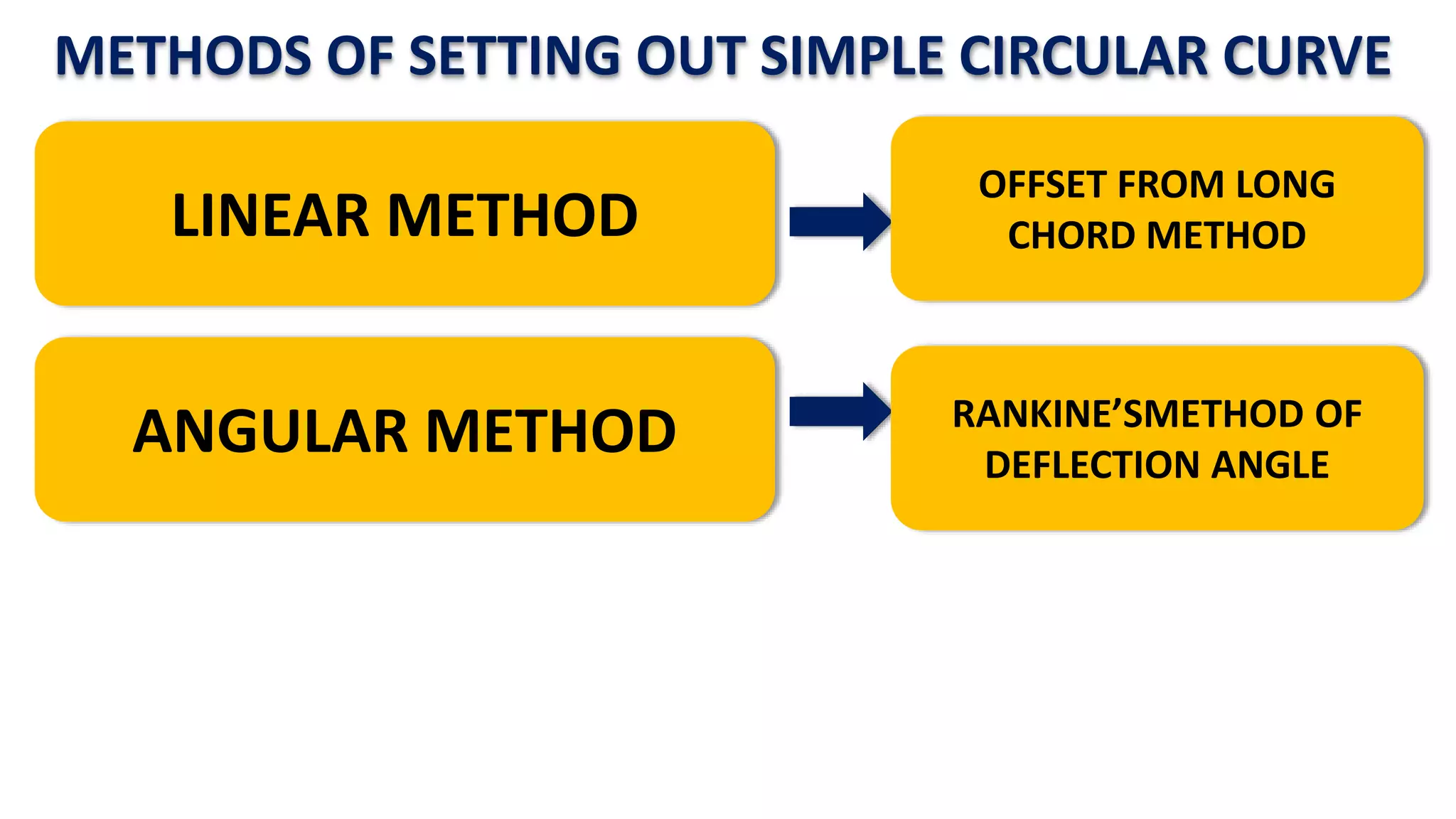
METHODS OF SETTING OUT SIMPLE CIRCULAR CURVE
LINEAR METHOD
ANGULAR METHOD
OFFSET FROM LONG
CHORD METHOD
RANKINE’SMETHOD OF
DEFLECTION ANGLE
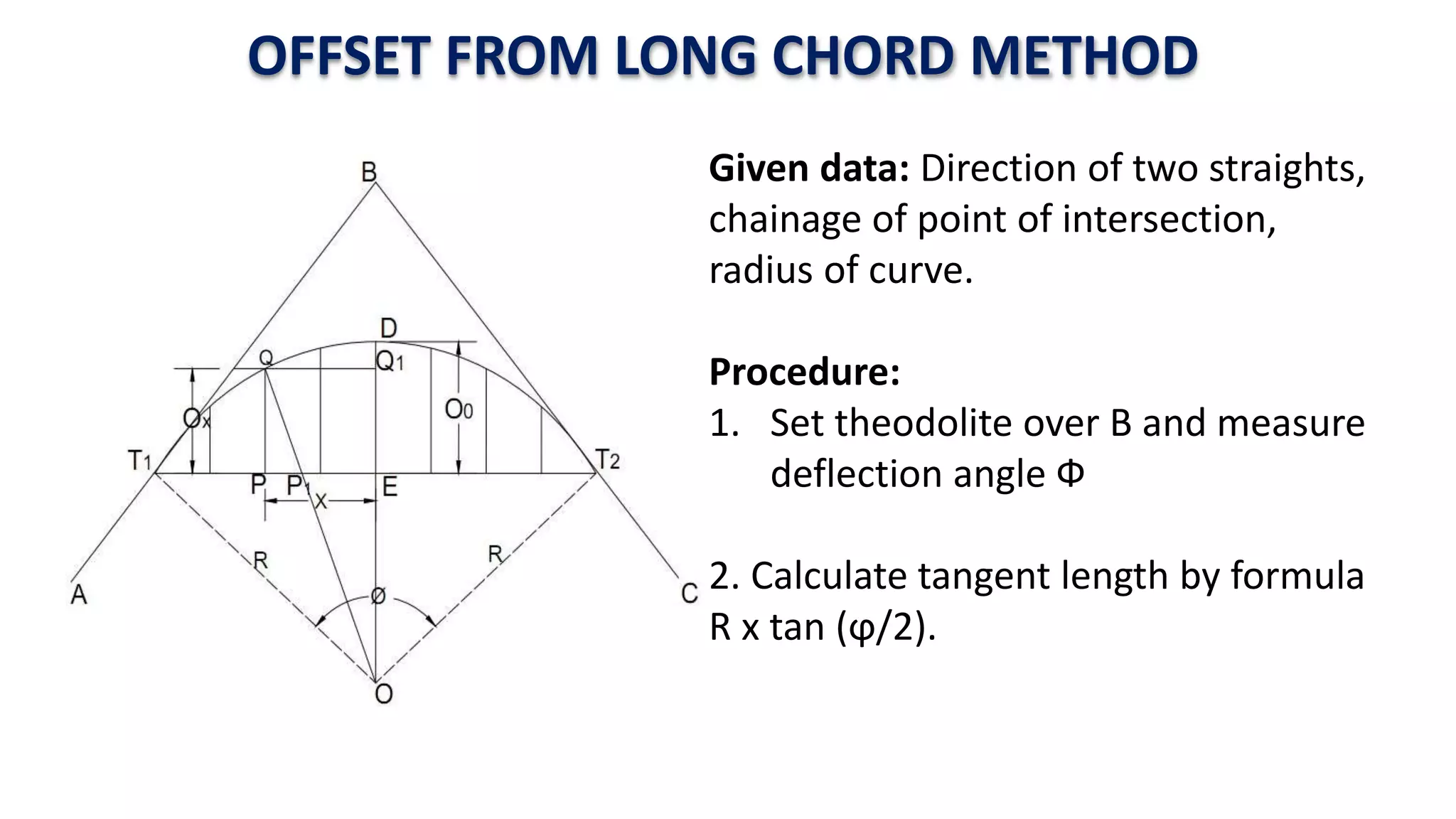
OFFSET FROM LONG CHORD METHOD
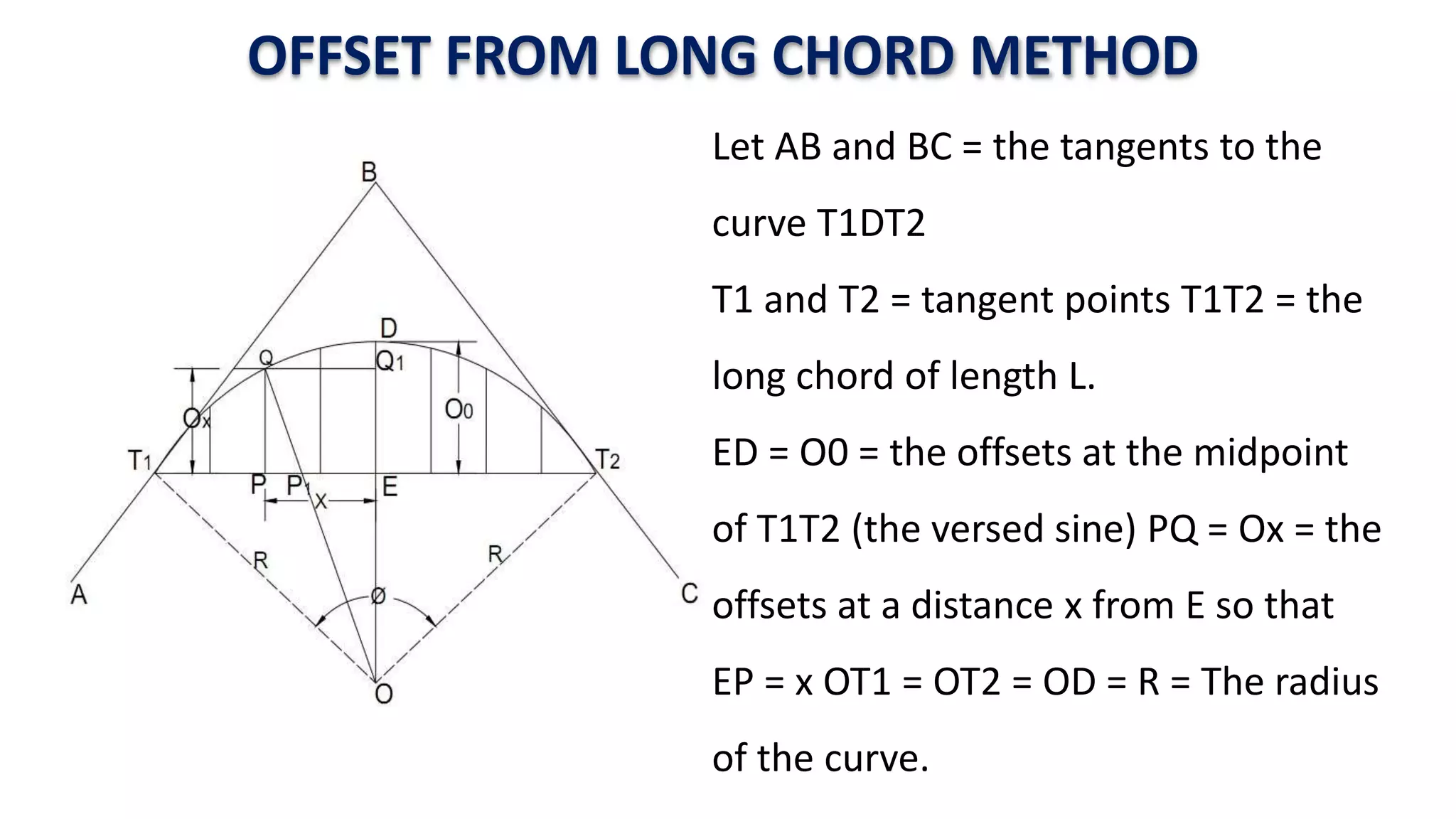
Let AB and BC = the tangents to the
curve T1DT2
T1 and T2 = tangent points T1T2 = the
long chord of length L.
ED = O0 = the offsets at the midpoint
of T1T2 (the versed sine) PQ = Ox = the
offsets at a distance x from E so that
EP = x OT1 = OT2 = OD = R = The radius
of the curve.
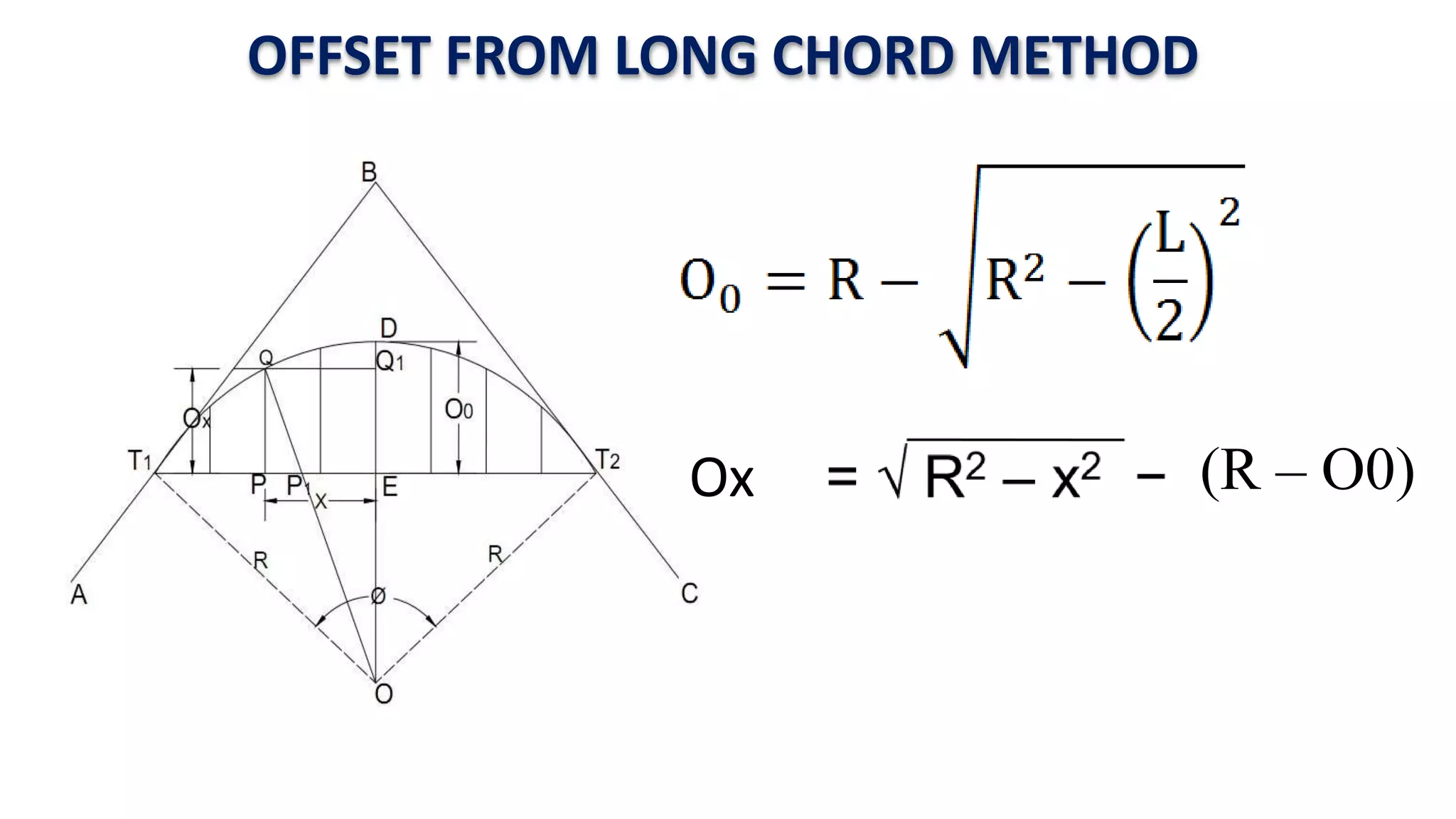
OFFSET FROM LONG CHORD METHOD
(R – O0)Ox
OFFSET FROM LONG CHORD METHOD
Given data: Direction of two straights,
chainage of point of intersection,
radius of curve.
Procedure:
1. Set theodolite over B and measure
deflection angle Ф
2. Calculate tangent length by formula
R x tan (ϕ/2).
OFFSET FROM LONG CHORD METHOD
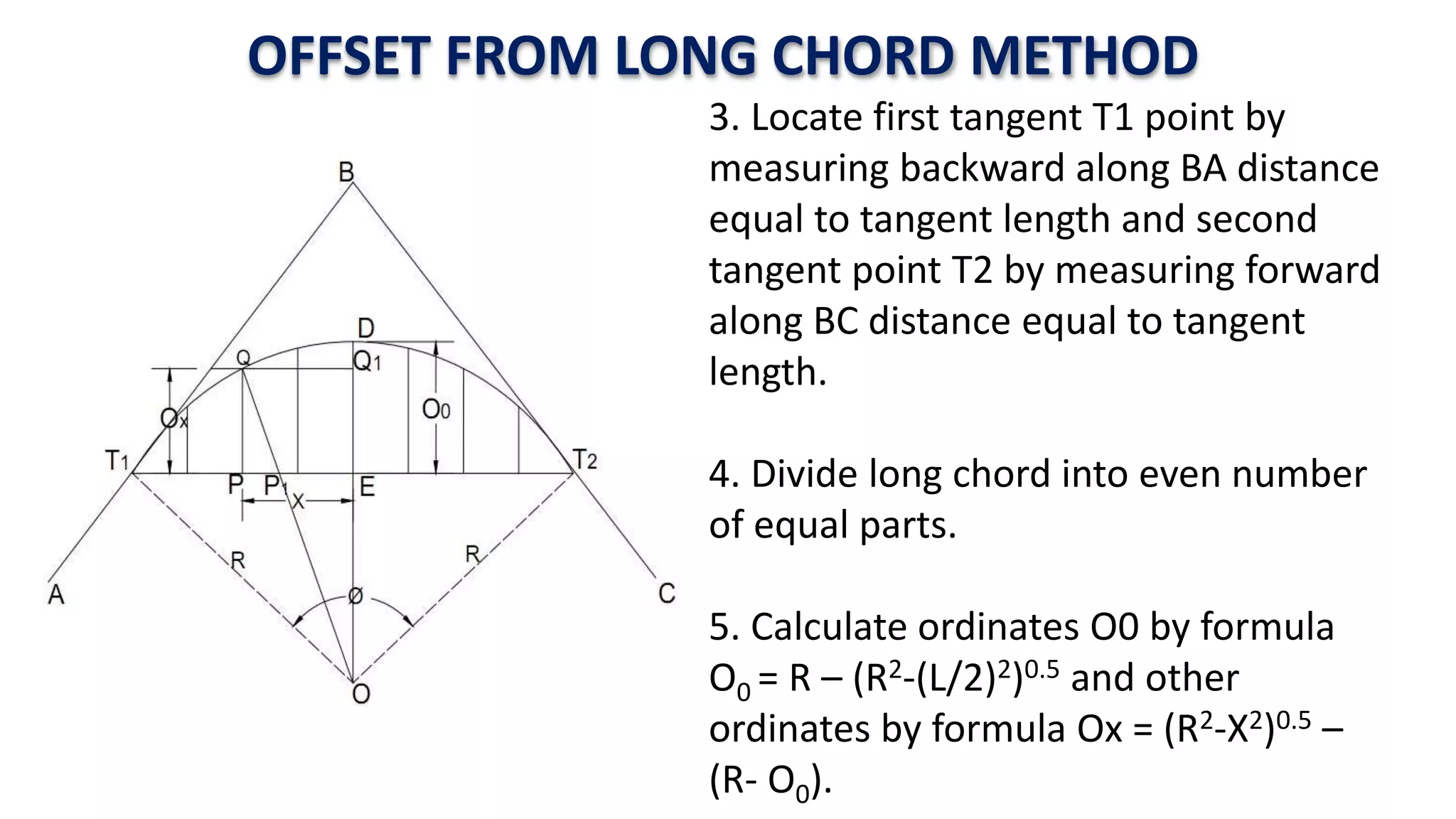
3. Locate first tangent T1 point by
measuring backward along BA distance
equal to tangent length and second
tangent point T2 by measuring forward
along BC distance equal to tangent
length.
4. Divide long chord into even number
of equal parts.
5. Calculate ordinates O0 by formula
O0 = R – (R2-(L/2)2)0.5 and other
ordinates by formula Ox = (R2-X2)0.5 –
(R- O0).
OFFSET FROM LONG CHORD METHOD
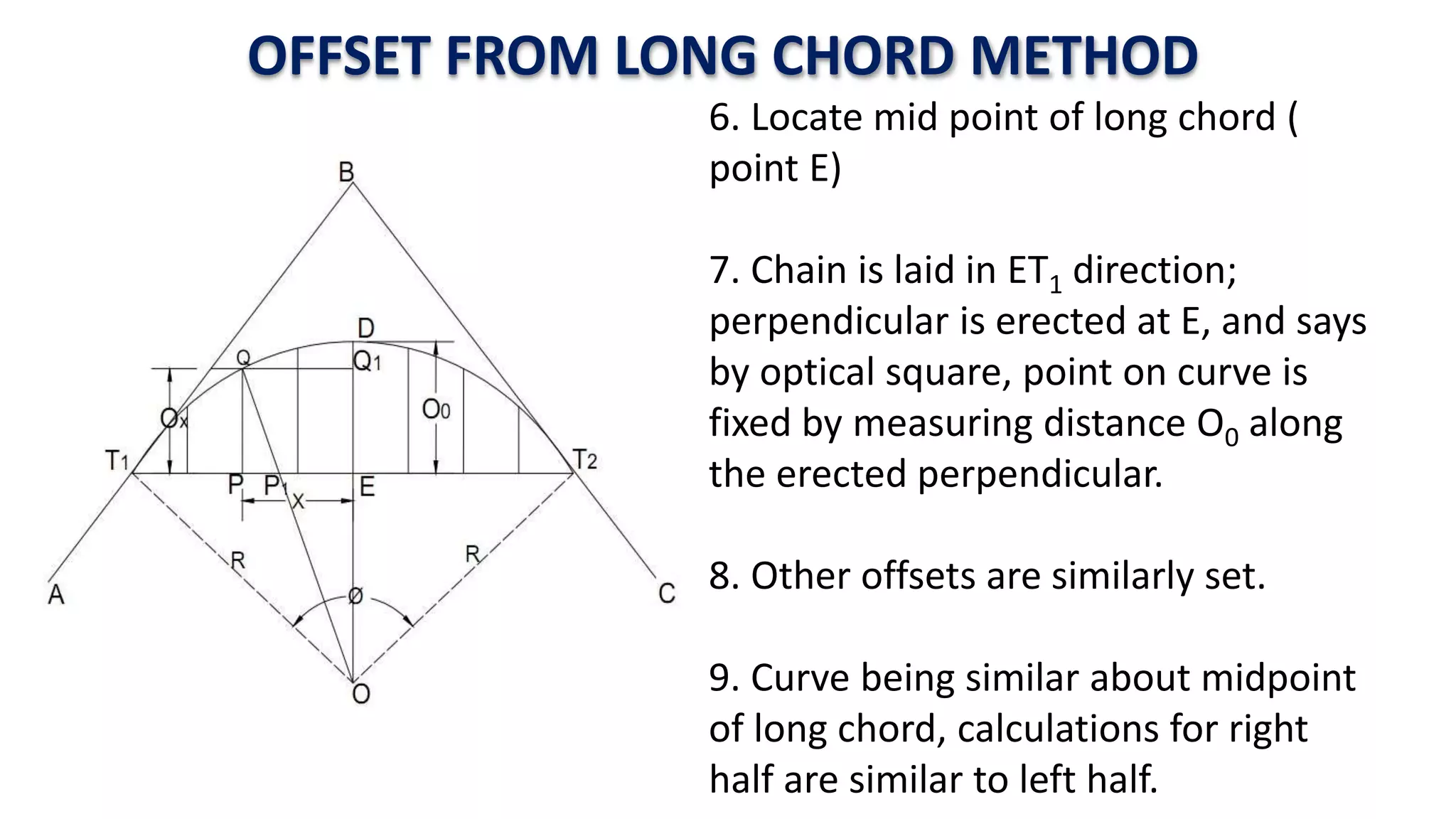
6. Locate mid point of long chord (
point E)
7. Chain is laid in ET1 direction;
perpendicular is erected at E, and says
by optical square, point on curve is
fixed by measuring distance O0 along
the erected perpendicular.
8. Other offsets are similarly set.
9. Curve being similar about midpoint
of long chord, calculations for right
half are similar to left half.
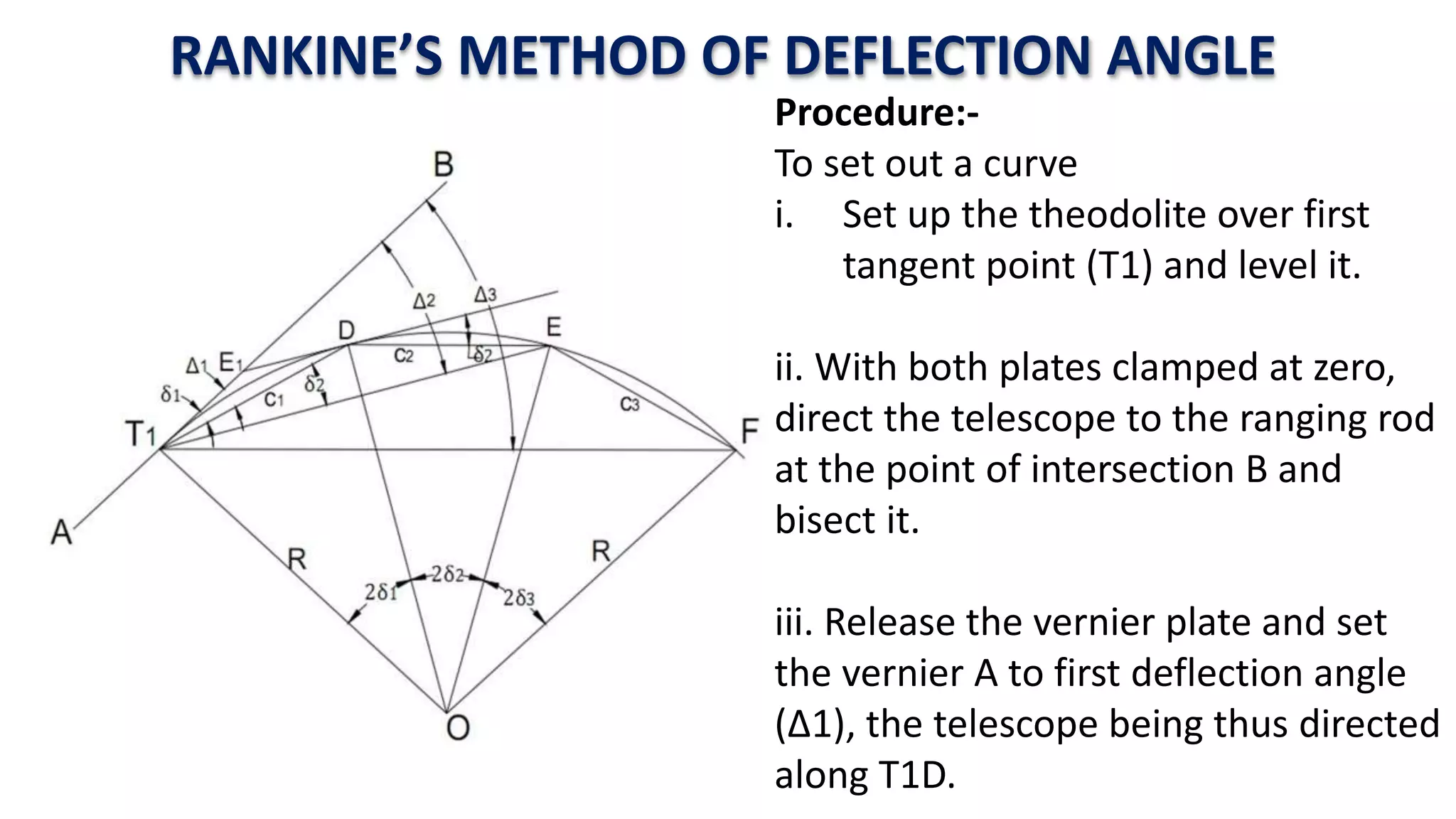
RANKINE’S METHOD OF DEFLECTION ANGLE
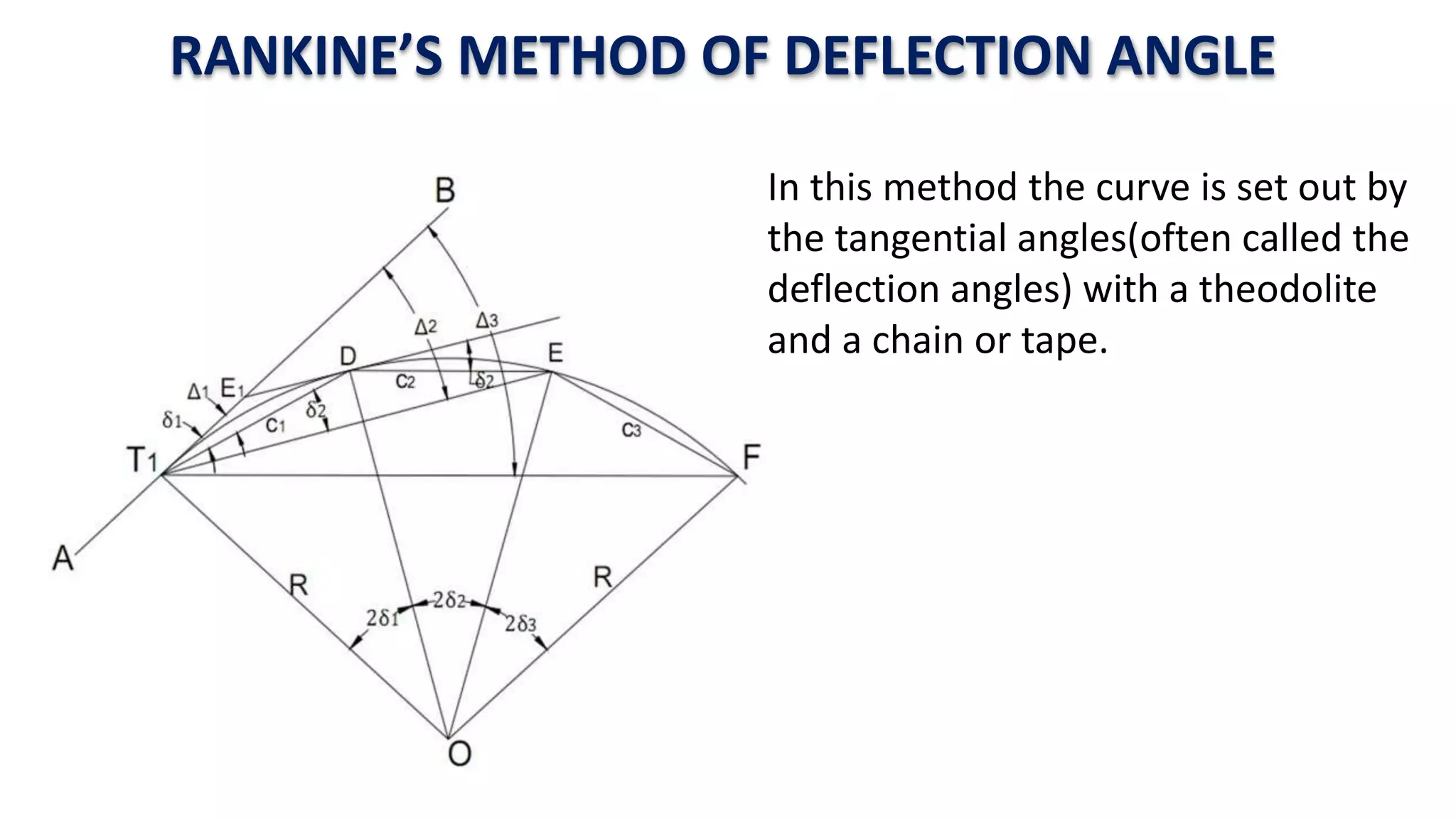
In this method the curve is set out by
the tangential angles(often called the
deflection angles) with a theodolite
and a chain or tape.
RANKINE’S METHOD OF DEFLECTION ANGLE
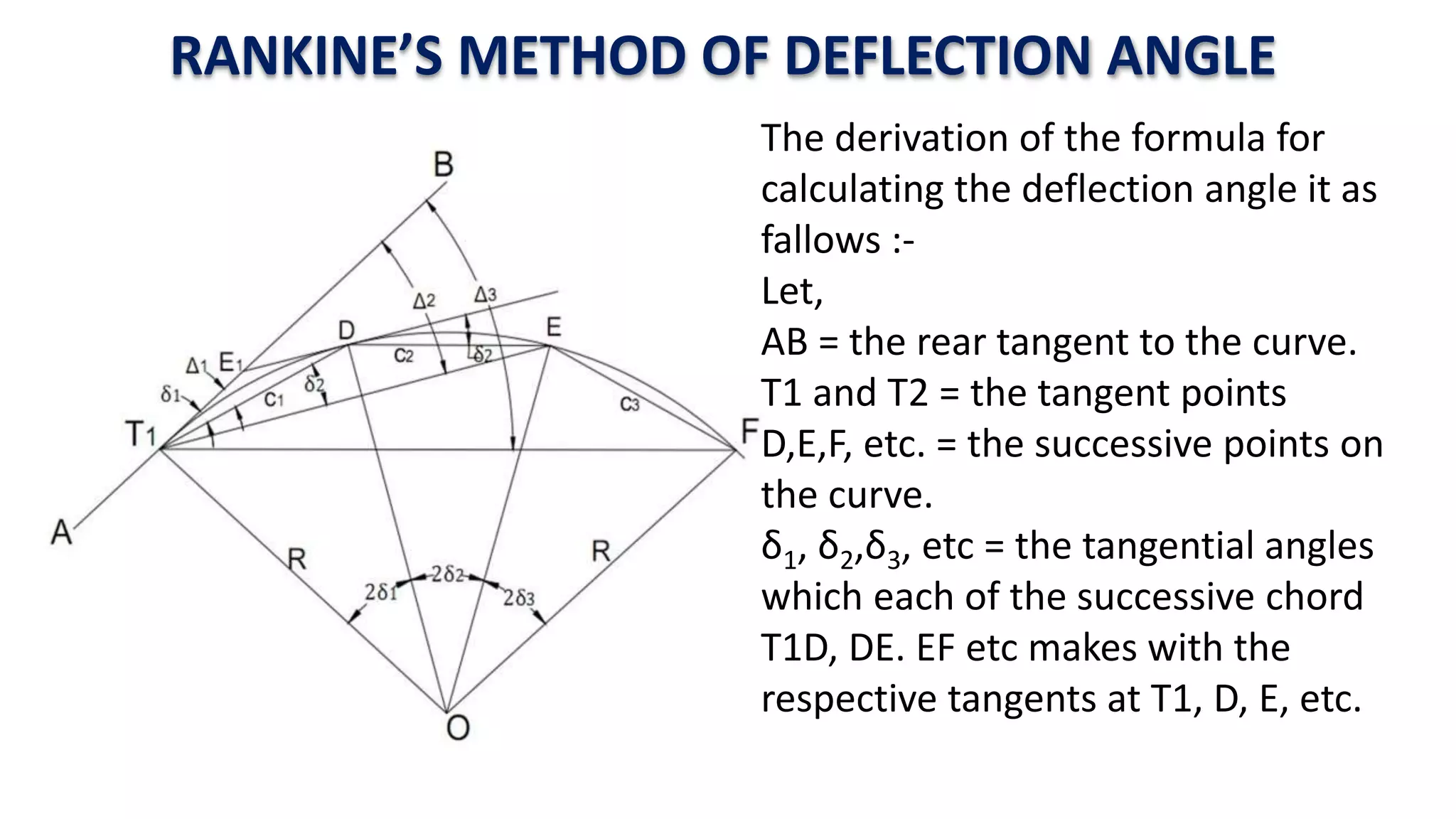
The derivation of the formula for
calculating the deflection angle it as
fallows :-
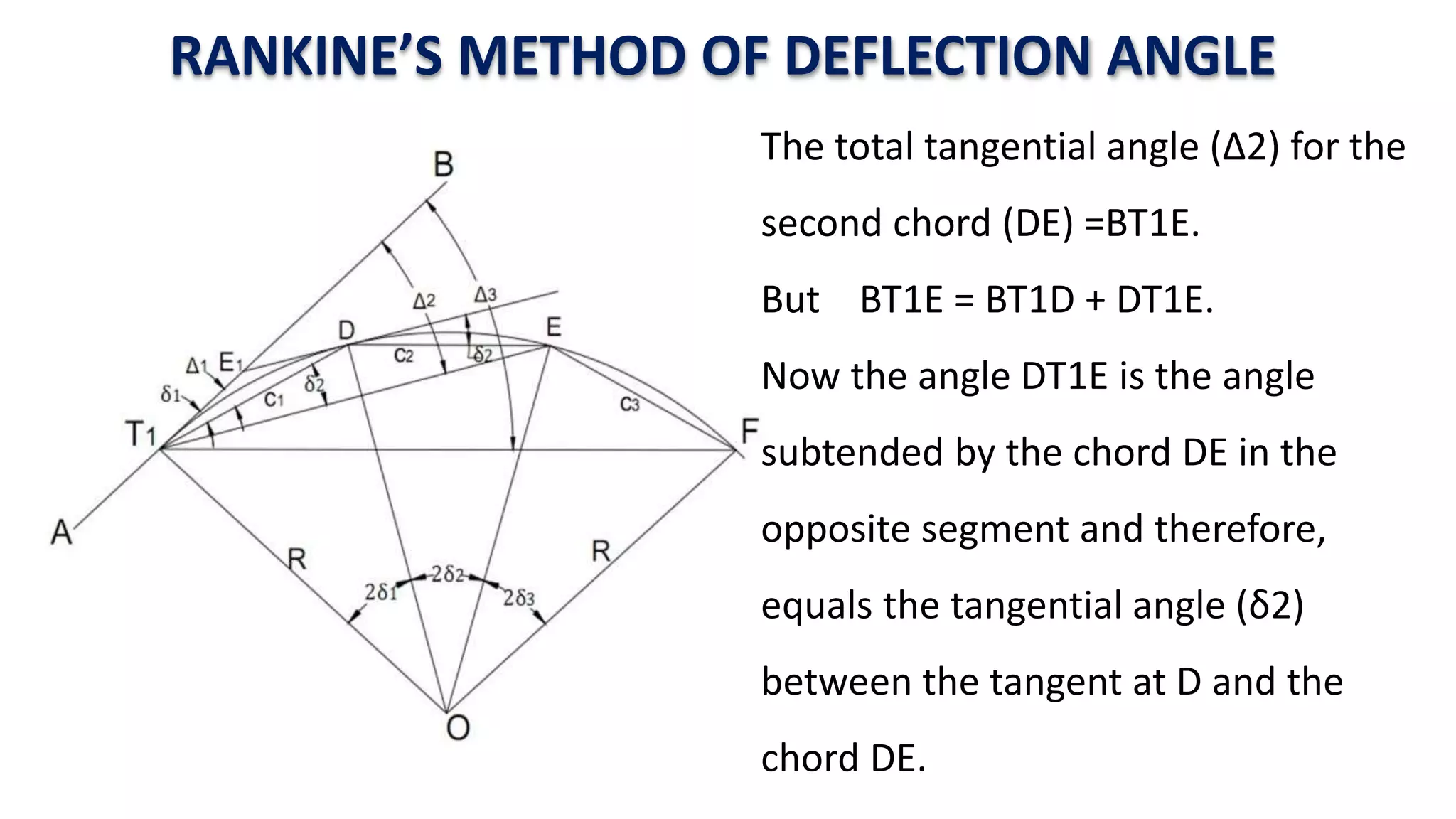
Let,
AB = the rear tangent to the curve.
T1 and T2 = the tangent points
D,E,F, etc. = the successive points on
the curve.
δ1, δ2,δ3, etc = the tangential angles
which each of the successive chord
T1D, DE. EF etc makes with the
respective tangents at T1, D, E, etc.
RANKINE’S METHOD OF DEFLECTION ANGLE
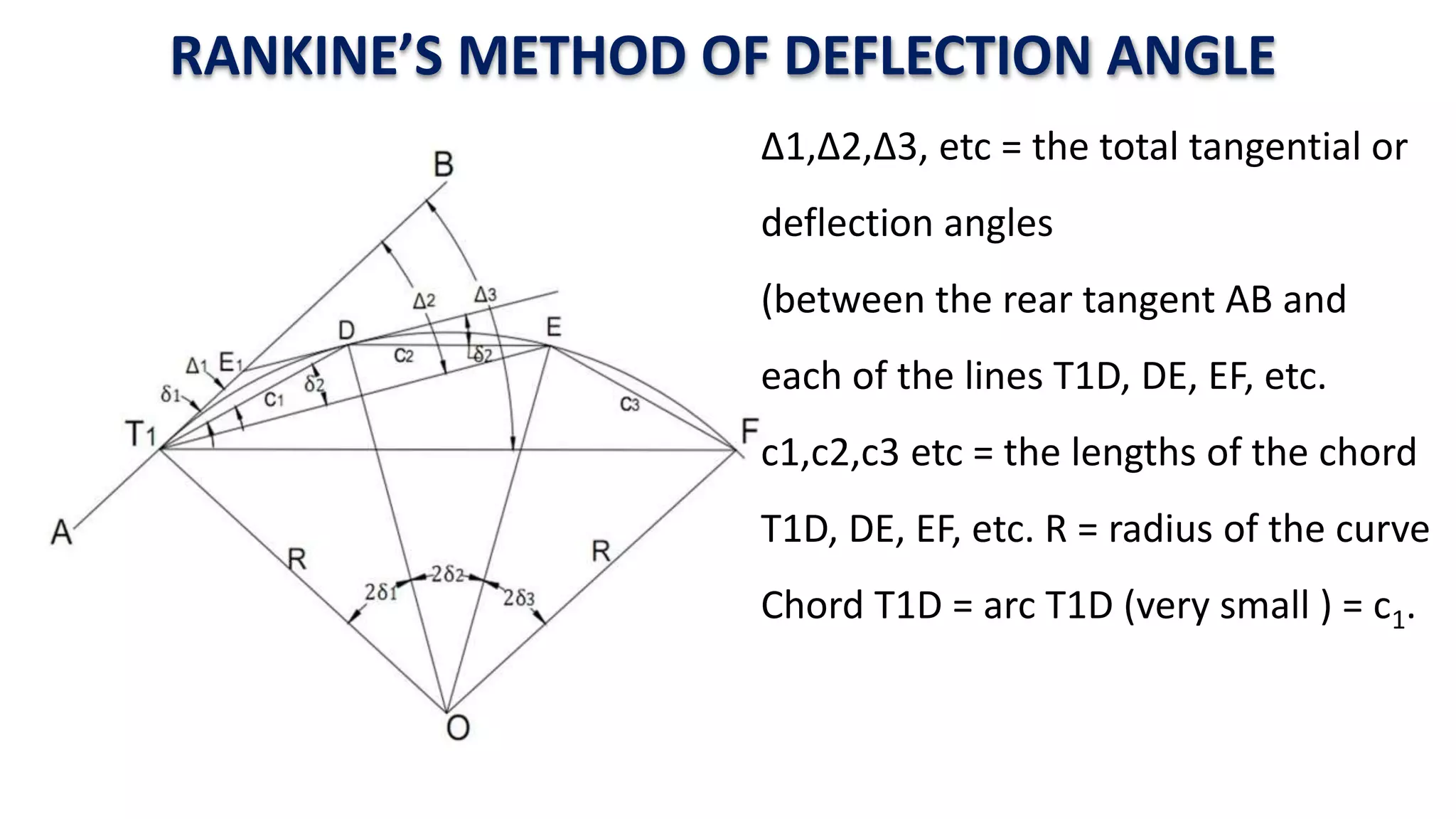
∆1,∆2,∆3, etc = the total tangential or
deflection angles
(between the rear tangent AB and
each of the lines T1D, DE, EF, etc.
c1,c2,c3 etc = the lengths of the chord
T1D, DE, EF, etc. R = radius of the curve
Chord T1D = arc T1D (very small ) = c1.
RANKINE’S METHOD OF DEFLECTION ANGLE
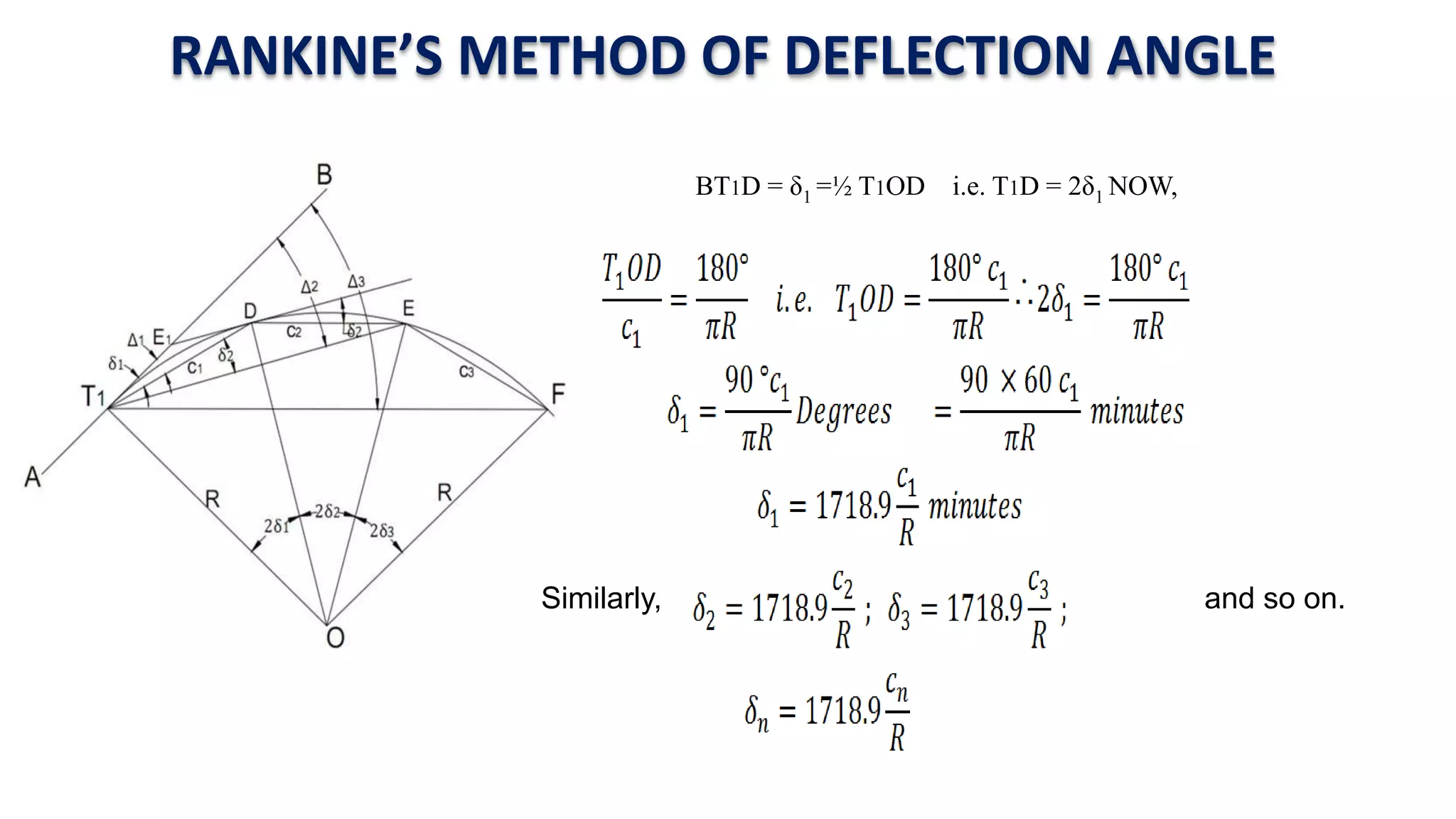
Similarly, and so on.
BT1D = δ1 =½ T1OD i.e. T1D = 2δ1 NOW,
RANKINE’S METHOD OF DEFLECTION ANGLE
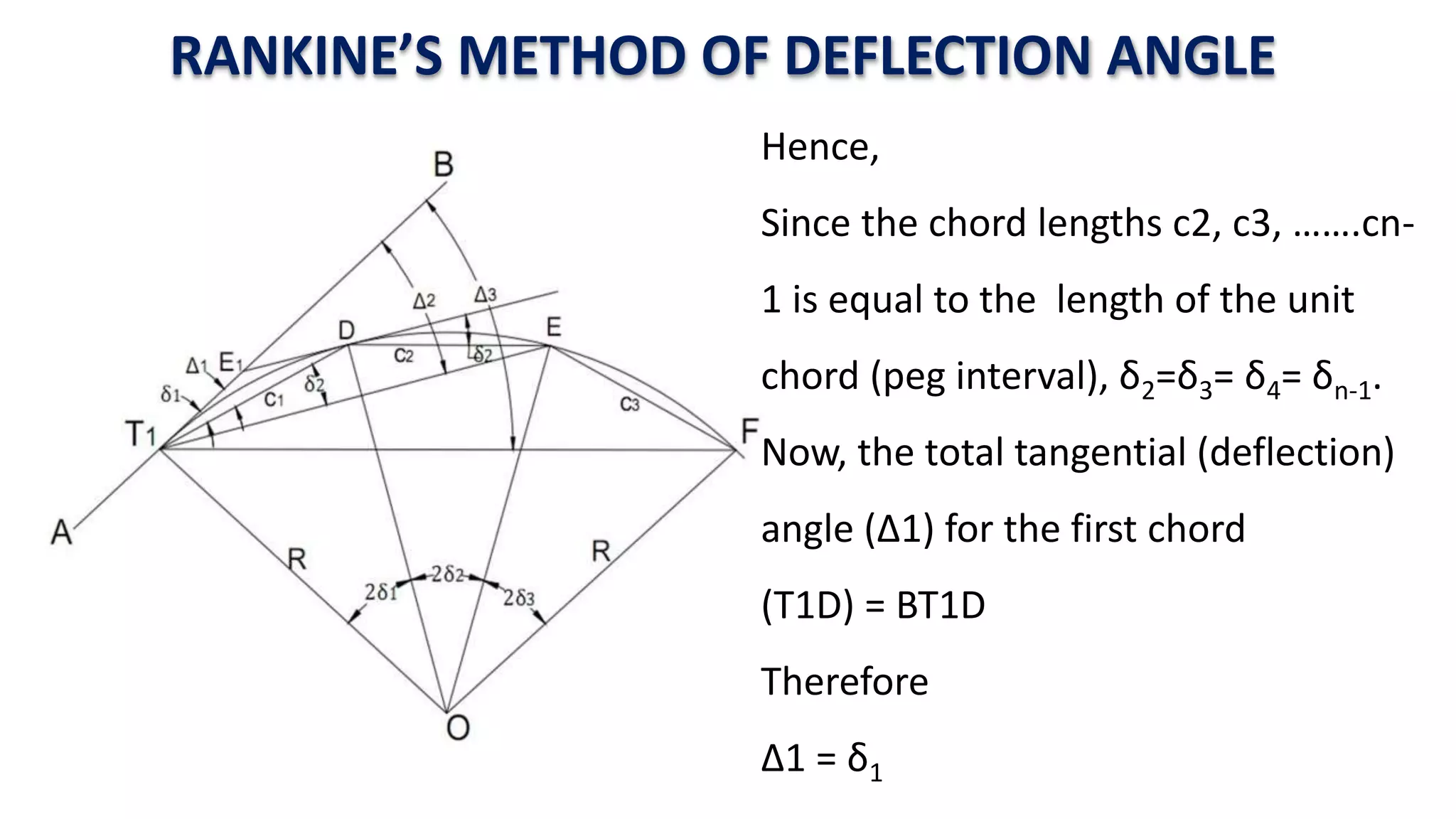
Hence,
Since the chord lengths c2, c3, …….cn-
1 is equal to the length of the unit
chord (peg interval), δ2=δ3= δ4= δn-1.
Now, the total tangential (deflection)
angle (∆1) for the first chord
(T1D) = BT1D
Therefore
∆1 = δ1
RANKINE’S METHOD OF DEFLECTION ANGLE
The total tangential angle (∆2) for the
second chord (DE) =BT1E.
But BT1E = BT1D + DT1E.
Now the angle DT1E is the angle
subtended by the chord DE in the
opposite segment and therefore,
equals the tangential angle (δ2)
between the tangent at D and the
chord DE.
RANKINE’S METHOD OF DEFLECTION ANGLE
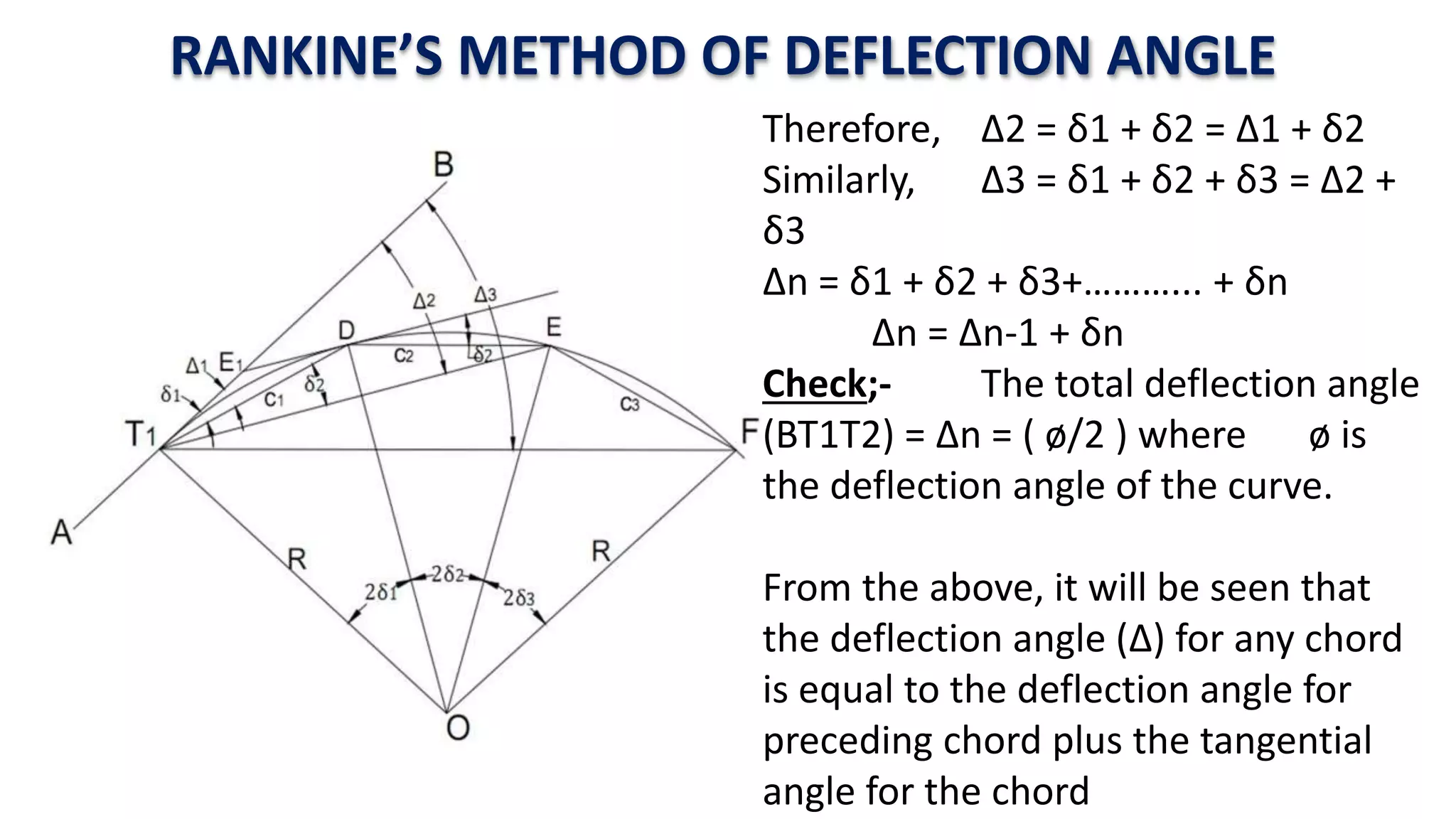
Therefore, ∆2 = δ1 + δ2 = ∆1 + δ2
Similarly, ∆3 = δ1 + δ2 + δ3 = ∆2 +
δ3
∆n = δ1 + δ2 + δ3+………... + δn
∆n = ∆n-1 + δn
Check;- The total deflection angle
(BT1T2) = ∆n = ( ø/2 ) where ø is
the deflection angle of the curve.
From the above, it will be seen that
the deflection angle (∆) for any chord
is equal to the deflection angle for
preceding chord plus the tangential
angle for the chord
RANKINE’S METHOD OF DEFLECTION ANGLE
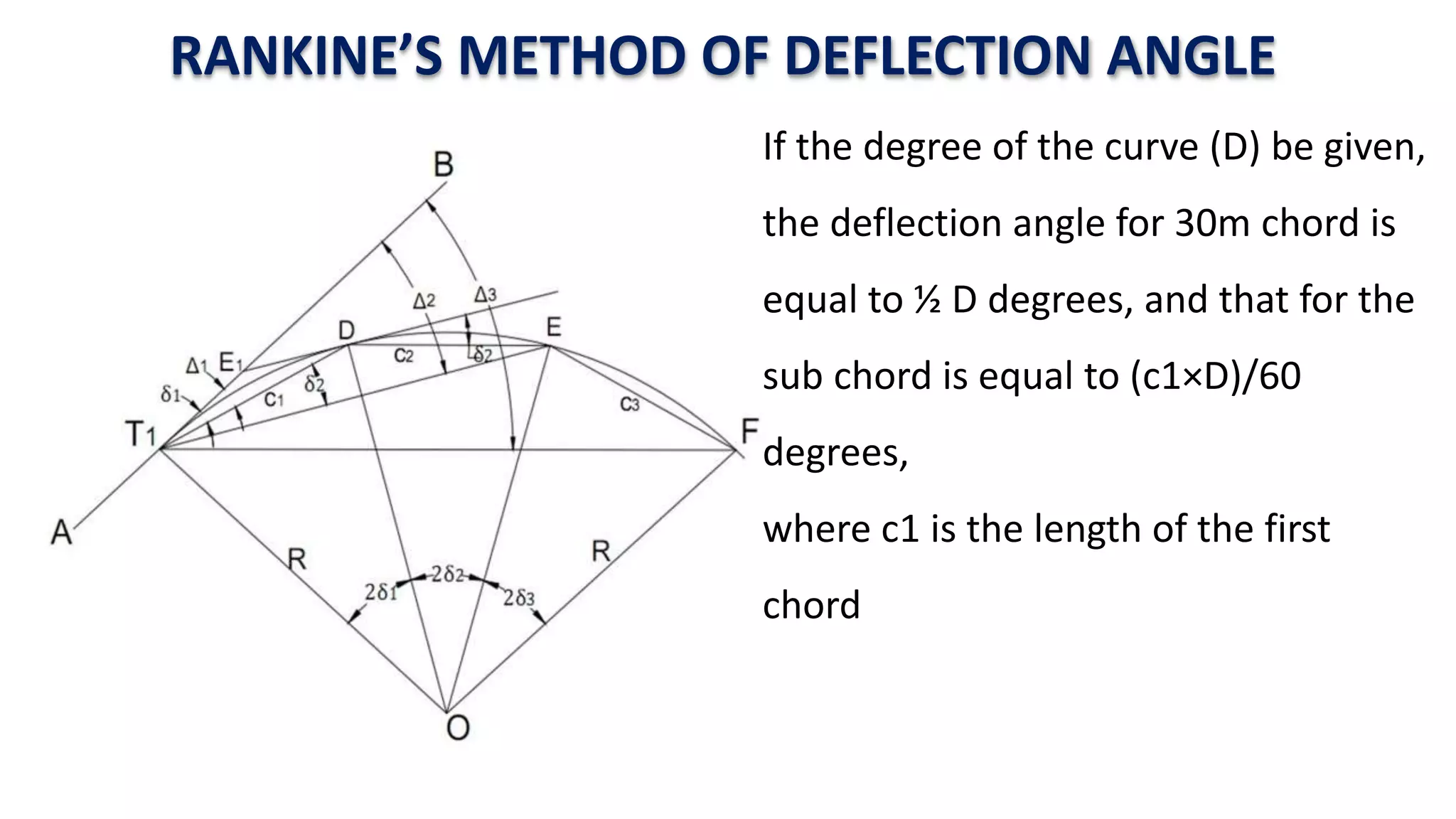
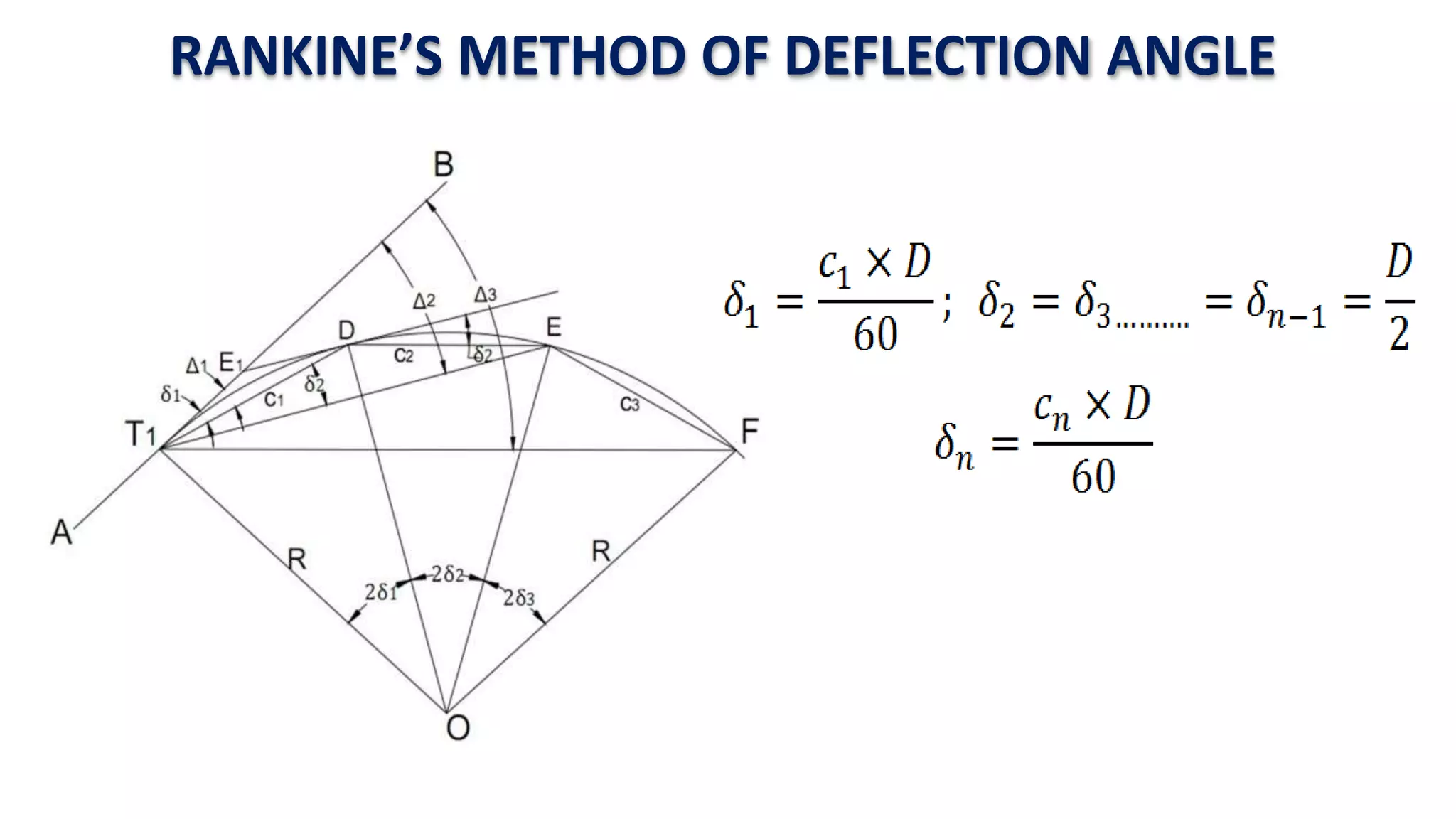
If the degree of the curve (D) be given,
the deflection angle for 30m chord is
equal to ½ D degrees, and that for the
sub chord is equal to (c1×D)/60
degrees,
where c1 is the length of the first
chord
RANKINE’S METHOD OF DEFLECTION ANGLE
Procedure:-
To set out a curve
i. Set up the theodolite over first
tangent point (T1) and level it.
ii. With both plates clamped at zero,
direct the telescope to the ranging rod
at the point of intersection B and
bisect it.
iii. Release the vernier plate and set
the vernier A to first deflection angle
(∆1), the telescope being thus directed
along T1D.
RANKINE’S METHOD OF DEFLECTION ANGLE
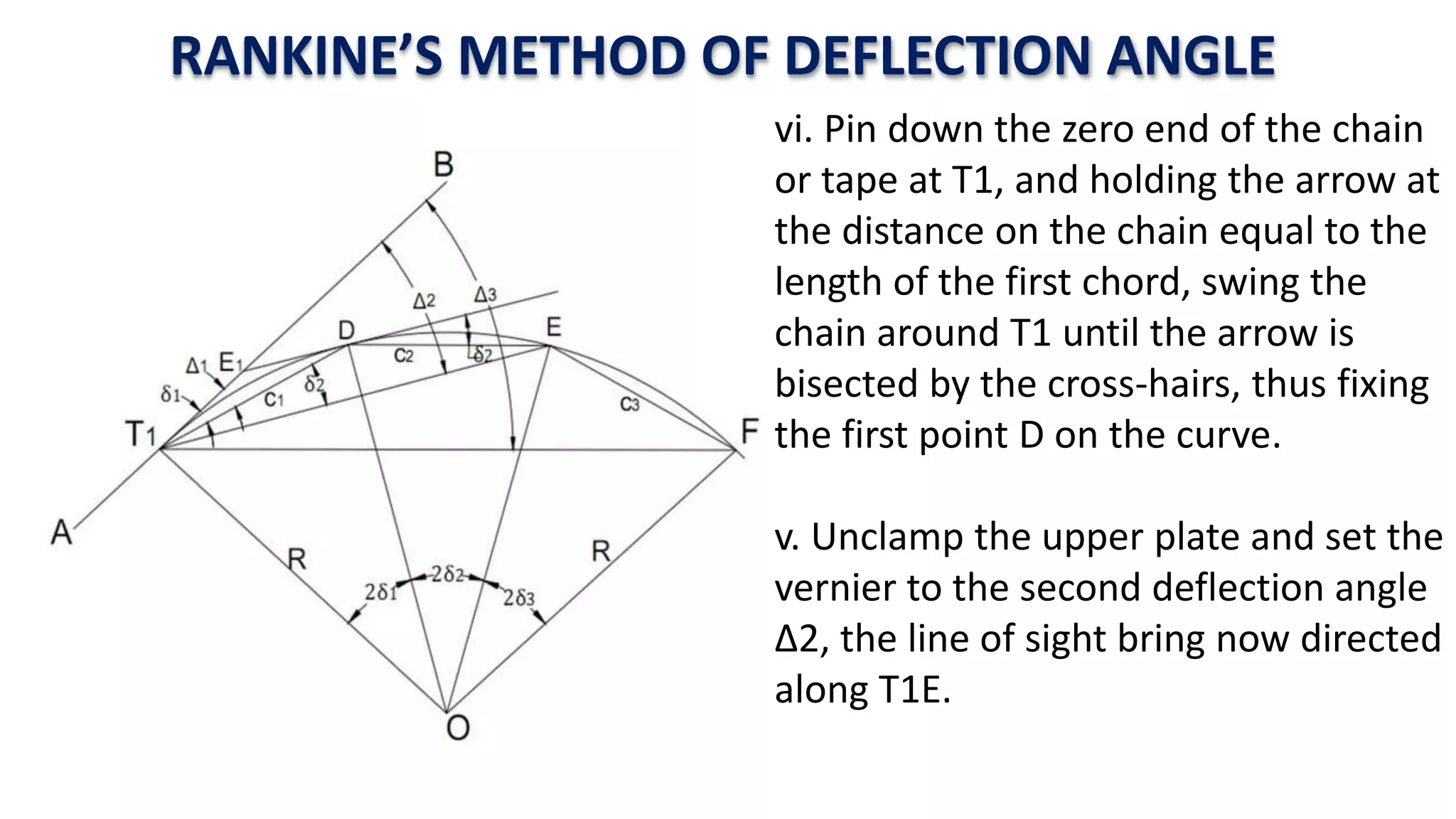
vi. Pin down the zero end of the chain
or tape at T1, and holding the arrow at
the distance on the chain equal to the
length of the first chord, swing the
chain around T1 until the arrow is
bisected by the cross-hairs, thus fixing
the first point D on the curve.
v. Unclamp the upper plate and set the
vernier to the second deflection angle
∆2, the line of sight bring now directed
along T1E.
RANKINE’S METHOD OF DEFLECTION ANGLE
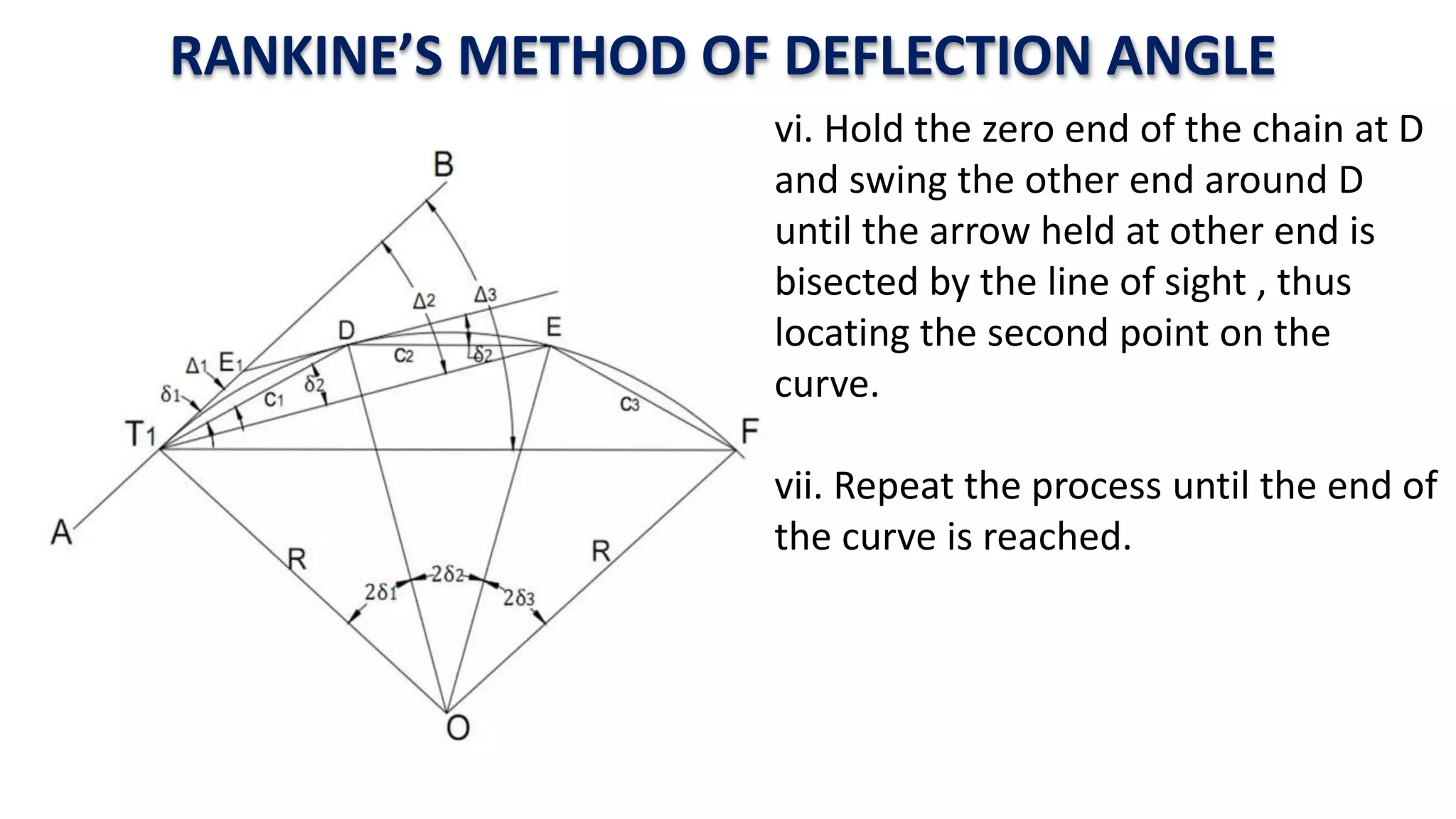
vi. Hold the zero end of the chain at D
and swing the other end around D
until the arrow held at other end is
bisected by the line of sight , thus
locating the second point on the
curve.
vii. Repeat the process until the end of
the curve is reached.
RANKINE’S METHOD OF DEFLECTION ANGLE
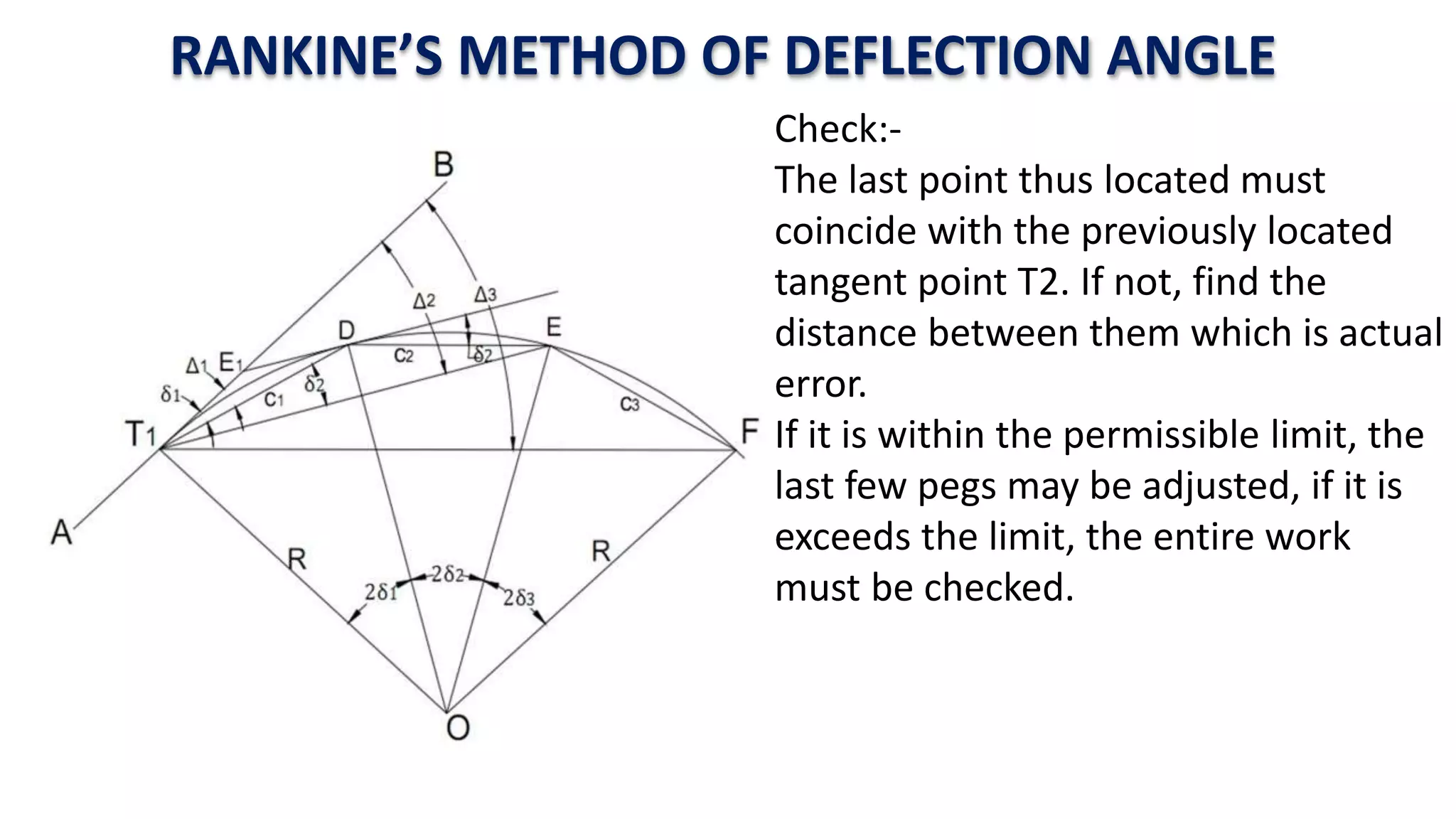
Check:-
The last point thus located must
coincide with the previously located
tangent point T2. If not, find the
distance between them which is actual
error.
If it is within the permissible limit, the
last few pegs may be adjusted, if it is
exceeds the limit, the entire work
must be checked.
Curve setting ppt

Curve setting ppt

  • 1.
  • 2.
    INTRODUCTION Curves are usuallyemployed in lines of communication in order that the change of direction at the intersection of the straight line shall be gradual. The lines connected by the curves are tangential to it and are called as tangents or straights.
  • 3.
    NECESSITY Excessive cutting andfilling can be prevented by providing the change in alignment by curves. The obstruction which came in the way of straight alignment can be made easier by providing by pass with the help of curves In the straight route gradient are made more comfortable and easy providing diversions with help of curves In the straight route costly land comes in the way then it can avoided by providing diversions with the help of curves.
  • 4.
  • 5.
    SIMPLE CIRCULAR CURVE Simplecircular curve consists of single arc connecting two tangents or straight. Simple curve is normally represented by the length of its radius or by the degree of curve
  • 6.
    COMPOUND CURVE A compoundcurve consist of two arcs of different radii curving in the same direction and lying on the same side of their common tangent , their centers being on the same side of the curve.
  • 7.
    REVERSE CURVE A reversecurve is composed of two arcs of equal or different radii bending or curving in opposite direction with common tangent at their junction, their centers being in opposite sides of the curve.
  • 8.
    TRANSITION CURVE A curveof varying radius is known as ‘transition curve’. The radius of such curve varies from infinity to certain fixed value. A transition curve is provided on both ends of the circular curve. The transition curve is also called as spiral or easement curve.
  • 11.
    OBJECTIVES OF PROVIDINGTRANSITION CURVE To accomplish gradually the transition from the tangent to the circular curve, and from the circular curve to the tangent. To obtain a gradual increase of curvature from zero at the tangent point to the specified quantity at the junction of the transition curve with the circular curve. To provide the super elevation gradually from zero at the tangent point to the specified amount on the circular curve To avoid the overturning of the vehicle.
  • 12.
    REQUIREMENTS OF IDEALTRANSITION CURVE It should meet the original straight tangentially It should meet the circular curve tangentially Its radius at the junction with the circular curve should be the same as that of the circular curve The rate of increase of curvature along the transition curve should be same as that of in increase of superelevation The length should be such that the full superelevation is attained at the junction with the circular curve
  • 13.
    LAMNISCATE CURVE It ismostly used in roads when it is required to have curve transitional throughout having no intermediate circular curve Since the curve is symmetrical and transitional throughout the super elevation or cant continuously increases till the apex is reached This may be objectionable in case of railways
  • 14.
    REASONS OF PROVIDINGLAMNISCATE CURVE IN ROADS Its radius of curvature decreases more gradually than circular curve Its rate of increase of curvature diminishes towards the transition curve thus fulfilling the essential condition It corresponds to the autogenous curve of vehicle(i.e. the path actually traced by vehicle when running freely)
  • 15.
  • 17.
    DEGREE OF CURVE Theangle subtended at the center of the circle by a chord of standard length of 30m is known as degree of curve.
  • 18.
    Referring Fig Let R= the radius of the curve in m. D = the degree of curve.— MN = the chord 30 m long. P = Mid point of chord MN In triangle OMP, OM = R, PM = ½MN = 15 m. Then sin D/2 = PM/OM = 15/R Or R = 15(Exact) Sin D/2 RELATION BETWEEN RADIUOS AND DEGREE OF CURVE
  • 19.
    RELATION BETWEEN RADIUOSAND DEGREE OF CURVE When D is small, sin D/2 = D/2 radians R= 15/((D/2)x (Л/180)) R=15/ (ЛD/360) R= 15x360/ ЛD R= 1718.89/D R= 1719/D
  • 20.
    NOTATIONS USED INSIMPLE CIRCULAR CURVE 1. The straight lines AB and BC, which are connected by the curve are called the tangents or straights to the curve. 2. The point B at which the two tangent lines AB and BC intersect is known as the point of intersection (P.I.) or the vertex (V). 3. If the curve deflects to the right of direction of progress of survey (AB), it is called as right hand curve, if to the left , it is called as left hand curve.
  • 21.
    NOTATIONS USED INSIMPLE CIRCULAR CURVE 4. The tangent line AB is called the first tangent or rear tangent (also called the back tangent) The tangent line BC is called as the second tangent or forward tangent. 5. The points (T1 and T2) at which the curve touches the straights are called tangent point(T.P.). 6. The beginning of the curve (T1) Is called the point of curve.(P.C.) or the tangent curve (T.C.). The end of the curve (T2) is known as the point of tangency(P.T.) or the curve tangent(C.T.).
  • 22.
    NOTATIONS USED INSIMPLE CIRCULAR CURVE 7. The ‫ے‬ABC between the tangent lines AB and BC is called the angle of intersection (I). The ‫ے‬B'BC (i.e. the angle by which the forward tangent deflects from the rear tangent) is known as the deflection angle (ø) of the curve. 8. The distance from the point of intersection to the tangent point is called the tangent distance or tangent length. (BT1 and BT2). 9. The line T1T2 joining the two point (T1 and T2) is known as the long chord.(L).
  • 23.
    NOTATIONS USED INSIMPLE CIRCULAR CURVE 10.The arc T1FT2 is called the length of the curve.(l). 11.The mid point F of the arc T1FT2 is known as the apex or the summit of the curve and lies on the bisector of the angle of the intersection. 12. The distance BF from the point of the intersection to the apex of the curve is called the apex distance of external distance.
  • 24.
    NOTATIONS USED INSIMPLE CIRCULAR CURVE 13.The angle T1OT2 subtended at the centre of curve by the arc T1FT2 is known as the central angle, and is equal to the deflection angle.(ø) 14.The intercept EF on the line OB between the apex (F) of the curve and the midpoint (E) of the long chord is called the versed sine of the curve.
  • 25.
    ELEMENTS OF SIMPLECIRCULAR CURVE T1BT2 + B’BT2 = 1800 or I + Ø =1800 ……….…(1) The angle T1OT2 = 1800 - I = Ø ……………(2) Tangent length = BT1 = BT2 = OT1 tan(Ø/2) = R tan(Ø/2) … ..(4) Length of the chord (L) = 2T1E = 2OT1 sin (Ø/2)=2R sin (Ø/2)…(5) Length of the curve(l) = length of the arc T1FT2 = R X Ø (in radians) = ЛR Ø/180°
  • 26.
    ELEMENTS OF SIMPLECIRCULAR CURVE If the curve be designated by the degrees of the curve(D), Length of the curve =(30 Ø)/D (30 m chord) ………….(6a) = (20 Ø)/D (20 m chord) ………....(6b) Apex distance = BF = BO – OF = OT1 sec (Ø/2) – OF
  • 27.
    ELEMENTS OF SIMPLECIRCULAR CURVE Versed sine of the curve = EF = OF – OE=OF – OT1 COS(Ø/2)
  • 28.
    Peg interval :- Itis the usual practice to fix pegs at equal intervalon the curve as along the straight. The interval between the peg is usually 20 to 30 m. strictly speaking this interval must be measured as the arch intercept between them. However as it is necessarily measured along the chord, the curve consist of series of a chord rather than of arcs. In other words, the length of the chord is assume to be equal to be that of the arc.
  • 29.
    Peg interval :- Inorder that the difference in length between the arc and chord may be negligible, the length of the chord should not be more than 1/20th of the radius of the curve.  The length of unit chord (peg interval) is,therefore, 30m for flat curve, 20m for sharp curve, and 10 m or less for very sharp curve. When the curve is of a small radius, the peg interval are considered to be along the arc and the length of the corresponding chords are calculated to locate the pegs.
  • 30.
    METHODS OF SETTINGOUT SIMPLE CIRCULAR CURVE LINEAR METHOD ANGULAR METHOD OFFSET FROM LONG CHORD METHOD RANKINE’SMETHOD OF DEFLECTION ANGLE
  • 31.
    OFFSET FROM LONGCHORD METHOD Let AB and BC = the tangents to the curve T1DT2 T1 and T2 = tangent points T1T2 = the long chord of length L. ED = O0 = the offsets at the midpoint of T1T2 (the versed sine) PQ = Ox = the offsets at a distance x from E so that EP = x OT1 = OT2 = OD = R = The radius of the curve.
  • 32.
    OFFSET FROM LONGCHORD METHOD (R – O0)Ox
  • 33.
    OFFSET FROM LONGCHORD METHOD Given data: Direction of two straights, chainage of point of intersection, radius of curve. Procedure: 1. Set theodolite over B and measure deflection angle Ф 2. Calculate tangent length by formula R x tan (ϕ/2).
  • 34.
    OFFSET FROM LONGCHORD METHOD 3. Locate first tangent T1 point by measuring backward along BA distance equal to tangent length and second tangent point T2 by measuring forward along BC distance equal to tangent length. 4. Divide long chord into even number of equal parts. 5. Calculate ordinates O0 by formula O0 = R – (R2-(L/2)2)0.5 and other ordinates by formula Ox = (R2-X2)0.5 – (R- O0).
  • 35.
    OFFSET FROM LONGCHORD METHOD 6. Locate mid point of long chord ( point E) 7. Chain is laid in ET1 direction; perpendicular is erected at E, and says by optical square, point on curve is fixed by measuring distance O0 along the erected perpendicular. 8. Other offsets are similarly set. 9. Curve being similar about midpoint of long chord, calculations for right half are similar to left half.
  • 36.
    RANKINE’S METHOD OFDEFLECTION ANGLE In this method the curve is set out by the tangential angles(often called the deflection angles) with a theodolite and a chain or tape.
  • 37.
    RANKINE’S METHOD OFDEFLECTION ANGLE The derivation of the formula for calculating the deflection angle it as fallows :- Let, AB = the rear tangent to the curve. T1 and T2 = the tangent points D,E,F, etc. = the successive points on the curve. δ1, δ2,δ3, etc = the tangential angles which each of the successive chord T1D, DE. EF etc makes with the respective tangents at T1, D, E, etc.
  • 38.
    RANKINE’S METHOD OFDEFLECTION ANGLE ∆1,∆2,∆3, etc = the total tangential or deflection angles (between the rear tangent AB and each of the lines T1D, DE, EF, etc. c1,c2,c3 etc = the lengths of the chord T1D, DE, EF, etc. R = radius of the curve Chord T1D = arc T1D (very small ) = c1.
  • 39.
    RANKINE’S METHOD OFDEFLECTION ANGLE Similarly, and so on. BT1D = δ1 =½ T1OD i.e. T1D = 2δ1 NOW,
  • 40.
    RANKINE’S METHOD OFDEFLECTION ANGLE Hence, Since the chord lengths c2, c3, …….cn- 1 is equal to the length of the unit chord (peg interval), δ2=δ3= δ4= δn-1. Now, the total tangential (deflection) angle (∆1) for the first chord (T1D) = BT1D Therefore ∆1 = δ1
  • 41.
    RANKINE’S METHOD OFDEFLECTION ANGLE The total tangential angle (∆2) for the second chord (DE) =BT1E. But BT1E = BT1D + DT1E. Now the angle DT1E is the angle subtended by the chord DE in the opposite segment and therefore, equals the tangential angle (δ2) between the tangent at D and the chord DE.
  • 42.
    RANKINE’S METHOD OFDEFLECTION ANGLE Therefore, ∆2 = δ1 + δ2 = ∆1 + δ2 Similarly, ∆3 = δ1 + δ2 + δ3 = ∆2 + δ3 ∆n = δ1 + δ2 + δ3+………... + δn ∆n = ∆n-1 + δn Check;- The total deflection angle (BT1T2) = ∆n = ( ø/2 ) where ø is the deflection angle of the curve. From the above, it will be seen that the deflection angle (∆) for any chord is equal to the deflection angle for preceding chord plus the tangential angle for the chord
  • 43.
    RANKINE’S METHOD OFDEFLECTION ANGLE If the degree of the curve (D) be given, the deflection angle for 30m chord is equal to ½ D degrees, and that for the sub chord is equal to (c1×D)/60 degrees, where c1 is the length of the first chord
  • 44.
    RANKINE’S METHOD OFDEFLECTION ANGLE
  • 45.
    RANKINE’S METHOD OFDEFLECTION ANGLE Procedure:- To set out a curve i. Set up the theodolite over first tangent point (T1) and level it. ii. With both plates clamped at zero, direct the telescope to the ranging rod at the point of intersection B and bisect it. iii. Release the vernier plate and set the vernier A to first deflection angle (∆1), the telescope being thus directed along T1D.
  • 46.
    RANKINE’S METHOD OFDEFLECTION ANGLE vi. Pin down the zero end of the chain or tape at T1, and holding the arrow at the distance on the chain equal to the length of the first chord, swing the chain around T1 until the arrow is bisected by the cross-hairs, thus fixing the first point D on the curve. v. Unclamp the upper plate and set the vernier to the second deflection angle ∆2, the line of sight bring now directed along T1E.
  • 47.
    RANKINE’S METHOD OFDEFLECTION ANGLE vi. Hold the zero end of the chain at D and swing the other end around D until the arrow held at other end is bisected by the line of sight , thus locating the second point on the curve. vii. Repeat the process until the end of the curve is reached.
  • 48.
    RANKINE’S METHOD OFDEFLECTION ANGLE Check:- The last point thus located must coincide with the previously located tangent point T2. If not, find the distance between them which is actual error. If it is within the permissible limit, the last few pegs may be adjusted, if it is exceeds the limit, the entire work must be checked.