CEE320
Winter2006
Transportation Planning
and Travel Demand Forecasting
CEE 320
Steve Muench
CEE320
Winter2006
Outline
1. Transportation Planning
– Defined
– Transportation Planning Organizations
– Long term plan example
– Short term plan example
2. Travel Demand Forecasting
– 4 step process
CEE320
Winter2006
Transportation Planning
• Transportation planning
– The process to provide the information needed for
decision makers to choose among alternative strategies
for improving transportation system performance.
• Transportation planning is future-oriented
– Uncertainty in predictions
– Balance short-term and long-term benefits
• The problem is not isolated and independent
– Hierarchical structure
– Broad impact and involvements
CEE320
Winter2006
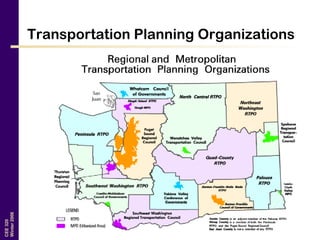
Transportation Planning Organizations
CEE320
Winter2006
Transportation Planning
Long term (strategic) planning
– Very complex
– Based on long-term predictions
– Involves multiple levels of government and administration
• Short to medium term planning
– Less complex
– Reduced uncertainty
– More specific
CEE320
Winter2006
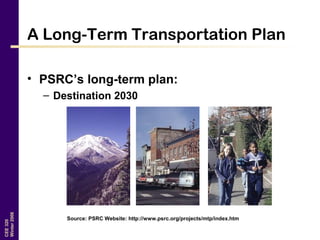
A Long-Term Transportation Plan
Source: PSRC Website: http://www.psrc.org/projects/mtp/index.htm
• PSRC’s long-term plan:
– Destination 2030
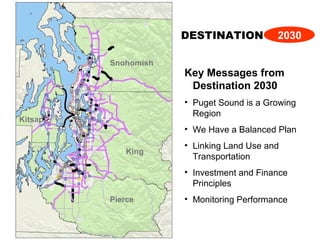
Key Messages from
Destination 2030
• Puget Sound is a Growing
Region
• We Have a Balanced Plan
• Linking Land Use and
Transportation
• Investment and Finance
Principles
• Monitoring Performance
DESTINATION 2030
Snohomish
Kitsap
King
Pierce
CEE320
Winter2006
A Long-Term Transportation Plan
• Destination 2030 is comprehensive:
– Identifies over 2,200 specific projects that have
been designed to result in improved roads,
transit, and ferry service.
– Over 2000 miles of new and improved regional
state roadways.
– More than 2000 miles of new walkways and
bikeways to connect communities with transit,
shopping, and services.
– Incentives to better transit service, carpools,
etc.
CEE320
Winter2006
A Long-Term Transportation Plan
• Programs:
– State Ferry and Highway Programs
– Local Transit
– Seattle Monorail
– Regional Transit
– Non-motorized
– Freight
– Aviation
More information at:http://www.psrc.org/projects/mtp/d2030plan.htm
CEE320
Winter2006
A Short-Term Transportation Plan
• SR 520
– Freeway bottleneck
– Old and at end of useful life
CEE320
Winter2006
A Short-Term Transportation Plan
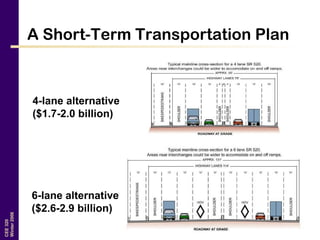
4-lane alternative
($1.7-2.0 billion)
6-lane alternative
($2.6-2.9 billion)
CEE320
Winter2006
A Short-Term Transportation Plan
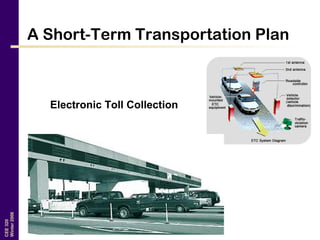
Electronic Toll Collection
CEE320
Winter2006
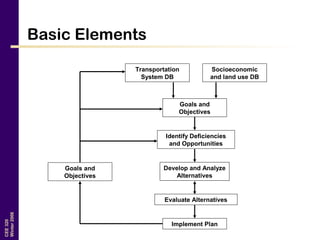
Basic Elements
Transportation
System DB
Socioeconomic
and land use DB
Goals and
Objectives
Identify Deficiencies
and Opportunities
Develop and Analyze
Alternatives
Evaluate Alternatives
Implement Plan
Goals and
Objectives
CEE320
Winter2006
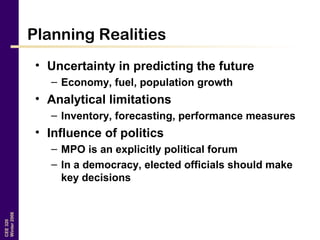
Planning Realities
• Uncertainty in predicting the future
– Economy, fuel, population growth
• Analytical limitations
– Inventory, forecasting, performance measures
• Influence of politics
– MPO is an explicitly political forum
– In a democracy, elected officials should make
key decisions
CEE320
Winter2006
Travel Demand Forecasting
CEE320
Winter2006
Need for Travel Demand Forecasting
• Impacts of facilities or modes of travel
– Lines on existing roads
– Roads
– Light rail
– Bus service
• Geometric design
• Pavement design
CEE320
Winter2006
Traveler Decisions
• Types of decisions
– Time (when do you go?)
– Destination (where do you go?)
– Mode (how do you get there?)
– Route choice (what route do you choose?)
• Influences
– Economic
– Social
CEE320
Winter2006
Predicting Travel Decisions
• Collect data on travel behavior
– Observation (number of buses, cars, bikes, etc.)
– Surveys
• Collect data on what travelers have done
• Collect data on their values and choices (utility)
• Inexact nature of prediction
– Incomplete data
– Reporting problems
CEE320
Winter2006
Travel Demand Forecasting
• Divide process into 4 steps:
– Trip Generation
– Trip Distribution
– Mode Split
– Trip Assignment
• We will explore further:
– Trip generation Poisson models
– Mode choice logit models
– Trip assignment route choice models
CEE320
Winter2006
Trip Generation
• Relates the number of trips being produced from
a zone or site by time period to the land use and
demographic characteristics found at that
location.
• Assumptions:
– Trip-making is a function of land use
– Trips are made for specific purposes
– Different trip types are made at different times of the day
– Travelers have options available to them
– Trips are made to minimize inconvenience
– System modeling is based on Traffic Analysis Zones
and networks
• Poisson model often used
CEE320
Winter2006
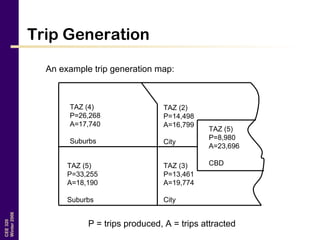
Trip Generation
TAZ (4)
P=26,268
A=17,740
Suburbs
TAZ (5)
P=33,255
A=18,190
Suburbs
TAZ (2)
P=14,498
A=16,799
City
TAZ (3)
P=13,461
A=19,774
City
TAZ (5)
P=8,980
A=23,696
CBD
P = trips produced, A = trips attracted
An example trip generation map:
CEE320
Winter2006
Trip Distribution
• Connect trip origins and destinations
estimated by the trip generation models
• Different trip distribution models are
developed for each of the trip purposes for
which trip generation has been estimated
• Most common model in practice is the
"gravity model"
CEE320
Winter2006
Gravity Models
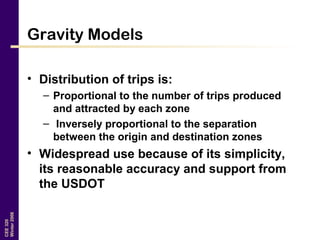
• Distribution of trips is:
– Proportional to the number of trips produced
and attracted by each zone
– Inversely proportional to the separation
between the origin and destination zones
• Widespread use because of its simplicity,
its reasonable accuracy and support from
the USDOT
CEE320
Winter2006
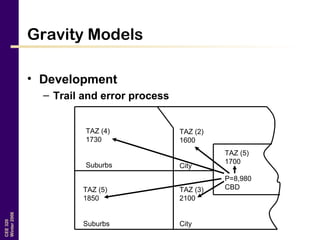
Gravity Models
• Development
– Trail and error process
TAZ (4)
1730
Suburbs
TAZ (5)
1850
Suburbs
TAZ (2)
1600
City
TAZ (3)
2100
City
TAZ (5)
1700
P=8,980
CBD
CEE320
Winter2006
Trip Distribution










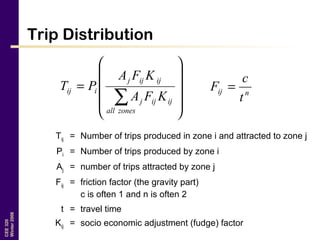
=
∑zonesall
ijijj
ijijj
iij
KFA
KFA
PT
Tij = Number of trips produced in zone i and attracted to zone j
Pi = Number of trips produced by zone i
Aj = number of trips attracted by zone j
Fij = friction factor (the gravity part)
c is often 1 and n is often 2
t = travel time
Kij = socio economic adjustment (fudge) factor
nij
t
c
F =
CEE320
Winter2006
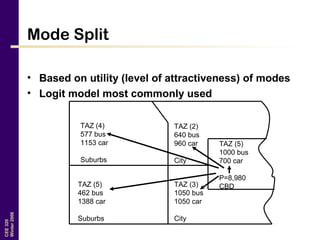
Mode Split
• Based on utility (level of attractiveness) of modes
• Logit model most commonly used
TAZ (4)
577 bus
1153 car
Suburbs
TAZ (5)
462 bus
1388 car
Suburbs
TAZ (2)
640 bus
960 car
City
TAZ (3)
1050 bus
1050 car
City
TAZ (5)
1000 bus
700 car
P=8,980
CBD
CEE320
Winter2006
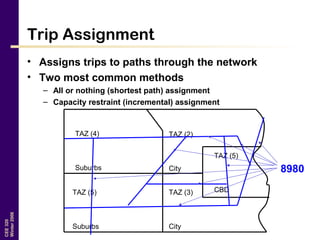
Trip Assignment
• Assigns trips to paths through the network
• Two most common methods
– All or nothing (shortest path) assignment
– Capacity restraint (incremental) assignment
TAZ (4)
Suburbs
TAZ (5)
Suburbs
TAZ (2)
City
TAZ (3)
City
TAZ (5)
CBD
8980
CEE320
Winter2006
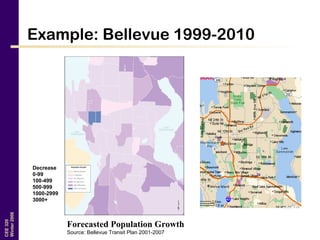
Example: Bellevue 1999-2010
Forecasted Population Growth
Source: Bellevue Transit Plan 2001-2007
Decrease
0-99
100-499
500-999
1000-2999
3000+
CEE320
Winter2006
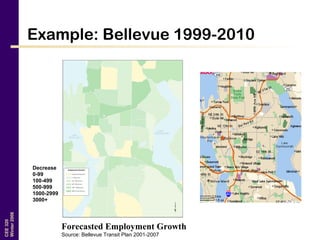
Example: Bellevue 1999-2010
Forecasted Employment Growth
Source: Bellevue Transit Plan 2001-2007
Decrease
0-99
100-499
500-999
1000-2999
3000+
CEE320
Winter2006
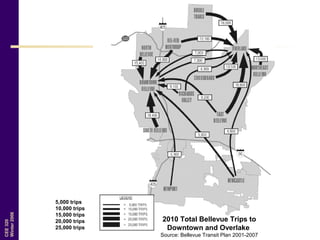
5,000 trips
10,000 trips
15,000 trips
20,000 trips
25,000 trips
2010 Total Bellevue Trips to
Downtown and Overlake
Source: Bellevue Transit Plan 2001-2007
CEE320
Winter2006
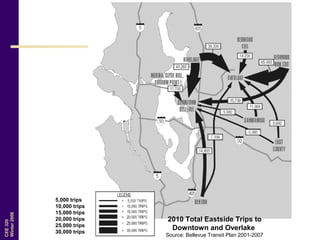
5,000 trips
10,000 trips
15,000 trips
20,000 trips
25,000 trips
30,000 trips
2010 Total Eastside Trips to
Downtown and Overlake
Source: Bellevue Transit Plan 2001-2007
CEE320
Winter2006
Primary References
• Mannering, F.L.; Kilareski, W.P. and Washburn, S.S. (2003). Principles
of Highway Engineering and Traffic Analysis, Third Editio. Chapter 8
• Transportation Engineering Online Lab Manual (2000). Oregon State
University, Portland State University, Idaho University.
http://www.webs1.uidaho.edu/niatt_labmanual/index.htm

Transportation Planning & Travel Demand Forecasting (Transportation Engineering)

Editor's Notes

  • #5 Federal transportation legislation requires that a Metropolitan Planning Organization (MPO) be designated for each urbanized area with a population of more than 50,000 people in order to carry out the metropolitan transportation planning process, as a condition of Federal aid. In 1990, the Washington State Legislature passed the Growth Management Act (ESHB 2929) authorizing the Regional Transporaton Planning Program. This program allows for the formation of Regional Transportation Planning Organizations (RTPOs). The primary functions of RTPOs are to develop regional plans and policies for transportation, growth management, environmental quality, and other topics determined by the RTPO; provide data and analysis to support local and regional decision making; build community consensus on regional issues through information and citizen involvement; build intergovernmental consensus on regional plans, policies and issues, and advocate local implementation; and provide planning and technical services on a contractual basis. --source: http://www.wsdot.wa.gov/ppsc/planning/WhatRTPO.htm
  • #6 Short term plan tends to place no great demands on construction activities and therefore has no large capital requirements. The scale of the problem usually is quite limited and the analysis and evaluation, while being detailed, are usually simple in structure. This type of problem comes under the generic term Transportation systems management (TSM).
  • #7 The Puget Sound Regional Council is an association of cities, towns, counties, ports, and state agencies that serves as a forum for developing policies and making decisions about regional growth and transportation issues in the four-county (Pierce, King, Snohomish and Kitsap) central Puget Sound region What is a Highway of Statewide Significance? The Revised Code of Washington (RCW) sets minimal criteria for HSS designation:  “This statewide system shall include at a minimum interstate highways and other statewide principal arterials that are needed to connect major communities across the state and support the state’s economy.” The Washington State Transportation Commission expanded the criteria, an HSS roadway must also be: A State Highway; A Principal Arterial that is part of the National Highway System (NHS); Rural routes serving statewide travel; and/or Urban routes that are: Statewide travel links to Rural HSS, Connections to Principal Arterial Ferry Routes, Long haul freight links - FGTS Class T1 and T2, and Connections to ports - FGTS Class T1 and T2.   Designation of a route as HSS means: Higher priority for improvement funding; State has authority for setting level-of-service (LOS); Highway segment is exempt from local transportation concurrency requirements; Identified as an essential public facility; Consideration for primary funding by a the RTID.
  • #8 <number> Our region’s growth is constrained by water on one side, mountains on the other, and things like wetlands and earthquake fault lines in between. Transportation answers aren’t simple or cheap. Custom fit: The beauty of Destination 2030 is it’s custom fit to our region – not just our topography but our cities, towns and neighborhoods. So in the end we can grow but still maintain our natural environment and quality of life.
  • #12 The WSDOT team studied potential I-5 improvements to accommodate SR 520 traffic from the 8-Lane Alternative through downtown Seattle. Project investigations found that I-5, already over capacity, would be unable to handle traffic from the 8-Lane Alternative without considerable improvements. The 8-Lane Alternative will be in the SR 520 Bridge Replacement and HOV Project Draft EIS as a traffic/engineering appendix. Further environmental analysis of the 8-Lane Alternative will not be included in the Draft EIS. The 8-Lane Alternative may be further evaluated if the I-5 study identifies operational improvements on I-5 that would accommodate the SR 520 8-Lane Alternative.
  • #13 WSDOT is assuming tolls to be a future means of funding the project. The Regional Transportation Investment District (RTID) - made up of King, Pierce and Snohomish counties - is also developing a potential long-term funding package for approval by the voters.
  • #22 Trip productions and attractions are computed for each zone by land use Trip Purposes HBW – Home based work trip HBNW – Home based nonwork trip NHB – Non-home based trip Usually computed using trip generation rates
  • #29 The legend is not recognizable, but the numbers are not important here. Basically the darker the color, the bigger the growth.
  • #30 The legends are not recognizable, but the numbers are not important here. Basically the darker the color, the bigger the growth.
  • #31 The legends are not recognizable, but the numbers are not important here. Basically the darker the color, the bigger the growth.