Effective Stress
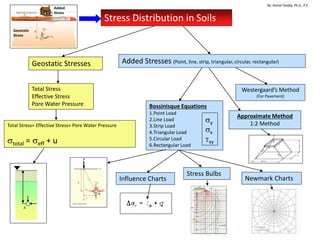
Geostatic Stresses
Total Stress
Effective Stress
Pore Water Pressure
Total Stress= Effective Stress+ Pore Water Pressure
stotal = seff + u
Bossinisque Equations
1.Point Load
2.Line Load
3.Strip Load
4.Triangular Load
5.Circular Load
6.Rectangular Load
Added Stresses (Point, line, strip, triangular, circular, rectangular)
Stress Distribution in Soils
Influence Charts Newmark Charts
Stress Bulbs
Westergaard’s Method
(For Pavement)
Approximate Method
1:2 Method
A
By: Kamal Tawfiq, Ph.D., P.E
Added
Stress
Geostatic
Stress
sy
sx
txy
Introduction
• Water may influence the nature of the mineral surface
chemically and consequently affect the bonding forces
between adjacent soil grain. This kind of interaction between
the soil and water is called chemical interaction.
• The other kind of interaction is physical interaction between
solid and water.
• Volume of the soil skeleton as a whole can change due to the
rearrangement of the soil particles into new positions mainly
by rolling and sliding due to force acting between particle.
This physical interaction is studied when we study the
effective stress concept.
• Effective stress concept was developed by Terzaghi.
• Effective stress concept applies to a fully saturated
soil and relates three types of stress
– Total Stress
– Neutral Stress
– Effective Stress
Total Stress
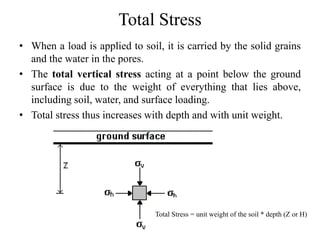
• When a load is applied to soil, it is carried by the solid grains
and the water in the pores.
• The total vertical stress acting at a point below the ground
surface is due to the weight of everything that lies above,
including soil, water, and surface loading.
• Total stress thus increases with depth and with unit weight.
Total Stress = unit weight of the soil * depth (Z or H)
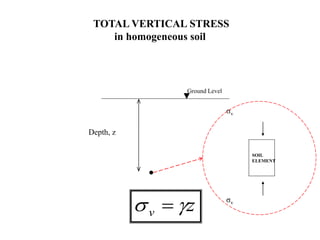
TOTAL VERTICAL STRESS
in homogeneous soil
z
v 
s 
Ground Level
Depth, z
SOIL
ELEMENT
σv
σv
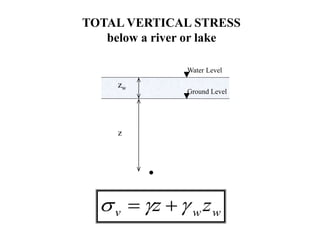
TOTAL VERTICAL STRESS
below a river or lake
w
w
v z
z 

s 

Ground Level
z
Water Level
zw
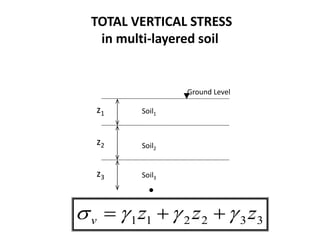
3
3
2
2
1
1 z
z
z
v 


s 


Ground Level
z1 Soil1
z2 Soil2
Soil3
z3
TOTAL VERTICAL STRESS
in multi-layered soil
TOTAL VERTICAL STRESS
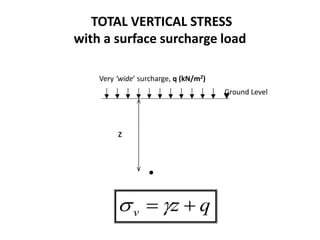
with a surface surcharge load
q
z
v 
 
s
Ground Level
z
Very ‘wide’ surcharge, q (kN/m2)
Pore Water Pressure
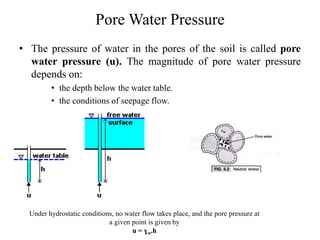
• The pressure of water in the pores of the soil is called pore
water pressure (u). The magnitude of pore water pressure
depends on:
• the depth below the water table.
• the conditions of seepage flow.
Under hydrostatic conditions, no water flow takes place, and the pore pressure at
a given point is given by
u = ɣw.h
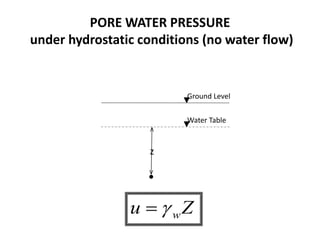
Ground Level
Water Table
z
Z
u w


PORE WATER PRESSURE
under hydrostatic conditions (no water flow)
Effective Stress
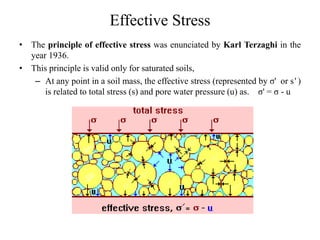
• The principle of effective stress was enunciated by Karl Terzaghi in the
year 1936.
• This principle is valid only for saturated soils,
– At any point in a soil mass, the effective stress (represented by σ' or s' )
is related to total stress (s) and pore water pressure (u) as. σ' = σ - u
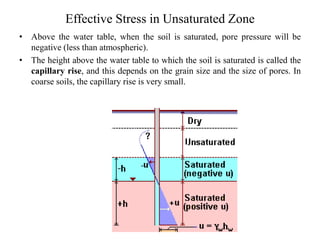
Effective Stress in Unsaturated Zone
• Above the water table, when the soil is saturated, pore pressure will be
negative (less than atmospheric).
• The height above the water table to which the soil is saturated is called the
capillary rise, and this depends on the grain size and the size of pores. In
coarse soils, the capillary rise is very small.
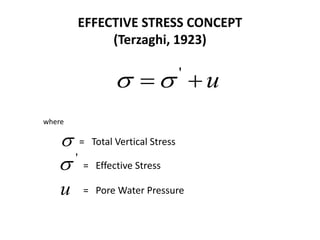
EFFECTIVE STRESS CONCEPT
(Terzaghi, 1923)
u

 '
s
s
s
where
= Total Vertical Stress
'
s = Effective Stress
u = Pore Water Pressure
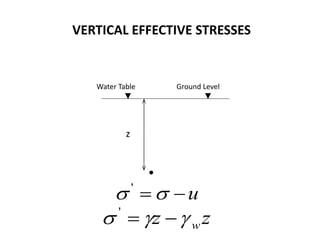
VERTICAL EFFECTIVE STRESSES
z
z w


s 

'
Ground Level
z
Water Table
u

 s
s '
Salient points about Effective Stress
• It should be noted that some times effective stress is also
called as intergannular stress (
𝐼𝑛𝑡𝑒𝑟𝑔𝑎𝑛𝑛𝑢𝑙𝑎𝑟 𝑓𝑜𝑟𝑐𝑒
𝐶𝑜𝑛𝑡𝑎𝑐𝑡 𝑎𝑟𝑒𝑎
) which is not
actually true.
• The actual contact stress or intergannular stress is very large,
as the contact area between the particles is very small.
Effective stress is an imaginary parameter which is sum of the
contact force divided by the gross area. This is the reason why
effective stress is not measured, hence it is not a physical
parameter.
• Effective stress is a function of normal force acting at the
contact points of grains and pore pressure.
• Effective Stress can only be computed by subtracting pore
water pressure form the total stress , both of which are
physical parameters.
• Even though Effective stress is not a measurable quantity, it is
very important parameter in soil mechanics, because Effective
stress is a parameter on which compressibility, consolidation,
settlements, shear stress and bearing capacity depends. These
parameters do not depend on total stress directly.
• Incase of clay mineral particles in soil mass, mineral crystals
are not in direct contact, since they are surrounded by absorbed
layer of water. But it is observed that inter – granular force can
be transformed through the absorbed layer.
• The principal of effective stress is valid for coarse grained and
clayey soils.
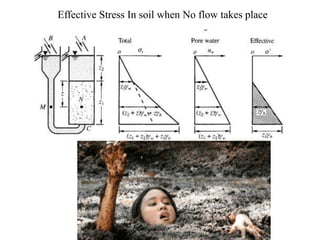
Effective Stress In soil when No flow takes place
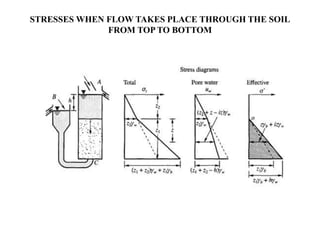
STRESSES WHEN FLOW TAKES PLACE THROUGH THE SOIL
FROM TOP TO BOTTOM
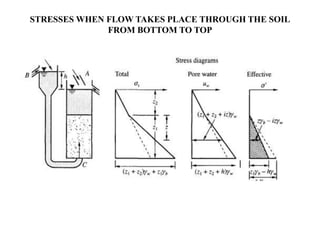
STRESSES WHEN FLOW TAKES PLACE THROUGH THE SOIL
FROM BOTTOM TO TOP

Effective stress

  • 1.
  • 2.
    Geostatic Stresses Total Stress EffectiveStress Pore Water Pressure Total Stress= Effective Stress+ Pore Water Pressure stotal = seff + u Bossinisque Equations 1.Point Load 2.Line Load 3.Strip Load 4.Triangular Load 5.Circular Load 6.Rectangular Load Added Stresses (Point, line, strip, triangular, circular, rectangular) Stress Distribution in Soils Influence Charts Newmark Charts Stress Bulbs Westergaard’s Method (For Pavement) Approximate Method 1:2 Method A By: Kamal Tawfiq, Ph.D., P.E Added Stress Geostatic Stress sy sx txy
  • 3.
    Introduction • Water mayinfluence the nature of the mineral surface chemically and consequently affect the bonding forces between adjacent soil grain. This kind of interaction between the soil and water is called chemical interaction. • The other kind of interaction is physical interaction between solid and water. • Volume of the soil skeleton as a whole can change due to the rearrangement of the soil particles into new positions mainly by rolling and sliding due to force acting between particle. This physical interaction is studied when we study the effective stress concept.
  • 4.
    • Effective stressconcept was developed by Terzaghi. • Effective stress concept applies to a fully saturated soil and relates three types of stress – Total Stress – Neutral Stress – Effective Stress
  • 5.
    Total Stress • Whena load is applied to soil, it is carried by the solid grains and the water in the pores. • The total vertical stress acting at a point below the ground surface is due to the weight of everything that lies above, including soil, water, and surface loading. • Total stress thus increases with depth and with unit weight. Total Stress = unit weight of the soil * depth (Z or H)
  • 6.
    TOTAL VERTICAL STRESS inhomogeneous soil z v  s  Ground Level Depth, z SOIL ELEMENT σv σv
  • 7.
    TOTAL VERTICAL STRESS belowa river or lake w w v z z   s   Ground Level z Water Level zw
  • 8.
    3 3 2 2 1 1 z z z v    s   Ground Level z1 Soil1 z2 Soil2 Soil3 z3 TOTAL VERTICAL STRESS in multi-layered soil
  • 9.
    TOTAL VERTICAL STRESS witha surface surcharge load q z v    s Ground Level z Very ‘wide’ surcharge, q (kN/m2)
  • 10.
    Pore Water Pressure •The pressure of water in the pores of the soil is called pore water pressure (u). The magnitude of pore water pressure depends on: • the depth below the water table. • the conditions of seepage flow. Under hydrostatic conditions, no water flow takes place, and the pore pressure at a given point is given by u = ɣw.h
  • 11.
    Ground Level Water Table z Z uw   PORE WATER PRESSURE under hydrostatic conditions (no water flow)
  • 12.
    Effective Stress • Theprinciple of effective stress was enunciated by Karl Terzaghi in the year 1936. • This principle is valid only for saturated soils, – At any point in a soil mass, the effective stress (represented by σ' or s' ) is related to total stress (s) and pore water pressure (u) as. σ' = σ - u
  • 13.
    Effective Stress inUnsaturated Zone • Above the water table, when the soil is saturated, pore pressure will be negative (less than atmospheric). • The height above the water table to which the soil is saturated is called the capillary rise, and this depends on the grain size and the size of pores. In coarse soils, the capillary rise is very small.
  • 14.
    EFFECTIVE STRESS CONCEPT (Terzaghi,1923) u   ' s s s where = Total Vertical Stress ' s = Effective Stress u = Pore Water Pressure
  • 15.
    VERTICAL EFFECTIVE STRESSES z zw   s   ' Ground Level z Water Table u   s s '
  • 16.
    Salient points aboutEffective Stress • It should be noted that some times effective stress is also called as intergannular stress ( 𝐼𝑛𝑡𝑒𝑟𝑔𝑎𝑛𝑛𝑢𝑙𝑎𝑟 𝑓𝑜𝑟𝑐𝑒 𝐶𝑜𝑛𝑡𝑎𝑐𝑡 𝑎𝑟𝑒𝑎 ) which is not actually true. • The actual contact stress or intergannular stress is very large, as the contact area between the particles is very small. Effective stress is an imaginary parameter which is sum of the contact force divided by the gross area. This is the reason why effective stress is not measured, hence it is not a physical parameter. • Effective stress is a function of normal force acting at the contact points of grains and pore pressure.
  • 17.
    • Effective Stresscan only be computed by subtracting pore water pressure form the total stress , both of which are physical parameters. • Even though Effective stress is not a measurable quantity, it is very important parameter in soil mechanics, because Effective stress is a parameter on which compressibility, consolidation, settlements, shear stress and bearing capacity depends. These parameters do not depend on total stress directly. • Incase of clay mineral particles in soil mass, mineral crystals are not in direct contact, since they are surrounded by absorbed layer of water. But it is observed that inter – granular force can be transformed through the absorbed layer. • The principal of effective stress is valid for coarse grained and clayey soils.
  • 18.
    Effective Stress Insoil when No flow takes place
  • 19.
    STRESSES WHEN FLOWTAKES PLACE THROUGH THE SOIL FROM TOP TO BOTTOM
  • 20.
    STRESSES WHEN FLOWTAKES PLACE THROUGH THE SOIL FROM BOTTOM TO TOP