Lina Shbeeb 1
Intersection design
An intersection is an areas shared by two or more roads with various degree of
complexity, whose main function is to provide for change of routine direction
Drivers have to make decision concerning which route they wish to take.
Intersection tends to have high potential for accidents.
Intersections are classified into three categories
 Grade separated without ramps
 Grade separated with ramps
 At grade
Grade separated intersection consist of structure that provide for traffic to cross at
different level without interruption; potential for accidents at these locations is
reduced.
At-grade intersections do not provide for traffic flow at different levels and there are
many conflict points between intersection streams.
Types of at grade intersections.
 T or three-leg intersections; three approaches
 Four-leg or cross intersections; four approaches
 Multi-leg intersections; five or more approaches
Lina Shbeeb 2
Lina Shbeeb 3
T-intersection
The T-intersections types differs in their complexity;
simplest is the plain intersection Figure (a) It is suitable for minor or local roads or
when a minor road intersect important highway with an angle less than 30° from the
normal.
It could be also used in rural two-lane highway s that carries light traffic
At locations with higher speed and turning volume an additional surface area or
flaring is provided. The flare is provided to separate right turn traffic from through
traffic Figure b
Lina Shbeeb 4
In case where left-turn volume from the through road into the minor road is high but
not very high to provide a separate left lane, an auxiliary lane is provided, this lane
provide the possibility for the through traffic to move around the left turn vehicle.
Figure (c)
When the left turning traffic volume from the through road into the minor road is high
and so the right turning volume is also high, a proper chanalization is provided.
A left turn storage lane is provided and right-turn lane is provided forming a
chanalized T-intersection in which the two-lane through is converted into a divided
highway through intersections
This design is suitable for signalized intersections Figure d
.
Lina Shbeeb 5
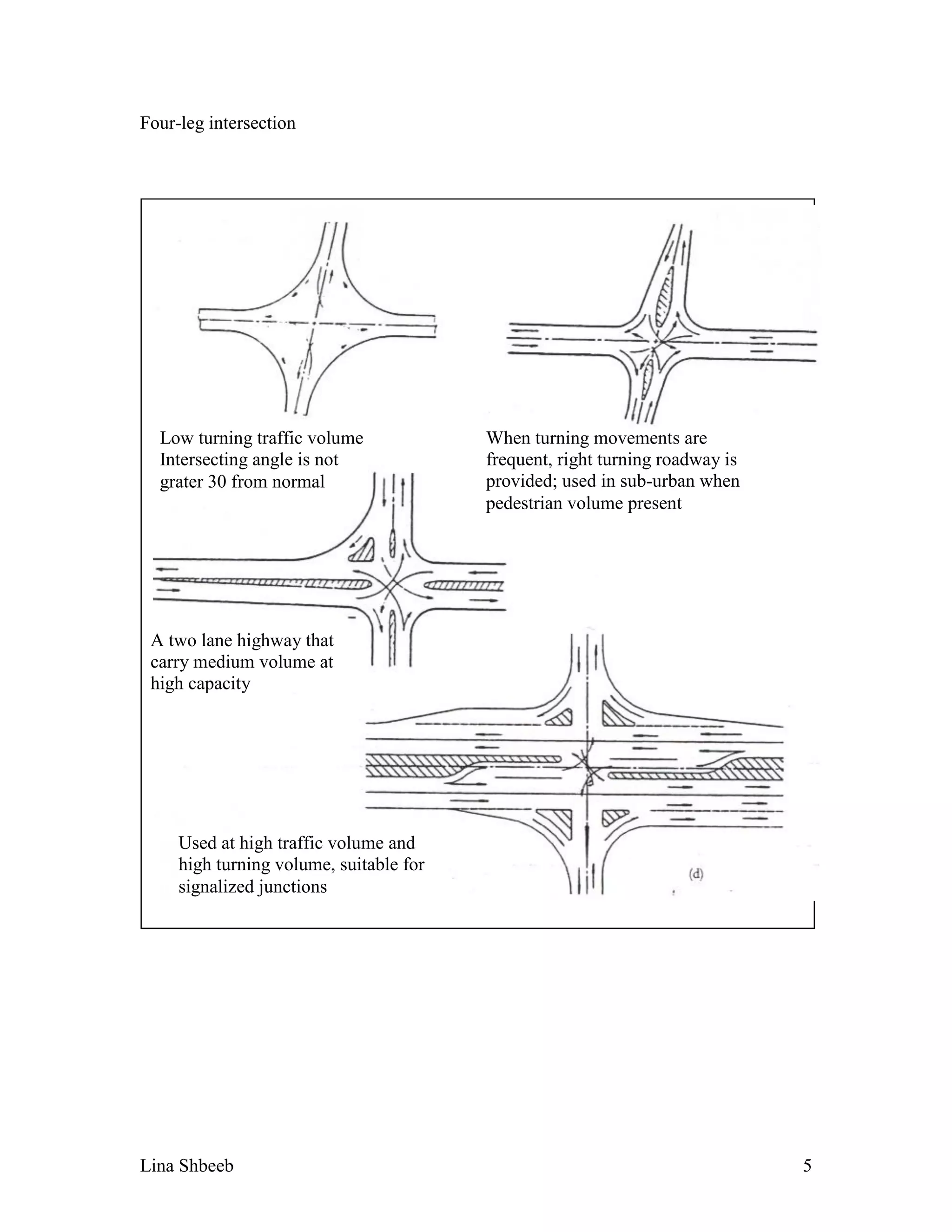
Four-leg intersection
Low turning traffic volume
Intersecting angle is not
grater 30 from normal
When turning movements are
frequent, right turning roadway is
provided; used in sub-urban when
pedestrian volume present
A two lane highway that
carry medium volume at
high capacity
Used at high traffic volume and
high turning volume, suitable for
signalized junctions
Lina Shbeeb 6
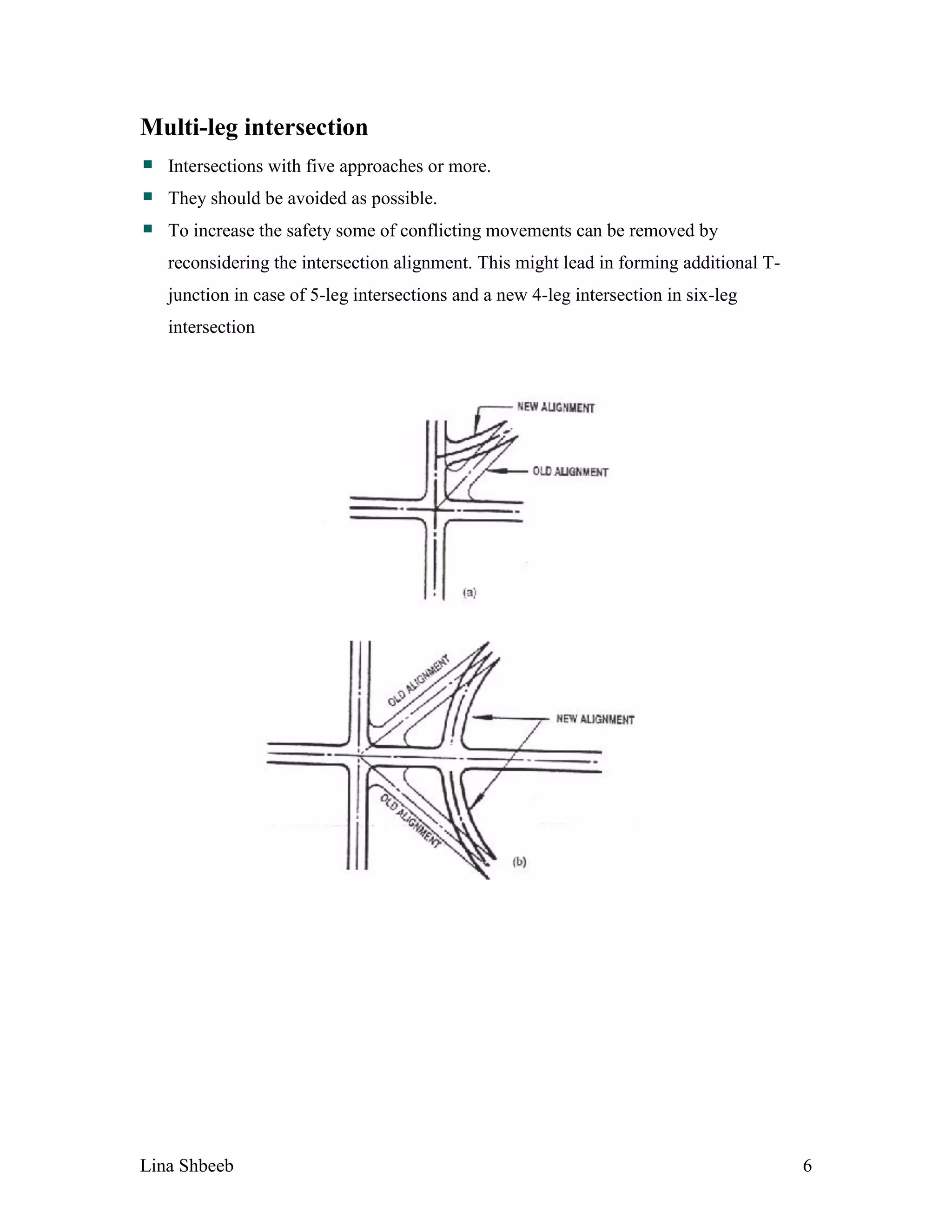
Multi-leg intersection
Intersections with five approaches or more.
They should be avoided as possible.
To increase the safety some of conflicting movements can be removed by
reconsidering the intersection alignment. This might lead in forming additional T-
junction in case of 5-leg intersections and a new 4-leg intersection in six-leg
intersection
Lina Shbeeb 7
When to use different types of intersections
Lina Shbeeb 8
Chanalization of At-grade intersections
Defined as a separation of conflicting traffic movements into a definite paths of travel
by traffic islands or pavement marking to facilitate the safe and orderly movement of
both vehicles and pedestrians.
A traffic island is a defined area between traffic lanes that is used to regulate the
movements of vehicles or as to serve as a pedestrian refuge, vehicle traffic is
excluded from the island area.
A proper chanalized area will
 Increase the intersection capacity
 Enhanced traffic safety conditions
 Increased driver confidence
Improper chanalization will have the opposite effect
Over-chanalization should be avoided since it produce more confusion for the
motorists and reduce the efficiency of the traffic system
The island design should not create any hazard to vehicles
Factors influencing the design of chanalized intersections
Availability of right of way
Terrain
Cross sections of crossing roads
Expected vehicular and pedestrian volumes,
Location and type of traffic control device.
Type of design vehicle
Approach speed and bus stop requirements
General characteristics of traffic islands
Traffic islands have different physical types
Island formed by using raised curbs
Island formed by using pavement marking
Island formed by using pavement edge
Factors influence the
extent to which
chanalization can be
under taken
Factors influence the design
of the edge of the pavements
Lina Shbeeb 9
Function of traffic islands
There are three functional categories of traffic islands
 Channelized islands: used to control and direct traffic
 Divisional islands: divide opposing or same directional traffic
 Refuge islands: Provide refuge for pedestrians
Divisional islands
Refuge Islands (pedestrian islands)
Lina Shbeeb 10
Used at urban intersection to serve refuge areas for wheelchairs and pedestrians
crossing wide intersections
They can also be used for loading and unloading transit passengers

Lec 07 Intersection Design (Transportation Engineering Dr.Lina Shbeeb)

  • 1.
    Lina Shbeeb 1 Intersectiondesign An intersection is an areas shared by two or more roads with various degree of complexity, whose main function is to provide for change of routine direction Drivers have to make decision concerning which route they wish to take. Intersection tends to have high potential for accidents. Intersections are classified into three categories  Grade separated without ramps  Grade separated with ramps  At grade Grade separated intersection consist of structure that provide for traffic to cross at different level without interruption; potential for accidents at these locations is reduced. At-grade intersections do not provide for traffic flow at different levels and there are many conflict points between intersection streams. Types of at grade intersections.  T or three-leg intersections; three approaches  Four-leg or cross intersections; four approaches  Multi-leg intersections; five or more approaches
  • 2.
  • 3.
    Lina Shbeeb 3 T-intersection TheT-intersections types differs in their complexity; simplest is the plain intersection Figure (a) It is suitable for minor or local roads or when a minor road intersect important highway with an angle less than 30° from the normal. It could be also used in rural two-lane highway s that carries light traffic At locations with higher speed and turning volume an additional surface area or flaring is provided. The flare is provided to separate right turn traffic from through traffic Figure b
  • 4.
    Lina Shbeeb 4 Incase where left-turn volume from the through road into the minor road is high but not very high to provide a separate left lane, an auxiliary lane is provided, this lane provide the possibility for the through traffic to move around the left turn vehicle. Figure (c) When the left turning traffic volume from the through road into the minor road is high and so the right turning volume is also high, a proper chanalization is provided. A left turn storage lane is provided and right-turn lane is provided forming a chanalized T-intersection in which the two-lane through is converted into a divided highway through intersections This design is suitable for signalized intersections Figure d .
  • 5.
    Lina Shbeeb 5 Four-legintersection Low turning traffic volume Intersecting angle is not grater 30 from normal When turning movements are frequent, right turning roadway is provided; used in sub-urban when pedestrian volume present A two lane highway that carry medium volume at high capacity Used at high traffic volume and high turning volume, suitable for signalized junctions
  • 6.
    Lina Shbeeb 6 Multi-legintersection Intersections with five approaches or more. They should be avoided as possible. To increase the safety some of conflicting movements can be removed by reconsidering the intersection alignment. This might lead in forming additional T- junction in case of 5-leg intersections and a new 4-leg intersection in six-leg intersection
  • 7.
    Lina Shbeeb 7 Whento use different types of intersections
  • 8.
    Lina Shbeeb 8 Chanalizationof At-grade intersections Defined as a separation of conflicting traffic movements into a definite paths of travel by traffic islands or pavement marking to facilitate the safe and orderly movement of both vehicles and pedestrians. A traffic island is a defined area between traffic lanes that is used to regulate the movements of vehicles or as to serve as a pedestrian refuge, vehicle traffic is excluded from the island area. A proper chanalized area will  Increase the intersection capacity  Enhanced traffic safety conditions  Increased driver confidence Improper chanalization will have the opposite effect Over-chanalization should be avoided since it produce more confusion for the motorists and reduce the efficiency of the traffic system The island design should not create any hazard to vehicles Factors influencing the design of chanalized intersections Availability of right of way Terrain Cross sections of crossing roads Expected vehicular and pedestrian volumes, Location and type of traffic control device. Type of design vehicle Approach speed and bus stop requirements General characteristics of traffic islands Traffic islands have different physical types Island formed by using raised curbs Island formed by using pavement marking Island formed by using pavement edge Factors influence the extent to which chanalization can be under taken Factors influence the design of the edge of the pavements
  • 9.
    Lina Shbeeb 9 Functionof traffic islands There are three functional categories of traffic islands  Channelized islands: used to control and direct traffic  Divisional islands: divide opposing or same directional traffic  Refuge islands: Provide refuge for pedestrians Divisional islands Refuge Islands (pedestrian islands)
  • 10.
    Lina Shbeeb 10 Usedat urban intersection to serve refuge areas for wheelchairs and pedestrians crossing wide intersections They can also be used for loading and unloading transit passengers