Syphilis(Treponema pallidum)
Prepared by:
Peshang Hassan
What’s syphilis
• Syphilis is a chronic bacterial
disease that is contracted
chiefly by infection during
sexual intercourse, but also
congenitally by infection of a
developing fetus.
• Syphilis is caused by the
bacteria Treponema pallidum.
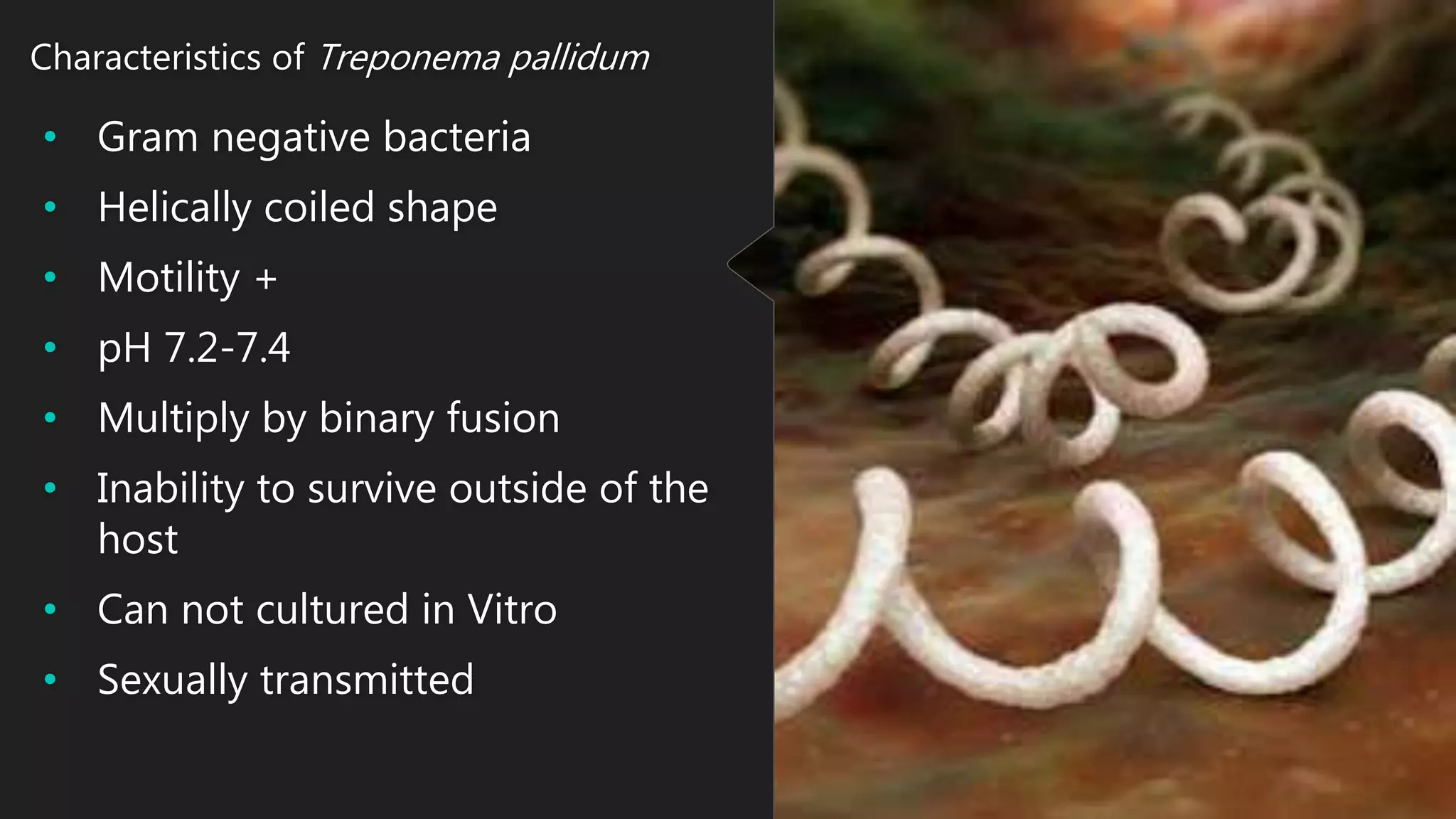
Characteristics of Treponema pallidum
• Gram negative bacteria
• Helically coiled shape
• Motility +
• pH 7.2-7.4
• Multiply by binary fusion
• Inability to survive outside of the
host
• Can not cultured in Vitro
• Sexually transmitted
Transmission
Syphilis is a highly contagious disease spread
primarily by sexual activity, including oral and anal
sex. Occasionally, the disease can be passed to
another person through prolonged kissing or close
bodily contact. Although this disease is spread from
sores, the vast majority of those sores go
unrecognized. The infected person is often unaware of
the disease and unknowingly passes it on to his or her
sexual partner.
Pregnant women with the disease can spread it to
their baby. This disease, called congenital syphilis, can
cause abnormalities or even death to the child.
Syphilis cannot be spread by toilet seats, door
knobs, swimming pools, bath tubs and shared
clothing
Stage and symptoms of Syphilis
Syphilis infection occurs in three distinct stages
 Early or primary syphilis. People with primary syphilis will develop one or more sores. The sores are
usually small painless ulcers. They occur on the genitals or in or around the mouth somewhere
between 10-90 days after exposure. Even without treatment they heal without a scar within six
weeks.
 The secondary stage is begins within six weeks to six months after exposure. People with secondary
syphilis experience a rosy "copper penny" rash typically on the palms of the hands and soles of the
feet. Also experience moist warts in the groin, white patches on the inside of the mouth, swollen
lymph glands, fever, and weight loss. Like primary syphilis, secondary syphilis will resolve without
treatment.
 Tertiary syphilis. If the infection isn't treated, it may then progress to a stage characterized by severe
problems with the heart, brain, and nerves that can result in paralysis,
blindness, dementia, deafness, impotence, and even death if it's not treated.
Prevention
• Avoid intimate contact with an infected person.
• If a sexual partner is infected, use a condom in every
sexual encounter.
Diagnosis
 Venereal disease research laboratory (VDRL) test. The VDRL test checks blood or spinal fluid for an antibody that
can be produced in people who have syphilis. This antibody is not produced as a reaction to syphilis specifically,
so the test result could be "abnormal" for reasons other than syphilis.
 Rapid plasma regain (RPR) test. The RPR test also finds syphilis antibodies.
 Enzyme immunoassay (EIA) test. This blood test checks for syphilis antibodies. A positive EIA test should be
confirmed with either the VDRL or RPR tests.
 Fluorescent treponemal antibody absorption (FTA-ABS) test. This test also checks for antibodies. It can be used
to find syphilis except during the first 3 to 4 weeks after exposure. The test can be done on a sample of blood or
spinal fluid.
 Treponema pallidum particle agglutination assay (TPPA)
 Darkfield microscopy.
 Microhemagglutination assay (MHA-TP)
 Polymerase chain reaction (PCR)
Treatment
 If patient infected with syphilis for less than a year, a single dose
of penicillin is usually enough to destroy the infection. For those
allergic to penicillin, tetracycline,doxycycline or another antibiotic
can be given instead. If patient are in a later stage of disease,
more doses will be needed.
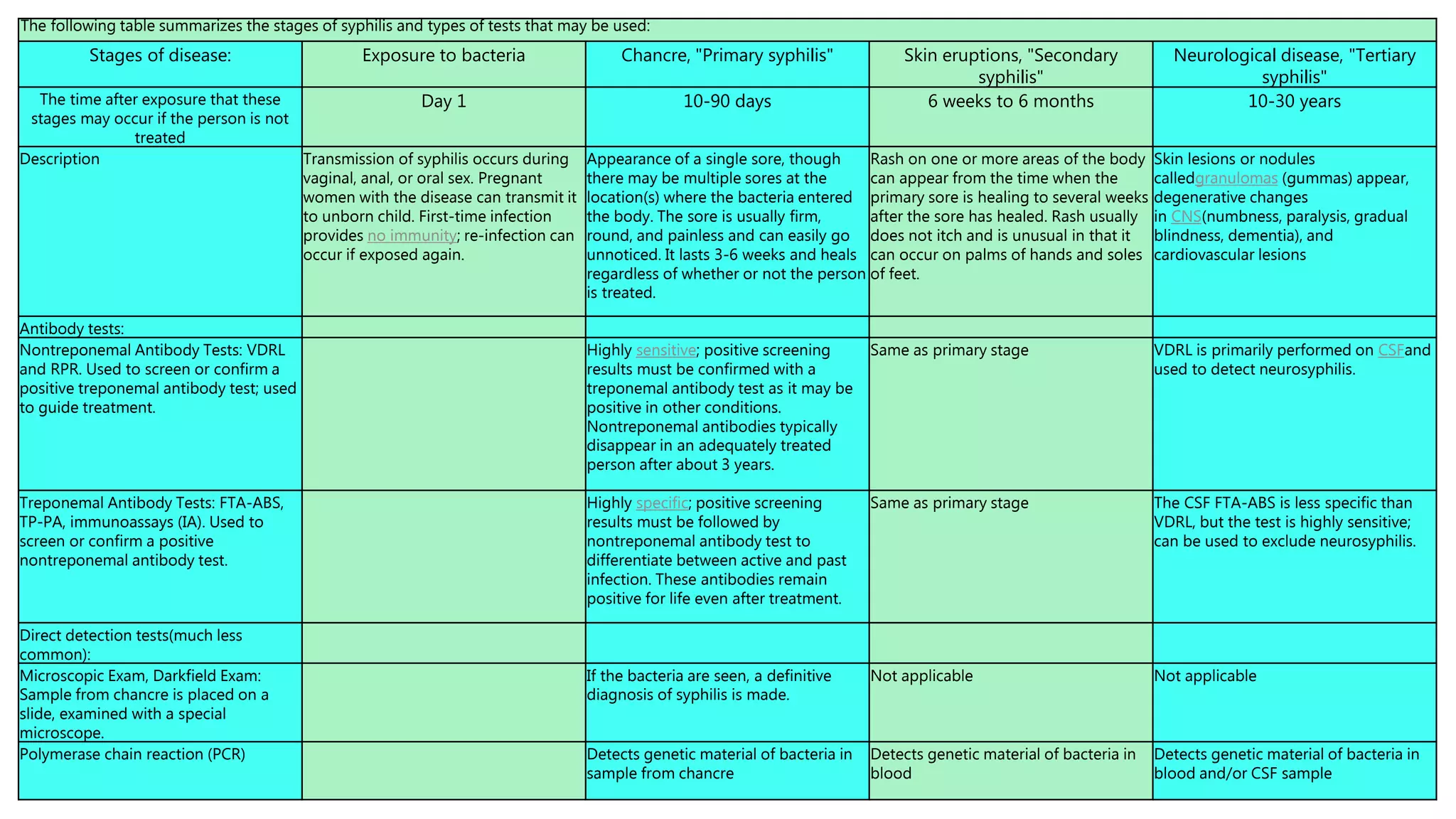
The following table summarizes the stages of syphilis and types of tests that may be used:
Stages of disease: Exposure to bacteria Chancre, "Primary syphilis" Skin eruptions, "Secondary
syphilis"
Neurological disease, "Tertiary
syphilis"
The time after exposure that these
stages may occur if the person is not
treated
Day 1 10-90 days 6 weeks to 6 months 10-30 years
Description Transmission of syphilis occurs during
vaginal, anal, or oral sex. Pregnant
women with the disease can transmit it
to unborn child. First-time infection
provides no immunity; re-infection can
occur if exposed again.
Appearance of a single sore, though
there may be multiple sores at the
location(s) where the bacteria entered
the body. The sore is usually firm,
round, and painless and can easily go
unnoticed. It lasts 3-6 weeks and heals
regardless of whether or not the person
is treated.
Rash on one or more areas of the body
can appear from the time when the
primary sore is healing to several weeks
after the sore has healed. Rash usually
does not itch and is unusual in that it
can occur on palms of hands and soles
of feet.
Skin lesions or nodules
calledgranulomas (gummas) appear,
degenerative changes
in CNS(numbness, paralysis, gradual
blindness, dementia), and
cardiovascular lesions
Antibody tests:
Nontreponemal Antibody Tests: VDRL
and RPR. Used to screen or confirm a
positive treponemal antibody test; used
to guide treatment.
Highly sensitive; positive screening
results must be confirmed with a
treponemal antibody test as it may be
positive in other conditions.
Nontreponemal antibodies typically
disappear in an adequately treated
person after about 3 years.
Same as primary stage VDRL is primarily performed on CSFand
used to detect neurosyphilis.
Treponemal Antibody Tests: FTA-ABS,
TP-PA, immunoassays (IA). Used to
screen or confirm a positive
nontreponemal antibody test.
Highly specific; positive screening
results must be followed by
nontreponemal antibody test to
differentiate between active and past
infection. These antibodies remain
positive for life even after treatment.
Same as primary stage The CSF FTA-ABS is less specific than
VDRL, but the test is highly sensitive;
can be used to exclude neurosyphilis.
Direct detection tests(much less
common):
Microscopic Exam, Darkfield Exam:
Sample from chancre is placed on a
slide, examined with a special
microscope.
If the bacteria are seen, a definitive
diagnosis of syphilis is made.
Not applicable Not applicable
Polymerase chain reaction (PCR) Detects genetic material of bacteria in
sample from chancre
Detects genetic material of bacteria in
blood
Detects genetic material of bacteria in
blood and/or CSF sample
Thank You

Syphilis(Treponema pallidum)

  • 1.
  • 2.
    What’s syphilis • Syphilisis a chronic bacterial disease that is contracted chiefly by infection during sexual intercourse, but also congenitally by infection of a developing fetus. • Syphilis is caused by the bacteria Treponema pallidum.
  • 3.
    Characteristics of Treponemapallidum • Gram negative bacteria • Helically coiled shape • Motility + • pH 7.2-7.4 • Multiply by binary fusion • Inability to survive outside of the host • Can not cultured in Vitro • Sexually transmitted
  • 4.
    Transmission Syphilis is ahighly contagious disease spread primarily by sexual activity, including oral and anal sex. Occasionally, the disease can be passed to another person through prolonged kissing or close bodily contact. Although this disease is spread from sores, the vast majority of those sores go unrecognized. The infected person is often unaware of the disease and unknowingly passes it on to his or her sexual partner. Pregnant women with the disease can spread it to their baby. This disease, called congenital syphilis, can cause abnormalities or even death to the child. Syphilis cannot be spread by toilet seats, door knobs, swimming pools, bath tubs and shared clothing
  • 5.
    Stage and symptomsof Syphilis Syphilis infection occurs in three distinct stages  Early or primary syphilis. People with primary syphilis will develop one or more sores. The sores are usually small painless ulcers. They occur on the genitals or in or around the mouth somewhere between 10-90 days after exposure. Even without treatment they heal without a scar within six weeks.  The secondary stage is begins within six weeks to six months after exposure. People with secondary syphilis experience a rosy "copper penny" rash typically on the palms of the hands and soles of the feet. Also experience moist warts in the groin, white patches on the inside of the mouth, swollen lymph glands, fever, and weight loss. Like primary syphilis, secondary syphilis will resolve without treatment.  Tertiary syphilis. If the infection isn't treated, it may then progress to a stage characterized by severe problems with the heart, brain, and nerves that can result in paralysis, blindness, dementia, deafness, impotence, and even death if it's not treated.
  • 6.
    Prevention • Avoid intimatecontact with an infected person. • If a sexual partner is infected, use a condom in every sexual encounter.
  • 7.
    Diagnosis  Venereal diseaseresearch laboratory (VDRL) test. The VDRL test checks blood or spinal fluid for an antibody that can be produced in people who have syphilis. This antibody is not produced as a reaction to syphilis specifically, so the test result could be "abnormal" for reasons other than syphilis.  Rapid plasma regain (RPR) test. The RPR test also finds syphilis antibodies.  Enzyme immunoassay (EIA) test. This blood test checks for syphilis antibodies. A positive EIA test should be confirmed with either the VDRL or RPR tests.  Fluorescent treponemal antibody absorption (FTA-ABS) test. This test also checks for antibodies. It can be used to find syphilis except during the first 3 to 4 weeks after exposure. The test can be done on a sample of blood or spinal fluid.  Treponema pallidum particle agglutination assay (TPPA)  Darkfield microscopy.  Microhemagglutination assay (MHA-TP)  Polymerase chain reaction (PCR)
  • 8.
    Treatment  If patientinfected with syphilis for less than a year, a single dose of penicillin is usually enough to destroy the infection. For those allergic to penicillin, tetracycline,doxycycline or another antibiotic can be given instead. If patient are in a later stage of disease, more doses will be needed.
  • 9.
    The following tablesummarizes the stages of syphilis and types of tests that may be used: Stages of disease: Exposure to bacteria Chancre, "Primary syphilis" Skin eruptions, "Secondary syphilis" Neurological disease, "Tertiary syphilis" The time after exposure that these stages may occur if the person is not treated Day 1 10-90 days 6 weeks to 6 months 10-30 years Description Transmission of syphilis occurs during vaginal, anal, or oral sex. Pregnant women with the disease can transmit it to unborn child. First-time infection provides no immunity; re-infection can occur if exposed again. Appearance of a single sore, though there may be multiple sores at the location(s) where the bacteria entered the body. The sore is usually firm, round, and painless and can easily go unnoticed. It lasts 3-6 weeks and heals regardless of whether or not the person is treated. Rash on one or more areas of the body can appear from the time when the primary sore is healing to several weeks after the sore has healed. Rash usually does not itch and is unusual in that it can occur on palms of hands and soles of feet. Skin lesions or nodules calledgranulomas (gummas) appear, degenerative changes in CNS(numbness, paralysis, gradual blindness, dementia), and cardiovascular lesions Antibody tests: Nontreponemal Antibody Tests: VDRL and RPR. Used to screen or confirm a positive treponemal antibody test; used to guide treatment. Highly sensitive; positive screening results must be confirmed with a treponemal antibody test as it may be positive in other conditions. Nontreponemal antibodies typically disappear in an adequately treated person after about 3 years. Same as primary stage VDRL is primarily performed on CSFand used to detect neurosyphilis. Treponemal Antibody Tests: FTA-ABS, TP-PA, immunoassays (IA). Used to screen or confirm a positive nontreponemal antibody test. Highly specific; positive screening results must be followed by nontreponemal antibody test to differentiate between active and past infection. These antibodies remain positive for life even after treatment. Same as primary stage The CSF FTA-ABS is less specific than VDRL, but the test is highly sensitive; can be used to exclude neurosyphilis. Direct detection tests(much less common): Microscopic Exam, Darkfield Exam: Sample from chancre is placed on a slide, examined with a special microscope. If the bacteria are seen, a definitive diagnosis of syphilis is made. Not applicable Not applicable Polymerase chain reaction (PCR) Detects genetic material of bacteria in sample from chancre Detects genetic material of bacteria in blood Detects genetic material of bacteria in blood and/or CSF sample
  • 10.

Editor's Notes

  • #3 Syphilis is a bacterial infection that's usually caught by having sex with someone who's infected.