LAB DIAGNOSIS OF STI/RTI
Basic terminology of laboratory test
• Antigen : A molecule which is recognized by the immune system
and induces an immune reaction(the organism itself).
• Antibody : A class of serum proteins which are induced
following contact with the antigen(an infectious organism).
• False positive : uninfected people diagnosed as positive.
• False negative : infected people diagnosed as negative
• Sensitivity :
– Indicates how good a test is at identifying people who are
infected
– The higher the sensitivity,the lower the rate of false
negatives(missed infections)
• Specificity
– Indicates how good a test is at identifying people
who are infected
– The higher the specificity,the lower the rate of
false positives
SYPHILIS
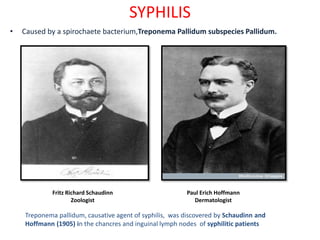
• Caused by a spirochaete bacterium,Treponema Pallidum subspecies Pallidum.
Fritz Richard Schaudinn
Zoologist
Paul Erich Hoffmann
Dermatologist
Treponema pallidum, causative agent of syphilis, was discovered by Schaudinn and
Hoffmann (1905) in the chancres and inguinal lymph nodes of syphilitic patients
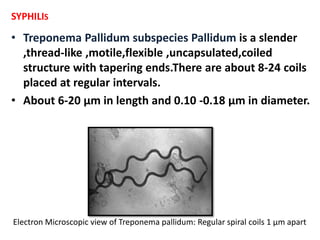
• Treponema Pallidum subspecies Pallidum is a slender
,thread-like ,motile,flexible ,uncapsulated,coiled
structure with tapering ends.There are about 8-24 coils
placed at regular intervals.
• About 6-20 µm in length and 0.10 -0.18 µm in diameter.
Electron Microscopic view of Treponema pallidum: Regular spiral coils 1 µm apart
SYPHILIS
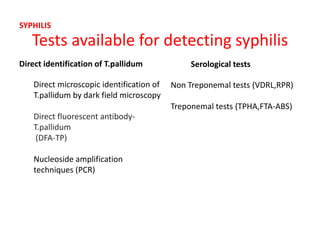
Tests available for detecting syphilis
Direct identification of T.pallidum Serological tests
Direct microscopic identification of
T.pallidum by dark field microscopy
Direct fluorescent antibody-
T.pallidum
(DFA-TP)
Nucleoside amplification
techniques (PCR)
Non Treponemal tests (VDRL,RPR)
Treponemal tests (TPHA,FTA-ABS)
SYPHILIS
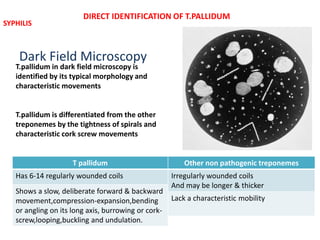
Dark Field Microscopy
T.pallidum in dark field microscopy is
identified by its typical morphology and
characteristic movements
T.pallidum is differentiated from the other
treponemes by the tightness of spirals and
characteristic cork screw movements
T pallidum
Has 6-14 regularly wounded coils
Shows a slow, deliberate forward & backward
movement,compression-expansion,bending
or angling on its long axis, burrowing or cork-
screw,looping,buckling and undulation.
Other non pathogenic treponemes
Irregularly wounded coils
And may be longer & thicker
Lack a characteristic mobility
DIRECT IDENTIFICATION OF T.PALLIDUM
SYPHILIS
DIRECT IDENTIFICATION OF T.PALLIDUM
• Direct fluorescent antibody-T.pallidum
(DFA-TP)
– It is a practical alternative to dark field examination and it
is more sensitive and specific than dark field microscopy.
– Samples from oral mucosa can also be examined .
– The smear is stained with fluorescein- labeled anti T.
pallidum globulin and examined under the fluorescent
microscope.
• Immunostaining
– Direct fluorescent antibody or silver stain
• Polymerase Chain Reaction (PCR)
– Not commercial available
SYPHILIS
SEROLOGICAL TESTS
• Useful in the latent stage of the disease as
treponemes are not readily sustainable in
culture and lesions are usually absent
• An ideal serological test
1. should have high specificity & sensitivity
2. should be suitable for treatment monitoring
3. should give a negative result on successful
therapy to give a clear cut diagnosis of
reinfection
SYPHILIS
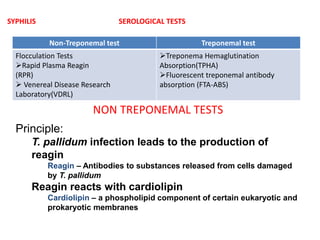
Non-Treponemal test Treponemal test
Flocculation Tests
Rapid Plasma Reagin
(RPR)
 Venereal Disease Research
Laboratory(VDRL)
Treponema Hemaglutination
Absorption(TPHA)
Fluorescent treponemal antibody
absorption (FTA-ABS)
NON TREPONEMAL TESTS
Principle:
T. pallidum infection leads to the production of
reagin
Reagin – Antibodies to substances released from cells damaged
by T. pallidum
Reagin reacts with cardiolipin
Cardiolipin – a phospholipid component of certain eukaryotic and
prokaryotic membranes
SEROLOGICAL TESTSSYPHILIS
• VDRL
– Venereal Disease Research Laboratory
(VDRL) Test is a slide flocculation test
employed in the diagnosis of syphilis.
– The VDRL can be used for qualitative and quantitative
measurements and is recommended when a patient
suspected of having syphilis has a negative dark field
microscopy result or when atypical lesions are present.
– Routine part of prenatal care during pregnancy .
– Specimen for the test is SERUM
– Screening test is most likely to be positive in the secondary
and latent stages of syphilis
– Test is not accurate in Early and Tertiary stage.
NON TREPONEMAL TESTSSYPHILIS
Every Pregnant women Needs
Screening
SYPHILIS
NON TREPONEMAL TESTS
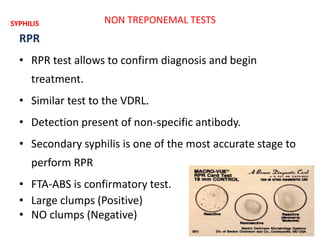
RPR
• RPR test allows to confirm diagnosis and begin
treatment.
• Similar test to the VDRL.
• Detection present of non-specific antibody.
• Secondary syphilis is one of the most accurate stage to
perform RPR
• FTA-ABS is confirmatory test.
• Large clumps (Positive)
• NO clumps (Negative)
SYPHILIS
TREPONEMAL TESTS
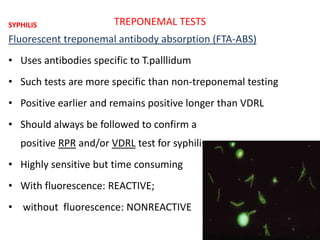
Fluorescent treponemal antibody absorption (FTA-ABS)
• Uses antibodies specific to T.palllidum
• Such tests are more specific than non-treponemal testing
• Positive earlier and remains positive longer than VDRL
• Should always be followed to confirm a
positive RPR and/or VDRL test for syphilis
• Highly sensitive but time consuming
• With fluorescence: REACTIVE;
• without fluorescence: NONREACTIVE
SYPHILIS
• A qualitative haemagglutination test using tanned
formalinised sheep RBC’s as the carrier for T.pallidum
antigen (sensitized cells)
• Patients serum is diluted in absorbing diluent which
contains:
1. Sonicated sheep & bovine red cell stroma
2. Normal rabbit testicular extract
3. Reiter treponemal sonicate
4. Normal rabbit serum
5. Stabilizers
TREPONEMAL TEST
SYPHILIS
Treponema pallidum Haemagglutination Assay (TPHA)
• Serum is tested with both sensitised and non
sensitised RBC’s
• Preliminary results are available in 3-4 hrs, final
results in 18 hrs
• REACTIVE : if agglutination occur in a dilution of 1:80
or more
• Reactivity Is positive around 4th-5th week of infection
CHANCROID
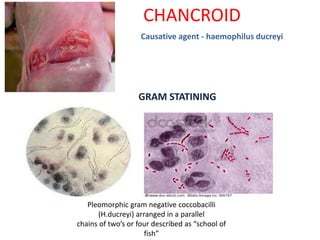
Causative agent - haemophilus ducreyi
GRAM STATINING
Pleomorphic gram negative coccobacilli
(H.ducreyi) arranged in a parallel
chains of two’s or four described as “school of
fish”
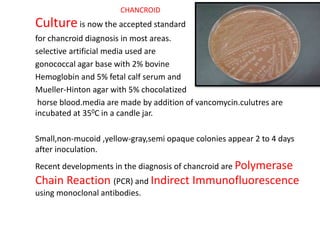
Cultureis now the accepted standard
for chancroid diagnosis in most areas.
selective artificial media used are
gonococcal agar base with 2% bovine
Hemoglobin and 5% fetal calf serum and
Mueller-Hinton agar with 5% chocolatized
horse blood.media are made by addition of vancomycin.culutres are
incubated at 350C in a candle jar.
Small,non-mucoid ,yellow-gray,semi opaque colonies appear 2 to 4 days
after inoculation.
Recent developments in the diagnosis of chancroid are Polymerase
Chain Reaction (PCR) and Indirect Immunofluorescence
using monoclonal antibodies.
CHANCROID
HERPES GENITALIS
• Caused by a DNA virus,Herpes Simples
Virus.
• HSV has been classified into
two distinct categories, HSV-1 and HSV-2.
STRUCTURE OF HERPES VIRUS
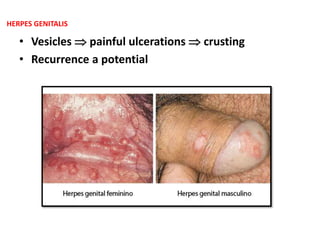
• Vesicles  painful ulcerations  crusting
• Recurrence a potential
HERPES GENITALIS
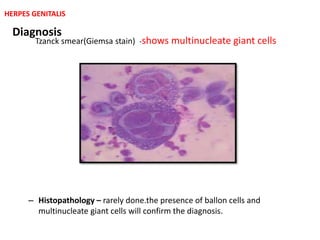
Diagnosis
– Histopathology – rarely done.the presence of ballon cells and
multinucleate giant cells will confirm the diagnosis.
Tzanck smear(Giemsa stain) -shows multinucleate giant cells
HERPES GENITALIS
– Viral Culture – cultures are usually positive in
primary or first episode infections and are
frequently negative from dry erosions or crusts.
– Serology – following tests detect antibodies to the
herpes simplex virus in the blood
• ELISA
• Complement fixation test
• Western blot
– PCR
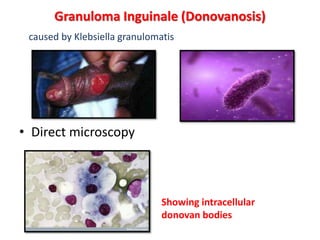
Granuloma Inguinale (Donovanosis)
• Direct microscopy
Showing intracellular
donovan bodies
caused by Klebsiella granulomatis
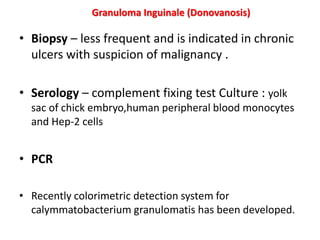
• Biopsy – less frequent and is indicated in chronic
ulcers with suspicion of malignancy .
• Serology – complement fixing test Culture : yolk
sac of chick embryo,human peripheral blood monocytes
and Hep-2 cells
• PCR
• Recently colorimetric detection system for
calymmatobacterium granulomatis has been developed.
Granuloma Inguinale (Donovanosis)
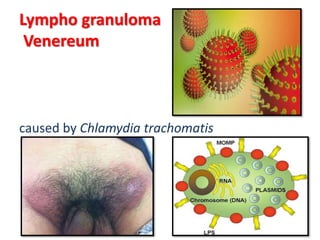
Lympho granuloma
Venereum
caused by Chlamydia trachomatis
Lympho granuloma Venereum
• Laboratory diagnosis of LGV can be made by
– A positive serology(complement fixation ) for
C.trachomatis.
– Isolation of C.trachomatis from infected tissue or
bubo pus using mouse brain,yolk sac or tissue
culture.
– Identification of C trachomatis in tissues or bubo
pus by using special stains such as Giemsa –
Romanowsky,iodine or Macchiavello stains.
STD’S CAUSES GENITAL DISCHARGE
–Gonorrhea
–Chlamydia
–Bacterial vaginosis
–Trichomonasis
–Candidiasis
–PID
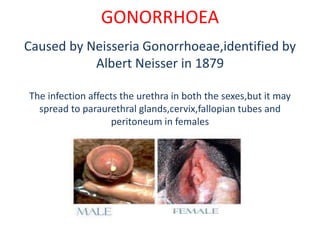
GONORRHOEA
Caused by Neisseria Gonorrhoeae,identified by
Albert Neisser in 1879
The infection affects the urethra in both the sexes,but it may
spread to paraurethral glands,cervix,fallopian tubes and
peritoneum in females
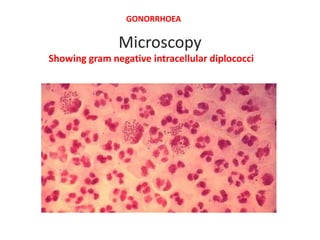
Microscopy
Showing gram negative intracellular diplococci
GONORRHOEA
• Culture – commonly used selective media for
N.gonorrhoes are modified Thayer Martin,Chacko Nayar
Medium,Martin Lewis media and New York City Media
• Recently Polymerase chain reaction(PCR),Ligase chain
reaction(LCR) and other nucleic acid amplification techniques
are also being developed to diagnose gonorrhoea
• Serology – the complement fixation,latex agglutination
immunofluorescence and anti-surface pili assays,ELISA and
immunoblotting can be used to detect serum antibody against
N.gonorrhoeae.
GONORRHOEA
Chlamydia
• Tissue culture has been the standard
– Specificity approaching 100%
– Sensitivity ranges from 60% to 90%
• Non-amplified tests
– Enzyme Immunoassay (EIA), e.g. Chlamydiazyme
• sensitivity and specificity of 85% and 97% respectively
• useful for high volume screening
• false positives
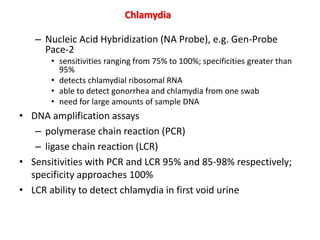
– Nucleic Acid Hybridization (NA Probe), e.g. Gen-Probe
Pace-2
• sensitivities ranging from 75% to 100%; specificities greater than
95%
• detects chlamydial ribosomal RNA
• able to detect gonorrhea and chlamydia from one swab
• need for large amounts of sample DNA
• DNA amplification assays
– polymerase chain reaction (PCR)
– ligase chain reaction (LCR)
• Sensitivities with PCR and LCR 95% and 85-98% respectively;
specificity approaches 100%
• LCR ability to detect chlamydia in first void urine
Chlamydia
Bacterial vaginosis
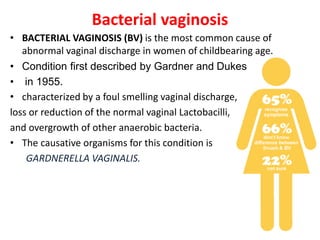
• BACTERIAL VAGINOSIS (BV) is the most common cause of
abnormal vaginal discharge in women of childbearing age.
• Condition first described by Gardner and Dukes
• in 1955.
• characterized by a foul smelling vaginal discharge,
loss or reduction of the normal vaginal Lactobacilli,
and overgrowth of other anaerobic bacteria.
• The causative organisms for this condition is
GARDNERELLA VAGINALIS.
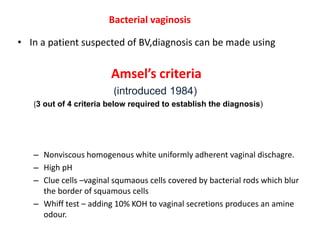
• In a patient suspected of BV,diagnosis can be made using
Amsel’s criteria
(introduced 1984)
(3 out of 4 criteria below required to establish the diagnosis)
– Nonviscous homogenous white uniformly adherent vaginal dischagre.
– High pH
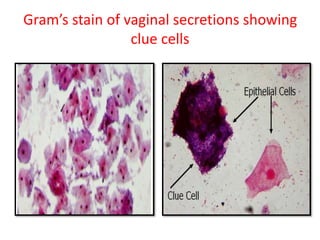
– Clue cells –vaginal squmaous cells covered by bacterial rods which blur
the border of squamous cells
– Whiff test – adding 10% KOH to vaginal secretions produces an amine
odour.
Bacterial vaginosis
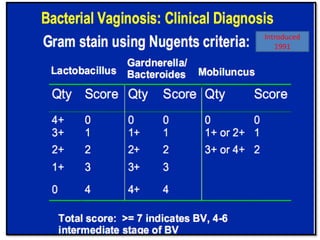
Introduced
1991
Gram’s stain of vaginal secretions showing
clue cells
Trichomoniasis
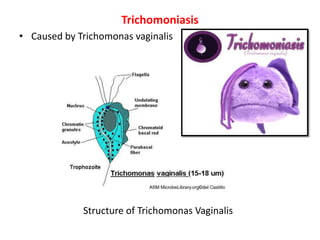
• Caused by Trichomonas vaginalis
Structure of Trichomonas Vaginalis
Trichomonas vaginalis is a
flagellated protozoan.
Trophozite is the only stage
present in the life cycle that is
infective stage of the
parasite.no cystic stage.
It is 7-30 µm long by 5-10 µm
wide.
Trophozite is pear shaped &
shows “TWITCHING TYPE”
Of motility due to presence
of 5 number of flagellae
Symptoms in women
• In females there is urethritis,vaginitis&cervicitis.
• Pain during intercourse and urination.
yellow-green, itchy, frothy foul-smelling ("fishy" smell)
in vaginal discharge in rare cases, lower abdominal
pain and inflammation of the external genitals can
occur.
• Symptoms usually appear in women
within 5 to 28 days of exposure.
Trichomoniasis
Symptoms in mens
• Urethritis and Prostatitis
• Asymptomatic,Dysurea,
• Non purulent discharge ( fish-like odour)
• irritation inside the penis or slight burning
after urination or ejaculation
• painful intercourse, and inflammation of the
external genitals.
Trichomoniasis
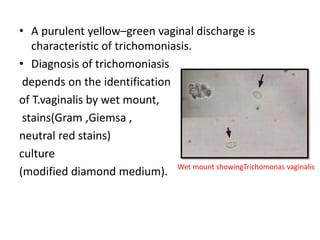
• A purulent yellow–green vaginal discharge is
characteristic of trichomoniasis.
• Diagnosis of trichomoniasis
depends on the identification
of T.vaginalis by wet mount,
stains(Gram ,Giemsa ,
neutral red stains)
culture
(modified diamond medium). Wet mount showingTrichomonas vaginalis
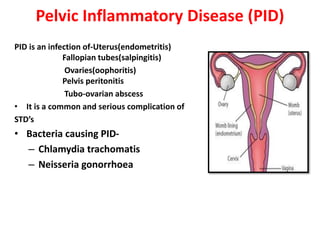
Pelvic Inflammatory Disease (PID)
PID is an infection of-Uterus(endometritis)
Fallopian tubes(salpingitis)
Ovaries(oophoritis)
Pelvis peritonitis
Tubo-ovarian abscess
• It is a common and serious complication of
STD’s
• Bacteria causing PID-
– Chlamydia trachomatis
– Neisseria gonorrhoea
symptoms
• Lower abdominal pain
• Pain during or after sex
• Bleeding between periods or after sex
• Lower back pain
• Sense of pressure or swelling in the lower abdomen
• Fever
• Abnormal vaginal discharge
• Nausea,vomiting and dizzinss
• Dysuria,frequently urination
Pelvic Inflammatory Disease (PID)
• CDC minimal criteria
– uterine adnexal tenderness, cervical motion tenderness
• Other symptoms include
– endocervical discharge, fever, lower abd. Pain
• Gram staining – specimens may be obatined by endocervical
swab,endometrial aspiration.
• Culture and DNA-PCR based test for N.gonorrhoeae and
chlamydia.
• USG and MRI
– Identification of tubo-ovarian or pelvic abscess.
– Increased tubal diameter,intratubal fluid ,tubal wall
thickening in case of salpingitis
Pelvic Inflammatory Disease (PID)
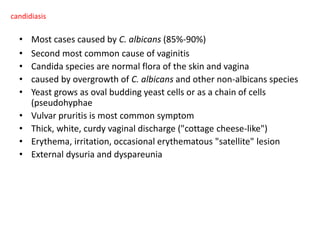
• Most cases caused by C. albicans (85%-90%)
• Second most common cause of vaginitis
• Candida species are normal flora of the skin and vagina
• caused by overgrowth of C. albicans and other non-albicans species
• Yeast grows as oval budding yeast cells or as a chain of cells
(pseudohyphae
• Vulvar pruritis is most common symptom
• Thick, white, curdy vaginal discharge ("cottage cheese-like")
• Erythema, irritation, occasional erythematous "satellite" lesion
• External dysuria and dyspareunia
candidiasis
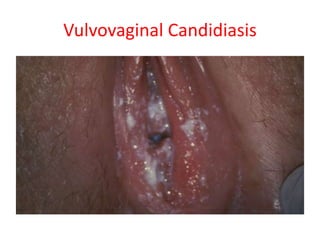
Vulvovaginal Candidiasis
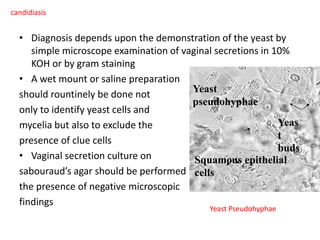
• Diagnosis depends upon the demonstration of the yeast by
simple microscope examination of vaginal secretions in 10%
KOH or by gram staining
• A wet mount or saline preparation
should rountinely be done not
only to identify yeast cells and
mycelia but also to exclude the
presence of clue cells
• Vaginal secretion culture on
sabouraud’s agar should be performed in
the presence of negative microscopic
findings
candidiasis
Yeast
pseudohyphae
Squamous epithelial
cells
Yeas
t
buds
Yeast Pseudohyphae
Life at Risk with Sexually Transmitted Infections
Best Choice Play safe

laboratory diagnosis of STI/RTI

  • 1.
  • 2.
    Basic terminology oflaboratory test • Antigen : A molecule which is recognized by the immune system and induces an immune reaction(the organism itself). • Antibody : A class of serum proteins which are induced following contact with the antigen(an infectious organism). • False positive : uninfected people diagnosed as positive. • False negative : infected people diagnosed as negative • Sensitivity : – Indicates how good a test is at identifying people who are infected – The higher the sensitivity,the lower the rate of false negatives(missed infections)
  • 3.
    • Specificity – Indicateshow good a test is at identifying people who are infected – The higher the specificity,the lower the rate of false positives
  • 4.
    SYPHILIS • Caused bya spirochaete bacterium,Treponema Pallidum subspecies Pallidum. Fritz Richard Schaudinn Zoologist Paul Erich Hoffmann Dermatologist Treponema pallidum, causative agent of syphilis, was discovered by Schaudinn and Hoffmann (1905) in the chancres and inguinal lymph nodes of syphilitic patients
  • 5.
    • Treponema Pallidumsubspecies Pallidum is a slender ,thread-like ,motile,flexible ,uncapsulated,coiled structure with tapering ends.There are about 8-24 coils placed at regular intervals. • About 6-20 µm in length and 0.10 -0.18 µm in diameter. Electron Microscopic view of Treponema pallidum: Regular spiral coils 1 µm apart SYPHILIS
  • 6.
    Tests available fordetecting syphilis Direct identification of T.pallidum Serological tests Direct microscopic identification of T.pallidum by dark field microscopy Direct fluorescent antibody- T.pallidum (DFA-TP) Nucleoside amplification techniques (PCR) Non Treponemal tests (VDRL,RPR) Treponemal tests (TPHA,FTA-ABS) SYPHILIS
  • 7.
    Dark Field Microscopy T.pallidumin dark field microscopy is identified by its typical morphology and characteristic movements T.pallidum is differentiated from the other treponemes by the tightness of spirals and characteristic cork screw movements T pallidum Has 6-14 regularly wounded coils Shows a slow, deliberate forward & backward movement,compression-expansion,bending or angling on its long axis, burrowing or cork- screw,looping,buckling and undulation. Other non pathogenic treponemes Irregularly wounded coils And may be longer & thicker Lack a characteristic mobility DIRECT IDENTIFICATION OF T.PALLIDUM SYPHILIS
  • 8.
    DIRECT IDENTIFICATION OFT.PALLIDUM • Direct fluorescent antibody-T.pallidum (DFA-TP) – It is a practical alternative to dark field examination and it is more sensitive and specific than dark field microscopy. – Samples from oral mucosa can also be examined . – The smear is stained with fluorescein- labeled anti T. pallidum globulin and examined under the fluorescent microscope. • Immunostaining – Direct fluorescent antibody or silver stain • Polymerase Chain Reaction (PCR) – Not commercial available SYPHILIS
  • 9.
    SEROLOGICAL TESTS • Usefulin the latent stage of the disease as treponemes are not readily sustainable in culture and lesions are usually absent • An ideal serological test 1. should have high specificity & sensitivity 2. should be suitable for treatment monitoring 3. should give a negative result on successful therapy to give a clear cut diagnosis of reinfection SYPHILIS
  • 10.
    Non-Treponemal test Treponemaltest Flocculation Tests Rapid Plasma Reagin (RPR)  Venereal Disease Research Laboratory(VDRL) Treponema Hemaglutination Absorption(TPHA) Fluorescent treponemal antibody absorption (FTA-ABS) NON TREPONEMAL TESTS Principle: T. pallidum infection leads to the production of reagin Reagin – Antibodies to substances released from cells damaged by T. pallidum Reagin reacts with cardiolipin Cardiolipin – a phospholipid component of certain eukaryotic and prokaryotic membranes SEROLOGICAL TESTSSYPHILIS
  • 11.
    • VDRL – VenerealDisease Research Laboratory (VDRL) Test is a slide flocculation test employed in the diagnosis of syphilis. – The VDRL can be used for qualitative and quantitative measurements and is recommended when a patient suspected of having syphilis has a negative dark field microscopy result or when atypical lesions are present. – Routine part of prenatal care during pregnancy . – Specimen for the test is SERUM – Screening test is most likely to be positive in the secondary and latent stages of syphilis – Test is not accurate in Early and Tertiary stage. NON TREPONEMAL TESTSSYPHILIS
  • 12.
    Every Pregnant womenNeeds Screening SYPHILIS
  • 13.
    NON TREPONEMAL TESTS RPR •RPR test allows to confirm diagnosis and begin treatment. • Similar test to the VDRL. • Detection present of non-specific antibody. • Secondary syphilis is one of the most accurate stage to perform RPR • FTA-ABS is confirmatory test. • Large clumps (Positive) • NO clumps (Negative) SYPHILIS
  • 14.
    TREPONEMAL TESTS Fluorescent treponemalantibody absorption (FTA-ABS) • Uses antibodies specific to T.palllidum • Such tests are more specific than non-treponemal testing • Positive earlier and remains positive longer than VDRL • Should always be followed to confirm a positive RPR and/or VDRL test for syphilis • Highly sensitive but time consuming • With fluorescence: REACTIVE; • without fluorescence: NONREACTIVE SYPHILIS
  • 15.
    • A qualitativehaemagglutination test using tanned formalinised sheep RBC’s as the carrier for T.pallidum antigen (sensitized cells) • Patients serum is diluted in absorbing diluent which contains: 1. Sonicated sheep & bovine red cell stroma 2. Normal rabbit testicular extract 3. Reiter treponemal sonicate 4. Normal rabbit serum 5. Stabilizers TREPONEMAL TEST SYPHILIS Treponema pallidum Haemagglutination Assay (TPHA)
  • 16.
    • Serum istested with both sensitised and non sensitised RBC’s • Preliminary results are available in 3-4 hrs, final results in 18 hrs • REACTIVE : if agglutination occur in a dilution of 1:80 or more • Reactivity Is positive around 4th-5th week of infection
  • 17.
    CHANCROID Causative agent -haemophilus ducreyi GRAM STATINING Pleomorphic gram negative coccobacilli (H.ducreyi) arranged in a parallel chains of two’s or four described as “school of fish”
  • 18.
    Cultureis now theaccepted standard for chancroid diagnosis in most areas. selective artificial media used are gonococcal agar base with 2% bovine Hemoglobin and 5% fetal calf serum and Mueller-Hinton agar with 5% chocolatized horse blood.media are made by addition of vancomycin.culutres are incubated at 350C in a candle jar. Small,non-mucoid ,yellow-gray,semi opaque colonies appear 2 to 4 days after inoculation. Recent developments in the diagnosis of chancroid are Polymerase Chain Reaction (PCR) and Indirect Immunofluorescence using monoclonal antibodies. CHANCROID
  • 19.
    HERPES GENITALIS • Causedby a DNA virus,Herpes Simples Virus. • HSV has been classified into two distinct categories, HSV-1 and HSV-2. STRUCTURE OF HERPES VIRUS
  • 20.
    • Vesicles painful ulcerations  crusting • Recurrence a potential HERPES GENITALIS
  • 21.
    Diagnosis – Histopathology –rarely done.the presence of ballon cells and multinucleate giant cells will confirm the diagnosis. Tzanck smear(Giemsa stain) -shows multinucleate giant cells HERPES GENITALIS
  • 22.
    – Viral Culture– cultures are usually positive in primary or first episode infections and are frequently negative from dry erosions or crusts. – Serology – following tests detect antibodies to the herpes simplex virus in the blood • ELISA • Complement fixation test • Western blot – PCR
  • 23.
    Granuloma Inguinale (Donovanosis) •Direct microscopy Showing intracellular donovan bodies caused by Klebsiella granulomatis
  • 24.
    • Biopsy –less frequent and is indicated in chronic ulcers with suspicion of malignancy . • Serology – complement fixing test Culture : yolk sac of chick embryo,human peripheral blood monocytes and Hep-2 cells • PCR • Recently colorimetric detection system for calymmatobacterium granulomatis has been developed. Granuloma Inguinale (Donovanosis)
  • 25.
  • 26.
    Lympho granuloma Venereum •Laboratory diagnosis of LGV can be made by – A positive serology(complement fixation ) for C.trachomatis. – Isolation of C.trachomatis from infected tissue or bubo pus using mouse brain,yolk sac or tissue culture. – Identification of C trachomatis in tissues or bubo pus by using special stains such as Giemsa – Romanowsky,iodine or Macchiavello stains.
  • 27.
    STD’S CAUSES GENITALDISCHARGE –Gonorrhea –Chlamydia –Bacterial vaginosis –Trichomonasis –Candidiasis –PID
  • 28.
    GONORRHOEA Caused by NeisseriaGonorrhoeae,identified by Albert Neisser in 1879 The infection affects the urethra in both the sexes,but it may spread to paraurethral glands,cervix,fallopian tubes and peritoneum in females
  • 29.
    Microscopy Showing gram negativeintracellular diplococci GONORRHOEA
  • 30.
    • Culture –commonly used selective media for N.gonorrhoes are modified Thayer Martin,Chacko Nayar Medium,Martin Lewis media and New York City Media • Recently Polymerase chain reaction(PCR),Ligase chain reaction(LCR) and other nucleic acid amplification techniques are also being developed to diagnose gonorrhoea • Serology – the complement fixation,latex agglutination immunofluorescence and anti-surface pili assays,ELISA and immunoblotting can be used to detect serum antibody against N.gonorrhoeae. GONORRHOEA
  • 31.
    Chlamydia • Tissue culturehas been the standard – Specificity approaching 100% – Sensitivity ranges from 60% to 90% • Non-amplified tests – Enzyme Immunoassay (EIA), e.g. Chlamydiazyme • sensitivity and specificity of 85% and 97% respectively • useful for high volume screening • false positives
  • 32.
    – Nucleic AcidHybridization (NA Probe), e.g. Gen-Probe Pace-2 • sensitivities ranging from 75% to 100%; specificities greater than 95% • detects chlamydial ribosomal RNA • able to detect gonorrhea and chlamydia from one swab • need for large amounts of sample DNA • DNA amplification assays – polymerase chain reaction (PCR) – ligase chain reaction (LCR) • Sensitivities with PCR and LCR 95% and 85-98% respectively; specificity approaches 100% • LCR ability to detect chlamydia in first void urine Chlamydia
  • 33.
    Bacterial vaginosis • BACTERIALVAGINOSIS (BV) is the most common cause of abnormal vaginal discharge in women of childbearing age. • Condition first described by Gardner and Dukes • in 1955. • characterized by a foul smelling vaginal discharge, loss or reduction of the normal vaginal Lactobacilli, and overgrowth of other anaerobic bacteria. • The causative organisms for this condition is GARDNERELLA VAGINALIS.
  • 34.
    • In apatient suspected of BV,diagnosis can be made using Amsel’s criteria (introduced 1984) (3 out of 4 criteria below required to establish the diagnosis) – Nonviscous homogenous white uniformly adherent vaginal dischagre. – High pH – Clue cells –vaginal squmaous cells covered by bacterial rods which blur the border of squamous cells – Whiff test – adding 10% KOH to vaginal secretions produces an amine odour. Bacterial vaginosis
  • 35.
  • 36.
    Gram’s stain ofvaginal secretions showing clue cells
  • 37.
    Trichomoniasis • Caused byTrichomonas vaginalis Structure of Trichomonas Vaginalis
  • 38.
    Trichomonas vaginalis isa flagellated protozoan. Trophozite is the only stage present in the life cycle that is infective stage of the parasite.no cystic stage. It is 7-30 µm long by 5-10 µm wide. Trophozite is pear shaped & shows “TWITCHING TYPE” Of motility due to presence of 5 number of flagellae
  • 39.
    Symptoms in women •In females there is urethritis,vaginitis&cervicitis. • Pain during intercourse and urination. yellow-green, itchy, frothy foul-smelling ("fishy" smell) in vaginal discharge in rare cases, lower abdominal pain and inflammation of the external genitals can occur. • Symptoms usually appear in women within 5 to 28 days of exposure. Trichomoniasis
  • 40.
    Symptoms in mens •Urethritis and Prostatitis • Asymptomatic,Dysurea, • Non purulent discharge ( fish-like odour) • irritation inside the penis or slight burning after urination or ejaculation • painful intercourse, and inflammation of the external genitals. Trichomoniasis
  • 41.
    • A purulentyellow–green vaginal discharge is characteristic of trichomoniasis. • Diagnosis of trichomoniasis depends on the identification of T.vaginalis by wet mount, stains(Gram ,Giemsa , neutral red stains) culture (modified diamond medium). Wet mount showingTrichomonas vaginalis
  • 42.
    Pelvic Inflammatory Disease(PID) PID is an infection of-Uterus(endometritis) Fallopian tubes(salpingitis) Ovaries(oophoritis) Pelvis peritonitis Tubo-ovarian abscess • It is a common and serious complication of STD’s • Bacteria causing PID- – Chlamydia trachomatis – Neisseria gonorrhoea
  • 43.
    symptoms • Lower abdominalpain • Pain during or after sex • Bleeding between periods or after sex • Lower back pain • Sense of pressure or swelling in the lower abdomen • Fever • Abnormal vaginal discharge • Nausea,vomiting and dizzinss • Dysuria,frequently urination Pelvic Inflammatory Disease (PID)
  • 44.
    • CDC minimalcriteria – uterine adnexal tenderness, cervical motion tenderness • Other symptoms include – endocervical discharge, fever, lower abd. Pain • Gram staining – specimens may be obatined by endocervical swab,endometrial aspiration. • Culture and DNA-PCR based test for N.gonorrhoeae and chlamydia. • USG and MRI – Identification of tubo-ovarian or pelvic abscess. – Increased tubal diameter,intratubal fluid ,tubal wall thickening in case of salpingitis Pelvic Inflammatory Disease (PID)
  • 45.
    • Most casescaused by C. albicans (85%-90%) • Second most common cause of vaginitis • Candida species are normal flora of the skin and vagina • caused by overgrowth of C. albicans and other non-albicans species • Yeast grows as oval budding yeast cells or as a chain of cells (pseudohyphae • Vulvar pruritis is most common symptom • Thick, white, curdy vaginal discharge ("cottage cheese-like") • Erythema, irritation, occasional erythematous "satellite" lesion • External dysuria and dyspareunia candidiasis
  • 46.
  • 47.
    • Diagnosis dependsupon the demonstration of the yeast by simple microscope examination of vaginal secretions in 10% KOH or by gram staining • A wet mount or saline preparation should rountinely be done not only to identify yeast cells and mycelia but also to exclude the presence of clue cells • Vaginal secretion culture on sabouraud’s agar should be performed in the presence of negative microscopic findings candidiasis Yeast pseudohyphae Squamous epithelial cells Yeas t buds Yeast Pseudohyphae
  • 48.
    Life at Riskwith Sexually Transmitted Infections Best Choice Play safe