Antimicrobial Susceptibility
Testing
By,
Dr.Malathi.M
II year PG, M.D., Microbiology
Chengalpattu medical college
Introduction
• Once an organism is isolated , characterization
frequently includes tests to detect antimicrobial
resistance, which is the prime important key
component for the physician.
• The procedures used to produce the
antimicrobial susceptibility profiles and detect
resistance to therapeutic agents are referred to as
antimicrobial susceptibility testing (AST)
methods.
TESTING METHODS:
• Methods that directly measure the activity of
one or more antimicrobial agents against a
bacterial isolate
• Methods that directly detect the presence of a
specific resistance mechanism in a bacterial
isolate
• Special methods that measure complex
antimicrobial organism interactions
GUIDELINES
• CLSI 2014 (CURRENT)
• EUCAST
Media
DiscInoculum
MEDIA IN AST
BEST MEDIUM – MHA (Mueller Hinton Agar)
1. Shows acceptable batch to batch
reproducibility for susceptibility testing
2. Low in sulphonamide, trimethoprim and
tetracycline inhibitors
3. Gives satisfactory growth of most non
fastidious pathogens
Media
• Store the plates at 2 to 8 deg C
• Use within 7 days of preparation
• Each batch of MHA plates should be checked for
sterility control
• MHA added with 2% NaCl
• MHA added with defibrinated sheep blood 5%s
Factors affecting AST
• pH
• Moisture
• Effects of Thymidine/thymine
• Divalent cations
Antibiotic Stock solutions
• Buy commercial pure source of antibiotics
• Don’t use injectable solutions
• Accurate weighing of powders is must
• Standard strains of stock cultures should be
used to evaluate the stock solution
• After preparing the stock solution, make 5 ml
aliquots and frozen it
Disc
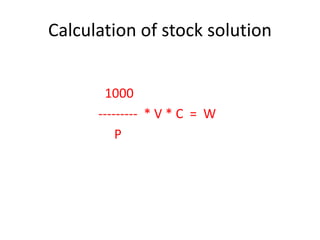
Calculation of stock solution
1000
--------- * V * C = W
P
DRIED FILTER PAPER DISCS:
• Whatmann no.1 filter paper is made to form a
disc size of 6mm
• Keep in petridish and sterilize in a hot air oven
• With the help of antibiotic delivery loop which
has a 20G wire with diameter of 2mm  the
antibiotic is delivered (0.005ml)
Storage of discs
• Refrigerate at 2 to 8 deg C
• Beta lactam class drugs should be frozen
• The drugs should be kept outside at RT 1 to 2
hours before work
• The dispensing apparatus which is used to
deliver the drugs should also be refrigerated
• Check the expiry of drugs
Inoculum – Standard:
• O.5 Mcfarland standard
• Prepared by 0.5ml of 0.048mol/L BaCl2 and
99.5ml of 0.18mol/L of H2SO4
• Added with constant stirring
• Turbidity standard is checked by
spectrophotometer – 625nm – absorbance
should be 0.008 to 0.10
Inoculum
• Seal the tubes containing the Mcfarland
standards and store in dark at RT
• The standard turbidity should be mixed
throroughly every time before use
• Check the density monthly and replace it
monthly
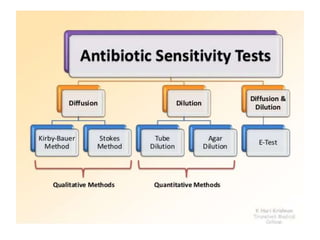
AST  METHODS
• Disk diffusion method
• MIC method
• E Test
• Automated systems
CONVENTIONAL AST
DISK DIFFUSION METHOD:
• Simplest and most convenient
• Widely used everywhere
• Developed by kirby, sherrris, bauer and turk in
1966
• Types:
1. Kirby Bauer method
2. Stokes method
KIRBY BAUER METHOD
• Types:
1. Direct colony suspension method
2. Inoculum (log phase ) method
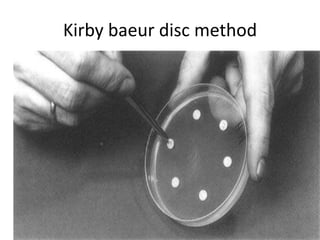
Application of Discs
• 150 mm plate  12 discs
• 100 mm plate  6 discs
• Drug should not be relocated
• Distance from the lid edge  15mm
• Distance between two drug from center to
center  24mm
• Inoculum  disc placement  incubation (
only 15 minutes delay is acceptable each)
Kirby baeur disc method
INTERPRETATION:
• After 16 to 18 hours
• Confluent lawn of growth
• Zones of inhibition  uniformly circular
• Read with reflected light
• For MRSA  read in transmitted light
• When proteus is tested  thin veil of
swarming growth after the zone of inhibition
should be ignored
STOKES METHOD
• Built in controls against many variables and
provide dependable results
• A standard sensitive strain of the bacterium is
inoculated in the middle third of the culture plate
• Standard strains:
• S.aureus ATCC 25923
• E.coli ATCC 25922
• P.aeruginosa ATCC 27853
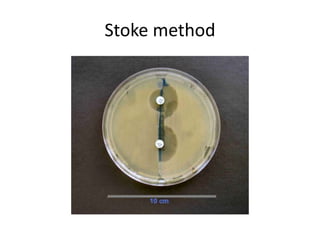
Stoke method
• The test bacterium is inoculated in the upper
and lower third of the plate
• Antibiotic discs are placed between the
standard and test inocula so that zones of
inhibition formed around each disc are
composed of standard and test bacteria.
• The results are reported as Susceptible,
Intermediate susceptible, Resistant
DILUTION METHODS
• The minimum concentration of antimicrobial
to inhibit or to kill the microorganism is
determined
• MIC
• Broth dilution method
• Agar dilution method
• MIC – lowest concentration of antimicrobial
that will inhibit the visible growth of an
organism in an ideal growth condition
• MBC – least concentration of the test antiiotic
which will completely kill the bacteria tested
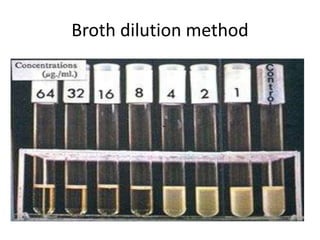
BROTH DILUTION METHOD
• Media: cation adjusted MH broth with a pH of
7.2 to 7.4
• For Haem.influenzae – HTM
• For TMP-SMX – Thymidine free medium
• For oxacillin Resistance – MH broth with 2%
NaCl
Working antibiotic solution
• Take original stock solution
• Prepare stock dilutions of the antibiotic of
concentrations 1000 and 100ug/ml
• Arrange two rows of 12 sterile 7.5*1.3cm
capped tubes in the rack
• Take a 30ml universal screw capped bottle
• Add 8ml broth and required antibiotic
concentration and mix the contents
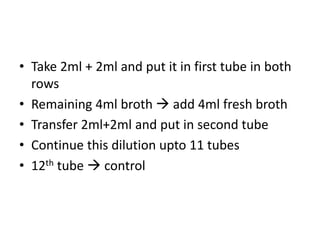
• Take 2ml + 2ml and put it in first tube in both
rows
• Remaining 4ml broth  add 4ml fresh broth
• Transfer 2ml+2ml and put in second tube
• Continue this dilution upto 11 tubes
• 12th tube  control
INOCULATION
• Inoculation of 1st row with one drop of overnight
broth culture 1 in 1000 dilutions
• 2nd row with control with known sensitivity
organisms
• Final inoculum = 5 * 105 cfu/ml
• Incubate at 37degC for 16 to 18 hours
• Inoculate another tube with 2ml broth and keep
at 4degC in a refrigerator overnight to be used as
standard for determinattion of complete
inhibition
Broth dilution method
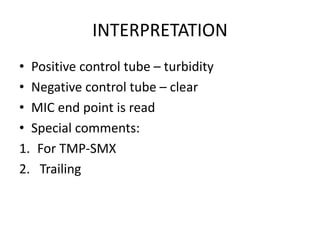
INTERPRETATION
• Positive control tube – turbidity
• Negative control tube – clear
• MIC end point is read
• Special comments:
1. For TMP-SMX
2. Trailing
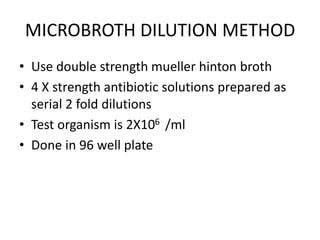
MICROBROTH DILUTION METHOD
• Use double strength mueller hinton broth
• 4 X strength antibiotic solutions prepared as
serial 2 fold dilutions
• Test organism is 2X10⁶ /ml
• Done in 96 well plate
AGAR DILUTION METHOD
• 1ml concentration of the drug + 24 ml of MHA
• Inoculum – make 1:10 dilution of
0.5Mcfarland standard inoculum which
delivers 107 cfu/ml
• Using pipette or calibrated loop , deliver 0.001
ml on the surface of the agar giving the final
inoculum of 104 cfu /spot
• Inoculate a control plate
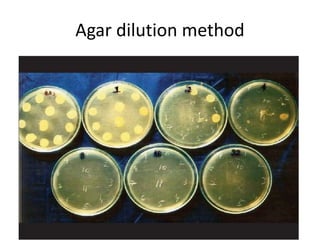
Agar dilution method
INTERPRETATION
• Examine the drug free control growth of the
test organism for viability and purity
• Place the plate on a dark background and
examine them for the lowest concentration
that inhibits visible growth
• A single colony of a faint haze is not recorded
as growth
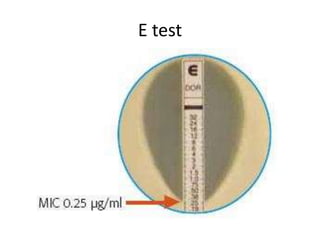
E test
• Epsilometer test
• An exponential gradient testing methodology
• A predefined stable antimicrobial gradient is
present on a thin inert carrier strip
• Following incubation, the E strip releases drug
and a symmetrical inhibition ellipse is
produced
• MIC = intersection of the inhibitory zone edge
and the calibrated carrier strip
E test
QUALITY CONTROL IN AST
• QC: a process in the laboratory designed to
monitor the analytical phase of testing
procedures to ensure that tests are working
properly
• CLSI recommends use of ATCC strains for QC in
AST
• QC strains should be included daily with the
test ideally
• Not more than 1 in 20 results should be
outside the accuracy limits
• No zone should be more than 4 SD away from
midpoint between the stated limits
• Due to expense, it can be switched as once
weekly testing
• Perform QC for 30 days and with less than
10% inaccuracy , continue for weekly
• Test repeated for each new drug included
• All documentation maintained indefinitely
REFERENCE STRAINS FOR QC
• Beta lactamase negative – ATCC E.coli 25922
• Beta lactamase positive – ATCC E.coli 35218
• Aminoglycosides – P.aeruginosa ATCC 27853
• Thymidine levels – E.feacalis ATCC 29212
• Cephalosporins – H.influenzae ATCC 49766
• Beta lactamase negative – ATCC staph.25923
• Beta lactamase positive – ATCC staph 38591
REFERENCES
• Diagnostic Microbiology – Bailey and Scott
13th edition
• CLSI guidelines 2014
• Quality control in AST – ijmm journal
• Practical microbiology – Mackie and
Mccartney – 14th edition
• Image courtesy – google search engine

antibiotic susceptibility testing

  • 1.
    Antimicrobial Susceptibility Testing By, Dr.Malathi.M II yearPG, M.D., Microbiology Chengalpattu medical college
  • 2.
    Introduction • Once anorganism is isolated , characterization frequently includes tests to detect antimicrobial resistance, which is the prime important key component for the physician. • The procedures used to produce the antimicrobial susceptibility profiles and detect resistance to therapeutic agents are referred to as antimicrobial susceptibility testing (AST) methods.
  • 3.
    TESTING METHODS: • Methodsthat directly measure the activity of one or more antimicrobial agents against a bacterial isolate • Methods that directly detect the presence of a specific resistance mechanism in a bacterial isolate • Special methods that measure complex antimicrobial organism interactions
  • 4.
    GUIDELINES • CLSI 2014(CURRENT) • EUCAST
  • 5.
  • 6.
    MEDIA IN AST BESTMEDIUM – MHA (Mueller Hinton Agar) 1. Shows acceptable batch to batch reproducibility for susceptibility testing 2. Low in sulphonamide, trimethoprim and tetracycline inhibitors 3. Gives satisfactory growth of most non fastidious pathogens Media
  • 7.
    • Store theplates at 2 to 8 deg C • Use within 7 days of preparation • Each batch of MHA plates should be checked for sterility control • MHA added with 2% NaCl • MHA added with defibrinated sheep blood 5%s
  • 8.
    Factors affecting AST •pH • Moisture • Effects of Thymidine/thymine • Divalent cations
  • 9.
    Antibiotic Stock solutions •Buy commercial pure source of antibiotics • Don’t use injectable solutions • Accurate weighing of powders is must • Standard strains of stock cultures should be used to evaluate the stock solution • After preparing the stock solution, make 5 ml aliquots and frozen it Disc
  • 10.
    Calculation of stocksolution 1000 --------- * V * C = W P
  • 11.
    DRIED FILTER PAPERDISCS: • Whatmann no.1 filter paper is made to form a disc size of 6mm • Keep in petridish and sterilize in a hot air oven • With the help of antibiotic delivery loop which has a 20G wire with diameter of 2mm  the antibiotic is delivered (0.005ml)
  • 12.
    Storage of discs •Refrigerate at 2 to 8 deg C • Beta lactam class drugs should be frozen • The drugs should be kept outside at RT 1 to 2 hours before work • The dispensing apparatus which is used to deliver the drugs should also be refrigerated • Check the expiry of drugs
  • 13.
    Inoculum – Standard: •O.5 Mcfarland standard • Prepared by 0.5ml of 0.048mol/L BaCl2 and 99.5ml of 0.18mol/L of H2SO4 • Added with constant stirring • Turbidity standard is checked by spectrophotometer – 625nm – absorbance should be 0.008 to 0.10 Inoculum
  • 14.
    • Seal thetubes containing the Mcfarland standards and store in dark at RT • The standard turbidity should be mixed throroughly every time before use • Check the density monthly and replace it monthly
  • 15.
    AST  METHODS •Disk diffusion method • MIC method • E Test • Automated systems
  • 17.
    CONVENTIONAL AST DISK DIFFUSIONMETHOD: • Simplest and most convenient • Widely used everywhere • Developed by kirby, sherrris, bauer and turk in 1966 • Types: 1. Kirby Bauer method 2. Stokes method
  • 18.
    KIRBY BAUER METHOD •Types: 1. Direct colony suspension method 2. Inoculum (log phase ) method
  • 19.
    Application of Discs •150 mm plate  12 discs • 100 mm plate  6 discs • Drug should not be relocated • Distance from the lid edge  15mm • Distance between two drug from center to center  24mm • Inoculum  disc placement  incubation ( only 15 minutes delay is acceptable each)
  • 20.
  • 21.
    INTERPRETATION: • After 16to 18 hours • Confluent lawn of growth • Zones of inhibition  uniformly circular • Read with reflected light • For MRSA  read in transmitted light • When proteus is tested  thin veil of swarming growth after the zone of inhibition should be ignored
  • 22.
    STOKES METHOD • Builtin controls against many variables and provide dependable results • A standard sensitive strain of the bacterium is inoculated in the middle third of the culture plate • Standard strains: • S.aureus ATCC 25923 • E.coli ATCC 25922 • P.aeruginosa ATCC 27853
  • 23.
  • 24.
    • The testbacterium is inoculated in the upper and lower third of the plate • Antibiotic discs are placed between the standard and test inocula so that zones of inhibition formed around each disc are composed of standard and test bacteria. • The results are reported as Susceptible, Intermediate susceptible, Resistant
  • 25.
    DILUTION METHODS • Theminimum concentration of antimicrobial to inhibit or to kill the microorganism is determined • MIC • Broth dilution method • Agar dilution method
  • 26.
    • MIC –lowest concentration of antimicrobial that will inhibit the visible growth of an organism in an ideal growth condition • MBC – least concentration of the test antiiotic which will completely kill the bacteria tested
  • 27.
    BROTH DILUTION METHOD •Media: cation adjusted MH broth with a pH of 7.2 to 7.4 • For Haem.influenzae – HTM • For TMP-SMX – Thymidine free medium • For oxacillin Resistance – MH broth with 2% NaCl
  • 28.
    Working antibiotic solution •Take original stock solution • Prepare stock dilutions of the antibiotic of concentrations 1000 and 100ug/ml • Arrange two rows of 12 sterile 7.5*1.3cm capped tubes in the rack • Take a 30ml universal screw capped bottle • Add 8ml broth and required antibiotic concentration and mix the contents
  • 29.
    • Take 2ml+ 2ml and put it in first tube in both rows • Remaining 4ml broth  add 4ml fresh broth • Transfer 2ml+2ml and put in second tube • Continue this dilution upto 11 tubes • 12th tube  control
  • 30.
    INOCULATION • Inoculation of1st row with one drop of overnight broth culture 1 in 1000 dilutions • 2nd row with control with known sensitivity organisms • Final inoculum = 5 * 105 cfu/ml • Incubate at 37degC for 16 to 18 hours • Inoculate another tube with 2ml broth and keep at 4degC in a refrigerator overnight to be used as standard for determinattion of complete inhibition
  • 31.
  • 32.
    INTERPRETATION • Positive controltube – turbidity • Negative control tube – clear • MIC end point is read • Special comments: 1. For TMP-SMX 2. Trailing
  • 33.
    MICROBROTH DILUTION METHOD •Use double strength mueller hinton broth • 4 X strength antibiotic solutions prepared as serial 2 fold dilutions • Test organism is 2X10⁶ /ml • Done in 96 well plate
  • 34.
    AGAR DILUTION METHOD •1ml concentration of the drug + 24 ml of MHA • Inoculum – make 1:10 dilution of 0.5Mcfarland standard inoculum which delivers 107 cfu/ml • Using pipette or calibrated loop , deliver 0.001 ml on the surface of the agar giving the final inoculum of 104 cfu /spot • Inoculate a control plate
  • 35.
  • 36.
    INTERPRETATION • Examine thedrug free control growth of the test organism for viability and purity • Place the plate on a dark background and examine them for the lowest concentration that inhibits visible growth • A single colony of a faint haze is not recorded as growth
  • 37.
    E test • Epsilometertest • An exponential gradient testing methodology • A predefined stable antimicrobial gradient is present on a thin inert carrier strip • Following incubation, the E strip releases drug and a symmetrical inhibition ellipse is produced • MIC = intersection of the inhibitory zone edge and the calibrated carrier strip
  • 38.
  • 39.
    QUALITY CONTROL INAST • QC: a process in the laboratory designed to monitor the analytical phase of testing procedures to ensure that tests are working properly • CLSI recommends use of ATCC strains for QC in AST
  • 40.
    • QC strainsshould be included daily with the test ideally • Not more than 1 in 20 results should be outside the accuracy limits • No zone should be more than 4 SD away from midpoint between the stated limits
  • 41.
    • Due toexpense, it can be switched as once weekly testing • Perform QC for 30 days and with less than 10% inaccuracy , continue for weekly • Test repeated for each new drug included • All documentation maintained indefinitely
  • 42.
    REFERENCE STRAINS FORQC • Beta lactamase negative – ATCC E.coli 25922 • Beta lactamase positive – ATCC E.coli 35218 • Aminoglycosides – P.aeruginosa ATCC 27853 • Thymidine levels – E.feacalis ATCC 29212 • Cephalosporins – H.influenzae ATCC 49766 • Beta lactamase negative – ATCC staph.25923 • Beta lactamase positive – ATCC staph 38591
  • 43.
    REFERENCES • Diagnostic Microbiology– Bailey and Scott 13th edition • CLSI guidelines 2014 • Quality control in AST – ijmm journal • Practical microbiology – Mackie and Mccartney – 14th edition • Image courtesy – google search engine