PRESERVATION OF INDUSTRIALLY
IMPORTANT MICROORGANISMS
R. NITHYA, M. Sc., M. Phil., (Ph. D)
ASSISTANT PROFESSOR
DEPARTMENT OF BIOTECHNOLOGY
SRI ADI CHUNCHNAGIRI WOMENS COLLEGE CUMBUM
THENI DT, TAMIL NADU, INDIA.
PRESERVATION
To maintain pure culture for extended periods in a viable conditions, without
any genetic change is referred as Preservation
AIM OF PRESERVATION
The aim of preservation is to stop the cell division at a particular stage i.e. to
stop microbial growth or at least lower the growth rate.
Due to this toxic chemicals are not accumulated and hence viability of
microorganisms is not affected.
To avoid contamination
To restrict Genetic change (Mutation)
PRESERVATION METHODS
The methods of preservation is mainly of two types
Short term methods
Long term methods
1. Periodic transfer to fresh medium
2. Storage in saline suspension
3. Storage at low temperature - Refrigeration & Cryopreservation
4. Storage in sterile soil
5. Preservation by overlaying culture with mineral oil
6. Lyophilisation or freeze drying
SHORT TERM METHODS
PERIODIC TRANSFER TO FRESH MEDIUM
Culture can be maintained by periodically preparing fresh culture
from previous stock culture.
Bacterial sub cultures remain viable for 2-4 weeks and fungus for
3-4 months.
To maintain viability the process of sub-culturing is repeated.
It is a simple and advantageous method.
PERIODIC TRANSFER TO FRESH MEDIUM
PRESERVATION OF BACTERIA USING GLYCEROL
Bacteria can be frozen using 15% glycerol.
The glycerol is diluted to 30% and an equal amount of glycerol and
culture broth are mixed, dispensed into tubes, and then frozen at -10˚ C.
The viability of organisms varied such as
Escherichia coli, Diplococcus pneumonia etc. viable for 5 months,
Haemophilus influnzae viable for 4 months,
Neisseria meningtidis for 6 weeks and
Neisseria gonorrhoeae for 3 weeks
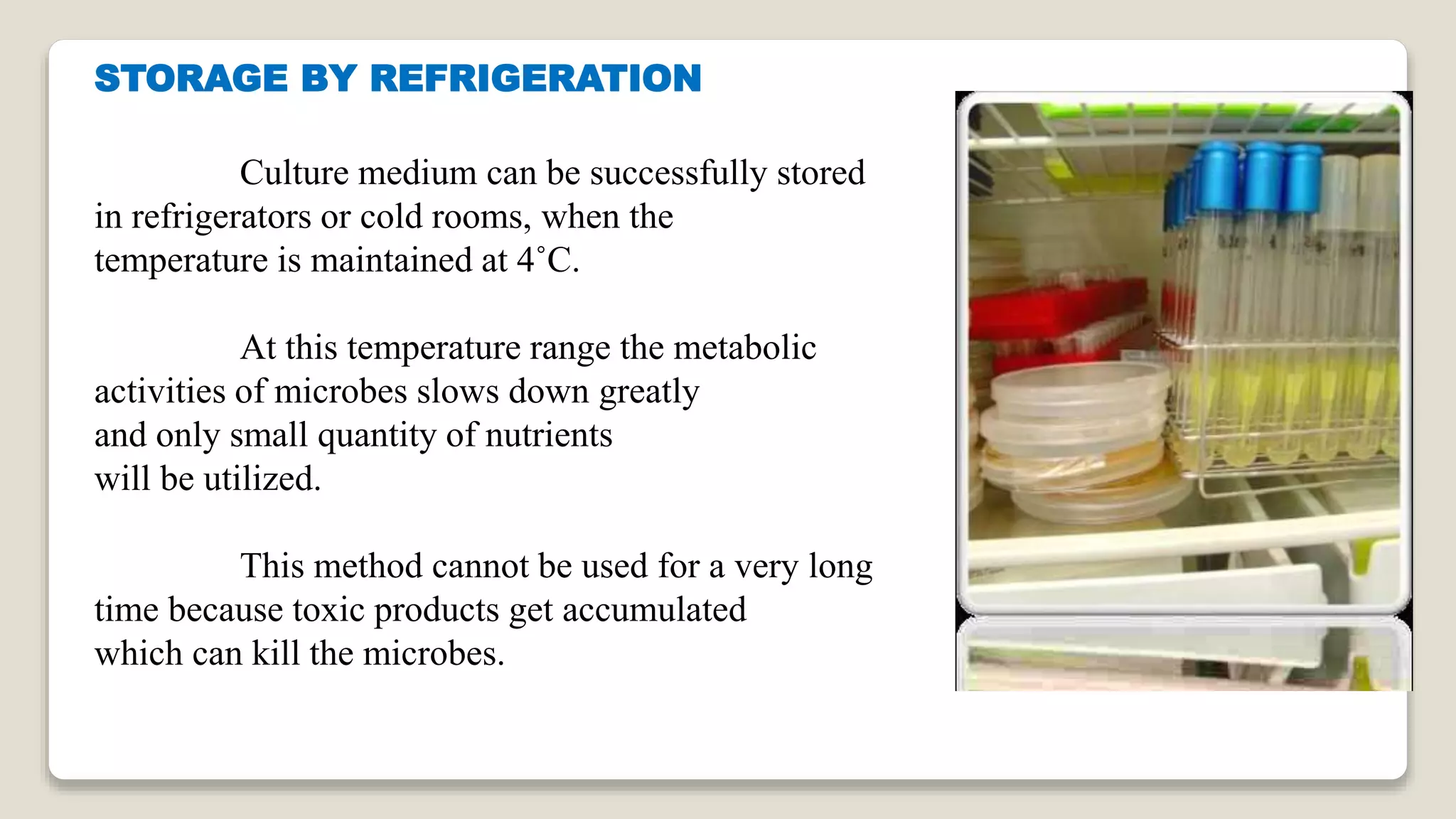
STORAGE BY REFRIGERATION
Culture medium can be successfully stored
in refrigerators or cold rooms, when the
temperature is maintained at 4˚C.
At this temperature range the metabolic
activities of microbes slows down greatly
and only small quantity of nutrients
will be utilized.
This method cannot be used for a very long
time because toxic products get accumulated
which can kill the microbes.
LONG TERM METHODS
MINERAL OIL OR LIQUID PARAFFIN STORAGE
In this method sterile liquid paraffin is poured over the
slant culture of microbes and stored upright at room
temperature.
Where as cultures can also be maintained by
covering agar slants by sterile mineral oil which
is stored at room temperature or preferably at 0-5°C.
It limit the oxygen access that reduces the microorganism’s
metabolism and growth, as well as to cell drying during preservation.
The preservation period for bacteria from the genera Azotobacter and
Mycobacterium is from 7-10 years, for Bacillus it is 8-12 years.
STORAGE IN SALINE SUSPENSION:
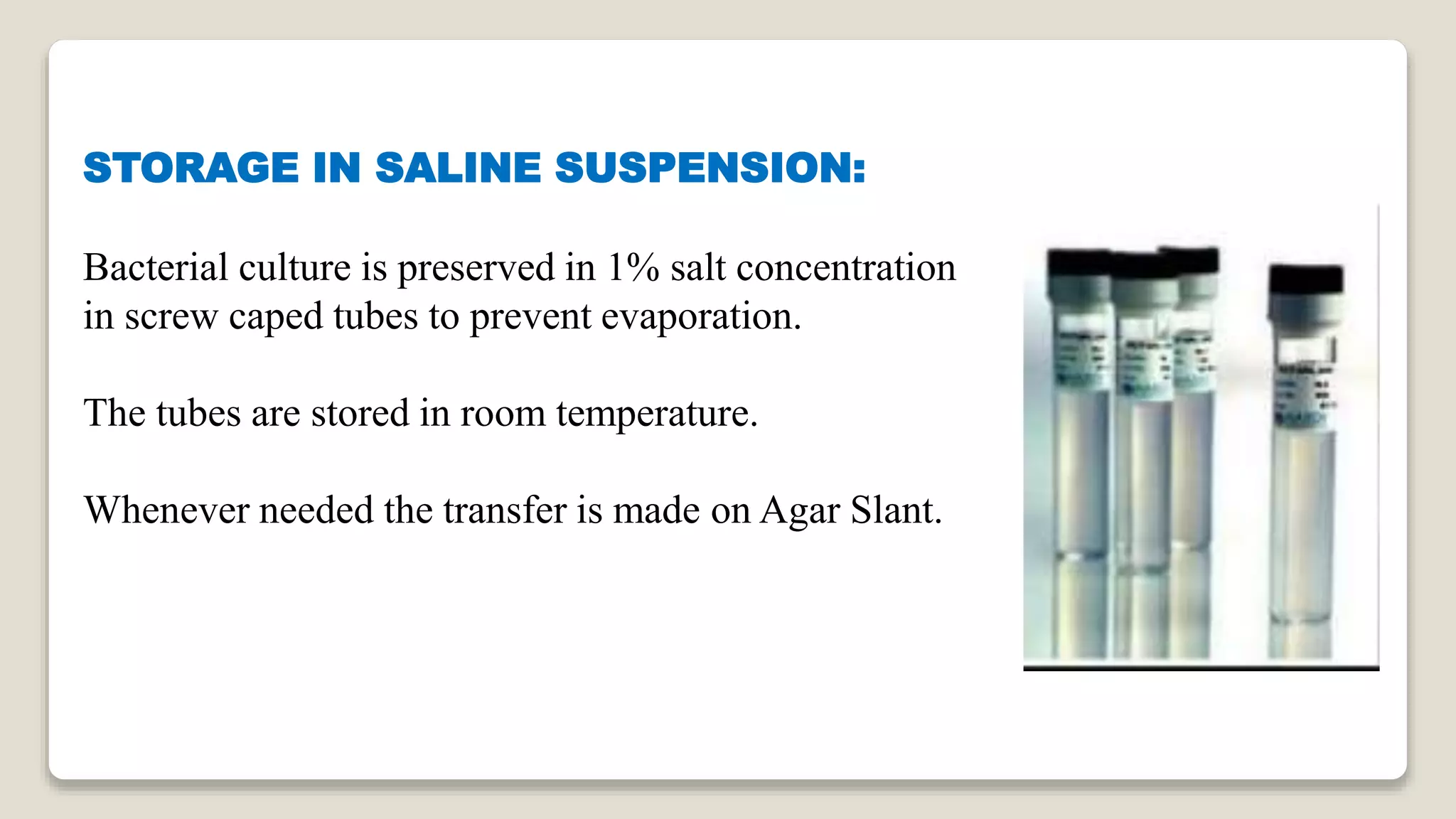
Bacterial culture is preserved in 1% salt concentration
in screw caped tubes to prevent evaporation.
The tubes are stored in room temperature.
Whenever needed the transfer is made on Agar Slant.
IMMERSION IN DISTILLED WATER:
Another inexpensive and low-maintenance method for storing fungal culture
is to immerse them in distilled water.
Fungi can be stored in this method at 20˚C, survived up to 2-10 years
depending upon the species.
FOR SPORULATING FUNGI:
It involves inoculating agar slants of preferred media with fungal cultures
and then incubating them at 25˚C for several weeks to induce sporulation.
Sterile distilled water(6-7 ml) is added aseptically to the culture, and the
surface of the culture is scraped gently with a pipette to produce a spore and
mycelial slurry.
This is kept in sterile glass vial at 25˚C and to retrieve a culture, 200-300μl of
the suspension is removed from the vial and placed on fresh medium.
STORAGE IN STERILE SOIL
 It is mainly applied for the preservation of sporulating microorganisms.
Fusarium, Penicillium, Alternaria, Rhizopus etc. proved successful for store in sterile
soil.
Soil storage involves inoculation of 1ml of spore suspension into soil (autoclaved
twice) and incubating at room temperature for 5-10 days.
The initial growth period allows the fungus to use the available moisture and gradually
to become dormant.
The bottles are then stored at refrigerator.
 Viability of organisms found around 70-80 years.
CRYOPRESERVATION
 Cryopreservation (i.e. freezing in liquid nitrogen at -196˚C or in the gas phase above
the liquid nitrogen at -150˚C) helps survival of pure cultures for long storage time.
 In this method, the microorganisms of culture are rapidly frozen in liquid nitrogen at -
196˚C in the presence of stabilizing agents such as Glycerol or Dimethyl Sulfoxide
(DMSO) that prevent the cell damage due to formation of ice crystals and promote cell
survival.
By this method species can remain viable for 10-30 years without undergoing change in
their characteristics.
CRYOPRESERVATION
STORED IN SILICA GEL
Microbes can be stored in silica gel powder at low temperature for a period 1-2
years.
The basic principle in this technique is quick desiccation at low temperature,
which allows the cell to remain viable for a long period of time.
 Some of the species which are preserved on anhydrous silica gel are such as-
Saccharomyces cerevisiae, Aspergillus nidulans, Pseudomonas denitrificans,
Escherichia coli etc.
LYOPHILLIZATION OR FREEZE DRYING
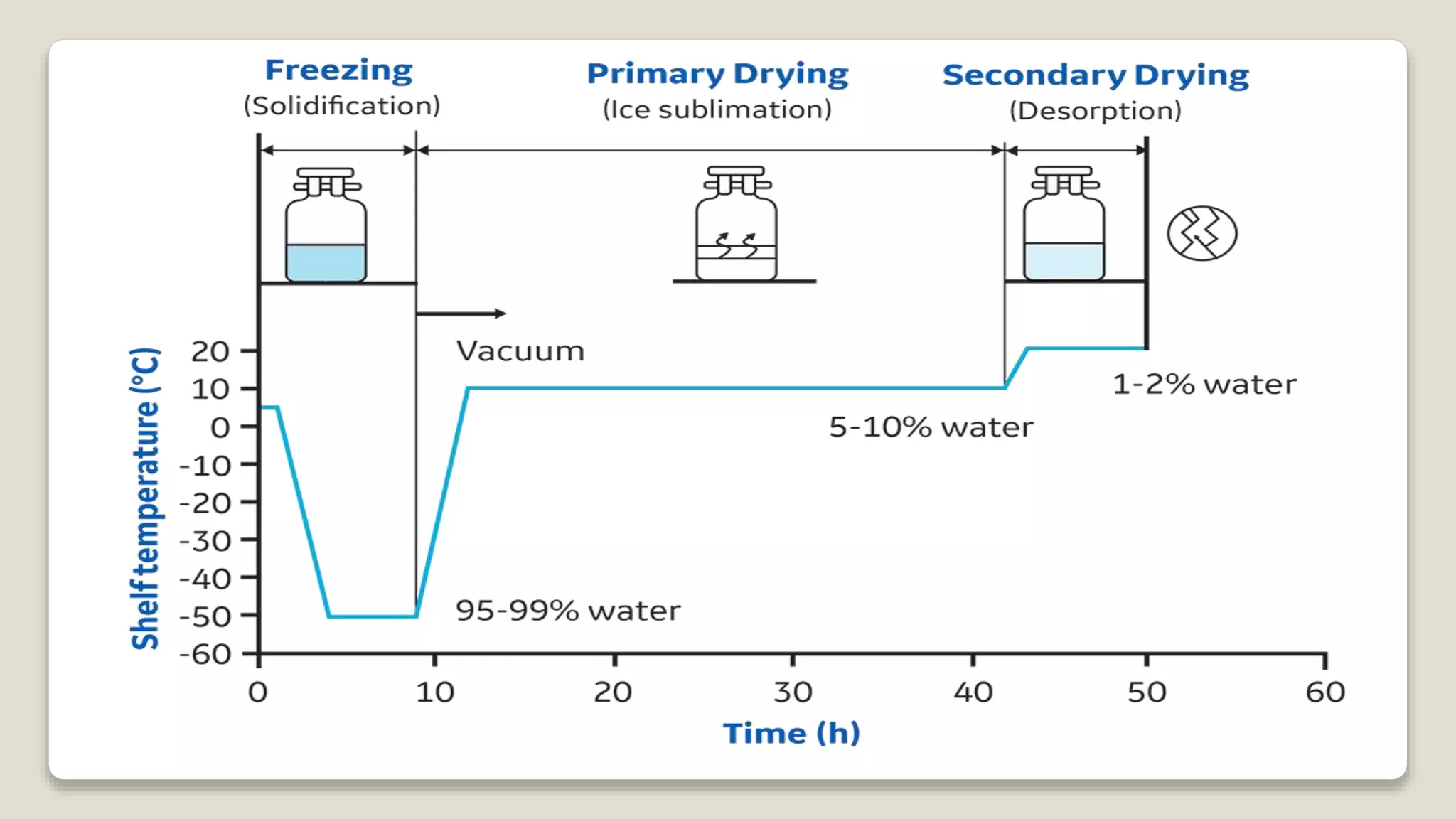
• Freeze drying is a stabilizing process in which a substance is first frozen and then
the quantity of the solvent is reduced, first by sublimation (primary drying stage) and
then desorption (secondary drying stage)
• Better preservation occurs with freeze-drying than with other methods because
freeze-drying reduces the risk of intracellular ice crystallization that compromises
viability
• Removal of water from the specimen effectively prevents this damage
• Lyophilisation is greatest with gram-positive bacteria (spore formers) and decrease
with gram -negative bacteria but viability can be maintained as long as 30 years.
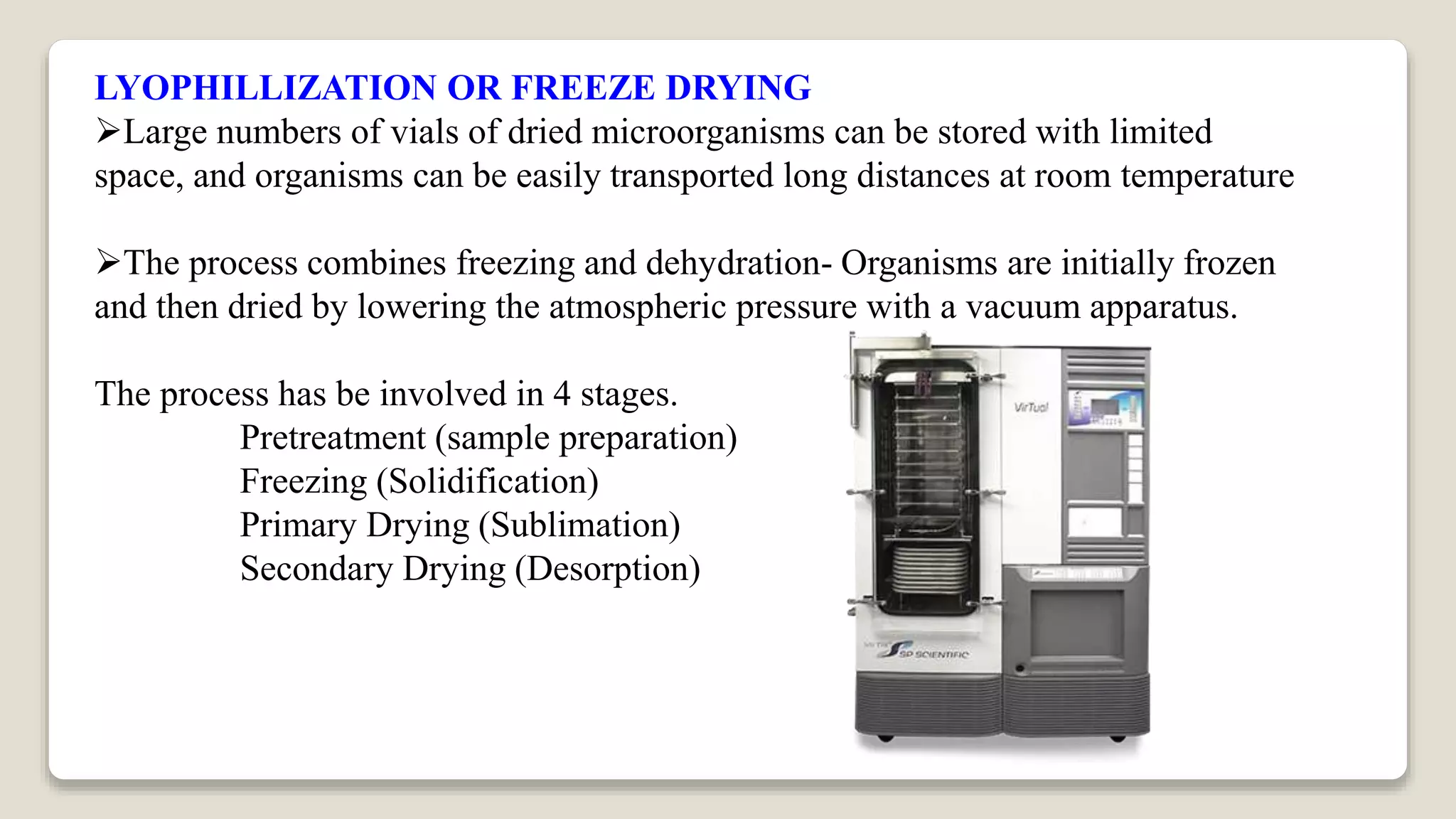
LYOPHILLIZATION OR FREEZE DRYING
Large numbers of vials of dried microorganisms can be stored with limited
space, and organisms can be easily transported long distances at room temperature
The process combines freezing and dehydration- Organisms are initially frozen
and then dried by lowering the atmospheric pressure with a vacuum apparatus.
The process has be involved in 4 stages.
Pretreatment (sample preparation)
Freezing (Solidification)
Primary Drying (Sublimation)
Secondary Drying (Desorption)
STORAGE VIALS
Glass vials are used for all freeze-dried specimens
When freeze-drying is performed in a chamber, double glass vials are used.
Cryoprotective Agents
Two most commonly used agents are
Skim milk for chamber lyophilization, and
Sucrose for manifold lyophilization
LYOPHILIZATION METHODS
Chamber method
An outer soft glass vial is added for protection and preservation of the
dehydrated specimen.
Silica gel granules are placed in the bottom of the outer
vial before the inner vial is inserted and cushioned with cotton
Manifold method
A single glass vial is used
Storage vial must be sealed to maintain the vacuum and the dry
atmospheric condition
ADVANTAGES
 Removal of water at low temperature
Thermolabile materials can be dried.
Sterility can be maintained.
Reconstitution is easy
DISADVANTAGES
 Many biological molecules are damaged by the stress associated with freezing,
freeze drying, or both.
E.g. the process of drying causes extensive damage to molds, protozoa, and most
viruses
 Hence, these microorganisms can not be stored by this method
The product is prone to oxidation, due to high porosity and large surface area.
Therefore the product should be packed in vacuum or using inert gas
Cost may be an issue, depending on the product.
Preservation of microbes

Preservation of microbes

  • 1.
    PRESERVATION OF INDUSTRIALLY IMPORTANTMICROORGANISMS R. NITHYA, M. Sc., M. Phil., (Ph. D) ASSISTANT PROFESSOR DEPARTMENT OF BIOTECHNOLOGY SRI ADI CHUNCHNAGIRI WOMENS COLLEGE CUMBUM THENI DT, TAMIL NADU, INDIA.
  • 2.
    PRESERVATION To maintain pureculture for extended periods in a viable conditions, without any genetic change is referred as Preservation AIM OF PRESERVATION The aim of preservation is to stop the cell division at a particular stage i.e. to stop microbial growth or at least lower the growth rate. Due to this toxic chemicals are not accumulated and hence viability of microorganisms is not affected. To avoid contamination To restrict Genetic change (Mutation)
  • 3.
    PRESERVATION METHODS The methodsof preservation is mainly of two types Short term methods Long term methods 1. Periodic transfer to fresh medium 2. Storage in saline suspension 3. Storage at low temperature - Refrigeration & Cryopreservation 4. Storage in sterile soil 5. Preservation by overlaying culture with mineral oil 6. Lyophilisation or freeze drying
  • 4.
    SHORT TERM METHODS PERIODICTRANSFER TO FRESH MEDIUM Culture can be maintained by periodically preparing fresh culture from previous stock culture. Bacterial sub cultures remain viable for 2-4 weeks and fungus for 3-4 months. To maintain viability the process of sub-culturing is repeated. It is a simple and advantageous method.
  • 5.
  • 6.
    PRESERVATION OF BACTERIAUSING GLYCEROL Bacteria can be frozen using 15% glycerol. The glycerol is diluted to 30% and an equal amount of glycerol and culture broth are mixed, dispensed into tubes, and then frozen at -10˚ C. The viability of organisms varied such as Escherichia coli, Diplococcus pneumonia etc. viable for 5 months, Haemophilus influnzae viable for 4 months, Neisseria meningtidis for 6 weeks and Neisseria gonorrhoeae for 3 weeks
  • 7.
    STORAGE BY REFRIGERATION Culturemedium can be successfully stored in refrigerators or cold rooms, when the temperature is maintained at 4˚C. At this temperature range the metabolic activities of microbes slows down greatly and only small quantity of nutrients will be utilized. This method cannot be used for a very long time because toxic products get accumulated which can kill the microbes.
  • 8.
    LONG TERM METHODS MINERALOIL OR LIQUID PARAFFIN STORAGE In this method sterile liquid paraffin is poured over the slant culture of microbes and stored upright at room temperature. Where as cultures can also be maintained by covering agar slants by sterile mineral oil which is stored at room temperature or preferably at 0-5°C. It limit the oxygen access that reduces the microorganism’s metabolism and growth, as well as to cell drying during preservation. The preservation period for bacteria from the genera Azotobacter and Mycobacterium is from 7-10 years, for Bacillus it is 8-12 years.
  • 9.
    STORAGE IN SALINESUSPENSION: Bacterial culture is preserved in 1% salt concentration in screw caped tubes to prevent evaporation. The tubes are stored in room temperature. Whenever needed the transfer is made on Agar Slant.
  • 10.
    IMMERSION IN DISTILLEDWATER: Another inexpensive and low-maintenance method for storing fungal culture is to immerse them in distilled water. Fungi can be stored in this method at 20˚C, survived up to 2-10 years depending upon the species. FOR SPORULATING FUNGI: It involves inoculating agar slants of preferred media with fungal cultures and then incubating them at 25˚C for several weeks to induce sporulation. Sterile distilled water(6-7 ml) is added aseptically to the culture, and the surface of the culture is scraped gently with a pipette to produce a spore and mycelial slurry. This is kept in sterile glass vial at 25˚C and to retrieve a culture, 200-300μl of the suspension is removed from the vial and placed on fresh medium.
  • 11.
    STORAGE IN STERILESOIL  It is mainly applied for the preservation of sporulating microorganisms. Fusarium, Penicillium, Alternaria, Rhizopus etc. proved successful for store in sterile soil. Soil storage involves inoculation of 1ml of spore suspension into soil (autoclaved twice) and incubating at room temperature for 5-10 days. The initial growth period allows the fungus to use the available moisture and gradually to become dormant. The bottles are then stored at refrigerator.  Viability of organisms found around 70-80 years.
  • 13.
    CRYOPRESERVATION  Cryopreservation (i.e.freezing in liquid nitrogen at -196˚C or in the gas phase above the liquid nitrogen at -150˚C) helps survival of pure cultures for long storage time.  In this method, the microorganisms of culture are rapidly frozen in liquid nitrogen at - 196˚C in the presence of stabilizing agents such as Glycerol or Dimethyl Sulfoxide (DMSO) that prevent the cell damage due to formation of ice crystals and promote cell survival. By this method species can remain viable for 10-30 years without undergoing change in their characteristics.
  • 14.
  • 15.
    STORED IN SILICAGEL Microbes can be stored in silica gel powder at low temperature for a period 1-2 years. The basic principle in this technique is quick desiccation at low temperature, which allows the cell to remain viable for a long period of time.  Some of the species which are preserved on anhydrous silica gel are such as- Saccharomyces cerevisiae, Aspergillus nidulans, Pseudomonas denitrificans, Escherichia coli etc.
  • 16.
    LYOPHILLIZATION OR FREEZEDRYING • Freeze drying is a stabilizing process in which a substance is first frozen and then the quantity of the solvent is reduced, first by sublimation (primary drying stage) and then desorption (secondary drying stage) • Better preservation occurs with freeze-drying than with other methods because freeze-drying reduces the risk of intracellular ice crystallization that compromises viability • Removal of water from the specimen effectively prevents this damage • Lyophilisation is greatest with gram-positive bacteria (spore formers) and decrease with gram -negative bacteria but viability can be maintained as long as 30 years.
  • 17.
    LYOPHILLIZATION OR FREEZEDRYING Large numbers of vials of dried microorganisms can be stored with limited space, and organisms can be easily transported long distances at room temperature The process combines freezing and dehydration- Organisms are initially frozen and then dried by lowering the atmospheric pressure with a vacuum apparatus. The process has be involved in 4 stages. Pretreatment (sample preparation) Freezing (Solidification) Primary Drying (Sublimation) Secondary Drying (Desorption)
  • 19.
    STORAGE VIALS Glass vialsare used for all freeze-dried specimens When freeze-drying is performed in a chamber, double glass vials are used. Cryoprotective Agents Two most commonly used agents are Skim milk for chamber lyophilization, and Sucrose for manifold lyophilization
  • 20.
    LYOPHILIZATION METHODS Chamber method Anouter soft glass vial is added for protection and preservation of the dehydrated specimen. Silica gel granules are placed in the bottom of the outer vial before the inner vial is inserted and cushioned with cotton Manifold method A single glass vial is used Storage vial must be sealed to maintain the vacuum and the dry atmospheric condition
  • 21.
    ADVANTAGES  Removal ofwater at low temperature Thermolabile materials can be dried. Sterility can be maintained. Reconstitution is easy DISADVANTAGES  Many biological molecules are damaged by the stress associated with freezing, freeze drying, or both. E.g. the process of drying causes extensive damage to molds, protozoa, and most viruses  Hence, these microorganisms can not be stored by this method The product is prone to oxidation, due to high porosity and large surface area. Therefore the product should be packed in vacuum or using inert gas Cost may be an issue, depending on the product.