Dr.M.Malathi
Final year postgraduate
M.D., Microbiology
Introduction
• Importance of Microbiological investigations
• High cost of culture media, reagents
• Lack of rational approach regarding laboratory
investigations
• Test report – Reliable and timely
Laboratory assessment
• Quality assurance (QA)
• Quality control (QC)
• Standard operating procedures (SOP)
Quality assurance
Definition by WHO:
The total process whereby the quality of
laboratory reports can be guaranteed.
• Right result, at the right time, on the right
specimen, from the right patient, with result
interpretation based on correct reference data
and at the right price.
Quality control
• QA = QC + IQA + EQA
• Quality control : The term QC covers that part
of QA , which primarily concerns the control of
errors in the performance of tests and
verification of test results.
• QC – covers all aspects of every procedure
• Practical, achievable and affordable
External quality assessment
• Laboratories must take part in the EQAS
programme.
Internal quality assessment
• Regular distribution of simulated specimens
for all sections and benches
• Can assess the following:
1. Changes in media, equipment and
procedures
2. Efficacy of communications and training
3. New tests, new procedures and equipment
can be checked
A guide for quality control
Standard Operating Procedures (SOPs):
• Quality of lab service
• Identify problems
• Written instructions
• Avoid short cuts
• Promote safe practices
QC at multiple stages of analysis
Pre analytical stage
Collection and transport of specimens :
• Quality of specimen
• Nature and timing of specimen
• Suitability of sampling method
• Transportation
• Transit time
• Information about patient
Analytical stage
• Standard procedure for methodologies as per
SOP
• QC of stains
• QC of reagents
• QC of culture media
• Preservation of stock cultures
• QC of antimicrobial susceptibility testing
• QC of antibiotic disks
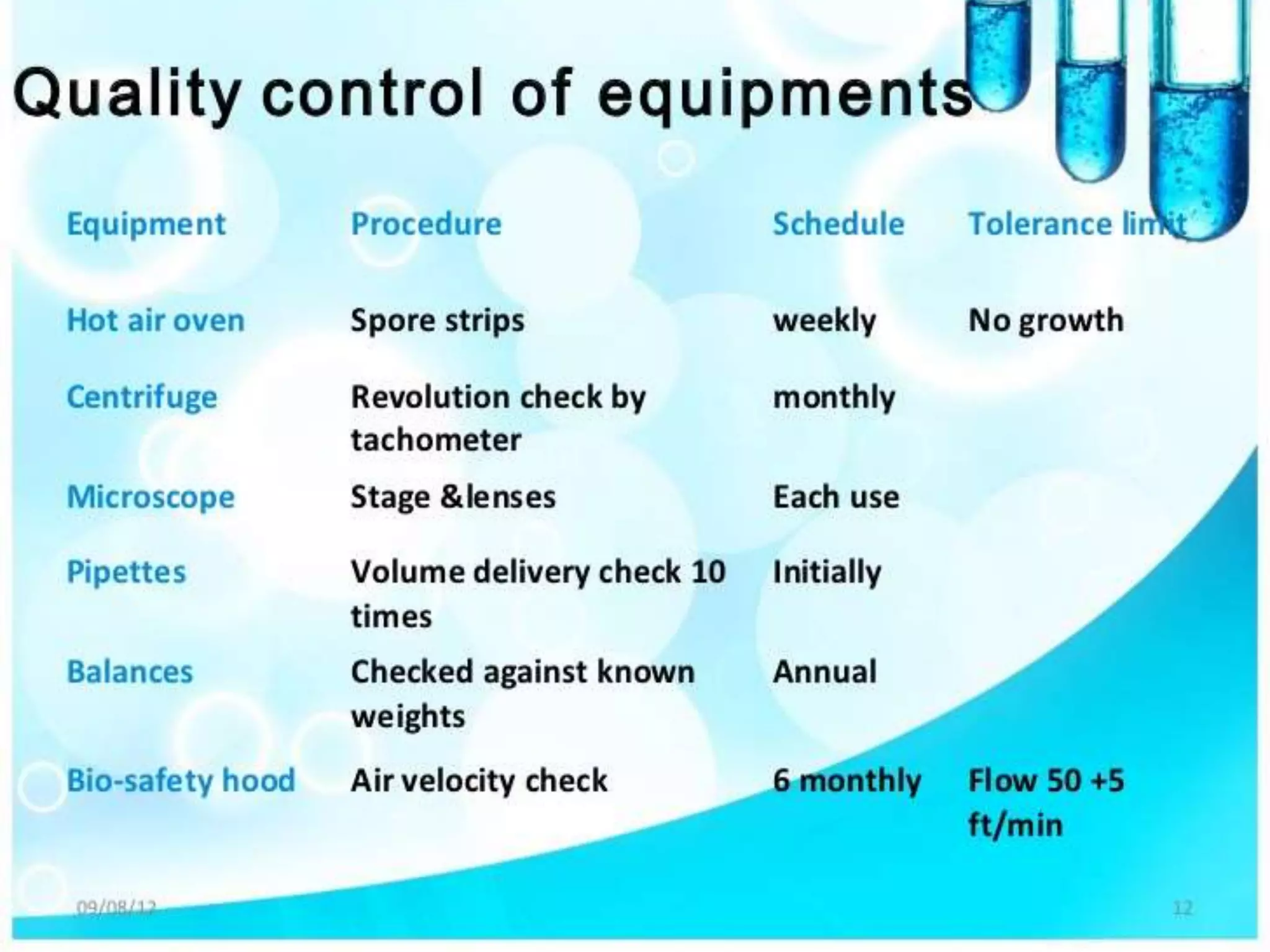
• QC of equipment
• QC of antigen and antibody reagents for
immunological techniques
• Sterility check of laboratory
Post analytical stage
• Reporting and interpretation of results
• Computerization
• Confidentiality
• Communication
Organization of quality control
QC officer
1. Set up QC in department
2. SOP
3. Regular monitoring
4. IQAS issue and result analysis
5. EQAS process and result analysis
6. Rectification of problems
7. Reporting to HOD about QC
8. Communication and training to all staffs of
department
9. Analysis of all QC data annually for
performance analysis
SUMMARY
• QC
• EQAS
• IQAS
• QA
• SOP
• Stage of analysis ?
References
1. Practice of quality assurance in laboratory medicine in developing
countries. In Health laboratory services in support of primary health care
in developing countries. World Health Organization, New Delhi, 1994:77-
137.
2. Cheesbrough, M. District laboratory practice in tropical countries. Part 1.
(Cambridge University Press, New York). 1st edition, 1998:3-37.
3. Specific guidelines for accreditation of clinical laboratories. National
Accreditation Board for Testing and Calibration Laboratories
112,1998:8.
4. Koneman EW, Allen SD, Janda WM, Schreckenberger PC, Winn Jr. WC.
Color atlas and textbook of diagnostic microbiology. Lippincott-Raven
Publishers, 5th edition, 1997:133-120.
5. Cheesbrough, M. District laboratory practice in tropical countries. Part
2. (Cambridge University Press, New York). 1st edition, 2000:1-9.

Quality control

  • 1.
  • 2.
    Introduction • Importance ofMicrobiological investigations • High cost of culture media, reagents • Lack of rational approach regarding laboratory investigations • Test report – Reliable and timely
  • 3.
    Laboratory assessment • Qualityassurance (QA) • Quality control (QC) • Standard operating procedures (SOP)
  • 4.
    Quality assurance Definition byWHO: The total process whereby the quality of laboratory reports can be guaranteed. • Right result, at the right time, on the right specimen, from the right patient, with result interpretation based on correct reference data and at the right price.
  • 5.
    Quality control • QA= QC + IQA + EQA • Quality control : The term QC covers that part of QA , which primarily concerns the control of errors in the performance of tests and verification of test results. • QC – covers all aspects of every procedure • Practical, achievable and affordable
  • 6.
    External quality assessment •Laboratories must take part in the EQAS programme.
  • 7.
    Internal quality assessment •Regular distribution of simulated specimens for all sections and benches • Can assess the following: 1. Changes in media, equipment and procedures 2. Efficacy of communications and training 3. New tests, new procedures and equipment can be checked
  • 8.
    A guide forquality control Standard Operating Procedures (SOPs): • Quality of lab service • Identify problems • Written instructions • Avoid short cuts • Promote safe practices
  • 9.
    QC at multiplestages of analysis
  • 10.
    Pre analytical stage Collectionand transport of specimens : • Quality of specimen • Nature and timing of specimen • Suitability of sampling method • Transportation • Transit time • Information about patient
  • 11.
    Analytical stage • Standardprocedure for methodologies as per SOP • QC of stains • QC of reagents • QC of culture media • Preservation of stock cultures • QC of antimicrobial susceptibility testing • QC of antibiotic disks
  • 12.
    • QC ofequipment • QC of antigen and antibody reagents for immunological techniques • Sterility check of laboratory
  • 14.
    Post analytical stage •Reporting and interpretation of results • Computerization • Confidentiality • Communication
  • 15.
    Organization of qualitycontrol QC officer 1. Set up QC in department 2. SOP 3. Regular monitoring 4. IQAS issue and result analysis 5. EQAS process and result analysis 6. Rectification of problems
  • 16.
    7. Reporting toHOD about QC 8. Communication and training to all staffs of department 9. Analysis of all QC data annually for performance analysis
  • 17.
    SUMMARY • QC • EQAS •IQAS • QA • SOP • Stage of analysis ?
  • 18.
    References 1. Practice ofquality assurance in laboratory medicine in developing countries. In Health laboratory services in support of primary health care in developing countries. World Health Organization, New Delhi, 1994:77- 137. 2. Cheesbrough, M. District laboratory practice in tropical countries. Part 1. (Cambridge University Press, New York). 1st edition, 1998:3-37. 3. Specific guidelines for accreditation of clinical laboratories. National Accreditation Board for Testing and Calibration Laboratories 112,1998:8. 4. Koneman EW, Allen SD, Janda WM, Schreckenberger PC, Winn Jr. WC. Color atlas and textbook of diagnostic microbiology. Lippincott-Raven Publishers, 5th edition, 1997:133-120. 5. Cheesbrough, M. District laboratory practice in tropical countries. Part 2. (Cambridge University Press, New York). 1st edition, 2000:1-9.