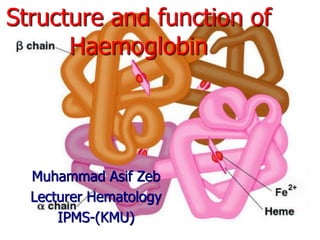
Structure and function of
Haemoglobin
Muhammad Asif Zeb
Lecturer Hematology
IPMS-(KMU)
Introduction
 Haemoglobin (Hb), protein constituting 1/3 of
the red blood cells
 65% at erythroblast stage
 35% at reticulocyte stage
 normal concentration of Hb in the blood:
adult males 13.5 – 16.5 g/dL
adult females 12.5 – 15 g/dl
 Two parts
 Haem
Synthesis of Haemoglobin (Hb)
 Haem & globin produced at two different
sites in the cells
 Haem in mitochondria
 Globin in ribosomes
 Well synchronized
Synthesis of Haemoglobin
Structure of Haem
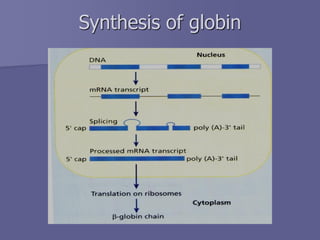
Synthesis of globin
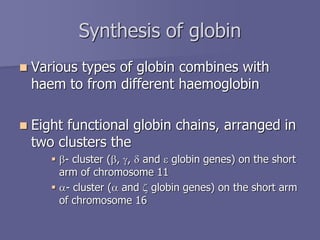
Synthesis of globin
 Various types of globin combines with
haem to from different haemoglobin
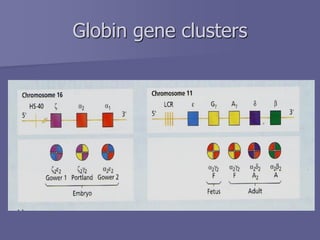
 Eight functional globin chains, arranged in
two clusters the
 b- cluster (b, g, d and e globin genes) on the short
arm of chromosome 11
 a- cluster (a and z globin genes) on the short arm
of chromosome 16
Globin gene clusters
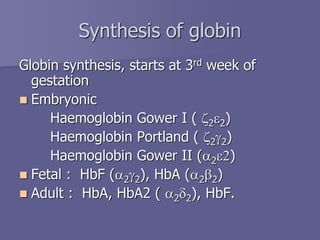
Globin synthesis, starts at 3rd week of
gestation
 Embryonic
Haemoglobin Gower I ( z2e2)
Haemoglobin Portland ( z2g2)
Haemoglobin Gower II (a2e2)
 Fetal : HbF (a2g2), HbA (a2b2)
 Adult : HbA, HbA2 ( a2d2), HbF.
Synthesis of globin
Globin chain switch
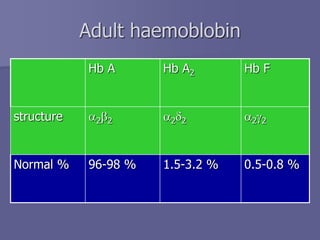
Hb A Hb A2 Hb F
structure a2b2 a2d2 a2g2
Normal % 96-98 % 1.5-3.2 % 0.5-0.8 %
Adult haemoblobin
Function of Hb
Functions of Haemoglobin
 Oxygen delivery to the tissues
 Reaction of Hb & oxygen
 Oxygenation not oxidation
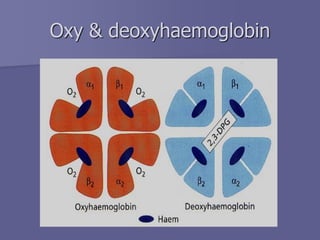
 One Hb can bind to four O2 molecules
 Less than .01 sec required for oxygenation
 b chain move closer when oxygenated
 When oxygenated 2,3-DPG is pushed out
 b chains are pulled apart when O2 is unloaded,
permitting entry of 2,3-DPG resulting in lower
affinity of O2
Oxy & deoxyhaemoglobin
Oxygen-haemoglobin dissociation
curve
 O2 carrying capacity of Hb at different Po2
 Sigmoid shape
 Binding of one molecule facilitate the second
molecule binding
 P 50 (partial pressure of O2 at which Hb is half
saturated with O2) 26.6mmHg
Hb-oxygen dissociation curve
 The normal position of curve depends on
 Concentration of 2,3-DPG
 H+ ion concentration (pH)
 CO2 in red blood cells
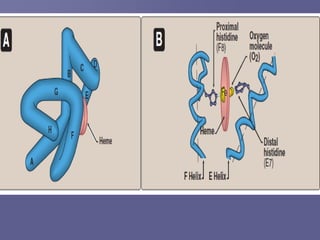
 Structure of Hb
Hb-oxygen dissociation curve
 Right shift (easy oxygen delivery)
 High 2,3-DPG
 High H+
 High CO2
 HbS
 Left shift (give up oxygen less readily)
 Low 2,3-DPG
 HbF
Hb-oxygen dissociation curve
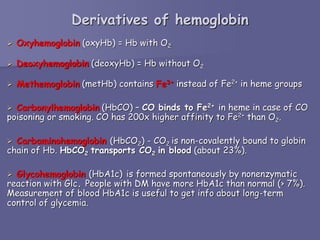
Derivatives of hemoglobin
 Oxyhemoglobin (oxyHb) = Hb with O2
 Deoxyhemoglobin (deoxyHb) = Hb without O2
 Methemoglobin (metHb) contains Fe3+ instead of Fe2+ in heme groups
 Carbonylhemoglobin (HbCO) – CO binds to Fe2+ in heme in case of CO
poisoning or smoking. CO has 200x higher affinity to Fe2+ than O2.
 Carbaminohemoglobin (HbCO2) - CO2 is non-covalently bound to globin
chain of Hb. HbCO2 transports CO2 in blood (about 23%).
 Glycohemoglobin (HbA1c) is formed spontaneously by nonenzymatic
reaction with Glc. People with DM have more HbA1c than normal (› 7%).
Measurement of blood HbA1c is useful to get info about long-term
control of glycemia.
Summary
 Normal structure including the proportion of
globin chains are necessary for the normal
function of haemoglobin
 Reduced haemoglobin in the red blood cells due
to any abnormality of any of its constituents
result into a clinical situation called anaemia
 Metabolic & other abnormalities result into
abnormal oxygen supply to the tissue

Structure and function of hemoglobin

  • 1.
    Structure and functionof Haemoglobin Muhammad Asif Zeb Lecturer Hematology IPMS-(KMU)
  • 3.
    Introduction  Haemoglobin (Hb),protein constituting 1/3 of the red blood cells  65% at erythroblast stage  35% at reticulocyte stage  normal concentration of Hb in the blood: adult males 13.5 – 16.5 g/dL adult females 12.5 – 15 g/dl  Two parts  Haem
  • 4.
    Synthesis of Haemoglobin(Hb)  Haem & globin produced at two different sites in the cells  Haem in mitochondria  Globin in ribosomes  Well synchronized
  • 5.
  • 6.
  • 7.
  • 8.
    Synthesis of globin Various types of globin combines with haem to from different haemoglobin  Eight functional globin chains, arranged in two clusters the  b- cluster (b, g, d and e globin genes) on the short arm of chromosome 11  a- cluster (a and z globin genes) on the short arm of chromosome 16
  • 10.
  • 11.
    Globin synthesis, startsat 3rd week of gestation  Embryonic Haemoglobin Gower I ( z2e2) Haemoglobin Portland ( z2g2) Haemoglobin Gower II (a2e2)  Fetal : HbF (a2g2), HbA (a2b2)  Adult : HbA, HbA2 ( a2d2), HbF. Synthesis of globin
  • 12.
  • 13.
    Hb A HbA2 Hb F structure a2b2 a2d2 a2g2 Normal % 96-98 % 1.5-3.2 % 0.5-0.8 % Adult haemoblobin
  • 14.
  • 16.
    Functions of Haemoglobin Oxygen delivery to the tissues  Reaction of Hb & oxygen  Oxygenation not oxidation  One Hb can bind to four O2 molecules  Less than .01 sec required for oxygenation  b chain move closer when oxygenated  When oxygenated 2,3-DPG is pushed out  b chains are pulled apart when O2 is unloaded, permitting entry of 2,3-DPG resulting in lower affinity of O2
  • 17.
  • 18.
    Oxygen-haemoglobin dissociation curve  O2carrying capacity of Hb at different Po2  Sigmoid shape  Binding of one molecule facilitate the second molecule binding  P 50 (partial pressure of O2 at which Hb is half saturated with O2) 26.6mmHg
  • 19.
  • 20.
     The normalposition of curve depends on  Concentration of 2,3-DPG  H+ ion concentration (pH)  CO2 in red blood cells  Structure of Hb Hb-oxygen dissociation curve
  • 21.
     Right shift(easy oxygen delivery)  High 2,3-DPG  High H+  High CO2  HbS  Left shift (give up oxygen less readily)  Low 2,3-DPG  HbF Hb-oxygen dissociation curve
  • 22.
    Derivatives of hemoglobin Oxyhemoglobin (oxyHb) = Hb with O2  Deoxyhemoglobin (deoxyHb) = Hb without O2  Methemoglobin (metHb) contains Fe3+ instead of Fe2+ in heme groups  Carbonylhemoglobin (HbCO) – CO binds to Fe2+ in heme in case of CO poisoning or smoking. CO has 200x higher affinity to Fe2+ than O2.  Carbaminohemoglobin (HbCO2) - CO2 is non-covalently bound to globin chain of Hb. HbCO2 transports CO2 in blood (about 23%).  Glycohemoglobin (HbA1c) is formed spontaneously by nonenzymatic reaction with Glc. People with DM have more HbA1c than normal (› 7%). Measurement of blood HbA1c is useful to get info about long-term control of glycemia.
  • 23.
    Summary  Normal structureincluding the proportion of globin chains are necessary for the normal function of haemoglobin  Reduced haemoglobin in the red blood cells due to any abnormality of any of its constituents result into a clinical situation called anaemia  Metabolic & other abnormalities result into abnormal oxygen supply to the tissue