1
Laboratory Safety
MUHAMMAD ASIF ZEB
Lecturer MLT (KMU)
Master in health and professional education (MHPE in
progress)
M.Sc. Hematology
B.Sc. MLT
Certificate in health and professional education (CHPE)
Certificate in health research (CHR)
2
Responsibility
Who is responsible for safety in laboratories
clinics and hospitals participating in clinical
trials
3
Responsibility
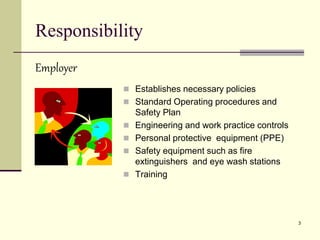
Employer
 Establishes necessary policies
 Standard Operating procedures and
Safety Plan
 Engineering and work practice controls
 Personal protective equipment (PPE)
 Safety equipment such as fire
extinguishers and eye wash stations
 Training
4
Responsibility
Employee
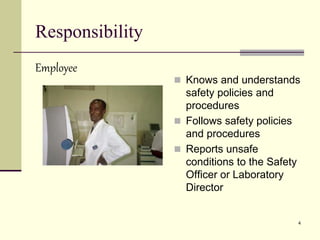
 Knows and understands
safety policies and
procedures
 Follows safety policies
and procedures
 Reports unsafe
conditions to the Safety
Officer or Laboratory
Director
5
Responsibility
Safety is Everyone’s Responsibility!
6
Components of a Safety Program
 Fire safety
 Chemical Safety
 Bloodborne Pathogens
7
Fire Safety
8
Fire Safety
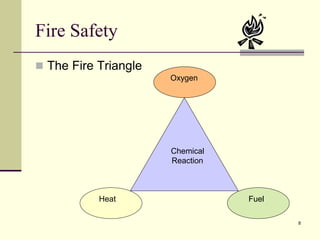
 The Fire Triangle
Chemical
Reaction
Heat
Oxygen
Fuel
9
Fire Safety
What should you do in case of a fire ?
Remember the acronym – RACE
Rescue – any people in danger
Alarm – activate the fire alarm
Contain – the fire by closing doors and windows
Extinguish – the fire if it is small enough
10
Fire Safety
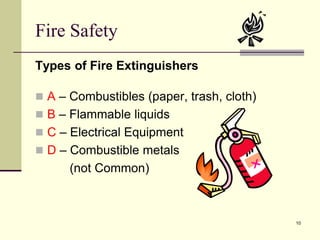
Types of Fire Extinguishers
 A – Combustibles (paper, trash, cloth)
 B – Flammable liquids
 C – Electrical Equipment
 D – Combustible metals
(not Common)
11
Fire Safety
How do you operate a fire extinguisher?
Remember PASS
 Pull - the pin
 Aim – at the base of the Fire
 Squeeze - the handle
 Sweep - to cover the fire
Patient Safety Monitoring in International
Laboratories (SMILE) Program
12
Fire Safety
Maintenance of Fire Extinguishers
Fire extinguishers should be visually inspected on a monthly basis.
The inspection should assure that Fire extinguishers are:
 In their assigned place
 Not blocked or hidden
 Pressure gauges show adequate pressure
 Pins and seals are in place
 No signs of damage
 The nozzles are free of blockages
13
Chemical Safety
14
Chemical Safety
How Do Chemicals enter the body?
 Inhalation – breathing in (e.g. powders, fumes)
 Absorption – on skin or mucus membranes
 Ingestion – entry through the mouth
 Injection - through skin by foreign body
15
Chemical Safety
Examples of Chemical Hazards
 Carcinogens – cancer
 Corrosives –burns
 Hepatotoxins –liver damage
 Mutagens-damage genetic materials in cells
 Nephrotoxins – Kidney damage
 Neurotoxins – damage to the nervous system
 Tertatogens – birth defects
16
Chemical Safety
How can you obtain information about the
Chemicals you use?
17
Chemical Safety
Material Safety Data Sheet (MSDS)
The following Data Can be found on MSDS sheets……….
Name of Chemical
Physical Characteristics and hazards
Health information
First Aid required if there is a spill or
exposure
Date of most recent update
Patient Safety Monitoring in International
Laboratories (SMILE) Program
18
Chemical Safety
MSDS Sheets Continued……….
 Need to check for updates annually
 Highlight the name of the chemical and the first
aid section for easy access in an emergency
 Organize in alphabetical order
 Must be available to everyone all of the time
 The internet is also a good way to access MSDS
sheets
 Instrument manufacturers usually have MSDS
sheets available on their websites.
19
Chemical Safety
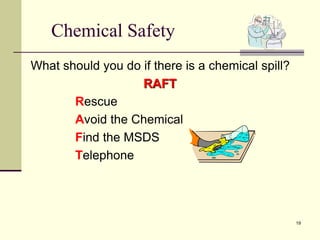
What should you do if there is a chemical spill?
RAFT
Rescue
Avoid the Chemical
Find the MSDS
Telephone
20
Chemical Safety
Chemical Exposures
First AID
Flush with plenty of water
 For at least 15 minutes
 Remove contaminated clothing
Seek medical Attention
Document incident
21
Chemical Safety
Liquid Nitrogen
Characteristics of Liquid Nitrogen
 78% of atmosphere
 Colorless, Odorless, Tasteless,
Nontoxic
 Boils at -196 Degrees C
 Non Flammable
22
Chemical Safety
Liquid Nitrogen
When returning to the gaseous state:
 Can displace oxygen from the air
 Can lead to asphyxiation
Will not support Life
Patient Safety Monitoring in International
Laboratories (SMILE) Program
23
Chemical Safety
Liquid Nitrogen – Precautions
Always wear safety equipment
Avoid use in a small enclosed area
Avoid prolonged breathing of vapors
Avoid rough handling of containers
Install O2 Monitors in LN work areas
24
Chemical Safety
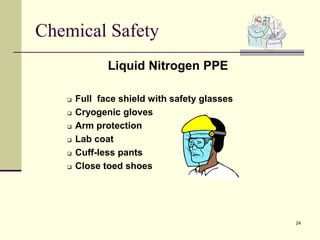
Liquid Nitrogen PPE
 Full face shield with safety glasses
 Cryogenic gloves
 Arm protection
 Lab coat
 Cuff-less pants
 Close toed shoes
25
Chemical Safety
Liquid Nitrogen Emergencies
 Inhalation – Move person into the fresh air
 Eyes – Flush with water for 15 minutes
 Skin - soak affected area in tepid water
 Seek medical attention
 Document incident
26
Chemical Safety
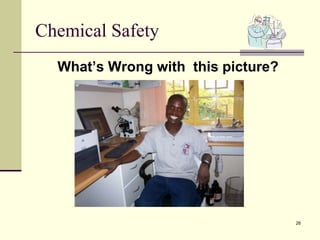
What’s Wrong with this picture?
27
Chemical Safety
Carbon Dioxide – Dry Ice
Characteristics of Carbon Dioxide
 Colorless, odorless, tasteless nontoxic
 Non flammable
 Can only be solid when the temperature is < -78oC
28
Chemical Safety
Solid Carbon Dioxide
Can displace oxygen from air
Can lead to asphyxiation
Will not support life
High concentrations cause rapid circulatory
insufficiency
Nausea
Headache
Vomiting
Unconsciousness
29
Chemical Safety
Solid Carbon Dioxide – Dry Ice
 Always wear safety equipment
 Avoid use in a small enclosed area
 Avoid prolonged breathing of vapors
 Vent Closed CO2 containers away from
you when opening
30
Chemical Safety
Solid Carbon Dioxide – PPE
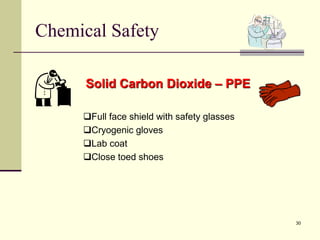
Full face shield with safety glasses
Cryogenic gloves
Lab coat
Close toed shoes
31
Chemical Safety
Solid Carbon Dioxide – Emergencies
 Inhalation – Move person into the fresh air
 Eyes – Flush with water for 15 minutes
 Skin - soak affected area in tepid water
Seek medical attention
 Document incident
32
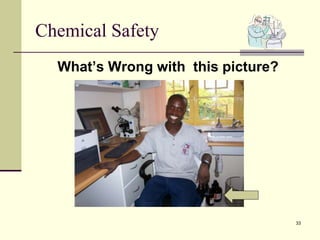
Chemical Safety
Managing Chemicals in the Laboratory
 Storage
 Hazard Communication
 MSDS Updates
 Acids and Bases in separate approved
cabinets
 Spill kits available
33
Chemical Safety
What’s Wrong with this picture?
34
SAFETY – Waste Disposal
Tips for safe disposal of laboratory waste:
 Place all sharps in approved sharps containers
 Use goggles or full face shields to protect mucus
membranes from splashes when disposing of liquid
waste or specimen tubes.
 Refer to MSDS sheets for information on the safe
disposal of chemicals
35
Bloodborne Pathogens
36
Bloodborne Pathogens
What are bloodborne pathogens?
Viruses, bacteria or other micro-organisms that are carried in the
bloodstream and are capable of causing disease.
Other body fluids that can spread bloodborne pathogens include:
 Blood products (plasma, platelets)
 Abdominal fluids
 Amniotic fluids
 Cerebrospinal fluids
 Vaginal secretions
 Semen
37
Bloodborne Pathogens
Most Common Bloodborne Pathogens
Hepatitis B
Hepatitis C
HIV
38
Bloodborne Pathogens
Standard Precautions
Standard Precautions replaces Universal
Precautions – using Standard Precautions all
blood and body fluids are treated as
infectious all of the time.
39
Bloodborne Pathogens
Personal Protective Equipment (PPE)
Gloves
Safety glasses/Goggles
Lab coats (should be fluid resistant)
Face shields
40
Bloodborne Pathogens
PPE Continued…….
How much PPE should you use?
Wear as much or as little as you anticipate you will
need to prevent blood and other infectious
materials from contact with your skin, mucus
membranes and clothing.
41
Blood borne Pathogens
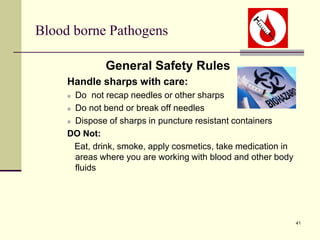
General Safety Rules
Handle sharps with care:
 Do not recap needles or other sharps
 Do not bend or break off needles
 Dispose of sharps in puncture resistant containers
DO Not:
Eat, drink, smoke, apply cosmetics, take medication in
areas where you are working with blood and other body
fluids
42
Bloodborne Pathogens
What should you do if there is a blood or body
fluid exposure ?
 Follow the post exposure prophylaxis (PEP) plan
 Wash puncture wounds with soap and water
 Flush affected mucus membranes with water
 Inform Safety Officer or administrative staff member
 Seek medical attention
 Complete an incident report form
43
Bloodborne Pathogens
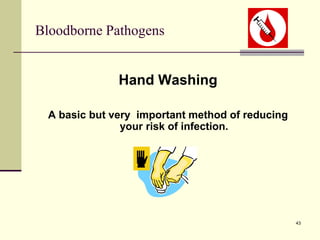
Hand Washing
A basic but very important method of reducing
your risk of infection.
44
Bloodborne Pathogens
Hand Washing
What song should you sing while you are
washing your hands so that you know
that you have washed for enough time?
45
Laboratory Safety
Questions and Comments
46
Laboratory Safety
References:
1.PPD (May, 2005) – PowerPoint Presentation, Presented at the
Washington DC GCLP Meeting.
2. WWW.safetylady.com

Asif lab safett

  • 1.
    1 Laboratory Safety MUHAMMAD ASIFZEB Lecturer MLT (KMU) Master in health and professional education (MHPE in progress) M.Sc. Hematology B.Sc. MLT Certificate in health and professional education (CHPE) Certificate in health research (CHR)
  • 2.
    2 Responsibility Who is responsiblefor safety in laboratories clinics and hospitals participating in clinical trials
  • 3.
    3 Responsibility Employer  Establishes necessarypolicies  Standard Operating procedures and Safety Plan  Engineering and work practice controls  Personal protective equipment (PPE)  Safety equipment such as fire extinguishers and eye wash stations  Training
  • 4.
    4 Responsibility Employee  Knows andunderstands safety policies and procedures  Follows safety policies and procedures  Reports unsafe conditions to the Safety Officer or Laboratory Director
  • 5.
  • 6.
    6 Components of aSafety Program  Fire safety  Chemical Safety  Bloodborne Pathogens
  • 7.
  • 8.
    8 Fire Safety  TheFire Triangle Chemical Reaction Heat Oxygen Fuel
  • 9.
    9 Fire Safety What shouldyou do in case of a fire ? Remember the acronym – RACE Rescue – any people in danger Alarm – activate the fire alarm Contain – the fire by closing doors and windows Extinguish – the fire if it is small enough
  • 10.
    10 Fire Safety Types ofFire Extinguishers  A – Combustibles (paper, trash, cloth)  B – Flammable liquids  C – Electrical Equipment  D – Combustible metals (not Common)
  • 11.
    11 Fire Safety How doyou operate a fire extinguisher? Remember PASS  Pull - the pin  Aim – at the base of the Fire  Squeeze - the handle  Sweep - to cover the fire
  • 12.
    Patient Safety Monitoringin International Laboratories (SMILE) Program 12 Fire Safety Maintenance of Fire Extinguishers Fire extinguishers should be visually inspected on a monthly basis. The inspection should assure that Fire extinguishers are:  In their assigned place  Not blocked or hidden  Pressure gauges show adequate pressure  Pins and seals are in place  No signs of damage  The nozzles are free of blockages
  • 13.
  • 14.
    14 Chemical Safety How DoChemicals enter the body?  Inhalation – breathing in (e.g. powders, fumes)  Absorption – on skin or mucus membranes  Ingestion – entry through the mouth  Injection - through skin by foreign body
  • 15.
    15 Chemical Safety Examples ofChemical Hazards  Carcinogens – cancer  Corrosives –burns  Hepatotoxins –liver damage  Mutagens-damage genetic materials in cells  Nephrotoxins – Kidney damage  Neurotoxins – damage to the nervous system  Tertatogens – birth defects
  • 16.
    16 Chemical Safety How canyou obtain information about the Chemicals you use?
  • 17.
    17 Chemical Safety Material SafetyData Sheet (MSDS) The following Data Can be found on MSDS sheets………. Name of Chemical Physical Characteristics and hazards Health information First Aid required if there is a spill or exposure Date of most recent update
  • 18.
    Patient Safety Monitoringin International Laboratories (SMILE) Program 18 Chemical Safety MSDS Sheets Continued……….  Need to check for updates annually  Highlight the name of the chemical and the first aid section for easy access in an emergency  Organize in alphabetical order  Must be available to everyone all of the time  The internet is also a good way to access MSDS sheets  Instrument manufacturers usually have MSDS sheets available on their websites.
  • 19.
    19 Chemical Safety What shouldyou do if there is a chemical spill? RAFT Rescue Avoid the Chemical Find the MSDS Telephone
  • 20.
    20 Chemical Safety Chemical Exposures FirstAID Flush with plenty of water  For at least 15 minutes  Remove contaminated clothing Seek medical Attention Document incident
  • 21.
    21 Chemical Safety Liquid Nitrogen Characteristicsof Liquid Nitrogen  78% of atmosphere  Colorless, Odorless, Tasteless, Nontoxic  Boils at -196 Degrees C  Non Flammable
  • 22.
    22 Chemical Safety Liquid Nitrogen Whenreturning to the gaseous state:  Can displace oxygen from the air  Can lead to asphyxiation Will not support Life
  • 23.
    Patient Safety Monitoringin International Laboratories (SMILE) Program 23 Chemical Safety Liquid Nitrogen – Precautions Always wear safety equipment Avoid use in a small enclosed area Avoid prolonged breathing of vapors Avoid rough handling of containers Install O2 Monitors in LN work areas
  • 24.
    24 Chemical Safety Liquid NitrogenPPE  Full face shield with safety glasses  Cryogenic gloves  Arm protection  Lab coat  Cuff-less pants  Close toed shoes
  • 25.
    25 Chemical Safety Liquid NitrogenEmergencies  Inhalation – Move person into the fresh air  Eyes – Flush with water for 15 minutes  Skin - soak affected area in tepid water  Seek medical attention  Document incident
  • 26.
  • 27.
    27 Chemical Safety Carbon Dioxide– Dry Ice Characteristics of Carbon Dioxide  Colorless, odorless, tasteless nontoxic  Non flammable  Can only be solid when the temperature is < -78oC
  • 28.
    28 Chemical Safety Solid CarbonDioxide Can displace oxygen from air Can lead to asphyxiation Will not support life High concentrations cause rapid circulatory insufficiency Nausea Headache Vomiting Unconsciousness
  • 29.
    29 Chemical Safety Solid CarbonDioxide – Dry Ice  Always wear safety equipment  Avoid use in a small enclosed area  Avoid prolonged breathing of vapors  Vent Closed CO2 containers away from you when opening
  • 30.
    30 Chemical Safety Solid CarbonDioxide – PPE Full face shield with safety glasses Cryogenic gloves Lab coat Close toed shoes
  • 31.
    31 Chemical Safety Solid CarbonDioxide – Emergencies  Inhalation – Move person into the fresh air  Eyes – Flush with water for 15 minutes  Skin - soak affected area in tepid water Seek medical attention  Document incident
  • 32.
    32 Chemical Safety Managing Chemicalsin the Laboratory  Storage  Hazard Communication  MSDS Updates  Acids and Bases in separate approved cabinets  Spill kits available
  • 33.
  • 34.
    34 SAFETY – WasteDisposal Tips for safe disposal of laboratory waste:  Place all sharps in approved sharps containers  Use goggles or full face shields to protect mucus membranes from splashes when disposing of liquid waste or specimen tubes.  Refer to MSDS sheets for information on the safe disposal of chemicals
  • 35.
  • 36.
    36 Bloodborne Pathogens What arebloodborne pathogens? Viruses, bacteria or other micro-organisms that are carried in the bloodstream and are capable of causing disease. Other body fluids that can spread bloodborne pathogens include:  Blood products (plasma, platelets)  Abdominal fluids  Amniotic fluids  Cerebrospinal fluids  Vaginal secretions  Semen
  • 37.
    37 Bloodborne Pathogens Most CommonBloodborne Pathogens Hepatitis B Hepatitis C HIV
  • 38.
    38 Bloodborne Pathogens Standard Precautions StandardPrecautions replaces Universal Precautions – using Standard Precautions all blood and body fluids are treated as infectious all of the time.
  • 39.
    39 Bloodborne Pathogens Personal ProtectiveEquipment (PPE) Gloves Safety glasses/Goggles Lab coats (should be fluid resistant) Face shields
  • 40.
    40 Bloodborne Pathogens PPE Continued……. Howmuch PPE should you use? Wear as much or as little as you anticipate you will need to prevent blood and other infectious materials from contact with your skin, mucus membranes and clothing.
  • 41.
    41 Blood borne Pathogens GeneralSafety Rules Handle sharps with care:  Do not recap needles or other sharps  Do not bend or break off needles  Dispose of sharps in puncture resistant containers DO Not: Eat, drink, smoke, apply cosmetics, take medication in areas where you are working with blood and other body fluids
  • 42.
    42 Bloodborne Pathogens What shouldyou do if there is a blood or body fluid exposure ?  Follow the post exposure prophylaxis (PEP) plan  Wash puncture wounds with soap and water  Flush affected mucus membranes with water  Inform Safety Officer or administrative staff member  Seek medical attention  Complete an incident report form
  • 43.
    43 Bloodborne Pathogens Hand Washing Abasic but very important method of reducing your risk of infection.
  • 44.
    44 Bloodborne Pathogens Hand Washing Whatsong should you sing while you are washing your hands so that you know that you have washed for enough time?
  • 45.
  • 46.
    46 Laboratory Safety References: 1.PPD (May,2005) – PowerPoint Presentation, Presented at the Washington DC GCLP Meeting. 2. WWW.safetylady.com