MUHAMMAD ASIF ZEB
LECTURER HEMATOLOGY
IPMS
IMMUNOGLOBULIN
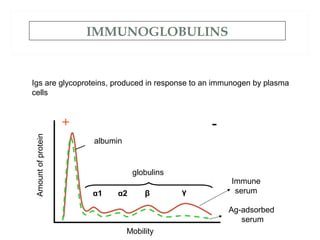
IMMUNOGLOBULINS
Immune
serum
Ag-adsorbed
serum
α1 α2 β γ
+ -
albumin
globulins
Mobility
Amountofprotein
Igs are glycoproteins, produced in response to an immunogen by plasma
cells
STRUCTURE OF ANTIBODIES
Simply Y shape structure
Composed of 2 identical heavy polypeptide chains and 2 identical
light chain.
Heavy chain means have high molecular weight i.e 50,000-77,000d
and composed of 450 amino acid.
There are five chain classed of heavy chain i.e mu(u), gamma(r),
alpha(a), delta(&) and epsilon(e)
Light chain are smaller having molecular weight 25ooo and
composed of 212 amino acid
Light chain may be further divide into either kappa or lambda.
Immunoglobulin may contain either kappa or lambda but not both
CONTI
Light and heavy chain are join to each other by disulfid bond
The light and heavy chain is composed of constant and
variable region.
The first 110-120 amino acid of the light and heavy region
form variable sequence and thought to antigen binding site.
The constant region is further divide into C1H,C2H and C3h
each have their own function.
In the medal of antibody a region called hinge region which
gives feasibility to antibody.
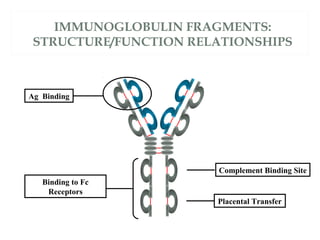
IMMUNOGLOBULIN FRAGMENTS:
STRUCTURE/FUNCTION RELATIONSHIPS
Ag Binding
Complement Binding Site
Placental Transfer
Binding to Fc
Receptors
HUMAN IMMUNOGLOBULIN CLASSES
Despite similarities, Abs are divided (size, charge,
solubility) into distinct classes and subclasses
• IgG - Gamma (γ) heavy chains
• IgM - Mu (µ) heavy chains
• IgA - Alpha (α) heavy chains
• IgD - Delta (δ) heavy chains
• IgE - Epsilon (ε) heavy chains
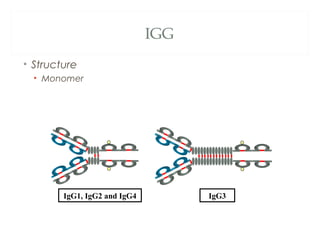
IGG
• Structure
• Monomer
IgG1, IgG2 and IgG4 IgG3
IGG
• Structure
• Properties
• Major serum Ig about 85% of imunoglobulin
• Monomeric structure
• Can cross placenta as have receptor on placenta
• Can Fixes complement (± IgG4)
• Opsonin antibodies and help in phagocytosis.
• Incomplete antibodies
• Best react at 37 c
• IgG Subclass
• IgG1 - Gamma 1 (γ1) heavy chains have 2 inter chain
disulfide bond
• IgG2 - Gamma 2 (γ2) heavy chains have 4
• IgG3 - Gamma 3 (γ3) heavy chains have 11
• IgG4 - Gamma 4 (γ4) heavy chains have 2
Ig3 have highest ability to activate complement followed by
Ig1 and then Ig2 while Ig4 cant
IGM
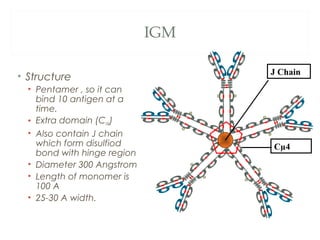
• Structure
• Pentamer , so it can
bind 10 antigen at a
time.
• Extra domain (CH4)
• Also contain J chain
which form disulfiod
bond with hinge region
• Diameter 300 Angstrom
• Length of monomer is
100 A
• 25-30 A width.
Cµ4
J Chain
IGM
•Properties
• 3rd highest serum Ig
First Ig made by fetus and B cells
• It Fixes complement
• Can not cross placenta
• Complete antibodies
• Usual temp 20c but best temperature is 4c
–Agglutinating antibody
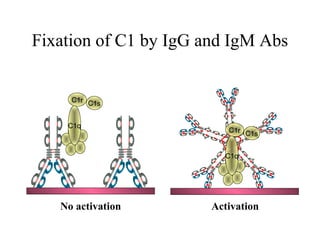
Fixation of C1 by IgG and IgM Abs
C1r C1s
C1q
C1r C1s
C1q
No activation Activation
IGA
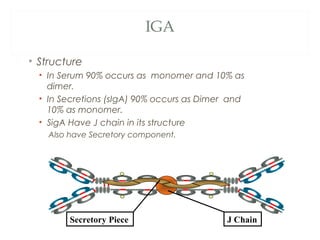
• Structure
• In Serum 90% occurs as monomer and 10% as
dimer.
• In Secretions (sIgA) 90% occurs as Dimer and
10% as monomer.
• SigA Have J chain in its structure
Also have Secretory component.
J ChainSecretory Piece
IGA
Properties
• It is 2nd highest serum Ig
• Major secretory Ig (Mucosal or Local Immunity)
• Tears, saliva, gastric and pulmonary secretions and server as first
lie of defense against microorganism invasion.
• Does not fix complement
• Cannt cross placenta
• Temp 37c
•IgA subtype
• IgA1 - Alpha 1 (α1) heavy chains
• IgA2 - Alpha 2 (α2) heavy chains
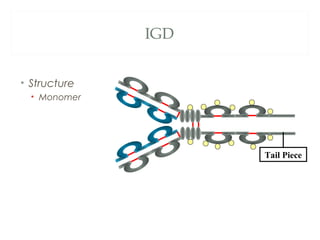
IGD
• Structure
• Monomer
Tail Piece
IGD
• Structure
• Properties
• 4th highest serum Ig
• B cell surface Ig
• Does not bind complement
• Function is unknown but may important as lymphocytic
differentiation.
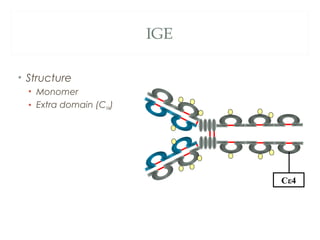
IGE
• Structure
• Monomer
• Extra domain (CH4)
Cε4
IGE
• Structure
• Properties
• Least common serum Ig
• Binds to basophils and mast cells (Does not require Ag binding)
• Allergic reactions
• Binds to Fc receptor on eosinophils
• Does not fix complement
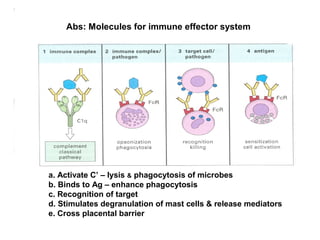
Abs: Molecules for immune effector system
a. Activate C’ – lysis & phagocytosis of microbes
b. Binds to Ag – enhance phagocytosis
c. Recognition of target
d. Stimulates degranulation of mast cells & release mediators
e. Cross placental barrier

Antiboy or immunoglobulin

  • 1.
    MUHAMMAD ASIF ZEB LECTURERHEMATOLOGY IPMS IMMUNOGLOBULIN
  • 2.
    IMMUNOGLOBULINS Immune serum Ag-adsorbed serum α1 α2 βγ + - albumin globulins Mobility Amountofprotein Igs are glycoproteins, produced in response to an immunogen by plasma cells
  • 3.
    STRUCTURE OF ANTIBODIES SimplyY shape structure Composed of 2 identical heavy polypeptide chains and 2 identical light chain. Heavy chain means have high molecular weight i.e 50,000-77,000d and composed of 450 amino acid. There are five chain classed of heavy chain i.e mu(u), gamma(r), alpha(a), delta(&) and epsilon(e) Light chain are smaller having molecular weight 25ooo and composed of 212 amino acid Light chain may be further divide into either kappa or lambda. Immunoglobulin may contain either kappa or lambda but not both
  • 4.
    CONTI Light and heavychain are join to each other by disulfid bond The light and heavy chain is composed of constant and variable region. The first 110-120 amino acid of the light and heavy region form variable sequence and thought to antigen binding site. The constant region is further divide into C1H,C2H and C3h each have their own function. In the medal of antibody a region called hinge region which gives feasibility to antibody.
  • 5.
    IMMUNOGLOBULIN FRAGMENTS: STRUCTURE/FUNCTION RELATIONSHIPS AgBinding Complement Binding Site Placental Transfer Binding to Fc Receptors
  • 6.
    HUMAN IMMUNOGLOBULIN CLASSES Despitesimilarities, Abs are divided (size, charge, solubility) into distinct classes and subclasses • IgG - Gamma (γ) heavy chains • IgM - Mu (µ) heavy chains • IgA - Alpha (α) heavy chains • IgD - Delta (δ) heavy chains • IgE - Epsilon (ε) heavy chains
  • 7.
  • 8.
    IGG • Structure • Properties •Major serum Ig about 85% of imunoglobulin • Monomeric structure • Can cross placenta as have receptor on placenta • Can Fixes complement (± IgG4) • Opsonin antibodies and help in phagocytosis. • Incomplete antibodies • Best react at 37 c
  • 9.
    • IgG Subclass •IgG1 - Gamma 1 (γ1) heavy chains have 2 inter chain disulfide bond • IgG2 - Gamma 2 (γ2) heavy chains have 4 • IgG3 - Gamma 3 (γ3) heavy chains have 11 • IgG4 - Gamma 4 (γ4) heavy chains have 2 Ig3 have highest ability to activate complement followed by Ig1 and then Ig2 while Ig4 cant
  • 10.
    IGM • Structure • Pentamer, so it can bind 10 antigen at a time. • Extra domain (CH4) • Also contain J chain which form disulfiod bond with hinge region • Diameter 300 Angstrom • Length of monomer is 100 A • 25-30 A width. Cµ4 J Chain
  • 11.
    IGM •Properties • 3rd highestserum Ig First Ig made by fetus and B cells • It Fixes complement • Can not cross placenta • Complete antibodies • Usual temp 20c but best temperature is 4c –Agglutinating antibody
  • 12.
    Fixation of C1by IgG and IgM Abs C1r C1s C1q C1r C1s C1q No activation Activation
  • 13.
    IGA • Structure • InSerum 90% occurs as monomer and 10% as dimer. • In Secretions (sIgA) 90% occurs as Dimer and 10% as monomer. • SigA Have J chain in its structure Also have Secretory component. J ChainSecretory Piece
  • 14.
    IGA Properties • It is2nd highest serum Ig • Major secretory Ig (Mucosal or Local Immunity) • Tears, saliva, gastric and pulmonary secretions and server as first lie of defense against microorganism invasion. • Does not fix complement • Cannt cross placenta • Temp 37c •IgA subtype • IgA1 - Alpha 1 (α1) heavy chains • IgA2 - Alpha 2 (α2) heavy chains
  • 15.
  • 16.
    IGD • Structure • Properties •4th highest serum Ig • B cell surface Ig • Does not bind complement • Function is unknown but may important as lymphocytic differentiation.
  • 17.
    IGE • Structure • Monomer •Extra domain (CH4) Cε4
  • 18.
    IGE • Structure • Properties •Least common serum Ig • Binds to basophils and mast cells (Does not require Ag binding) • Allergic reactions • Binds to Fc receptor on eosinophils • Does not fix complement
  • 19.
    Abs: Molecules forimmune effector system a. Activate C’ – lysis & phagocytosis of microbes b. Binds to Ag – enhance phagocytosis c. Recognition of target d. Stimulates degranulation of mast cells & release mediators e. Cross placental barrier