Hemoglobin structure, function
and its applied aspects
nted by:
Dr. Faisal
Govt
College
INTRODUCTION
 Haemoglobin is a red globular protein composed of heme (consisting
of iron and protoporphyrin) and globin.
 Globin portion of the molecule consists of four (or two pairs of)
polypeptide chains.
 Has molecular weight of about 64,500 daltons contributing one third
of weight of rbc.
 Over 500 different haemoglobin variants have been described but all
share the same basic structure of four globin polypeptide chains
each with heme group.
 Functional haemoglobin is composed of two pairs of dissimilar
globins.
Normal Values of Hb
Age/Sex Hemoglobin (g/dl)
Adult males 13-17
Adult females 12-15
Adult females(pregnant) 11-14
Children,(6-12 years) 11.5-15.5
Children,(6 months – 6 years) 11-14
Newborn 13.6-19.6
Hemoglobin Synthesis
• Although haem & globin synthesis occur separately within
developing red cell precursors , their rate of synthesis are
carefully coordinated to ensure optimal efficiency of
haemoglobin assembly.
• 65% of haem is synthesized in the erythroblasts.
• 35% of it at reticulocyte stage.
• Heme part occurs in the mitochondria first and then in the cytoplasm of
RBC precursors .
Important points about first step
 This reaction is energy dependent and so occurs in the
mitochondria.
 It’s catalyzed by the enzyme δ ALA synthase.
 This step is a first-limiting step for the whole process of
heme synthesis.
 It is stimulated by the presence of globin chains and
inhibited by the presence of free heme groups.
 This represents an important control mechanism of the rate
of heme synthesis and it’s coordination with globin
synthesis.
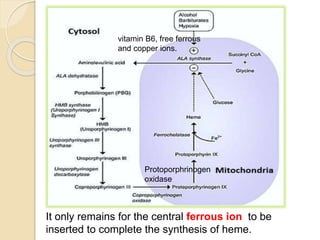
vitamin B6, free ferrous
and copper ions.
Protoporphrinogen
oxidase
It only remains for the central ferrous ion to be
inserted to complete the synthesis of heme.
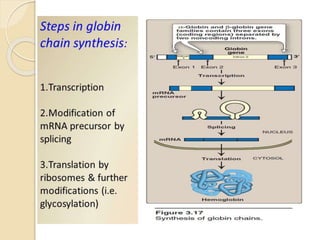
Globin Synthesis
 Humans normally carry 8 functional globin genes, arranged
in two duplicate gene clusters.
 The α-like cluster on the short arm of chromosome 16.
 The β-like cluster on the short arm of chromosome 11.
 These genes code for 6 different types of globin chains:
α,β,γ,δ,ε,ζ globin.
 Globin part occurs in polyribosomes
Globin Gene Cluster
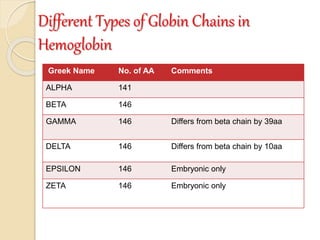
Globin Chains
 Globin chains are synthesized in the cytosol of erythrocytes.
 Consists of varied sequences of AA: polypeptide chains.
 The chains are designated by Greek letters:
◦ Alpha (α), Beta (β),Gamma (γ), Delta (δ), Epsilon (ε) and Zeta (ζ).
 The difference in the globin chains designates relates both to the
sequence and to no. of AA in the chain.
Greek Name No. of AA Comments
ALPHA 141
BETA 146
GAMMA 146 Differs from beta chain by 39aa
DELTA 146 Differs from beta chain by 10aa
EPSILON 146 Embryonic only
ZETA 146 Embryonic only
Different Types of Globin Chains in
Hemoglobin
Adult Hb(Hb A):
 Hb A1(2α & 2β subunits) is the major form of Hb 96-98% in
adults & in children over 7 months of age.
 Hb A2 (2α & 2δ subunits) is the minor form of Hb in adults.
◦ It forms only 2.2-3.5% of total Hb A .
◦ Poor form of Hb for oxygen carriage
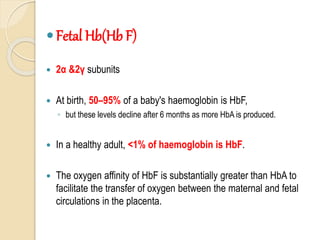
Fetal Hb(Hb F)
 2α &2γ subunits
 At birth, 50–95% of a baby's haemoglobin is HbF,
◦ but these levels decline after 6 months as more HbA is produced.
 In a healthy adult, <1% of haemoglobin is HbF.
 The oxygen affinity of HbF is substantially greater than HbA to
facilitate the transfer of oxygen between the maternal and fetal
circulations in the placenta.
HbA1c: glycosylated
haemoglobin
 Subtype of HbA1
 Attachment of glucose to N terminal amino acid valine of the
beta chain of hemoglobin.
 Indicator of how well the blood glucose level has been
controlled over a long period of time, every 2-3 months.
 Its high value is directly related to complications from
diabetes.
Type of Hb Globin chain combination %age
HbA1 α2b2
96-98 %
EMBRYONIC Hb α22
NIL
HbF α22
0.2-0.8%
HbA2 α2d2
1.5-3.2 %
HbA1C α2b2
4-6%
Types of Hb in normal Adult
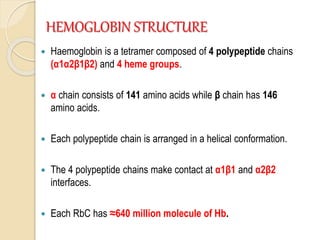
HEMOGLOBIN STRUCTURE
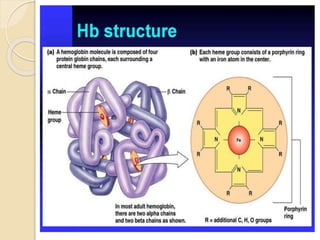
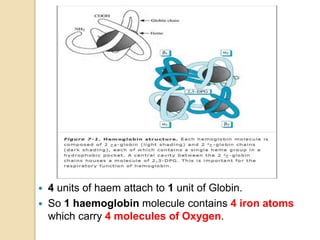
 Haemoglobin is a tetramer composed of 4 polypeptide chains
(α1α2β1β2) and 4 heme groups.
 α chain consists of 141 amino acids while β chain has 146
amino acids.
 Each polypeptide chain is arranged in a helical conformation.
 The 4 polypeptide chains make contact at α1β1 and α2β2
interfaces.
 Each RbC has ≈640 million molecule of Hb.
 4 units of haem attach to 1 unit of Globin.
 So 1 haemoglobin molecule contains 4 iron atoms
which carry 4 molecules of Oxygen.
Primary Structure
 The primary structure of globin refers to the amino acid
sequence of the various chain types.
 Numbering from the N-terminal end identifies the position of
individual amino acids.
 Any change in the identity and position of these amino acids
cause gross impairment to molecular function.
SECONDARY STRUCTURE
 The secondary structure of all globin chain types comprises 9
non-helical sections joined by 8 helical sections.
 There are 8 helical segment designated A to H.
 Iron of heme is covalently bound to histidine at the eighth
position of the F helical segments.
Tertiary folding gives rise to atleast 3 functionally important
characteristic of Hb molecule
 Tertiary folding make the surface of the molecule hydrophilic
and the interior hydrophobic.
 An open-toped cleft in the surface of the subunit known as
haem pocket is created.
 This hydrophobic cleft protects the ferrous ion from oxidation.
 The amino acids, which form the inter-subunit bonds
responsible for maintaining the quaternary structure.
Quaternary structure of globin
 The quaternary structure of haemoglobin has
four subunits arranged tetrahedrally.
 In adult haemoglobin- (HbA), there are different
contact areas:
◦ α1β1 and α2β2 - confirms stability of the molecule
◦ α1β2 and α2β1 - confirms solubility of the molecule
◦ α1α2 and β1β2 - weak bonds to permit oxygenation
and deoxygenation
Functions of Hemoglobin
Transport of oxygen from the lungs to the tissues, mostly
to facilitate oxidative phosphorylation in the mitochondria.
Carriage of carbon dioxide from tissues to the lungs as
carbaminohaemoglobin.
Buffering of hydrogen ions formed in the erythrocyte from
the conversion of carbon dioxide into bicarbonate.
Nitric oxide metabolism.
Oxygen Transport
 Haemoglobin is an allosteric protein; the binding of oxygen to
one haem group increases the oxygen affinity within the
remaining haem groups.
 Oxygen binds reversibly to haem, so each haemoglobin
molecule can carry up to four oxygen molecules.
 As partial pressure of oxygen increases hemoglobin shows
progressive increasing affinity for oxygen.
 Small changes in oxygen tension allow significant amount of
oxygen to be released.
Oxygen Transport
 Each gm of hemoglobin binds 1.34ml of oxygen.
 < .01 sec required for oxygenation.
 β -chain move closer when oxygenated.
 When oxygenated 2,3-DPG is pushed out.
 β chains are pulled apart when O2 is unloaded, permitting entry
of 2,3-DPG resulting in lower affinity of O2.
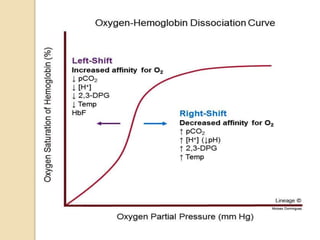
Hb Oxygen dissociation curve
 When the percent saturation of Hb with O2 is plotted against the
partial pressure of O2, a sigmoid shaped oxygen dissociation
curve is obtained.
 The characteristics of this curve are
◦ related in part to properties of hemoglobin itself
◦ in part to the environment within the erythrocyte, including
 pH, temperature, ionic strength
 concentration of phosphorylated compounds, especially (2,3-DPG)
 presence of Hb variants (methemoglobin,Hb Barts and HbH)
 The degree of saturation is related to the oxygen tension (pO2),
which normally ranges from 100 mm hg in arterial blood to
about 35 mm hg in veins.
Hb –OXYGEN DISSOCIATION CURVE
The normal position of curve depends on
• Concentration of 2,3-DPG
• H+ ion concentration (pH)
• CO2 in red blood cells
• Structure of Hb
Hb–oxygen dissociation curve
• High 2,3-DPG
• High pH
• High pCo2
• High temp
Right shift (easy
oxygen
delivery)
• Low pCo2
• Low 2,3-DPG
• HbF
• Low pH ie acidic
• Meth hb
• Low temp
Left shift (give
up oxygen less
readily)
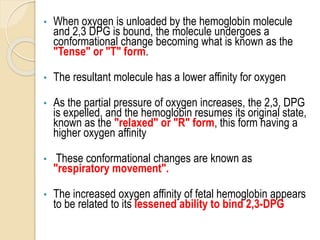
• When oxygen is unloaded by the hemoglobin molecule
and 2,3 DPG is bound, the molecule undergoes a
conformational change becoming what is known as the
"Tense" or "T" form.
• The resultant molecule has a lower affinity for oxygen
• As the partial pressure of oxygen increases, the 2,3, DPG
is expelled, and the hemoglobin resumes its original state,
known as the "relaxed" or "R" form, this form having a
higher oxygen affinity
• These conformational changes are known as
"respiratory movement".
• The increased oxygen affinity of fetal hemoglobin appears
to be related to its lessened ability to bind 2,3-DPG
As each oxygen molecule binds, the position of the haem molecule changes which affects
the interaction between adjacent globin chains, relaxing the molecule and so allowing
easier access of subsequent oxygen molecules to their binding site.
In its deoxygenated ‘tense’ form, the crevice containing the haem molecule is narrow,
restricting the access of oxygen to its binding site
2,3 Diphosphoglycerate (2,3-DPG)
 This compound is synthesized from glycolytic intermediates by
means of a pathway known as the Rapoport-Luebering shunt.
 In the erythrocyte, 2-3-DPG constitutes the predominant
phosphorylated compound.
 In the deoxygenated state, hemoglobin A can bind 2,3-DPG in a
molar ratio of 1:1, a reaction leading to reduced oxygen affinity
and improved oxygen delivery to tissues
Relation of pH and 2,3-DPG in storage
Fall in ph in stored blood results in a decrease in red cell 2,3-DPG level,which
results in increase in hb o2 affinity.
DPG depleted red cells have impaired capacity to deliver oxygen to tissues.
The degree of reduction of 2,3-DPG levels depends upon the preservative
solution used.
As ACD solution has lower ph levels fall quick;ly with in few days that that of CPD
solution(CPD/CPDA-1) maintains adequate levels of 2,3 DPGfor 10-14 days.
After transfusion red cells continue to synthesize 2,3-DPG and levels return to
normal values within 24 hours.
The acid base status of patient ,phosphorus metabolism and degree of
metabolism influence the rate of restoration of 2,3-DPG.
Pathological
effects of
transfusion of
red cells with low
2,3-DPG levels
and increased
affinity with O2
Increase in
cardiac output.
Decrease in
mixed venous
PO2 tension.
BOHR EFFECT
 Alteration in oxygen affinity with pH is known as the Bohr effect.
 Hemoglobin oxygen affinity is reduced as the acidity
increases.
 Since the tissues are relatively rich in carbon dioxide, the pH is
lower, than in arterial blood therefore the Bohr effect facilitates
transfer of oxygen.
 The Bohr effect is a manifestation of the acid-base equilibrium of
hemoglobin.
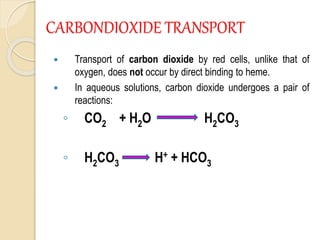
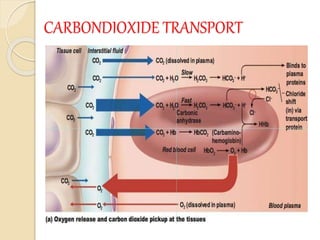
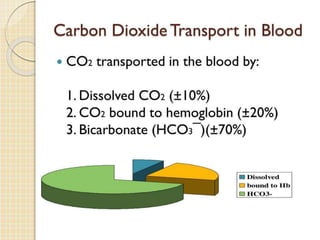
CARBONDIOXIDE TRANSPORT
 Transport of carbon dioxide by red cells, unlike that of
oxygen, does not occur by direct binding to heme.
 In aqueous solutions, carbon dioxide undergoes a pair of
reactions:
◦ CO2 + H2O H2CO3
◦ H2CO3 H+ + HCO3
CARBONDIOXIDE TRANSPORT
Non-Functional Hemoglobin
 Carboxyhemoglobin
◦ Oxygen molecules bound to heme are replaced by
carbon monoxide.
◦ Slightly increased levels of carboxyhemoglobin are
present in heavy smokers and as a result of
environmental pollution.
◦ Carbonmonoxide preferentially binds to hemoglobin
over oxygen by an affinity 210 times greater than
oxygen.
◦ Can revert to oxyhemoglobin.
Non-Functional Hemoglobin
 Methemoglobin
◦ Iron in the hemoglobin molecule is in the ferric (Fe3+)
state instead of the ferrous (Fe2+) state
◦ Incapable of combining with oxygen
◦ Can revert to oxyhemoglobin
 Sulfhemoglobin
◦ Hemoglobin molecule contains sulfur.
◦ Caused by certain sulfur-containing drugs or chronic
constipation.
◦ Cannot revert to oxyhemoglobin and may cause
death.
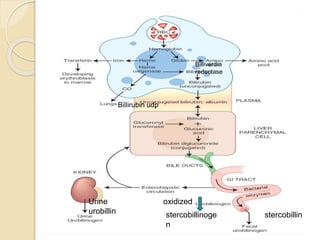
Hemoglobin metabolism
 The senescent RBC are engulfed by cells of the
reticuloendothelial system.
 There is thus turnover of 6g/day of hemoglobin.
 Globin chains are broken down to amino acids which then return
to the amino acid pool.
 Iron is re-used by the bone marrow to synthesize haem. Small
amounts of free haemoglobin may be released into the plasma.
 Protoporphyrin degradation begins with the cleavage of the ring
to form a linear tetrapyrrole molecule, biliverdin, which is then
reduced to bilirubin.
 Bilirubin is bound to albumin for transport to the liver, where it is
conjugated with glucuronic acid.
Hemoglobin metabolism
 In the hepatocytes , the bilirubin is conjugated to two equivalents
of glucuronic acid to produce more water soluble bilirubin
diglucuronide,with the help of enzymes bilirubin-UDP-
glucuronyltransferase.
 Bilirubin diglucuronide is transported to intestines where the
intestinal bacterias remove the glucuronide part resulting bilirubin
is converted to urobilinogen.
 A part of urobilinogen participates in enterohepatic circulation
and remainder is excreted as urobilin in urine and other part is
oxidised to stercobilinogen and excreted as stercobilinin feaces.
Billirubin udp
Urine
urobillin stercobillinoge
n
stercobillin
Billiverdin
reductase
oxidized
HEMOGLOBIN ESTIMATION
Indications:
Determine the
presence and
severity of anemia.
Screening for
polycythemia.
Response to
specific therapy in
anemia.
Selection of blood
donors.
Methods:
Specific
Gravity method
Colorimetric
method
Chemical
method
Gasometric
method
Specific Gravity Method
 Also known as copper sulphate solution method.
 The method is based on specific gravity and is reasonably
reliable method for determining the Hb of blood donors.
 It is an indirect measure of the Hb value.
 CuSO4 Solution of specific gravity 1.053 is used for Hb
estimation.
Remedial Source of Errors in Hb estimation by
CuSO4 Method
 Taking first drop of blood from finger prick.
 Squeezing the finger because the blood not flowing freely.
 Dirty pipette.
 Chip of delivering end of pipette.
 ADVANTAGES:
◦ It is a quick and safe method.
◦ It is an inexpensive method.
◦ It uses only one drop of blood.
◦ Can be used for mass screening as in mobile camps.
 DISADVANTAGES:
◦ If plasma protein level of donors is on lower limit of normal,it is
possible a donor may be rejected though having reuired Hb
◦ So, its less accurate.
Colorimetric Methods
Color comparison between standard and test sample by-
A. Visual methods
1. Sahlis acid hematin.
2. Tallqvist hemoglobin chart.
3. WHO hemoglobin Color scale
B. Photoelectric / Spectrophotometric methods
1. Cyanhemoglobin method
2. Oxyhemoglobin Method
3. Alkaline Hematin Method
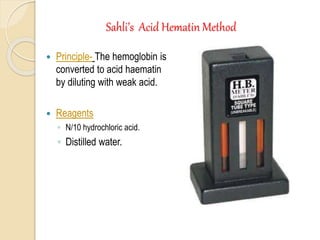
Sahli’s Acid Hematin Method
 Principle- The hemoglobin is
converted to acid haematin
by diluting with weak acid.
 Reagents
◦ N/10 hydrochloric acid.
◦ Distilled water.
A. ADVANTAGES:
1. Easy to perform
2. Quick
3. Inexpensive
4. Can be used as a bedside procedure
5. Does not require technical expertise
B. DISADVANTAGES:
1. Individual error(objective)
2. Only oxy hemoglobin is measured by this method
3. The color develops slowly and is unstable, so begins to fade almost immediately
after it reaches its peak
4. For these reasons,this method usually gives result approximately 5% less than
actual value
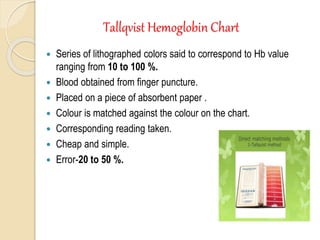
Tallqvist Hemoglobin Chart
 Series of lithographed colors said to correspond to Hb value
ranging from 10 to 100 %.
 Blood obtained from finger puncture.
 Placed on a piece of absorbent paper .
 Colour is matched against the colour on the chart.
 Corresponding reading taken.
 Cheap and simple.
 Error-20 to 50 %.
WHO Hemoglobin Color Scale
 Devised by Scott and Lewis.
 Principle is similar to Tallqvist method .
 Rapid , simple , inexpensive and
reliable
 Printed set of colors corresponding to
Hb values from 4-14 grams/dl
 Efficiency-> 90 % in detecting anemia .
◦ 86 % in classifying its grade
 Useful for screening blood donors .
 Screening women and children in
health programmes .
 Iron-therapy follw up.
Cyanmethhemoglobin Method
 It is internationally recommended method for determining the
Hemoglobin concentration of blood.
 PRINCIPLE- The basis of the method is dilution of blood in a
solution containing potassium cyanide and potassium
ferricyanide .
 Hemoglobin, methemoglobin and carboxyhemoglobin are all
converted to cyanhemoglobin but not sulfhemoglobin.
 The absorbance of the solution is then measured in photoelectric
colorimeter at a wavelength 540nm or with a green filter.
REAGENTS
 Modified Drabkin’s solution:
◦ Potassium Ferricyanide - 200mg
◦ Potassium Cyanide - 50mg
◦ NomideP40(Shell chemical Co)- 140mg
◦ Distilled water - 1L
 Cyanmethemoglobin Standard Solution:
◦ Standard solution is available commercially.
◦ The unused solution should be discarded at the end of the
day , to avoid contamination.
◦ The HiCN Standard solution is used for direct comparison
with blood , which is also converted to HiCN in drabkin’s
solution.
 The reagents should be clear and pale yellow in color and pH
should be 7.0- 7.4 .
 When measured against water as blank in a photoelectric
colorimeter at a wavelength of 540nm, The absorbance must
read zero.
 BLOOD SAMPLE:
 Measurement can be carried out on blood which has been
stored in EDTA (1.5mgm EDTA/ml).
 Fresh capillary blood from finger prick can also be used if
added immediately to reagent solution.
ADVANTAGES:
1. All forms of Hb except sulfhemoglobin are converted
to hemoglobincyanide/cyanmethemoglobin (HiCN).
2. Visual error is not there as no color matching is
required.
3. Cyanmethemoglobin solution is stable and it’s color
does not fade with time so readings may not be taken
immediately.
4. Absorbance may be measured soon after dilution.
Disadvantages:
1. Diluted blood has to stand for a period of time to ensure
complete conversion of Hb.
2. Potassium cyanide is a poisonous substance and that is why
Drabkin’s solution must never be pipetted by mouth.
3. The rate of conversion of blood containing carboxyhemoglobin
is slowed considerably. Prolonging the reaction time to 30min .
4. Abnormal plasma proteins cause turbidity when blood is diluted
with Drabkin’s solution.
5. A high leucocyte count also causes turbidity on dilution of
blood. Centrifuging the diluted blood can help overcome the
turbidity
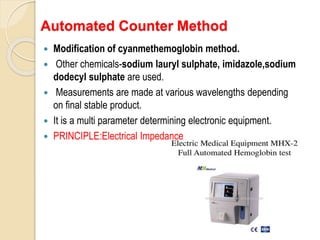
Automated Counter Method
 Modification of cyanmethemoglobin method.
 Other chemicals-sodium lauryl sulphate, imidazole,sodium
dodecyl sulphate are used.
 Measurements are made at various wavelengths depending
on final stable product.
 It is a multi parameter determining electronic equipment.
 PRINCIPLE:Electrical Impedance
 ADVANTAGES:
1. Free Hb is rapidly converted to detectable chromogen, decreasing
the measurement time.
2. Reagent is cyanide free , so non –toxic.
3. MCV, MCHC , RDW , Hematocrit And Platelet parameters can
also be measured by this method.
 DISADVANTAGE:
1. High WBC count (>30,ooo/ ul) causes false elevation of Hb.
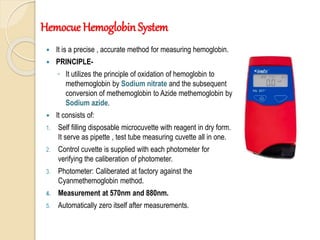
 It is a precise , accurate method for measuring hemoglobin.
 PRINCIPLE-
◦ It utilizes the principle of oxidation of hemoglobin to
methemoglobin by Sodium nitrate and the subsequent
conversion of methemoglobin to Azide methemoglobin by
Sodium azide.
 It consists of:
1. Self filling disposable microcuvette with reagent in dry form.
It serve as pipette , test tube measuring cuvette all in one.
2. Control cuvette is supplied with each photometer for
verifying the caliberation of photometer.
3. Photometer: Caliberated at factory against the
Cyanmethemoglobin method.
4. Measurement at 570nm and 880nm.
5. Automatically zero itself after measurements.
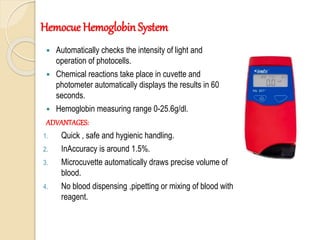
Hemocue Hemoglobin System
 Automatically checks the intensity of light and
operation of photocells.
 Chemical reactions take place in cuvette and
photometer automatically displays the results in 60
seconds.
 Hemoglobin measuring range 0-25.6g/dl.
ADVANTAGES:
1. Quick , safe and hygienic handling.
2. InAccuracy is around 1.5%.
3. Microcuvette automatically draws precise volume of
blood.
4. No blood dispensing ,pipetting or mixing of blood with
reagent.
Hemocue Hemoglobin System
Oxyhemoglobin Method
 Blood mixed with weak ammonia solution.
 Absorbance compared with the standard.
 Rapid and simple .
 No stable solution is available.
ALKALINE HEMATIN METHOD
 The alkaline hematin method gives a true estimate of total Hb
even carboxyHb , methemoglobin and sulfhemoglobin is
present.
 It is a modified method in which blood is diluted in an alkaline
solution with non-ionic detergent and read in a spectrometer at
a absorbance of 575nm against a standard solution of
chloro haemin.
 Shows bias of 2.6%
GASOMETRIC METHOD
 Oxygen carrying capacity measured by Van Slyke apparatus.

 Based on formula:1 gm of Hb carries 1.34 ml of oxygen.
 It does not measure
◦ carboxyhemoglobin
◦ sulfhemoglobin
◦ methemoglobin.
 Disadvantage
◦ It is time-consuming and expensive.
CHEMICAL METHOD
 Iron content of hemoglobin is first estimated.
 Indirectly Hb is derived - 100 grams of hemoglobin contain
374 grams of iron.
 It is time-consuming method.
Hb estimation in Blood Donation
 Pre-donation hemoglobin screening is among the first and
foremost tests done for blood donor selection with the main
intention of preventing blood collection from an anemic donor.
 According to the Indian Drugs and Cosmetics Act, 1940 for blood
donation, the minimum acceptable hemoglobin (Hb) is 12.5 g/dl or
hematocrit (Hct) of 38% for both males and females.
 This level is set :
◦ To ensure that donors have enough blood to give and also have
enough iron available in their bodies to make more blood after they
donate.
◦ For preventing blood collection from an anaemic donor.
 Method for Hb screening in donors should –
◦ Save time i.e quick
◦ Be Cost effective
◦ Be accurate and easily validated for Internal Quality control
 The Hb in blood donors may be measured by the following
methods:-
◦ Specific gravity method using copper sulphate solution of
specific gravity 1.053. It is quick method.
◦ Hem cue Method- It is the quick , precise and safe method.
◦ Sahli’s method
 Out of these, copper sulphate is generally used as a Hb
screening procedure in donors as it is quick, safe and in
expensive test.
 In donors for the aphaeresis procedure – Hemoglobin estimation
is relevant in the donor for the aphaeresis procedure. In donors ,
Hb should be more than 12.5gm%.
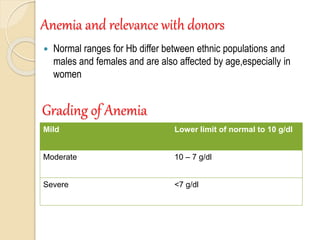
Anemia and relevance with donors
 Normal ranges for Hb differ between ethnic populations and
males and females and are also affected by age,especially in
women
Grading of Anemia
Mild Lower limit of normal to 10 g/dl
Moderate 10 – 7 g/dl
Severe <7 g/dl
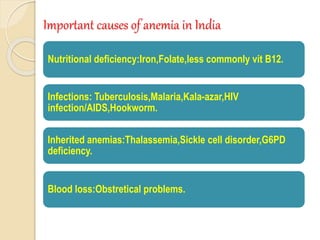
Important causes of anemia in India
Nutritional deficiency:Iron,Folate,less commonly vit B12.
Infections: Tuberculosis,Malaria,Kala-azar,HIV
infection/AIDS,Hookworm.
Inherited anemias:Thalassemia,Sickle cell disorder,G6PD
deficiency.
Blood loss:Obstretical problems.
HEMOGLOBIN

HEMOGLOBIN

  • 1.
    Hemoglobin structure, function andits applied aspects nted by: Dr. Faisal Govt College
  • 2.
    INTRODUCTION  Haemoglobin isa red globular protein composed of heme (consisting of iron and protoporphyrin) and globin.  Globin portion of the molecule consists of four (or two pairs of) polypeptide chains.  Has molecular weight of about 64,500 daltons contributing one third of weight of rbc.  Over 500 different haemoglobin variants have been described but all share the same basic structure of four globin polypeptide chains each with heme group.  Functional haemoglobin is composed of two pairs of dissimilar globins.
  • 3.
    Normal Values ofHb Age/Sex Hemoglobin (g/dl) Adult males 13-17 Adult females 12-15 Adult females(pregnant) 11-14 Children,(6-12 years) 11.5-15.5 Children,(6 months – 6 years) 11-14 Newborn 13.6-19.6
  • 4.
    Hemoglobin Synthesis • Althoughhaem & globin synthesis occur separately within developing red cell precursors , their rate of synthesis are carefully coordinated to ensure optimal efficiency of haemoglobin assembly. • 65% of haem is synthesized in the erythroblasts. • 35% of it at reticulocyte stage. • Heme part occurs in the mitochondria first and then in the cytoplasm of RBC precursors .
  • 5.
    Important points aboutfirst step  This reaction is energy dependent and so occurs in the mitochondria.  It’s catalyzed by the enzyme δ ALA synthase.  This step is a first-limiting step for the whole process of heme synthesis.  It is stimulated by the presence of globin chains and inhibited by the presence of free heme groups.  This represents an important control mechanism of the rate of heme synthesis and it’s coordination with globin synthesis.
  • 6.
    vitamin B6, freeferrous and copper ions. Protoporphrinogen oxidase It only remains for the central ferrous ion to be inserted to complete the synthesis of heme.
  • 7.
    Globin Synthesis  Humansnormally carry 8 functional globin genes, arranged in two duplicate gene clusters.  The α-like cluster on the short arm of chromosome 16.  The β-like cluster on the short arm of chromosome 11.  These genes code for 6 different types of globin chains: α,β,γ,δ,ε,ζ globin.  Globin part occurs in polyribosomes
  • 8.
  • 9.
    Globin Chains  Globinchains are synthesized in the cytosol of erythrocytes.  Consists of varied sequences of AA: polypeptide chains.  The chains are designated by Greek letters: ◦ Alpha (α), Beta (β),Gamma (γ), Delta (δ), Epsilon (ε) and Zeta (ζ).  The difference in the globin chains designates relates both to the sequence and to no. of AA in the chain.
  • 11.
    Greek Name No.of AA Comments ALPHA 141 BETA 146 GAMMA 146 Differs from beta chain by 39aa DELTA 146 Differs from beta chain by 10aa EPSILON 146 Embryonic only ZETA 146 Embryonic only Different Types of Globin Chains in Hemoglobin
  • 12.
    Adult Hb(Hb A): Hb A1(2α & 2β subunits) is the major form of Hb 96-98% in adults & in children over 7 months of age.  Hb A2 (2α & 2δ subunits) is the minor form of Hb in adults. ◦ It forms only 2.2-3.5% of total Hb A . ◦ Poor form of Hb for oxygen carriage
  • 13.
    Fetal Hb(Hb F) 2α &2γ subunits  At birth, 50–95% of a baby's haemoglobin is HbF, ◦ but these levels decline after 6 months as more HbA is produced.  In a healthy adult, <1% of haemoglobin is HbF.  The oxygen affinity of HbF is substantially greater than HbA to facilitate the transfer of oxygen between the maternal and fetal circulations in the placenta.
  • 14.
    HbA1c: glycosylated haemoglobin  Subtypeof HbA1  Attachment of glucose to N terminal amino acid valine of the beta chain of hemoglobin.  Indicator of how well the blood glucose level has been controlled over a long period of time, every 2-3 months.  Its high value is directly related to complications from diabetes.
  • 15.
    Type of HbGlobin chain combination %age HbA1 α2b2 96-98 % EMBRYONIC Hb α22 NIL HbF α22 0.2-0.8% HbA2 α2d2 1.5-3.2 % HbA1C α2b2 4-6% Types of Hb in normal Adult
  • 16.
    HEMOGLOBIN STRUCTURE  Haemoglobinis a tetramer composed of 4 polypeptide chains (α1α2β1β2) and 4 heme groups.  α chain consists of 141 amino acids while β chain has 146 amino acids.  Each polypeptide chain is arranged in a helical conformation.  The 4 polypeptide chains make contact at α1β1 and α2β2 interfaces.  Each RbC has ≈640 million molecule of Hb.
  • 18.
     4 unitsof haem attach to 1 unit of Globin.  So 1 haemoglobin molecule contains 4 iron atoms which carry 4 molecules of Oxygen.
  • 19.
    Primary Structure  Theprimary structure of globin refers to the amino acid sequence of the various chain types.  Numbering from the N-terminal end identifies the position of individual amino acids.  Any change in the identity and position of these amino acids cause gross impairment to molecular function.
  • 20.
    SECONDARY STRUCTURE  Thesecondary structure of all globin chain types comprises 9 non-helical sections joined by 8 helical sections.  There are 8 helical segment designated A to H.  Iron of heme is covalently bound to histidine at the eighth position of the F helical segments.
  • 21.
    Tertiary folding givesrise to atleast 3 functionally important characteristic of Hb molecule  Tertiary folding make the surface of the molecule hydrophilic and the interior hydrophobic.  An open-toped cleft in the surface of the subunit known as haem pocket is created.  This hydrophobic cleft protects the ferrous ion from oxidation.  The amino acids, which form the inter-subunit bonds responsible for maintaining the quaternary structure.
  • 22.
    Quaternary structure ofglobin  The quaternary structure of haemoglobin has four subunits arranged tetrahedrally.  In adult haemoglobin- (HbA), there are different contact areas: ◦ α1β1 and α2β2 - confirms stability of the molecule ◦ α1β2 and α2β1 - confirms solubility of the molecule ◦ α1α2 and β1β2 - weak bonds to permit oxygenation and deoxygenation
  • 24.
    Functions of Hemoglobin Transportof oxygen from the lungs to the tissues, mostly to facilitate oxidative phosphorylation in the mitochondria. Carriage of carbon dioxide from tissues to the lungs as carbaminohaemoglobin. Buffering of hydrogen ions formed in the erythrocyte from the conversion of carbon dioxide into bicarbonate. Nitric oxide metabolism.
  • 25.
    Oxygen Transport  Haemoglobinis an allosteric protein; the binding of oxygen to one haem group increases the oxygen affinity within the remaining haem groups.  Oxygen binds reversibly to haem, so each haemoglobin molecule can carry up to four oxygen molecules.  As partial pressure of oxygen increases hemoglobin shows progressive increasing affinity for oxygen.  Small changes in oxygen tension allow significant amount of oxygen to be released.
  • 26.
    Oxygen Transport  Eachgm of hemoglobin binds 1.34ml of oxygen.  < .01 sec required for oxygenation.  β -chain move closer when oxygenated.  When oxygenated 2,3-DPG is pushed out.  β chains are pulled apart when O2 is unloaded, permitting entry of 2,3-DPG resulting in lower affinity of O2.
  • 27.
    Hb Oxygen dissociationcurve  When the percent saturation of Hb with O2 is plotted against the partial pressure of O2, a sigmoid shaped oxygen dissociation curve is obtained.  The characteristics of this curve are ◦ related in part to properties of hemoglobin itself ◦ in part to the environment within the erythrocyte, including  pH, temperature, ionic strength  concentration of phosphorylated compounds, especially (2,3-DPG)  presence of Hb variants (methemoglobin,Hb Barts and HbH)  The degree of saturation is related to the oxygen tension (pO2), which normally ranges from 100 mm hg in arterial blood to about 35 mm hg in veins.
  • 28.
    Hb –OXYGEN DISSOCIATIONCURVE The normal position of curve depends on • Concentration of 2,3-DPG • H+ ion concentration (pH) • CO2 in red blood cells • Structure of Hb
  • 29.
    Hb–oxygen dissociation curve •High 2,3-DPG • High pH • High pCo2 • High temp Right shift (easy oxygen delivery) • Low pCo2 • Low 2,3-DPG • HbF • Low pH ie acidic • Meth hb • Low temp Left shift (give up oxygen less readily)
  • 31.
    • When oxygenis unloaded by the hemoglobin molecule and 2,3 DPG is bound, the molecule undergoes a conformational change becoming what is known as the "Tense" or "T" form. • The resultant molecule has a lower affinity for oxygen • As the partial pressure of oxygen increases, the 2,3, DPG is expelled, and the hemoglobin resumes its original state, known as the "relaxed" or "R" form, this form having a higher oxygen affinity • These conformational changes are known as "respiratory movement". • The increased oxygen affinity of fetal hemoglobin appears to be related to its lessened ability to bind 2,3-DPG
  • 32.
    As each oxygenmolecule binds, the position of the haem molecule changes which affects the interaction between adjacent globin chains, relaxing the molecule and so allowing easier access of subsequent oxygen molecules to their binding site. In its deoxygenated ‘tense’ form, the crevice containing the haem molecule is narrow, restricting the access of oxygen to its binding site
  • 33.
    2,3 Diphosphoglycerate (2,3-DPG) This compound is synthesized from glycolytic intermediates by means of a pathway known as the Rapoport-Luebering shunt.  In the erythrocyte, 2-3-DPG constitutes the predominant phosphorylated compound.  In the deoxygenated state, hemoglobin A can bind 2,3-DPG in a molar ratio of 1:1, a reaction leading to reduced oxygen affinity and improved oxygen delivery to tissues
  • 34.
    Relation of pHand 2,3-DPG in storage Fall in ph in stored blood results in a decrease in red cell 2,3-DPG level,which results in increase in hb o2 affinity. DPG depleted red cells have impaired capacity to deliver oxygen to tissues. The degree of reduction of 2,3-DPG levels depends upon the preservative solution used. As ACD solution has lower ph levels fall quick;ly with in few days that that of CPD solution(CPD/CPDA-1) maintains adequate levels of 2,3 DPGfor 10-14 days. After transfusion red cells continue to synthesize 2,3-DPG and levels return to normal values within 24 hours. The acid base status of patient ,phosphorus metabolism and degree of metabolism influence the rate of restoration of 2,3-DPG.
  • 35.
    Pathological effects of transfusion of redcells with low 2,3-DPG levels and increased affinity with O2 Increase in cardiac output. Decrease in mixed venous PO2 tension.
  • 36.
    BOHR EFFECT  Alterationin oxygen affinity with pH is known as the Bohr effect.  Hemoglobin oxygen affinity is reduced as the acidity increases.  Since the tissues are relatively rich in carbon dioxide, the pH is lower, than in arterial blood therefore the Bohr effect facilitates transfer of oxygen.  The Bohr effect is a manifestation of the acid-base equilibrium of hemoglobin.
  • 37.
    CARBONDIOXIDE TRANSPORT  Transportof carbon dioxide by red cells, unlike that of oxygen, does not occur by direct binding to heme.  In aqueous solutions, carbon dioxide undergoes a pair of reactions: ◦ CO2 + H2O H2CO3 ◦ H2CO3 H+ + HCO3
  • 38.
  • 40.
    Non-Functional Hemoglobin  Carboxyhemoglobin ◦Oxygen molecules bound to heme are replaced by carbon monoxide. ◦ Slightly increased levels of carboxyhemoglobin are present in heavy smokers and as a result of environmental pollution. ◦ Carbonmonoxide preferentially binds to hemoglobin over oxygen by an affinity 210 times greater than oxygen. ◦ Can revert to oxyhemoglobin.
  • 41.
    Non-Functional Hemoglobin  Methemoglobin ◦Iron in the hemoglobin molecule is in the ferric (Fe3+) state instead of the ferrous (Fe2+) state ◦ Incapable of combining with oxygen ◦ Can revert to oxyhemoglobin  Sulfhemoglobin ◦ Hemoglobin molecule contains sulfur. ◦ Caused by certain sulfur-containing drugs or chronic constipation. ◦ Cannot revert to oxyhemoglobin and may cause death.
  • 42.
    Hemoglobin metabolism  Thesenescent RBC are engulfed by cells of the reticuloendothelial system.  There is thus turnover of 6g/day of hemoglobin.  Globin chains are broken down to amino acids which then return to the amino acid pool.  Iron is re-used by the bone marrow to synthesize haem. Small amounts of free haemoglobin may be released into the plasma.  Protoporphyrin degradation begins with the cleavage of the ring to form a linear tetrapyrrole molecule, biliverdin, which is then reduced to bilirubin.  Bilirubin is bound to albumin for transport to the liver, where it is conjugated with glucuronic acid.
  • 43.
    Hemoglobin metabolism  Inthe hepatocytes , the bilirubin is conjugated to two equivalents of glucuronic acid to produce more water soluble bilirubin diglucuronide,with the help of enzymes bilirubin-UDP- glucuronyltransferase.  Bilirubin diglucuronide is transported to intestines where the intestinal bacterias remove the glucuronide part resulting bilirubin is converted to urobilinogen.  A part of urobilinogen participates in enterohepatic circulation and remainder is excreted as urobilin in urine and other part is oxidised to stercobilinogen and excreted as stercobilinin feaces.
  • 44.
  • 45.
    HEMOGLOBIN ESTIMATION Indications: Determine the presenceand severity of anemia. Screening for polycythemia. Response to specific therapy in anemia. Selection of blood donors. Methods: Specific Gravity method Colorimetric method Chemical method Gasometric method
  • 46.
    Specific Gravity Method Also known as copper sulphate solution method.  The method is based on specific gravity and is reasonably reliable method for determining the Hb of blood donors.  It is an indirect measure of the Hb value.  CuSO4 Solution of specific gravity 1.053 is used for Hb estimation.
  • 47.
    Remedial Source ofErrors in Hb estimation by CuSO4 Method  Taking first drop of blood from finger prick.  Squeezing the finger because the blood not flowing freely.  Dirty pipette.  Chip of delivering end of pipette.
  • 48.
     ADVANTAGES: ◦ Itis a quick and safe method. ◦ It is an inexpensive method. ◦ It uses only one drop of blood. ◦ Can be used for mass screening as in mobile camps.  DISADVANTAGES: ◦ If plasma protein level of donors is on lower limit of normal,it is possible a donor may be rejected though having reuired Hb ◦ So, its less accurate.
  • 49.
    Colorimetric Methods Color comparisonbetween standard and test sample by- A. Visual methods 1. Sahlis acid hematin. 2. Tallqvist hemoglobin chart. 3. WHO hemoglobin Color scale B. Photoelectric / Spectrophotometric methods 1. Cyanhemoglobin method 2. Oxyhemoglobin Method 3. Alkaline Hematin Method
  • 50.
    Sahli’s Acid HematinMethod  Principle- The hemoglobin is converted to acid haematin by diluting with weak acid.  Reagents ◦ N/10 hydrochloric acid. ◦ Distilled water.
  • 51.
    A. ADVANTAGES: 1. Easyto perform 2. Quick 3. Inexpensive 4. Can be used as a bedside procedure 5. Does not require technical expertise B. DISADVANTAGES: 1. Individual error(objective) 2. Only oxy hemoglobin is measured by this method 3. The color develops slowly and is unstable, so begins to fade almost immediately after it reaches its peak 4. For these reasons,this method usually gives result approximately 5% less than actual value
  • 52.
    Tallqvist Hemoglobin Chart Series of lithographed colors said to correspond to Hb value ranging from 10 to 100 %.  Blood obtained from finger puncture.  Placed on a piece of absorbent paper .  Colour is matched against the colour on the chart.  Corresponding reading taken.  Cheap and simple.  Error-20 to 50 %.
  • 53.
    WHO Hemoglobin ColorScale  Devised by Scott and Lewis.  Principle is similar to Tallqvist method .  Rapid , simple , inexpensive and reliable  Printed set of colors corresponding to Hb values from 4-14 grams/dl  Efficiency-> 90 % in detecting anemia . ◦ 86 % in classifying its grade  Useful for screening blood donors .  Screening women and children in health programmes .  Iron-therapy follw up.
  • 54.
    Cyanmethhemoglobin Method  Itis internationally recommended method for determining the Hemoglobin concentration of blood.  PRINCIPLE- The basis of the method is dilution of blood in a solution containing potassium cyanide and potassium ferricyanide .  Hemoglobin, methemoglobin and carboxyhemoglobin are all converted to cyanhemoglobin but not sulfhemoglobin.  The absorbance of the solution is then measured in photoelectric colorimeter at a wavelength 540nm or with a green filter.
  • 55.
    REAGENTS  Modified Drabkin’ssolution: ◦ Potassium Ferricyanide - 200mg ◦ Potassium Cyanide - 50mg ◦ NomideP40(Shell chemical Co)- 140mg ◦ Distilled water - 1L  Cyanmethemoglobin Standard Solution: ◦ Standard solution is available commercially. ◦ The unused solution should be discarded at the end of the day , to avoid contamination. ◦ The HiCN Standard solution is used for direct comparison with blood , which is also converted to HiCN in drabkin’s solution.
  • 56.
     The reagentsshould be clear and pale yellow in color and pH should be 7.0- 7.4 .  When measured against water as blank in a photoelectric colorimeter at a wavelength of 540nm, The absorbance must read zero.  BLOOD SAMPLE:  Measurement can be carried out on blood which has been stored in EDTA (1.5mgm EDTA/ml).  Fresh capillary blood from finger prick can also be used if added immediately to reagent solution.
  • 57.
    ADVANTAGES: 1. All formsof Hb except sulfhemoglobin are converted to hemoglobincyanide/cyanmethemoglobin (HiCN). 2. Visual error is not there as no color matching is required. 3. Cyanmethemoglobin solution is stable and it’s color does not fade with time so readings may not be taken immediately. 4. Absorbance may be measured soon after dilution.
  • 58.
    Disadvantages: 1. Diluted bloodhas to stand for a period of time to ensure complete conversion of Hb. 2. Potassium cyanide is a poisonous substance and that is why Drabkin’s solution must never be pipetted by mouth. 3. The rate of conversion of blood containing carboxyhemoglobin is slowed considerably. Prolonging the reaction time to 30min . 4. Abnormal plasma proteins cause turbidity when blood is diluted with Drabkin’s solution. 5. A high leucocyte count also causes turbidity on dilution of blood. Centrifuging the diluted blood can help overcome the turbidity
  • 59.
    Automated Counter Method Modification of cyanmethemoglobin method.  Other chemicals-sodium lauryl sulphate, imidazole,sodium dodecyl sulphate are used.  Measurements are made at various wavelengths depending on final stable product.  It is a multi parameter determining electronic equipment.  PRINCIPLE:Electrical Impedance
  • 60.
     ADVANTAGES: 1. FreeHb is rapidly converted to detectable chromogen, decreasing the measurement time. 2. Reagent is cyanide free , so non –toxic. 3. MCV, MCHC , RDW , Hematocrit And Platelet parameters can also be measured by this method.  DISADVANTAGE: 1. High WBC count (>30,ooo/ ul) causes false elevation of Hb.
  • 61.
     It isa precise , accurate method for measuring hemoglobin.  PRINCIPLE- ◦ It utilizes the principle of oxidation of hemoglobin to methemoglobin by Sodium nitrate and the subsequent conversion of methemoglobin to Azide methemoglobin by Sodium azide.  It consists of: 1. Self filling disposable microcuvette with reagent in dry form. It serve as pipette , test tube measuring cuvette all in one. 2. Control cuvette is supplied with each photometer for verifying the caliberation of photometer. 3. Photometer: Caliberated at factory against the Cyanmethemoglobin method. 4. Measurement at 570nm and 880nm. 5. Automatically zero itself after measurements. Hemocue Hemoglobin System
  • 62.
     Automatically checksthe intensity of light and operation of photocells.  Chemical reactions take place in cuvette and photometer automatically displays the results in 60 seconds.  Hemoglobin measuring range 0-25.6g/dl. ADVANTAGES: 1. Quick , safe and hygienic handling. 2. InAccuracy is around 1.5%. 3. Microcuvette automatically draws precise volume of blood. 4. No blood dispensing ,pipetting or mixing of blood with reagent. Hemocue Hemoglobin System
  • 63.
    Oxyhemoglobin Method  Bloodmixed with weak ammonia solution.  Absorbance compared with the standard.  Rapid and simple .  No stable solution is available.
  • 64.
    ALKALINE HEMATIN METHOD The alkaline hematin method gives a true estimate of total Hb even carboxyHb , methemoglobin and sulfhemoglobin is present.  It is a modified method in which blood is diluted in an alkaline solution with non-ionic detergent and read in a spectrometer at a absorbance of 575nm against a standard solution of chloro haemin.  Shows bias of 2.6%
  • 65.
    GASOMETRIC METHOD  Oxygencarrying capacity measured by Van Slyke apparatus.   Based on formula:1 gm of Hb carries 1.34 ml of oxygen.  It does not measure ◦ carboxyhemoglobin ◦ sulfhemoglobin ◦ methemoglobin.  Disadvantage ◦ It is time-consuming and expensive.
  • 66.
    CHEMICAL METHOD  Ironcontent of hemoglobin is first estimated.  Indirectly Hb is derived - 100 grams of hemoglobin contain 374 grams of iron.  It is time-consuming method.
  • 67.
    Hb estimation inBlood Donation  Pre-donation hemoglobin screening is among the first and foremost tests done for blood donor selection with the main intention of preventing blood collection from an anemic donor.  According to the Indian Drugs and Cosmetics Act, 1940 for blood donation, the minimum acceptable hemoglobin (Hb) is 12.5 g/dl or hematocrit (Hct) of 38% for both males and females.  This level is set : ◦ To ensure that donors have enough blood to give and also have enough iron available in their bodies to make more blood after they donate. ◦ For preventing blood collection from an anaemic donor.  Method for Hb screening in donors should – ◦ Save time i.e quick ◦ Be Cost effective ◦ Be accurate and easily validated for Internal Quality control
  • 68.
     The Hbin blood donors may be measured by the following methods:- ◦ Specific gravity method using copper sulphate solution of specific gravity 1.053. It is quick method. ◦ Hem cue Method- It is the quick , precise and safe method. ◦ Sahli’s method  Out of these, copper sulphate is generally used as a Hb screening procedure in donors as it is quick, safe and in expensive test.  In donors for the aphaeresis procedure – Hemoglobin estimation is relevant in the donor for the aphaeresis procedure. In donors , Hb should be more than 12.5gm%.
  • 69.
    Anemia and relevancewith donors  Normal ranges for Hb differ between ethnic populations and males and females and are also affected by age,especially in women Grading of Anemia Mild Lower limit of normal to 10 g/dl Moderate 10 – 7 g/dl Severe <7 g/dl
  • 70.
    Important causes ofanemia in India Nutritional deficiency:Iron,Folate,less commonly vit B12. Infections: Tuberculosis,Malaria,Kala-azar,HIV infection/AIDS,Hookworm. Inherited anemias:Thalassemia,Sickle cell disorder,G6PD deficiency. Blood loss:Obstretical problems.