RBC
Ms Ankita R Bhatiya
Assistant Professor
Shree P.M.Patel COLLEGE OF PARAMEDICAL
SCIENCE N TECHNOLOGY
It include:
 1.What is RBC?
 2.Function of RBC.
 3.Production of RBC
 4. Method for detection of RBC
RBC
 INTRODUCTION :
 RBC - red cells / red blood corpuscles / haematids /
erythroid cells / erythrocytes.
 Derived from Greek erythros for "red" and kytos for
"hollow vessel", with -cyte translated as "cell" in modern
usage.
 Non-nucleated formed elements in the blood.
 It lacks cytoplasmic organelles such as nucleolus,
mitochondria & ribosome.
DIMENSIONS
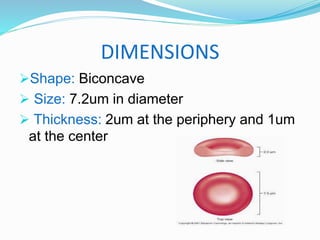
Shape: Biconcave
 Size: 7.2um in diameter
 Thickness: 2um at the periphery and 1um
at the center
RBC
 Advantages of Biconcave Shape of RBCs:
 Greater surface area for exchange of gases.
 Flexibilty of RBC
 Minimal tension when the volume of cell alters.
 How is the shape maintained?
 Spectrin - a contractile protein - maintains shape and
flexibility of RBC
Composition of RBC
 COMPOSITION :
 62.5% water
 35% Hemoglobin
 2.5% : - Sugar – glucose
 Lipids – Cephalin, Cholesterol & Lecithin Protein –
Glutathion : insoluble
 protein which acts as a reducing agent and prevents
damage of hemoglobin
FUNCTIONS
Respiratory
 Acid Base balance
 Maintain viscosity
 Pigment: various pigments are derived from
hemoglobin after disintegration of RBC.
VARIATION
 Physiologic causes of increase count:
 Age
 Gender
 High altitude
 Exercise
 Temperature
 Meal Decrease in count: High barometric pressure,
Pregnancy, sleep
ERYTHROPOIESIS
The process of origin, development and
maturation of erythrocytes.
 Site of erythropoiesis:
 In fetal life: - Mesoblastic stage
 Hepatic stage - Myeloid stage
 In newborns, children and adults
Stages of erythropoiesis
Function of RBC
 It carries the oxygen from lungs to the tissue & carbon
dioxide from tissue to the lungs.
 It also maintains the acid base balance; it is carried out
by buffering action of Hb & other intracellular buffer.
 Red cell maintain ion balance by semi permeability of
cell membrane. Thus they help in maintaining the
balance between positive & negative ions in blood.
 The RBC helps to maintain the viscosity of blood.
Method for counting of Rbc
 Aim: Determination of Total erythrocyte counts by
haemocytometly.
 Clinical Significance: At birth total RBC varies from 6.5 to
7.25 million /cumm. An increase in total RBC count is
observed in condition such as haemoconcentration due to
burns, cholera etc. in chronic heart disease, emphysema & in
polycythemia. Decrease in RBC count is observed in old age,
pregnancy, & anaemia.
 Normal Range:
Method for counting of Rbc
 Requirements: Microscope, Neubauer's chamber, Hb
pipette
 RBC diluting fluid:
 It is prepared as follow:
 Sodium citrate (3.8 gm/dl): It prevents coagulation of blood
& provides osmotic pressure.
 Formalin (5 ml): It act as a preservative & checks the
bacterial & fungal growth.
 D/ w (95 ml): This solution is stable at room temp. for at
Method for counting of Rbc
Principle: The blood specimen is
diluted 1:200 with the RBC diluting
fluid & the cells are counted under
high power by using counting
chamber. The number of cells in
undiluted blood are calculated &
Procedure:
1. Identify the right patient.
2. Collect all the Requirements.
3.Do the labelling
4. Collect required amount of blood by capillary or vein puncture.
5. In a labelled test tube take 3.98 ml RBC Diluting fluid.
6. Add 0.02 ml blood sample with the help 0fHb pipette. Wipe
excess blood outside the pipette by using cotton.
7.Mix well & keep it for 5 min.
8.Charge the Neubauer's chamber allow the cells to settle
for 2 to 3 minutes.
9. Place the counting chamber on the stage of the
microscope.
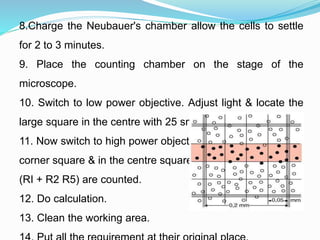
10. Switch to low power objective. Adjust light & locate the
large square in the centre with 25 small squares.
11. Now switch to high power objective. The RBC in the four
corner square & in the centre square
(RI + R2 R5) are counted.
12. Do calculation.
13. Clean the working area.
Method for counting of Rbc
 Calculation: RBC million/cumm=
RBC= RI + R2+ R3+ R4+ R5 x 10,000 cells/ cumin
Method for counting of of
Rbc
 Precaution:
 The counting chamber should be clean & dry.
 Diluting fluid is drawn up to the mark & care is taken not
to allow air bubbles to enter.
 The filling of the chamber should be done in one
application or the tip or the pipette.
 Air bubbles should not be present under the coverslip.
 The diluting fluid should not over run the coverslip.
 Longer waiting leads to drying of the fluid and disturb the
cells.
 Before the counting the condenser & mirror of the
microscope should be properly adjusted.
REFERENCE
Praful godkar,Textbook of medical laboratory
technology, 2nd edition.

Rbc

  • 1.
    RBC Ms Ankita RBhatiya Assistant Professor Shree P.M.Patel COLLEGE OF PARAMEDICAL SCIENCE N TECHNOLOGY
  • 2.
    It include:  1.Whatis RBC?  2.Function of RBC.  3.Production of RBC  4. Method for detection of RBC
  • 3.
    RBC  INTRODUCTION : RBC - red cells / red blood corpuscles / haematids / erythroid cells / erythrocytes.  Derived from Greek erythros for "red" and kytos for "hollow vessel", with -cyte translated as "cell" in modern usage.  Non-nucleated formed elements in the blood.  It lacks cytoplasmic organelles such as nucleolus, mitochondria & ribosome.
  • 4.
    DIMENSIONS Shape: Biconcave  Size:7.2um in diameter  Thickness: 2um at the periphery and 1um at the center
  • 5.
    RBC  Advantages ofBiconcave Shape of RBCs:  Greater surface area for exchange of gases.  Flexibilty of RBC  Minimal tension when the volume of cell alters.  How is the shape maintained?  Spectrin - a contractile protein - maintains shape and flexibility of RBC
  • 6.
    Composition of RBC COMPOSITION :  62.5% water  35% Hemoglobin  2.5% : - Sugar – glucose  Lipids – Cephalin, Cholesterol & Lecithin Protein – Glutathion : insoluble  protein which acts as a reducing agent and prevents damage of hemoglobin
  • 7.
    FUNCTIONS Respiratory  Acid Basebalance  Maintain viscosity  Pigment: various pigments are derived from hemoglobin after disintegration of RBC.
  • 8.
    VARIATION  Physiologic causesof increase count:  Age  Gender  High altitude  Exercise  Temperature  Meal Decrease in count: High barometric pressure, Pregnancy, sleep
  • 9.
    ERYTHROPOIESIS The process oforigin, development and maturation of erythrocytes.  Site of erythropoiesis:  In fetal life: - Mesoblastic stage  Hepatic stage - Myeloid stage  In newborns, children and adults
  • 10.
  • 11.
    Function of RBC It carries the oxygen from lungs to the tissue & carbon dioxide from tissue to the lungs.  It also maintains the acid base balance; it is carried out by buffering action of Hb & other intracellular buffer.  Red cell maintain ion balance by semi permeability of cell membrane. Thus they help in maintaining the balance between positive & negative ions in blood.  The RBC helps to maintain the viscosity of blood.
  • 12.
    Method for countingof Rbc  Aim: Determination of Total erythrocyte counts by haemocytometly.  Clinical Significance: At birth total RBC varies from 6.5 to 7.25 million /cumm. An increase in total RBC count is observed in condition such as haemoconcentration due to burns, cholera etc. in chronic heart disease, emphysema & in polycythemia. Decrease in RBC count is observed in old age, pregnancy, & anaemia.  Normal Range:
  • 13.
    Method for countingof Rbc  Requirements: Microscope, Neubauer's chamber, Hb pipette  RBC diluting fluid:  It is prepared as follow:  Sodium citrate (3.8 gm/dl): It prevents coagulation of blood & provides osmotic pressure.  Formalin (5 ml): It act as a preservative & checks the bacterial & fungal growth.  D/ w (95 ml): This solution is stable at room temp. for at
  • 14.
    Method for countingof Rbc Principle: The blood specimen is diluted 1:200 with the RBC diluting fluid & the cells are counted under high power by using counting chamber. The number of cells in undiluted blood are calculated &
  • 15.
    Procedure: 1. Identify theright patient. 2. Collect all the Requirements. 3.Do the labelling 4. Collect required amount of blood by capillary or vein puncture. 5. In a labelled test tube take 3.98 ml RBC Diluting fluid. 6. Add 0.02 ml blood sample with the help 0fHb pipette. Wipe excess blood outside the pipette by using cotton. 7.Mix well & keep it for 5 min.
  • 16.
    8.Charge the Neubauer'schamber allow the cells to settle for 2 to 3 minutes. 9. Place the counting chamber on the stage of the microscope. 10. Switch to low power objective. Adjust light & locate the large square in the centre with 25 small squares. 11. Now switch to high power objective. The RBC in the four corner square & in the centre square (RI + R2 R5) are counted. 12. Do calculation. 13. Clean the working area.
  • 17.
    Method for countingof Rbc  Calculation: RBC million/cumm= RBC= RI + R2+ R3+ R4+ R5 x 10,000 cells/ cumin
  • 18.
    Method for countingof of Rbc  Precaution:  The counting chamber should be clean & dry.  Diluting fluid is drawn up to the mark & care is taken not to allow air bubbles to enter.  The filling of the chamber should be done in one application or the tip or the pipette.  Air bubbles should not be present under the coverslip.  The diluting fluid should not over run the coverslip.  Longer waiting leads to drying of the fluid and disturb the cells.  Before the counting the condenser & mirror of the microscope should be properly adjusted.
  • 19.
    REFERENCE Praful godkar,Textbook ofmedical laboratory technology, 2nd edition.