WHITE BLOOD CELLS
LEUCOCYTES
 White blood cells or leucocytes are defined as a
white or colorless blood cells (corpuscle).
 They are capable of amoeboid movement
 Its chief functions is to protect the body against
micro organisms causing disease.
LEUCOCYTES
 Leucocytes are formed in the bone marrow from
myeloid stem cells and some being formed in the
lymph nodes from lymphoid stem cells.
 Leucocytes are the units of the body’s resistance to
infection, disease
CLASSIFCATION
 They are classified in two main groups which are
granular or agranular.
 This is dependent on whether they contain
conspicuous ( visible) chemical filled cytoplasmic
granules ( vesicles), that are made visible by
staining.
DIFFERENCES BETWEEN A AND GRANULAR
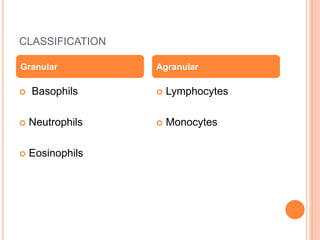
CLASSIFICATION
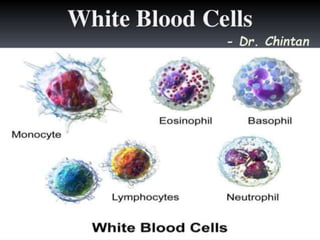
 Basophils
 Neutrophils
 Eosinophils
 Lymphocytes
 Monocytes
Granular Agranular
GRANULAR LEUCOCYTES
BASOPHILS
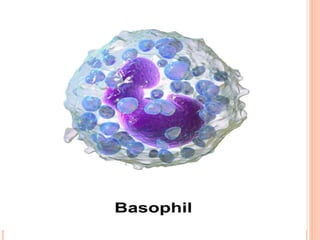
 Make up 0.5-1% of all white blood cells.
 They are 8-10 micrometer in diameter
 The nucleus contains 2 lobes
 When stained, large cytoplasmic granules appear
deep blue-purple.
BASOPHILS FUNCTION
Liberate heparin, histamine, and
serotonin in allergic reactions that
intensify the overall inflammatory
response.
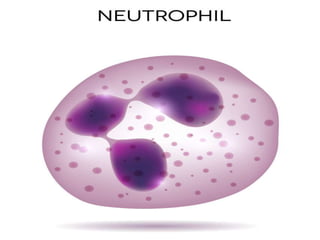
NEUTROPHILS
 Make up 60%-70% of all white blood cells.
 They are normally 10-12 micro meters in diameter
 The nucleus contains 2-5 lobes connected by thin
strand of chromatin
 The cytoplasm has very fine, pale lilac granules
NEUTROPHILS FUNCTION
 Its functions as a phagocyte
 Destroy bacteria with lysozyme, defensins and
strong oxidocents such as superoxide anions,
hydrogen peroxide and hydrochlorite anion.
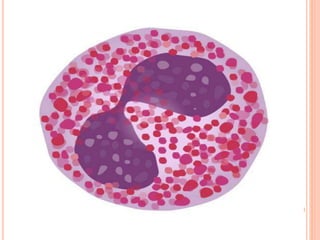
EOSINOPHILS
 Makes up 2-4% of all white blood cells.
 They are 10-12 micrometer in diameter
 Its nucleus has 2 or 3 lobes: large, red-orange
granules fill the cytoplasm.
EOSINOPHILS FUNCTION
 Combat the effects of histamine in allergic
reactions,
 Phagocytize antigen-antibody complexes
 Destroy certain parasitic worms.
AGRANULAR LEUCOCYTES
MONOCYTES
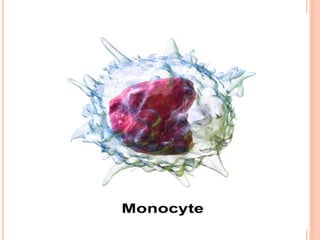
They are 12-20 micrometer in diameter
The nucleus is kidney shaped or
horseshoe shaped
 Cytoplasm is blue-gray and has foamy
appearance.
Make up 3-8% of all white blood cells.
MONOCYTES FUNCTION
 Phagocytosis this occurs after they transform into
fixed or wandering macrophages.
LYMPHOCYTES
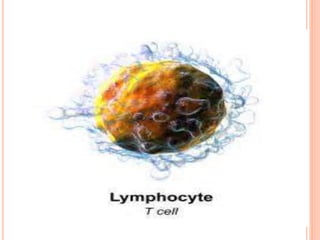
 Lymphocytes are divided in to three subtypes
 T Cells
 B cells
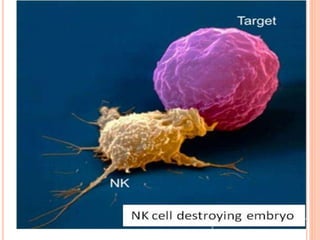
 Natural killer cells
LEUCOCYTES
Make up 20-25% of all white blood cells.
Small lymphocytes are 6-9 micrometer in
diameter
 large lymphocytes are 10-14 micrometer
in diameter
LYMPHOCYTES
 nucleus is round or slightly indented
 cytoplasm forms a rim around the nucleus
that looks sky blue
 the larger the cell, the more cytoplasm is
visible.
LEUCOCYTES FUNCTION
 Mediate immune responses, including antigen-
antibody reactions.
 B cells develop into plasma cell, which secrete
antibodies.
 T cells attack invading viruses, cancer cells and
transplanted tissue cells.
 Natural killer cells attack a wide variety of
infectious microbes and certain spontaneously
arising tumor cells.
REFERENCE

Wbc ppt

  • 1.
  • 3.
    LEUCOCYTES  White bloodcells or leucocytes are defined as a white or colorless blood cells (corpuscle).  They are capable of amoeboid movement  Its chief functions is to protect the body against micro organisms causing disease.
  • 4.
    LEUCOCYTES  Leucocytes areformed in the bone marrow from myeloid stem cells and some being formed in the lymph nodes from lymphoid stem cells.  Leucocytes are the units of the body’s resistance to infection, disease
  • 5.
    CLASSIFCATION  They areclassified in two main groups which are granular or agranular.  This is dependent on whether they contain conspicuous ( visible) chemical filled cytoplasmic granules ( vesicles), that are made visible by staining.
  • 6.
  • 7.
    CLASSIFICATION  Basophils  Neutrophils Eosinophils  Lymphocytes  Monocytes Granular Agranular
  • 8.
  • 9.
    BASOPHILS  Make up0.5-1% of all white blood cells.  They are 8-10 micrometer in diameter  The nucleus contains 2 lobes  When stained, large cytoplasmic granules appear deep blue-purple.
  • 11.
    BASOPHILS FUNCTION Liberate heparin,histamine, and serotonin in allergic reactions that intensify the overall inflammatory response.
  • 12.
    NEUTROPHILS  Make up60%-70% of all white blood cells.  They are normally 10-12 micro meters in diameter  The nucleus contains 2-5 lobes connected by thin strand of chromatin  The cytoplasm has very fine, pale lilac granules
  • 14.
    NEUTROPHILS FUNCTION  Itsfunctions as a phagocyte  Destroy bacteria with lysozyme, defensins and strong oxidocents such as superoxide anions, hydrogen peroxide and hydrochlorite anion.
  • 15.
    EOSINOPHILS  Makes up2-4% of all white blood cells.  They are 10-12 micrometer in diameter  Its nucleus has 2 or 3 lobes: large, red-orange granules fill the cytoplasm.
  • 17.
    EOSINOPHILS FUNCTION  Combatthe effects of histamine in allergic reactions,  Phagocytize antigen-antibody complexes  Destroy certain parasitic worms.
  • 18.
  • 19.
    MONOCYTES They are 12-20micrometer in diameter The nucleus is kidney shaped or horseshoe shaped  Cytoplasm is blue-gray and has foamy appearance. Make up 3-8% of all white blood cells.
  • 21.
    MONOCYTES FUNCTION  Phagocytosisthis occurs after they transform into fixed or wandering macrophages.
  • 22.
    LYMPHOCYTES  Lymphocytes aredivided in to three subtypes  T Cells  B cells  Natural killer cells
  • 23.
    LEUCOCYTES Make up 20-25%of all white blood cells. Small lymphocytes are 6-9 micrometer in diameter  large lymphocytes are 10-14 micrometer in diameter
  • 24.
    LYMPHOCYTES  nucleus isround or slightly indented  cytoplasm forms a rim around the nucleus that looks sky blue  the larger the cell, the more cytoplasm is visible.
  • 28.
    LEUCOCYTES FUNCTION  Mediateimmune responses, including antigen- antibody reactions.  B cells develop into plasma cell, which secrete antibodies.  T cells attack invading viruses, cancer cells and transplanted tissue cells.  Natural killer cells attack a wide variety of infectious microbes and certain spontaneously arising tumor cells.
  • 29.