Angel Anna Lal
1st
Year
BIotechnology
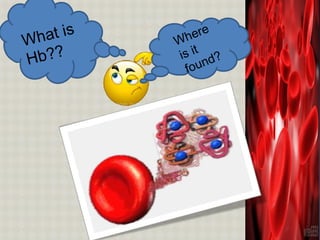
What is
Hb??
Where
is it
found?
 The main function of red blood cell
 Transfer of O2 from lungs to tissue
 Transfer of CO2 from tissue to lungs
 To accomplish this function red blood cells
has haemoglobin (Hb)
 Hb is a globular protein.
 Each red cell has 640 million molecules of Hb
 Haemoglobin (Hb), protein constitutes 1/3 of the
red blood cells
Haem & globin produced at two different sites
in the cells
 Haem in mitochondria
 Globin in polyribosomes
Haemoglobin is involved in transport of other
gases such as co2 carboamino haemoglobin {co2 is
bound to globular protein.}
Protein found in root nodules of nitrogen fixing
root nodules [leguminous plants]Legheamoglobin
 Haemoglobin [Hb or Hgb] is the iron containing
oxygen transport metalloprotein in red blood
cells of all vertebrates.
 Structure was elucidated by Max Preutz {Father
of X-ray crystallographic method}
 Hb A is Haemoglobin found excluseivly in RBC’s
of adults,and is composed of four polypeptide
chains.
 It’s a terameric protein with quaternary
structure
 ––{ two sets of similar units ({ two sets of similar units (αα22ββ22)})}
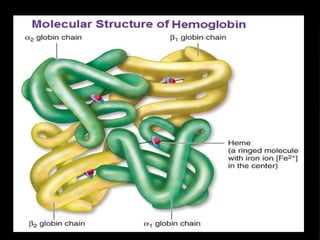
Heme is the prosthetic
group
that mediates
reversible
binding of oxygen by
hemoglobin.
Globin is the
protein that
surrounds and
protects the
heme
molecule. 
 Most of the amino acids in heamoglobin form
alpha helices, connected by short non-helical
segments.
 Hydrogen bonds stabilize the helical sections
inside this protein, causing attractions within the
molecule, folding each polypeptide chain into a
specific shape.
 Hemoglobin's quaternary structure comes from
its four subunits in roughly a tetrahedral
arrangement
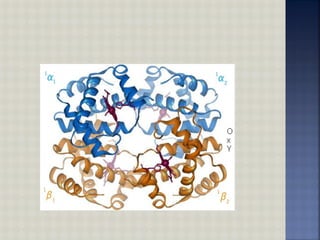
 Hb is a tetramer
 Roughly spheroidal with dimension 64
*55 *50Angstrom.
 4 subunits α1,α2 & β1 β2
subunits are remarkably similar
 18% of the residues are identical.
 2 α chains and 2 β chains are held together by
non covalent linkages.
• aa11- b- b11 made of 141 amino acid residues
• aa 11- b- b 22 146 amino acid residues
• aa11- b- b11 units have 35 interactionsunits have 35 interactions
• aa 11- b- b 22 units have 19 interaction sitesunits have 19 interaction sites
• These associations are predominantlyThese associations are predominantly
hydrophobic.hydrophobic.
• the two αthe two α and twoand two ββ subunits face eachsubunits face each
other through aqueous channels.other through aqueous channels.
Methyl
vinyl
Proponyl
Histidine
Imidazole
 Heme contains:
 a) organic part protoporyphirin
 b) Inorganic part Fe atom [metal]
 Four Pyrrole groups [A to D] linked byFour Pyrrole groups [A to D] linked by
methane bridgesmethane bridges
 Ferrous in heme acts as prosthetic group
 Ferrous [Fe2+] ion resides at the center of
tetrapyrole ring called hydrophobic heme
pocket.
 Hemoglobin has 4 heme,hence can carry 4
oxygen atoms.
 The iron is bound strongly (covalently) to the
globular protein via the imidazole ring of
F8 histidine residue (also known as the proximal
histidine) below the porphyrin ring.
 A sixth position can reversibly bind oxygen by
a coordinate covalent bond, completing the
octahedral group of six ligands.
 Oxygen binds in an "end-on bent" geometry
where one oxygen atom binds Fe and the other
protrudes at an angle.
 When oxygen is not bound, a very weakly bonded
water molecule fills the site, forming a
distorted octahedron.
A molecule of OA molecule of O22 acts as 6acts as 6thth
ligand.ligand.
Porphyrin rings in heme with its particularPorphyrin rings in heme with its particular
arrangement of 4 methyl, 2 propionates & 2arrangement of 4 methyl, 2 propionates & 2
vinyl substituentsvinyl substituents protoporyphyrin I Xprotoporyphyrin I X
In deoxy form,theIn deoxy form,the ferrous atoms sit out of planeferrous atoms sit out of plane
poryphyrinporyphyrin by about 0.6 Angstrom.by about 0.6 Angstrom.
This is due to stearic repulsion between HisThis is due to stearic repulsion between His
F8[proximal histidine] and the poryphyrin plane.F8[proximal histidine] and the poryphyrin plane.
When oWhen o22 binds ,staeric repulsion is minimisedbinds ,staeric repulsion is minimised
and ferrous atom comes to the plane.and ferrous atom comes to the plane.
Oxygenation changes electrostatic state of FeOxygenation changes electrostatic state of Fe2+2+
of heme.of heme.
oxygenation changes state of Feoxygenation changes state of Fe
Purple to red color of blood,Purple to red color of blood,
FeFe+3+3
– brown– brown
 In the tetrameric form of normal adult
hemoglobin, the binding of oxygen is
a cooperative process.
 The binding affinity of hemoglobin for
oxygen is increased by the oxygen saturation
of the molecule, with the first oxygens
bound influencing the shape of the binding
sites for the next oxygens, in a way favorable
for binding.
 This positive cooperative binding is achieved
through steric conformational changes
 Oxygen binding to hemoglobin is due to the
effect of the ligand-binding state of one heme
group on the ligand-binding affinity of another.
 Too far apart to interact! (25 to 37 Å apart)
 Mechanically transmitted between heme groups
by motions of the proteins
 This means the molecule changes shape!
PERUTZ MECHANISMPERUTZ MECHANISM
Hb has two conformational statesHb has two conformational states -- the deoxy orthe deoxy or TT
statestate andand the oxy orthe oxy or R state.R state.
In deoxy haemoglobin quaternary structureIn deoxy haemoglobin quaternary structure
interactions are constrainedinteractions are constrained  T-stateT-state [Tensed[Tensed
state taut]state taut]
When OWhen O22 binds, it relaxes the quaternary structurebinds, it relaxes the quaternary structure
 R-StateR-State [Relaxed state][Relaxed state]
 [Relaxed coformation due to interaction][Relaxed coformation due to interaction]
 When OWhen O22 bindsbinds
 oxygen pulls some of electron density from Feoxygen pulls some of electron density from Fe
atom.atom.
 As a result it reduces the electron density andAs a result it reduces the electron density and
size of Fe atom.size of Fe atom.
 It can move more to the center of plane ofIt can move more to the center of plane of
protoporiphyrin.protoporiphyrin.
 Oxygen pulls Fe atom the poriphyrin
structure α helix.
 So when binding takes place there is a surface to
surface interaction between adjacent
polypeptide chains.
 This interaction forces the plane of the ring
sideways toward the outside of the tetramer,
and also induces a strain in the protein helix
containing the histidine as it moves nearer to the
iron atom
 This strain is transmitted to the remaining three
monomers in the tetramer, where it induces a
similar conformational change in the other heme
sites such that binding of oxygen to these sites
becomes easier.
 Deoxyhaemoglobin has an extensive network
of saltbridges,which stabilize T-state
 These ion pairs are torn in transition from T-
sate to R-state
LungsTissues
Sigmoidal/ S-shaped curve
Partial preassure {P50} of oxygen at which oxygen is half-
saturated {26.6mmHg}
 Sigmoidal shape of Hb dissociation curve shows
characteristic of cooperative process.
 Right to Left  Dissociation
 In LUNGS O2 tension is high {100mmHg},provides
complete saturation.
 Releasing of O2 is a gradual process.
 As blood leaves the lungs for peripheral tissue Hb
releases its load and % of oxyheamoglobin
decreases.
 Left to Right binding of oxygen
 1st
moulecule bound causes structural changes
that influences the binding of next molecule.
 Initial slope is low as Hb is independently
competing for first o2 .
 Once Oxygen molecule is bound to 1 Hb’s
subunits,increases the o2 binding affinity of its
other subunits
 [thereby incresing slope of midle portion]
 The normal position of curve depends on
 Concentration of 2,3-DPG
 H+
ion concentration (pH)
 CO2 in red blood cells
 Structure of Hb
 Right shift (easy oxygen delivery)
 High 2,3-DPG
 High H+
 High CO2
 HbS
 Left shift (give up oxygen less readily)
 Low 2,3-DPG
 HbF
THANK
YOU!

Haemoglobin

  • 1.
  • 2.
  • 3.
     The mainfunction of red blood cell  Transfer of O2 from lungs to tissue  Transfer of CO2 from tissue to lungs  To accomplish this function red blood cells has haemoglobin (Hb)  Hb is a globular protein.  Each red cell has 640 million molecules of Hb  Haemoglobin (Hb), protein constitutes 1/3 of the red blood cells
  • 4.
    Haem & globinproduced at two different sites in the cells  Haem in mitochondria  Globin in polyribosomes Haemoglobin is involved in transport of other gases such as co2 carboamino haemoglobin {co2 is bound to globular protein.} Protein found in root nodules of nitrogen fixing root nodules [leguminous plants]Legheamoglobin
  • 5.
     Haemoglobin [Hbor Hgb] is the iron containing oxygen transport metalloprotein in red blood cells of all vertebrates.  Structure was elucidated by Max Preutz {Father of X-ray crystallographic method}  Hb A is Haemoglobin found excluseivly in RBC’s of adults,and is composed of four polypeptide chains.  It’s a terameric protein with quaternary structure  ––{ two sets of similar units ({ two sets of similar units (αα22ββ22)})}
  • 6.
    Heme is theprosthetic group that mediates reversible binding of oxygen by hemoglobin. Globin is the protein that surrounds and protects the heme molecule. 
  • 8.
     Most ofthe amino acids in heamoglobin form alpha helices, connected by short non-helical segments.  Hydrogen bonds stabilize the helical sections inside this protein, causing attractions within the molecule, folding each polypeptide chain into a specific shape.  Hemoglobin's quaternary structure comes from its four subunits in roughly a tetrahedral arrangement
  • 9.
     Hb isa tetramer  Roughly spheroidal with dimension 64 *55 *50Angstrom.  4 subunits α1,α2 & β1 β2 subunits are remarkably similar  18% of the residues are identical.  2 α chains and 2 β chains are held together by non covalent linkages.
  • 10.
    • aa11- b-b11 made of 141 amino acid residues • aa 11- b- b 22 146 amino acid residues • aa11- b- b11 units have 35 interactionsunits have 35 interactions • aa 11- b- b 22 units have 19 interaction sitesunits have 19 interaction sites • These associations are predominantlyThese associations are predominantly hydrophobic.hydrophobic. • the two αthe two α and twoand two ββ subunits face eachsubunits face each other through aqueous channels.other through aqueous channels.
  • 12.
  • 13.
     Heme contains: a) organic part protoporyphirin  b) Inorganic part Fe atom [metal]  Four Pyrrole groups [A to D] linked byFour Pyrrole groups [A to D] linked by methane bridgesmethane bridges  Ferrous in heme acts as prosthetic group  Ferrous [Fe2+] ion resides at the center of tetrapyrole ring called hydrophobic heme pocket.  Hemoglobin has 4 heme,hence can carry 4 oxygen atoms.
  • 14.
     The ironis bound strongly (covalently) to the globular protein via the imidazole ring of F8 histidine residue (also known as the proximal histidine) below the porphyrin ring.  A sixth position can reversibly bind oxygen by a coordinate covalent bond, completing the octahedral group of six ligands.  Oxygen binds in an "end-on bent" geometry where one oxygen atom binds Fe and the other protrudes at an angle.  When oxygen is not bound, a very weakly bonded water molecule fills the site, forming a distorted octahedron.
  • 15.
    A molecule ofOA molecule of O22 acts as 6acts as 6thth ligand.ligand. Porphyrin rings in heme with its particularPorphyrin rings in heme with its particular arrangement of 4 methyl, 2 propionates & 2arrangement of 4 methyl, 2 propionates & 2 vinyl substituentsvinyl substituents protoporyphyrin I Xprotoporyphyrin I X In deoxy form,theIn deoxy form,the ferrous atoms sit out of planeferrous atoms sit out of plane poryphyrinporyphyrin by about 0.6 Angstrom.by about 0.6 Angstrom. This is due to stearic repulsion between HisThis is due to stearic repulsion between His F8[proximal histidine] and the poryphyrin plane.F8[proximal histidine] and the poryphyrin plane. When oWhen o22 binds ,staeric repulsion is minimisedbinds ,staeric repulsion is minimised and ferrous atom comes to the plane.and ferrous atom comes to the plane. Oxygenation changes electrostatic state of FeOxygenation changes electrostatic state of Fe2+2+ of heme.of heme.
  • 16.
    oxygenation changes stateof Feoxygenation changes state of Fe Purple to red color of blood,Purple to red color of blood, FeFe+3+3 – brown– brown
  • 18.
     In thetetrameric form of normal adult hemoglobin, the binding of oxygen is a cooperative process.  The binding affinity of hemoglobin for oxygen is increased by the oxygen saturation of the molecule, with the first oxygens bound influencing the shape of the binding sites for the next oxygens, in a way favorable for binding.  This positive cooperative binding is achieved through steric conformational changes
  • 19.
     Oxygen bindingto hemoglobin is due to the effect of the ligand-binding state of one heme group on the ligand-binding affinity of another.  Too far apart to interact! (25 to 37 Å apart)  Mechanically transmitted between heme groups by motions of the proteins  This means the molecule changes shape!
  • 20.
    PERUTZ MECHANISMPERUTZ MECHANISM Hbhas two conformational statesHb has two conformational states -- the deoxy orthe deoxy or TT statestate andand the oxy orthe oxy or R state.R state. In deoxy haemoglobin quaternary structureIn deoxy haemoglobin quaternary structure interactions are constrainedinteractions are constrained  T-stateT-state [Tensed[Tensed state taut]state taut] When OWhen O22 binds, it relaxes the quaternary structurebinds, it relaxes the quaternary structure  R-StateR-State [Relaxed state][Relaxed state]  [Relaxed coformation due to interaction][Relaxed coformation due to interaction]
  • 21.
     When OWhenO22 bindsbinds  oxygen pulls some of electron density from Feoxygen pulls some of electron density from Fe atom.atom.  As a result it reduces the electron density andAs a result it reduces the electron density and size of Fe atom.size of Fe atom.  It can move more to the center of plane ofIt can move more to the center of plane of protoporiphyrin.protoporiphyrin.  Oxygen pulls Fe atom the poriphyrin structure α helix.  So when binding takes place there is a surface to surface interaction between adjacent polypeptide chains.
  • 22.
     This interactionforces the plane of the ring sideways toward the outside of the tetramer, and also induces a strain in the protein helix containing the histidine as it moves nearer to the iron atom  This strain is transmitted to the remaining three monomers in the tetramer, where it induces a similar conformational change in the other heme sites such that binding of oxygen to these sites becomes easier.
  • 24.
     Deoxyhaemoglobin hasan extensive network of saltbridges,which stabilize T-state  These ion pairs are torn in transition from T- sate to R-state
  • 27.
  • 28.
    Partial preassure {P50}of oxygen at which oxygen is half- saturated {26.6mmHg}
  • 29.
     Sigmoidal shapeof Hb dissociation curve shows characteristic of cooperative process.  Right to Left  Dissociation  In LUNGS O2 tension is high {100mmHg},provides complete saturation.  Releasing of O2 is a gradual process.  As blood leaves the lungs for peripheral tissue Hb releases its load and % of oxyheamoglobin decreases.
  • 30.
     Left toRight binding of oxygen  1st moulecule bound causes structural changes that influences the binding of next molecule.  Initial slope is low as Hb is independently competing for first o2 .  Once Oxygen molecule is bound to 1 Hb’s subunits,increases the o2 binding affinity of its other subunits  [thereby incresing slope of midle portion]
  • 31.
     The normalposition of curve depends on  Concentration of 2,3-DPG  H+ ion concentration (pH)  CO2 in red blood cells  Structure of Hb
  • 32.
     Right shift(easy oxygen delivery)  High 2,3-DPG  High H+  High CO2  HbS  Left shift (give up oxygen less readily)  Low 2,3-DPG  HbF
  • 33.