Mechanisms of Mutation
And DNA repair
Thet Su Win
MTMT/D-5736940
DNA and its mutation
• Components of DNA has its unique structures.
• Its integrity and stability are essential for life.
• Some factors can influence on DNA, resulting DNA
damage.
• If not repaired, will lead to mutation and possibly
disease.
• Permanent change in the DNA sequence is called
Mutation.
Clancy, S. (2008) DNA damage and repair: mechanisms for maintaining DNA integrity. Nature Education 1(1):103
Mutagenesis
http://www.usfca.edu/fac-staff/dever/mutation_andrepair.pdf
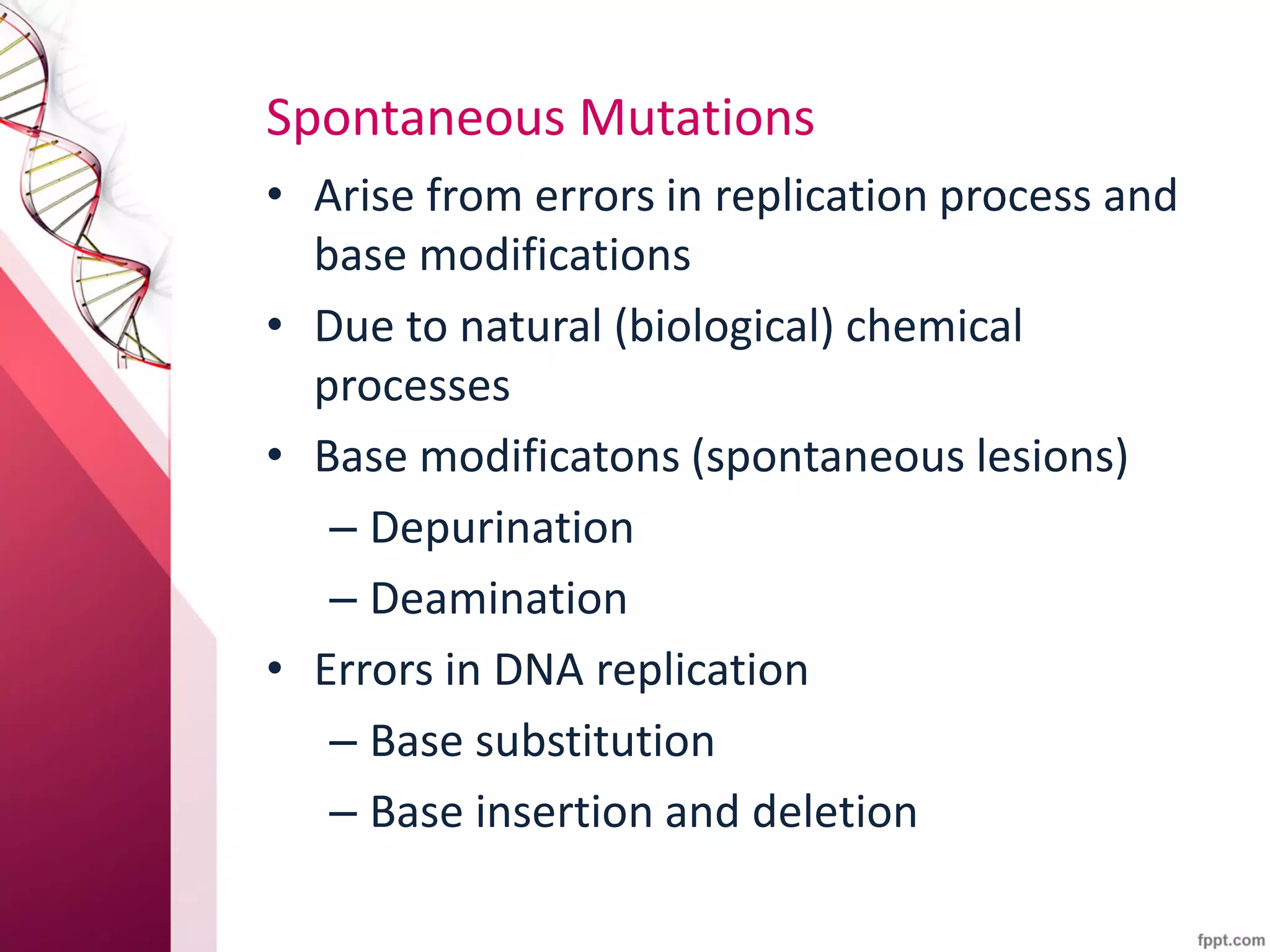
Spontaneous Mutations
• Arise from errors in replication process and
base modifications
• Due to natural (biological) chemical
processes
• Base modificatons (spontaneous lesions)
– Depurination
– Deamination
• Errors in DNA replication
– Base substitution
– Base insertion and deletion
Depurination
• Loss of a purine base, occurs spontaneously
• A mammalian cell loses about 10,000 purines in
20hrs cell generation period
Depurination produces an Apurinic site
http://www.nature.com/scitable/content/depurination-produces-an-apurinic-site-55400
Deamination
Deamination of (a) Cytosine and (b) 5-methylcytosine
Griffiths et al (2004)
(5-methyluracil)
Errors in DNA replication
Base Substitutions
• No chemical reaction is perfect
• Error in replication can occur when an illegitimate
nucleotide pair (e.g. A-C) forms in DNA synthesis.
• leading to a base substitution.
Base insertion and deletion
Griffiths et al (2004)
Deletion
Insertion
Indel mutation
Induced Mutations
• Arise after treatment with mutagens or
environment agents.
• Chemicals
– Alkylating agents (ENU)
– Methylating agents (EMS)
– Polycyclic hydrocarbons
– DNA intercalating agents (ethidium bromide)
– DNA crosslinker (platinum)
– Oxidative damage (oxygen radicals)
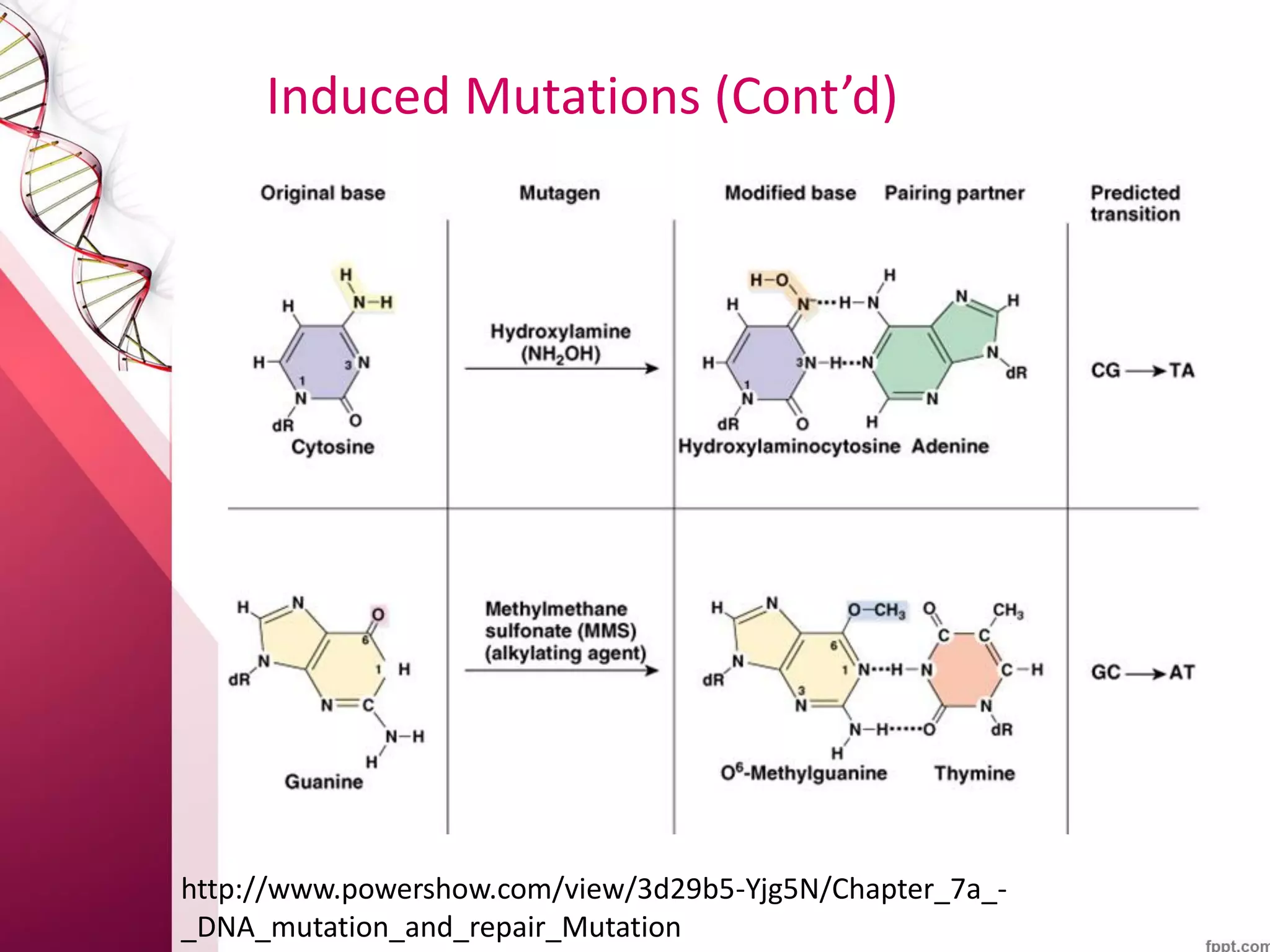
Induced Mutations (Cont’d)
http://www.powershow.com/view/3d29b5-Yjg5N/Chapter_7a_-
_DNA_mutation_and_repair_Mutation
Induced Mutations (Cont’d)
• Radiation
– UV (nonionizing radiation)
– Ionizing radiation
• Other mutagens
– aflatoxin B1 (AFB1)
Classification of Mutations
Mutations
Small-scale
mutations
(microalteration)
Point Mutations
Transition and
Transversion
Silent mutation
Missense mutation
Nonsense mutation
Insertions
Deletions
Large-scale
mutations
(macroalteration)
Amplification or
duplication
Deletions
Inversions
Rearrangement
Mutation and genetic disorders
Progeria
• Autosomal recessive disorders
• rapid aging disease
• caused by single point mutation
(in LMNA gene)
• Thin, bald, old-looking skin
Mutation and
haematological disorders
• Sickle cell anaemia
• a result of single nucleotide
polymorphism (SNP)
• Hb S
http://evolution.berkeley.edu/evolibrary/article/mutations_06
Mutation and Cancer
• Mutation in p53 tumor suppressor gene is the most
prevalent mutation found in human cancers (over
50%)
• P53 function – cell cycle regulation and apoptosis
induction
Mutated p53 and cancer
https://voer.edu.vn/m/cancer-and-the-cell-cycle/3962112d
Mutation in p53 gene
http://bio1151.nicerweb.com/Locked/media/ch18/p53_tumor-suppressor.html
DNA Repair mechanisms
DNA Repair
• Restore the premutational damage to the normal
base sequence
• Failure in these systems can lead to a higher
mutation rate
• Some repair systems are very efficient at resorting
the original sequence.
• Others convert the original sequence into a
permanent mutation.
DNA Repair (Cont’d)
• Repair the damaged DNA base
• Delete the damaged DNA and using the
complementary sequences to restore the normal
sequence
Direct reversal
Excision repair pathways
Repair of double strand breaks
Direct reversal of damaged DNA
• Photoreactivation by
Photolyase enzyme.
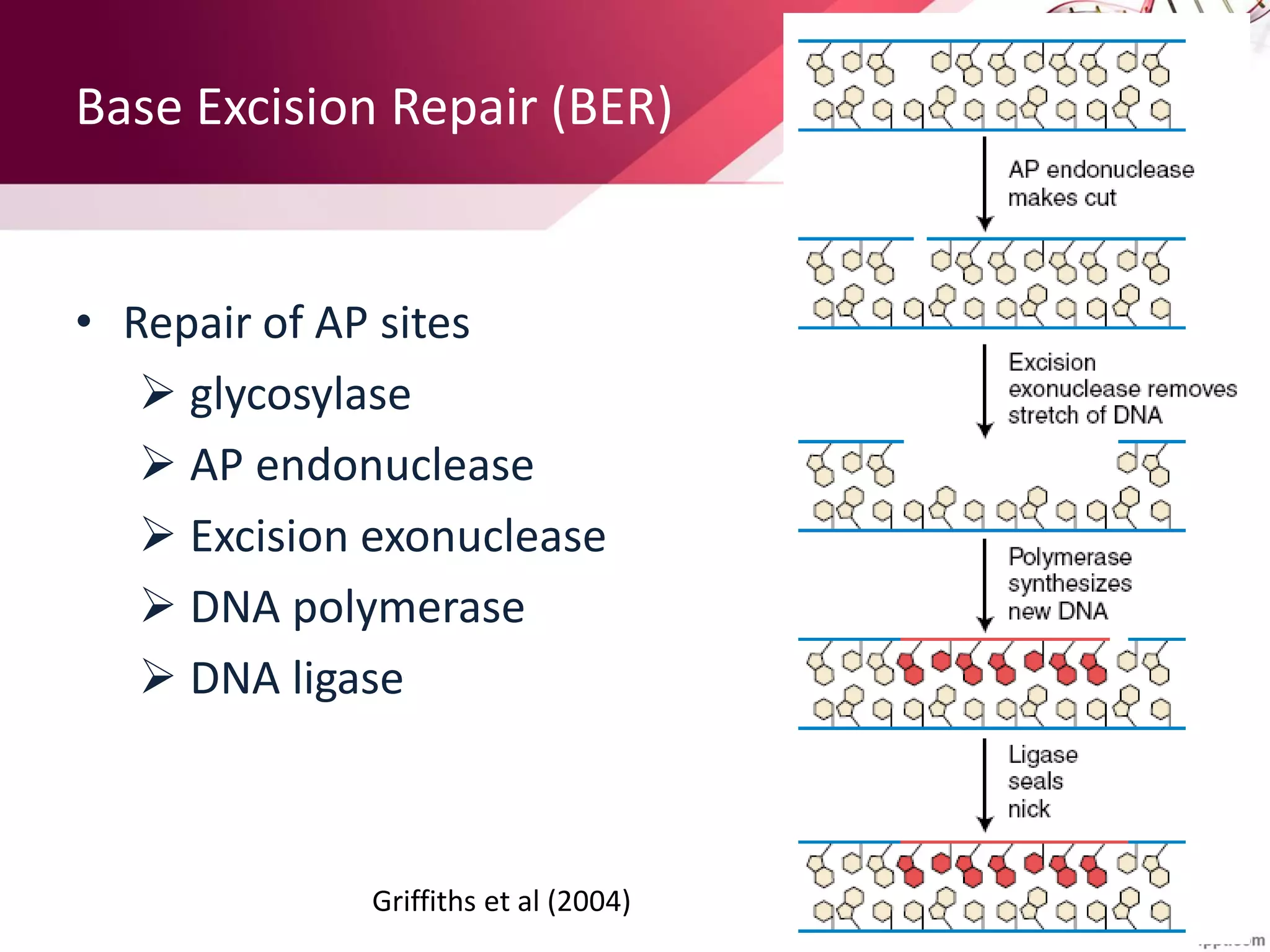
Base Excision Repair (BER)
• Repair of AP sites
 glycosylase
 AP endonuclease
 Excision exonuclease
 DNA polymerase
 DNA ligase
Griffiths et al (2004)
Nucleotide Excision Repair
(NER)
Excinuclease
• detects the distortions in
double helix cause by the
presence of abnormal base
• Such distortions include
pyrimidine dimer caused by
UV light or aflatoxin induced
mutation.
Griffiths et al (2004)
Repair of double-strand breaks
• Double-strand break is a mutation in which both
strands of the double helix were to break at sites that
were close together.
• If left unrepaired, this can cause a variety of
chromosomal aberrations resulting in cell death or a
precancerous state.
• Double-strand breaks can arise spontaneously or
induced by ionizing radiation.
• Two mechanisms to repair these lesions are
Nonhomologous end joining (NHEJ) and homologous
recombination.
Nonhomologous end-joining
(NHEJ)
• Complementary strand cannot
exploited because both strands
are damage.
• No sister chromatid
• Error prone mechanism
• Imperfect repair
• Better than leaving unrepaired
Griffiths et al (2004)
Homologous
Recombination
• Utilize sister chromatoid
• Error free
Griffiths et al (2004)
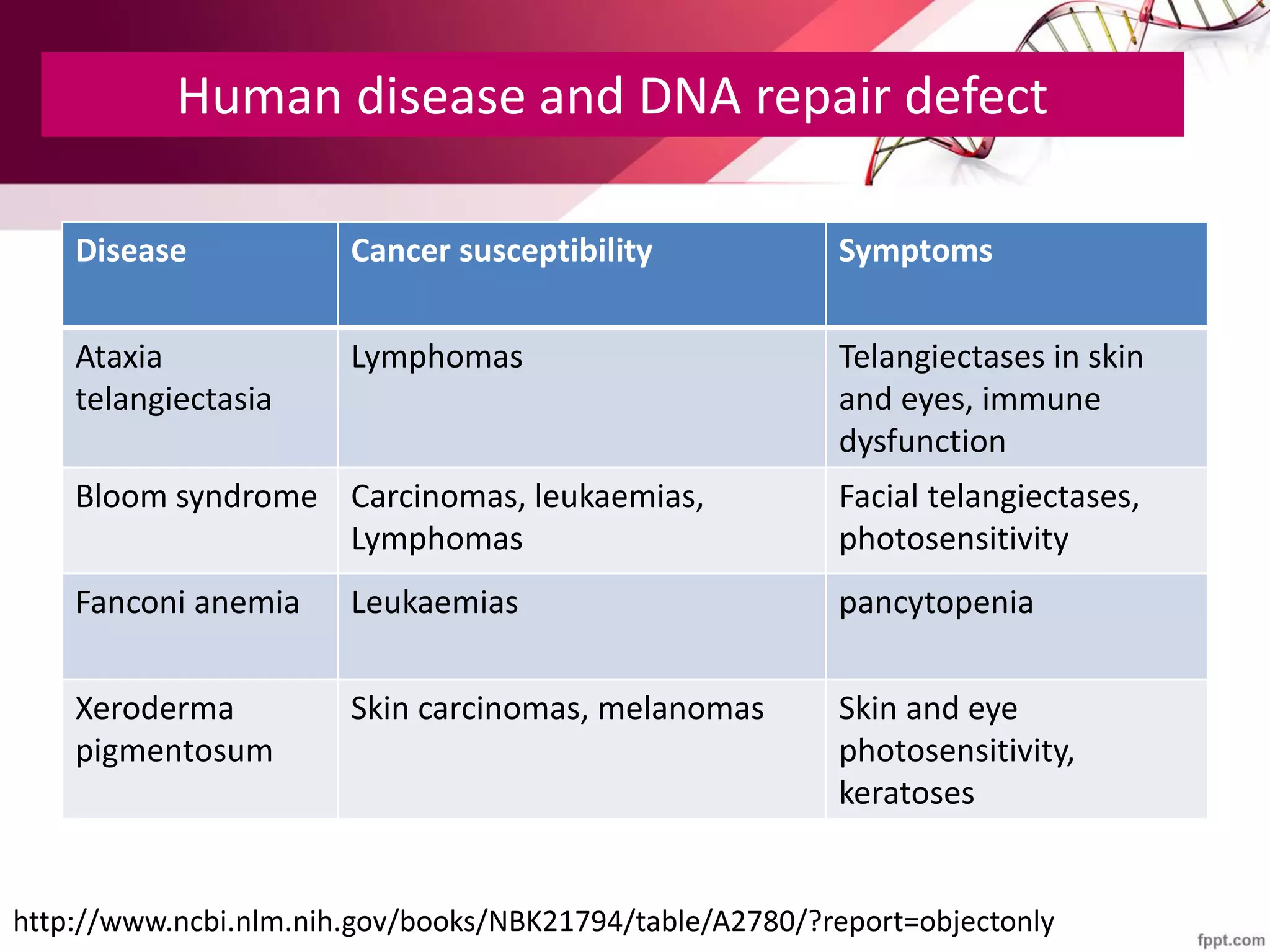
Human disease and DNA repair defect
Disease Cancer susceptibility Symptoms
Ataxia
telangiectasia
Lymphomas Telangiectases in skin
and eyes, immune
dysfunction
Bloom syndrome Carcinomas, leukaemias,
Lymphomas
Facial telangiectases,
photosensitivity
Fanconi anemia Leukaemias pancytopenia
Xeroderma
pigmentosum
Skin carcinomas, melanomas Skin and eye
photosensitivity,
keratoses
http://www.ncbi.nlm.nih.gov/books/NBK21794/table/A2780/?report=objectonly
PTEN
• Phosphatase and tensin homolog detected on
chromosome Ten
• Tumor suppressor protein
• play a role in maintenance of tumor
microenvironment, cellular senescence and cell cycle
regulation
• regulate DNA damage mechanism
http://jcs.biologists.org/content/114/13/2375/F2.expansion.html
Objectives of the study
• To investigate the role of phosphorylation
• subsequent nuclear localization of PTEN with DNA
repair.
• Using PTEN deficient U87MG cells
Materials and Methods
• MTT assay
• Fluorescence microscopy
• Western blotting and immunoprecipitation
• Comet assay
• Statistical analysis with Origin Pro v.8 software
Results from MTT assay
Percentage of survivability is lowered in all transfected cells compared to untransfected cell
Results of Comet assay
Conclusion
• DNA damage augments phosphorylation of PTEN.
• Nuclear accumulation of PTEN increases which
positively regulates the DNA repair process.
• PTEN as the intermediate component of DNA repair.
• Phosphorylation of PTEN is associated with DNA
repair
• PTEN is essential for successful DNA repair.
References
• Clancy S. DNA damage and repair: Mechanisms for
Maintaining DNA Integrity. Nature Education.
2008;1(1):103.
• Griffiths AJF, Wessler SR, Lewontin RC, Gelbart WM,
Suzuki DT, Miller JH. Introduction to Genetic Analysis. 8th
ed. W.H. Freeman; 2004.
• Karp G. Cell and Molecular Biology: Concepts and
Experiments. 7th ed. John Wiley and Sons Inc; 2013.
• Wei, S., Shalhout, S., Ahn, Y.H. and Bhagwat, A.S. (2015).
A versatile new tool to quantify abasic sites in DNA and
inhibit base excision repair. DNA repair 27(2015)9-18
Mutation and DNA repair

Mutation and DNA repair

  • 1.
    Mechanisms of Mutation AndDNA repair Thet Su Win MTMT/D-5736940
  • 2.
    DNA and itsmutation • Components of DNA has its unique structures. • Its integrity and stability are essential for life. • Some factors can influence on DNA, resulting DNA damage. • If not repaired, will lead to mutation and possibly disease. • Permanent change in the DNA sequence is called Mutation. Clancy, S. (2008) DNA damage and repair: mechanisms for maintaining DNA integrity. Nature Education 1(1):103
  • 3.
  • 4.
    Spontaneous Mutations • Arisefrom errors in replication process and base modifications • Due to natural (biological) chemical processes • Base modificatons (spontaneous lesions) – Depurination – Deamination • Errors in DNA replication – Base substitution – Base insertion and deletion
  • 5.
    Depurination • Loss ofa purine base, occurs spontaneously • A mammalian cell loses about 10,000 purines in 20hrs cell generation period
  • 6.
    Depurination produces anApurinic site http://www.nature.com/scitable/content/depurination-produces-an-apurinic-site-55400
  • 7.
    Deamination Deamination of (a)Cytosine and (b) 5-methylcytosine Griffiths et al (2004) (5-methyluracil)
  • 8.
    Errors in DNAreplication Base Substitutions • No chemical reaction is perfect • Error in replication can occur when an illegitimate nucleotide pair (e.g. A-C) forms in DNA synthesis. • leading to a base substitution.
  • 9.
    Base insertion anddeletion Griffiths et al (2004) Deletion Insertion Indel mutation
  • 10.
    Induced Mutations • Ariseafter treatment with mutagens or environment agents. • Chemicals – Alkylating agents (ENU) – Methylating agents (EMS) – Polycyclic hydrocarbons – DNA intercalating agents (ethidium bromide) – DNA crosslinker (platinum) – Oxidative damage (oxygen radicals)
  • 11.
  • 12.
    Induced Mutations (Cont’d) •Radiation – UV (nonionizing radiation) – Ionizing radiation • Other mutagens – aflatoxin B1 (AFB1)
  • 13.
    Classification of Mutations Mutations Small-scale mutations (microalteration) PointMutations Transition and Transversion Silent mutation Missense mutation Nonsense mutation Insertions Deletions Large-scale mutations (macroalteration) Amplification or duplication Deletions Inversions Rearrangement
  • 14.
    Mutation and geneticdisorders Progeria • Autosomal recessive disorders • rapid aging disease • caused by single point mutation (in LMNA gene) • Thin, bald, old-looking skin
  • 15.
    Mutation and haematological disorders •Sickle cell anaemia • a result of single nucleotide polymorphism (SNP) • Hb S http://evolution.berkeley.edu/evolibrary/article/mutations_06
  • 16.
    Mutation and Cancer •Mutation in p53 tumor suppressor gene is the most prevalent mutation found in human cancers (over 50%) • P53 function – cell cycle regulation and apoptosis induction
  • 17.
    Mutated p53 andcancer https://voer.edu.vn/m/cancer-and-the-cell-cycle/3962112d
  • 18.
    Mutation in p53gene http://bio1151.nicerweb.com/Locked/media/ch18/p53_tumor-suppressor.html
  • 19.
  • 20.
    DNA Repair • Restorethe premutational damage to the normal base sequence • Failure in these systems can lead to a higher mutation rate • Some repair systems are very efficient at resorting the original sequence. • Others convert the original sequence into a permanent mutation.
  • 21.
    DNA Repair (Cont’d) •Repair the damaged DNA base • Delete the damaged DNA and using the complementary sequences to restore the normal sequence Direct reversal Excision repair pathways Repair of double strand breaks
  • 22.
    Direct reversal ofdamaged DNA • Photoreactivation by Photolyase enzyme.
  • 23.
    Base Excision Repair(BER) • Repair of AP sites  glycosylase  AP endonuclease  Excision exonuclease  DNA polymerase  DNA ligase Griffiths et al (2004)
  • 24.
    Nucleotide Excision Repair (NER) Excinuclease •detects the distortions in double helix cause by the presence of abnormal base • Such distortions include pyrimidine dimer caused by UV light or aflatoxin induced mutation. Griffiths et al (2004)
  • 25.
    Repair of double-strandbreaks • Double-strand break is a mutation in which both strands of the double helix were to break at sites that were close together. • If left unrepaired, this can cause a variety of chromosomal aberrations resulting in cell death or a precancerous state. • Double-strand breaks can arise spontaneously or induced by ionizing radiation. • Two mechanisms to repair these lesions are Nonhomologous end joining (NHEJ) and homologous recombination.
  • 26.
    Nonhomologous end-joining (NHEJ) • Complementarystrand cannot exploited because both strands are damage. • No sister chromatid • Error prone mechanism • Imperfect repair • Better than leaving unrepaired Griffiths et al (2004)
  • 27.
    Homologous Recombination • Utilize sisterchromatoid • Error free Griffiths et al (2004)
  • 28.
    Human disease andDNA repair defect Disease Cancer susceptibility Symptoms Ataxia telangiectasia Lymphomas Telangiectases in skin and eyes, immune dysfunction Bloom syndrome Carcinomas, leukaemias, Lymphomas Facial telangiectases, photosensitivity Fanconi anemia Leukaemias pancytopenia Xeroderma pigmentosum Skin carcinomas, melanomas Skin and eye photosensitivity, keratoses http://www.ncbi.nlm.nih.gov/books/NBK21794/table/A2780/?report=objectonly
  • 30.
    PTEN • Phosphatase andtensin homolog detected on chromosome Ten • Tumor suppressor protein • play a role in maintenance of tumor microenvironment, cellular senescence and cell cycle regulation • regulate DNA damage mechanism
  • 31.
  • 32.
    Objectives of thestudy • To investigate the role of phosphorylation • subsequent nuclear localization of PTEN with DNA repair. • Using PTEN deficient U87MG cells
  • 33.
    Materials and Methods •MTT assay • Fluorescence microscopy • Western blotting and immunoprecipitation • Comet assay • Statistical analysis with Origin Pro v.8 software
  • 34.
    Results from MTTassay Percentage of survivability is lowered in all transfected cells compared to untransfected cell
  • 35.
  • 37.
    Conclusion • DNA damageaugments phosphorylation of PTEN. • Nuclear accumulation of PTEN increases which positively regulates the DNA repair process. • PTEN as the intermediate component of DNA repair. • Phosphorylation of PTEN is associated with DNA repair • PTEN is essential for successful DNA repair.
  • 38.
    References • Clancy S.DNA damage and repair: Mechanisms for Maintaining DNA Integrity. Nature Education. 2008;1(1):103. • Griffiths AJF, Wessler SR, Lewontin RC, Gelbart WM, Suzuki DT, Miller JH. Introduction to Genetic Analysis. 8th ed. W.H. Freeman; 2004. • Karp G. Cell and Molecular Biology: Concepts and Experiments. 7th ed. John Wiley and Sons Inc; 2013. • Wei, S., Shalhout, S., Ahn, Y.H. and Bhagwat, A.S. (2015). A versatile new tool to quantify abasic sites in DNA and inhibit base excision repair. DNA repair 27(2015)9-18