TRANSLATIONAL PROOFREADING AND
TRANSLATIONAL INHIBITORS.
BY:
S. DASH
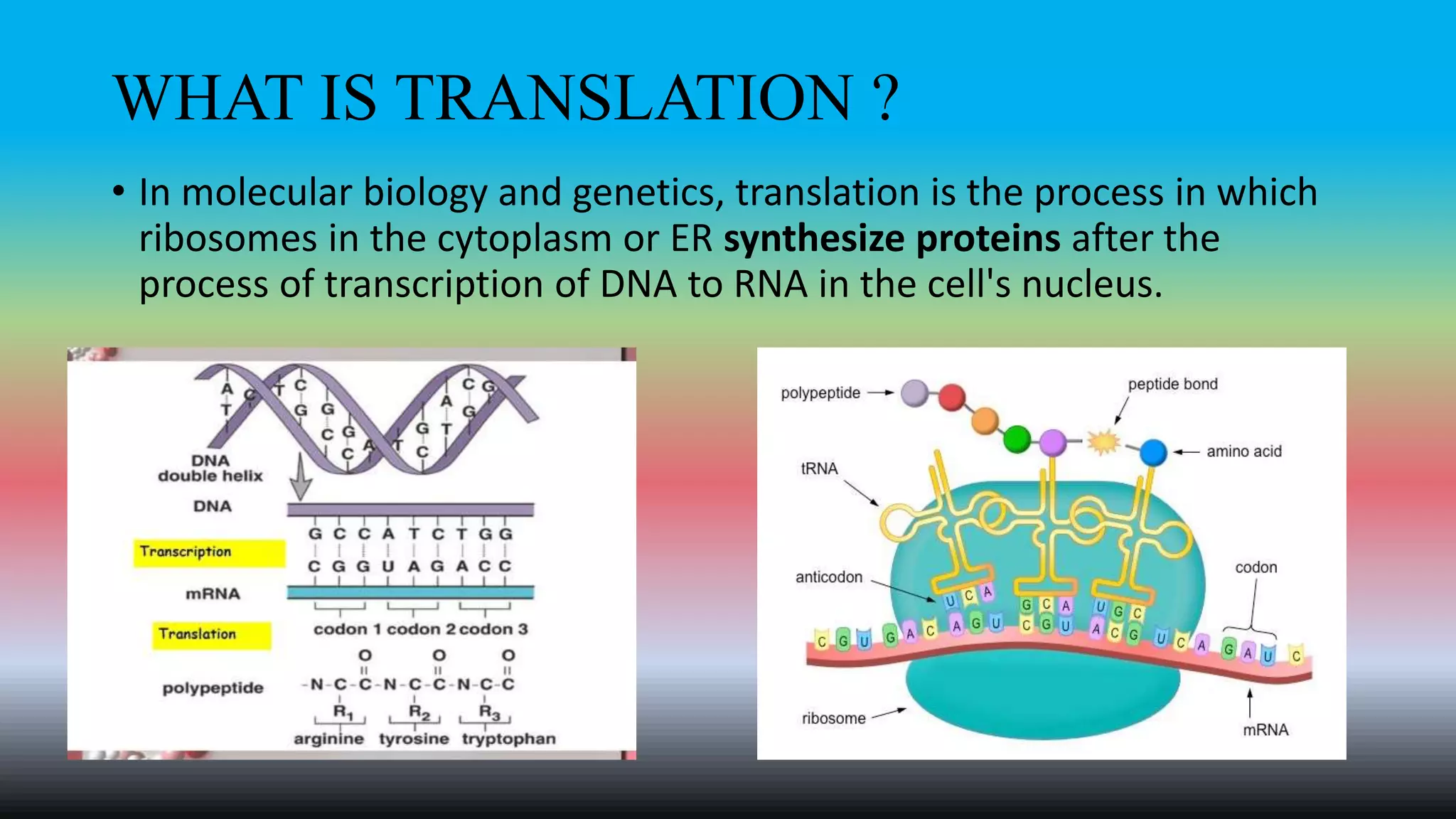
WHAT IS TRANSLATION ?
• In molecular biology and genetics, translation is the process in which
ribosomes in the cytoplasm or ER synthesize proteins after the
process of transcription of DNA to RNA in the cell's nucleus.
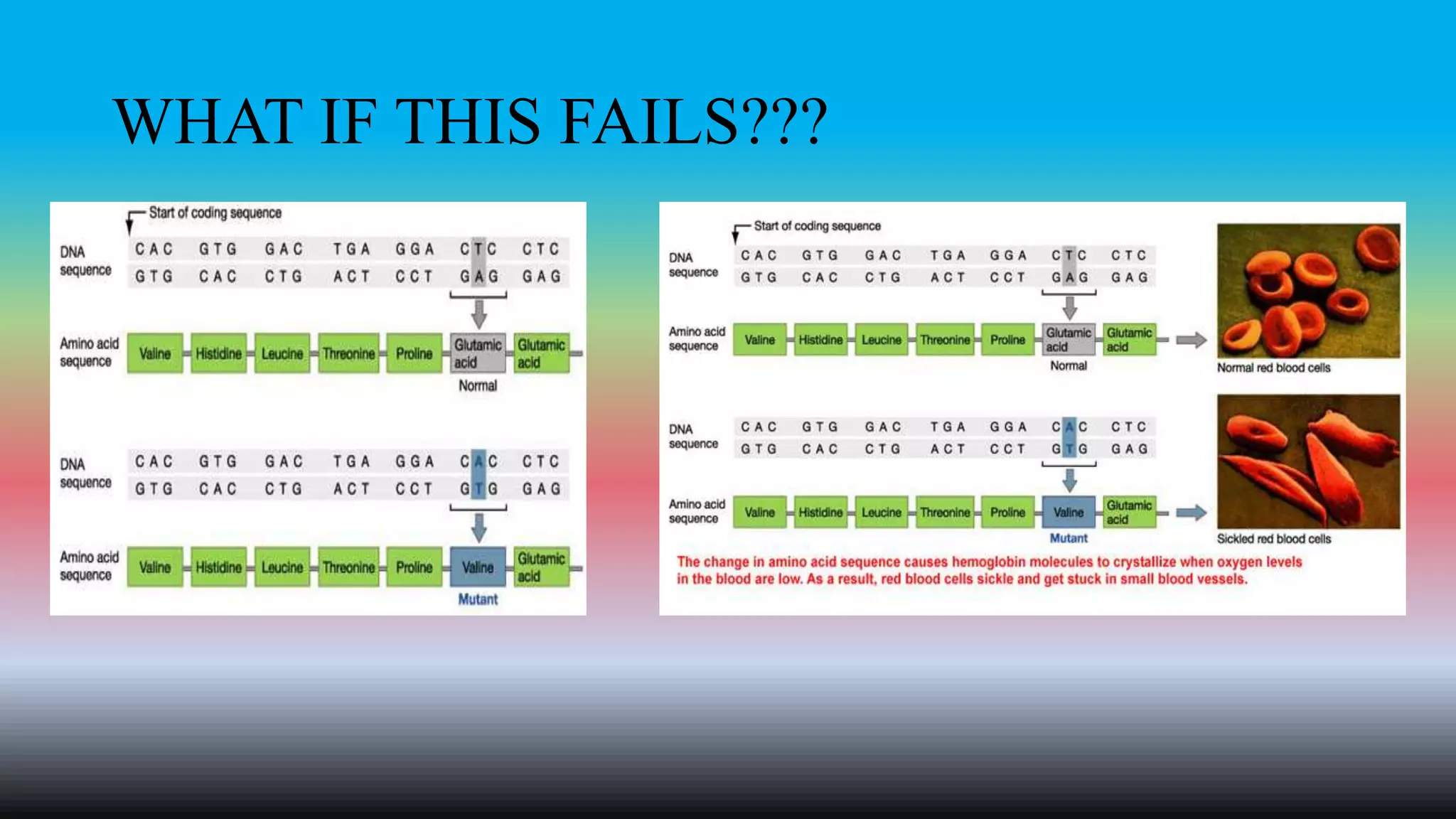
WHAT IF THIS FAILS???
TRANSLATIONAL PROOFREADING
• The term proofreading is used in genetics to refer to the error-
correcting processes, first proposed by John Hopfield and Jacques
Ninio, involved in DNA replication, immune system specificity,
enzyme-substrate recognition among many other processes that
require enhanced specificity.
• Proofreading also occurs in mRNA translation for protein synthesis.
• Mainly proceeds via three mechanisms.
[1] Involving two adjacent adenine residues in the 16SrRNA component
of the small protein subunit.
[2]Involves GTPase activity of EF-Tu
[3] Using t-RNA accommodation mechanism
• To participate successfully in the peptidyl transferase reaction, the t-
RNA must rotate into a peptidyl transferase centre of the large subunit,
this is known as ACCOMODATION.
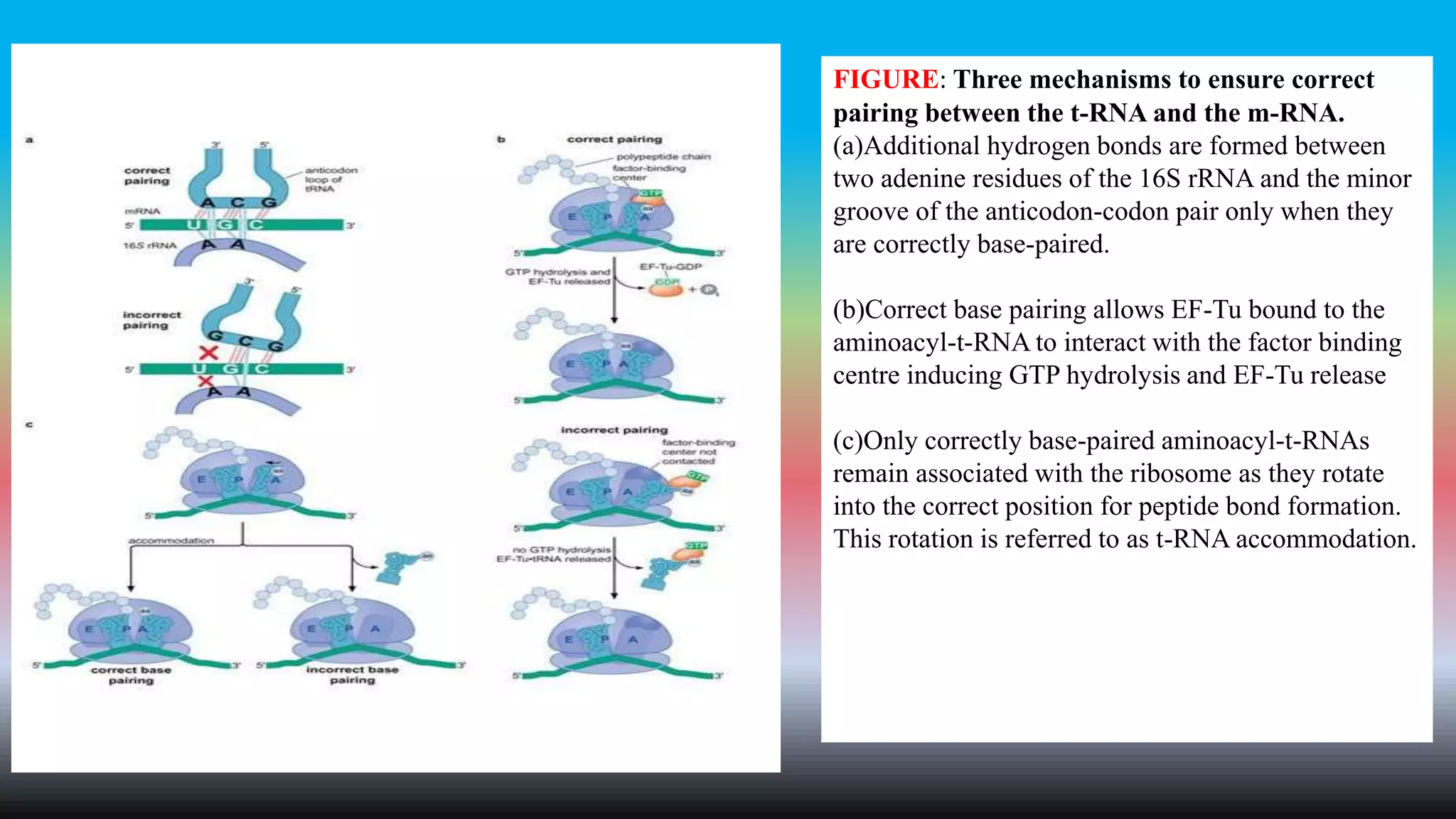
FIGURE: Three mechanisms to ensure correct
pairing between the t-RNA and the m-RNA.
(a)Additional hydrogen bonds are formed between
two adenine residues of the 16S rRNA and the minor
groove of the anticodon-codon pair only when they
are correctly base-paired.
(b)Correct base pairing allows EF-Tu bound to the
aminoacyl-t-RNA to interact with the factor binding
centre inducing GTP hydrolysis and EF-Tu release
(c)Only correctly base-paired aminoacyl-t-RNAs
remain associated with the ribosome as they rotate
into the correct position for peptide bond formation.
This rotation is referred to as t-RNA accommodation.
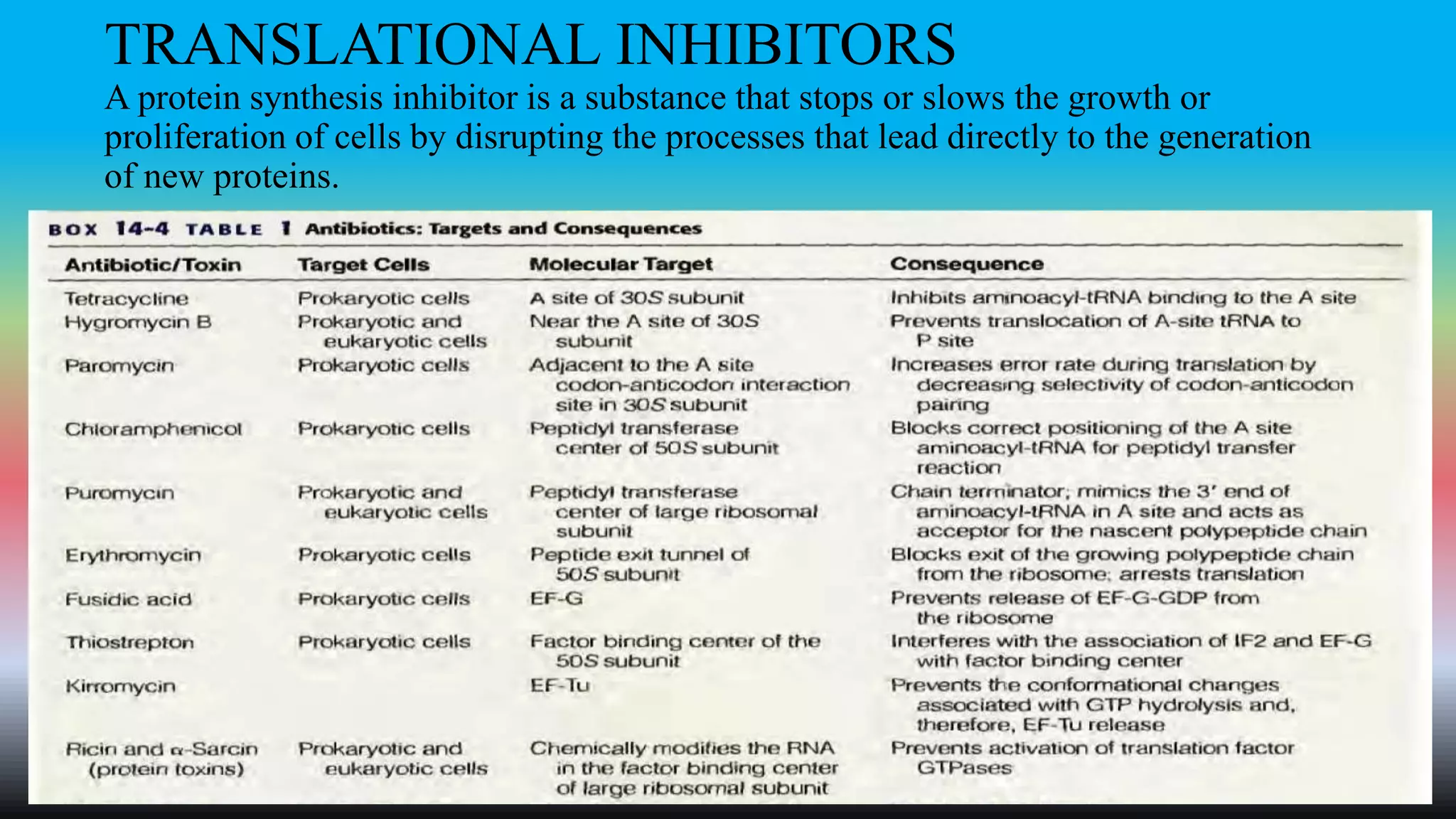
TRANSLATIONAL INHIBITORS
A protein synthesis inhibitor is a substance that stops or slows the growth or
proliferation of cells by disrupting the processes that lead directly to the generation
of new proteins.
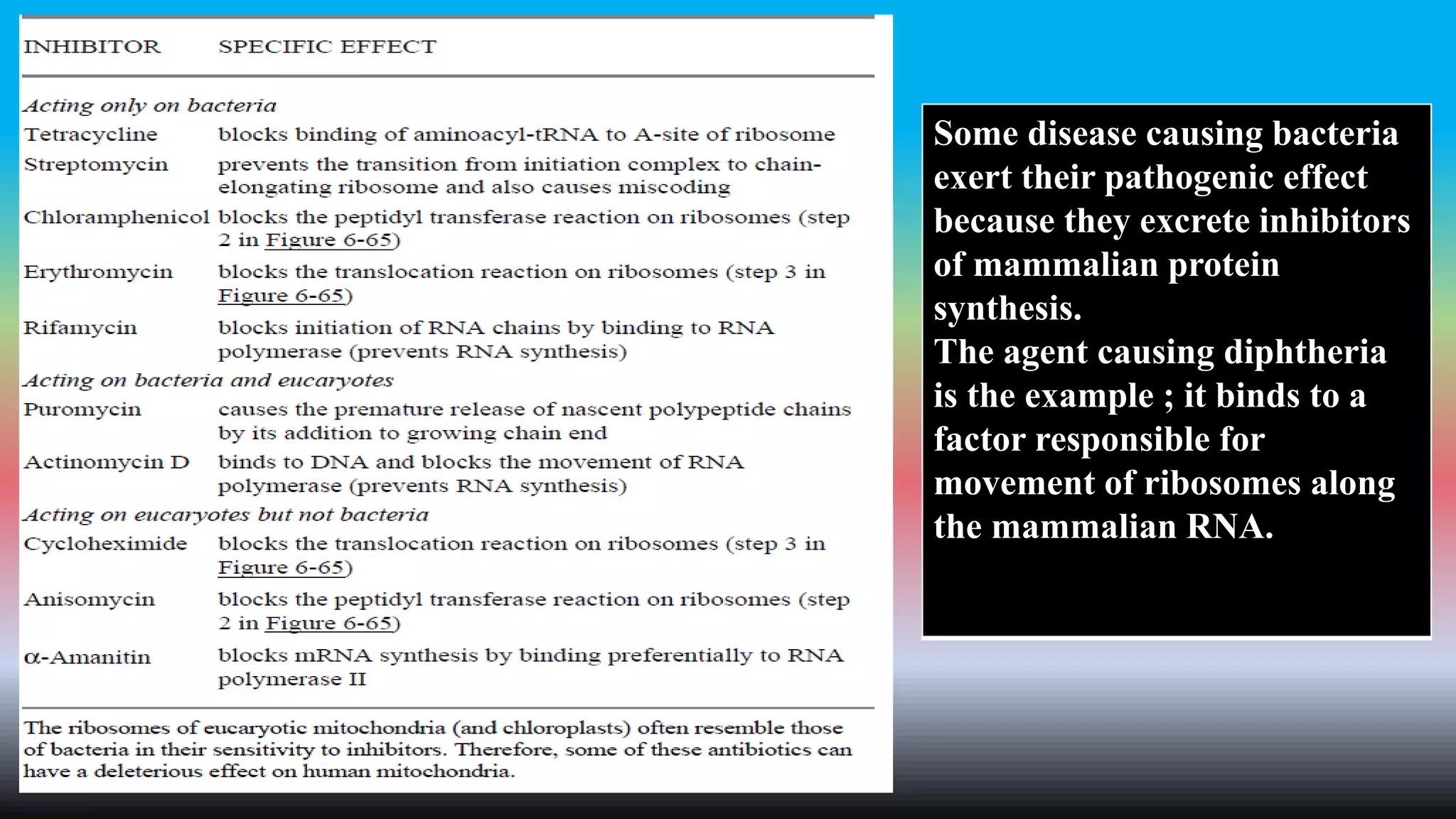
Some disease causing bacteria
exert their pathogenic effect
because they excrete inhibitors
of mammalian protein
synthesis.
The agent causing diphtheria
is the example ; it binds to a
factor responsible for
movement of ribosomes along
the mammalian RNA.
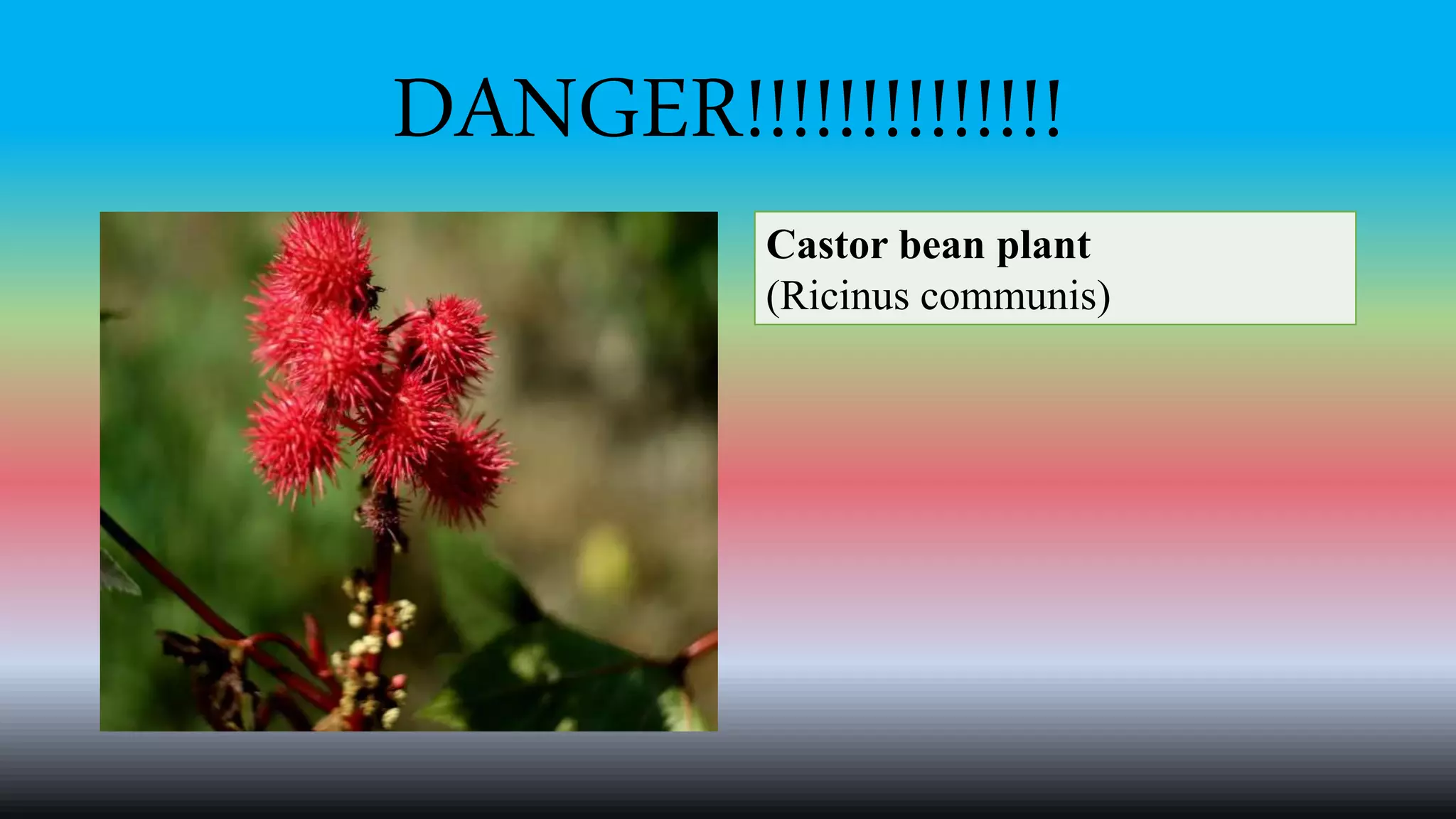
DANGER!!!!!!!!!!!!!!
Castor bean plant
(Ricinus communis)
REFERENCES:
• Molecular biology of the gene(Edition-5) by Watson, Baker, Bell,
Gann, Levine, Losick.
• Molecular biology of the cell(Edition-4) by Alberts, Johnson, Lewis,
Raff, Roberts, Walter.
• Concepts in Biochemistry (Edition-3) by Rodney Boyer.
• https://www.wikipedia.org/

Translational proofreading and translational inhibitors

  • 1.
  • 2.
    WHAT IS TRANSLATION? • In molecular biology and genetics, translation is the process in which ribosomes in the cytoplasm or ER synthesize proteins after the process of transcription of DNA to RNA in the cell's nucleus.
  • 3.
    WHAT IF THISFAILS???
  • 4.
    TRANSLATIONAL PROOFREADING • Theterm proofreading is used in genetics to refer to the error- correcting processes, first proposed by John Hopfield and Jacques Ninio, involved in DNA replication, immune system specificity, enzyme-substrate recognition among many other processes that require enhanced specificity. • Proofreading also occurs in mRNA translation for protein synthesis. • Mainly proceeds via three mechanisms.
  • 5.
    [1] Involving twoadjacent adenine residues in the 16SrRNA component of the small protein subunit.
  • 6.
  • 7.
    [3] Using t-RNAaccommodation mechanism • To participate successfully in the peptidyl transferase reaction, the t- RNA must rotate into a peptidyl transferase centre of the large subunit, this is known as ACCOMODATION.
  • 8.
    FIGURE: Three mechanismsto ensure correct pairing between the t-RNA and the m-RNA. (a)Additional hydrogen bonds are formed between two adenine residues of the 16S rRNA and the minor groove of the anticodon-codon pair only when they are correctly base-paired. (b)Correct base pairing allows EF-Tu bound to the aminoacyl-t-RNA to interact with the factor binding centre inducing GTP hydrolysis and EF-Tu release (c)Only correctly base-paired aminoacyl-t-RNAs remain associated with the ribosome as they rotate into the correct position for peptide bond formation. This rotation is referred to as t-RNA accommodation.
  • 9.
    TRANSLATIONAL INHIBITORS A proteinsynthesis inhibitor is a substance that stops or slows the growth or proliferation of cells by disrupting the processes that lead directly to the generation of new proteins.
  • 10.
    Some disease causingbacteria exert their pathogenic effect because they excrete inhibitors of mammalian protein synthesis. The agent causing diphtheria is the example ; it binds to a factor responsible for movement of ribosomes along the mammalian RNA.
  • 11.
  • 12.
    REFERENCES: • Molecular biologyof the gene(Edition-5) by Watson, Baker, Bell, Gann, Levine, Losick. • Molecular biology of the cell(Edition-4) by Alberts, Johnson, Lewis, Raff, Roberts, Walter. • Concepts in Biochemistry (Edition-3) by Rodney Boyer. • https://www.wikipedia.org/