C-13 NMR
SPECTROSCOPY
By-
Manish Sahu
M.Sc. Chemistry (Final)
Sp.- Physical Chemistry
C-13 NMR SPECTROSCOPY
 CONTENS
 INTRODUCTION
 HISTORY
 PRINCIPLE
 C-13NMR
 WHY C-13 NMR REQUIRED
 CHEMICAL SHIFT
 NUMBER OF SIGNAL
 SPIN SPIN SPLITTING OF C-13 NMR
 FACTOR AFFECTING C-13 NMR
 APPLICATION
 REFERENCES
INTRODUCTION
 Nuclear magnetic resonance Spectroscopy is a
powerful analytical technique used to charecterise
organic molecule by identifying Carbon-Hydrogen
frameworks with in molecule.
 Two types of NMR Spectroscopy are used to
charecterise organic structure :-
 H-1 NMR :-To determine the type and number of H
atoms in a molecule.
 C-13 NMR:- Used to determine type of carbon atoms in
the molecule.
HISTORY
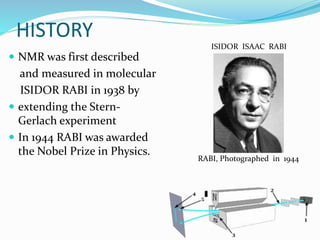
 NMR was first described
and measured in molecular
ISIDOR RABI in 1938 by
 extending the Stern-
Gerlach experiment
 In 1944 RABI was awarded
the Nobel Prize in Physics.
ISIDOR ISAAC RABI
RABI, Photographed in 1944
PRINCIPLE
 Nuclear magnetic resonance concern the magnetic
properties of certain atomic nuclei.
 It concern the atom having spin quantum number.
 C-12 nucleus is not magnetic active because ;
C-12:- Proton 6 ,Neutron 6
Nuclear spin (I)=0
C-13:- Proton 6,Neutron 7
Nuclear spin (I)=1/2
 Relatively new technique as compared to proton NMR.
C-13 NMR
 C-12 have no magnetic spin and produce no NMR
signal.
 C-13 have magnetic spin(I)=1/2
 C-13 account for only 1.1%of naturally occurring
carbon.
No coupling between C-13 and C.
C-13 have weak signal.
C-13 have strong coupling with H.
C-13 have weak coupling with C.
C-13 NMR
 C-13 has only about 1.1% natural abundance (of carbon
atoms).
 C-12 does not exhibit NMR behavior.
 As a result, C is about 400 times less sensitive than H
nucleus to the NMR phenomena.
 Chemical shift range is normally 0 to 220ppm.
 Normal C-13 Spectra are “broadband, proton
decoupled”so the peaks show as single lines.
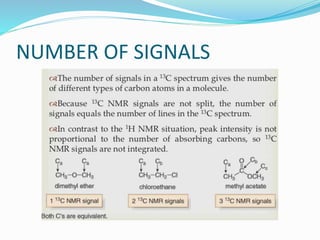
 Number of peak indicates the number of type of
Carbon atoms.
WHY C-13 NMR REQUIRED
 Carbon NMR can used to determine the number of
non-equivalent carbon and no identify the types of
carbon atoms (methyl,methylene,aromatic ,carbonyl
)which may present in compound.
 C13 Signal are spread over a much wider range than
proton signal making it easier to identify and counts
individual nuclei.
CHEMICAL SHIFT
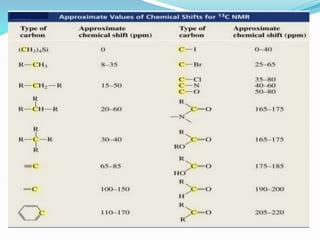
 In contrast to the small range of chemical shift in H-1
NMR (0-10ppm), C-13 NMR absorption
occurs over a much broader range (0-220ppm).
 The chemical shift reference standard for C- 13 is the
carbon in TMS whose chemical shift is considered top
be 0.0ppm.
NUMBER OF SIGNALS
SPIN SPIN SPLITTING OF C-13 NMR
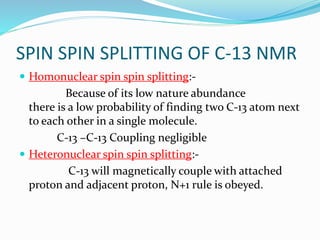
 Homonuclear spin spin splitting:-
Because of its low nature abundance
there is a low probability of finding two C-13 atom next
to each other in a single molecule.
C-13 –C-13 Coupling negligible
 Heteronuclear spin spin splitting:-
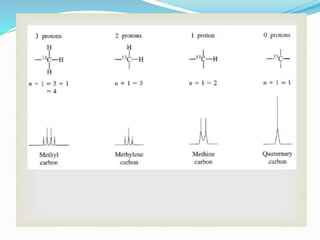
C-13 will magnetically couple with attached
proton and adjacent proton, N+1 rule is obeyed.
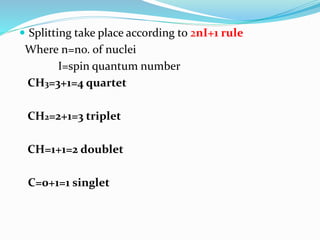
 Splitting take place according to 2nI+1 rule
Where n=no. of nuclei
I=spin quantum number
CH3=3+1=4 quartet
CH2=2+1=3 triplet
CH=1+1=2 doublet
C=0+1=1 singlet
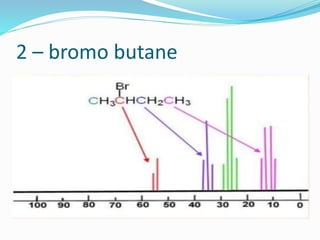
2 – bromo butane
FACTOR AFFECTING OF C-13 NMR
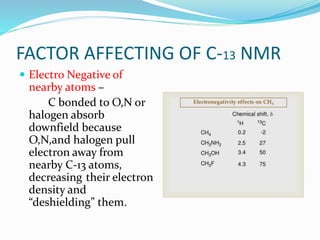
 Electro Negative of
nearby atoms –
C bonded to O,N or
halogen absorb
downfield because
O,N,and halogen pull
electron away from
nearby C-13 atoms,
decreasing their electron
density and
“deshielding” them.
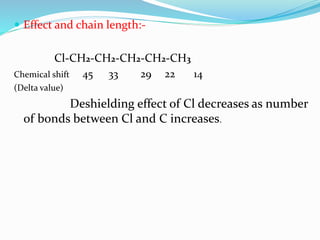
 Effect and chain length:-
Cl-CH2-CH2-CH2-CH2-CH3
Chemical shift 45 33 29 22 14
(Delta value)
Deshielding effect of Cl decreases as number
of bonds between Cl and C increases.
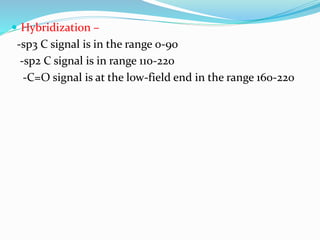
 Hybridization –
-sp3 C signal is in the range 0-90
-sp2 C signal is in range 110-220
-C=O signal is at the low-field end in the range 160-220
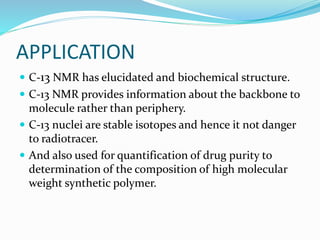
APPLICATION
 C-13 NMR has elucidated and biochemical structure.
 C-13 NMR provides information about the backbone to
molecule rather than periphery.
 C-13 nuclei are stable isotopes and hence it not danger
to radiotracer.
 And also used for quantification of drug purity to
determination of the composition of high molecular
weight synthetic polymer.
REFERENCES
 McCash M. Elain and Banwell N.Colen “fundamental
of molecular spectroscopy,”4th edittion,
TataMcGrawHill publishing company LTD.New
Delhi.page no-234-240.
 Chatwal R. Gurdeep and Anand K. Sham,”Intrumental
method of chemical analysis,”Himalaya publishing
house mumbai, Delhi. page no. 2.231.
 H. Kour by Spectroscopy ,12th eddi. Pragati
publication,page no. 415-424.
C-13 NMR Spectroscopy

C-13 NMR Spectroscopy

  • 1.
    C-13 NMR SPECTROSCOPY By- Manish Sahu M.Sc.Chemistry (Final) Sp.- Physical Chemistry
  • 2.
    C-13 NMR SPECTROSCOPY CONTENS  INTRODUCTION  HISTORY  PRINCIPLE  C-13NMR  WHY C-13 NMR REQUIRED  CHEMICAL SHIFT  NUMBER OF SIGNAL  SPIN SPIN SPLITTING OF C-13 NMR  FACTOR AFFECTING C-13 NMR  APPLICATION  REFERENCES
  • 3.
    INTRODUCTION  Nuclear magneticresonance Spectroscopy is a powerful analytical technique used to charecterise organic molecule by identifying Carbon-Hydrogen frameworks with in molecule.  Two types of NMR Spectroscopy are used to charecterise organic structure :-  H-1 NMR :-To determine the type and number of H atoms in a molecule.  C-13 NMR:- Used to determine type of carbon atoms in the molecule.
  • 4.
    HISTORY  NMR wasfirst described and measured in molecular ISIDOR RABI in 1938 by  extending the Stern- Gerlach experiment  In 1944 RABI was awarded the Nobel Prize in Physics. ISIDOR ISAAC RABI RABI, Photographed in 1944
  • 5.
    PRINCIPLE  Nuclear magneticresonance concern the magnetic properties of certain atomic nuclei.  It concern the atom having spin quantum number.  C-12 nucleus is not magnetic active because ; C-12:- Proton 6 ,Neutron 6 Nuclear spin (I)=0 C-13:- Proton 6,Neutron 7 Nuclear spin (I)=1/2  Relatively new technique as compared to proton NMR.
  • 6.
    C-13 NMR  C-12have no magnetic spin and produce no NMR signal.  C-13 have magnetic spin(I)=1/2  C-13 account for only 1.1%of naturally occurring carbon. No coupling between C-13 and C. C-13 have weak signal. C-13 have strong coupling with H. C-13 have weak coupling with C.
  • 7.
    C-13 NMR  C-13has only about 1.1% natural abundance (of carbon atoms).  C-12 does not exhibit NMR behavior.  As a result, C is about 400 times less sensitive than H nucleus to the NMR phenomena.  Chemical shift range is normally 0 to 220ppm.  Normal C-13 Spectra are “broadband, proton decoupled”so the peaks show as single lines.  Number of peak indicates the number of type of Carbon atoms.
  • 8.
    WHY C-13 NMRREQUIRED  Carbon NMR can used to determine the number of non-equivalent carbon and no identify the types of carbon atoms (methyl,methylene,aromatic ,carbonyl )which may present in compound.  C13 Signal are spread over a much wider range than proton signal making it easier to identify and counts individual nuclei.
  • 9.
    CHEMICAL SHIFT  Incontrast to the small range of chemical shift in H-1 NMR (0-10ppm), C-13 NMR absorption occurs over a much broader range (0-220ppm).  The chemical shift reference standard for C- 13 is the carbon in TMS whose chemical shift is considered top be 0.0ppm.
  • 11.
  • 12.
    SPIN SPIN SPLITTINGOF C-13 NMR  Homonuclear spin spin splitting:- Because of its low nature abundance there is a low probability of finding two C-13 atom next to each other in a single molecule. C-13 –C-13 Coupling negligible  Heteronuclear spin spin splitting:- C-13 will magnetically couple with attached proton and adjacent proton, N+1 rule is obeyed.
  • 13.
     Splitting takeplace according to 2nI+1 rule Where n=no. of nuclei I=spin quantum number CH3=3+1=4 quartet CH2=2+1=3 triplet CH=1+1=2 doublet C=0+1=1 singlet
  • 15.
  • 16.
    FACTOR AFFECTING OFC-13 NMR  Electro Negative of nearby atoms – C bonded to O,N or halogen absorb downfield because O,N,and halogen pull electron away from nearby C-13 atoms, decreasing their electron density and “deshielding” them.
  • 17.
     Effect andchain length:- Cl-CH2-CH2-CH2-CH2-CH3 Chemical shift 45 33 29 22 14 (Delta value) Deshielding effect of Cl decreases as number of bonds between Cl and C increases.
  • 18.
     Hybridization – -sp3C signal is in the range 0-90 -sp2 C signal is in range 110-220 -C=O signal is at the low-field end in the range 160-220
  • 19.
    APPLICATION  C-13 NMRhas elucidated and biochemical structure.  C-13 NMR provides information about the backbone to molecule rather than periphery.  C-13 nuclei are stable isotopes and hence it not danger to radiotracer.  And also used for quantification of drug purity to determination of the composition of high molecular weight synthetic polymer.
  • 20.
    REFERENCES  McCash M.Elain and Banwell N.Colen “fundamental of molecular spectroscopy,”4th edittion, TataMcGrawHill publishing company LTD.New Delhi.page no-234-240.  Chatwal R. Gurdeep and Anand K. Sham,”Intrumental method of chemical analysis,”Himalaya publishing house mumbai, Delhi. page no. 2.231.  H. Kour by Spectroscopy ,12th eddi. Pragati publication,page no. 415-424.