Seminar on c-13 nmr Spectroscopy
Presented by ,
NIVEDITHA G
1st M.Pharm
Dept. Of Pharmaceutics
NARGUND COLLEGE OF PHARMACY
INTRODUCTION
 Carbon-13 (13C) is a natural and stable
isotope of carbon.
 12C is the most abundant isotope of carbon
and is inactive since it has nuclear spin of
Zero.
 13C however has odd mass and is active with
nuclear spin ,with I=½
 In general any nucleus with a nuclear spin
½ will give rise to NMR signal provided the
appropriate magnetic field and radio
frequency radiations are applied.
2
DIFFICULTIES ENCOUNTERED IN 13C NMR
1.Natural Abundance:-
 The natural abundance of 13C is only 1.1%
than that of 12C.
 As a result magnetic resonance of 13C is
much weaker i.e sensitivity is only 1.6% than
that of 1H nuclei which is not adequate for its
study.
2.Magnetic moment and Gyro magnetic ratio:-
 The magnetic moment of 13C is much weaker
due to low natural abundance of 13C nucleus.
 The Gyro magnetic ratio of 13C is 1.4043 as
compared to 5.5854 of a proton 1H .
3
CHARACTERISTIC FEATURES OF 13C NMR
 The Chemical shift of CMR is wider (d is 0-
240 relative to TMS) in comparison to PMR (d
is 0-14 relative to TMS) .
 13C -13C coupling is negligible because of low
natural abundance of 13C in the compound.
The proton- coupled spectra, the signal for
each carbon of magnetically equivalent is
split by the proton directly to that carbon
and the n+1 rule is followed.
4
13C- 13C COUPLING
 The concentration of carbon-13 in a
compound is very small.
 Therefore chances of having more than one
carbon-13 nucleus in the same molecule are
small.
 Hence homonuclear coupling is rarely
observed.
 Therefore 13C- 13C coupling is ignored.
5
PROTON COUPLED 13C SPECTRA
(13C-1H COUPLING)
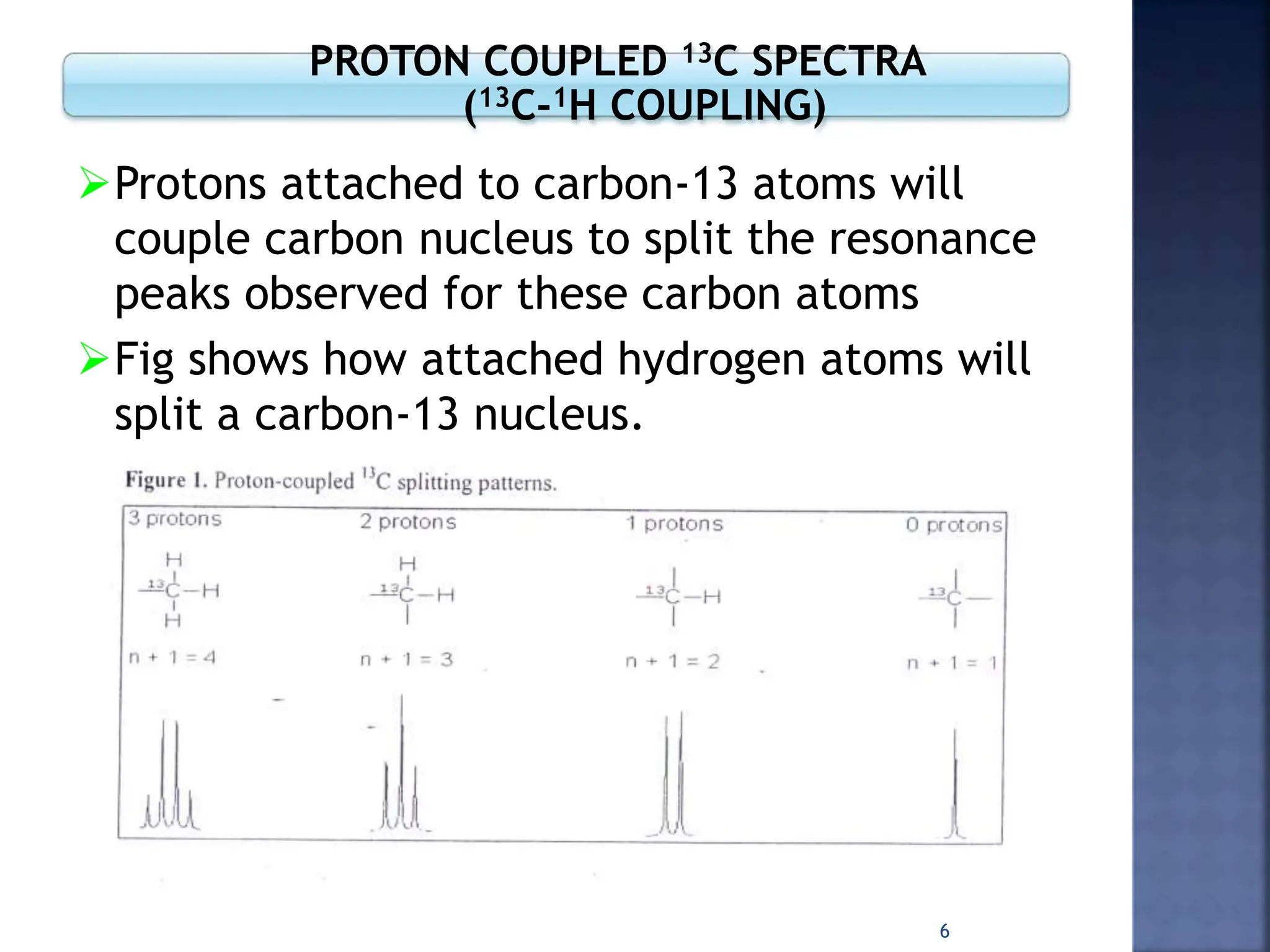
Protons attached to carbon-13 atoms will
couple carbon nucleus to split the resonance
peaks observed for these carbon atoms
Fig shows how attached hydrogen atoms will
split a carbon-13 nucleus.
6
SPIN-SPIN COUPLING OR SPLITTING
 The magnetic interaction that occurs between 2
or more proton, most often through the
intervening electrons there by result in splitting
of spectral lines is called spin coupling.
 It is related to number of possible spin
orientation of neighboring protons.
 The spacing of adjacent peaks in the multiplets
is a direct measure of spin coupling of protons
and is known as spin coupling constant,
designated as ‘J’.
7
 If the NMR spectrum is very complex and
difficult to interpret by spin coupling the
simplification may be achieved by two ways:-
Use of higher magnetic field with high
homogeneity
Spin-spin decoupling
1.The chemical shifts are field dependent,
where as coupling constants are not
independent of field, therefore by use of
higher magnetic field we may simplify the
spectra.
8
SPIN-SPIN DECOUPLING
 It is a technique for irradiating a nucleus with a
strong radiofrequency signal at its resonance
frequency while scanning other nuclei to detect
which ones are affected by decoupling from
irradiated nucleus.
 The process of removing the spin-spin splitting
between spins of a proton is called decoupling.
 Decoupling of a particular nucleus means
eliminating magnetic effect of that nucleus from
reminder of the molecule.
9
DECOUPLING
 The decoupling simplifies 13C spectra by
removing the multiplet.
Principle:-
In addition to basic NMR spectrometer it
requires tunable radio frequency source to
irradiate a particular nucleus at a desired
frequency, while scanning nucleus.
It is also known as double resonance as
sample is irradiated by two frequencies:-
 Observation frequency
 Decoupling frequency
10
TYPES OF DECOUPLING
 Homonuclear decoupling
 Heteronuclear decoupling
Homonuclear decoupling :- It is a selective
decoupling where the type of nucleus being
decoupled is same as that being observed.
Ex:- Decoupling one proton while observing other
proton.1H[1H]
Heteronuclear decoupling:-It is occurs when
decoupled nuclei are different from the observed
one.
Ex:- Decoupling of 1H while observing 13C. 13C[1H]
11
Heteronuclear decoupling is of different types:-
 Proton decoupling or Noise decoupling
 Broad band decoupling
 Off resonance decoupling.
Proton decoupling or Noise decoupling:-
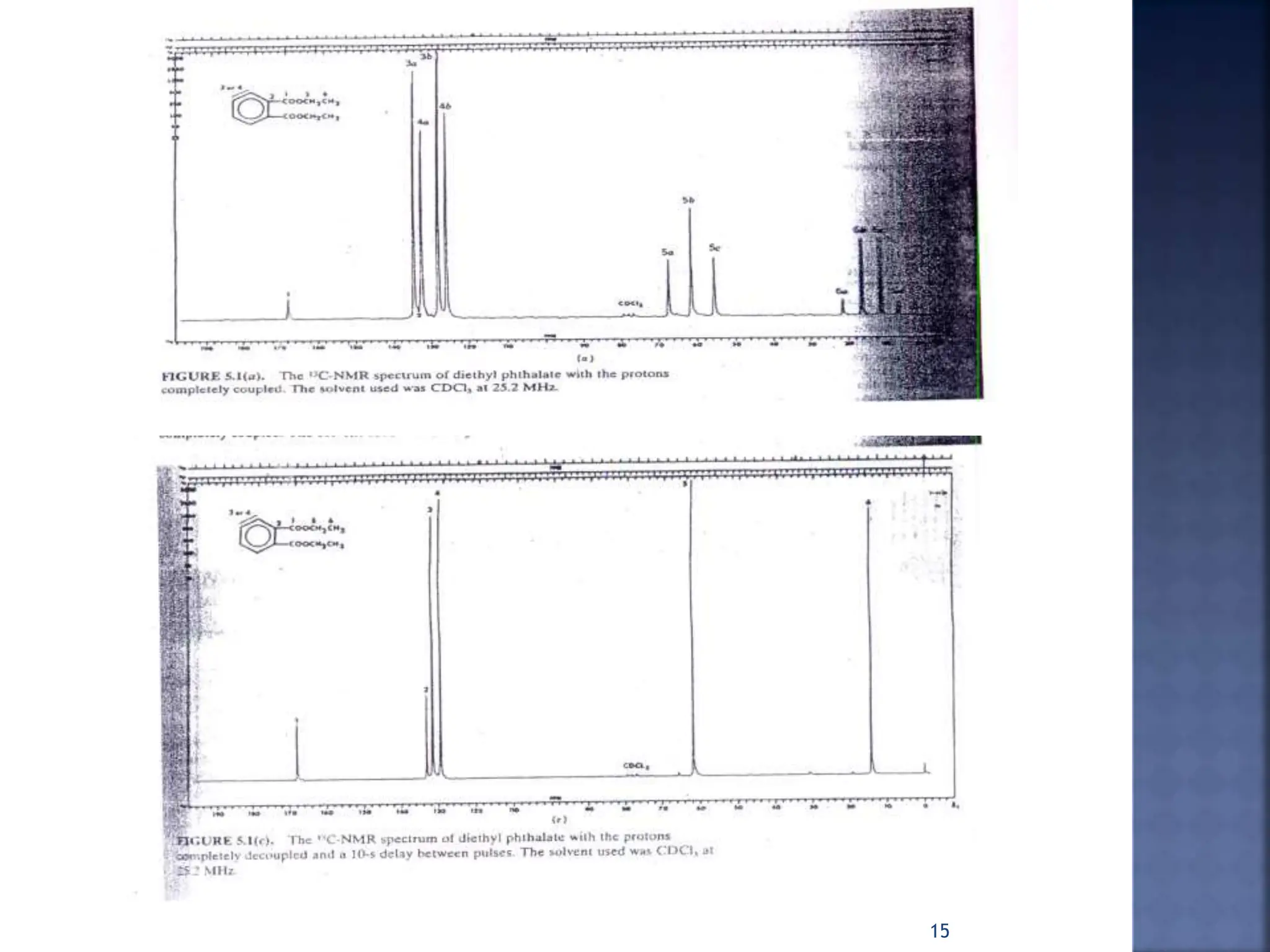
The coupling from 13C-1H makes the CMR spectrum very
complex.The coupling constant for 13C-1H is very large,
hence there is an overlap of multiplets.
12
Principle
The spectra is recorded by irradiating the
sample at two frequencies:-
 First radiofrequency is used to affect
carbon magnetic resonance while
simultaneous exposure.
 Second signal causes all the protons in
resonance at the same time.
 As a result there is no coupling and each
proton appears as a single unsplit peak at he
position corresponding to its chemical shifts.
13
SPECTRA IS OBTAINED AS FOLLOWS
Irradiate the sample at two frequencies of proton
resonance.
First to affect proton magnetic resonance i.e 80
MHz
Second to resonance all proton at the same time.
13C-1H coupling effect in spectrum can be
eliminated by decoupling the hydrogen nuclei .
Decoupling is carried out by applying the
decoupling signal .
This has all the H+ frequencies and is therefore a
form of radiofrequency noise.
Thus the obtained spectrum is proton or noise
decoupled.
Ex:- Proton decoupled spectra of Diethyl phthalate
14
15
BROAD BAND DECOUPLING
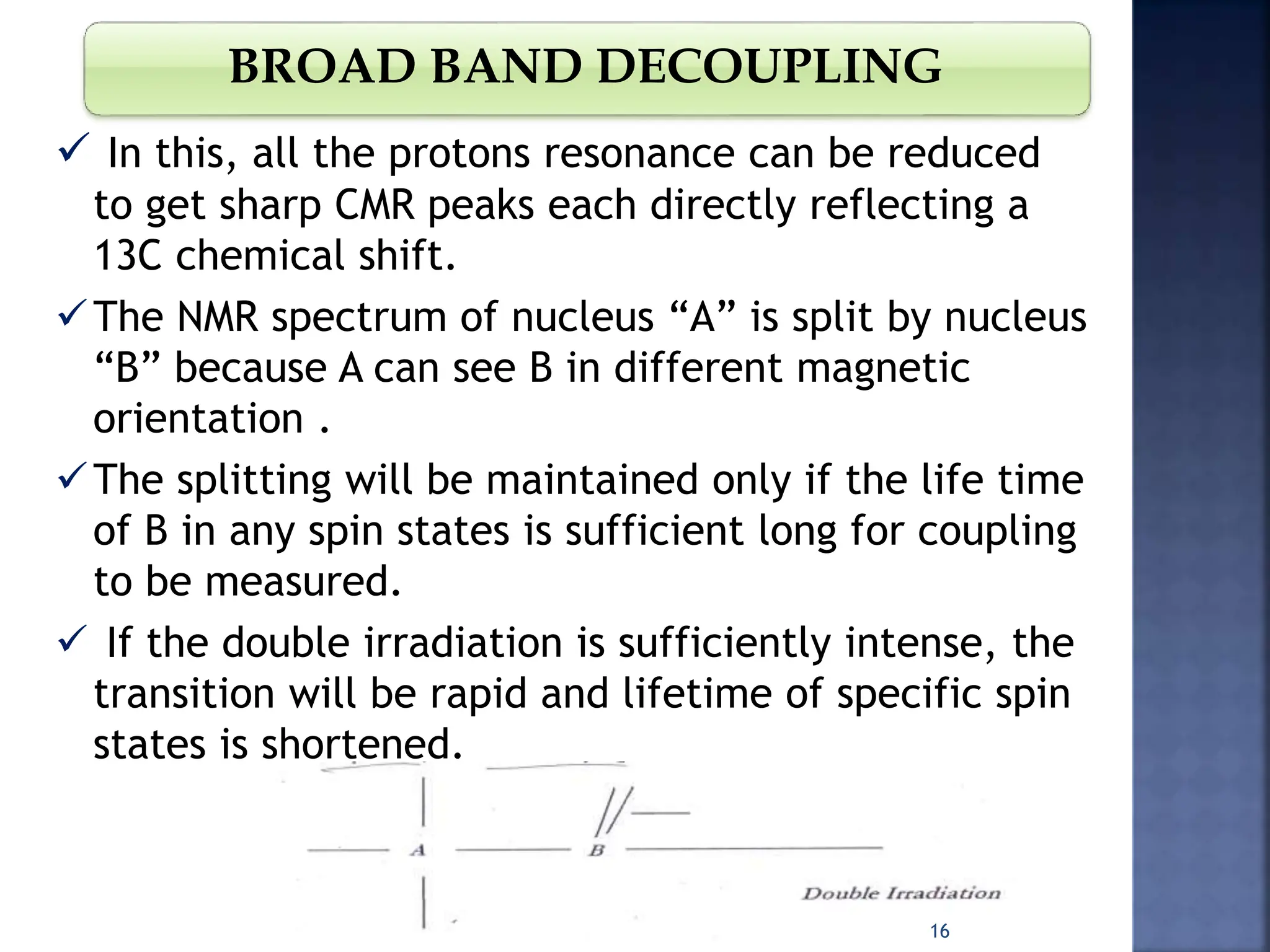
 In this, all the protons resonance can be reduced
to get sharp CMR peaks each directly reflecting a
13C chemical shift.
The NMR spectrum of nucleus “A” is split by nucleus
“B” because A can see B in different magnetic
orientation .
The splitting will be maintained only if the life time
of B in any spin states is sufficient long for coupling
to be measured.
 If the double irradiation is sufficiently intense, the
transition will be rapid and lifetime of specific spin
states is shortened.
16
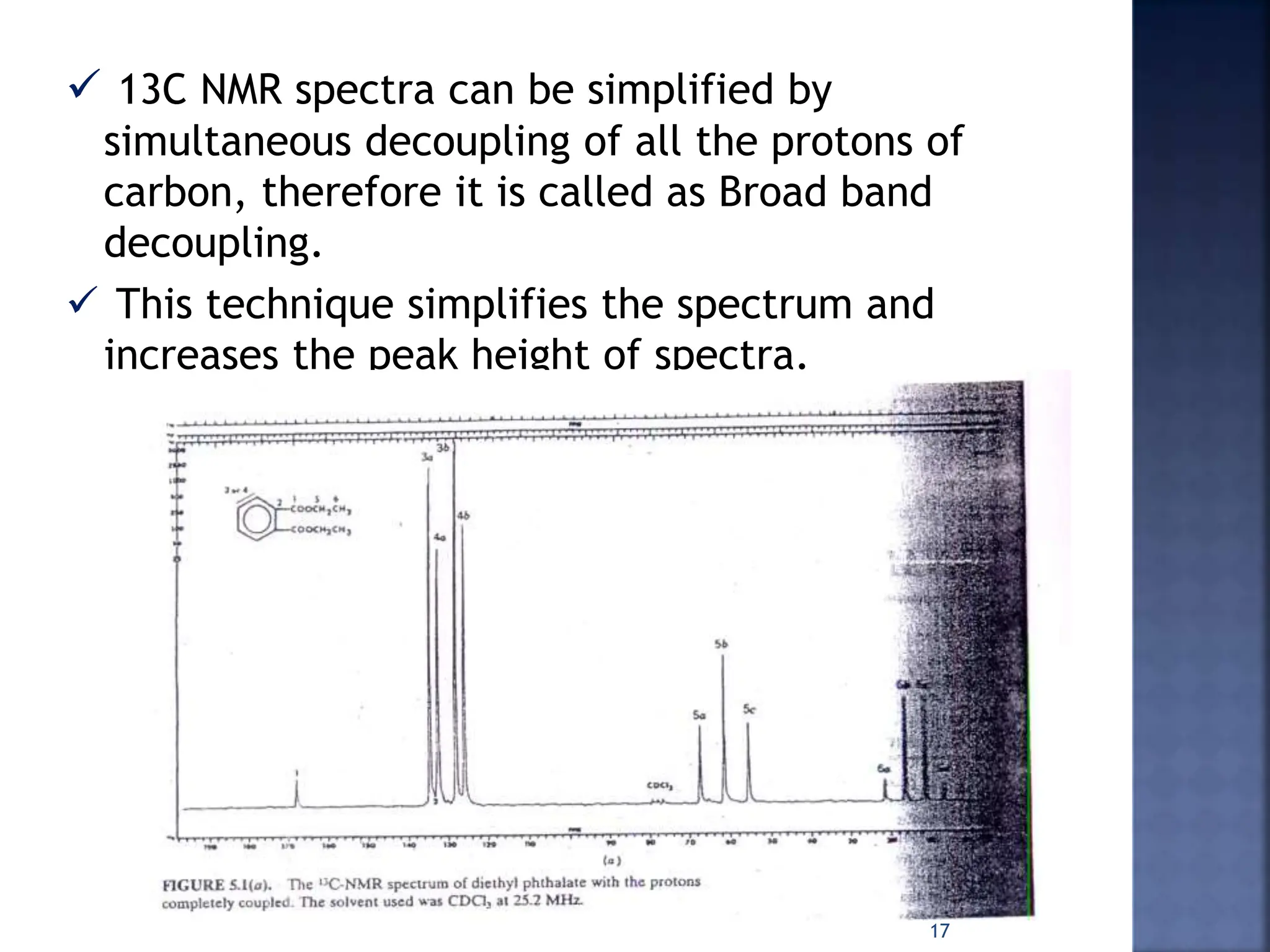
 13C NMR spectra can be simplified by
simultaneous decoupling of all the protons of
carbon, therefore it is called as Broad band
decoupling.
 This technique simplifies the spectrum and
increases the peak height of spectra.
17
OFF RESONANCE DECOUPLING
 The technique that is used to obtain typical proton
decoupled spectra that all peak becomes singlets.
 It is achieved by off setting the high power proton
decoupler by:-
 About 1000-2000Hz upfield or 2000-3000Hz
downfield from the frequency of TMS without using
noise generator.
 In this, sample is irradiated at a frequency close to
resonance frequency of protons.
 Consequently, the multiplets become narrow and not
removed altogether as in fully decouple spectra.
18
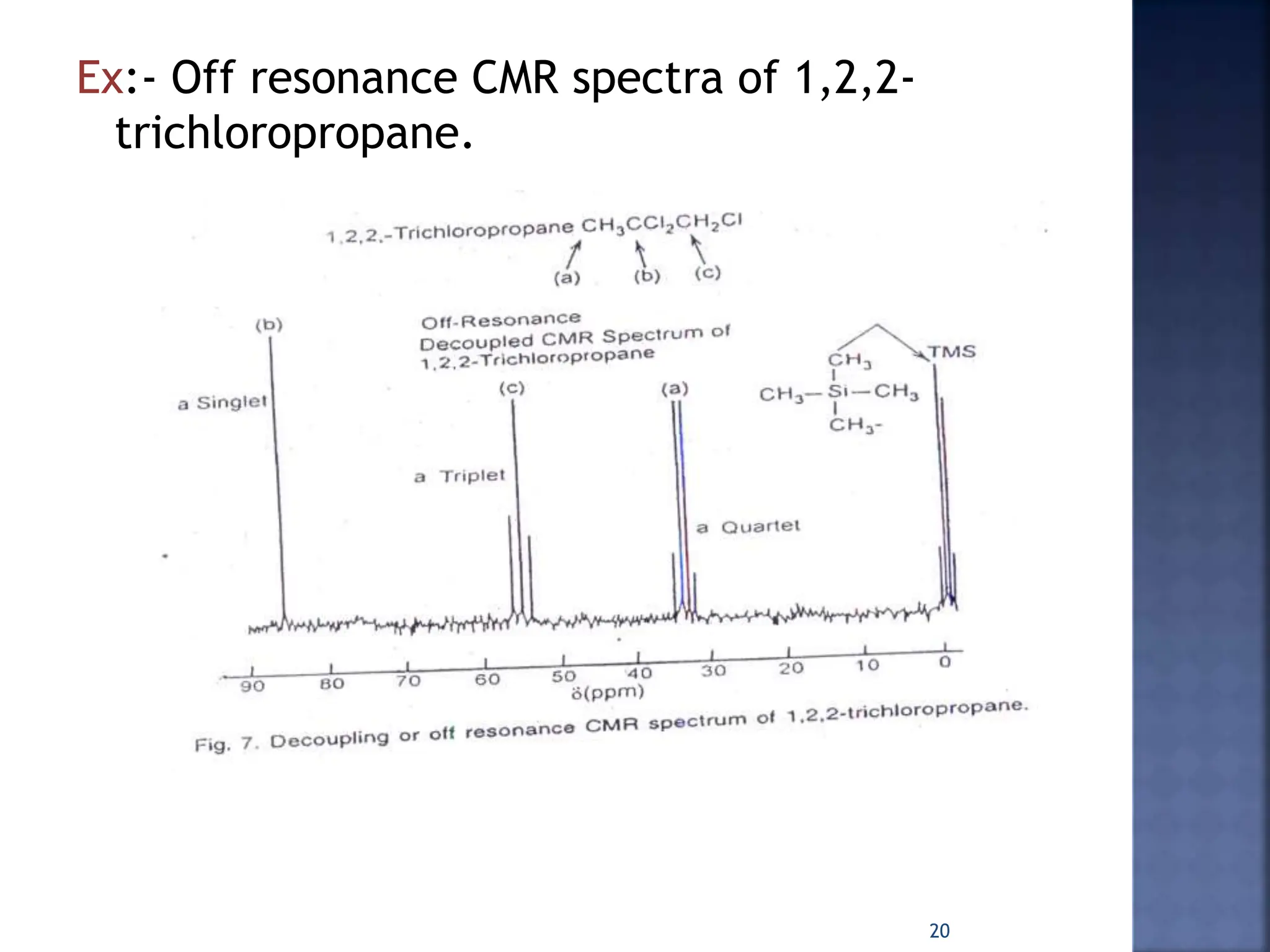
 In this methyl carbon atoms appear as
quartets, methylene as triplets, methines as
doublets and quarternary as singlet.
 In conclusion, off resonance decoupling
simplifies the spectrum by permitting some
splitting information.
19
Ex:- Off resonance CMR spectra of 1,2,2-
trichloropropane.
20
RELAXATION PHENOMENON
 The transitions occurring from one spin state
to another is directly proportional to state
from which transition takes place.
 However while lower energy state is more
populated than upper energy state, upward
transition predominates slightly.
 Hence absorption of energy from radiation
beam takes place.
21
The excited nucleus can undergo energy loss
by transition from high energy state to low
energy state is called Relaxation.
 The energy difference E can be reemitted by
nucleus as radio frequency radiation.
 There are 2 types of relaxation process:-
1. Spin-Lattice relaxation
2. Spin-Spin relaxation
22
CHEMICAL SHIFTS IN 13C NMR
Chemical shifts of 13C nuclei are expressed in
units of parts per million(ppm).
The range of 13C chemical shifts is much greater
200ppm compared to 20ppm range of proton
chemical shifts.
Carbons of the methyl groups of TMS are used for
reference.
Because of wide spread of signals it is unlikely
that two 13C nuclei will have identical chemical
shifts.
23
PROPERTIES
 13C spectra has long relaxation times means
no integrations.
 Normal 13C spectra are broadband, proton
decoupled, so the peaks show as single lines.
 Number of peaks indicates the number of
types of carbon.
 Decoupling simplifies the spectrum and
increases peak height.
24
The chemical shift correlation chart is divided
into 4 sections:-
 Saturated carbon atoms with hydrogen appears
at highest field(upfield) nearest to TMS (8-
60ppm) .
 Second chart demonstrates the effect of
electronegative atoms (40-80ppm).
 Third includes alkenes and aromatics ring
carbon atoms (100-175ppm).
 Fourth contains carbonyl carbons appearing at
lowest field (downfield) values (155-220ppm).
25
 Elementary Organic Spectroscopy by
Y.R.Sharma.
 Internet source
 Instrumental methods of chemical analysis by Dr
B.K.Sharma.
26
27

Nuclear magnetic resonance effect, introduction, principles, applications

  • 1.
    Seminar on c-13nmr Spectroscopy Presented by , NIVEDITHA G 1st M.Pharm Dept. Of Pharmaceutics NARGUND COLLEGE OF PHARMACY
  • 2.
    INTRODUCTION  Carbon-13 (13C)is a natural and stable isotope of carbon.  12C is the most abundant isotope of carbon and is inactive since it has nuclear spin of Zero.  13C however has odd mass and is active with nuclear spin ,with I=½  In general any nucleus with a nuclear spin ½ will give rise to NMR signal provided the appropriate magnetic field and radio frequency radiations are applied. 2
  • 3.
    DIFFICULTIES ENCOUNTERED IN13C NMR 1.Natural Abundance:-  The natural abundance of 13C is only 1.1% than that of 12C.  As a result magnetic resonance of 13C is much weaker i.e sensitivity is only 1.6% than that of 1H nuclei which is not adequate for its study. 2.Magnetic moment and Gyro magnetic ratio:-  The magnetic moment of 13C is much weaker due to low natural abundance of 13C nucleus.  The Gyro magnetic ratio of 13C is 1.4043 as compared to 5.5854 of a proton 1H . 3
  • 4.
    CHARACTERISTIC FEATURES OF13C NMR  The Chemical shift of CMR is wider (d is 0- 240 relative to TMS) in comparison to PMR (d is 0-14 relative to TMS) .  13C -13C coupling is negligible because of low natural abundance of 13C in the compound. The proton- coupled spectra, the signal for each carbon of magnetically equivalent is split by the proton directly to that carbon and the n+1 rule is followed. 4
  • 5.
    13C- 13C COUPLING The concentration of carbon-13 in a compound is very small.  Therefore chances of having more than one carbon-13 nucleus in the same molecule are small.  Hence homonuclear coupling is rarely observed.  Therefore 13C- 13C coupling is ignored. 5
  • 6.
    PROTON COUPLED 13CSPECTRA (13C-1H COUPLING) Protons attached to carbon-13 atoms will couple carbon nucleus to split the resonance peaks observed for these carbon atoms Fig shows how attached hydrogen atoms will split a carbon-13 nucleus. 6
  • 7.
    SPIN-SPIN COUPLING ORSPLITTING  The magnetic interaction that occurs between 2 or more proton, most often through the intervening electrons there by result in splitting of spectral lines is called spin coupling.  It is related to number of possible spin orientation of neighboring protons.  The spacing of adjacent peaks in the multiplets is a direct measure of spin coupling of protons and is known as spin coupling constant, designated as ‘J’. 7
  • 8.
     If theNMR spectrum is very complex and difficult to interpret by spin coupling the simplification may be achieved by two ways:- Use of higher magnetic field with high homogeneity Spin-spin decoupling 1.The chemical shifts are field dependent, where as coupling constants are not independent of field, therefore by use of higher magnetic field we may simplify the spectra. 8
  • 9.
    SPIN-SPIN DECOUPLING  Itis a technique for irradiating a nucleus with a strong radiofrequency signal at its resonance frequency while scanning other nuclei to detect which ones are affected by decoupling from irradiated nucleus.  The process of removing the spin-spin splitting between spins of a proton is called decoupling.  Decoupling of a particular nucleus means eliminating magnetic effect of that nucleus from reminder of the molecule. 9
  • 10.
    DECOUPLING  The decouplingsimplifies 13C spectra by removing the multiplet. Principle:- In addition to basic NMR spectrometer it requires tunable radio frequency source to irradiate a particular nucleus at a desired frequency, while scanning nucleus. It is also known as double resonance as sample is irradiated by two frequencies:-  Observation frequency  Decoupling frequency 10
  • 11.
    TYPES OF DECOUPLING Homonuclear decoupling  Heteronuclear decoupling Homonuclear decoupling :- It is a selective decoupling where the type of nucleus being decoupled is same as that being observed. Ex:- Decoupling one proton while observing other proton.1H[1H] Heteronuclear decoupling:-It is occurs when decoupled nuclei are different from the observed one. Ex:- Decoupling of 1H while observing 13C. 13C[1H] 11
  • 12.
    Heteronuclear decoupling isof different types:-  Proton decoupling or Noise decoupling  Broad band decoupling  Off resonance decoupling. Proton decoupling or Noise decoupling:- The coupling from 13C-1H makes the CMR spectrum very complex.The coupling constant for 13C-1H is very large, hence there is an overlap of multiplets. 12
  • 13.
    Principle The spectra isrecorded by irradiating the sample at two frequencies:-  First radiofrequency is used to affect carbon magnetic resonance while simultaneous exposure.  Second signal causes all the protons in resonance at the same time.  As a result there is no coupling and each proton appears as a single unsplit peak at he position corresponding to its chemical shifts. 13
  • 14.
    SPECTRA IS OBTAINEDAS FOLLOWS Irradiate the sample at two frequencies of proton resonance. First to affect proton magnetic resonance i.e 80 MHz Second to resonance all proton at the same time. 13C-1H coupling effect in spectrum can be eliminated by decoupling the hydrogen nuclei . Decoupling is carried out by applying the decoupling signal . This has all the H+ frequencies and is therefore a form of radiofrequency noise. Thus the obtained spectrum is proton or noise decoupled. Ex:- Proton decoupled spectra of Diethyl phthalate 14
  • 15.
  • 16.
    BROAD BAND DECOUPLING In this, all the protons resonance can be reduced to get sharp CMR peaks each directly reflecting a 13C chemical shift. The NMR spectrum of nucleus “A” is split by nucleus “B” because A can see B in different magnetic orientation . The splitting will be maintained only if the life time of B in any spin states is sufficient long for coupling to be measured.  If the double irradiation is sufficiently intense, the transition will be rapid and lifetime of specific spin states is shortened. 16
  • 17.
     13C NMRspectra can be simplified by simultaneous decoupling of all the protons of carbon, therefore it is called as Broad band decoupling.  This technique simplifies the spectrum and increases the peak height of spectra. 17
  • 18.
    OFF RESONANCE DECOUPLING The technique that is used to obtain typical proton decoupled spectra that all peak becomes singlets.  It is achieved by off setting the high power proton decoupler by:-  About 1000-2000Hz upfield or 2000-3000Hz downfield from the frequency of TMS without using noise generator.  In this, sample is irradiated at a frequency close to resonance frequency of protons.  Consequently, the multiplets become narrow and not removed altogether as in fully decouple spectra. 18
  • 19.
     In thismethyl carbon atoms appear as quartets, methylene as triplets, methines as doublets and quarternary as singlet.  In conclusion, off resonance decoupling simplifies the spectrum by permitting some splitting information. 19
  • 20.
    Ex:- Off resonanceCMR spectra of 1,2,2- trichloropropane. 20
  • 21.
    RELAXATION PHENOMENON  Thetransitions occurring from one spin state to another is directly proportional to state from which transition takes place.  However while lower energy state is more populated than upper energy state, upward transition predominates slightly.  Hence absorption of energy from radiation beam takes place. 21
  • 22.
    The excited nucleuscan undergo energy loss by transition from high energy state to low energy state is called Relaxation.  The energy difference E can be reemitted by nucleus as radio frequency radiation.  There are 2 types of relaxation process:- 1. Spin-Lattice relaxation 2. Spin-Spin relaxation 22
  • 23.
    CHEMICAL SHIFTS IN13C NMR Chemical shifts of 13C nuclei are expressed in units of parts per million(ppm). The range of 13C chemical shifts is much greater 200ppm compared to 20ppm range of proton chemical shifts. Carbons of the methyl groups of TMS are used for reference. Because of wide spread of signals it is unlikely that two 13C nuclei will have identical chemical shifts. 23
  • 24.
    PROPERTIES  13C spectrahas long relaxation times means no integrations.  Normal 13C spectra are broadband, proton decoupled, so the peaks show as single lines.  Number of peaks indicates the number of types of carbon.  Decoupling simplifies the spectrum and increases peak height. 24
  • 25.
    The chemical shiftcorrelation chart is divided into 4 sections:-  Saturated carbon atoms with hydrogen appears at highest field(upfield) nearest to TMS (8- 60ppm) .  Second chart demonstrates the effect of electronegative atoms (40-80ppm).  Third includes alkenes and aromatics ring carbon atoms (100-175ppm).  Fourth contains carbonyl carbons appearing at lowest field (downfield) values (155-220ppm). 25
  • 26.
     Elementary OrganicSpectroscopy by Y.R.Sharma.  Internet source  Instrumental methods of chemical analysis by Dr B.K.Sharma. 26
  • 27.