1
PRESENTED BY
Mr. Darshan N U B Pharm ( M Pharm)
M Pharmacy II Semester
Dept. of Pharmaceutical Chemistry
SACCP
PRESENTING TO
Dr. T. Yunus Pasha
Professor and Head
Dept. of Pharmaceutical Chemistry
SACCP
1
Nitrogen rule and McLafferty rearrangement
McLafferty rearrangement
2
Nitrogen rule
•The nitrogen rule states that a molecule that
has no or even number of nitrogen atoms has
an even nominal mass, whereas a molecule
that has an odd number of nitrogen atoms has
an odd nominal mass.
3
4
5
Molecule: Ammonia Hydrazine TNT Caffeine
Formula: NH3 N2H4
C7H5N3O
6
C8H10N4O2
m/z (M):
17
32 227 194
One nitrogen
m/z (M)
is odd
Two nitrogen
s
m/z (M)
is even
Three nitrog
ens
m/z (M)
is odd
Four nitroge
ns
m/z (M)
is even
•
6
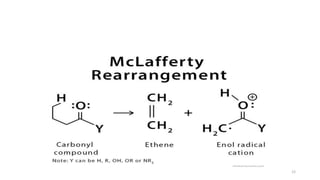
The McLafferty rearrangement is a reaction observed in mass
spectrometry during the fragmentation or dissociation of organic
molecules. It is sometimes found that a molecule containing a keto-
group undergoes β-cleavage, with the gain of the γ-hydrogen atom.
When hydrogen is available at the gamma position on carbonyl
compounds, these compounds go through a specific rearrangement
due to the cleavage of multiple bonds, including the bonds at alpha and
gamma positions. This reaction is known as the McLafferty
rearrangement.
7
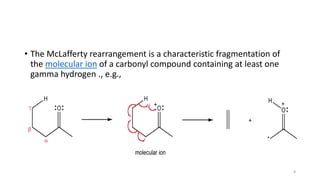
• The McLafferty rearrangement is a characteristic fragmentation of
the molecular ion of a carbonyl compound containing at least one
gamma hydrogen ., e.g.,
8
Hexan-2-one
9
• The fragmentation of the molecule ions of hexan-2-one by α-
cleavage at the carbonyl group .
• The α-cleavage at a carbonyl group gives rise to the
stable acetyl cation CH3CO+, m/z 43, and to the •C3H7 radical,
• while transfer of an H atom from the γ-CH2 group to the CO group
accompanied by cleavage of the C(α)C(β) bond produces the radical
cation of the acetone enol and a propene molecule.
10
11
12
• The rearrangement involves a six-membered ring transition state in
which the carbonyl group pulls off the gamma proton, splitting the
molecule into two pieces.
• These pieces consist of an enol radical cation and a neutral alkene
fragment. The enol radical cation is observed in the mass spectrum,
while the neutral alkene fragment is not observed.
13
• Any carbonyl compound that has hydrogen in the gamma
position is likely to have a peak in the mass spectrum
corresponding to the enol radical cation formed by the
McLafferty rearrangement.
• Both ketones and aldehydes give prominent molecular ion
peaks though the [M+] peak is more prominent in ketones.
14
•Only ketones and aldehydes that do not undergo
this rearrangement are those which lack a side
chain that can donate a hydrogen atom to the pi
system .
15

McLaffertey rearrangement.

  • 1.
    1 PRESENTED BY Mr. DarshanN U B Pharm ( M Pharm) M Pharmacy II Semester Dept. of Pharmaceutical Chemistry SACCP PRESENTING TO Dr. T. Yunus Pasha Professor and Head Dept. of Pharmaceutical Chemistry SACCP 1 Nitrogen rule and McLafferty rearrangement
  • 2.
  • 3.
    Nitrogen rule •The nitrogenrule states that a molecule that has no or even number of nitrogen atoms has an even nominal mass, whereas a molecule that has an odd number of nitrogen atoms has an odd nominal mass. 3
  • 4.
  • 5.
  • 6.
    Molecule: Ammonia HydrazineTNT Caffeine Formula: NH3 N2H4 C7H5N3O 6 C8H10N4O2 m/z (M): 17 32 227 194 One nitrogen m/z (M) is odd Two nitrogen s m/z (M) is even Three nitrog ens m/z (M) is odd Four nitroge ns m/z (M) is even • 6
  • 7.
    The McLafferty rearrangementis a reaction observed in mass spectrometry during the fragmentation or dissociation of organic molecules. It is sometimes found that a molecule containing a keto- group undergoes β-cleavage, with the gain of the γ-hydrogen atom. When hydrogen is available at the gamma position on carbonyl compounds, these compounds go through a specific rearrangement due to the cleavage of multiple bonds, including the bonds at alpha and gamma positions. This reaction is known as the McLafferty rearrangement. 7
  • 8.
    • The McLaffertyrearrangement is a characteristic fragmentation of the molecular ion of a carbonyl compound containing at least one gamma hydrogen ., e.g., 8
  • 9.
  • 10.
    • The fragmentationof the molecule ions of hexan-2-one by α- cleavage at the carbonyl group . • The α-cleavage at a carbonyl group gives rise to the stable acetyl cation CH3CO+, m/z 43, and to the •C3H7 radical, • while transfer of an H atom from the γ-CH2 group to the CO group accompanied by cleavage of the C(α)C(β) bond produces the radical cation of the acetone enol and a propene molecule. 10
  • 11.
  • 12.
  • 13.
    • The rearrangementinvolves a six-membered ring transition state in which the carbonyl group pulls off the gamma proton, splitting the molecule into two pieces. • These pieces consist of an enol radical cation and a neutral alkene fragment. The enol radical cation is observed in the mass spectrum, while the neutral alkene fragment is not observed. 13
  • 14.
    • Any carbonylcompound that has hydrogen in the gamma position is likely to have a peak in the mass spectrum corresponding to the enol radical cation formed by the McLafferty rearrangement. • Both ketones and aldehydes give prominent molecular ion peaks though the [M+] peak is more prominent in ketones. 14
  • 15.
    •Only ketones andaldehydes that do not undergo this rearrangement are those which lack a side chain that can donate a hydrogen atom to the pi system . 15