Cholesterol
Prepared by
Dr. N.GOPINATHAN
ASSISTANT PROFESSOR
DEPARTMENT OF PHARMACEUTICAL CHEMISTRY
FACULTY OF PHARMACY
SRI RAMACHANDRA UNIVERSITY
CHENNAI-116
TAMILNADU
It is present in all mammalian tissues
either in free state or esterified with fatty
acid.
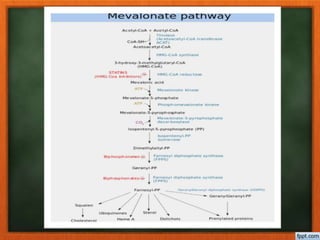
Microsomal and cytosolfraction of cell is
responsible for cholesterol synthesis.
Large quantities present in brain and nerve
tissue.
It is optically active levo rotatory in nature.
• It is an animal sterol occurs as free and
fatty ester.
• Main source are brain, spinal cord
gallstone and fish liver oil.
• It was first isolated from human
gallstone deposited in the bile duct. It is
known as cholesterol.
• Human body not only synthesis it but
can absorb it from food through the
intestine into the blood stream
• Too high concentration of cholesterol in
the blood can lead to its precipitation in
the circulatory vessel results in high
Blood pressure and arteriosclerosis.
• It is white crystal and optically active
solid with melting point 149◦ C
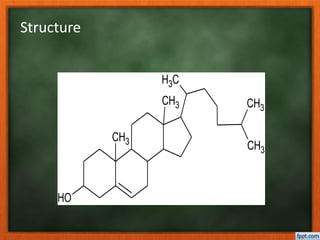
Structure
CH3
CH3
OH
CH3
CH3
CH3
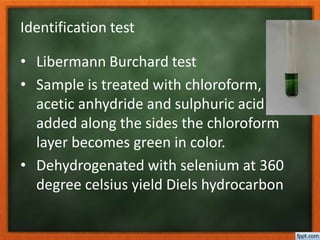
Identification test
• Libermann Burchard test
• Sample is treated with chloroform,
acetic anhydride and sulphuric acid is
added along the sides the chloroform
layer becomes green in color.
• Dehydrogenated with selenium at 360
degree celsius yield Diels hydrocarbon
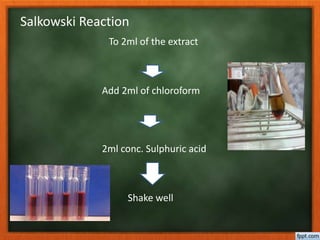
Salkowski Reaction
To 2ml of the extract
Add 2ml of chloroform
2ml conc. Sulphuric acid
Shake well
Chemistry
• On acetylation it forms mono
acetate indicates the presence of
OH group.
• It takes up two bromine atoms
suggest that the presence of
double bond.
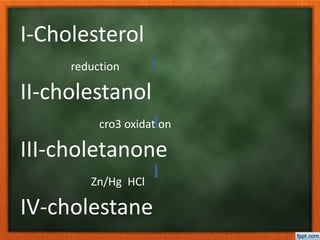
I-Cholesterol
reduction
II-cholestanol
cro3 oxidation
III-choletanone
Zn/Hg HCl
IV-cholestane
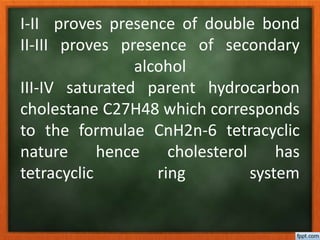
I-II proves presence of double bond
II-III proves presence of secondary
alcohol
III-IV saturated parent hydrocarbon
cholestane C27H48 which corresponds
to the formulae CnH2n-6 tetracyclic
nature hence cholesterol has
tetracyclic ring system
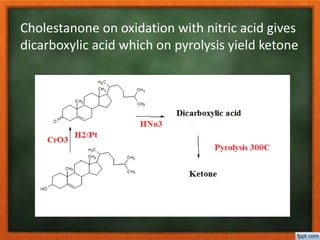
Cholestanone on oxidation with nitric acid gives
dicarboxylic acid which on pyrolysis yield ketone
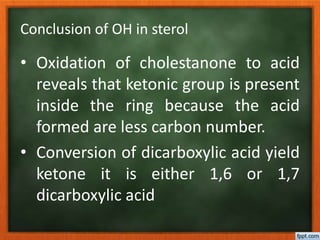
Conclusion of OH in sterol
• Oxidation of cholestanone to acid
reveals that ketonic group is present
inside the ring because the acid
formed are less carbon number.
• Conversion of dicarboxylic acid yield
ketone it is either 1,6 or 1,7
dicarboxylic acid
Conclusion of OH in sterol
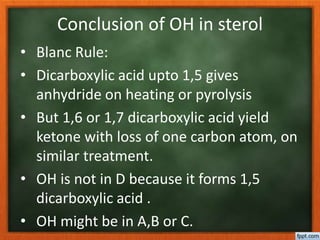
• Blanc Rule:
• Dicarboxylic acid upto 1,5 gives
anhydride on heating or pyrolysis
• But 1,6 or 1,7 dicarboxylic acid yield
ketone with loss of one carbon atom, on
similar treatment.
• OH is not in D because it forms 1,5
dicarboxylic acid .
• OH might be in A,B or C.
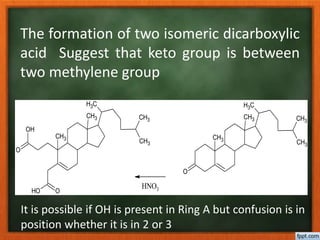
The formation of two isomeric dicarboxylic
acid Suggest that keto group is between
two methylene group
CH3
CH3
CH3
CH3
CH3
OOH
O
OH
CH3
CH3
O
CH3
CH3
CH3
HNO3
It is possible if OH is present in Ring A but confusion is in
position whether it is in 2 or 3
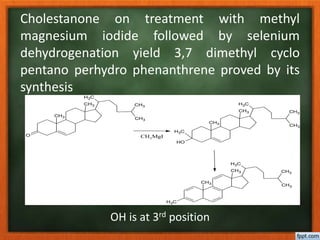
Cholestanone on treatment with methyl
magnesium iodide followed by selenium
dehydrogenation yield 3,7 dimethyl cyclo
pentano perhydro phenanthrene proved by its
synthesis
CH3
CH3
O
CH3
CH3
CH3
CH3
CH3
OH
CH3
CH3
CH3
CH3
CH3MgI
CH3
CH3
CH3
CH3
CH3
CH3
OH is at 3rd position
Position of double bond
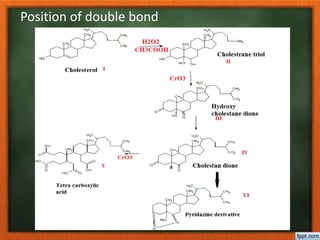
I to II represent hydroxylation of
doublebond
II on oxidation yield diketone
indicating that II possess two
secondary OH and Third OH is
tertiary because resistant to
oxidation
IV is oxidised to V tetra
carboxylic acid without any loss
of carbon atom suggest that
two keto groups are in different
ring. IF they are in same ring,
the carbon atom would have
been lost during oxidation
Double bond and OH are in
different ring. Already OH is
in Ring A therefore double
bond must be in B , C or D
Cholestanedione IV forms pyridazine
derivative. Two keto groups must be in
gamma position. Thus double bond must
be in C5 andC6.
UV spectra of cholestenone gives λ max at
240 nm which shows that keto group and
double bond are in conjugation.
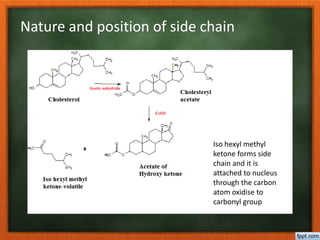
Nature and position of side chain
Iso hexyl methyl
ketone forms side
chain and it is
attached to nucleus
through the carbon
atom oxidise to
carbonyl group
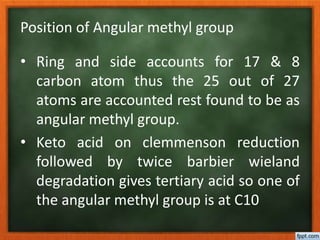
Position of Angular methyl group
• Ring and side accounts for 17 & 8
carbon atom thus the 25 out of 27
atoms are accounted rest found to be as
angular methyl group.
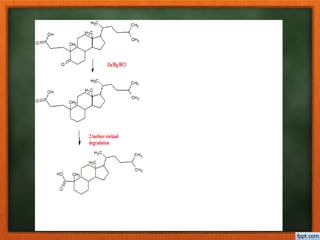
• Keto acid on clemmenson reduction
followed by twice barbier wieland
degradation gives tertiary acid so one of
the angular methyl group is at C10
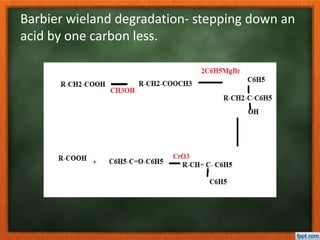
Barbier wieland degradation- stepping down an
acid by one carbon less.
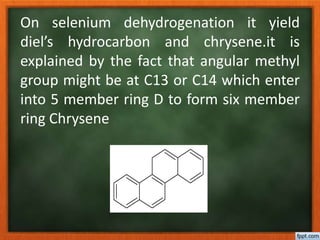
On selenium dehydrogenation it yield
diel’s hydrocarbon and chrysene.it is
explained by the fact that angular methyl
group might be at C13 or C14 which enter
into 5 member ring D to form six member
ring Chrysene
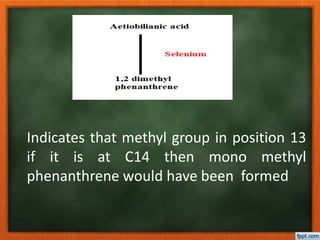
Indicates that methyl group in position 13
if it is at C14 then mono methyl
phenanthrene would have been formed
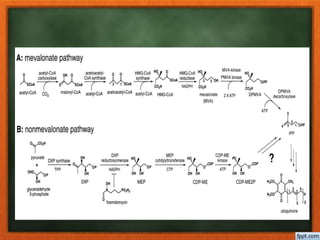
• The structure of
cholesterol is further
confirmed by its
synthesis
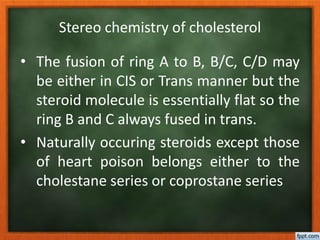
Stereo chemistry of cholesterol
• The fusion of ring A to B, B/C, C/D may
be either in CIS or Trans manner but the
steroid molecule is essentially flat so the
ring B and C always fused in trans.
• Naturally occuring steroids except those
of heart poison belongs either to the
cholestane series or coprostane series
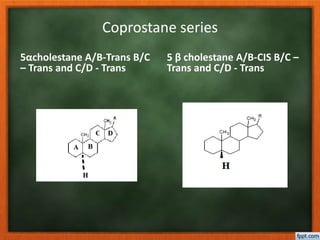
Coprostane series
5αcholestane A/B-Trans B/C
– Trans and C/D - Trans
5 β cholestane A/B-CIS B/C –
Trans and C/D - Trans
• Both the angular methyl groups are CIS.
• The compound derived from cholestane
are known as Allo compound whereas
the compounds derived from
coprostane are known as normal
compound
If OH is present above the lane
of ring i.e in CIS position with
respect to methyl group at C10
then it is β
on the other hand if hydroxyl
group is present below the
plane of ring is known as α or
epi compound
Thank you

4.cholesterol

  • 1.
    Cholesterol Prepared by Dr. N.GOPINATHAN ASSISTANTPROFESSOR DEPARTMENT OF PHARMACEUTICAL CHEMISTRY FACULTY OF PHARMACY SRI RAMACHANDRA UNIVERSITY CHENNAI-116 TAMILNADU
  • 2.
    It is presentin all mammalian tissues either in free state or esterified with fatty acid. Microsomal and cytosolfraction of cell is responsible for cholesterol synthesis. Large quantities present in brain and nerve tissue. It is optically active levo rotatory in nature.
  • 3.
    • It isan animal sterol occurs as free and fatty ester. • Main source are brain, spinal cord gallstone and fish liver oil. • It was first isolated from human gallstone deposited in the bile duct. It is known as cholesterol.
  • 4.
    • Human bodynot only synthesis it but can absorb it from food through the intestine into the blood stream • Too high concentration of cholesterol in the blood can lead to its precipitation in the circulatory vessel results in high Blood pressure and arteriosclerosis. • It is white crystal and optically active solid with melting point 149◦ C
  • 5.
  • 6.
    Identification test • LibermannBurchard test • Sample is treated with chloroform, acetic anhydride and sulphuric acid is added along the sides the chloroform layer becomes green in color. • Dehydrogenated with selenium at 360 degree celsius yield Diels hydrocarbon
  • 7.
    Salkowski Reaction To 2mlof the extract Add 2ml of chloroform 2ml conc. Sulphuric acid Shake well
  • 8.
    Chemistry • On acetylationit forms mono acetate indicates the presence of OH group. • It takes up two bromine atoms suggest that the presence of double bond.
  • 9.
  • 10.
    I-II proves presenceof double bond II-III proves presence of secondary alcohol III-IV saturated parent hydrocarbon cholestane C27H48 which corresponds to the formulae CnH2n-6 tetracyclic nature hence cholesterol has tetracyclic ring system
  • 11.
    Cholestanone on oxidationwith nitric acid gives dicarboxylic acid which on pyrolysis yield ketone
  • 12.
    Conclusion of OHin sterol • Oxidation of cholestanone to acid reveals that ketonic group is present inside the ring because the acid formed are less carbon number. • Conversion of dicarboxylic acid yield ketone it is either 1,6 or 1,7 dicarboxylic acid
  • 13.
    Conclusion of OHin sterol • Blanc Rule: • Dicarboxylic acid upto 1,5 gives anhydride on heating or pyrolysis • But 1,6 or 1,7 dicarboxylic acid yield ketone with loss of one carbon atom, on similar treatment. • OH is not in D because it forms 1,5 dicarboxylic acid . • OH might be in A,B or C.
  • 14.
    The formation oftwo isomeric dicarboxylic acid Suggest that keto group is between two methylene group CH3 CH3 CH3 CH3 CH3 OOH O OH CH3 CH3 O CH3 CH3 CH3 HNO3 It is possible if OH is present in Ring A but confusion is in position whether it is in 2 or 3
  • 15.
    Cholestanone on treatmentwith methyl magnesium iodide followed by selenium dehydrogenation yield 3,7 dimethyl cyclo pentano perhydro phenanthrene proved by its synthesis CH3 CH3 O CH3 CH3 CH3 CH3 CH3 OH CH3 CH3 CH3 CH3 CH3MgI CH3 CH3 CH3 CH3 CH3 CH3 OH is at 3rd position
  • 16.
  • 17.
    I to IIrepresent hydroxylation of doublebond II on oxidation yield diketone indicating that II possess two secondary OH and Third OH is tertiary because resistant to oxidation
  • 18.
    IV is oxidisedto V tetra carboxylic acid without any loss of carbon atom suggest that two keto groups are in different ring. IF they are in same ring, the carbon atom would have been lost during oxidation
  • 19.
    Double bond andOH are in different ring. Already OH is in Ring A therefore double bond must be in B , C or D
  • 20.
    Cholestanedione IV formspyridazine derivative. Two keto groups must be in gamma position. Thus double bond must be in C5 andC6. UV spectra of cholestenone gives λ max at 240 nm which shows that keto group and double bond are in conjugation.
  • 21.
    Nature and positionof side chain Iso hexyl methyl ketone forms side chain and it is attached to nucleus through the carbon atom oxidise to carbonyl group
  • 22.
    Position of Angularmethyl group • Ring and side accounts for 17 & 8 carbon atom thus the 25 out of 27 atoms are accounted rest found to be as angular methyl group. • Keto acid on clemmenson reduction followed by twice barbier wieland degradation gives tertiary acid so one of the angular methyl group is at C10
  • 24.
    Barbier wieland degradation-stepping down an acid by one carbon less.
  • 25.
    On selenium dehydrogenationit yield diel’s hydrocarbon and chrysene.it is explained by the fact that angular methyl group might be at C13 or C14 which enter into 5 member ring D to form six member ring Chrysene
  • 26.
    Indicates that methylgroup in position 13 if it is at C14 then mono methyl phenanthrene would have been formed
  • 27.
    • The structureof cholesterol is further confirmed by its synthesis
  • 30.
    Stereo chemistry ofcholesterol • The fusion of ring A to B, B/C, C/D may be either in CIS or Trans manner but the steroid molecule is essentially flat so the ring B and C always fused in trans. • Naturally occuring steroids except those of heart poison belongs either to the cholestane series or coprostane series
  • 31.
    Coprostane series 5αcholestane A/B-TransB/C – Trans and C/D - Trans 5 β cholestane A/B-CIS B/C – Trans and C/D - Trans
  • 32.
    • Both theangular methyl groups are CIS. • The compound derived from cholestane are known as Allo compound whereas the compounds derived from coprostane are known as normal compound
  • 33.
    If OH ispresent above the lane of ring i.e in CIS position with respect to methyl group at C10 then it is β on the other hand if hydroxyl group is present below the plane of ring is known as α or epi compound
  • 34.