Presented To- Ms.Gul Naz Fatima
Sr. Asst. Professor, BBDNIIT, Lucknow
Presented By- Sachin Kumar Vishwakarma
M.Pharm. 1st year
(Pharmaceutical Chemistry)
STRATEGIES FOR SYNTHESIS OF
THREE, FOUR, FIVE AND SIX-
MEMBERED RINGS
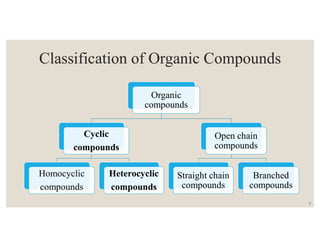
Classification of Organic Compounds
Organic
compounds
Cyclic
compounds
Homocyclic
compounds
Heterocyclic
compounds
Open chain
compounds
Straight chain
compounds
Branched
compounds
2
Heterocyclic compounds
Greek word “heteros” means different .
Heterocyclic compounds are those where one or more
atom(s) of the ring are heteroatoms, for example, N, O, S, P,
As, Se, B, and so on.
More than half of the known organic compounds are
heterocyclic compounds .
For example- nucleic acid bases, hemoglobin, chlorophyll,
vitamins, amino acids, alkaloids, carbohydrates etc.
3
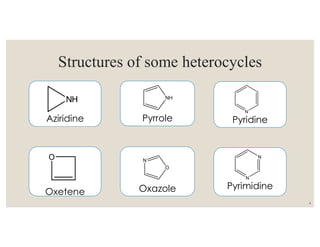
Structures of some heterocycles
Aziridine
Pyrimidine
Pyrrole Pyridine
Oxetene Oxazole
NH
O
NH
N
O
N
N
N
4
Three membered heterocycles
Formally derived from cyclopropane by replacing a carbon
atom with a hetero atom.
Such a change widely affects the physical and chemical
properties of the resulting heterocyclic rings.
Three membered saturated heterocyclic compounds
containing a N, O, and S as the hetero atom are known as
aziridine, oxirane, and thiirane respectively .
Chemically they are most stable than cyclopropane
derivatives .
5
Strategies for synthesis
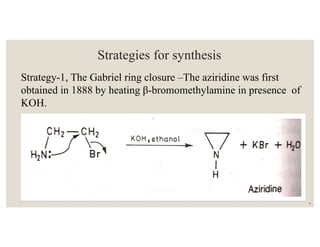
Strategy-1, The Gabriel ring closure –The aziridine was first
obtained in 1888 by heating β-bromomethylamine in presence of
KOH.
6
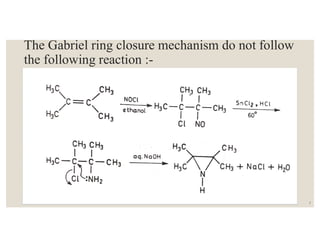
The Gabriel ring closure mechanism do not follow
the following reaction :-
7
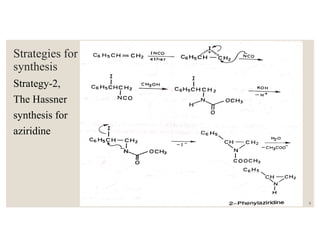
Strategies for
synthesis
Strategy-2,
The Hassner
synthesis for
aziridine
8
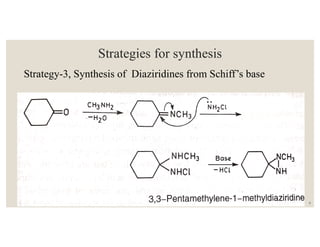
Strategies for synthesis
Strategy-3, Synthesis of Diaziridines from Schiff’s base
9
Four membered heterocycles
Heterocyclic analogues of cyclobutane .
Relatively less strained than the three membered
heterocyclic rings .
Some examples are as follows :-
HN
Azitidine
O
Oxetane
S
Thietane
HN
2-Azetine
N
Azete
10
Strategies for synthesis
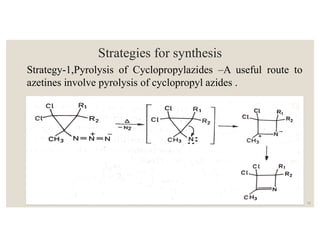
Strategy-1,Pyrolysis of Cyclopropylazides –A useful route to
azetines involve pyrolysis of cyclopropyl azides .
11
Strategies for synthesis
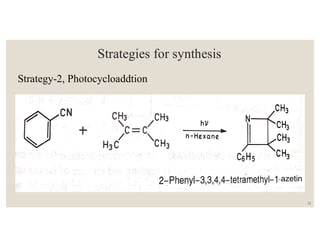
Strategy-2, Photocycloaddtion
12
-azetin
Strategies for synthesis
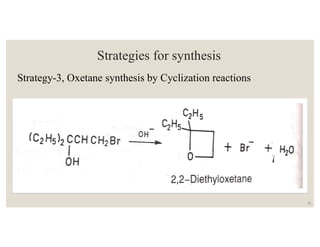
Strategy-3, Oxetane synthesis by Cyclization reactions
13
Five membered heterocycles
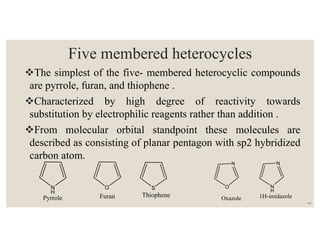
The simplest of the five- membered heterocyclic compounds
are pyrrole, furan, and thiophene .
Characterized by high degree of reactivity towards
substitution by electrophilic reagents rather than addition .
From molecular orbital standpoint these molecules are
described as consisting of planar pentagon with sp2 hybridized
carbon atom.
ON
H
N
H
S
Pyrrole Furan Thiophene Oxazole 1H-imidazole
N
O
N
N
H
14
Strategies for synthesis
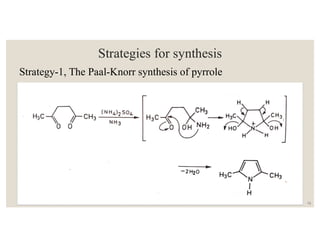
Strategy-1, The Paal-Knorr synthesis of pyrrole
15
Strategies for synthesis
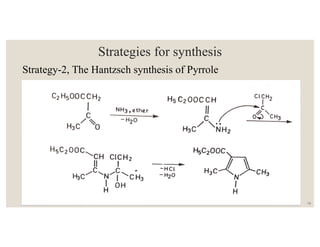
Strategy-2, The Hantzsch synthesis of Pyrrole
16
Strategies for synthesis
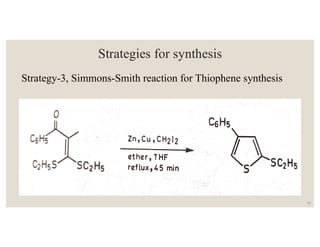
Strategy-3, Simmons-Smith reaction for Thiophene synthesis
17
Six membered heterocycles
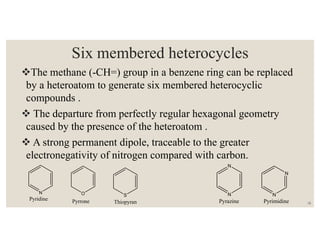
The methane (-CH=) group in a benzene ring can be replaced
by a heteroatom to generate six membered heterocyclic
compounds .
 The departure from perfectly regular hexagonal geometry
caused by the presence of the heteroatom .
 A strong permanent dipole, traceable to the greater
electronegativity of nitrogen compared with carbon.
N O S
Pyridine Pyrrone Thiopyran
N
N
N
N
Pyrazine Pyrimidine 18
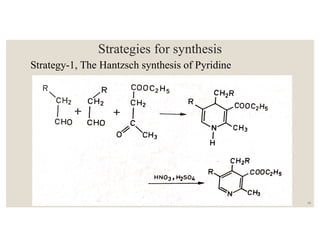
Strategies for synthesis
Strategy-1, The Hantzsch synthesis of Pyridine
19
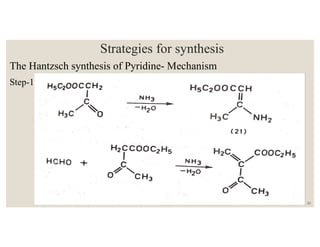
Strategies for synthesis
The Hantzsch synthesis of Pyridine- Mechanism
Step-1
20
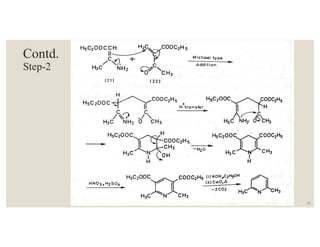
Contd.
Step-2
21
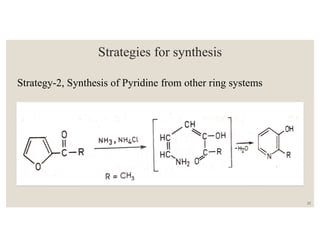
Strategies for synthesis
Strategy-2, Synthesis of Pyridine from other ring systems
22
Strategies for synthesis
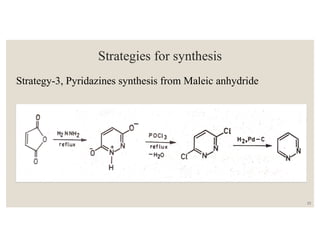
Strategy-3, Pyridazines synthesis from Maleic anhydride
23
References
1.Bansal, R.K.; ‘‘Heterocyclic Chemistry’’; Third edition; New
Age International Publishers; New Delhi, 2002.
2.Joule, J.A.; Mills, K.; ‘‘Heterocyclic Chemistry’’; Fifth
edition; John Wiley & Sons Ltd.; United Kingdom, 2010.
3.Morrison, R.T.; Boyd, N.B.; Bhattacharjee, S.K.; ‘‘Organic
Chemistry’’; Seventh edition; Dorling Kindersley Pvt. Ltd.;
New Delhi, 2013.
24
25

Strategies for Heterocycle ring synthesis

  • 1.
    Presented To- Ms.GulNaz Fatima Sr. Asst. Professor, BBDNIIT, Lucknow Presented By- Sachin Kumar Vishwakarma M.Pharm. 1st year (Pharmaceutical Chemistry) STRATEGIES FOR SYNTHESIS OF THREE, FOUR, FIVE AND SIX- MEMBERED RINGS
  • 2.
    Classification of OrganicCompounds Organic compounds Cyclic compounds Homocyclic compounds Heterocyclic compounds Open chain compounds Straight chain compounds Branched compounds 2
  • 3.
    Heterocyclic compounds Greek word“heteros” means different . Heterocyclic compounds are those where one or more atom(s) of the ring are heteroatoms, for example, N, O, S, P, As, Se, B, and so on. More than half of the known organic compounds are heterocyclic compounds . For example- nucleic acid bases, hemoglobin, chlorophyll, vitamins, amino acids, alkaloids, carbohydrates etc. 3
  • 4.
    Structures of someheterocycles Aziridine Pyrimidine Pyrrole Pyridine Oxetene Oxazole NH O NH N O N N N 4
  • 5.
    Three membered heterocycles Formallyderived from cyclopropane by replacing a carbon atom with a hetero atom. Such a change widely affects the physical and chemical properties of the resulting heterocyclic rings. Three membered saturated heterocyclic compounds containing a N, O, and S as the hetero atom are known as aziridine, oxirane, and thiirane respectively . Chemically they are most stable than cyclopropane derivatives . 5
  • 6.
    Strategies for synthesis Strategy-1,The Gabriel ring closure –The aziridine was first obtained in 1888 by heating β-bromomethylamine in presence of KOH. 6
  • 7.
    The Gabriel ringclosure mechanism do not follow the following reaction :- 7
  • 8.
  • 9.
    Strategies for synthesis Strategy-3,Synthesis of Diaziridines from Schiff’s base 9
  • 10.
    Four membered heterocycles Heterocyclicanalogues of cyclobutane . Relatively less strained than the three membered heterocyclic rings . Some examples are as follows :- HN Azitidine O Oxetane S Thietane HN 2-Azetine N Azete 10
  • 11.
    Strategies for synthesis Strategy-1,Pyrolysisof Cyclopropylazides –A useful route to azetines involve pyrolysis of cyclopropyl azides . 11
  • 12.
    Strategies for synthesis Strategy-2,Photocycloaddtion 12 -azetin
  • 13.
    Strategies for synthesis Strategy-3,Oxetane synthesis by Cyclization reactions 13
  • 14.
    Five membered heterocycles Thesimplest of the five- membered heterocyclic compounds are pyrrole, furan, and thiophene . Characterized by high degree of reactivity towards substitution by electrophilic reagents rather than addition . From molecular orbital standpoint these molecules are described as consisting of planar pentagon with sp2 hybridized carbon atom. ON H N H S Pyrrole Furan Thiophene Oxazole 1H-imidazole N O N N H 14
  • 15.
    Strategies for synthesis Strategy-1,The Paal-Knorr synthesis of pyrrole 15
  • 16.
    Strategies for synthesis Strategy-2,The Hantzsch synthesis of Pyrrole 16
  • 17.
    Strategies for synthesis Strategy-3,Simmons-Smith reaction for Thiophene synthesis 17
  • 18.
    Six membered heterocycles Themethane (-CH=) group in a benzene ring can be replaced by a heteroatom to generate six membered heterocyclic compounds .  The departure from perfectly regular hexagonal geometry caused by the presence of the heteroatom .  A strong permanent dipole, traceable to the greater electronegativity of nitrogen compared with carbon. N O S Pyridine Pyrrone Thiopyran N N N N Pyrazine Pyrimidine 18
  • 19.
    Strategies for synthesis Strategy-1,The Hantzsch synthesis of Pyridine 19
  • 20.
    Strategies for synthesis TheHantzsch synthesis of Pyridine- Mechanism Step-1 20
  • 21.
  • 22.
    Strategies for synthesis Strategy-2,Synthesis of Pyridine from other ring systems 22
  • 23.
    Strategies for synthesis Strategy-3,Pyridazines synthesis from Maleic anhydride 23
  • 24.
    References 1.Bansal, R.K.; ‘‘HeterocyclicChemistry’’; Third edition; New Age International Publishers; New Delhi, 2002. 2.Joule, J.A.; Mills, K.; ‘‘Heterocyclic Chemistry’’; Fifth edition; John Wiley & Sons Ltd.; United Kingdom, 2010. 3.Morrison, R.T.; Boyd, N.B.; Bhattacharjee, S.K.; ‘‘Organic Chemistry’’; Seventh edition; Dorling Kindersley Pvt. Ltd.; New Delhi, 2013. 24
  • 25.