umpolung
SUBMITTED BY
L.ISHWARYA
21PCH17
Whatisumpolung?
Polarity inversion in organic chemistry is the chemical
modification of a functional group with the aim of the
reversal of polarity of that group.
The concept was introduced by D.SEEBACH(hence the
German word umpolung for reversed polarity) and E.J.COREY.
Polarity analysis during retrosynthetic analysis tells a chemist
when umpolung tactics are required to synthesize a target
molecule.
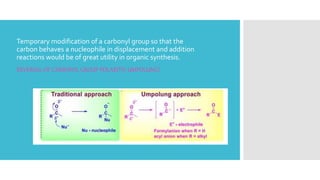
Temporary modification of a carbonyl group so that the
carbon behaves a nucleophile in displacement and addition
reactions would be of great utility in organic synthesis.
REVERSAL OF CARBONYL GROUP POLARITY( UMPOLUNG)
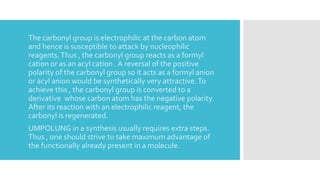
The carbonyl group is electrophilic at the carbon atom
and hence is susceptible to attack by nucleophilic
reagents.Thus , the carbonyl group reacts as a formyl
cation or as an acyl cation . A reversal of the positive
polarity of the carbonyl group so it acts as a formyl anion
or acyl anion would be synthetically very attractive.To
achieve this , the carbonyl group is converted to a
derivative whose carbon atom has the negative polarity.
After its reaction with an electrophilic reagent, the
carbonyl is regenerated.
UMPOLUNG in a synthesis usually requires extra steps.
Thus , one should strive to take maximum advantage of
the functionally already present in a molecule.
CARBONYLGROUPREACTIVITYANDTARGETMOLECULE
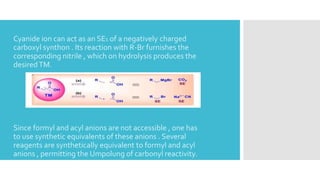
The normal disconnection pattern of a carboxylic acid
with a Grignard reagent and carbon dioxide as a SEs
(path A) and a disconnection leading to a carboxyl
synthon with an “unnatural” negative charge ( path B ).
Cyanide ion can act as an SES of a negatively charged
carboxyl synthon . Its reaction with R-Br furnishes the
corresponding nitrile , which on hydrolysis produces the
desiredTM.
Since formyl and acyl anions are not accessible , one has
to use synthetic equivalents of these anions . Several
reagents are synthetically equivalent to formyl and acyl
anions , permitting the Umpolung of carbonyl reactivity.
FORMYLANDACYLANIONSDERIVEDFROM1,3-DITHIANES
The most utilized Umpolung strategy is based on formyl and
acyl anion equivalents derived from 2-lithio-1,3-dithiane
species .These are readily generated from 1,3-dithianes
(thioacetals) because the hydrogens at C(2) are relatively
acidic(pKa : 31) . In this case connection it should be noted
that thiols (EtSH , pKa : 11) are stronger acids compared
to alcohols (EtOH , pKa: 16)
The lower ionization potential and the greater polarizability of the
valence electrons of sulfur compared to oxygen make the divalent
sulfur compounds more nucleophilic in Sn2 reaction.The
polarizability factor may also be responsible for the stabilization of
carbanions a to sulfur.
The anions derived from dithianes react with alkyl halides to
give the corresponding alkylated dithianes. After hydrolysis produced
aldehydes or ketones.
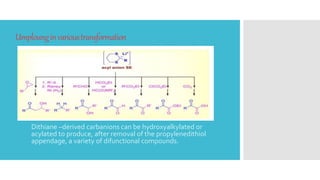
Umplounginvarioustransformation
Dithiane –derived carbanions can be hydroxyalkylated or
acylated to produce, after removal of the propylenedithiol
appendage, a variety of difunctional compounds.
Synthesisofvermiculinusingumploungconcept
TMEDA- tetramethylethylenediamine
(Me2NCH2CH2NMe2)
used to sequester Li+ and disrupt n-BuLi
aggregate
An instructive example of using a dithiane umpolung
approach to synthesize a complex natural product is
the one-pot preparation of the multifunctional
intermediate, which ultimately was elaborated to the
antibiotic vermiculin.
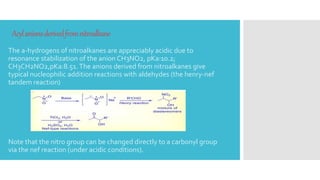
Acylanionsderivedfromnitroalkane
The a-hydrogens of nitroalkanes are appreciably acidic due to
resonance stabilization of the anion CH3NO2, pKa:10.2;
CH3CH2NO2,pKa:8.51.The anions derived from nitroalkanes give
typical nucleophilic addition reactions with aldehydes (the henry-nef
tandem reaction)
Note that the nitro group can be changed directly to a carbonyl group
via the nef reaction (under acidic conditions).
Under basic conditions, salts of secondary nitro
compounds are converted into ketones by the
pyridine-HMPA complex of molybdenum (VI)
peroxide. Nitronates from primary nitro
compounds yields carboxylic acids since the
initially formed aldehydes is rapidly oxidized
under the reaction conditions.
Stetterreactionusingumpolungconcept
Acyl anion synthons derived from cyanohydrins may be generated
catalytically by cyanide ion via the stetter reaction. However, further
reaction with electrophiles is confined to carbonyl compounds and
Michael acceptors.
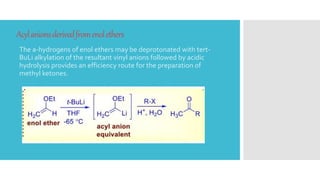
Acylanionsderivedfromenolethers
The a-hydrogens of enol ethers may be deprotonated with tert-
BuLi alkylation of the resultant vinyl anions followed by acidic
hydrolysis provides an efficiency route for the preparation of
methyl ketones.
Acylanionsderivedfromlithiumacetylide
Treatment of lithium acetylide with a primary alkyl halide (bromide
or iodide) or with aldehydes or ketones produces the corresponding
monosubstituted acetylene or propargylic alcohols. Mercuric ion-
catalyzed hydration of these furnishes methyl ketones and methyl
a-hydrogen ketones, respectively.
Thankyou

UMPLOUNG.pptx

  • 1.
  • 2.
    Whatisumpolung? Polarity inversion inorganic chemistry is the chemical modification of a functional group with the aim of the reversal of polarity of that group. The concept was introduced by D.SEEBACH(hence the German word umpolung for reversed polarity) and E.J.COREY. Polarity analysis during retrosynthetic analysis tells a chemist when umpolung tactics are required to synthesize a target molecule.
  • 3.
    Temporary modification ofa carbonyl group so that the carbon behaves a nucleophile in displacement and addition reactions would be of great utility in organic synthesis. REVERSAL OF CARBONYL GROUP POLARITY( UMPOLUNG)
  • 4.
    The carbonyl groupis electrophilic at the carbon atom and hence is susceptible to attack by nucleophilic reagents.Thus , the carbonyl group reacts as a formyl cation or as an acyl cation . A reversal of the positive polarity of the carbonyl group so it acts as a formyl anion or acyl anion would be synthetically very attractive.To achieve this , the carbonyl group is converted to a derivative whose carbon atom has the negative polarity. After its reaction with an electrophilic reagent, the carbonyl is regenerated. UMPOLUNG in a synthesis usually requires extra steps. Thus , one should strive to take maximum advantage of the functionally already present in a molecule.
  • 5.
    CARBONYLGROUPREACTIVITYANDTARGETMOLECULE The normal disconnectionpattern of a carboxylic acid with a Grignard reagent and carbon dioxide as a SEs (path A) and a disconnection leading to a carboxyl synthon with an “unnatural” negative charge ( path B ).
  • 6.
    Cyanide ion canact as an SES of a negatively charged carboxyl synthon . Its reaction with R-Br furnishes the corresponding nitrile , which on hydrolysis produces the desiredTM. Since formyl and acyl anions are not accessible , one has to use synthetic equivalents of these anions . Several reagents are synthetically equivalent to formyl and acyl anions , permitting the Umpolung of carbonyl reactivity.
  • 7.
    FORMYLANDACYLANIONSDERIVEDFROM1,3-DITHIANES The most utilizedUmpolung strategy is based on formyl and acyl anion equivalents derived from 2-lithio-1,3-dithiane species .These are readily generated from 1,3-dithianes (thioacetals) because the hydrogens at C(2) are relatively acidic(pKa : 31) . In this case connection it should be noted that thiols (EtSH , pKa : 11) are stronger acids compared to alcohols (EtOH , pKa: 16)
  • 8.
    The lower ionizationpotential and the greater polarizability of the valence electrons of sulfur compared to oxygen make the divalent sulfur compounds more nucleophilic in Sn2 reaction.The polarizability factor may also be responsible for the stabilization of carbanions a to sulfur. The anions derived from dithianes react with alkyl halides to give the corresponding alkylated dithianes. After hydrolysis produced aldehydes or ketones.
  • 10.
    Umplounginvarioustransformation Dithiane –derived carbanionscan be hydroxyalkylated or acylated to produce, after removal of the propylenedithiol appendage, a variety of difunctional compounds.
  • 11.
  • 12.
    TMEDA- tetramethylethylenediamine (Me2NCH2CH2NMe2) used tosequester Li+ and disrupt n-BuLi aggregate An instructive example of using a dithiane umpolung approach to synthesize a complex natural product is the one-pot preparation of the multifunctional intermediate, which ultimately was elaborated to the antibiotic vermiculin.
  • 13.
    Acylanionsderivedfromnitroalkane The a-hydrogens ofnitroalkanes are appreciably acidic due to resonance stabilization of the anion CH3NO2, pKa:10.2; CH3CH2NO2,pKa:8.51.The anions derived from nitroalkanes give typical nucleophilic addition reactions with aldehydes (the henry-nef tandem reaction) Note that the nitro group can be changed directly to a carbonyl group via the nef reaction (under acidic conditions).
  • 14.
    Under basic conditions,salts of secondary nitro compounds are converted into ketones by the pyridine-HMPA complex of molybdenum (VI) peroxide. Nitronates from primary nitro compounds yields carboxylic acids since the initially formed aldehydes is rapidly oxidized under the reaction conditions.
  • 16.
    Stetterreactionusingumpolungconcept Acyl anion synthonsderived from cyanohydrins may be generated catalytically by cyanide ion via the stetter reaction. However, further reaction with electrophiles is confined to carbonyl compounds and Michael acceptors.
  • 17.
    Acylanionsderivedfromenolethers The a-hydrogens ofenol ethers may be deprotonated with tert- BuLi alkylation of the resultant vinyl anions followed by acidic hydrolysis provides an efficiency route for the preparation of methyl ketones.
  • 18.
    Acylanionsderivedfromlithiumacetylide Treatment of lithiumacetylide with a primary alkyl halide (bromide or iodide) or with aldehydes or ketones produces the corresponding monosubstituted acetylene or propargylic alcohols. Mercuric ion- catalyzed hydration of these furnishes methyl ketones and methyl a-hydrogen ketones, respectively.
  • 19.