By
DEVI PRIYA
SUGATHAN
MSc
CHOLESTEROL
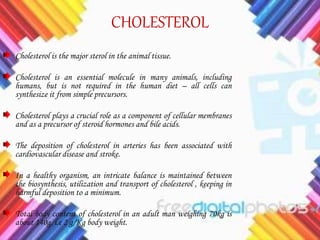
Cholesterol is the major sterol in the animal tissue.
Cholesterol is an essential molecule in many animals, including
humans, but is not required in the human diet – all cells can
synthesize it from simple precursors.
Cholesterol plays a crucial role as a component of cellular membranes
and as a precursor of steroid hormones and bile acids.
The deposition of cholesterol in arteries has been associated with
cardiovascular disease and stroke.
In a healthy organism, an intricate balance is maintained between
the biosynthesis, utilization and transport of cholesterol , keeping in
harmful deposition to a minimum.
Total body content of cholesterol in an adult man weighing 70kg is
about 140g. i.e 2 g/Kg body weight.
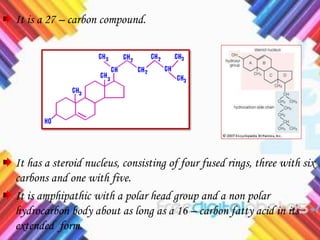
It is a 27 – carbon compound.
It has a steroid nucleus, consisting of four fused rings, three with six
carbons and one with five.
It is amphipathic with a polar head group and a non polar
hydrocarbon body about as long as a 16 – carbon fatty acid in its
extended form.
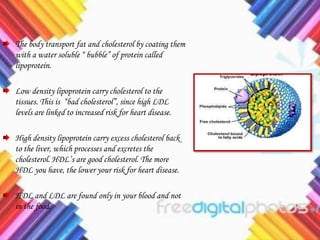
The body transport fat and cholesterol by coating them
with a water soluble “ bubble” of protein called
lipoprotein.
Low density lipoprotein carry cholesterol to the
tissues. This is “bad cholesterol”, since high LDL
levels are linked to increased risk for heart disease.
High density lipoprotein carry excess cholesterol back
to the liver, which processes and excretes the
cholesterol. HDL’s are good cholesterol. The more
HDL you have, the lower your risk for heart disease.
HDL and LDL are found only in your blood and not
in the food.
It has a complex biosynthetic pathway.
All of its carbon atom are provided by a
single precursor – acetate.
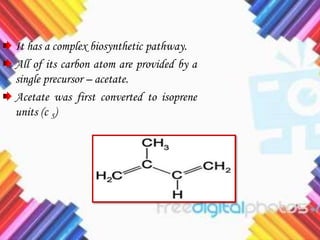
Acetate was first converted to isoprene
units (c 5)
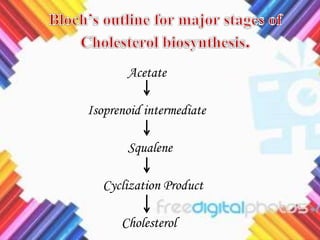
Acetate
Isoprenoid intermediate
Squalene
Cyclization Product
Cholesterol
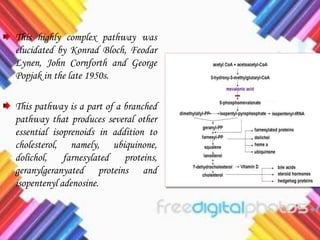
This highly complex pathway was
elucidated by Konrad Bloch, Feodar
Lynen, John Cornforth and George
Popjak in the late 1950s.
This pathway is a part of a branched
pathway that produces several other
essential isoprenoids in addition to
cholesterol, namely, ubiquinone,
dolichol, farnesylated proteins,
geranylgeranyated proteins and
isopentenyl adenosine.
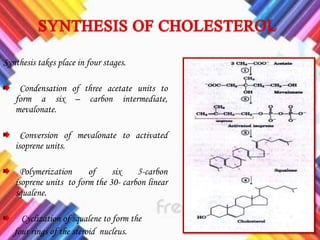
Synthesis takes place in four stages.
Condensation of three acetate units to
form a six – carbon intermediate,
mevalonate.
Conversion of mevalonate to activated
isoprene units.
Polymerization of six 5-carbon
isoprene units to form the 30- carbon linear
squalene.
Cyclization of squalene to form the
four rings of the steroid nucleus.
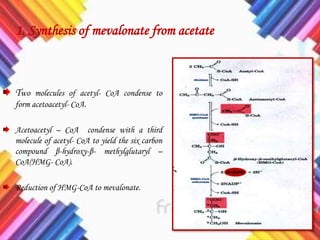
1. Synthesis of mevalonate from acetate
Two molecules of acetyl- CoA condense to
form acetoacetyl- CoA.
Acetoacetyl – CoA condense with a third
molecule of acetyl- CoA to yield the six carbon
compound β-hydroxy-β- methylglutaryl –
CoA(HMG- CoA).
Reduction of HMG-CoA to mevalonate.
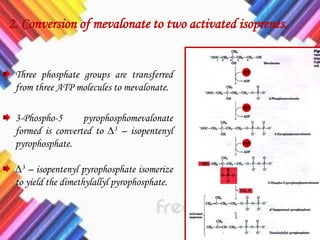
2. Conversion of mevalonate to two activated isoprenes.
Three phosphate groups are transferred
from three ATP molecules to mevalonate.
3-Phospho-5 pyrophosphomevalonate
formed is converted to ∆3 – isopentenyl
pyrophosphate.
∆3 – isopentenyl pyrophosphate isomerize
to yield the dimethylallyl pyrophosphate.
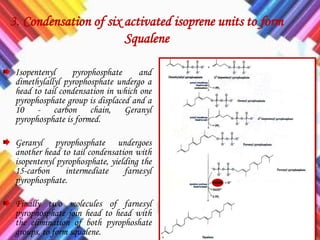
3. Condensation of six activated isoprene units to form
Squalene
Isopentenyl pyrophosphate and
dimethylallyl pyrophosphate undergo a
head to tail condensation in which one
pyrophosphate group is displaced and a
10 - carbon chain, Geranyl
pyrophosphate is formed.
Geranyl pyrophosphate undergoes
another head to tail condensation with
isopentenyl pyrophosphate, yielding the
15-carbon intermediate farnesyl
pyrophosphate.
Finally two molecules of farnesyl
pyrophosphate join head to head with
the elimination of both pyrophoshate
groups, to form squalene.
4. Conversion of squalene to the four ring steroid
nucleus.
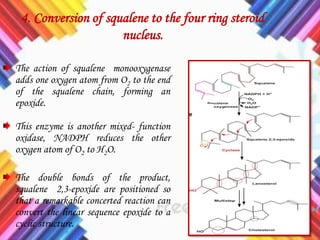
The action of squalene monooxygenase
adds one oxygen atom from O2 to the end
of the squalene chain, forming an
epoxide.
This enzyme is another mixed- function
oxidase, NADPH reduces the other
oxygen atom of O2 to H2O.
The double bonds of the product,
squalene 2,3-epoxide are positioned so
that a remarkable concerted reaction can
convert the linear sequence epoxide to a
cyclic structure.
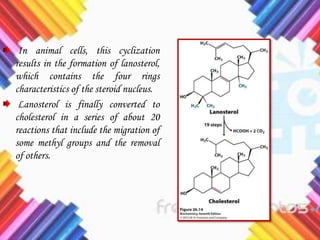
In animal cells, this cyclization
results in the formation of lanosterol,
which contains the four rings
characteristics of the steroid nucleus.
Lanosterol is finally converted to
cholesterol in a series of about 20
reactions that include the migration of
some methyl groups and the removal
of others.
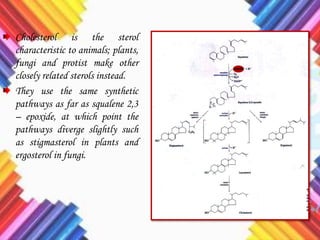
Cholesterol is the sterol
characteristic to animals; plants,
fungi and protist make other
closely related sterols instead.
They use the same synthetic
pathways as far as squalene 2,3
– epoxide, at which point the
pathways diverge slightly such
as stigmasterol in plants and
ergosterol in fungi.
Regulation of cholesterol
biosynthesis
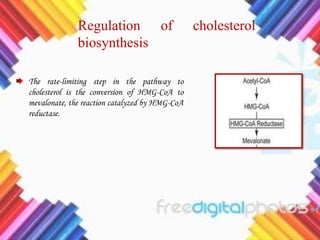
The rate-limiting step in the pathway to
cholesterol is the conversion of HMG-CoA to
mevalonate, the reaction catalyzed by HMG-CoA
reductase.
Regulation of cholesterol level by the
transcriptional regulation of the gene encoding
HMG - CoA Reductase.
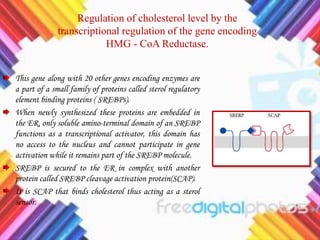
This gene along with 20 other genes encoding enzymes are
a part of a small family of proteins called sterol regulatory
element binding proteins ( SREBPs).
When newly synthesized these proteins are embedded in
the ER, only soluble amino-terminal domain of an SREBP
functions as a transcriptional activator, this domain has
no access to the nucleus and cannot participate in gene
activation while it remains part of the SREBP molecule.
SREBP is secured to the ER in complex with another
protein called SREBP cleavage activation protein(SCAP).
It is SCAP that binds cholesterol thus acting as a sterol
sensor.
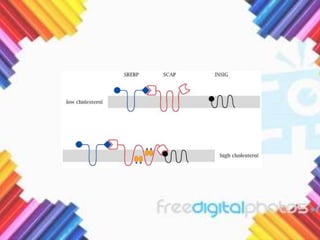
When cholesterol levels are high, SREBP are inactive, secured to the ER in a
complex with SCAP.
When cholesterol levels are low, the conformational change in SCAP causes
release of the SCAP-SREBP complex from the ER – retention activity and the
complex migrates within vesicles to the golgi complex.
In the Golgi complex the SREBP is cleaved twice by two different proteases
the second cleavage releasing the amino terminal domain into the cytosol.
This domain travels to the nucleus and activates transcription of its
target genes
The amino terminal domain of SREBP has a short half life and is
rapidly degraded by proteosomes.
When sterol levels increases sufficiently the proteolytic release of
SREBP amino terminal domain is again blocked and proteosome
degradation of the existing active domains results in a rapid shut down
of the gene targets.
HORMONAL
CONTROL
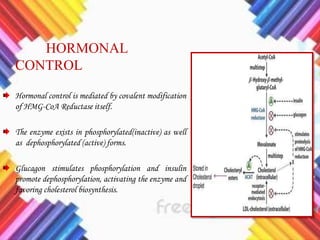
Hormonal control is mediated by covalent modification
of HMG-CoA Reductase itself.
The enzyme exists in phosphorylated(inactive) as well
as dephosphorylated (active) forms.
Glucagon stimulates phosphorylation and insulin
promote dephosphorylation, activating the enzyme and
favoring cholesterol biosynthesis.
ATHEROSCLEROSIS
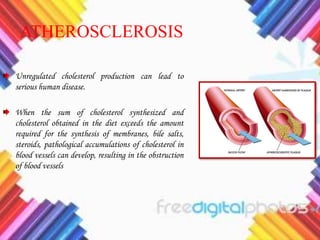
Unregulated cholesterol production can lead to
serious human disease.
When the sum of cholesterol synthesized and
cholesterol obtained in the diet exceeds the amount
required for the synthesis of membranes, bile salts,
steroids, pathological accumulations of cholesterol in
blood vessels can develop, resulting in the obstruction
of blood vessels
Cholesterol biosynthesis

Cholesterol biosynthesis

  • 1.
  • 2.
    CHOLESTEROL Cholesterol is themajor sterol in the animal tissue. Cholesterol is an essential molecule in many animals, including humans, but is not required in the human diet – all cells can synthesize it from simple precursors. Cholesterol plays a crucial role as a component of cellular membranes and as a precursor of steroid hormones and bile acids. The deposition of cholesterol in arteries has been associated with cardiovascular disease and stroke. In a healthy organism, an intricate balance is maintained between the biosynthesis, utilization and transport of cholesterol , keeping in harmful deposition to a minimum. Total body content of cholesterol in an adult man weighing 70kg is about 140g. i.e 2 g/Kg body weight.
  • 3.
    It is a27 – carbon compound. It has a steroid nucleus, consisting of four fused rings, three with six carbons and one with five. It is amphipathic with a polar head group and a non polar hydrocarbon body about as long as a 16 – carbon fatty acid in its extended form.
  • 4.
    The body transportfat and cholesterol by coating them with a water soluble “ bubble” of protein called lipoprotein. Low density lipoprotein carry cholesterol to the tissues. This is “bad cholesterol”, since high LDL levels are linked to increased risk for heart disease. High density lipoprotein carry excess cholesterol back to the liver, which processes and excretes the cholesterol. HDL’s are good cholesterol. The more HDL you have, the lower your risk for heart disease. HDL and LDL are found only in your blood and not in the food.
  • 5.
    It has acomplex biosynthetic pathway. All of its carbon atom are provided by a single precursor – acetate. Acetate was first converted to isoprene units (c 5)
  • 6.
  • 7.
    This highly complexpathway was elucidated by Konrad Bloch, Feodar Lynen, John Cornforth and George Popjak in the late 1950s. This pathway is a part of a branched pathway that produces several other essential isoprenoids in addition to cholesterol, namely, ubiquinone, dolichol, farnesylated proteins, geranylgeranyated proteins and isopentenyl adenosine.
  • 8.
    Synthesis takes placein four stages. Condensation of three acetate units to form a six – carbon intermediate, mevalonate. Conversion of mevalonate to activated isoprene units. Polymerization of six 5-carbon isoprene units to form the 30- carbon linear squalene. Cyclization of squalene to form the four rings of the steroid nucleus.
  • 9.
    1. Synthesis ofmevalonate from acetate Two molecules of acetyl- CoA condense to form acetoacetyl- CoA. Acetoacetyl – CoA condense with a third molecule of acetyl- CoA to yield the six carbon compound β-hydroxy-β- methylglutaryl – CoA(HMG- CoA). Reduction of HMG-CoA to mevalonate.
  • 10.
    2. Conversion ofmevalonate to two activated isoprenes. Three phosphate groups are transferred from three ATP molecules to mevalonate. 3-Phospho-5 pyrophosphomevalonate formed is converted to ∆3 – isopentenyl pyrophosphate. ∆3 – isopentenyl pyrophosphate isomerize to yield the dimethylallyl pyrophosphate.
  • 11.
    3. Condensation ofsix activated isoprene units to form Squalene Isopentenyl pyrophosphate and dimethylallyl pyrophosphate undergo a head to tail condensation in which one pyrophosphate group is displaced and a 10 - carbon chain, Geranyl pyrophosphate is formed. Geranyl pyrophosphate undergoes another head to tail condensation with isopentenyl pyrophosphate, yielding the 15-carbon intermediate farnesyl pyrophosphate. Finally two molecules of farnesyl pyrophosphate join head to head with the elimination of both pyrophoshate groups, to form squalene.
  • 12.
    4. Conversion ofsqualene to the four ring steroid nucleus. The action of squalene monooxygenase adds one oxygen atom from O2 to the end of the squalene chain, forming an epoxide. This enzyme is another mixed- function oxidase, NADPH reduces the other oxygen atom of O2 to H2O. The double bonds of the product, squalene 2,3-epoxide are positioned so that a remarkable concerted reaction can convert the linear sequence epoxide to a cyclic structure.
  • 13.
    In animal cells,this cyclization results in the formation of lanosterol, which contains the four rings characteristics of the steroid nucleus. Lanosterol is finally converted to cholesterol in a series of about 20 reactions that include the migration of some methyl groups and the removal of others.
  • 14.
    Cholesterol is thesterol characteristic to animals; plants, fungi and protist make other closely related sterols instead. They use the same synthetic pathways as far as squalene 2,3 – epoxide, at which point the pathways diverge slightly such as stigmasterol in plants and ergosterol in fungi.
  • 15.
    Regulation of cholesterol biosynthesis Therate-limiting step in the pathway to cholesterol is the conversion of HMG-CoA to mevalonate, the reaction catalyzed by HMG-CoA reductase.
  • 16.
    Regulation of cholesterollevel by the transcriptional regulation of the gene encoding HMG - CoA Reductase. This gene along with 20 other genes encoding enzymes are a part of a small family of proteins called sterol regulatory element binding proteins ( SREBPs). When newly synthesized these proteins are embedded in the ER, only soluble amino-terminal domain of an SREBP functions as a transcriptional activator, this domain has no access to the nucleus and cannot participate in gene activation while it remains part of the SREBP molecule. SREBP is secured to the ER in complex with another protein called SREBP cleavage activation protein(SCAP). It is SCAP that binds cholesterol thus acting as a sterol sensor.
  • 17.
    When cholesterol levelsare high, SREBP are inactive, secured to the ER in a complex with SCAP. When cholesterol levels are low, the conformational change in SCAP causes release of the SCAP-SREBP complex from the ER – retention activity and the complex migrates within vesicles to the golgi complex. In the Golgi complex the SREBP is cleaved twice by two different proteases the second cleavage releasing the amino terminal domain into the cytosol.
  • 18.
    This domain travelsto the nucleus and activates transcription of its target genes The amino terminal domain of SREBP has a short half life and is rapidly degraded by proteosomes. When sterol levels increases sufficiently the proteolytic release of SREBP amino terminal domain is again blocked and proteosome degradation of the existing active domains results in a rapid shut down of the gene targets.
  • 20.
    HORMONAL CONTROL Hormonal control ismediated by covalent modification of HMG-CoA Reductase itself. The enzyme exists in phosphorylated(inactive) as well as dephosphorylated (active) forms. Glucagon stimulates phosphorylation and insulin promote dephosphorylation, activating the enzyme and favoring cholesterol biosynthesis.
  • 21.
    ATHEROSCLEROSIS Unregulated cholesterol productioncan lead to serious human disease. When the sum of cholesterol synthesized and cholesterol obtained in the diet exceeds the amount required for the synthesis of membranes, bile salts, steroids, pathological accumulations of cholesterol in blood vessels can develop, resulting in the obstruction of blood vessels