EXTRACTION OF OILS
Prepared by
Dr. N.GOPINATHAN
ASSISTANT PROFESSOR
DEPARTMENT OF
PHARMACEUTICAL CHEMISTRY
FACULTY OF PHARMACY
SRI RAMACHANDRA
UNIVERSITY
CHENNAI-116
TAMILNADU
INDIA
History
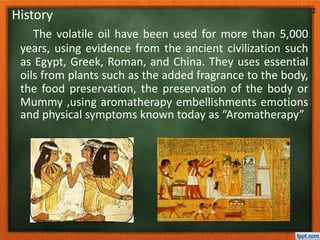
The volatile oil have been used for more than 5,000
years, using evidence from the ancient civilization such
as Egypt, Greek, Roman, and China. They uses essential
oils from plants such as the added fragrance to the body,
the food preservation, the preservation of the body or
Mummy ,using aromatherapy embellishments emotions
and physical symptoms known today as “Aromatherapy”
2
Extraction Methods
• Expression
• Steam Distillation
• Extraction by volatile solvent
• CO2 Extracts
• Adsorption in purified fat
Expression
• It is not in use but possess oly historical
importance.
• Plant material is cut into small pieces
then crushed to get juice which is
screened to get juice.
• Juice is centrifuged at high speed.
• Inferior quality of oil is obtained by
distillation
• Eg. Citrus fruit and grass oil
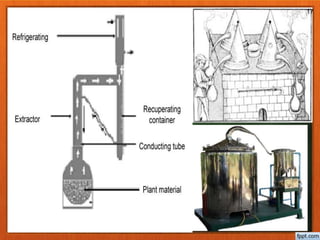
-Distillation
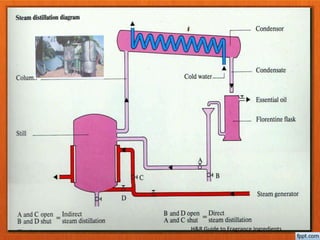
When water evaporates the steam will help bring in
the essential oils of the plant tissue out
simultaneously on the condenser steam and vapor
is condensed into liquid oil. the separation of oil
and water together. Distillation plant for small
amounts in the laboratory we can do it refined
using a set made ​​of glass called a refined kind
“Clevenger type
apparatus”.
16
17
H&R Guide to Fragrance Ingredients
Steam distillation
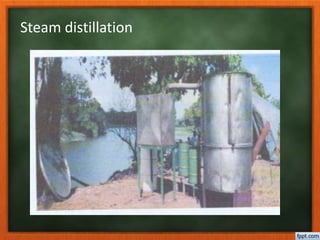
Steam distillation
• Essential oils are produced in the cells of aromatic
plants and are held in specialized glands.
• They are released from the plant and collected
(concentrated) most often through steam
distillation (and sometimes hydro or water
distillation or a combination thereof).
• Distillation is a method of separating components
based on differences in volatile constituents in a
heated mixture.
• Steam distillation involves bubbling steam
through the plant material.
• The temperature of steam is easy to control,
making it ideal for heat-sensitive essential oils.
Demerits of steam distillation
• Essential oil undergoes decomposition.
• Some constituent of essential oil eg.
Ester which are responsible for the odor
and fragrance of the oil may undergo
decomposition resulting in a perfume of
inferior quality
Extraction by volatile solvent
• WHAT IS AN ABSOLUTE?
• Like essential oils, absolutes come from
volatile, aromatic fluids extracted from
plants.
• Delicate flowers such as rose, jasmine
and orange blossom are oftentimes
extracted as absolutes to yield a higher
percentage of oil without using the
heat that can damage the petals during
steam distillation.
• Absolutes differ from essential oils in
that they contain a higher density of
colorants, waxes and other
constituents from the plant, making
the aroma highly concentrated and
more true to nature.
• They are solvent extracted, and since a
trace amount of solvent may be
present they are not used for
therapeutic purposes, but instead, for
natural perfumery.
• An absolute is the most concentrated form
of fragrance and highly regarded in natural
perfumery.
• Absolutes differ from essential oils in that
they contain not only essential oil, but also
a higher density of coloring, waxes and
other constituents from the plant.
• In addition, they usually contain a small
percentage of alcohol remaining from the
second phase of the extraction process
(typically up to 2 or 3 percent).
• Absolutes are highly concentrated
aromatic oils extracted from plants using a
solvent method.
• The multi-step process includes first
extracting the aromatic oil from the plant
material with a solvent such as hexane.
• After the hexane is removed what is left
behind is a waxy substance called a
concrete.
• The aromatic oils are then extracted from
the concrete with ethyl alcohol, and after
the ethyl alcohol is removed, the
remaining substance is an absolute – an oil
with an aroma close to the plant from
which it came.
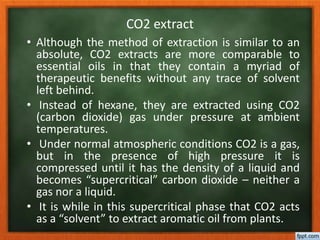
CO2 extract
• Although the method of extraction is similar to an
absolute, CO2 extracts are more comparable to
essential oils in that they contain a myriad of
therapeutic benefits without any trace of solvent
left behind.
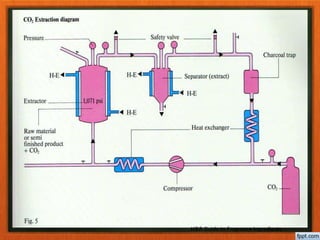
• Instead of hexane, they are extracted using CO2
(carbon dioxide) gas under pressure at ambient
temperatures.
• Under normal atmospheric conditions CO2 is a gas,
but in the presence of high pressure it is
compressed until it has the density of a liquid and
becomes “supercritical” carbon dioxide – neither a
gas nor a liquid.
• It is while in this supercritical phase that CO2 acts
as a “solvent” to extract aromatic oil from plants.
H&R Guide to Fragrance Ingredients
• The beauty of CO2 extraction is that once
the oil is extracted from the plant material,
the CO2 is simply returned to its gaseous
state and quickly and completely dissipates.
• The advantage of CO2 extraction over
steam distillation is that since there is very
low heat during the process a greater
amount of valuable constituents can be
retained.
• Typically, they have an aroma closer to the
natural plant, especially those oils with
spicy notes.
• Although there are some advantages of CO2
extraction over steam distillation, there are
oils, such as Patchouli, where steam
distillation produces a richer, more full-
bodied oil.
Super critical fluid
• A supercritical fluid (SCF) is any
substance at a temperature and
pressure above its critical point, where
distinct liquid and gas phases do not
exist. It can effuse through solids like a
gas, and dissolve materials like a liquid.
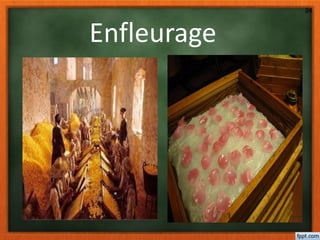
Enfleurage
24
• Fat is taken in glass plate warmed to
about 50◦C
• Surface is covered with petals and kept
for 24 hours.
• Replace the petals until the fat is
saturated with essential oil .
• The petals are removed and the fat is
digested with ethyl alcohol.
• Fat is soluble in ethyl alcohol.
• Fat in essential oil during digestion can be
removed by cooling to 20◦C where the fat
separates out.
• It can be distilled under reduced pressure to
remove solvent
• Recently the fat has been replaced by
coconut charcoal due to its greater stability
and higher adsorption.
• Charcoal after enfleurage with petals
subjected to steam distillation. It is the
superior method
2.Extraction of terpenoids

2.Extraction of terpenoids

  • 1.
    EXTRACTION OF OILS Preparedby Dr. N.GOPINATHAN ASSISTANT PROFESSOR DEPARTMENT OF PHARMACEUTICAL CHEMISTRY FACULTY OF PHARMACY SRI RAMACHANDRA UNIVERSITY CHENNAI-116 TAMILNADU INDIA
  • 2.
    History The volatile oilhave been used for more than 5,000 years, using evidence from the ancient civilization such as Egypt, Greek, Roman, and China. They uses essential oils from plants such as the added fragrance to the body, the food preservation, the preservation of the body or Mummy ,using aromatherapy embellishments emotions and physical symptoms known today as “Aromatherapy” 2
  • 3.
    Extraction Methods • Expression •Steam Distillation • Extraction by volatile solvent • CO2 Extracts • Adsorption in purified fat
  • 4.
    Expression • It isnot in use but possess oly historical importance. • Plant material is cut into small pieces then crushed to get juice which is screened to get juice. • Juice is centrifuged at high speed. • Inferior quality of oil is obtained by distillation • Eg. Citrus fruit and grass oil
  • 5.
    -Distillation When water evaporatesthe steam will help bring in the essential oils of the plant tissue out simultaneously on the condenser steam and vapor is condensed into liquid oil. the separation of oil and water together. Distillation plant for small amounts in the laboratory we can do it refined using a set made ​​of glass called a refined kind “Clevenger type apparatus”. 16
  • 6.
  • 8.
    H&R Guide toFragrance Ingredients
  • 9.
  • 10.
    Steam distillation • Essentialoils are produced in the cells of aromatic plants and are held in specialized glands. • They are released from the plant and collected (concentrated) most often through steam distillation (and sometimes hydro or water distillation or a combination thereof). • Distillation is a method of separating components based on differences in volatile constituents in a heated mixture. • Steam distillation involves bubbling steam through the plant material. • The temperature of steam is easy to control, making it ideal for heat-sensitive essential oils.
  • 11.
    Demerits of steamdistillation • Essential oil undergoes decomposition. • Some constituent of essential oil eg. Ester which are responsible for the odor and fragrance of the oil may undergo decomposition resulting in a perfume of inferior quality
  • 12.
    Extraction by volatilesolvent • WHAT IS AN ABSOLUTE? • Like essential oils, absolutes come from volatile, aromatic fluids extracted from plants. • Delicate flowers such as rose, jasmine and orange blossom are oftentimes extracted as absolutes to yield a higher percentage of oil without using the heat that can damage the petals during steam distillation.
  • 13.
    • Absolutes differfrom essential oils in that they contain a higher density of colorants, waxes and other constituents from the plant, making the aroma highly concentrated and more true to nature. • They are solvent extracted, and since a trace amount of solvent may be present they are not used for therapeutic purposes, but instead, for natural perfumery.
  • 14.
    • An absoluteis the most concentrated form of fragrance and highly regarded in natural perfumery. • Absolutes differ from essential oils in that they contain not only essential oil, but also a higher density of coloring, waxes and other constituents from the plant. • In addition, they usually contain a small percentage of alcohol remaining from the second phase of the extraction process (typically up to 2 or 3 percent).
  • 15.
    • Absolutes arehighly concentrated aromatic oils extracted from plants using a solvent method. • The multi-step process includes first extracting the aromatic oil from the plant material with a solvent such as hexane. • After the hexane is removed what is left behind is a waxy substance called a concrete. • The aromatic oils are then extracted from the concrete with ethyl alcohol, and after the ethyl alcohol is removed, the remaining substance is an absolute – an oil with an aroma close to the plant from which it came.
  • 16.
    CO2 extract • Althoughthe method of extraction is similar to an absolute, CO2 extracts are more comparable to essential oils in that they contain a myriad of therapeutic benefits without any trace of solvent left behind. • Instead of hexane, they are extracted using CO2 (carbon dioxide) gas under pressure at ambient temperatures. • Under normal atmospheric conditions CO2 is a gas, but in the presence of high pressure it is compressed until it has the density of a liquid and becomes “supercritical” carbon dioxide – neither a gas nor a liquid. • It is while in this supercritical phase that CO2 acts as a “solvent” to extract aromatic oil from plants.
  • 17.
    H&R Guide toFragrance Ingredients
  • 18.
    • The beautyof CO2 extraction is that once the oil is extracted from the plant material, the CO2 is simply returned to its gaseous state and quickly and completely dissipates. • The advantage of CO2 extraction over steam distillation is that since there is very low heat during the process a greater amount of valuable constituents can be retained. • Typically, they have an aroma closer to the natural plant, especially those oils with spicy notes. • Although there are some advantages of CO2 extraction over steam distillation, there are oils, such as Patchouli, where steam distillation produces a richer, more full- bodied oil.
  • 19.
    Super critical fluid •A supercritical fluid (SCF) is any substance at a temperature and pressure above its critical point, where distinct liquid and gas phases do not exist. It can effuse through solids like a gas, and dissolve materials like a liquid.
  • 20.
  • 21.
    • Fat istaken in glass plate warmed to about 50◦C • Surface is covered with petals and kept for 24 hours. • Replace the petals until the fat is saturated with essential oil . • The petals are removed and the fat is digested with ethyl alcohol. • Fat is soluble in ethyl alcohol.
  • 22.
    • Fat inessential oil during digestion can be removed by cooling to 20◦C where the fat separates out. • It can be distilled under reduced pressure to remove solvent • Recently the fat has been replaced by coconut charcoal due to its greater stability and higher adsorption. • Charcoal after enfleurage with petals subjected to steam distillation. It is the superior method