General Introduction,
Chemistry of Sterols
DEPARTMENT OF PHARMACEUTICAL
CHEMISTRY
ISF College of Pharmacy, Moga
Shalini Jaswal
M pharm (Pharmaceutical Chemistry)
1st sem
STEROIDS
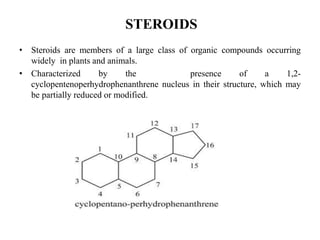
• Steroids are members of a large class of organic compounds occurring
widely in plants and animals.
• Characterized by the presence of a 1,2-
cyclopentenoperhydrophenanthrene nucleus in their structure, which may
be partially reduced or modified.
STEROLS
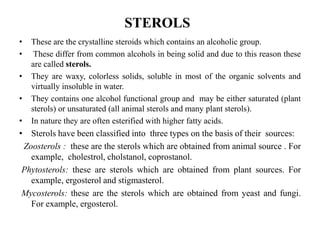
• These are the crystalline steroids which contains an alcoholic group.
• These differ from common alcohols in being solid and due to this reason these
are called sterols.
• They are waxy, colorless solids, soluble in most of the organic solvents and
virtually insoluble in water.
• They contains one alcohol functional group and may be either saturated (plant
sterols) or unsaturated (all animal sterols and many plant sterols).
• In nature they are often esterified with higher fatty acids.
• Sterols have been classified into three types on the basis of their sources:
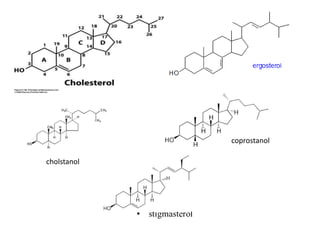
Zoosterols : these are the sterols which are obtained from animal source . For
example, cholestrol, cholstanol, coprostanol.
Phytosterols: these are sterols which are obtained from plant sources. For
example, ergosterol and stigmasterol.
Mycosterols: these are the sterols which are obtained from yeast and fungi.
For example, ergosterol.
cholstanol
coprostanol
Cholesterol
Introduction
• This is the sterol which is present in all mammalian tissues either in the free
state or esterified with fatty acids.
• The solid matter of the human brain is 17% cholesterol, and gall-stones
consist nearly entirely of cholesterol.
• All mammalian steroid hormones and bile acids are derived enzymatically
from cholesterol.
• It is also true that the steroidal sapogenins and several groups of the steroid
alkaloids are based structurally on the cholesterol framework.
• It also utilised commercially for the prepration of vitamine D.
Source
• First of all, cholesterol was isolated from human gall stones
• However the various source of cholesterol are fishliver oil, and the brain
and the spinal cord of the cattle.
Properties
• It is white crystalline solid which melts at 149.
c.
• It is optically active and is laevorotatory in nature.
Colour reaction
Salkowaski’s reaction. A solution of cholesterol in chloroform , when treated with
conc. Sulphuric acid, develops a red colour in the chloroform layer.
Libermann- burchard reaction. A solution of cholesterol in chloroform , when
treated with conc. Sulphuric acid and acetic anhydride gives a greenish
colour.
Constitution of cholesterol
• the constitution of cholesterol was elucidated by Wieland and their co-
workers(1903-1932).
• So the complete constitution of cholesterol may be explained in the
following heading.
1. Structure of the nucleus
2. Position of the hydroxyl group and double bond.
3. Nature and position of the side chain.
4. Position of the angular methyl group.
1. Structure of the nucleus
I. The molecular formula of cholesterol is C27H46O.
II. On acetylation it forms monoacetate the presence of one hydroxyl group
III. It adds up two bromine atoms suggesting the presence of one double bond.
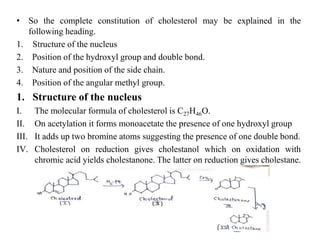
IV. Cholesterol on reduction gives cholestanol which on oxidation with
chromic acid yields cholestanone. The latter on reduction gives cholestane.
This led to the following conclusion:
• The conversion of I to II proves the presence of double bond.
• Oxidation of II to III shows that cholesterol is a secondary alcohol.
• The saturated hydrocarbon (cholestane) of cholesterol corresponds to the
general formula (CnH2n-6) for tetracyclic compounds, hence cholesterol is a
tetacyclic alcohol.
2. Position of the hydroxyl group and double bond
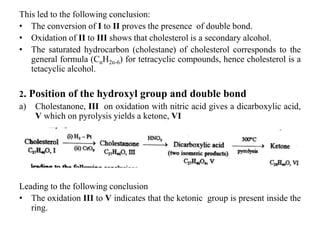
a) Cholestanone, III on oxidation with nitric acid gives a dicarboxylic acid,
V which on pyrolysis yields a ketone, VI
Leading to the following conclusion
• The oxidation III to V indicates that the ketonic group is present inside the
ring.
• The conversation of dicarboxylic acid, V to a ketone, VI indicates that V is
either a 1, 6 or 1, 7- decarboxylic acid [blanc rule]. Now we see that this
dicarboxylic acid is obtained from the hydroxyl group of cholesterol which
can’t present in ring D as it would form a ,5- decarboxylic acid instead of 1,6-
or 1,7- decarboxylic acid on the above treatment. Hence the hydroxyl group
may be either in ring A,B or C.
• The formation of two isomeric dicarboxylic acids, V, suggest that the keto
group in cholestanone is flanked by a methylene group on either side(-
CH2.CO.CH2-) .
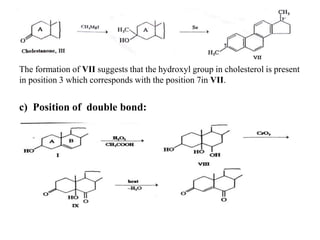
b) Cholestone, III. on treatment with methyl magnesium iodide followed by
selinium dehydrogenation yields 3’, 7- dimethylcyclopentenophenanthrene, VII,
the structure of which is proved by its synthesis.
The formation of VII suggests that the hydroxyl group in cholesterol is present
in position 3 which corresponds with the position 7in VII.
c) Position of double bond:
let us consider the following set of reactions
• The conversion of I to VII , represents the hydroxylation of the double bond.
• Cholestanetriol VIII, on oxidation gives tetracarboxylic acid, XI, without loss of
any carbon atom suggest that the two ketonic groups are secondary in nature and
the third(resistant to oxidation) is tertiary one.
• The oxidation of cholestanedione, X to a tetracarboxylic acid, XI, without loss of
any carbon atomsuggests that the two ketonic groups in X are present in different
rings, i.e., the double bond and the hydroxyl group in cholesterol are present in
two different rings
• Since cholestanedione X , can forms a pyridazine derivatives withn hydrazine,
the two ketonic groups of X are in gamma position with respect to each other
which is possible only if the double bond is present in between C5 and C6.
3. Nature and position of side chain.
1.
The above reaction shows that the isohexylmethly ketones forms the side chain of
cholesterol and is attached to the nucleus of cholesterol through the carbon atom oxidised
to -CO group.
2. Point of attachment of side chain.
Cholesterol on selenium dehydrogenation yields Diel’s hydrocarbans indicating that the
side chain is attached to C17 in cholesterol. This position is further proved by X-ray
photographs and surface film measurements.
4. Position of the angular methyl group
i. The keto- acid on clemmensen reduction followed by the twice B-W
degradation gives tertiary acid, so angular methyl group must be present on
C10.
ii. The angular methyl group at C13 or C14 which enters the five membered ring of
cholesterol to form a six membered ring of chrysene.
Synthesis of cholesterol
Many synthesis of cholesterol have been announced by various groups of scientists,
e.g., Woodward, Johnson and Robinson. The main difficulty in the synthesis of
steroids is due to their stereochemistry viz , near 256 optically active isomers are
possible in cholesterol
Woodward synthesis
Cholesterol

Cholesterol

  • 1.
    General Introduction, Chemistry ofSterols DEPARTMENT OF PHARMACEUTICAL CHEMISTRY ISF College of Pharmacy, Moga Shalini Jaswal M pharm (Pharmaceutical Chemistry) 1st sem
  • 2.
    STEROIDS • Steroids aremembers of a large class of organic compounds occurring widely in plants and animals. • Characterized by the presence of a 1,2- cyclopentenoperhydrophenanthrene nucleus in their structure, which may be partially reduced or modified.
  • 3.
    STEROLS • These arethe crystalline steroids which contains an alcoholic group. • These differ from common alcohols in being solid and due to this reason these are called sterols. • They are waxy, colorless solids, soluble in most of the organic solvents and virtually insoluble in water. • They contains one alcohol functional group and may be either saturated (plant sterols) or unsaturated (all animal sterols and many plant sterols). • In nature they are often esterified with higher fatty acids. • Sterols have been classified into three types on the basis of their sources: Zoosterols : these are the sterols which are obtained from animal source . For example, cholestrol, cholstanol, coprostanol. Phytosterols: these are sterols which are obtained from plant sources. For example, ergosterol and stigmasterol. Mycosterols: these are the sterols which are obtained from yeast and fungi. For example, ergosterol.
  • 4.
  • 5.
    Cholesterol Introduction • This isthe sterol which is present in all mammalian tissues either in the free state or esterified with fatty acids. • The solid matter of the human brain is 17% cholesterol, and gall-stones consist nearly entirely of cholesterol. • All mammalian steroid hormones and bile acids are derived enzymatically from cholesterol. • It is also true that the steroidal sapogenins and several groups of the steroid alkaloids are based structurally on the cholesterol framework. • It also utilised commercially for the prepration of vitamine D. Source • First of all, cholesterol was isolated from human gall stones • However the various source of cholesterol are fishliver oil, and the brain and the spinal cord of the cattle.
  • 6.
    Properties • It iswhite crystalline solid which melts at 149. c. • It is optically active and is laevorotatory in nature. Colour reaction Salkowaski’s reaction. A solution of cholesterol in chloroform , when treated with conc. Sulphuric acid, develops a red colour in the chloroform layer. Libermann- burchard reaction. A solution of cholesterol in chloroform , when treated with conc. Sulphuric acid and acetic anhydride gives a greenish colour. Constitution of cholesterol • the constitution of cholesterol was elucidated by Wieland and their co- workers(1903-1932).
  • 7.
    • So thecomplete constitution of cholesterol may be explained in the following heading. 1. Structure of the nucleus 2. Position of the hydroxyl group and double bond. 3. Nature and position of the side chain. 4. Position of the angular methyl group. 1. Structure of the nucleus I. The molecular formula of cholesterol is C27H46O. II. On acetylation it forms monoacetate the presence of one hydroxyl group III. It adds up two bromine atoms suggesting the presence of one double bond. IV. Cholesterol on reduction gives cholestanol which on oxidation with chromic acid yields cholestanone. The latter on reduction gives cholestane.
  • 8.
    This led tothe following conclusion: • The conversion of I to II proves the presence of double bond. • Oxidation of II to III shows that cholesterol is a secondary alcohol. • The saturated hydrocarbon (cholestane) of cholesterol corresponds to the general formula (CnH2n-6) for tetracyclic compounds, hence cholesterol is a tetacyclic alcohol. 2. Position of the hydroxyl group and double bond a) Cholestanone, III on oxidation with nitric acid gives a dicarboxylic acid, V which on pyrolysis yields a ketone, VI Leading to the following conclusion • The oxidation III to V indicates that the ketonic group is present inside the ring.
  • 9.
    • The conversationof dicarboxylic acid, V to a ketone, VI indicates that V is either a 1, 6 or 1, 7- decarboxylic acid [blanc rule]. Now we see that this dicarboxylic acid is obtained from the hydroxyl group of cholesterol which can’t present in ring D as it would form a ,5- decarboxylic acid instead of 1,6- or 1,7- decarboxylic acid on the above treatment. Hence the hydroxyl group may be either in ring A,B or C. • The formation of two isomeric dicarboxylic acids, V, suggest that the keto group in cholestanone is flanked by a methylene group on either side(- CH2.CO.CH2-) . b) Cholestone, III. on treatment with methyl magnesium iodide followed by selinium dehydrogenation yields 3’, 7- dimethylcyclopentenophenanthrene, VII, the structure of which is proved by its synthesis.
  • 10.
    The formation ofVII suggests that the hydroxyl group in cholesterol is present in position 3 which corresponds with the position 7in VII. c) Position of double bond:
  • 11.
    let us considerthe following set of reactions • The conversion of I to VII , represents the hydroxylation of the double bond. • Cholestanetriol VIII, on oxidation gives tetracarboxylic acid, XI, without loss of any carbon atom suggest that the two ketonic groups are secondary in nature and the third(resistant to oxidation) is tertiary one. • The oxidation of cholestanedione, X to a tetracarboxylic acid, XI, without loss of any carbon atomsuggests that the two ketonic groups in X are present in different rings, i.e., the double bond and the hydroxyl group in cholesterol are present in two different rings • Since cholestanedione X , can forms a pyridazine derivatives withn hydrazine, the two ketonic groups of X are in gamma position with respect to each other which is possible only if the double bond is present in between C5 and C6.
  • 12.
    3. Nature andposition of side chain. 1. The above reaction shows that the isohexylmethly ketones forms the side chain of cholesterol and is attached to the nucleus of cholesterol through the carbon atom oxidised to -CO group. 2. Point of attachment of side chain. Cholesterol on selenium dehydrogenation yields Diel’s hydrocarbans indicating that the side chain is attached to C17 in cholesterol. This position is further proved by X-ray photographs and surface film measurements. 4. Position of the angular methyl group i. The keto- acid on clemmensen reduction followed by the twice B-W degradation gives tertiary acid, so angular methyl group must be present on C10.
  • 13.
    ii. The angularmethyl group at C13 or C14 which enters the five membered ring of cholesterol to form a six membered ring of chrysene. Synthesis of cholesterol Many synthesis of cholesterol have been announced by various groups of scientists, e.g., Woodward, Johnson and Robinson. The main difficulty in the synthesis of steroids is due to their stereochemistry viz , near 256 optically active isomers are possible in cholesterol
  • 14.

Editor's Notes

  • #10 Blanc rule decarboxylic acid upto 1,5 gives anhydride on heating or pyrolysis but 1,6 or 1,7 decarboxylic acids yields ketonwith loss of one carbon atom