GEOGRAPHICAL SKILLS AND INVESTIGATIONS
In this Chapter you will explore three key topics:
• Topographical map reading skills
• Geographical data and techniques
• Geographical investigations
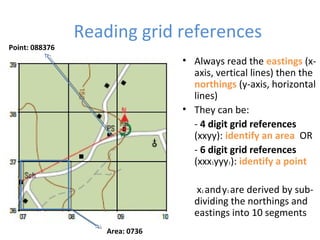
Reading grid references
• Always read the eastings (x-
axis, vertical lines) then the
northings (y-axis, horizontal
lines)
• They can be:
- 4 digit grid references
(xxyy): identify an area OR
- 6 digit grid references
(xxx1yyy1): identify a point
x1 andy1 are derived by sub-
dividing the northings and
eastings into 10 segments
Area: 0736
Point: 088376
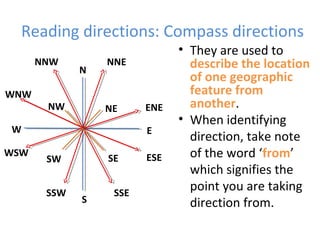
Reading directions: Compass directions
• They are used to
describe the location
of one geographic
feature from
another.
• When identifying
direction, take note
of the word ‘from’
which signifies the
point you are taking
direction from.
N
E
S
W
NE
SESW
NW
NNE
ENE
ESE
SSESSW
WSW
WNW
NNW
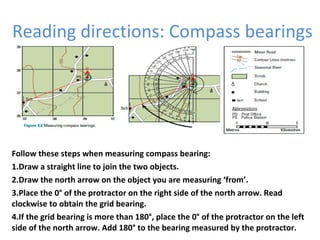
Follow these steps when measuring compass bearing:
1.Draw a straight line to join the two objects.
2.Draw the north arrow on the object you are measuring ‘from’.
3.Place the 0° of the protractor on the right side of the north arrow. Read
clockwise to obtain the grid bearing.
4.If the grid bearing is more than 180°, place the 0° of the protractor on the left
side of the north arrow. Add 180° to the bearing measured by the protractor.
Reading directions: Compass bearings
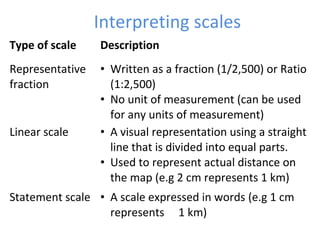
Interpreting scales
Type of scale Description
Representative
fraction
• Written as a fraction (1/2,500) or Ratio
(1:2,500)
• No unit of measurement (can be used
for any units of measurement)
Linear scale • A visual representation using a straight
line that is divided into equal parts.
• Used to represent actual distance on
the map (e.g 2 cm represents 1 km)
Statement scale • A scale expressed in words (e.g 1 cm
represents 1 km)
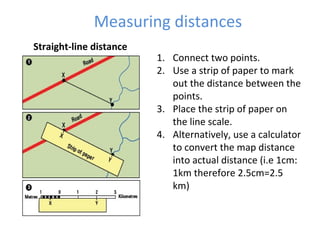
Measuring distances
Straight-line distance
1. Connect two points.
2. Use a strip of paper to mark
out the distance between the
points.
3. Place the strip of paper on
the line scale.
4. Alternatively, use a calculator
to convert the map distance
into actual distance (i.e 1cm:
1km therefore 2.5cm=2.5
km)
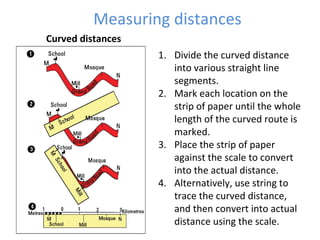
Curved distances
1. Divide the curved distance
into various straight line
segments.
2. Mark each location on the
strip of paper until the whole
length of the curved route is
marked.
3. Place the strip of paper
against the scale to convert
into the actual distance.
4. Alternatively, use string to
trace the curved distance,
and then convert into actual
distance using the scale.
Measuring distances
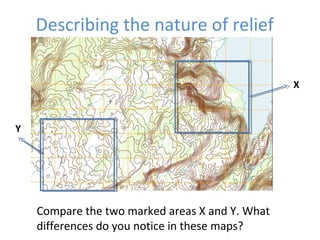
Describing the nature of relief
Compare the two marked areas X and Y. What
differences do you notice in these maps?
X
Y
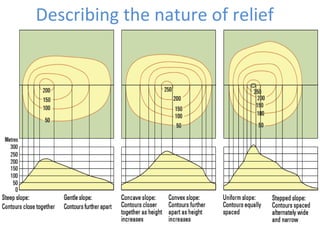
Describing the nature of relief
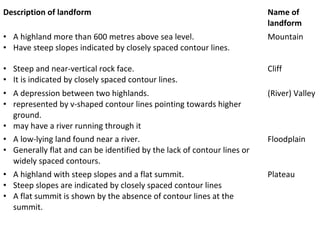
Description of landform Name of
landform
• A highland more than 600 metres above sea level.
• Have steep slopes indicated by closely spaced contour lines.
Mountain
• Steep and near-vertical rock face.
• It is indicated by closely spaced contour lines.
Cliff
• A depression between two highlands.
• represented by v-shaped contour lines pointing towards higher
ground.
• may have a river running through it
(River) Valley
• A low-lying land found near a river.
• Generally flat and can be identified by the lack of contour lines or
widely spaced contours.
Floodplain
• A highland with steep slopes and a flat summit.
• Steep slopes are indicated by closely spaced contour lines
• A flat summit is shown by the absence of contour lines at the
summit.
Plateau
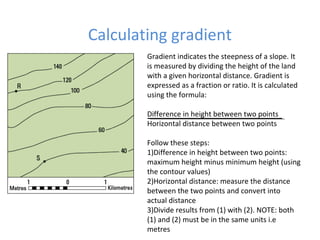
Calculating gradient
Gradient indicates the steepness of a slope. It
is measured by dividing the height of the land
with a given horizontal distance. Gradient is
expressed as a fraction or ratio. It is calculated
using the formula:
Difference in height between two points
Horizontal distance between two points
Follow these steps:
1)Difference in height between two points:
maximum height minus minimum height (using
the contour values)
2)Horizontal distance: measure the distance
between the two points and convert into
actual distance
3)Divide results from (1) with (2). NOTE: both
(1) and (2) must be in the same units i.e
metres
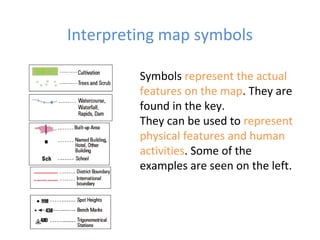
Interpreting map symbols
Symbols represent the actual
features on the map. They are
found in the key.
They can be used to represent
physical features and human
activities. Some of the
examples are seen on the left.
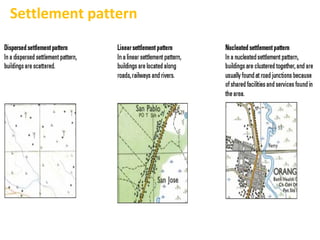
Settlement pattern
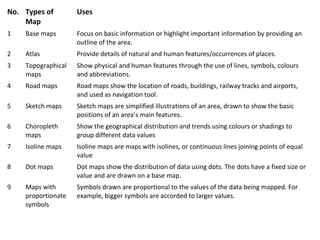
No. Types of
Map
Uses
1 Base maps Focus on basic information or highlight important information by providing an
outline of the area.
2 Atlas Provide details of natural and human features/occurrences of places.
3 Topographical
maps
Show physical and human features through the use of lines, symbols, colours
and abbreviations.
4 Road maps Road maps show the location of roads, buildings, railway tracks and airports,
and used as navigation tool.
5 Sketch maps Sketch maps are simplified illustrations of an area, drawn to show the basic
positions of an area’s main features.
6 Choropleth
maps
Show the geographical distribution and trends using colours or shadings to
group different data values
7 Isoline maps Isoline maps are maps with isolines, or continuous lines joining points of equal
value
8 Dot maps Dot maps show the distribution of data using dots. The dots have a fixed size or
value and are drawn on a base map.
9 Maps with
proportionate
symbols
Symbols drawn are proportional to the values of the data being mapped. For
example, bigger symbols are accorded to larger values.
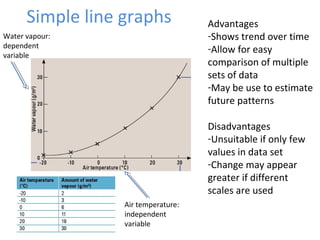
Simple line graphs Advantages
-Shows trend over time
-Allow for easy
comparison of multiple
sets of data
-May be use to estimate
future patterns
Disadvantages
-Unsuitable if only few
values in data set
-Change may appear
greater if different
scales are used
Air temperature:
independent
variable
Water vapour:
dependent
variable
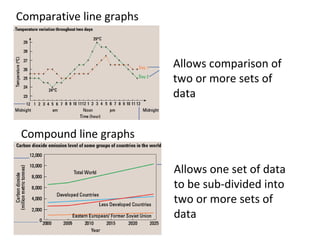
Comparative line graphs
Allows comparison of
two or more sets of
data
Compound line graphs
Allows one set of data
to be sub-divided into
two or more sets of
data
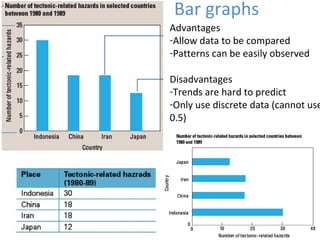
Bar graphs
Advantages
-Allow data to be compared
-Patterns can be easily observed
Disadvantages
-Trends are hard to predict
-Only use discrete data (cannot use
0.5)
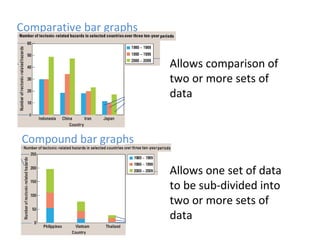
Comparative bar graphs
Allows comparison of
two or more sets of
data
Compound bar graphs
Allows one set of data
to be sub-divided into
two or more sets of
data
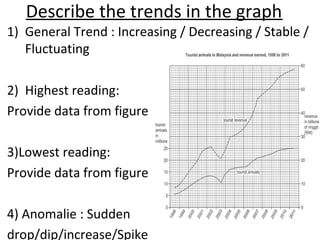
Describe the trends in the graph
1) General Trend : Increasing / Decreasing / Stable /
Fluctuating
2) Highest reading:
Provide data from figure
3)Lowest reading:
Provide data from figure
4) Anomalie : Sudden
drop/dip/increase/Spike
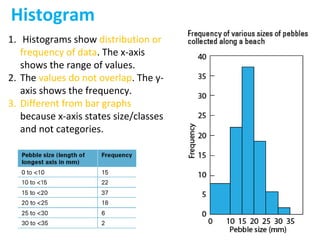
Histogram
1. Histograms show distribution or
frequency of data. The x-axis
shows the range of values.
2. The values do not overlap. The y-
axis shows the frequency.
3. Different from bar graphs
because x-axis states size/classes
and not categories.
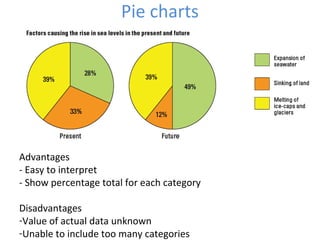
Pie charts
Advantages
- Easy to interpret
- Show percentage total for each category
Disadvantages
-Value of actual data unknown
-Unable to include too many categories
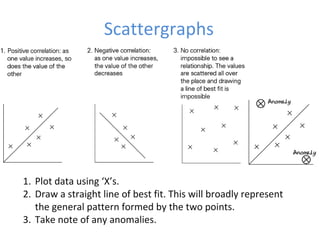
Scattergraphs
1. Plot data using ‘X’s.
2. Draw a straight line of best fit. This will broadly represent
the general pattern formed by the two points.
3. Take note of any anomalies.
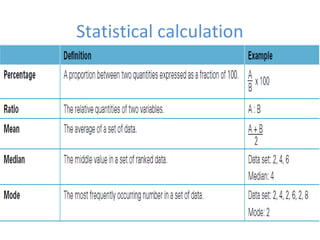
Statistical calculation
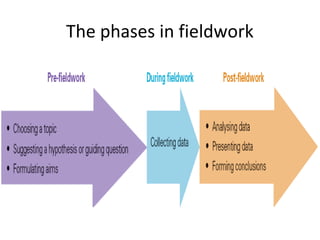
The phases in fieldwork
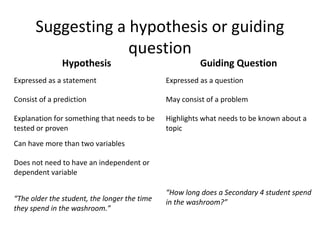
Suggesting a hypothesis or guiding
question
Hypothesis Guiding Question
Expressed as a statement Expressed as a question
Consist of a prediction May consist of a problem
Explanation for something that needs to be
tested or proven
Highlights what needs to be known about a
topic
Can have more than two variables
“How long does a Secondary 4 student spend
in the washroom?”
Does not need to have an independent or
dependent variable
“The older the student, the longer the time
they spend in the washroom.”

Gi

  • 1.
    GEOGRAPHICAL SKILLS ANDINVESTIGATIONS In this Chapter you will explore three key topics: • Topographical map reading skills • Geographical data and techniques • Geographical investigations
  • 2.
    Reading grid references •Always read the eastings (x- axis, vertical lines) then the northings (y-axis, horizontal lines) • They can be: - 4 digit grid references (xxyy): identify an area OR - 6 digit grid references (xxx1yyy1): identify a point x1 andy1 are derived by sub- dividing the northings and eastings into 10 segments Area: 0736 Point: 088376
  • 3.
    Reading directions: Compassdirections • They are used to describe the location of one geographic feature from another. • When identifying direction, take note of the word ‘from’ which signifies the point you are taking direction from. N E S W NE SESW NW NNE ENE ESE SSESSW WSW WNW NNW
  • 4.
    Follow these stepswhen measuring compass bearing: 1.Draw a straight line to join the two objects. 2.Draw the north arrow on the object you are measuring ‘from’. 3.Place the 0° of the protractor on the right side of the north arrow. Read clockwise to obtain the grid bearing. 4.If the grid bearing is more than 180°, place the 0° of the protractor on the left side of the north arrow. Add 180° to the bearing measured by the protractor. Reading directions: Compass bearings
  • 5.
    Interpreting scales Type ofscale Description Representative fraction • Written as a fraction (1/2,500) or Ratio (1:2,500) • No unit of measurement (can be used for any units of measurement) Linear scale • A visual representation using a straight line that is divided into equal parts. • Used to represent actual distance on the map (e.g 2 cm represents 1 km) Statement scale • A scale expressed in words (e.g 1 cm represents 1 km)
  • 6.
    Measuring distances Straight-line distance 1.Connect two points. 2. Use a strip of paper to mark out the distance between the points. 3. Place the strip of paper on the line scale. 4. Alternatively, use a calculator to convert the map distance into actual distance (i.e 1cm: 1km therefore 2.5cm=2.5 km)
  • 7.
    Curved distances 1. Dividethe curved distance into various straight line segments. 2. Mark each location on the strip of paper until the whole length of the curved route is marked. 3. Place the strip of paper against the scale to convert into the actual distance. 4. Alternatively, use string to trace the curved distance, and then convert into actual distance using the scale. Measuring distances
  • 8.
    Describing the natureof relief Compare the two marked areas X and Y. What differences do you notice in these maps? X Y
  • 9.
  • 10.
    Description of landformName of landform • A highland more than 600 metres above sea level. • Have steep slopes indicated by closely spaced contour lines. Mountain • Steep and near-vertical rock face. • It is indicated by closely spaced contour lines. Cliff • A depression between two highlands. • represented by v-shaped contour lines pointing towards higher ground. • may have a river running through it (River) Valley • A low-lying land found near a river. • Generally flat and can be identified by the lack of contour lines or widely spaced contours. Floodplain • A highland with steep slopes and a flat summit. • Steep slopes are indicated by closely spaced contour lines • A flat summit is shown by the absence of contour lines at the summit. Plateau
  • 11.
    Calculating gradient Gradient indicatesthe steepness of a slope. It is measured by dividing the height of the land with a given horizontal distance. Gradient is expressed as a fraction or ratio. It is calculated using the formula: Difference in height between two points Horizontal distance between two points Follow these steps: 1)Difference in height between two points: maximum height minus minimum height (using the contour values) 2)Horizontal distance: measure the distance between the two points and convert into actual distance 3)Divide results from (1) with (2). NOTE: both (1) and (2) must be in the same units i.e metres
  • 12.
    Interpreting map symbols Symbolsrepresent the actual features on the map. They are found in the key. They can be used to represent physical features and human activities. Some of the examples are seen on the left.
  • 13.
  • 14.
    No. Types of Map Uses 1Base maps Focus on basic information or highlight important information by providing an outline of the area. 2 Atlas Provide details of natural and human features/occurrences of places. 3 Topographical maps Show physical and human features through the use of lines, symbols, colours and abbreviations. 4 Road maps Road maps show the location of roads, buildings, railway tracks and airports, and used as navigation tool. 5 Sketch maps Sketch maps are simplified illustrations of an area, drawn to show the basic positions of an area’s main features. 6 Choropleth maps Show the geographical distribution and trends using colours or shadings to group different data values 7 Isoline maps Isoline maps are maps with isolines, or continuous lines joining points of equal value 8 Dot maps Dot maps show the distribution of data using dots. The dots have a fixed size or value and are drawn on a base map. 9 Maps with proportionate symbols Symbols drawn are proportional to the values of the data being mapped. For example, bigger symbols are accorded to larger values.
  • 15.
    Simple line graphsAdvantages -Shows trend over time -Allow for easy comparison of multiple sets of data -May be use to estimate future patterns Disadvantages -Unsuitable if only few values in data set -Change may appear greater if different scales are used Air temperature: independent variable Water vapour: dependent variable
  • 16.
    Comparative line graphs Allowscomparison of two or more sets of data Compound line graphs Allows one set of data to be sub-divided into two or more sets of data
  • 17.
    Bar graphs Advantages -Allow datato be compared -Patterns can be easily observed Disadvantages -Trends are hard to predict -Only use discrete data (cannot use 0.5)
  • 18.
    Comparative bar graphs Allowscomparison of two or more sets of data Compound bar graphs Allows one set of data to be sub-divided into two or more sets of data
  • 19.
    Describe the trendsin the graph 1) General Trend : Increasing / Decreasing / Stable / Fluctuating 2) Highest reading: Provide data from figure 3)Lowest reading: Provide data from figure 4) Anomalie : Sudden drop/dip/increase/Spike
  • 20.
    Histogram 1. Histograms showdistribution or frequency of data. The x-axis shows the range of values. 2. The values do not overlap. The y- axis shows the frequency. 3. Different from bar graphs because x-axis states size/classes and not categories.
  • 21.
    Pie charts Advantages - Easyto interpret - Show percentage total for each category Disadvantages -Value of actual data unknown -Unable to include too many categories
  • 22.
    Scattergraphs 1. Plot datausing ‘X’s. 2. Draw a straight line of best fit. This will broadly represent the general pattern formed by the two points. 3. Take note of any anomalies.
  • 23.
  • 24.
    The phases infieldwork
  • 25.
    Suggesting a hypothesisor guiding question Hypothesis Guiding Question Expressed as a statement Expressed as a question Consist of a prediction May consist of a problem Explanation for something that needs to be tested or proven Highlights what needs to be known about a topic Can have more than two variables “How long does a Secondary 4 student spend in the washroom?” Does not need to have an independent or dependent variable “The older the student, the longer the time they spend in the washroom.”

Editor's Notes

  • #3 Suggested activity: - Illustrate to students how the 10 segments can be drawn. Help students understand grid references by showing them these videos: http://www.youtube.com/watch?v=CRb2gRiTQxY&feature=related http://www.youtube.com/watch?v=AJVxgWttUdY
  • #4 Note: Students often have difficulty in visualizing the 16 cardinal points. Use the animation in the slide to help them.
  • #5 Suggested activity: - As most students will have problems identifying the object they should be measuring the bearing from, the same approach shown in slide 9 can be used to help students determine the angle they have to measure. In this case, accuracy is not essential, the exercise is meant to provide students sufficient practice in determining the angle they have to measure.
  • #6 Suggested activity: - Show students a topographical map and ask them to identify the R.F, linear scale and write a statement scale.
  • #9 Suggested activity: - Ask students to list the differences based solely on superficial observations (no need for any prior knowledge) of the two areas. Possible answers include X is near to large water body. X has ‘darker lines’ or ‘lines’ that are close together. For NA students: - Guide their observations with the following questions:  What do you notice about the number of lines on both the maps?  What is the distance between the lines? Image: © U.S Geological Survey
  • #10 Suggested activity - Show students how cross-sections are drawn with this video: http://www.youtube.com/watch?v=X6uavZnHTuY - Ask students to determine which landform has the lowest height. The height of the first landform from the left is the lowest. The other two is the same height of 250m. This exercise allows students to understand that the contour lines indicate the height of the landform. - Ask students what the difference in value between the contour lines is. 50 m. Tell students that the difference between the lines is called a contour interval. Maps generally have a constant contour interval although some maps may use different contour intervals. In this case, the contour interval is 50m. - Emphasise that contour lines that are close together show steep relief while those that are far apart show gentle relief.
  • #11 Suggested activity: - Ask students to match the landforms found in this slide and the next to the descriptions found in slides 22-23. - Ask students to make inferences based on their prior knowledge.
  • #12 Suggested activity: - Ask students to follow these steps and calculate the gradient of between R and S in the figure before referring to the answer in the Textbook.
  • #15 Ask students to refer to the Textbook for details on the various types of map.
  • #25 Tell students that geographical Investigation allows them to explore and understand certain issues about our environment. In order to fully understand the issue, they need to gather, analyse and present data in a systematic manner.
  • #26 Suggested activity: Ask students to brainstorm some hypotheses and guiding questions related to their everyday lives. Once the students are used to coming up with hypotheses/guiding questions, they can then craft hypotheses/guiding questions more related to geographical issues. Ask students to write down the aims for the hypotheses/guiding questions they come up with.