dr samarth mishra
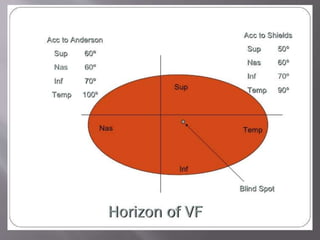
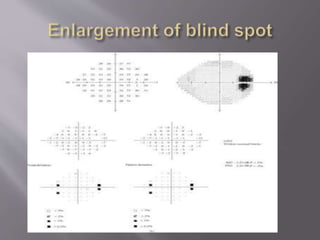
 The 3 dimensional area of a subjects surrounding
that can be seen at any one time around an object of
fixation.
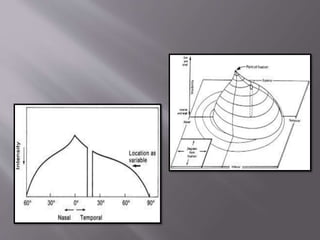
 Traquair defined visual field as “ island or hill of
vision surrounded by the sea of darkness”
 The shape of hill of vision correlates to density of
photoreceptors and their receptive field sizes.
 Perimetry is the systematic measurement of visual
field function.
 It is the measurement of Hill of Vision in terms of
establishing the patient’s differential light
sensitivity across the visual field.
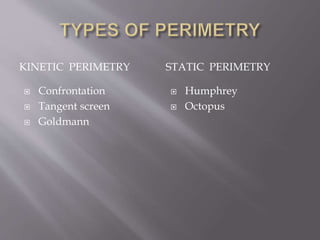
KINETIC PERIMETRY STATIC PERIMETRY
 Confrontation
 Tangent screen
 Goldmann
 Humphrey
 Octopus
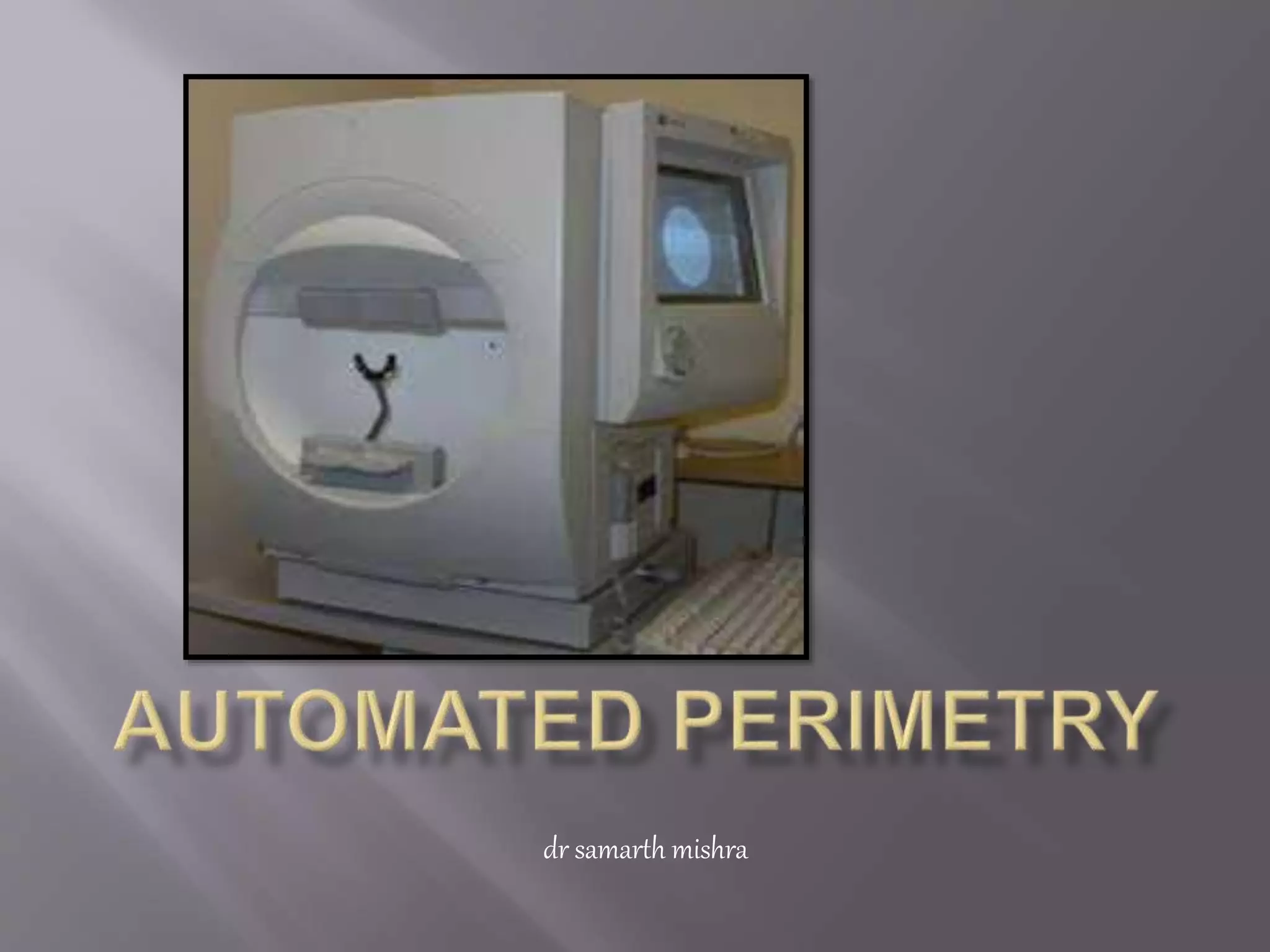
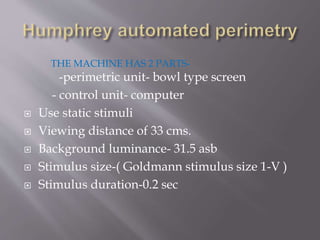
THE MACHINE HAS 2 PARTS-
-perimetric unit- bowl type screen
- control unit- computer
 Use static stimuli
 Viewing distance of 33 cms.
 Background luminance- 31.5 asb
 Stimulus size-( Goldmann stimulus size 1-V )
 Stimulus duration-0.2 sec
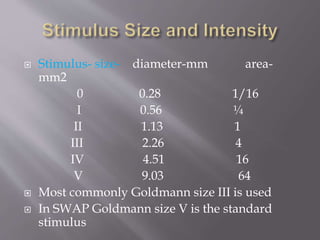
 Stimulus- size- diameter-mm area-
mm2
0 0.28 1/16
I 0.56 ¼
II 1.13 1
III 2.26 4
IV 4.51 16
V 9.03 64
 Most commonly Goldmann size III is used
 In SWAP Goldmann size V is the standard
stimulus
 Heijl-Krakau method of fixation monitoring- It
provides index of quality of patient fixation
during examination by periodically exposing
stimuli in blind spot
 Eye Monitoring by perimetrist
 Infra red Gaze Monitors
 SUPRATHRESHOLD TESTING
 THRESHOLD TESTING
1. Full threshold
2. FASTPAC
3. SITA standard
4. SITAFAST
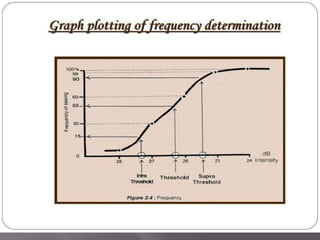
 Field is mapped with a stimulus that is 4 to 6 dB
above the threshold
 Very rapid evaluation
 Screening purpose
 In this technique light sensitivity ( threshold) is
determined at each testing location in the field.
 Provides more accurate hill of vision
 Capable of detecting early and shallow focal loss
 Central 30-2 – 76 points are tested. Each point 6
deg apart
 Central 24-2 – 56 points are tested. Each point 6
deg apart
 Central 10-2 – 68 points are tested . Each point
2 deg apart
 Macular threshold test – square grid of 16
points each 2 deg apart
 Nasal step- 14 points peripheral field
testing
 60-4- 60 points .
 Useful to determine macular split
 Used when only central 5 deg of field remains
 If a defect impinges on fixation , but other
points are preserved macular pogramme is
used in addition to other programmes.
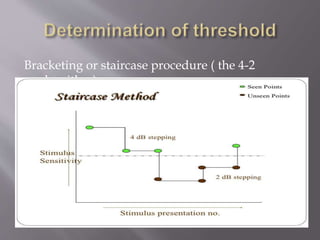
Bracketing or staircase procedure ( the 4-2
algorithm)
 LESS TIME CONSUMING
 IT CHANGES THE STIMULUS INTENSITY IN
3 dB steps either increasing it or decreasing it
depending on patients initial response
 High intratest variability i.e. Short-term
Fluctuation
 More efficient estimation of threshold
 2 strategies- SITA Standard
SITA FAST
 short test time without compromising on the
sensitivity
 SITA creates prior probability models for normal
and glaucomatous populations
 The pace of the test is dependant on patient’s
response
 It uses informative index derived from visual field
model for each point that determines when to stop.
 Ambient light- dim
 Distance- 30cm
 Full refractive correction
 Pt chin on chin holder
 One eye occluded
 Pt hands on button ,explained about the test
 Presents 4 points one in each quadrant and
thresholds them 9d from horizontal and vertical
meridians – 25dB
 Size- III4e
 Pupil- 3-4mm
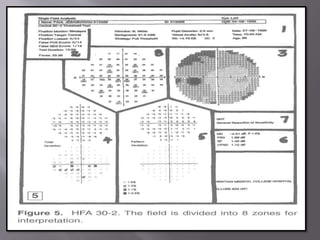
 Zone 1 : Reproduciblity
 Zone 2: Reliability indices and foveal threshold
 Zone 3: Gray scale
 Zone 4:Total deviation plot
 Zone 5: Pattern deviation plot
 Zone 6: Global Indices
 Zone 7: Glaucoma hemifield test
 Zone 8: Raw data
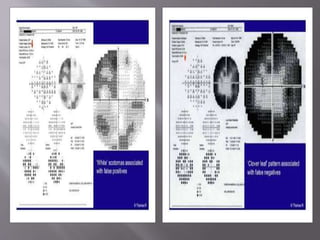
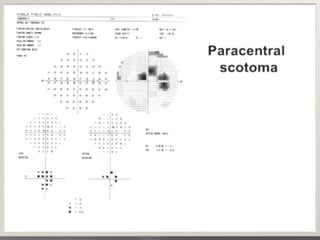
False positive error- number of times pt
responds when no stimulus shown,Trigger
happy,<33%, white scotomas
False negative error-brighter stimulus
presented which was previosly sensitive,if pt
not respond- inattentive/fatigue,<33%,clover
leaf pattern
Fixation losses- <20%
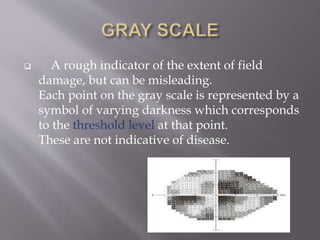
 A rough indicator of the extent of field
damage, but can be misleading.
Each point on the gray scale is represented by a
symbol of varying darkness which corresponds
to the threshold level at that point.
These are not indicative of disease.
 Total deviation plot (Zone-4) is created by
subtracting the actual raw data from the
expected value for age matched controls, at
each point.
 The Pattern deviation plot (Zone-5) based on
further calculations, is derived from the total
deviation data and the overall depression of
the visual field. It highlights focal changes
which are concealed within diffuse changes
 Mean deviation (MD): It is the weighted score of
all the points on the total deviation plot. It takes into
account both the severity of loss and amount of
field affected
 Pattern standard deviation (PSD): It measures the
extent to which the damaged points vary from the
expected hill of vision (localized loss)
 Short term fluctuation (SF): Though listed under
global indices it is a good indicator of intra test
reliability. It measures the variation at each point
on repeated thresholding in the same test.
 Corrected pattern standard deviation (CPSD): It is
calculated with the help of SF to adjust the
PSD.
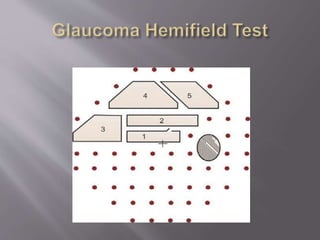
Glaucoma Hemifield test (Zone-8) is a
sophisticated analysis of 5 geometric point
clusters in the superior and the inferior arcuate
regions whose probability maps are compared
with one another. It is very
sensitive and specific at detecting asymmetry
between these regions as well as symmetric
deviations from normal data.
 Outside Normal Limits
 Borderline
 General reduction of sensitivity
 Abnormally high sensitivity
 Within normal limits
 3 or more congrous ‘non edge points’ in typical
arcuate area on 30-2 programme depressed @
p< 5% with at least one point @ p<1%
 PSD/CPSD@ P<5%
 GHT-outside normal limits
Must be demonstrated on 2 field tests
 Detection of glaucoma, progression
 Chorioretinal lesions
 Optic disc and optic nerve lesions
 Neuro-ophthalmological diseases
 Establishing a base line
 Overview printout
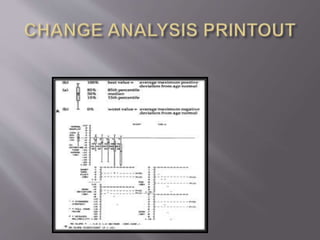
 Change Analysis Printout
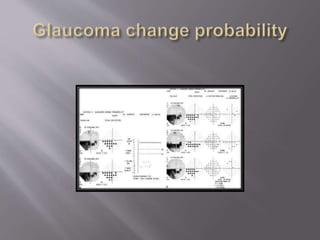
 Glaucoma Change Probability Analysis
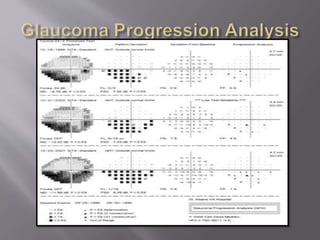
 Glaucoma Progression Analysis
 OBSTRUCTION
.Rim Artefact
.Ptosis
.Media Opacities
.Angioscotoma
 MIOSIS
 REFRACTIVE ARTEFACTS
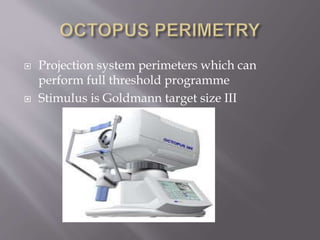
 Projection system perimeters which can
perform full threshold programme
 Stimulus is Goldmann target size III
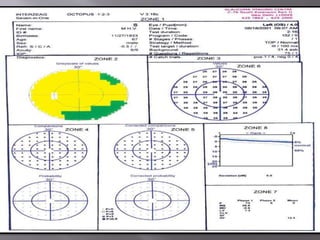
 Reproducibility (Zone-1)
 Reliability factors (Zone-2)
 Gray scale (Zone-3)
 Comparison (Zone-4)
 Corrected comparison (Zone-5)
 Numeric data/raw data(Zone-6)
 Visual field indices (Zone-7):
 Bebie.’s curve (Zone-8)
 SWAP[Short Wave Automated Perimetry]
 FDP[Frequency Doubling Perimetry]
 HPRP[High Pass Resolution Perimetry]
 Flicker Perimetry
 Multifocal Electroretinography
 ACCUMAP[Multifocal Visual Evoked
Potential]
 Motion Perimetry
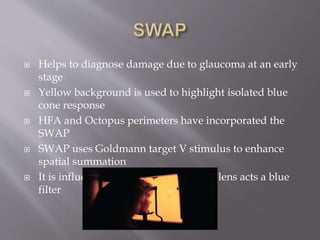
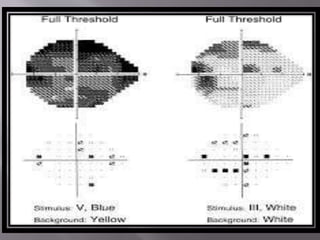
 Helps to diagnose damage due to glaucoma at an early
stage
 Yellow background is used to highlight isolated blue
cone response
 HFA and Octopus perimeters have incorporated the
SWAP
 SWAP uses Goldmann target V stimulus to enhance
spatial summation
 It is influenced by nuclear sclerosis as lens acts a blue
filter
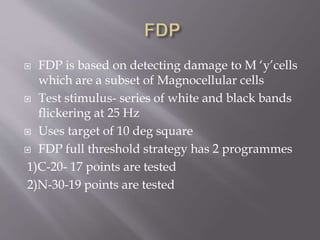
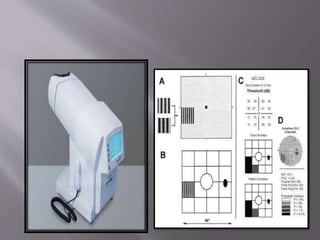
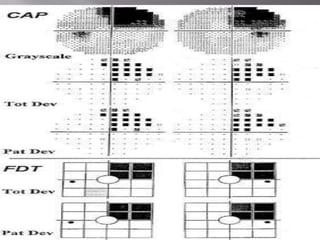
 FDP is based on detecting damage to M ‘y’cells
which are a subset of Magnocellular cells
 Test stimulus- series of white and black bands
flickering at 25 Hz
 Uses target of 10 deg square
 FDP full threshold strategy has 2 programmes
1)C-20- 17 points are tested
2)N-30-19 points are tested
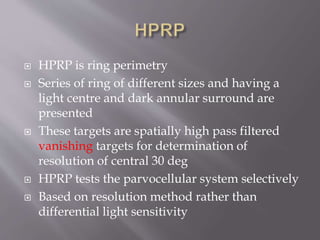
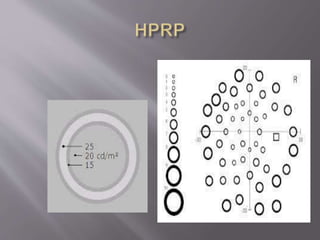
 HPRP is ring perimetry
 Series of ring of different sizes and having a
light centre and dark annular surround are
presented
 These targets are spatially high pass filtered
vanishing targets for determination of
resolution of central 30 deg
 HPRP tests the parvocellular system selectively
 Based on resolution method rather than
differential light sensitivity
 It detects light and dark stimulus
alternations(flicker) at various locations in the
field
 It targets magnocellular pathway( responsible
for flicker perception)
 Not influenced by media opacities and
refractive error
Two types-
1)Critical Fusion Frequency
2) Temporal Modulation Perimetry
Automated perimetry

Automated perimetry

  • 1.
  • 2.
     The 3dimensional area of a subjects surrounding that can be seen at any one time around an object of fixation.  Traquair defined visual field as “ island or hill of vision surrounded by the sea of darkness”  The shape of hill of vision correlates to density of photoreceptors and their receptive field sizes.
  • 5.
     Perimetry isthe systematic measurement of visual field function.  It is the measurement of Hill of Vision in terms of establishing the patient’s differential light sensitivity across the visual field.
  • 6.
    KINETIC PERIMETRY STATICPERIMETRY  Confrontation  Tangent screen  Goldmann  Humphrey  Octopus
  • 7.
    THE MACHINE HAS2 PARTS- -perimetric unit- bowl type screen - control unit- computer  Use static stimuli  Viewing distance of 33 cms.  Background luminance- 31.5 asb  Stimulus size-( Goldmann stimulus size 1-V )  Stimulus duration-0.2 sec
  • 8.
     Stimulus- size-diameter-mm area- mm2 0 0.28 1/16 I 0.56 ¼ II 1.13 1 III 2.26 4 IV 4.51 16 V 9.03 64  Most commonly Goldmann size III is used  In SWAP Goldmann size V is the standard stimulus
  • 9.
     Heijl-Krakau methodof fixation monitoring- It provides index of quality of patient fixation during examination by periodically exposing stimuli in blind spot  Eye Monitoring by perimetrist  Infra red Gaze Monitors
  • 10.
     SUPRATHRESHOLD TESTING THRESHOLD TESTING 1. Full threshold 2. FASTPAC 3. SITA standard 4. SITAFAST
  • 12.
     Field ismapped with a stimulus that is 4 to 6 dB above the threshold  Very rapid evaluation  Screening purpose
  • 13.
     In thistechnique light sensitivity ( threshold) is determined at each testing location in the field.  Provides more accurate hill of vision  Capable of detecting early and shallow focal loss
  • 14.
     Central 30-2– 76 points are tested. Each point 6 deg apart  Central 24-2 – 56 points are tested. Each point 6 deg apart  Central 10-2 – 68 points are tested . Each point 2 deg apart  Macular threshold test – square grid of 16 points each 2 deg apart  Nasal step- 14 points peripheral field testing  60-4- 60 points .
  • 15.
     Useful todetermine macular split  Used when only central 5 deg of field remains  If a defect impinges on fixation , but other points are preserved macular pogramme is used in addition to other programmes.
  • 16.
    Bracketing or staircaseprocedure ( the 4-2 algorithm)
  • 17.
     LESS TIMECONSUMING  IT CHANGES THE STIMULUS INTENSITY IN 3 dB steps either increasing it or decreasing it depending on patients initial response  High intratest variability i.e. Short-term Fluctuation
  • 18.
     More efficientestimation of threshold  2 strategies- SITA Standard SITA FAST  short test time without compromising on the sensitivity  SITA creates prior probability models for normal and glaucomatous populations  The pace of the test is dependant on patient’s response  It uses informative index derived from visual field model for each point that determines when to stop.
  • 19.
     Ambient light-dim  Distance- 30cm  Full refractive correction  Pt chin on chin holder  One eye occluded  Pt hands on button ,explained about the test  Presents 4 points one in each quadrant and thresholds them 9d from horizontal and vertical meridians – 25dB  Size- III4e  Pupil- 3-4mm
  • 20.
     Zone 1: Reproduciblity  Zone 2: Reliability indices and foveal threshold  Zone 3: Gray scale  Zone 4:Total deviation plot  Zone 5: Pattern deviation plot  Zone 6: Global Indices  Zone 7: Glaucoma hemifield test  Zone 8: Raw data
  • 22.
    False positive error-number of times pt responds when no stimulus shown,Trigger happy,<33%, white scotomas False negative error-brighter stimulus presented which was previosly sensitive,if pt not respond- inattentive/fatigue,<33%,clover leaf pattern Fixation losses- <20%
  • 24.
     A roughindicator of the extent of field damage, but can be misleading. Each point on the gray scale is represented by a symbol of varying darkness which corresponds to the threshold level at that point. These are not indicative of disease.
  • 25.
     Total deviationplot (Zone-4) is created by subtracting the actual raw data from the expected value for age matched controls, at each point.  The Pattern deviation plot (Zone-5) based on further calculations, is derived from the total deviation data and the overall depression of the visual field. It highlights focal changes which are concealed within diffuse changes
  • 26.
     Mean deviation(MD): It is the weighted score of all the points on the total deviation plot. It takes into account both the severity of loss and amount of field affected  Pattern standard deviation (PSD): It measures the extent to which the damaged points vary from the expected hill of vision (localized loss)  Short term fluctuation (SF): Though listed under global indices it is a good indicator of intra test reliability. It measures the variation at each point on repeated thresholding in the same test.
  • 27.
     Corrected patternstandard deviation (CPSD): It is calculated with the help of SF to adjust the PSD.
  • 28.
    Glaucoma Hemifield test(Zone-8) is a sophisticated analysis of 5 geometric point clusters in the superior and the inferior arcuate regions whose probability maps are compared with one another. It is very sensitive and specific at detecting asymmetry between these regions as well as symmetric deviations from normal data.
  • 29.
     Outside NormalLimits  Borderline  General reduction of sensitivity  Abnormally high sensitivity  Within normal limits
  • 31.
     3 ormore congrous ‘non edge points’ in typical arcuate area on 30-2 programme depressed @ p< 5% with at least one point @ p<1%  PSD/CPSD@ P<5%  GHT-outside normal limits Must be demonstrated on 2 field tests
  • 32.
     Detection ofglaucoma, progression  Chorioretinal lesions  Optic disc and optic nerve lesions  Neuro-ophthalmological diseases
  • 41.
     Establishing abase line  Overview printout  Change Analysis Printout  Glaucoma Change Probability Analysis  Glaucoma Progression Analysis
  • 46.
     OBSTRUCTION .Rim Artefact .Ptosis .MediaOpacities .Angioscotoma  MIOSIS  REFRACTIVE ARTEFACTS
  • 47.
     Projection systemperimeters which can perform full threshold programme  Stimulus is Goldmann target size III
  • 48.
     Reproducibility (Zone-1) Reliability factors (Zone-2)  Gray scale (Zone-3)  Comparison (Zone-4)  Corrected comparison (Zone-5)  Numeric data/raw data(Zone-6)  Visual field indices (Zone-7):  Bebie.’s curve (Zone-8)
  • 50.
     SWAP[Short WaveAutomated Perimetry]  FDP[Frequency Doubling Perimetry]  HPRP[High Pass Resolution Perimetry]  Flicker Perimetry  Multifocal Electroretinography  ACCUMAP[Multifocal Visual Evoked Potential]  Motion Perimetry
  • 51.
     Helps todiagnose damage due to glaucoma at an early stage  Yellow background is used to highlight isolated blue cone response  HFA and Octopus perimeters have incorporated the SWAP  SWAP uses Goldmann target V stimulus to enhance spatial summation  It is influenced by nuclear sclerosis as lens acts a blue filter
  • 53.
     FDP isbased on detecting damage to M ‘y’cells which are a subset of Magnocellular cells  Test stimulus- series of white and black bands flickering at 25 Hz  Uses target of 10 deg square  FDP full threshold strategy has 2 programmes 1)C-20- 17 points are tested 2)N-30-19 points are tested
  • 56.
     HPRP isring perimetry  Series of ring of different sizes and having a light centre and dark annular surround are presented  These targets are spatially high pass filtered vanishing targets for determination of resolution of central 30 deg  HPRP tests the parvocellular system selectively  Based on resolution method rather than differential light sensitivity
  • 58.
     It detectslight and dark stimulus alternations(flicker) at various locations in the field  It targets magnocellular pathway( responsible for flicker perception)  Not influenced by media opacities and refractive error Two types- 1)Critical Fusion Frequency 2) Temporal Modulation Perimetry