VECTOR CALCULUS AND LINEAR
ALGEBRA (2110015)
Made By :-
DIVYANGSINH RAJ (150990119004)
NAVED FRUITWALA (150990119006)
UTKARSH GANDHI (150990119007)
Branch :- MECHANICAL ENGINEERING
Semester :- 2ᴺᴰ
TOPIC :-
LINEAR DEPENDENCE(LD)
&
LINEAR
INDEPENDENCE(LI)
Linear Dependence and
Independence :-
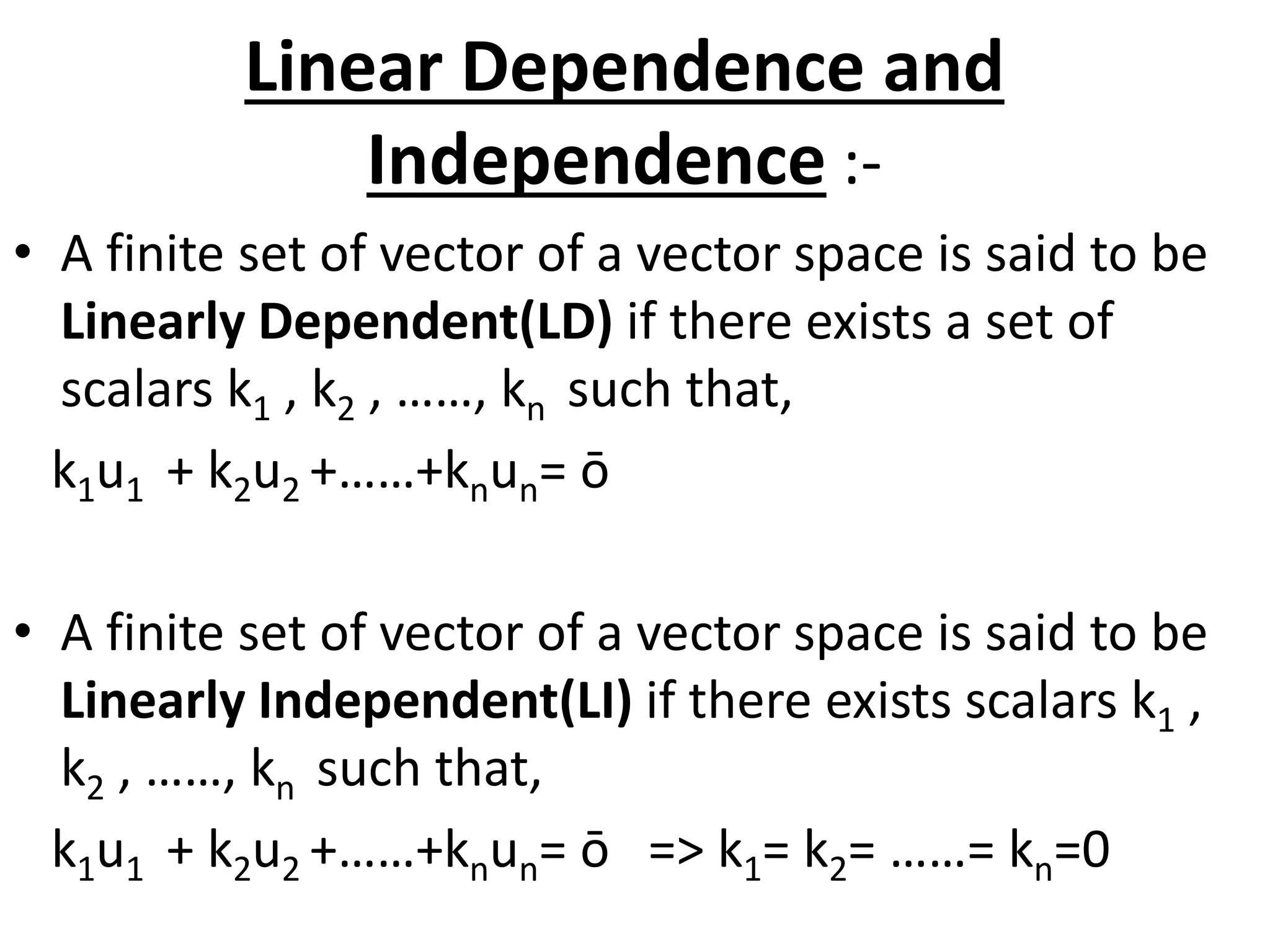
• A finite set of vector of a vector space is said to be
Linearly Dependent(LD) if there exists a set of
scalars k1 , k2 , ……, kn such that,
k1u1 + k2u2 +……+knun= ō
• A finite set of vector of a vector space is said to be
Linearly Independent(LI) if there exists scalars k1 ,
k2 , ……, kn such that,
k1u1 + k2u2 +……+knun= ō => k1= k2= ……= kn=0
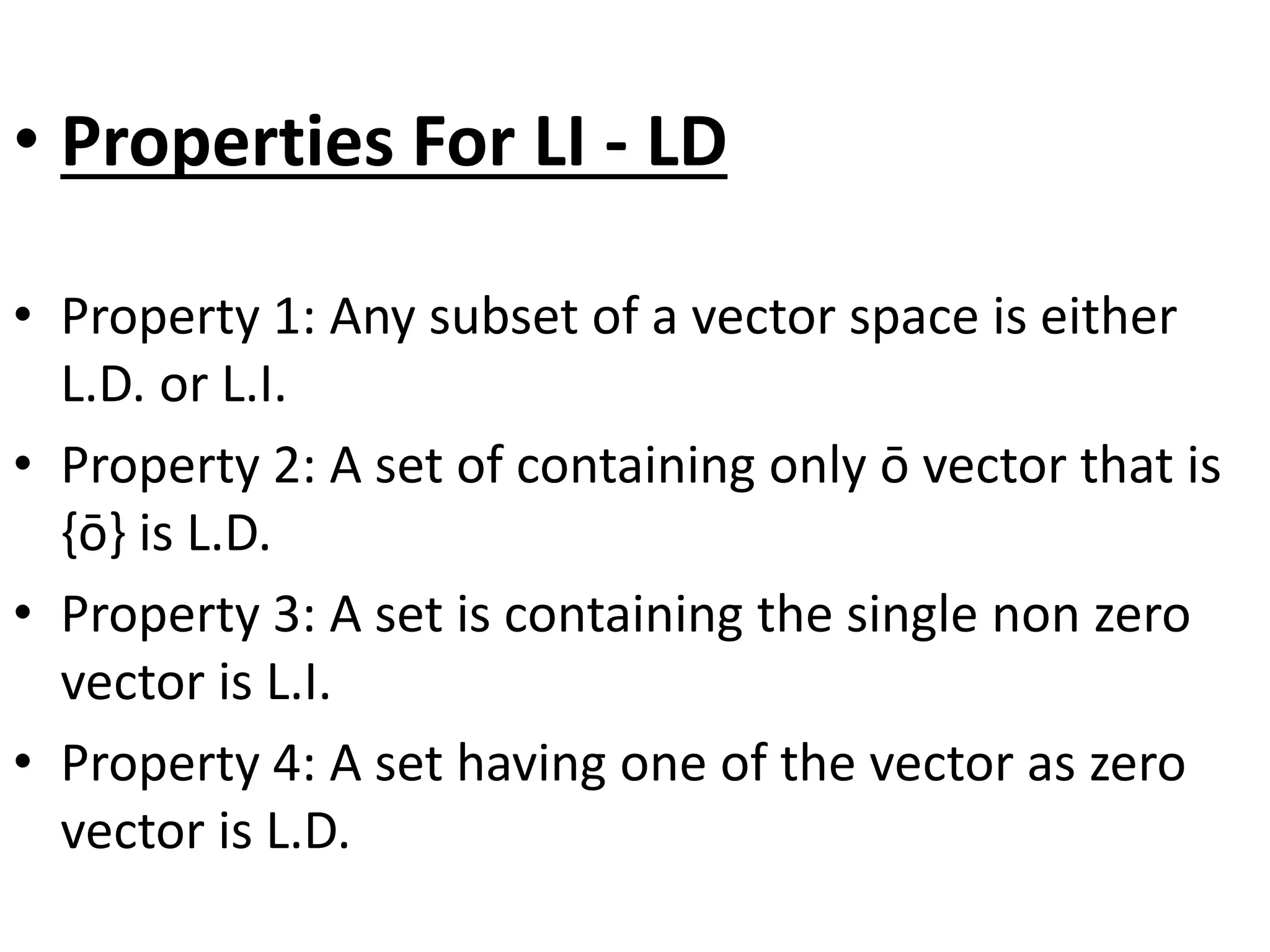
• Properties For LI - LD
• Property 1: Any subset of a vector space is either
L.D. or L.I.
• Property 2: A set of containing only ō vector that is
{ō} is L.D.
• Property 3: A set is containing the single non zero
vector is L.I.
• Property 4: A set having one of the vector as zero
vector is L.D.
EXAMPLES
• 1.] Consider the set of vectors to check LI or LD
{(1,0,0),(0,1,0),(0,0,1)} in R³.
• Solution :-
Let k₁,k₂,k₃ belongs to R such that,
k₁(1,0,0)+k₂(0,1,0)+k₃(0,0,1)=(0,0,0)
(k₁,k₂,k₃)=(0,0,0)
k₁=0,k₂=0,k₃=0
Therefore, the set {i,j,k} is LI.
• 2.] Determine whether the vectors are LI in R³ (1-
2,1),(2,1,-1),(7,-4,1).
• Solution :-
Let k₁,k₂,k₃ belongs to R such that,
k₁(1,-2,1)+k₂(2,1,-1)+k₃(7,-4,1)=(0,0,0)
k₁+2k₂+7k₃=0
-2k₁+1k₂-4k₃=0
k₁-k₂+k₃=0
|A|=
|A|= 1[(1)(1)-(-4)(-1)]
-2[(-2)(1)-(-4)(1)]
+7[(-2)(-1)-(1)(1)]
|A|= -3-4+7
|A|=0
Since the determinant of the system is zero, the
system of these equations has a nontrivial
solution. That is at least one of k₁,k₂,k₃ is nonzero.
Thus the vectors are LD.
1 2 7
−2 1 −4
1 −1 1
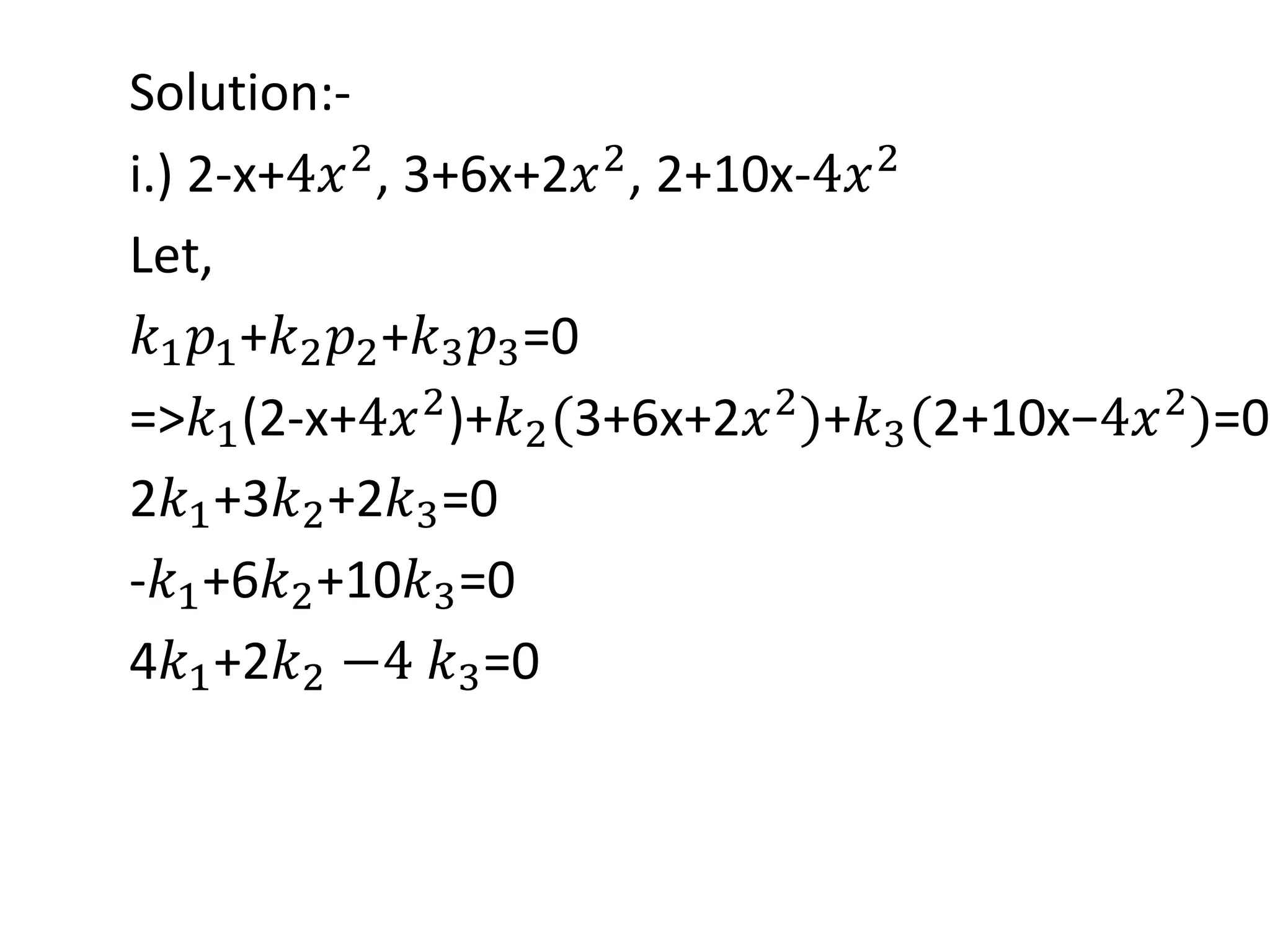
Solution:-
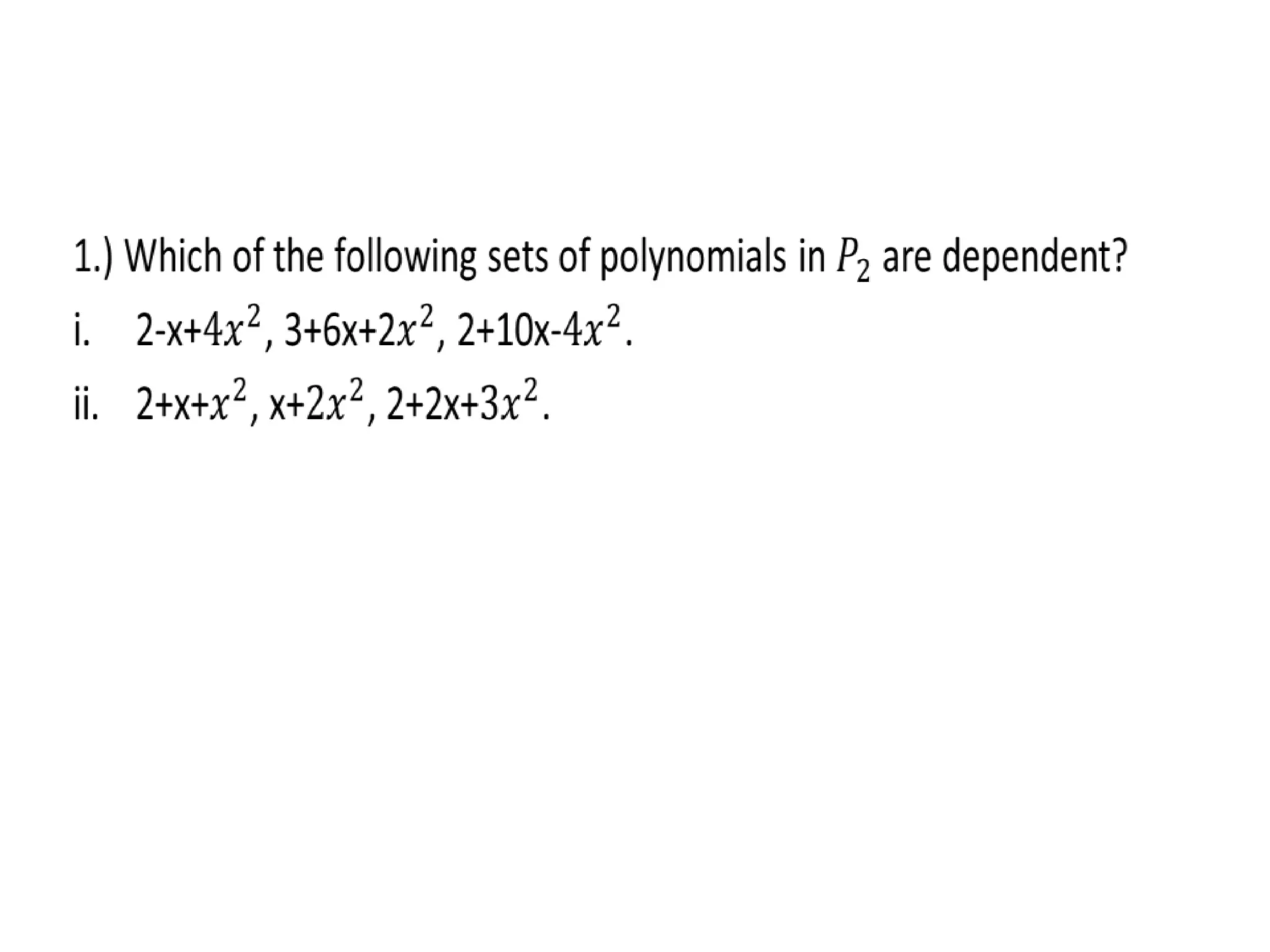
i.) 2-x+4𝑥2
, 3+6x+2𝑥2
, 2+10x-4𝑥2
Let,
𝑘1 𝑝1+𝑘2 𝑝2+𝑘3 𝑝3=0
=>𝑘1(2-x+4𝑥2
)+𝑘2(3+6x+2𝑥2
)+𝑘3(2+10x−4𝑥2
)=0
2𝑘1+3𝑘2+2𝑘3=0
-𝑘1+6𝑘2+10𝑘3=0
4𝑘1+2𝑘2 −4 𝑘3=0
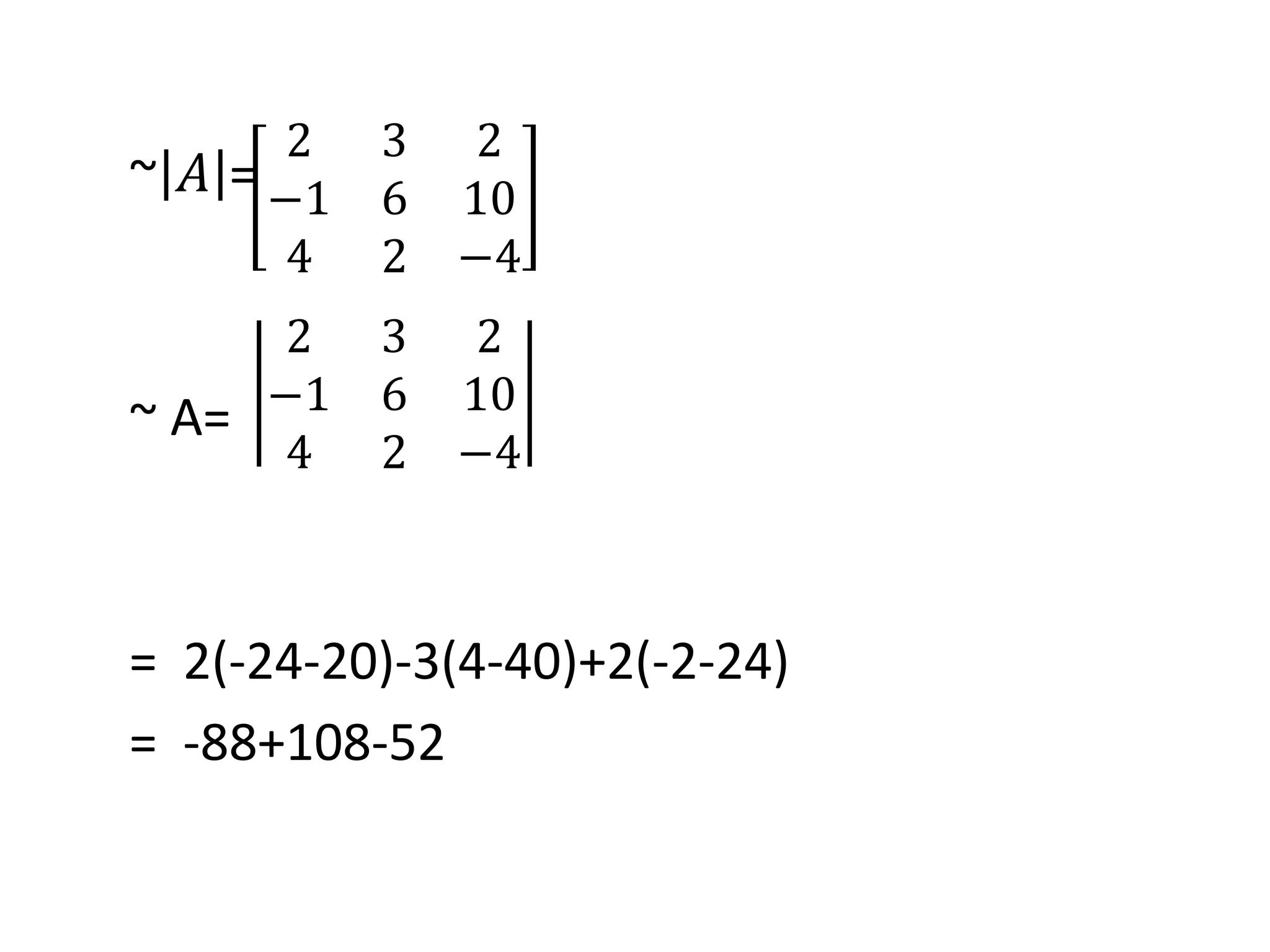
~ 𝐴 =
~ A=
= 2(-24-20)-3(4-40)+2(-2-24)
= -88+108-52
2 3 2
−1 6 10
4 2 −4
2 3 2
−1 6 10
4 2 −4
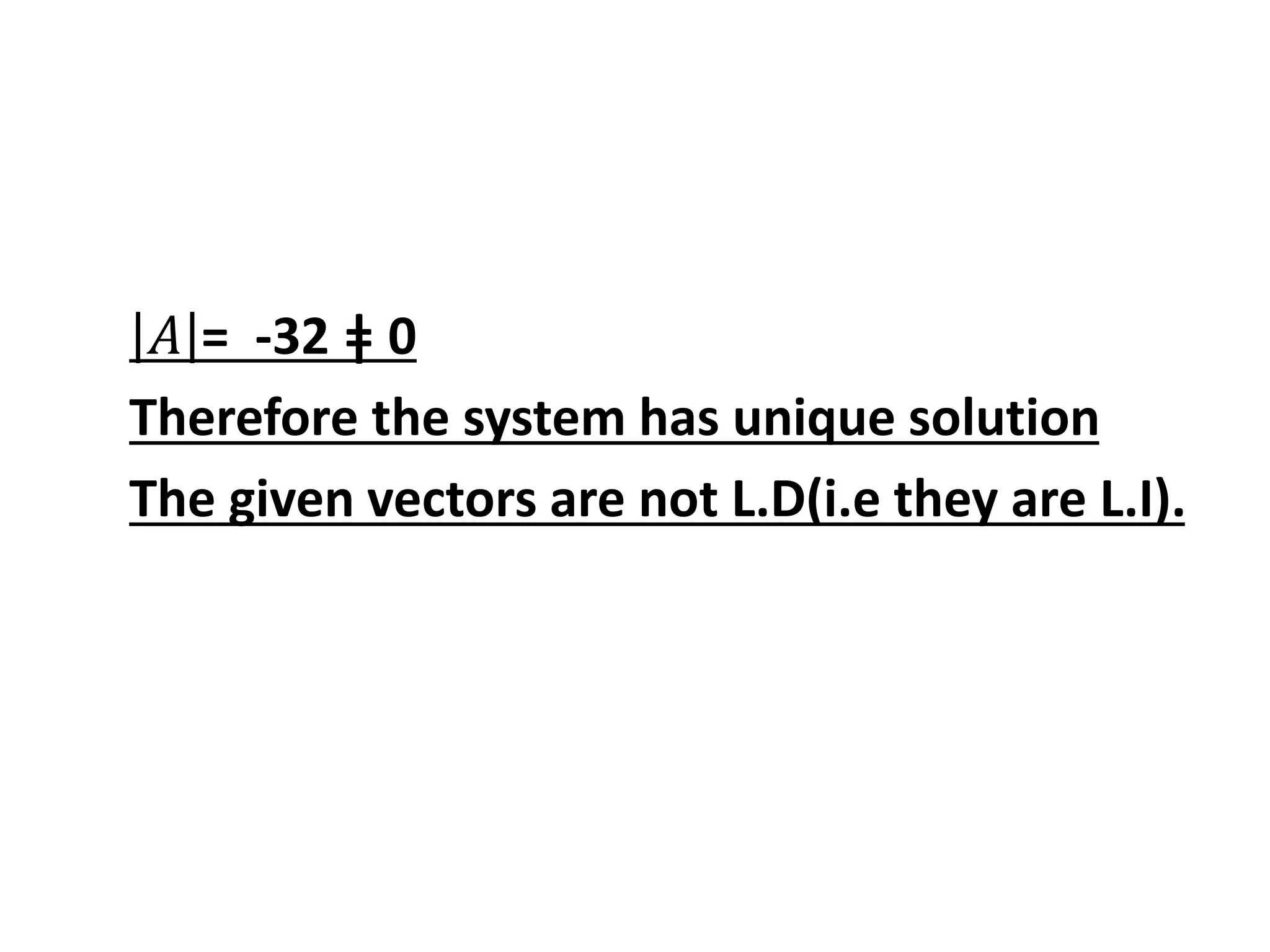
𝐴 = -32 ǂ 0
Therefore the system has unique solution
The given vectors are not L.D(i.e they are L.I).
Solution:-
ii.) A= 2+x+𝑥2
, x+2𝑥2
, 2+2x+3𝑥2
Let,
𝑘1 𝑝1+𝑘2 𝑝2+𝑘3 𝑝3=0
𝑘1(2+x+𝑥2
)+𝑘2(x+2𝑥2
)+𝑘3(2+2x+3𝑥2
)=0
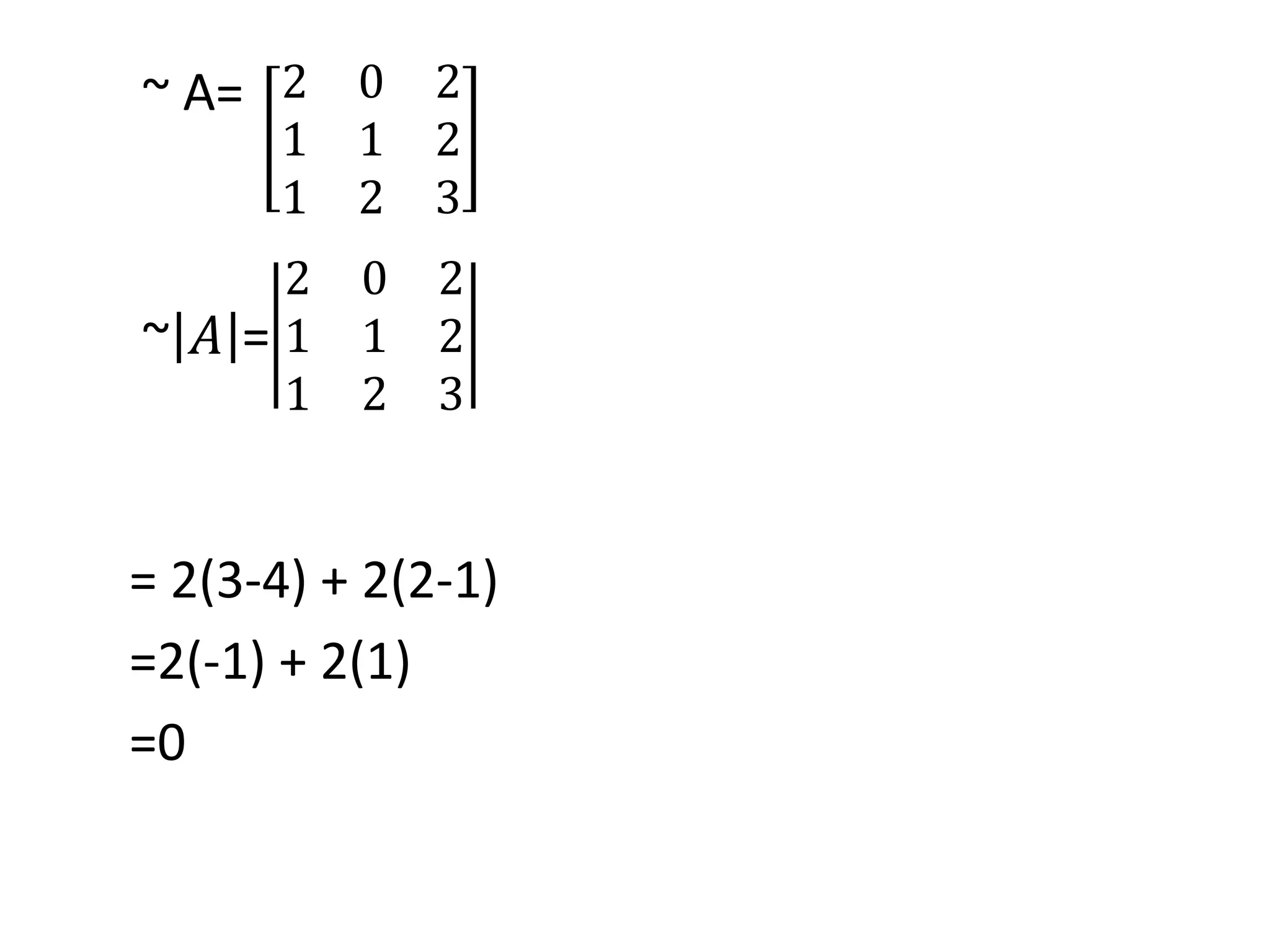
2𝑘1+0𝑘2+2𝑘3=0
𝑘1+𝑘2+2𝑘3=0
𝑘1+2𝑘2 +3 𝑘3=0
~ A=
~ 𝐴 =
= 2(3-4) + 2(2-1)
=2(-1) + 2(1)
=0
2 0 2
1 1 2
1 2 3
2 0 2
1 1 2
1 2 3
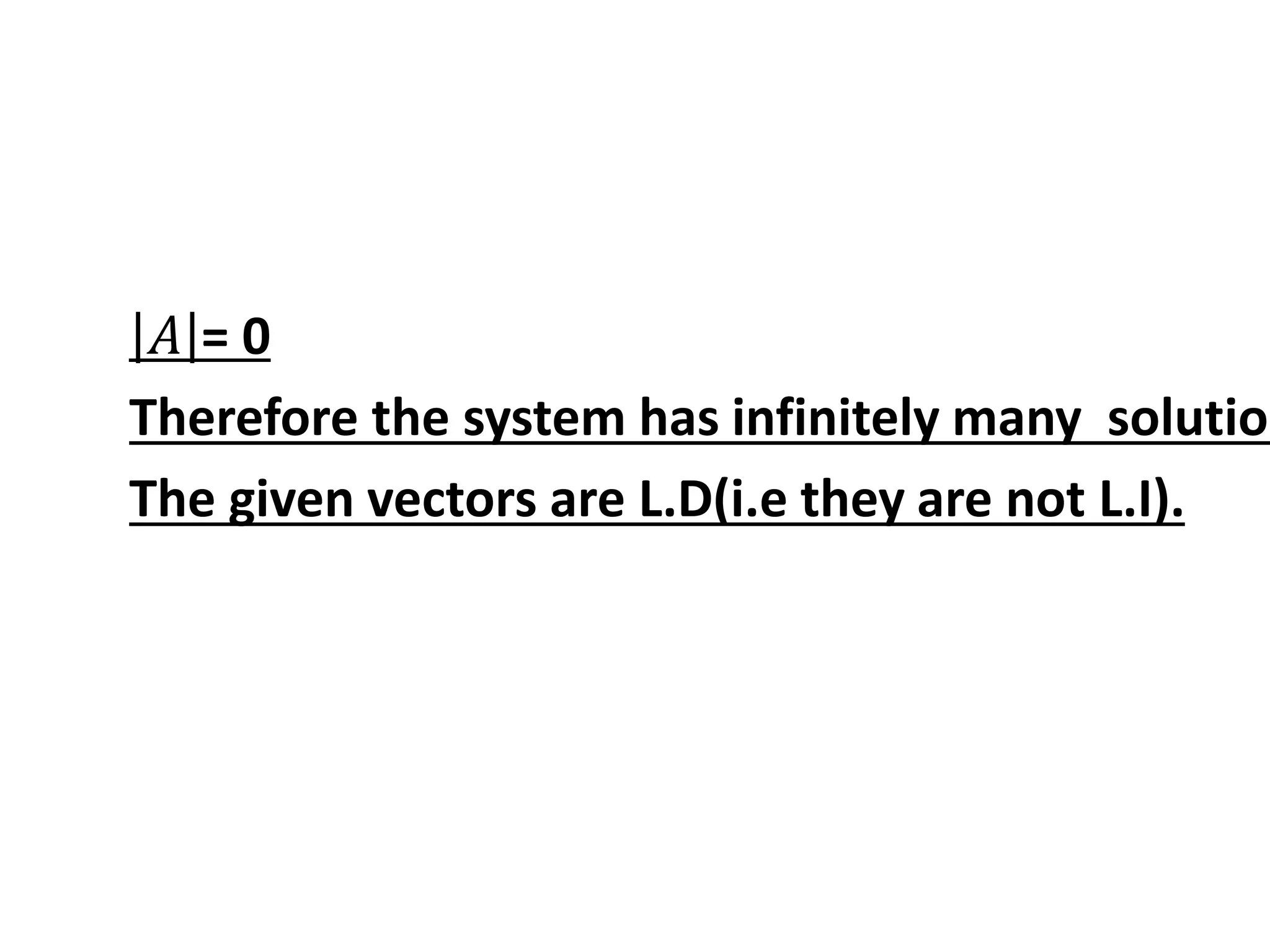
𝐴 = 0
Therefore the system has infinitely many solution
The given vectors are L.D(i.e they are not L.I).
Linear dependence(ld)  &linear independence(li)

Linear dependence(ld) &linear independence(li)

  • 1.
    VECTOR CALCULUS ANDLINEAR ALGEBRA (2110015) Made By :- DIVYANGSINH RAJ (150990119004) NAVED FRUITWALA (150990119006) UTKARSH GANDHI (150990119007) Branch :- MECHANICAL ENGINEERING Semester :- 2ᴺᴰ
  • 2.
  • 3.
    Linear Dependence and Independence:- • A finite set of vector of a vector space is said to be Linearly Dependent(LD) if there exists a set of scalars k1 , k2 , ……, kn such that, k1u1 + k2u2 +……+knun= ō • A finite set of vector of a vector space is said to be Linearly Independent(LI) if there exists scalars k1 , k2 , ……, kn such that, k1u1 + k2u2 +……+knun= ō => k1= k2= ……= kn=0
  • 4.
    • Properties ForLI - LD • Property 1: Any subset of a vector space is either L.D. or L.I. • Property 2: A set of containing only ō vector that is {ō} is L.D. • Property 3: A set is containing the single non zero vector is L.I. • Property 4: A set having one of the vector as zero vector is L.D.
  • 5.
    EXAMPLES • 1.] Considerthe set of vectors to check LI or LD {(1,0,0),(0,1,0),(0,0,1)} in R³. • Solution :- Let k₁,k₂,k₃ belongs to R such that, k₁(1,0,0)+k₂(0,1,0)+k₃(0,0,1)=(0,0,0) (k₁,k₂,k₃)=(0,0,0) k₁=0,k₂=0,k₃=0 Therefore, the set {i,j,k} is LI.
  • 6.
    • 2.] Determinewhether the vectors are LI in R³ (1- 2,1),(2,1,-1),(7,-4,1). • Solution :- Let k₁,k₂,k₃ belongs to R such that, k₁(1,-2,1)+k₂(2,1,-1)+k₃(7,-4,1)=(0,0,0) k₁+2k₂+7k₃=0 -2k₁+1k₂-4k₃=0 k₁-k₂+k₃=0
  • 7.
    |A|= |A|= 1[(1)(1)-(-4)(-1)] -2[(-2)(1)-(-4)(1)] +7[(-2)(-1)-(1)(1)] |A|= -3-4+7 |A|=0 Sincethe determinant of the system is zero, the system of these equations has a nontrivial solution. That is at least one of k₁,k₂,k₃ is nonzero. Thus the vectors are LD. 1 2 7 −2 1 −4 1 −1 1
  • 9.
    Solution:- i.) 2-x+4𝑥2 , 3+6x+2𝑥2 ,2+10x-4𝑥2 Let, 𝑘1 𝑝1+𝑘2 𝑝2+𝑘3 𝑝3=0 =>𝑘1(2-x+4𝑥2 )+𝑘2(3+6x+2𝑥2 )+𝑘3(2+10x−4𝑥2 )=0 2𝑘1+3𝑘2+2𝑘3=0 -𝑘1+6𝑘2+10𝑘3=0 4𝑘1+2𝑘2 −4 𝑘3=0
  • 10.
    ~ 𝐴 = ~A= = 2(-24-20)-3(4-40)+2(-2-24) = -88+108-52 2 3 2 −1 6 10 4 2 −4 2 3 2 −1 6 10 4 2 −4
  • 11.
    𝐴 = -32ǂ 0 Therefore the system has unique solution The given vectors are not L.D(i.e they are L.I).
  • 12.
    Solution:- ii.) A= 2+x+𝑥2 ,x+2𝑥2 , 2+2x+3𝑥2 Let, 𝑘1 𝑝1+𝑘2 𝑝2+𝑘3 𝑝3=0 𝑘1(2+x+𝑥2 )+𝑘2(x+2𝑥2 )+𝑘3(2+2x+3𝑥2 )=0 2𝑘1+0𝑘2+2𝑘3=0 𝑘1+𝑘2+2𝑘3=0 𝑘1+2𝑘2 +3 𝑘3=0
  • 13.
    ~ A= ~ 𝐴= = 2(3-4) + 2(2-1) =2(-1) + 2(1) =0 2 0 2 1 1 2 1 2 3 2 0 2 1 1 2 1 2 3
  • 14.
    𝐴 = 0 Thereforethe system has infinitely many solution The given vectors are L.D(i.e they are not L.I).