Linear Algebra with Applications 2nd Edition Bretscher Solutions Manual
Linear Algebra with Applications 2nd Edition Bretscher Solutions Manual
Linear Algebra with Applications 2nd Edition Bretscher Solutions Manual
Linear Algebra with Applications 2nd Edition Bretscher Solutions Manual
Linear Algebra with Applications 2nd Edition Bretscher Solutions Manual
1.
Visit https://testbankfan.com todownload the full version and
explore more testbank or solution manual
Linear Algebra with Applications 2nd Edition
Bretscher Solutions Manual
_____ Click the link below to download _____
https://testbankfan.com/product/linear-algebra-with-
applications-2nd-edition-bretscher-solutions-manual/
Explore and download more testbank at testbankfan.com
2.
Here are somesuggested products you might be interested in.
Click the link to download
Linear Algebra with Applications 5th Edition Bretscher
Solutions Manual
https://testbankfan.com/product/linear-algebra-with-applications-5th-
edition-bretscher-solutions-manual/
Linear Algebra with Applications 2nd Edition Holt
Solutions Manual
https://testbankfan.com/product/linear-algebra-with-applications-2nd-
edition-holt-solutions-manual/
Linear Algebra with Applications 2nd Edition Holt Test
Bank
https://testbankfan.com/product/linear-algebra-with-applications-2nd-
edition-holt-test-bank/
Labor Economics 1st Edition Laing Test Bank
https://testbankfan.com/product/labor-economics-1st-edition-laing-
test-bank/
3.
Statistics Data Analysisand Decision Modeling 5th Edition
Evans Solutions Manual
https://testbankfan.com/product/statistics-data-analysis-and-decision-
modeling-5th-edition-evans-solutions-manual/
Computer Accounting with QuickBooks Online A Cloud Based
Approach 1st Edition Yacht Solutions Manual
https://testbankfan.com/product/computer-accounting-with-quickbooks-
online-a-cloud-based-approach-1st-edition-yacht-solutions-manual/
International Economics 16th Edition Carbaugh Solutions
Manual
https://testbankfan.com/product/international-economics-16th-edition-
carbaugh-solutions-manual/
Soil Science and Management 6th Edition Edward Plaster
Test Bank
https://testbankfan.com/product/soil-science-and-management-6th-
edition-edward-plaster-test-bank/
Economics Of Money Banking And Financial Markets 12th
Edition Mishkin Test Bank
https://testbankfan.com/product/economics-of-money-banking-and-
financial-markets-12th-edition-mishkin-test-bank/
4.
Geosystems An Introductionto Physical Geography Updated
Canadian 4th Edition Christopherson Test Bank
https://testbankfan.com/product/geosystems-an-introduction-to-
physical-geography-updated-canadian-4th-edition-christopherson-test-
bank/
5.
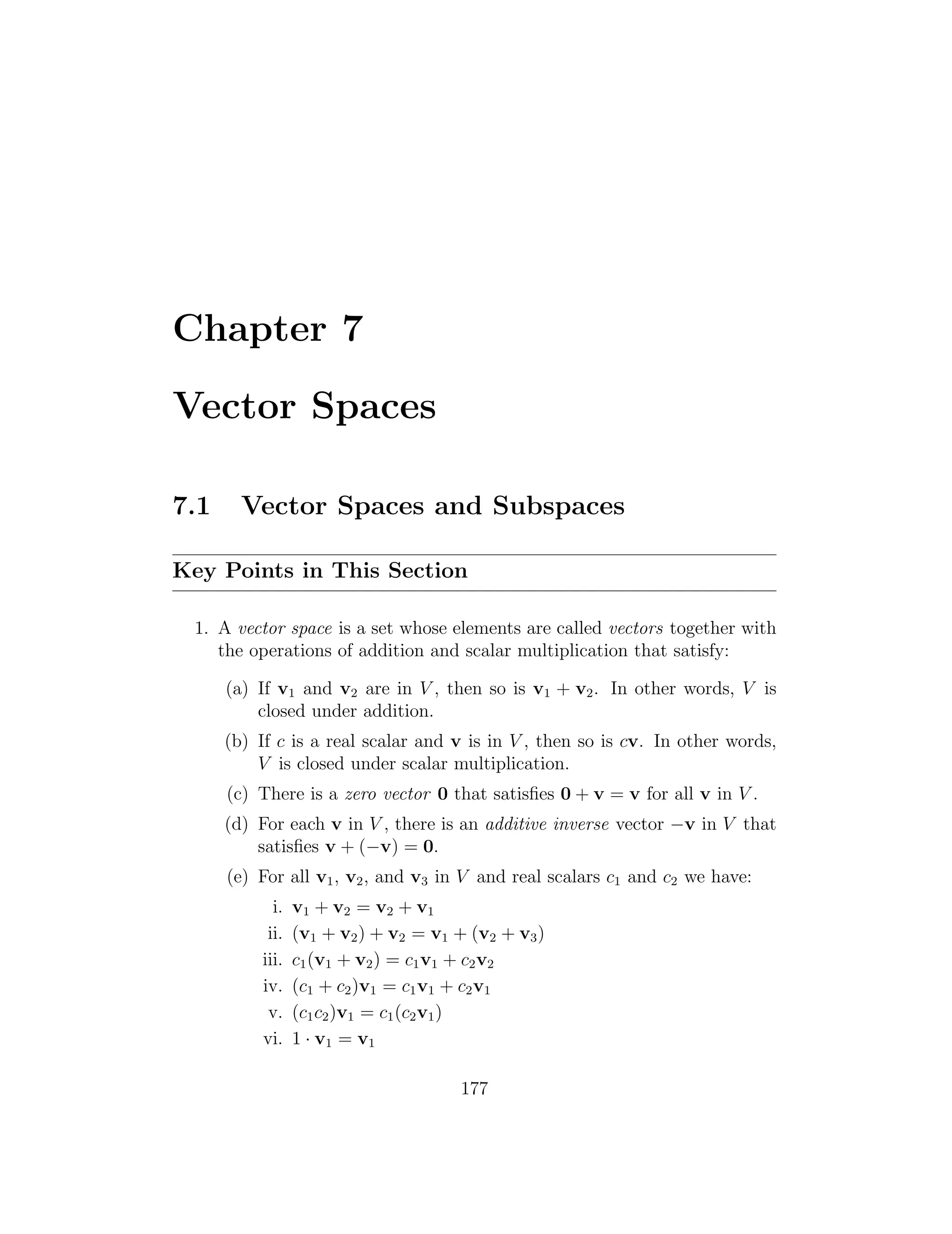
Chapter 7
Vector Spaces
7.1Vector Spaces and Subspaces
Key Points in This Section
1. A vector space is a set whose elements are called vectors together with
the operations of addition and scalar multiplication that satisfy:
(a) If v1 and v2 are in V , then so is v1 + v2. In other words, V is
closed under addition.
(b) If c is a real scalar and v is in V , then so is cv. In other words,
V is closed under scalar multiplication.
(c) There is a zero vector 0 that satisfies 0 + v = v for all v in V .
(d) For each v in V , there is an additive inverse vector v in V that
satisfies v + ( v) = 0.
(e) For all v1, v2, and v3 in V and real scalars c1 and c2 we have:
i. v1 + v2 = v2 + v1
ii. (v1 + v2) + v2 = v1 + (v2 + v3)
iii. c1(v1 + v2) = c1v1 + c2v2
iv. (c1 + c2)v1 = c1v1 + c2v1
v. (c1c2)v1 = c1(c2v1)
vi. 1 · v1 = v1
177
6.
2. The followingstatements hold in any vector space V and for any vector
v in V :
(a) If 0 is a zero vector, then v + 0 = v.
(b) If v is an additive inverse to v, then ( v) + v = 0.
(c) v has a unique additive inverse v.
(d) The zero vector 0 is unique.
(e) 0 · v = 0.
(f) ( 1) · v = v.
(Theorem 7.2)
3. Examples of vector spaces include:
(a) Rn
.
(b) Rm⇥n
the set of m ⇥ n matrices with real entries.
(c) Pn
the set of polynomials with real coefficients and degree at most
n.
(d) P the set of all polynomials with real coefficients.
(e) R1
the set of infinite sequences of real numbers v = (v1, v2, . . .).
(f) T(m, n) the set of linear transformations T : Rm
! Rn
.
(g) C[a, b] the set of continuous functions f : [a, b] ! R.
(h) C(R) the set of continuous functions f : R ! R.
4. A subspace of a vector space V is a subset that is also a vector space.
The only conditions that need to be checked are:
(a) S contains the zero vector 0.
(b) If u and v are in S, then so is u + v.
(c) If c is a scalar and v is in S, then so is cv.
5. Given a vector space V , the subsets S = {0} and S = V are subspaces,
called the trivial subspaces (Theorem 7.4).
178
7.
Teaching Suggestions
This chapterintroduces the notion of an abstract vector space. The notions of
subspace, span, linear independence, basis and dimension that were originally
defined for Rn
in Chapters 2 and 4 are defined and examined in this chapter
for the abstract version.
This first section gives the definition of an abstract vector space. Students
not familiar with defining a set via properties may find this section confusing
and unnecessary, especially since it will be shown later on that any finite
dimensional (real) vector space is isomorphic to Rn
.
You can add something interesting to this section by looking at the dif
ference between P, the vector space of all polynomials with real coefficients
and the subspace S consisting of the even polynomials. One is a proper sub
space of the other, but yet are they the same? This can naturally lead into
a discussion of what is meant by “infinity” and the notion of cardinality.
As in Section 4.1, a subspace can be defined as a nonempty subset that
is closed under addition and scalar multiplication. Alternatively, a subspace
can be defined as a subset that is also a vector space.
Suggested Classroom Examples
7.1.1 Example. Verify that T(2, 3) is a vector space.
Solution. Recall, T(2, 3) is the set of linear transformations T : R2
! R3
.
Addition is defined as follows, given T1, T2 in T(2, 3), we define T1 + T2 :
R2
! R3
by: (T1 + T2)(v) = T1(v) + T2(v). We need to check that T1 + T2
is a linear transformation.
Given v1, v2 in R2
we have:
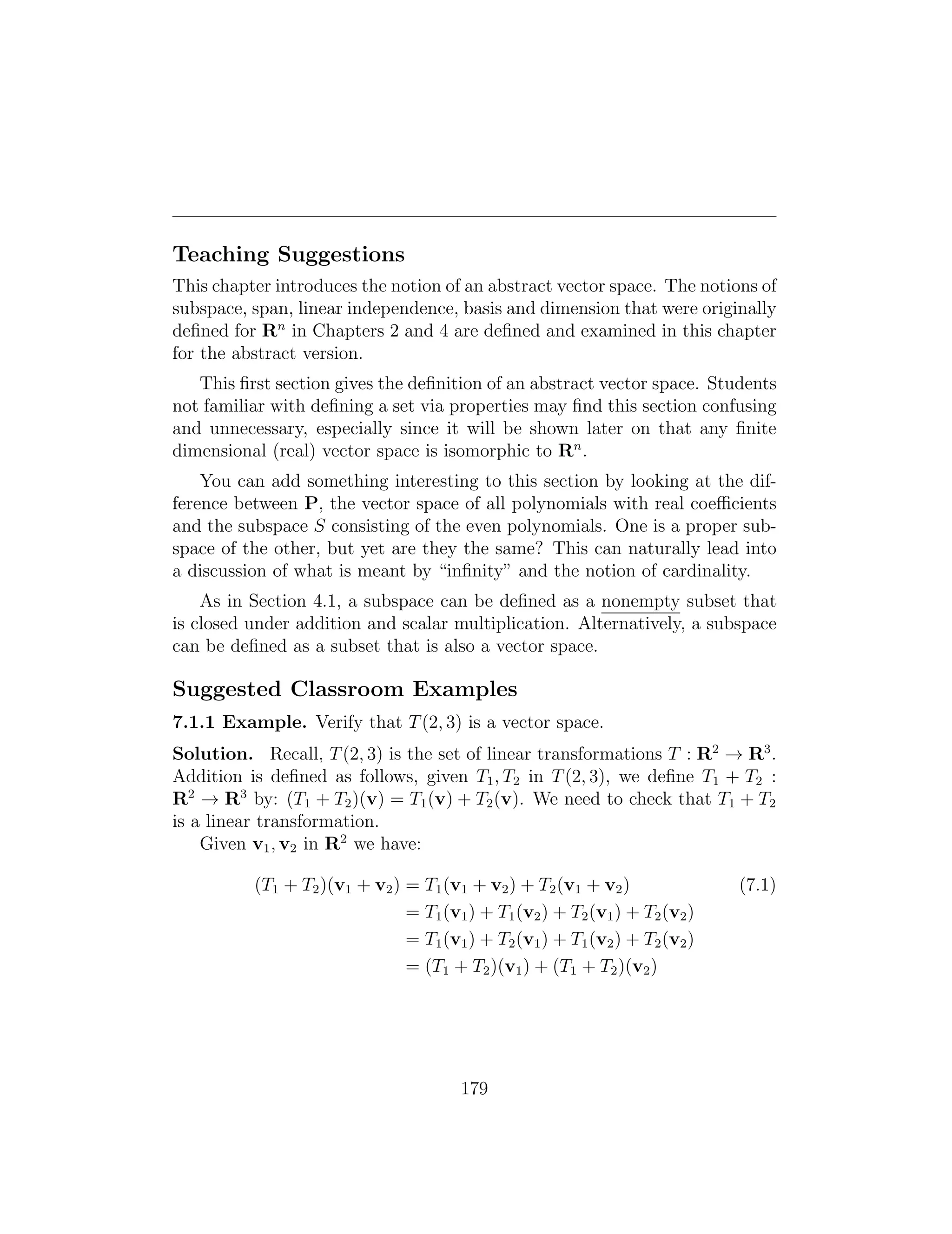
(T1 + T2)(v1 + v2) = T1(v1 + v2) + T2(v1 + v2) (7.1)
= T1(v1) + T1(v2) + T2(v1) + T2(v2)
= T1(v1) + T2(v1) + T1(v2) + T2(v2)
= (T1 + T2)(v1) + (T1 + T2)(v2)
179
8.
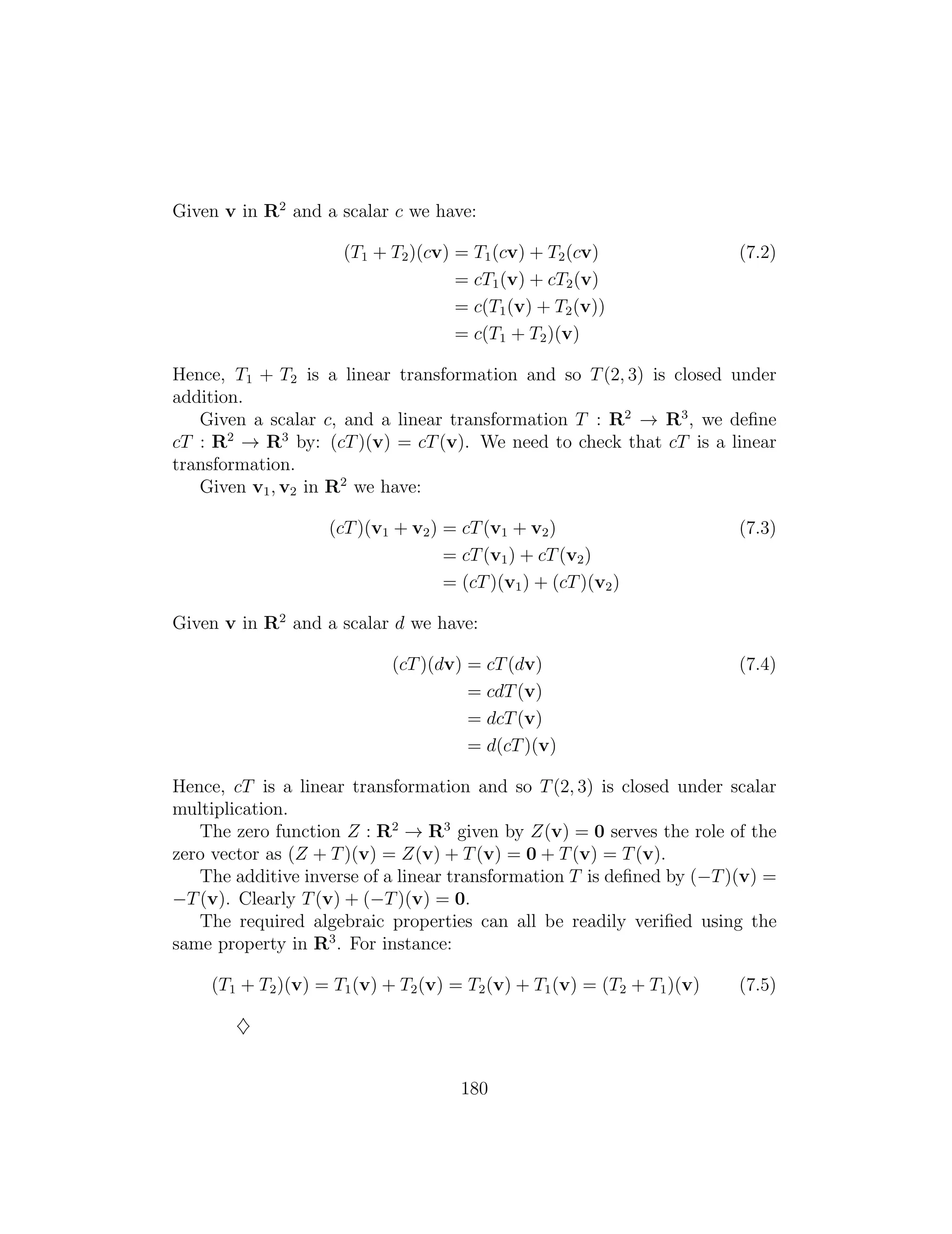
Given v inR2
and a scalar c we have:
(T1 + T2)(cv) = T1(cv) + T2(cv) (7.2)
= cT1(v) + cT2(v)
= c(T1(v) + T2(v))
= c(T1 + T2)(v)
Hence, T1 + T2 is a linear transformation and so T(2, 3) is closed under
addition.
Given a scalar c, and a linear transformation T : R2
! R3
, we define
cT : R2
! R3
by: (cT)(v) = cT(v). We need to check that cT is a linear
transformation.
Given v1, v2 in R2
we have:
(cT)(v1 + v2) = cT(v1 + v2) (7.3)
= cT(v1) + cT(v2)
= (cT)(v1) + (cT)(v2)
Given v in R2
and a scalar d we have:
(cT)(dv) = cT(dv) (7.4)
= cdT(v)
= dcT(v)
= d(cT)(v)
Hence, cT is a linear transformation and so T(2, 3) is closed under scalar
multiplication.
The zero function Z : R2
! R3
given by Z(v) = 0 serves the role of the
zero vector as (Z + T)(v) = Z(v) + T(v) = 0 + T(v) = T(v).
The additive inverse of a linear transformation T is defined by ( T)(v) =
T(v). Clearly T(v) + ( T)(v) = 0.
The required algebraic properties can all be readily verified using the
same property in R3
. For instance:
(T1 + T2)(v) = T1(v) + T2(v) = T2(v) + T1(v) = (T2 + T1)(v) (7.5)
}
180
9.
7.1.2 Example. Showthat S is a subspace of V where V = R2⇥2
and S is
the subset of matrices such that a11 = a22 = 0.
Solution. Vectors in S have the form:
0 a12
(7.6)
a21 0
= [ 0 0
add two vectors of this form we get:
Clearly the zero matrix 022 0 0 ] is of this form and so 022 is in S. If we
0 a12 0 b12 0 a12 + b12
+ = (7.7)
a21 0 b21 0 a21 + b21 0
and so S is closed under addition. Finally, given a scalar c we have:
0 a12 0 ca12
c = (7.8)
a21 0 ca21 0
and so S is closed under scalar multiplication. Therefore, S is a subspace of
R2⇥2
. }
7.1.3 Example. Explain why S is not a subspace of V .
1. V = R2⇥2
, S is the subset of matrices such that a11a22 = 0.
2. V = R2
, S is the subset of vectors such that a1 0.
3. V = P2
, S is the subset of polynomials such that p(0) = 1.
Solution.
1. This subset is not closed under addition. Notice A = [ 1 1
1 1 0 ] and A2 =
[ 0 1
1 1 ] are both in S but:
1 1 0 1 1 2
A1 + A2 = + = (7.9)
1 0 1 1 2 1
Hence, A1 + A2 is not in S. Observe that 022 is in S and that S is
closed under scalar multiplication.
2. This subset is not closed under scalar multiplication. Notice that v =
[ 1
1 ] is in S but 1 · v = [ 1
1
] is not in S. Observe that 0 is in S and
that S is closed under addition.
181
10.
3. This subsetdoes not contain the zero vector, is not closed under addi
tion, and is not closed under scalar multiplication. To see that it is not
closed under addition, notice that the constant polynomial p(t) = 1 is
in S, but (p + p)(t) = 2 is not.
}
7.1.4 Example. Let V be a vector space. Show that 0·v = 0 for any vector
v in V .
Solution. Using the properties of a vector space we have
0 · v + 1 · v = (0 + 1)v = v (7.10)
for any vector v. Hence, 0 · v is a zero vector. As the zero vector is unique
(Theorem 7.2(d)), we have that 0 · v = 0. }
7.2 Span and Linear Independence
Key Points in This Section
1. Suppose V = {v1, v2, . . . , vm} is a nonempty set of finitely many vectors
in a vector space V . The span of V, denoted span(V) is defined to the
set of all linear combinations of the form:
c1v1 + c2v2 + · · · + cmvm (7.11)
where c1, c2, . . . , cm are real scalars. If V contains infinitely many vec
tors, then span(V) is the set of all linear combinations of finite subsets
of V.
2. If V is a nonempty subset of vectors in a vector space V , then span(V)
is a subspace of V (Theorem 7.6).
3. Suppose V = {v1, v2, . . . , vm} is a set of finitely many vectors in a
vector space V . Then V is linearly independent if the equation:
c1v1 + c2v2 + · · · + cmvm = 0 (7.12)
only has the trivial solution c1 = c2 = · · · = cm = 0. Otherwise
the set is said to be linearly dependent. If V is infinite, V is linearly
independent if every finite subset is linearly independent.
182
11.
4. A setV of vectors in a vector space V is linearly dependent if and only
if one of the vectors is in the span of the others (Theorem 7.8).
5. Suppose V = {v1, v2, . . . , vm} is a subset of vectors in a vector space.
Then:
(a) The set V is linearly independent if and only if for any v in V , the
equation c1v1 + c2v2 + · · · + cmvm = v has at most one solution.
(b) The set V spans V if and only if for any v in V , the equation
c1v1 + c2v2 + · · · + cmvm = v has at least one solution.
(Theorem 7.9)
Teaching Suggestions
This section extends the notions of span and linear independence originally
defined for Rn
to abstract vector spaces. Students who grasped these con
cepts in the setting of Rn
should not have a problem with them in the general
setting.
One issue that arises in the abstract vector space setting that does not
arise in Rn
is the idea of infinite linear combinations. For classes that have
some mathematical maturity, posing the question of whether the function
f(x) = ex
is in P can lead to an interesting discussion. It is clear that is it
not a polynomial and so it
P
should not be in P, but when thinking about its
Taylor series f(x) = ex
= 1 xn
n=0 it seems like
n
maybe it should
!
be.
Suggested Classroom Examples
7.2.1 Example. Determine if the given vector is in span(V).
1. V = {1 + 2t + 2t2
, t 3t2
} ⇢ P2
, v = 4 + 6t + 14t2
82 3 2 3 2 39 2 3
< 1 0 1 0 1 0 0 1 2 = 2 3 0
2. V = 40 1 05 , 40 1 05 , 42 1 05 , v = 4 1 2 05
: ;
1 2 0 1 1 0 2 1 0 2 1 2
183
12.
2 3 23
1 0 4 1 0 4
2 1 6 ⇠ 0 1 2 (7.15)
2 3 14 0 0 0
4 5 4 5
Solution.
1. We are trying to find scalars c1 and c2 such that:
c1(1 + 2t + 2t2
) + c2(t 3t2
) = 4 + 6t + 14t2
(7.13)
By comparing the individual terms, we get three equations:
c1 = 4
2c1 + c2 = 6 (7.14)
2c1 3c2 = 14
We put the augmented matrix of this linear system into reduced echelon
form:
Hence, the linear system in (7.14) has solution where c1 = 4 and c2 =
2. Therefore, v is in the span of V.
2. We are trying to find scalars c1, c2, and c3 such that:
2 3 2 3 2 3 2 3
1 0 1 0 1 0 0 1 2 2 3 0
c1 0 1 0 +c2 0 1 0 +c3 2 1 0 = 1 2 0 (7.16)
1 2 0 1 1 0 2 1 0 2 1 2
4 5 4 5 4 5 4 5
By comparing the individual entries, we get a linear system of nine
equations in three variables. Without writing down the complete sys
tem, it is easy to see that a solution does not exist. For instance, by
looking at the top left entries, we see that in a solution c1 = 2. By
looking at the middle left entries we see that in a solution c3 = 1/2. But
then in the top right entry we get the equation 1( 2)+0(c2)+ 2(1/2) =
0 which does not have a solution. Therefore, v is not in the span of V.
}
7.2.2 Example. Determine if the given subset is linearly independent.
⇢
1 0 0 2 1 1
⇢ R2⇥2
1. , ,
2 1 1 1 2 0
2. {2 + t t3
, 1 + 2t + t2
, 3t 2t2
t3
} ⇢ P3
184
13.
Solution.
1. We mustdetermine if there is a nontrivial solution to:
1 0 0 2 1 1 0 0
c1 + c2 + c3 = (7.17)
2 1 1 1 2 0 0 0
By examining the four individual entries, we get four equations:
c1 + c3 = 0
2c2 + c3 = 0
(7.18)
2c1 + c2 + 2c3 = 0
c1 + c2 = 0
It is easy to see that the only solution is the trivial one c1 = c2 = c3 = 0.
For instance, the first and fourth equations imply that c1 = c2 = c3.
Plugging this into the second equation, we have 3c2 = 0 and hence
c2 = 0 and so c1 = 0 and c3 = 0 as well. Therefore, the three matrices
are linearly independent.
2. We must determine if there is a nontrivial solution to:
c1(2 + t t3
) + c2(1 + 2t + t2
) + c3( 3t 2t2
t3
) = 0 (7.19)
By comparing the individual terms, we get the linear system:
2c1 + c2 = 0
c1 + 2c2 3c2 = 0
(7.20)
c2 2c3 = 0
c1 c3 = 0
Using the row reduction, we find that c1 = 1, c2 = 2 and c3 = 1 is
a nontrivial solution. Therefore, the set of polynomials is not linearly
independent. Using this solution, we can write:
3t 2t2
t3
= (2 + t t3
) 2(1 + 2t + t2
) (7.21)
This shows that 3t 2t2
t3
is in the span of the other two.
}
7.2.3 Example. Show that V spans P2
where:
V = {1 + 2t + 2t2
, t + t2
, 1 t2
}
185
14.
2 3 23
1 0 1 a0 1 0 1 a0
42 1 1 a1
5 ⇠ 40 1 3 a1 2a0
5 (7.24)
2 1 1 a2 0 0 2 a2 a1
Solution. We must show that for any polynomial p(t) = a0 + a1t + a2t2
in
P2
that there are scalars c1, c2, and c3 such that:
c1(1 + 2t + 2t2
) + c2(t + t2
) + c3(1 t2
) = a0 + a1t + a2t2
(7.22)
By comparing the individual terms, we get a linear system:
c1 c3 = a0
2c1 + c2 + c3 = a1 (7.23)
2c1 + c2 c3 = a2
The augmented matrix and its echelon form are:
From this we see that the linear system in (7.23) has a solution for any a0, a1
and a2. Hence, V does indeed span P2
. }
7.3 Basis and Dimension
Key Points in This Section
1. A basis for a vector space V is a subset of vectors that is linearly
independent and that spans V .
2. The set V = {v1, v2, . . . , vm} is a basis for a vector space V if and only
if the equation:
c1v1 + c2v2 + · · · + cmvm = v (7.25)
has a unique solution for each v in V (Theorem 7.11).
3. If both V1 and V2 are bases of a vector space V , then V1 and V2 have
the same number of elements (Theorem 7.12).
186
15.
4. The dimensionof a vector space V , denoted dim(V ), is the number of
vectors in any basis for V . If a basis for V has infinitely many vectors,
then we say that the dimension of V is infinite.
5. Dimensions of common vector spaces:
(a) dim(Rn
) = n
(b) dim(Rm⇥n
) = mn
(c) dim(Pn
) = n + 1
(d) dim(P) = 1
(e) dim(R1
) = 1
(f) dim(T(m, n)) = mn
(g) dim(C(R)) = 1
6. Suppose V = {v1, v2, . . . , vm} is a subset of a nontrivial finite dimen
sional vector space V , that is, 0 < dim(V ) < 1.
(a) If V spans V , then either V is a basis for V , or vectors can be
removed from V to form a basis for V .
(b) If V is linearly independent, then either V is a basis for V or
vectors can be added to V to form a basis for V .
(Theorem 7.14)
7. Let V1 be a vector space and V2 a subspace of V1. Then dim(V2)
dim(V1) (Theorem 7.15).
8. Let V be a vector space where dim(V ) = n and let V = {v1, v2, . . . , vm}
be a subset of V .
(a) If m < n, then V does not span V .
(b) If m > n then V is not linearly independent.
(Theorem 7.16)
9. Let V be a vector space where dim(V ) = m < 1 and let V =
{v1, v2, . . . , vm} be a subset of V . Then V is linearly independent
if and only if V spans V if and only if V is a basis for V (Theorem
7.17).
187
16.
Teaching Suggestions
This sectionextends the ideas of basis and dimension first introduced in
Section 4.2 for subspace of Rn
to abstract vector spaces. Most of the com
putations involve restating the given problem as linear system, solving the
system using the methods previously discussed, and then interpreting the
solution. As in the previous section, students who grasped these concepts in
the setting of Rn
should have no problem with them in the general setting.
Again, the issue of infinity can arise and lead to interesting discussions.
In the setting of Rn
, the only subspace S of Rn
with dim(S) = dim(Rn
) is
S = Rn
. This is true for finite dimensional vector spaces, but not for infinite
dimensional vector spaces. For instance, the subspace of P consisting of even
polynomials is a proper subspace of P that has the same dimension as P.
Suggested Classroom Examples
7.3.1 Example. Determine if V is a basis for V .
1. V = {1 + t, t + t2
, 1 t, 1 t2
}, V = P2
2. V = {1 + t, t + t2
, 1 t}, V = P2
⇢
1 0 1 0 1 1 1 0 0
3. V = , , , V = R2⇥3
0 1 0 0 0 0 1 0 1
⇢
1 1 1 0 1 0 1 1
= R2⇥2
4. V = , , , , V
0 1 0 1 1 1 1 1
Solution.
1. No, dim(P2
) = 3 and so V cannot be a basis as it has more than 3
vectors.
2. The number of vectors in V is the same as the dimension of P2
, so
this set could be a basis. We need to see if every polynomial can be
uniquely expressed as a linear combination of the polynomials in V.
This gives the equation:
c1(1 + t) + c2(t + t2
) + c3(1 t) = a0 + a1t + a2t2
(7.26)
188
17.
2 3 23
1 0 1 a0 1 0 0 a1 a2
41 1 0 a1
5 ⇠ 40 1 0 a2
5 (7.28)
0 1 0 a2 0 0 1 a0 a1 + a2
Rewriting and collecting the terms together gives us the linear system:
c1 + c3 = a0
c1 + c2 = a1 (7.27)
c2 = a2
The augmented matrix and its row reduced echelon form are:
Back substitution now shows that there is a unique solution to the
linear system (7.27) for any choice of a0, a1, a2. Therefore, V is a basis.
3. No, dim(R2⇥3
) = 6 and so V cannot be a basis as it has fewer than 6
vectors.
4. The number of vectors in V is the same as the dimension of R2⇥2
, so
this set could be a basis. Using Theorem 7.17, we just need to check
to see if this set is linearly independent. This gives the equation:
1 1 1 0 1 0 1 1 0 0
c1 + c2 + c3 + c4 = (7.29)
0 1 0 1 1 1 1 1 0 0
By looking at the individual entries, we get the linear system:
c1 + c2 + c3 + c4 = 0
c1 + c4 = 0
(7.30)
c3 + c4 = 0
c1 + c2 + c3 + c4 = 0
As the first and last equation are the same, this is really a linear system
with three equations and four unknowns; hence, there are nontrivial
solutions. Therefore, the matrices are not linearly independent, and V
is not a basis for R2⇥2
.
}
7.3.2 Example. Find a basis for the subspace of R2⇥2
consisting of matrices
[ a11 a12
a21 a22 ] where a11 a22 = 0.
189
18.
Solution. The conditionimplies that a11 = a22. Thus matrices in the
subspace are of the form: [ a11 a12
a21 a11 ]. This subspace is spanned by:
1 0
0 1
,
0 1
0 0
,
0 0
1 0
(7.31)
as we can write:
a11
a21
a12
a22
= a11
1 0
0 1
+ a12
0 1
0 0
+ a21
0 0
1 0
(7.32)
It is easy to see that the matrices in (7.31) are linearly independent too. Thus
they form a basis for the subspace. We see that the subspace has dimension
3. }
7.3.3 Example. Find a basis for the subspace of P3
consisting of poly
nomials p(t) = a0 + a1t + a2t2
+ a3t3
such that p( 1) = 0 and p(1) = 0.
Solution. These conditions can be written as a homogeneous linear system:
p( 1) = a0 a1 + a2 a3 = 0
(7.33)
p(1) = a0 + a1 + a2 + a3 = 0
Subtracting the first equation from the second gives the linear system:
a0 a1 + a2 a3 = 0
(7.34)
2a1 + 2a3 = 0
Dividing the second equation by 2 and adding the resulting equation to the
first yields the linear system:
a0 + a2 = 0
(7.35)
a1 + a3 = 0
Hence, a2 = a0 and a3 = a1 for any polynomial in the subspace. Thus
the subspace is spanned by the polynomials: 1 t2
and t t3
. It is easy to
see that these are linearly independent. For instance, one is 0 at t = 0 while
the other is not; hence, neither is a multiple of the other. They form a basis,
and so the dimension of the subspace is 2. }
7.3.4 Example. Remove vectors from V to yield a basis for P2
.
{1 + t, 1 t, 1 + 2t, t t2
, 1 + t + t2
}
190
19.
2 3 23
1 1 1 0 1 0 1 1 1 0 1 0
41 1 2 1 1 05 ⇠ 40 2 1 1 0 05 (7.38)
0 0 0 1 1 0 0 0 0 1 1 0
Solution. We need to try and find a linear dependence between these
vectors.
c1(1 + t) + c2(1 t) + c3(1 + 2t) + c4(t t2
) + c5(1 + t + t2
) = 0 (7.36)
Rearranging and considering the individual terms we get a homogeneous
linear system:
c1 + c2 + c3 + c5 = 0
c1 c2 + 2c3 + c4 + c5 = 0 (7.37)
c4 + c5 = 0
The augmented matrix and its echelon form are:
As in Section 4.2 (see Theorem 4.11 and the example following it page 190),
the pivot columns of this matrix correspond to linearly independent polyno
mials. Thus:
{1 + t, 1 t, t t2
} (7.39)
is a basis for P2
. }
191
exactly know inwhat species of the human family to place me,
and the students are a little bewildered. The other people at first
regarded me with suspicion, but I am so quiet and gentle that
suspicion turns to astonishment, and even the little boys in the
street stand still and stare as I pass. ’Tis droll; sometimes I laugh,
sometimes I feel a little sad, but in Geneva the nine days’ wonder
soon will cease, and I cannot but congratulate myself on having
found at last the right place for my beginning.
I had not the slightest idea of the commotion
created by my appearance as a medical student in
the little town. Very slowly I perceived that a doctor’s
wife at the table avoided any communication with
me, and that as I walked backwards and forwards to
college the ladies stopped to stare at me, as at a
curious animal. I afterwards found that I had so
shocked Geneva propriety that the theory was fully
established either that I was a bad woman, whose
designs would gradually become evident, or that,
being insane, an outbreak of insanity would soon be
apparent. Feeling the unfriendliness of the people,
though quite unaware of all this gossip, I never
walked abroad, but hastening daily to my college as
to a sure refuge, I knew when I shut the great doors
behind me that I shut out all unkindly criticism, and I
soon felt perfectly at home amongst my fellow-
students.
22.
The following extractsfrom my journal of those
days show how any early difficulties were
successfully overcome:—
November 9.—My first happy day; I feel really encouraged.
The little fat Professor of Anatomy is a capital fellow; certainly I
shall love fat men more than lean ones henceforth. He gave just
the go-ahead directing impulse needful; he will afford me every
advantage, and says I shall graduate with éclat. Then, too, I am
glad that they like the notoriety of the thing, and think it a good
‘spec.’
November 10.—Attended the demonstrator’s evening lecture
—very clear—how superior to books! Oh, this is the way to learn!
The class behaves very well; and people seem all to grow kind.
November 11.—Anatomy very interesting to-day; two
admirable demonstrations. Dr. Webster, full of enthusiasm, told us
of Godman, who was converted to phrenology by reading a work
against it, in order to cut it up.
November 15.—To-day, a second operation at which I was not
allowed to be present. This annoys me. I was quite saddened and
discouraged by Dr. Webster requesting me to be absent from
some of his demonstrations. I don’t believe it is his wish. I wrote
to him hoping to change things.
November 17.—Dr. Webster seemed much pleased with my
note, and quite cheered me by his wish to read it to the class to-
morrow, saying if they were all actuated by such sentiments the
medical class at Geneva would be a very noble one. He could
hardly guess how much I needed a little praise. I have no fear of
the kind students.
23.
November 20.—In theamphitheatre yesterday a little folded
paper dropped on my arms as I was making notes; it looked very
much as if there were writing in it, but I shook it off and went on
quietly with my notes. Some after-demonstration of a similar kind
produced a hiss from the opposite side of the room. I felt also a
very light touch on my head, but I guess my quiet manner will
soon stop any nonsense.
November 22.—A trying day, and I feel almost worn out,
though it was encouraging too, and in some measure a triumph;
but ’tis a terrible ordeal! That dissection was just as much as I
could bear. Some of the students blushed, some were hysterical,
not one could keep in a smile, and some who I am sure would not
hurt my feelings for the world if it depended on them, held down
their faces and shook. My delicacy was certainly shocked, and yet
the exhibition was in some sense ludicrous. I had to pinch my
hand till the blood nearly came, and call on Christ to help me
from smiling, for that would have ruined everything; but I sat in
grave indifference, though the effort made my heart palpitate
most painfully. Dr. Webster, who had perhaps the most trying
position, behaved admirably.
November 24.—To-day the Doctor read my note to the class.
In this note I told him that I was there as a student with an
earnest purpose, and as a student simply I should be regarded;
that the study of anatomy was a most serious one, exciting
profound reverence, and the suggestion to absent myself from
any lectures seemed to me a grave mistake. I did not wish to do
so, but would yield to any wish of the class without hesitation, if it
was their desire. I stayed in the ante-room whilst the note was
being read. I listened joyfully to the very hearty approbation with
which it was received by the class, and then entered the
amphitheatre and quietly resumed my place. The Doctor told me
he felt quite relieved.
24.
No further difficultyever afterwards occurred.
December 4.—Dr. Webster sent for me to examine a case of a
poor woman at his rooms. ’Twas a horrible exposure; indecent for
any poor woman to be subjected to such a torture; she seemed
to feel it, poor and ignorant as she was. I felt more than ever the
necessity of my mission. But I went home out of spirits, I hardly
know why. I felt alone. I must work by myself all life long.
Christmas Day.—Bright and gay with sleighs. The lake looks
most beautiful, the mist rising from it in arches, the sky a brilliant
blue, and the ground covered with snow. I received my Christmas
Annual with great joy; and having purchased 25 cents’ worth of
almonds and raisins, I had quite a cosy time reading it.
Sunday, January 16.—A most beautiful day; it did me good.
The text impressed itself on me—‘Thou wilt keep him in perfect
peace whose mind is stayed on Thee.’ I felt happy and blessed.
Ah! if the Almighty would always shine on me, how strong I
should be! ‘The Lord God is a sun and shield; the Lord will give
grace and glory; no good thing will He withhold from them that
walk uprightly.’
The behaviour of the medical class during the
two years that I was with them was admirable. It
was that of true Christian gentlemen. I learned later
that some of them had been inclined to think my
application for admission a hoax, perpetrated at their
expense by a rival college. But when the bona-fide
student actually appeared they gave her a manly
25.
welcome, and fulfilledto the letter the promise
contained in their invitation.
My place in the various lecture-rooms was always
kept for me, and I was never in any way molested.
Walking down the crowded amphitheatre after the
class was seated, no notice was taken of me. Whilst
the class waited in one of the large lecture-rooms for
the Professor of Practice, groups of the wilder
students gathered at the windows, which overlooked
the grounds of a large normal school for young
ladies. The pupils of this institution knew the hour of
this lecture, and gathered at their windows for a little
fun. Here, peeping from behind the blinds, they
responded to the jests and hurrahs of the students.
‘See the one in pink!’ ‘No, look at the one with a blue
tie; she has a note,’ &c.—fun suddenly hushed by the
entrance of the Professor. Meanwhile I had quietly
looked over my notes in the seat always reserved for
me, entirely undisturbed by the frolic going on at the
windows.
My studies in anatomy were most thoughtfully
arranged by Dr. Le Ford, who selected four of the
steadier students to work with me in the private
room of the surgical professor, adjoining the
26.
amphitheatre. There weworked evening after
evening in the most friendly way, and I gained
curious glimpses into the escapades of student life.
Being several years older than my companions, they
treated me like an elder sister, and talked freely
together, feeling my friendly sympathy.
Under the intelligent instruction of the
demonstrator anatomy became a most fascinating
study. The wonderful arrangements of the human
body excited an interest and admiration which simply
obliterated the more superficial feelings of
repugnance; and I passed hour after hour at night
alone in the college, tracing out the ramification of
parts, until, suddenly struck by the intense stillness
around, I found that it was nearly midnight, and the
rest of the little town asleep.
I was equally amazed and shocked some years
later, after dining with Mr. Walsh, the American
Consul in Paris, to learn that he had remarked that
he could not look at my long slender fingers without
thinking of the anatomical work in which they had
been engaged.
As the term drew to its end there was regret at
parting from friends I had made, and also anxiety
27.
from the uncertaintiesthat still attended my future
course. These feelings are expressed in my journal:—
January 21.—I felt sad when the lectures actually closed. I
received a curious friendly letter from one of the students,
requesting the honour of an occasional correspondence. It
cheered me, funny as it was. Another student told me he had a
daguerreotype-room, and asked me to sit for my likeness to-
morrow; but I told him it had annoyed me so much to see my
name in the papers that I certainly could not give my face too.[3]
He said he had thought of graduating in August, but now he was
glad he had not, as I intended returning to Geneva—too funny!
January 24.—Went to Dr. Hadley for my certificate; and
attended the examinations. I suppose they were as thorough as
most; but they were certainly not much of a test. Most of the
students answered very well, but some very badly.
Miss Waller gave me an oyster supper and we had a very
pleasant time. Mrs. Wilson convulsed us by an account of how she
was actually struck down by the sudden braying of a jackass,
which she heard for the first time during a visit to the North, she
never having heard the bray before.
January 25.—Attended Commencement (or ceremony of
graduation), which after all was not so very formidable. When I
went to wish Dr. Hadley good-bye I found the whole faculty
assembled, and very merry at breaking up. They talked over my
affairs, but gave me no important advice. To my great
disappointment no letters of introduction were prepared for me,
but only a promise given that they should be sent on at once. I
was very sad at parting from the Wallers; but had a pleasant chat
with the students whom I found in the railroad cars.
28.
Passing through NewYork, where I dined with
my kind preceptor, Dr. S. H. Dickson, and his wife,
then living in the town, I returned to Philadelphia to
try and arrange for summer study. Whilst seeking
medical opportunities I again stayed in Dr. Elder’s
family, and endeavoured to increase my slender
finances by disposing of some stories I had written,
and by obtaining music pupils.
Knowing very little of practical medicine, I finally
decided to spend the summer, if possible, studying in
the hospital wards of the great Blockley Almshouse
of Philadelphia. This enormous institution promised a
fine field of observation. I obtained a letter of
introduction to Mr. Gilpin, one of the directors of the
almshouse.
He received me most kindly, but informed me
that the institution was so dominated by party feeling
that if he, as a Whig, should bring forward my
application for admission, it would be inevitably
opposed by the other two parties—viz. the
Democrats and the Native Americans. He said that
my only chance of admission lay in securing the
support of each of those parties, without referring in
any way to the other rival parties. I accordingly
29.
undertook my soleact of ‘lobbying.’ I interviewed
each political leader with favourable results, and then
sent in my petition to the first Board meeting—when,
lo! a unique scene took place; all were prepared to
fight in my behalf, but there was no one to fight! I
was unanimously admitted to reside in the hospital.
This unanimity, I was afterwards assured, was quite
without precedent in the records of the institution.
On entering the Blockley Almshouse, a large
room on the third floor had been appropriated to my
use. It was in the women’s syphilitic department, the
most unruly part of the institution. It was thought
that my residence there might act as a check on the
very disorderly inmates. My presence was a mystery
to these poor creatures. I used to hear stealthy steps
approach and pause at my door, evidently curious to
know what I was about. So I placed my table with
the books and papers on which I was engaged
directly in a line with the keyhole; and there I
worked in view of any who chose to investigate the
proceedings of the mysterious stranger. The
following home letter gives a glimpse of the Blockley
life:—
August.
30.
Dear Mother,—Do notfear for me. I go on smoothly and
healthily at Blockley; there is really nothing pestilential amongst
the diseases, and I live simply, do my duty, trust in God, and
mock at the devil! The matron is the only lady in the
establishment (present company excepted), and I frequently step
in to see her. She wears a nice white cap, has smooth grey hair,
and soft dove’s eyes like yours, and I sometimes look at her and
think of you till her loud voice breaks forth in fierce scolding, and
then I think of Mrs. Beelzebub. She sits in an immense room, in
the centre of the almshouse proper, and ensconced in her
armchair, with feet propped on a velvet footstool, she dispenses
orders from morning to night, gives out clothing, raves at the
paupers, and dooms the refractory ones to a shower-bath. She is
a Quaker—very pious, I believe—attends yearly meeting regularly,
and has an Episcopal minister for her only son; she is one of the
‘strong-minded women,’ and manages matters to the entire
satisfaction of the committee. I like to talk with her occasionally,
for she is shrewd and has seen much of life through dark
spectacles.
What a contrast she is to our head physician! When I first saw
Dr. Benedict I thought him the very loveliest man the Almighty
ever created, and I still preserve my opinion; the tears come into
his eyes as he bends down to soothe some dying woman, and his
voice is as gentle, his touch as kind to each patient as if she were
his sister. Then he is as truthful, energetic, and spirited as he is
kind, so, of course, we are very good friends, though we don’t
see much of each other.
I often send a thought to Cincinnati as I roam through the
wards and imagine our contrasted employments; all letters unite
in calling you the best, the most cheerful, most indefatigable
mother that ever did exist. ‘All her daughters praise her, and her
sons call her blessed.’ How I wish you could pay me another visit
31.
this summer! Well,dear mother, Heaven bless you—write to me
sometime.
Your loving physician, E.
At that time, and for many years after, the
subject which those wards where I lived represented
was an unknown problem to me. I was strangely
ignorant of the extent and meaning of that phase of
our human society which represents the selfish
relations of men and women. This semi-blindness,
however, proved a real safeguard to me through the
many unusual experiences of my subsequent life. It
was not until 1869, when attending the Social
Science Congress in Bristol, that my mind at last fully
comprehended the hideousness of modern
fornication.
But my residence at Blockley prepared my mind
to some extent for later revelations, as is shown by
entries in my journal:—
June 22.—I had a long talk with Nurse Welch, on the patients
in her departments, which impressed me deeply. Most of the
women are unmarried, a large proportion having lived at service
and been seduced by their masters, though, on the whole, about
as many seducers are unmarried as married; I found no instance
of a married woman living with her husband entering.
32.
This morning oneyoung woman tried to escape from Blockley
by tying sheets together and fastening them outside the window
bars, but they giving way, she fell down from the third storey, and
was picked up suffering from concussion of the brain and other
injuries. All this is horrible! Women must really open their eyes to
it. I am convinced that they must regulate this matter. But how?
August 17.—Drank tea with the matron, and had a very
pleasant time. She excites me, and I influence her. She actually
apologised to me for her rough and tyrannical treatment of one of
the women.
August 19.—A beautiful thought came to me this lovely
morning. Emerson says, ‘Our faith comes to us in moments, our
vice is habitual.’ I never till now could explain this to my
satisfaction. It is that the atmosphere of our society, of our daily
surroundings, is false; it attracts the demons, they encompass us
continually, for we live in their home. The angels have to strive to
come to us. But when by a holy inspiration, or an effort of man’s
nobler nature, he rises to a purer sphere, then the angels throng
lovingly round him: he breathes the Divine life. But the moment
this effort is relaxed, he, not living in a heavenly atmosphere,
naturally and inevitably sinks again into hell, because his present
home is there—for he cannot separate himself from the race. Not
till the race is redeemed will our habitual state be heavenly, and
the true spontaneous Divine life be possible. This is the
philosophy of effort. The solidarity of our race asserts the
impossibility of present permanent Divine life. Bless God for our
deep momentary experiences—our prophetic assurances! This
sweet morning refreshes me inexpressibly. The wind that lifts my
hair seems filled with angel hands that soothe the soul to peace;
that little warbling bird fills me with holy joy; a glory seems to
rest everywhere, a tide from the Divine Nature.
33.
During my residenceat Blockley, the medical
head of the hospital, Dr. Benedict, was most kind,
and gave me every facility in his power. I had free
entry to all the women’s wards, and was soon on
good terms with the nurses. But the young resident
physicians, unlike their chief, were not friendly. When
I walked into the wards they walked out. They
ceased to write the diagnosis and treatment of
patients on the card at the head of each bed, which
had hitherto been the custom, thus throwing me
entirely on my own resources for clinical study.
During the summer of 1848 the famine fever was
raging in Ireland. Multitudes of emigrants were
attacked with fever whilst crossing the ocean, and so
many were brought to Blockley that it was difficult to
provide accommodation for them, many being laid on
beds on the floor. But this terrible epidemic furnished
an impressive object-lesson, and I chose this form of
typhus as the subject of my graduation thesis,
studying in the midst of the poor dying sufferers who
crowded the hospital wards. I read my thesis to Dr.
Elder, and was greatly encouraged by his hearty
approbation.
34.
Trying as mypainful residence at Blockley had
been both to body and mind, I was conscious of the
great gain in medical knowledge and worldly
experience which it had afforded. The following
journal entry expresses the mixed feelings with
which that strange residence was left:—
September 22.—My last evening at Blockley. Here I sit writing
by my first fire. How glad I am, to-morrow, to-morrow, I go home
to my friends! And yet as I watched the beautiful sunset from my
great windows, as little Mary Ann pays her willing attendance, and
all seems so friendly; as I walked to Dr. Benedict’s with my thesis,
and felt the entrancing day and the lovely country, I almost
regretted that I was going to leave. Heaven guide me! May good
spirits ever surround me!
At the end of the summer I gladly returned to
the healthy and hopeful college life at Geneva.
Passing through New York, where I saw Dr. Dickson
and his family and heard Henry Ward Beecher
preach, I reached my winter’s home on October 3,
reported myself at college, met everywhere a kind
welcome, and settled down for winter work. The
clever demonstrator again afforded me his valuable
aid in anatomy, and the friendliness of the class
continued. Sometimes, whilst sitting by the Doctor
during some delicate demonstration of the brain, the
students who were crowding round, standing on
35.
chairs, leaning onone another’s shoulders, kept most
respectfully from me, drawing back instantly when by
accident they touched my head or shoulder.[4]
October 26.—The class held a meeting to-day to request a
holiday on election day; and a political division was called for by
the assembled students. I went over to the ‘Free Soil’ side, and
was received with repeated cheering. I asked Dr. Le Ford,
reproachfully, if he was going to vote for the slave-holder, Taylor;
whereupon he gave me his reasons for political action, and grew
quite eloquent in his self-defence.
November 12.—Howy made his appearance to-day, just as I
settled down to perpetrate an essay for the family Christmas
Annual. How good it is to see a brother! He looked very well, and
we had a merry time together. I stayed away from afternoon
lectures to be with him. He is a capital companion and greatly
improved. I did more laughing than I’ve done for months. His visit
did me real good, for I have been so lonely. Heaven bless the
dear boy in his future!
Sunday, 19th.—Alone all day in my room, yet anything but
lonely. Bright visions of usefulness have been floating round me. I
consecrated myself anew to the accomplishment of a great idea. I
tried to lecture for an hour to an imaginary audience; striving to
prepare for work by seeking expression for my thoughts.
I would I were not so exclusively a doer; speech seems
essential to the reformer, but mine is at present a very
stammering, childish utterance.
26th.—Went to church. Mr. Hogarth said some true things. He
drew our thoughts to the reformers of old, with their sublime trust
in the Most High. With a strange feeling of pleasure I claimed
36.
kindred with Asa,King of Judah, who broke the idols of the
people and overcame the hosts of the Ethiopians.
November 30.—Our evening lecture broke up in a political
Hurrah! for a Whig orator and John Van Buren were both
speaking in the town, and the students rushed to attend the
political meetings. I again discussed the subject with Dr. Le Ford;
he justifying himself enthusiastically for being a Whig. He talked
well, but I grew tired of those old expediences.
By this time the genuine character of my medical
studies was fully established.
Had I been at leisure to seek social
acquaintance, I might have been cordially welcomed.
But my time was anxiously and engrossingly
occupied with studies and the approaching
examinations. I lived in my room and my college,
and the outside world made little impression on me.
Extracts from the Journal.
December 22.—The deepest snow I have seen for years. It
was as much as I could do to walk to college; but all was
pleasant, the class seem so very friendly. One set me a chair,
another spoke so pleasantly, and I had several little friendly chats.
How little they know my sensitiveness to these trifling tokens! The
unusual weather, an alarm of fire, Dr. Webster’s arrival, were so
many points for sociability.
37.
December 31.—The NewYear’s Eve. Alone, as usual, I spent
the day; at night, as I watched the last moments of the year
slowly depart, a deep solemnity came over me—a hopeless
sorrow for poor humanity. I seemed to hear the heavy resounding
bell of time, tolling mournfully the dying year, whilst angels with
covered faces, and forms that bent with sorrow, waited to receive
the finishing scroll of the world’s existence, that the fearful record
guarded in darkness and silence might at last be unrolled in the
terrible light of eternity!
January 1.—Stayed quietly in my room, whilst the merry
sleigh-bells and gay voices rang without.
11th.—I called to see the pretty blind girl operated on this
morning; she was all alone in the hotel, her friends far away. Poor
child! she has no protector, within or without; she asked me who
the student was that brought her home, when college would be
out, &c.; her simple heart and idle fancy are soon caught. Such
are the women I long to surround with my stronger arm. Alas!
how almost hopeless does the task seem! But God is omnipotent.
January 19.—Dear M.,—I sit down to try and quiet myself by
writing to you for this morning. I, as first on the list of candidates,
passed through the usual examinations, presented my certificates,
received the testimony of satisfaction from the faculty, whose
recommendation will procure me the diploma next Tuesday. Now,
though the examinations were not very formidable, still the
anxiety and effort were as great as if everything were at stake,
and when I came from the room and joined the other candidates
who were anxiously awaiting their turn, my face burned, my
whole being was excited, but a great load was lifted from my
mind. The students received me with applause—they all seem to
like me, and I believe I shall receive my degree with their united
approval; a generous and chivalric feeling having conquered any
38.
little feelings ofjealousy. I often feel when I am with them how
beautiful the relations of man and woman might be under a truer
development of character, in nobler circumstances. I do not know
the moral character of any one of our students, for I have no
genius for hunting up the darker parts of a person’s soul; but I
know that Geneva is a very immoral place, the lower classes of
women being often worthless, the higher ones fastidious and
exclusive, so that there is no healthy blending of the sexes. But
notwithstanding the bad associations in which they may have
been brought up, I have never had any difficulty in giving the
right tone to our intercourse. I am more convinced than ever that
Fourier is right in placing this matter in the hands of women, and
my hope rises when I find that the inner heart of the human
being may still remain pure, notwithstanding some corruption of
the outer coverings. I don’t know if I’ve ever told you how deep
this matter of licentiousness has gradually sunk into my soul, and
that the determination to wage a war of extermination with it
strengthens continually, and the hope of gaining power and
experience to do it worthily is one of my strongest supports in
action. So help me God, I will not be blind, indifferent, or stupid in
relation to this matter, as are most women. I feel specially called
to act in this reform when I have gained wisdom for the task; the
world can never be redeemed till this central relation of life is
placed on a truer footing.
But I meant to talk to you about the cholera. Our physicians
confessedly cannot cure it. The Professor who lectured upon it
yesterday commenced: ‘Gentlemen, I wish I could tell you how to
cure the cholera, but under all modes of treatment the mortality
seems to be the same; however, I will tell you something of the
disease, and what I would do if called to a case.’
39.
The cordial relationswith Professor and students
continued. Throughout the examination time the
most friendly interest was felt in my success by my
fellow-students. One of my brothers came on to
Geneva to attend my graduation. Being personally a
stranger to the students, he was much amused by
the free indications of friendly comradeship which he
overheard. The ceremony of conferring the full and
equal diploma of Doctor of Medicine upon a woman
excited much interest in the neighbourhood. It was
held in the large Presbyterian Church, which, with its
ample galleries, was crowded in every part with
spectators. The other students walked in procession
from the college to the church, but I went up with
my brother and took my seat in the side aisle.
Extracts from the Journal of 1849.
January 22.—Our examinations came off successfully.
Hurrah,’tis almost over!
Tuesday, January 23, 1849.—The day, the grand day, is nearly
finished; and now whilst visitors are dropping in I must record my
first entrance into public life—’twas bright and beautiful and very
gratifying. Great curiosity was felt. As I entered and sat in the
church I gave one thought to friends, and then thought only of
the Holy One. After the degree had been conferred on the others,
I was called up alone to the platform. The President, in full
40.
academical costume, roseas I came on the stage, and, going
through the usual formula of a short Latin address, presented me
my diploma. I said: ‘Sir, I thank you; it shall be the effort of my
life, with the help of the Most High, to shed honour on my
diploma.’ The audience applauded, but their presence was little to
me. I was filled with a sense of the grandeur of a holy life, with
high resolves for the future. As I came down, George Field
opened the door of the front row, and I was much touched by the
graduates making room for me, and insisting that I should sit with
them for the remainder of the exercises. Most gladly I obeyed the
friendly invitation, feeling more thoroughly at home in the midst
of these true-hearted young men than anywhere else in the town.
I heard little of what was said; my whole soul was absorbed in
heavenly communion. I felt the angels around me. Dr. Lee gave
the valedictory address; he surprised me by the strong and
beautiful way in which he alluded to the event. I felt encouraged,
strengthened to be greatly good. As I stood at the door the
faculty all most kindly wished me good-bye, and Dr. Hale and
Bishop De Lancy shook hands and congratulated me. All the
ladies collected in the entry, and let me pass between their ranks;
and several spoke to me most kindly.
For the next few hours, before I left by train, my room was
thronged by visitors. I was glad of the sudden conversion thus
shown, but my past experience had given me a useful and
permanent lesson at the outset of life as to the very shallow
nature of popularity.
The following letter, written by a younger brother
who came to be with me on this important occasion,
gives some interesting as well as amusing details of
the event:—
41.
Geneva: January 23,1849.
Beloved Relations.—The important crisis is past, the great
occasion over, the object of so much and so justifiable anticipation
has been attained, and proud as I always feel of the Blackwells,
my familism never seemed to me so reasonable and so perfectly a
matter of course as it did this morning, when, having escorted E.
into the crowded church and taken my seat beside her, we
learned from the music that the graduating class, headed by the
dean, trustees, faculty, &c., were marching in solemn conclave
into the aisle. I found E. well and in good spirits, as you may
suppose. Monday morning E. and I went to the college, where
she underwent a second examination, as did also the other
members of the graduating class, from the curators of the
university, no others but themselves, the class, and the faculty
being admitted. From this, as from the former one, our Sis came
off with flying colours and the reputation of being altogether the
leader of the class. In the afternoon they were successively called
upon to read from their theses, and to this I was admitted; but
Elizabeth’s being in Buffalo to be printed, she could not be called
upon. The Professor and students all seem to feel most kindly and
warmly friendly. While I sat by the stove on Monday morning at
the college whilst the graduating class were undergoing their
examination below, the other students, scarcely any of them
being acquainted with my personality, conversed freely about
matters and things, and of course about Elizabeth. ‘Well, boys,’
one would say, ‘our Elib. feels first-rate this morning. Do you
notice how pleased she looks?’ ‘Yes, indeed,’ replied another, ‘and
I think she well may after the examination she passed yesterday.’
‘So Lizzie will get her diploma after all,’ said a third. ‘If any
member of the class gets one, she is sure of it,’ said a fourth.
Then all agreed that ‘our Elib.’ was ‘a great girl,’ and in short I
found that she was a universal favourite with both professors and
42.
students. Nothing couldbe more cordial than the former are, and
several are very gentlemanly and intelligent men indeed, and I
formed some pleasant acquaintances among them.
On the morning of the Commencement little Dr. Webster was
in his glory; he is a warm supporter of Elizabeth and likes a fuss,
and nothing could exceed his delight when he found that the
whole country round was sending in large numbers of people, and
that all the ladies of Geneva were turning out en masse to see a
lady receive a medical diploma. At ten o’clock a.m. the students
met at the college and marched in procession with music to the
Literary College, where they were headed by the Bishop of New
York, Dr. Hale, the dean, and the curators, the faculty, &c. Dr.
Webster was very anxious that E. should march in procession, and
sent down two messages to that effect; but E. very properly
refused. About half-past ten o’clock Elizabeth and I walked up to
the church—she was very nicely dressed in her black brocaded
silk gown, invisibly green gloves, black silk stockings, &c. As we
ascended the college steps, Dr. Webster met Eliz. and again urged
the request, whereupon she told him peremptorily that ‘it
wouldn’t be ladylike.’ ‘Wouldn’t it indeed? Why, no, I forgot—I
suppose it wouldn’t,’ said the little Doctor, evidently struck for the
first time with the idea. So it was arranged that Eliz. and I should
sit down at the entrance of the left aisle and join the procession
as it came up, and we then walked in and sat down. We found
the church, galleries and all, crowded with ladies, they only
having been as yet admitted; and of course when we came in
there was a general stir and murmur, and everybody turned to
look at us. By the time the procession came up, all the pews,
except those reserved for students, were filled, and the
gentlemen had to pour in afterwards and take the aisles, &c.
When the procession entered, Mr. Field, a very pleasant,
gentlemanly fellow-graduate, offered his arm, and all the class
43.
took their seatstogether in front of the stage. After a short
discourse by Dr. Hale, the President, the diplomas were conferred
—four being called up at a time—and, ascending the steps to the
platform, the President, addressed them in a Latin formula, taking
off his hat, but remaining seated, and so handed them their
diplomas, which they received with a bow and retired. Elizabeth
was left to the last and called up alone. The President taking off
his hat, rose, and addressing her in the same formula,
substituting Domina for Domine, presented her the diploma,
whereupon our Sis, who had walked up and stood before him
with much dignity, bowed and half turned to retire, but suddenly
turning back replied: ‘Sir, I thank you; by the help of the Most
High it shall be the effort of my life to shed honour upon your
diploma;’ whereupon she bowed and the President bowed, the
audience gave manifestations of applause, little Dr. Webster
rubbed his hands, the learned curators and faculty nodded grave
approbation at each other upon the platform, and our Sis,
descending the steps, took her seat with her fellow-physicians in
front. Now walks up into the pulpit Professor Lee, with a large
manuscript and a solemn air, and commences his address to the
graduates. It was on the whole good; he gave it pretty strong to
Homœopathists, Hydropathists, Mesmerists, Thompsonians, &c.,
and gave the ladies of the audience quite a lecture for their
encouragement and circulation of quack medicines, informing
them that they had better study a little the principles of medicine
before attempting to practise what they were so profoundly
ignorant about. At the close he alluded to the novel proceeding
which they had taken, and the censure or imitation which it would
necessarily create. He justified the proceeding, and passed a most
gratifying and enthusiastic encomium on the result of the
experiment in the case of Eliz. He pronounced her the leader of
her class; stated that she had passed through a thorough course
in every department, slighting none; that she had profited to the
44.
very utmost byall the advantages of the institution, and by her
ladylike and dignified deportment had proved that the strongest
intellect and nerve and the most untiring perseverance were
compatible with the softest attributes of feminine delicacy and
grace, &c., to all which the students manifest by decided attempts
at applause their entire concurrence. As the audience passed out
the Bishop came up with Dr. Hale, requested an introduction, and
spoke very pleasantly, congratulating her on her course, to the
great astonishment of the conservatives. As we walked out of the
church we found that almost all the ladies had stopped outside,
and as we appeared, opened their ranks and let us pass,
regarding E. with very friendly countenances. Most of E.’s time
was taken up till our departure next day at half-past one o’clock in
receiving calls from her few friends.
The admission of a woman for the first time to a
complete medical education and full equality in the
privileges and the responsibilities of the profession
produced a widespread effect in America. The public
press very generally recorded the event, and
expressed a favourable opinion of it.
Even in Europe some notice of it was taken, and
‘Punch’ showed his cordial appreciation by his
amusing but friendly verses.[5]
I knew, however, that a first step only had been
taken. Although popular sanction had been gained
for the innovation, and a full recognised status
45.
secured, yet muchmore medical experience than I
possessed was needed before the serious
responsibilities of practice could be justly met.
Returning, therefore, to Philadelphia, I endeavoured
still to continue my studies. I was politely received by
the heads of the profession in Philadelphia as a
professional sister, and made the following notes in a
journal of that date:—
March 6.—A morning of great gratification; welcomed cordially
to the university, and afterwards heard Doctors Jackson, Hodges,
Gibson, Chapman, and Horner lecture. Drs. Lee and Ford were
with me, the former quite in spirits at my reception.
March 10.—Heard Dr. Williamson lecture and received his
ticket. Visited the Pennsylvania Hospital, Dr. Levich showing me
over it; admired the gallery with its alcoves and the excellent
ventilation. I heard Professor Agassiz last night. He has just
commenced a course of lectures on the animal world; his manner
was simple and earnest, and the principle he laid down will render
his course of lectures very interesting if he develop them fully. I
am also rubbing up my French, which may be very important to
me.
The following letter is characteristic of that
period of life:—
February 25.
My dear Mother.—You sent me a dear, good, welcome letter,
and I kiss you heartily for all its affection and sympathy in my
46.
eccentric course. Idid not miss out, either, any of the pious parts,
but I do think, mother mine, that it is a little hard that you will not
believe me when I tell you so seriously that my soul is doing first-
rate. You urge upon me the importance of religion—why, bless the
dear mother, what am I doing else but living religion all the time?
Isn’t it my meat and my drink to do the good will of God; didn’t I
use to sit in the lecture-room and send up a whole cannonade of
little prayers; and didn’t a whole flood of answers come straight
down from the throne of grace? And what am I doing now? Do
you think I care about medicine? Nay, verily, it’s just to kill the
devil, whom I hate so heartily—that’s the fact, mother; and if that
isn’t forming Christ in one, the hope of Glory, why, I don’t know
what is. So pray comfort yourself, and have faith that such a ‘child
of many prayers’ will be fixed up all straight at last.... I live in a
good society, the fellowship of hard-workers, for however little the
result of my actions may be, I have the strengthening conviction
that my aim is right, and that I, too, am working after my little
fashion for the redemption of mankind. I agree with you fully in
distrusting the ‘Harbinger,’ and should certainly banish it from my
centre table if I had risen to the dignity of possessing one. I
dislike their discussions, and their way of discussing some
subjects. I think them calculated to do a great deal of mischief,
and am only consoled by the reflection that few people read
them. I go in whole-souledly for the Divine marriage institution,
and shall always support it by precept, and as soon as I get the
chance by example too, and all those who would upset it I
consider fools and infidels. I think Associationists too often a very
poor set of people, and if they would commence by reforming
themselves, and let the Almighty take care of the world, I think
they would be much better employed. As to the infidel French
philosophy you talk of, it is just twaddle, which I should instantly
reject if anybody were to stuff it into me. I am now longing to be
at work abroad, where I might spend my time much more
47.
profitably—but I dowant greatly to see you all again. How long it
is since I was at home!—more than five years, I think. I cannot
consent to become a stranger to the Geschwistern, and W. and E.
& E. seem almost unknown. Good-bye, dear mother. I shall see
you soon, and then you will be able to read me sermons to your
heart’s content.—Your M. D.
I felt, however, keenly the need of much wider
opportunities for study than were open to women in
America. Whilst considering this problem I received
an invitation from one of my cousins, then visiting
America, to return with him to England, and
endeavour to spend some time in European study
before engaging in practice in America. This valuable
offer was joyfully accepted, and I prepared for a
journey to Europe, first of all paying a short farewell
visit to my family in Cincinnati.
Extracts from the Journal.
April 5.—How kind and good and glad to see me they all
were! I walked out with S. and met them all. G. had quite grown
out of my knowledge. I am very glad to have spent this fortnight
at home. We had general and private talks without end.
April 7.—They all came down to see me off. They stood on the
adjoining boat as we sailed away up the river, mother leaning on
S., the three sisters on one side, H. and G. on the other, all hearts
48.
in sympathy. Icould not keep down the tears as I caught the last
glimpse of those dear, true ones.
Travelling East, I joined my cousin in Boston,
whence we sailed for Liverpool.
Extracts from the Journal.
April 18.—Dear Mr. Channing was with me till I left. His
medical uncle, Dr. Channing, also came to see me. I never met
my old friend more fully; he regretted deeply this flying visit,
which disappointed him in the talks he had planned. Beautiful
Boston Bay vanished in the distance. America, that land of
memories, was left far behind. I took to my berth and lay there in
misery five days and nights. How I loathe the ship!
49.
CHAPTER IV
STUDY INEUROPE
1849-1851
On April 30 we landed at Liverpool, and I began
to make acquaintance with the wonderful and
unknown Old World, which I had left when a child of
eleven. Everything seemed new and striking. The
substantial character of Liverpool, the ‘finished look’
of the surrounding country, the extraordinary
character of the mining district—all awakened keen
interest. My poor cousin being ill with rheumatism,
however, we journeyed on at once to his home at
Portway Hall, near Dudley. A fortnight was spent in
this pleasant home, which, though in the centre of
the ‘Black Country,’ was surrounded by gardens
where the flowers were fresh and sweet, the trees in
beautiful leaf, whilst the cuckoo saluted us in the
morning and the nightingales at night. I gained a
glimpse of the lovely English country, and spent a
50.
memorable time inexamining the novel surroundings
of the great mining district of England. The following
letters are descriptive of a young student’s
impressions on revisiting her native land more than a
generation ago.
Portway: May 2, 1849.
Thanks be to Heaven, I am on land once more, and never do
I wish again to experience that hideous nightmare—a voyage
across the ocean. We had the warmest welcome at my cousin’s
pleasant home.... I went one afternoon to see the casting—that
is, when the melted iron, like a river of fire, flows into the moulds
which shape it. The Russel Hall Works are close by the town of
Dudley. There is a wide extent of smoky country, with many little
groups of machinery and brick buildings, each constituting or
rather surrounding a pit; many mounds of glowing coal turning
into coke; piles of ironstone being burned previous to the
smelting; the houses of the managers in various directions, the
office at the entrance; and immediately in front the two great
blast-furnaces, which burn incessantly day and night, making
many thousands of tons a year. Very few workmen were to be
seen, but underground a whole army of them were hard at work.
The casting was very curious. Twice a day the melted iron is
drawn off from the bottom of the great brick towers they call
furnaces. Strong men with faces as black and scorched as a coal
were busy, armed with iron poles, guiding the sea of fire that
rushed out into the moulds that covered a great extent of ground,
drawing out the white-hot masses of cinders and dirt, and
splashing cold water over the front of the furnace to enable them
to stand there. We remained at the farther end, but the heat was
51.
Welcome to ourwebsite – the ideal destination for book lovers and
knowledge seekers. With a mission to inspire endlessly, we offer a
vast collection of books, ranging from classic literary works to
specialized publications, self-development books, and children's
literature. Each book is a new journey of discovery, expanding
knowledge and enriching the soul of the reade
Our website is not just a platform for buying books, but a bridge
connecting readers to the timeless values of culture and wisdom. With
an elegant, user-friendly interface and an intelligent search system,
we are committed to providing a quick and convenient shopping
experience. Additionally, our special promotions and home delivery
services ensure that you save time and fully enjoy the joy of reading.
Let us accompany you on the journey of exploring knowledge and
personal growth!
testbankfan.com




![2. The following statements hold in any vector space V and for any vector
v in V :
(a) If 0 is a zero vector, then v + 0 = v.
(b) If v is an additive inverse to v, then ( v) + v = 0.
(c) v has a unique additive inverse v.
(d) The zero vector 0 is unique.
(e) 0 · v = 0.
(f) ( 1) · v = v.
(Theorem 7.2)
3. Examples of vector spaces include:
(a) Rn
.
(b) Rm⇥n
the set of m ⇥ n matrices with real entries.
(c) Pn
the set of polynomials with real coefficients and degree at most
n.
(d) P the set of all polynomials with real coefficients.
(e) R1
the set of infinite sequences of real numbers v = (v1, v2, . . .).
(f) T(m, n) the set of linear transformations T : Rm
! Rn
.
(g) C[a, b] the set of continuous functions f : [a, b] ! R.
(h) C(R) the set of continuous functions f : R ! R.
4. A subspace of a vector space V is a subset that is also a vector space.
The only conditions that need to be checked are:
(a) S contains the zero vector 0.
(b) If u and v are in S, then so is u + v.
(c) If c is a scalar and v is in S, then so is cv.
5. Given a vector space V , the subsets S = {0} and S = V are subspaces,
called the trivial subspaces (Theorem 7.4).
178](https://image.slidesharecdn.com/7554-250223094304-561786df/75/Linear-Algebra-with-Applications-2nd-Edition-Bretscher-Solutions-Manual-6-2048.jpg)
![7.1.2 Example. Show that S is a subspace of V where V = R2⇥2
and S is
the subset of matrices such that a11 = a22 = 0.
Solution. Vectors in S have the form:
0 a12
(7.6)
a21 0
= [ 0 0
add two vectors of this form we get:
Clearly the zero matrix 022 0 0 ] is of this form and so 022 is in S. If we
0 a12 0 b12 0 a12 + b12
+ = (7.7)
a21 0 b21 0 a21 + b21 0
and so S is closed under addition. Finally, given a scalar c we have:
0 a12 0 ca12
c = (7.8)
a21 0 ca21 0
and so S is closed under scalar multiplication. Therefore, S is a subspace of
R2⇥2
. }
7.1.3 Example. Explain why S is not a subspace of V .
1. V = R2⇥2
, S is the subset of matrices such that a11a22 = 0.
2. V = R2
, S is the subset of vectors such that a1 0.
3. V = P2
, S is the subset of polynomials such that p(0) = 1.
Solution.
1. This subset is not closed under addition. Notice A = [ 1 1
1 1 0 ] and A2 =
[ 0 1
1 1 ] are both in S but:
1 1 0 1 1 2
A1 + A2 = + = (7.9)
1 0 1 1 2 1
Hence, A1 + A2 is not in S. Observe that 022 is in S and that S is
closed under scalar multiplication.
2. This subset is not closed under scalar multiplication. Notice that v =
[ 1
1 ] is in S but 1 · v = [ 1
1
] is not in S. Observe that 0 is in S and
that S is closed under addition.
181](https://image.slidesharecdn.com/7554-250223094304-561786df/75/Linear-Algebra-with-Applications-2nd-Edition-Bretscher-Solutions-Manual-9-2048.jpg)
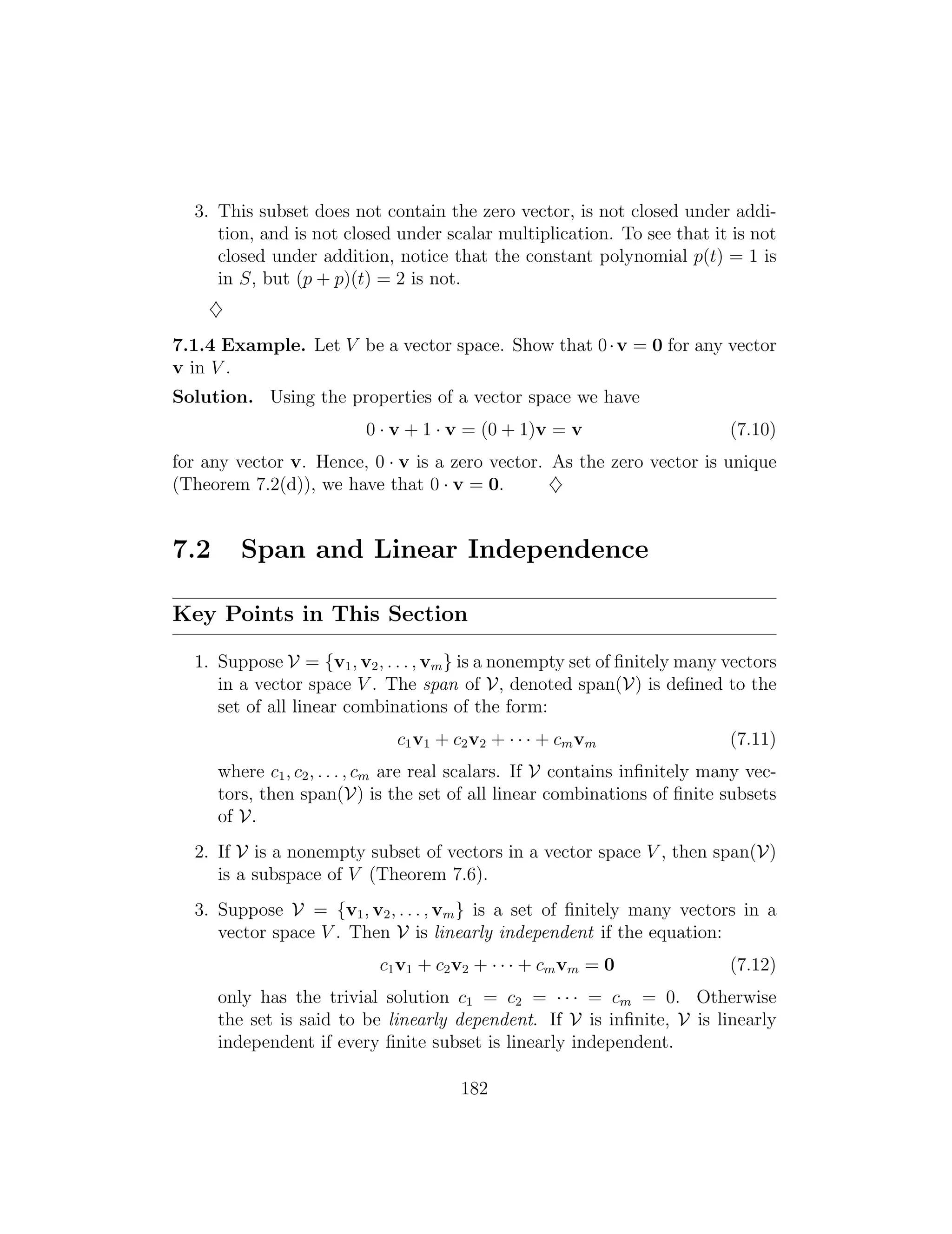
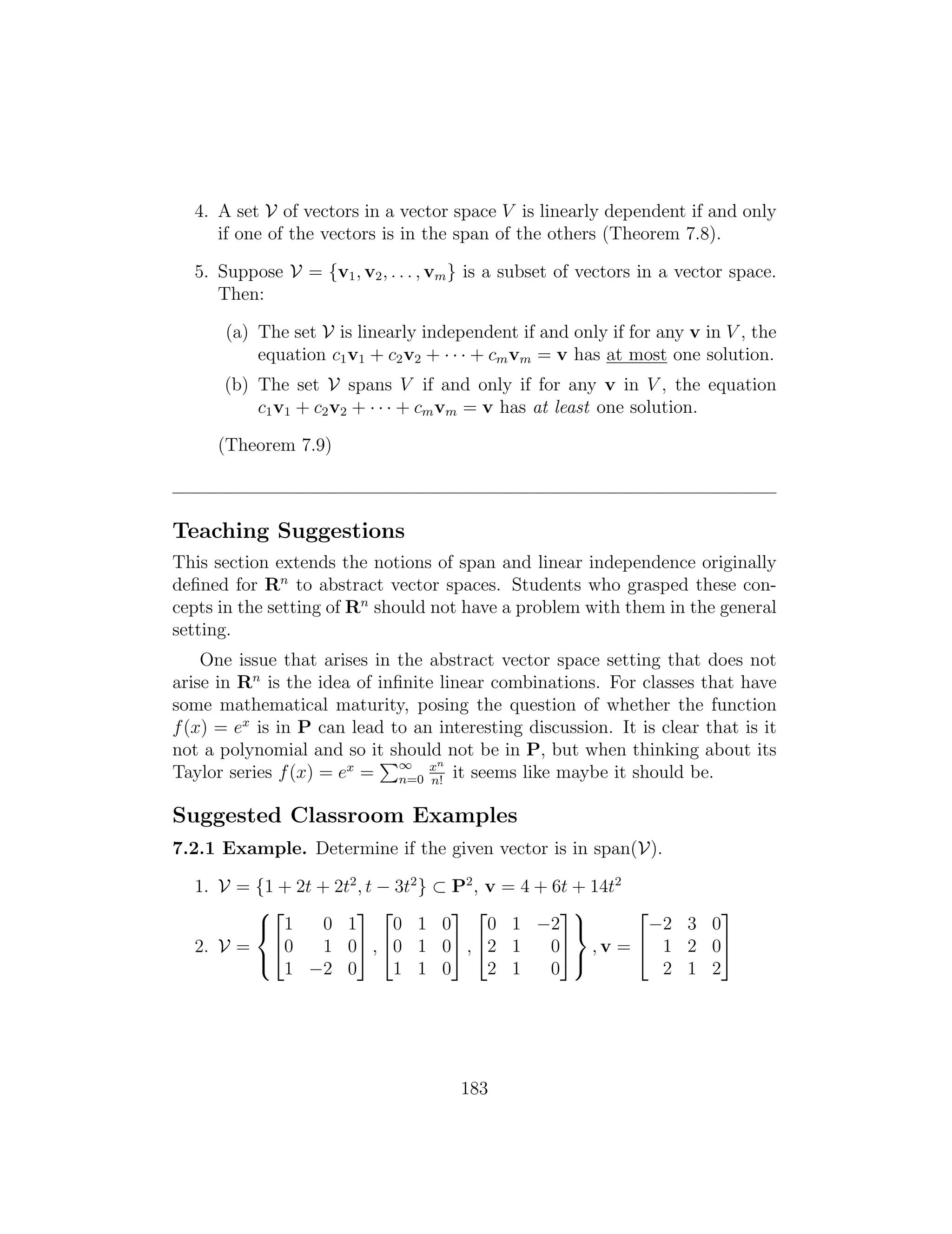
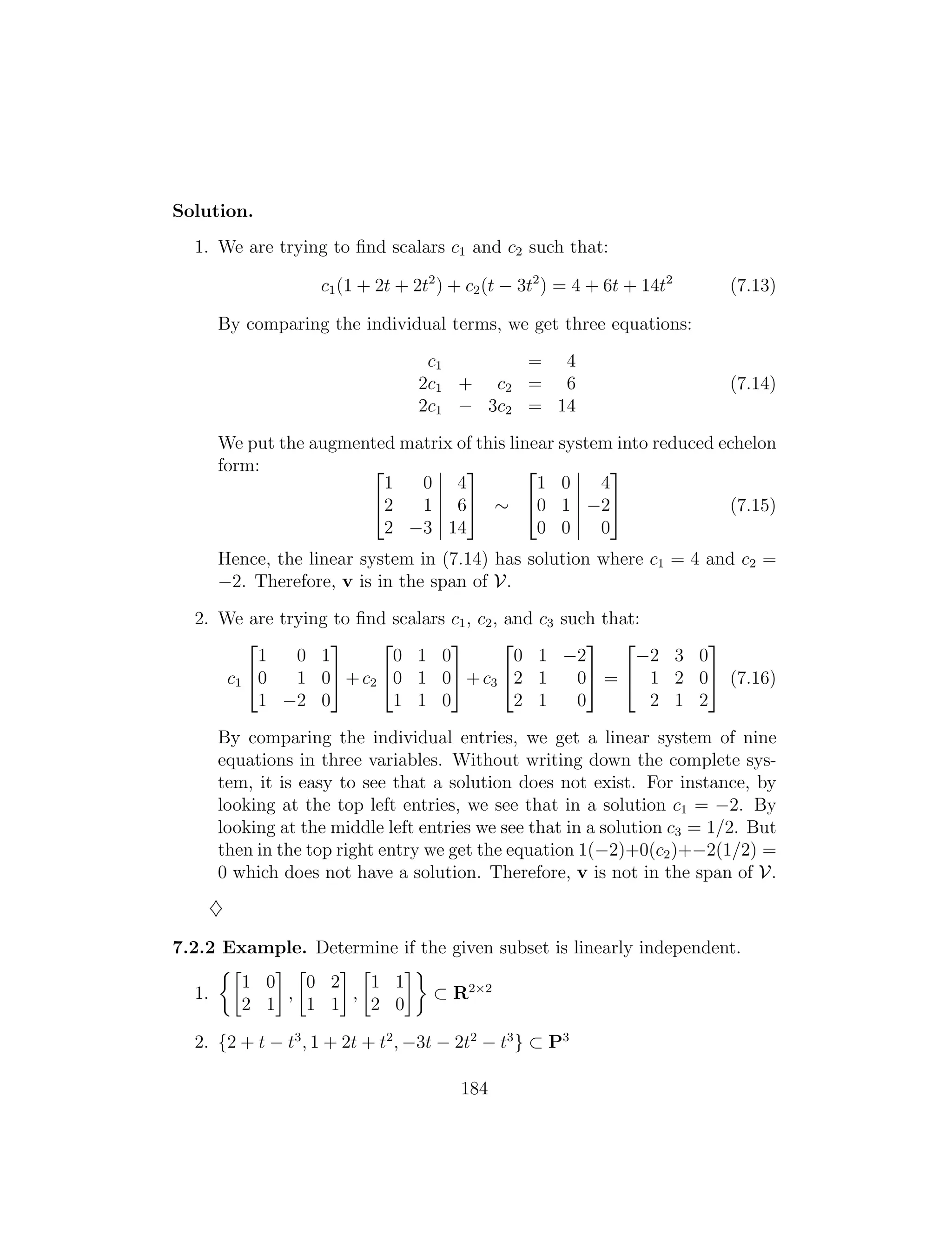
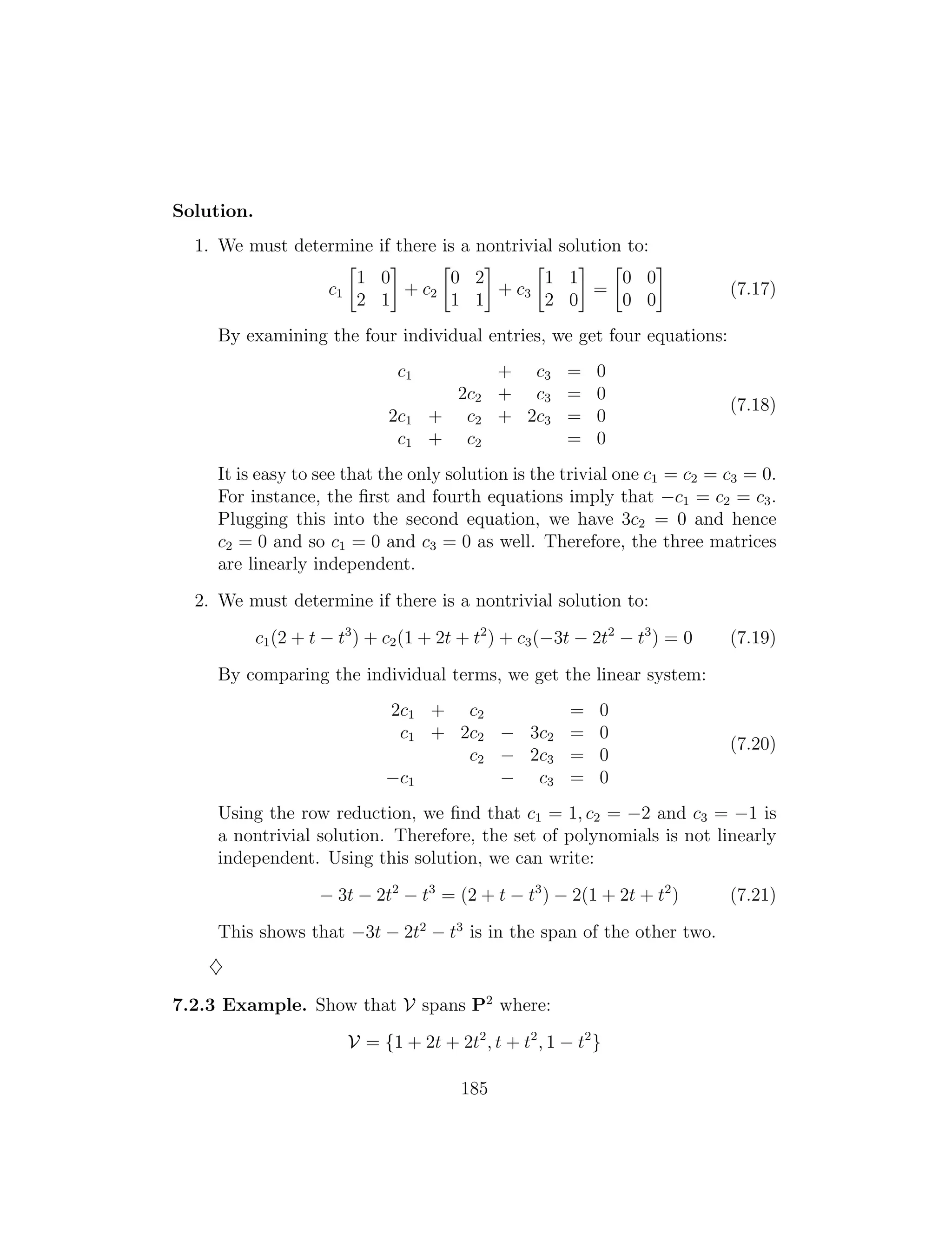
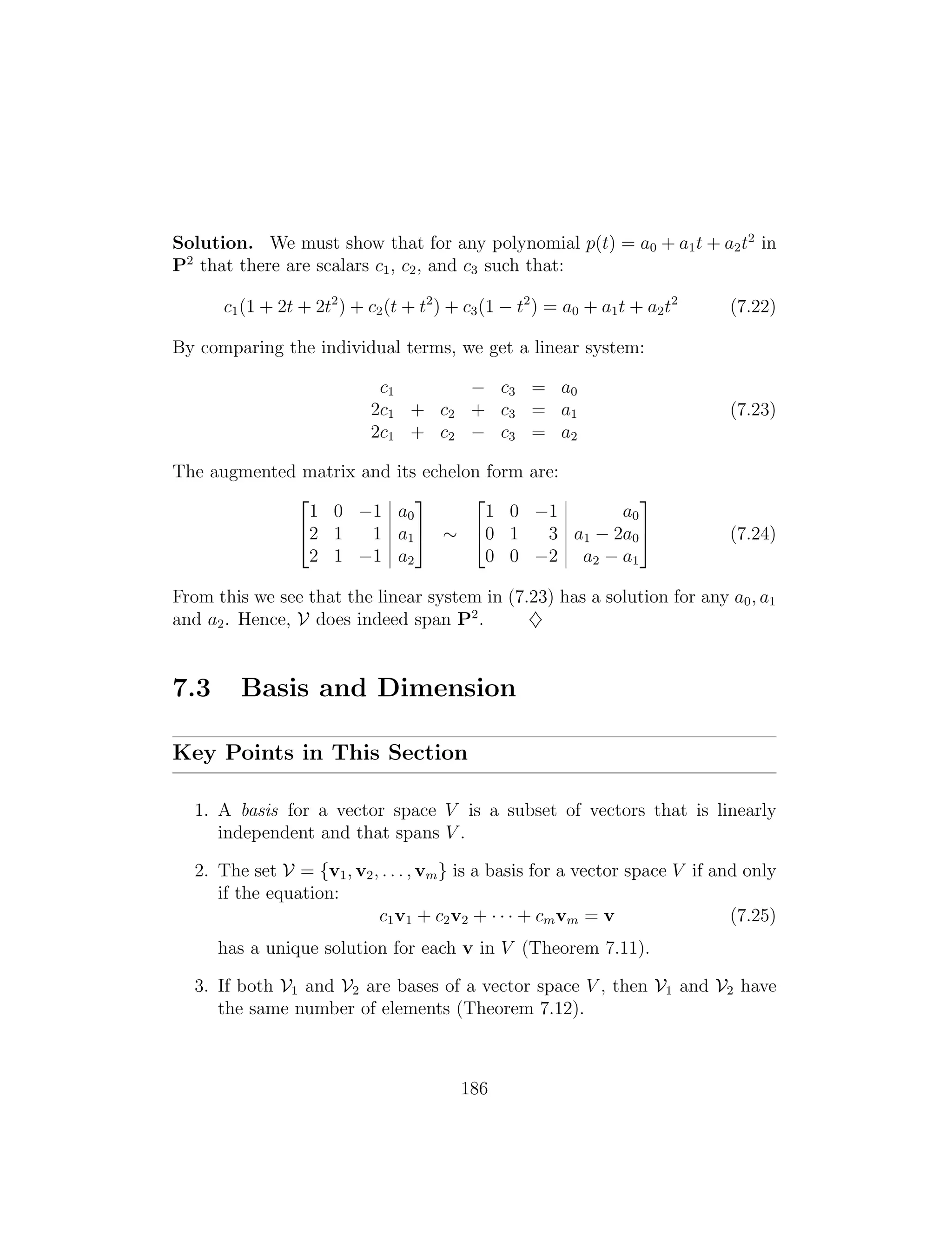
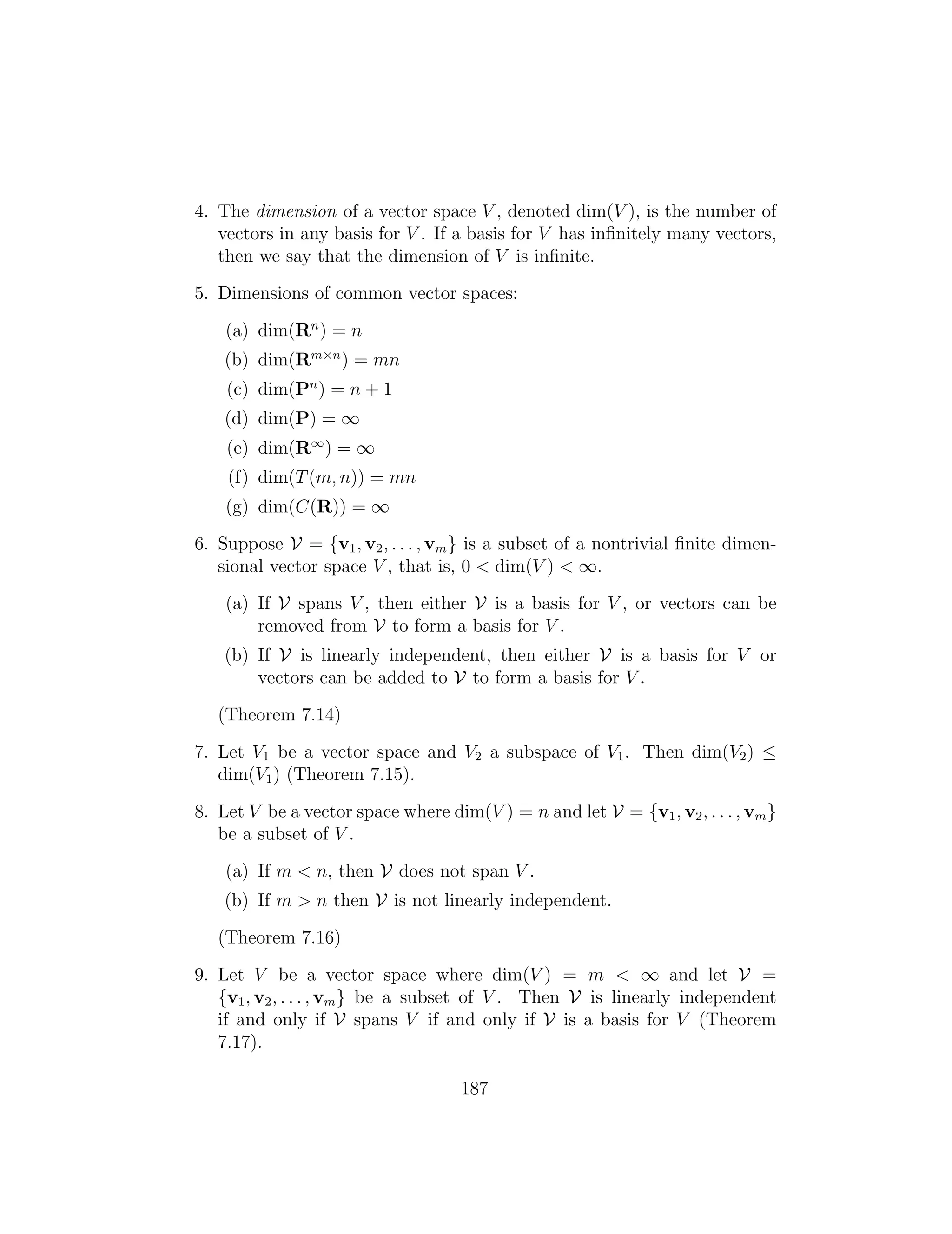
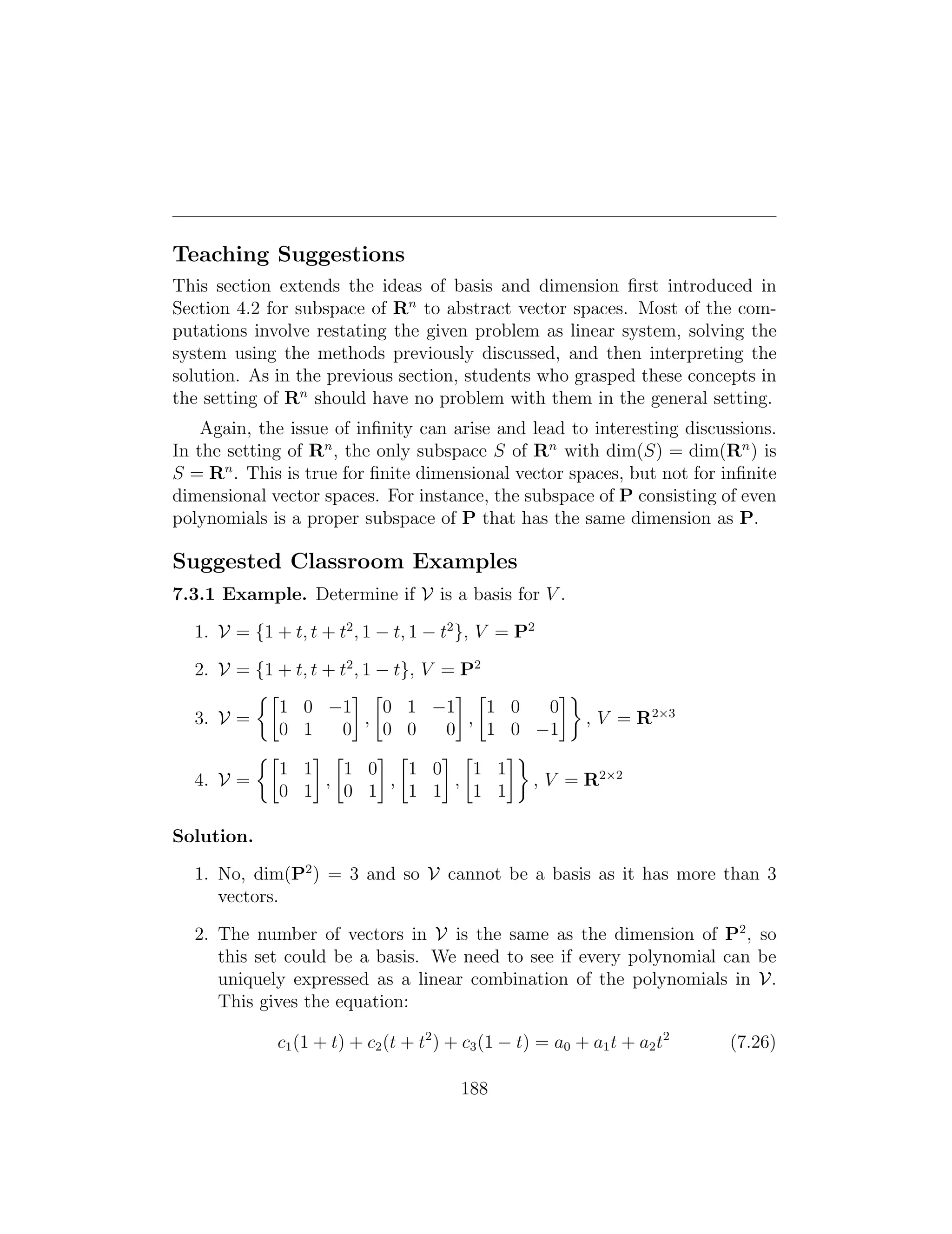
![2 3 2 3
1 0 1 a0 1 0 0 a1 a2
41 1 0 a1
5 ⇠ 40 1 0 a2
5 (7.28)
0 1 0 a2 0 0 1 a0 a1 + a2
Rewriting and collecting the terms together gives us the linear system:
c1 + c3 = a0
c1 + c2 = a1 (7.27)
c2 = a2
The augmented matrix and its row reduced echelon form are:
Back substitution now shows that there is a unique solution to the
linear system (7.27) for any choice of a0, a1, a2. Therefore, V is a basis.
3. No, dim(R2⇥3
) = 6 and so V cannot be a basis as it has fewer than 6
vectors.
4. The number of vectors in V is the same as the dimension of R2⇥2
, so
this set could be a basis. Using Theorem 7.17, we just need to check
to see if this set is linearly independent. This gives the equation:
1 1 1 0 1 0 1 1 0 0
c1 + c2 + c3 + c4 = (7.29)
0 1 0 1 1 1 1 1 0 0
By looking at the individual entries, we get the linear system:
c1 + c2 + c3 + c4 = 0
c1 + c4 = 0
(7.30)
c3 + c4 = 0
c1 + c2 + c3 + c4 = 0
As the first and last equation are the same, this is really a linear system
with three equations and four unknowns; hence, there are nontrivial
solutions. Therefore, the matrices are not linearly independent, and V
is not a basis for R2⇥2
.
}
7.3.2 Example. Find a basis for the subspace of R2⇥2
consisting of matrices
[ a11 a12
a21 a22 ] where a11 a22 = 0.
189](https://image.slidesharecdn.com/7554-250223094304-561786df/75/Linear-Algebra-with-Applications-2nd-Edition-Bretscher-Solutions-Manual-17-2048.jpg)
![Solution. The condition implies that a11 = a22. Thus matrices in the
subspace are of the form: [ a11 a12
a21 a11 ]. This subspace is spanned by:
1 0
0 1
,
0 1
0 0
,
0 0
1 0
(7.31)
as we can write:
a11
a21
a12
a22
= a11
1 0
0 1
+ a12
0 1
0 0
+ a21
0 0
1 0
(7.32)
It is easy to see that the matrices in (7.31) are linearly independent too. Thus
they form a basis for the subspace. We see that the subspace has dimension
3. }
7.3.3 Example. Find a basis for the subspace of P3
consisting of poly
nomials p(t) = a0 + a1t + a2t2
+ a3t3
such that p( 1) = 0 and p(1) = 0.
Solution. These conditions can be written as a homogeneous linear system:
p( 1) = a0 a1 + a2 a3 = 0
(7.33)
p(1) = a0 + a1 + a2 + a3 = 0
Subtracting the first equation from the second gives the linear system:
a0 a1 + a2 a3 = 0
(7.34)
2a1 + 2a3 = 0
Dividing the second equation by 2 and adding the resulting equation to the
first yields the linear system:
a0 + a2 = 0
(7.35)
a1 + a3 = 0
Hence, a2 = a0 and a3 = a1 for any polynomial in the subspace. Thus
the subspace is spanned by the polynomials: 1 t2
and t t3
. It is easy to
see that these are linearly independent. For instance, one is 0 at t = 0 while
the other is not; hence, neither is a multiple of the other. They form a basis,
and so the dimension of the subspace is 2. }
7.3.4 Example. Remove vectors from V to yield a basis for P2
.
{1 + t, 1 t, 1 + 2t, t t2
, 1 + t + t2
}
190](https://image.slidesharecdn.com/7554-250223094304-561786df/75/Linear-Algebra-with-Applications-2nd-Edition-Bretscher-Solutions-Manual-18-2048.jpg)
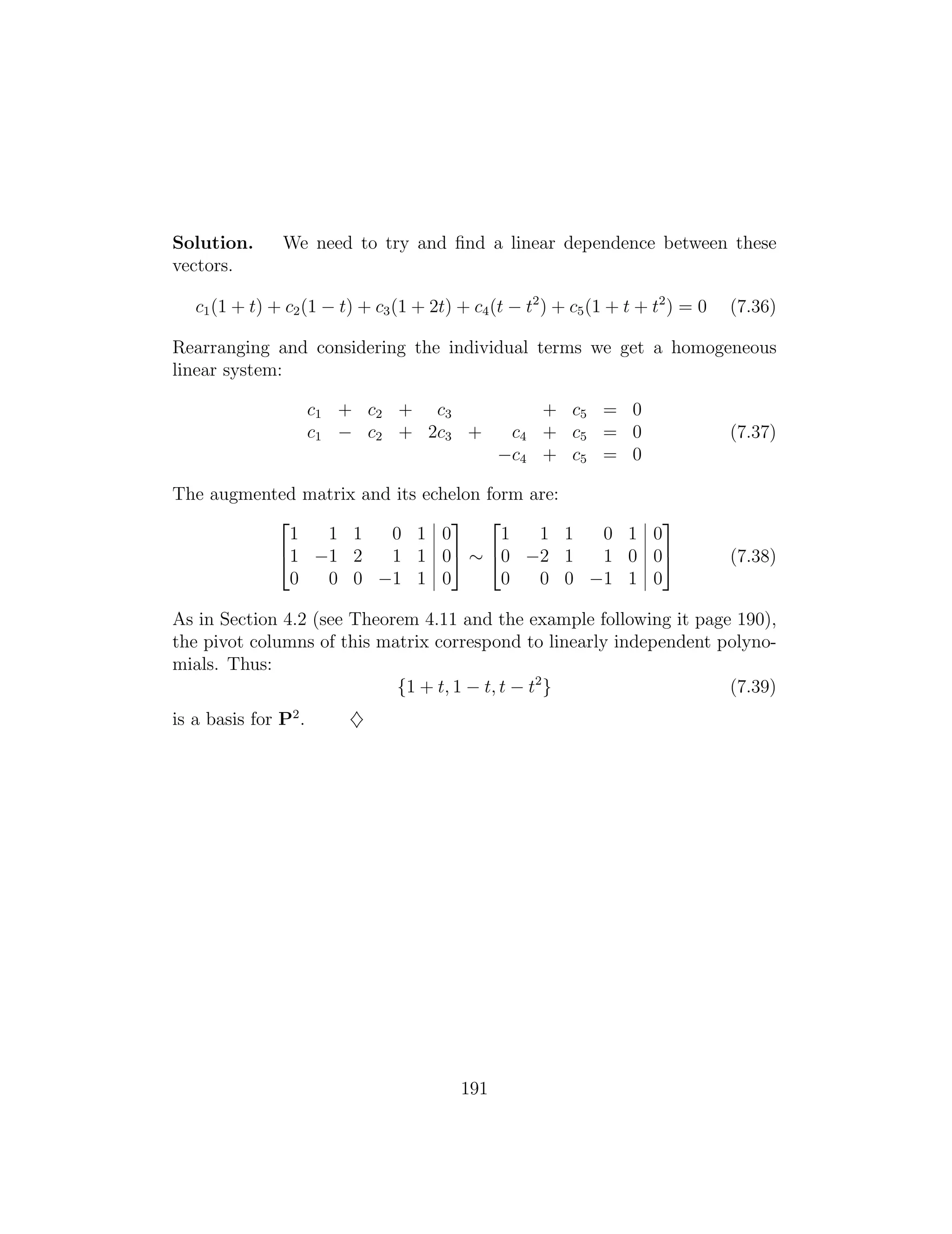

![from the uncertainties that still attended my future
course. These feelings are expressed in my journal:—
January 21.—I felt sad when the lectures actually closed. I
received a curious friendly letter from one of the students,
requesting the honour of an occasional correspondence. It
cheered me, funny as it was. Another student told me he had a
daguerreotype-room, and asked me to sit for my likeness to-
morrow; but I told him it had annoyed me so much to see my
name in the papers that I certainly could not give my face too.[3]
He said he had thought of graduating in August, but now he was
glad he had not, as I intended returning to Geneva—too funny!
January 24.—Went to Dr. Hadley for my certificate; and
attended the examinations. I suppose they were as thorough as
most; but they were certainly not much of a test. Most of the
students answered very well, but some very badly.
Miss Waller gave me an oyster supper and we had a very
pleasant time. Mrs. Wilson convulsed us by an account of how she
was actually struck down by the sudden braying of a jackass,
which she heard for the first time during a visit to the North, she
never having heard the bray before.
January 25.—Attended Commencement (or ceremony of
graduation), which after all was not so very formidable. When I
went to wish Dr. Hadley good-bye I found the whole faculty
assembled, and very merry at breaking up. They talked over my
affairs, but gave me no important advice. To my great
disappointment no letters of introduction were prepared for me,
but only a promise given that they should be sent on at once. I
was very sad at parting from the Wallers; but had a pleasant chat
with the students whom I found in the railroad cars.](https://image.slidesharecdn.com/7554-250223094304-561786df/75/Linear-Algebra-with-Applications-2nd-Edition-Bretscher-Solutions-Manual-27-2048.jpg)
![chairs, leaning on one another’s shoulders, kept most
respectfully from me, drawing back instantly when by
accident they touched my head or shoulder.[4]
October 26.—The class held a meeting to-day to request a
holiday on election day; and a political division was called for by
the assembled students. I went over to the ‘Free Soil’ side, and
was received with repeated cheering. I asked Dr. Le Ford,
reproachfully, if he was going to vote for the slave-holder, Taylor;
whereupon he gave me his reasons for political action, and grew
quite eloquent in his self-defence.
November 12.—Howy made his appearance to-day, just as I
settled down to perpetrate an essay for the family Christmas
Annual. How good it is to see a brother! He looked very well, and
we had a merry time together. I stayed away from afternoon
lectures to be with him. He is a capital companion and greatly
improved. I did more laughing than I’ve done for months. His visit
did me real good, for I have been so lonely. Heaven bless the
dear boy in his future!
Sunday, 19th.—Alone all day in my room, yet anything but
lonely. Bright visions of usefulness have been floating round me. I
consecrated myself anew to the accomplishment of a great idea. I
tried to lecture for an hour to an imaginary audience; striving to
prepare for work by seeking expression for my thoughts.
I would I were not so exclusively a doer; speech seems
essential to the reformer, but mine is at present a very
stammering, childish utterance.
26th.—Went to church. Mr. Hogarth said some true things. He
drew our thoughts to the reformers of old, with their sublime trust
in the Most High. With a strange feeling of pleasure I claimed](https://image.slidesharecdn.com/7554-250223094304-561786df/75/Linear-Algebra-with-Applications-2nd-Edition-Bretscher-Solutions-Manual-35-2048.jpg)
![very utmost by all the advantages of the institution, and by her
ladylike and dignified deportment had proved that the strongest
intellect and nerve and the most untiring perseverance were
compatible with the softest attributes of feminine delicacy and
grace, &c., to all which the students manifest by decided attempts
at applause their entire concurrence. As the audience passed out
the Bishop came up with Dr. Hale, requested an introduction, and
spoke very pleasantly, congratulating her on her course, to the
great astonishment of the conservatives. As we walked out of the
church we found that almost all the ladies had stopped outside,
and as we appeared, opened their ranks and let us pass,
regarding E. with very friendly countenances. Most of E.’s time
was taken up till our departure next day at half-past one o’clock in
receiving calls from her few friends.
The admission of a woman for the first time to a
complete medical education and full equality in the
privileges and the responsibilities of the profession
produced a widespread effect in America. The public
press very generally recorded the event, and
expressed a favourable opinion of it.
Even in Europe some notice of it was taken, and
‘Punch’ showed his cordial appreciation by his
amusing but friendly verses.[5]
I knew, however, that a first step only had been
taken. Although popular sanction had been gained
for the innovation, and a full recognised status](https://image.slidesharecdn.com/7554-250223094304-561786df/75/Linear-Algebra-with-Applications-2nd-Edition-Bretscher-Solutions-Manual-44-2048.jpg)